Introduction
The HIV epidemic emerged in the late 1970’s or early 1980’s in African countries, was recognized around 1985, and became generalized in several countries. According to Demographic and Health Surveys (DHS), HIV prevalence among adults age 15-49 varies very much by country: from 0.4% (Niger, 2012) to 19.7% (Eswatini, 2007) among the 67 surveys conducted between 2000 and 2019 (DHS program 2021). HIV prevalence and incidence are declining in most African countries for which data are available. On average in sub-Saharan Africa, prevalence among adults age 15-49 declined from 5.7% in 2000 to 4.8% in 2019, and incidence declined from 7.0 to 2.4 per 1000 over the same period of time, as a result of prevention programs and changing behaviour (UNAIDS 2021).
Many prevention programs were launched since the early years to control the course of the HIV epidemic, starting with the cleaning of the blood bank in the late 1980’s, the most important being the ‘ABC’ programs in the 1990’s, focusing on sexual behaviour and condom protection (ABC stands for: Abstinence, Be faithful, and Condom use) (Low-Beer & Stoneburner Reference Low-Beer and Stoneburner2003; Murphy et al. Reference Murphy, Greene, Mihailovic and Olupot-Olupot2006; Okware et al. Reference Okware, Kinsman, Onyango, Opio and Kaggwa2005). Anti-Retroviral Therapy (ART) became available in the early 2000’s in Africa, and was added to the list because it reduces viral load and therefore HIV transmission. An additional tool was proposed in 2007 by the World Health Organization (WHO): voluntary medical male circumcision (VMMC), for countries with high HIV prevalence and low levels of traditional circumcision, all located in Eastern and Southern Africa (WHO & UNAIDS 2007). This recommendation was based on the results from three randomized controlled trials (RCT’s) showing a reduced HIV incidence (by about 50%) among circumcised men in the short run (18-24 months after circumcision). Soon after, VMMC programs were launched in 15 countries, and 10 years later, by 2018, some 22.6 million men had been circumcised, with main focus on men age 15-29 (UNAIDS & WHO 2009). This situation allows one to evaluate the long term effect of male circumcision in countries with high HIV prevalence.
The long term effect of male circumcision on HIV prevalence was controversial from the beginning. Firstly, local observations showed that huge epidemics could develop among fully circumcised groups, such as the Xhosa and Shangaan of South Africa (HSRC 2021; Shisana et al. Reference Shisana, Rehle and Simbayi2002; Reference Shisana, Rehle, Simbayi, Parker, Zuma, Bhana, Connolly, Jooste and Pillay2005; Reference Shisana, Rehle, Simbayi, Zuma, Jooste, Pillay-van-Wyk, Mbelle, Van Zyl, Parker, Zungu and Pezi2009; Reference Shisana, Rehle, Simbayi, Zuma, Jooste, Zungu, Labadarios and Onoya2014; Simbayi et al. Reference Simbayi, Zuma, Zungu, Moyo, Marinda, Jooste, Mabaso, Ramlagan, North, Van Zyl, Mohlabane and Dietrich2019). Secondly, when population based surveys (DHS: Demographic and Health Surveys and AIS: AIDS Interview Surveys) became available in the early 2000’s, no correlation was found between HIV prevalence and circumcision status among 19 African countries (Garenne Reference Garenne2006; Reference Garenne2008). Further evidence based on similar DHS and AIS surveys showed that among the 42 surveys conducted in Africa between 2001 and 2017, 21 surveys exhibited more HIV among circumcised groups than among intact groups, while 21 exhibited the opposite (DHS program 2021). Surveys conducted in South Africa also showed virtually no impact of circumcision on HIV prevalence (Shisana et al. Reference Shisana, Rehle and Simbayi2002; Reference Shisana, Rehle, Simbayi, Parker, Zuma, Bhana, Connolly, Jooste and Pillay2005; Reference Shisana, Rehle, Simbayi, Zuma, Jooste, Pillay-van-Wyk, Mbelle, Van Zyl, Parker, Zungu and Pezi2009; Reference Shisana, Rehle, Simbayi, Zuma, Jooste, Zungu, Labadarios and Onoya2014; Simbayi et al. Reference Simbayi, Zuma, Zungu, Moyo, Marinda, Jooste, Mabaso, Ramlagan, North, Van Zyl, Mohlabane and Dietrich2019; Connolly et al. Reference Connolly, Simbayi, Shanmugam and Nqeketo2008; Myers & Myers Reference Myers and Myers2008; Rosenberg et al. Reference Rosenberg, Gómez-Olivé, Rohr, Kahn and Bärnighausen2018). Ironically, in South Africa HIV prevalence increased from 2008 (16.9%) to 2017 (20.6%) while the proportion of men circumcised increased from 40.6% to 61.6%. (Shisana et al. Reference Shisana, Rehle, Simbayi, Zuma, Jooste, Pillay-van-Wyk, Mbelle, Van Zyl, Parker, Zungu and Pezi2009; Simbayi et al. Reference Simbayi, Zuma, Zungu, Moyo, Marinda, Jooste, Mabaso, Ramlagan, North, Van Zyl, Mohlabane and Dietrich2019). Additional evidence came from other studies, showing again virtually no long term effect of circumcision on HIV among various groups (Van Howe 1999; Reference Van Howe2015).
In a number of countries it was observed that HIV prevalence could be lower among circumcised groups than among intact groups at younger ages (e.g. age 20-29), but much less later in life, and even higher or equal at older ages (e.g. at age 40-49 or 50-59). For instance, in Agincourt, South Africa, HIV prevalence among men age 40 and above (23.7%) was not different among circumcised (22.7%) and intact men (24.0%), and was significantly higher among VMMC men (30.6%) (Rosenberg et al. Reference Rosenberg, Gómez-Olivé, Rohr, Kahn and Bärnighausen2018). In the Human Sciences Research Council (HSRC) surveys conducted in 2002, 2008 and 2012 in South Africa, the ratio of HIV prevalence among circumcised vs intact groups was also higher than 1 above age 45 (RR = 1.19) (author’s computation from HSRC surveys 2002-2012). The question now is whether the apparent gains associated with circumcision at younger ages are sustained over the life cycle. Let us recall the dynamics of HIV infection over the reproductive ages. For men, the first sexual intercourse occurs around or before age 20 (the median age at first sex = 19.5 in African DHS surveys). Then, men are exposed to sexually transmitted diseases mainly between age 20 and 49, with various degrees of exposure depending on the infection rate of their partners, the number of partners, the stability of relationships, protection by condoms, and various co-factors. In population based surveys, HIV prevalence among men is always very low at age 15-19, and about the same as at age 5-14, then it increases more or less rapidly between age 20 and 49. Above age 50 the dynamics are complex, and depend on AIDS mortality and on cohort trends. So, the rise of HIV prevalence between age 20 and 49 is a good indicator of the dynamics of the epidemic, and a target group to evaluate the long term effect of circumcision. Since most circumcisions occur before age 20 (median age = 18 years in African DHS surveys), and hopefully before men are infected through sexual transmission, the prevalence at age 40-59, and the rise of prevalence between age 20 and 49 are pertinent indicators for evaluating the long-term effect of circumcision. When men age 40-59 have a low prevalence (as in West Africa), the epidemic is considered as a minor public health issue, whereas when they have a high prevalence (as in Southern Africa), the epidemic is considered as a major public health issue.
The aim of the study was to analyse the statistical relationship between circumcision and HIV infection by age, using population-based surveys in selected African countries with high HIV prevalence and participating in the VMMC campaigns program. The focus is on age patterns, that is the increasing prevalence with age in the general population. The concept of ‘age-incidence’ will be introduced to measure the increasing prevalence with age. Recent PHIA surveys, conducted in 2017-2018 are appropriate to evaluate the effect of circumcision on HIV, and in particular the effect of medical circumcision (PHIA project 2021).
Data and Methods
Survey data
The study was based on surveys conducted by the PHIA project in Africa (PHIA project 2021). These are standardized surveys with information on HIV prevalence and circumcision status. All surveys are based on representative samples of national populations, with large sample size (average of 11,000 households in each country), and were conducted by the same institution (the Mailman School of Public Health, University of Columbia, New York, USA), with similar laboratory procedures and similar questionnaires. They allow comparison and merging by country. All details on sampling and laboratory procedures can be found on the PHIA web site and in survey reports [PHIA project 2021; PHIA report Eswatini 2019; PHIA report Lesotho 2019; PHIA report Malawi 2018; PHIA report Namibia 2019; PHIA report Zambia 2019; PHIA report Zimbabwe 2019].
The study focused on African countries with high HIV prevalence, and low- but increasing- circumcision following the VMMC campaigns. Among the 13 countries with PHIA surveys conducted in 2016-2018, the study excluded countries with nearly universal circumcision (Cameroon, Cote d’Ivoire, Ethiopia), and countries with relatively low HIV prevalence (Kenya, Rwanda, Tanzania, Uganda). Therefore, the study selected six countries, all located in Southern Africa, with high HIV prevalence (> 10%), low or moderate prevalence of traditional circumcision (< 50%), and major VMMC programs: Eswatini (formerly Swaziland), Lesotho, Malawi, Namibia, Zambia and Zimbabwe. The study selected men age 20-59 with known HIV and circumcision status.
Methods
The statistical analysis was based on standard 2 by 2 cross-tabulation of men by HIV status (positive/negative) and circumcision status (circumcised/intact). This was done by single year of age, from age 20 to 59. Age 20 was selected because a majority of men have had sexual intercourse by age 20: the median age at first sexual encounter ranges from 17.5 to 19.5 in these countries (DHS program 2021). Age 59 was selected because it is the maximum common to the six surveys (only few surveys included men above age 60). For presentation, ages were grouped by 10 year: 20-29, 30-39, 40-49, and 50-59.
The age pattern of prevalence defines the magnitude of the epidemic, and the speed of HIV transmission among adult men. According to the surveys, HIV prevalence before age 20 is always very low (average 1.1%), and the peak of prevalence is reached around age 45-49 for men. So, the ‘age-incidence’ was defined as the Logit slope of the age pattern, from age 20 to age 49. The statistical model was:
 $${\rm{Logit}}\left( {{\rm{Pv}}} \right) = {\rm{a}} + {\rm{b}} \times {\rm{Age}}$$
Where Pv is the prevalence at age x (in years), and b is the ‘age-incidence’. This model can be seen either as a synthetic cohort (as routinely done in demographic analysis), or as an age-standardized prevalence (as routinely done in epidemiologic analysis).
The model was applied for intact and circumcised men separately, and the difference between the slopes defines the difference in the rate of acquisition of HIV infection between the two groups (two synthetic cohorts). Testing the difference between slopes allows one to determine whether intact and circumcised men get infected at the same speed, that is with the same age-incidence, independently from the baseline level at age 20. Conversely, it allows testing the difference between the age-standardized prevalences.
Results
The six PHIA surveys
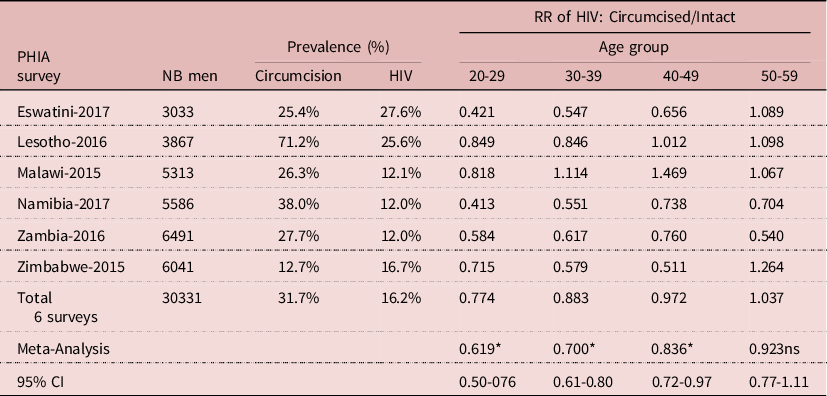
The six surveys were conducted in Southern Africa between 2015 and 2017, some 7 to 9 years after the onset of VMMC campaigns. The surveys totalled 30,331 men age 20-59 (range 3033 to 6491 per country), a large sample for investigating the relationship between HIV and circumcision. The proportion of men circumcised averaged 31.7%, with a wide range from 12.7% (Zimbabwe) to 71.2% (Lesotho). HIV prevalence averaged 16.2%, with a range from 12.0% (Namibia, Zambia) to 27.6% (Eswatini). Three countries had lower prevalence than average (Malawi, Namibia, Zambia), one had average prevalence (Zimbabwe), and two countries stood out with very high HIV prevalence (Eswatini and Lesotho). The correlation between HIV prevalence and proportion circumcised at country level was moderate and positive (ρ = +0.39), that is more circumcision was associated with more HIV (Table 1).
Basic characteristics of PHIA surveys, men 20-59 with known HIV and circumcision status

Note: Testing relative risk <> 1: * P< 0.05; ns= not significant
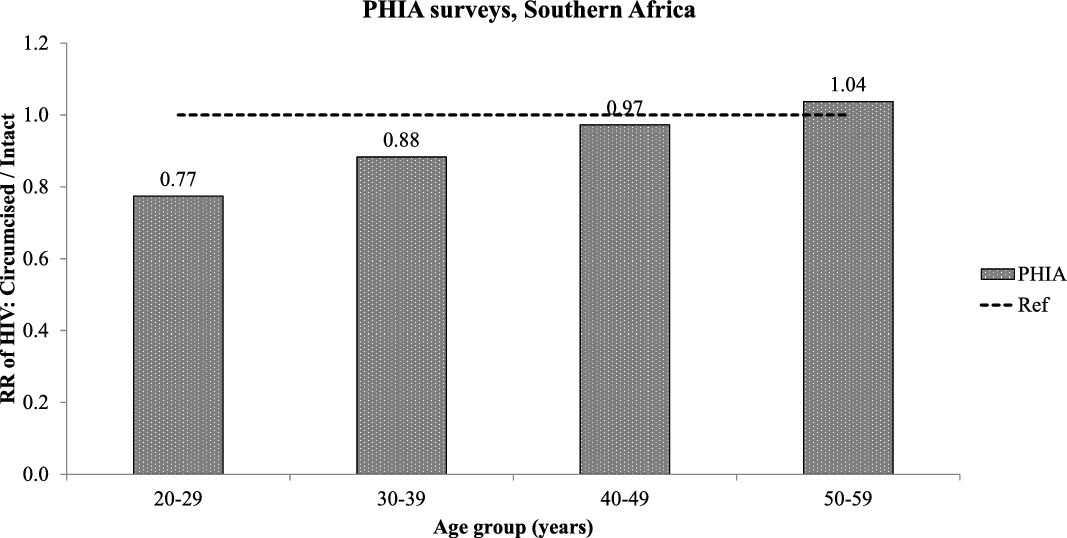
The relative risk of HIV prevalence associated with circumcision status (Circumcised/Intact) varied by survey and by age, from 0.41 (Namibia at age 20-29) to 1.47 (Malawi at age 40-49). On average it was close to 1.0 in Malawi and Lesotho, and lower than 1.0 in the other four countries. More important, the relative risk of HIV prevalence tended to increase with age. For the six surveys lumped together it increased from 0.774 at age 20-29, 0.883 at age 30-39, 0.971 at age 40-49 and 1.037 at age 50-59. This means that if circumcision was associated with lower HIV prevalence at younger ages, it was no longer at older ages. In other words, if circumcised men were less infected early in their adult life, they quickly caught up with intact men, so that at the peak of prevalence they were as infected as the others (Table 1, Figure 1).
Risk ratio of HIV prevalence by circumcision status (circumcised/intact), PHIA surveys in Southern Africa.

The age pattern of the relative risk was partly due to the interactions between circumcision and HIV at country level. A meta-analysis was therefore performed, by age group. Weights were proportionate to the inverse of the square-root of the variance. Results showed lower values for the risk ratios, but still increasing with age: 0.619 at age 20-29 (95% CI: 0.501-0.765); 0.700 at age 30-39 (95% CI: 0.608-0.805); 0.836 at age 40-49 (95% CI: 0.724-0.966), and 0.923 at age 50-59 (95% CI: 0.769-1.108). Note that the relative risk was again not significantly different from 1.0 at older ages (P = 0.390) (Table 1).
Age incidence
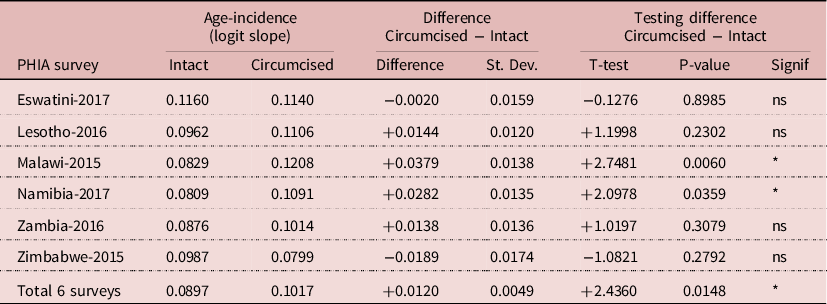
In order to investigate the rise in HIV prevalence by age and circumcision status, the age-incidence was calculated as the slope of the linear-logistic relationship between HIV prevalence and age for men age 20-49. Results show only small differences in the age-incidence rate between circumcised and intact men. In four countries the difference between slopes was somewhat positive (higher age-incidence among circumcised men) and in two cases the difference was somewhat negative. In only two countries (Malawi and Namibia) the differences were statistically significant but positive (higher age-incidence among circumcised men). In total, when the six surveys were lumped together, the age-incidence was significantly higher among circumcised men (+0.1017) than among intact men (+0.0897), the difference being statistically significant (P = 0.015) (Table 2).
Age-incidence of HIV in PHIA surveys, men age 20-49, Southern African countries

NB. Results of linear-logistic regression. Model = Logit(%HIV)= A + B×Age.
(*) P< 0.05; ns= not significant
Age-standardized prevalence
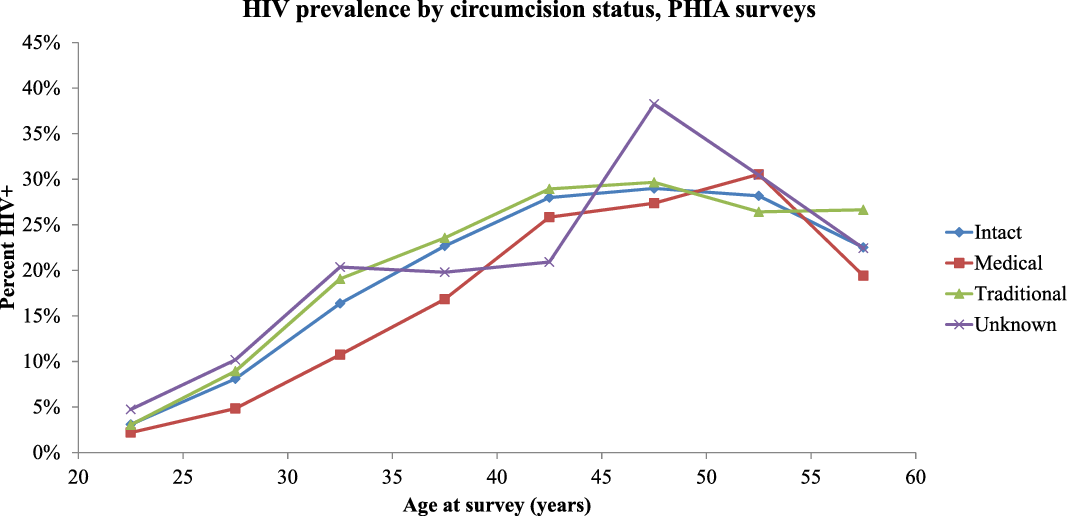
In other words, even though circumcised men started their adult life with lower levels of HIV infection, they became infected at least as rapidly as intact men, so that by age 50 they had about the same level of HIV prevalence. This pattern appears clearly in Figure 2: hardly any difference in age-specific prevalence between circumcised and intact men, both groups become infected the same way. The regression model predicted similar levels of age-standardized prevalence at age 50 among the circumcised group (43.5%) than among the intact group (42.7%).
HIV prevalence by circumcision status, PHIA surveys in Southern Africa.

Selection for VMMC
In earlier studies, no relation was found between circumcision and HIV prevalence (Garenne Reference Garenne2008). In this section, reasons for lower level of HIV prevalence among young circumcised men in the PHIA surveys were investigated. Particular attention was paid to medical circumcision resulting from the recent campaigns of VMMC. These campaigns target young men (age 15-29), and are likely to be selective, since informed consent is required for the surgical procedure.
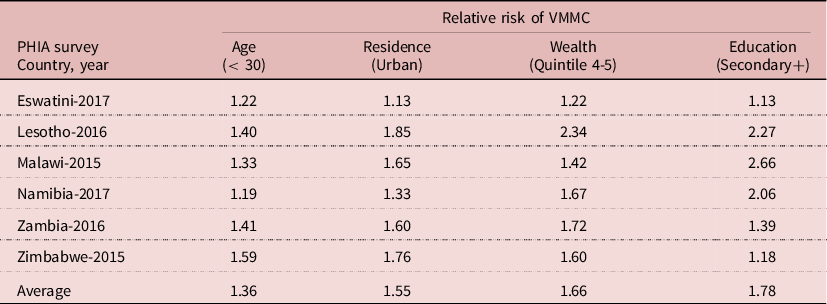
Potential selection was investigated by computing the proportion of men who underwent VMMC by large categories: age at survey (< 30 years vs ≥ 30 years); urban residence (urban vs rural); household wealth (top 2 quintiles vs low 3 quintiles); level of education (secondary or higher vs lower level). In all countries, a clear selection occurred: men who underwent VMMC were younger (average RR = 1.36), were more urbanized (average RR = 1.55), were from wealthier households (average RR = 1.66), and were more educated (average RR = 1.78). Results were consistent for all six countries, and none of the relative risks investigated was lower than one (Table 3). This selection could explain why young circumcised men were somewhat less infected than intact men of the same age.
Selection for VMMC: ratios of men medically circumcised in high category/low category, PHIA surveys, men age 20-49

RR = ratio of proportions medically circumcised in high category/low category. High category: Age < 30 years; Residence: urban; Wealth: top two quintiles; level of education: secondary or higher.
HIV prevalence by type of circumcision
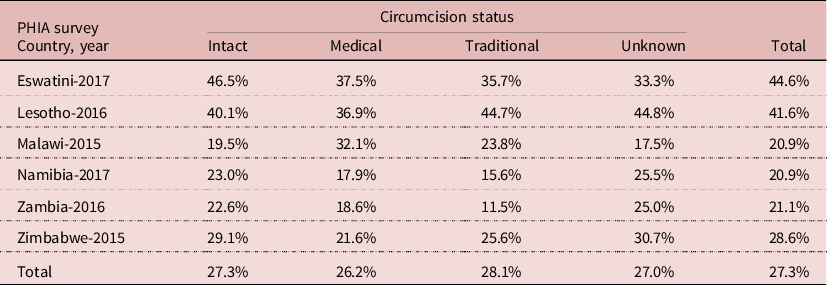
Finally, HIV prevalence at older ages (40-59), where it is highest, was compared by circumcision status. The PHIA surveys provide this information in four categories: intact (never circumcised), medical (circumcision performed by a medical professional), traditional (circumcision performed by non-medical personnel), and unknown (type of practitioner not stated). Results showed no difference between the four groups: in the six PHIA surveys (based on 10,172 men) HIV prevalence averaged 27.3% in total, with 27.3% among intact groups, 26.2% in the medical group, 28.1% in the traditional group and 27.0% in the unknown group, none of these differences being statistically significant, with all P values > 0.470 (Table 4). When the six countries were considered separately, HIV prevalence was significantly higher among medically circumcised men in Malawi (32.1% vs 20.9%, P = 0.012), and HIV prevalence was lower among traditionally circumcised men in Namibia (15.6% vs 20.9%, P = 0.028), and in Zambia (11.5% vs 21.1%, P = 0.002), while all other differences were not significant. In addition, there were no significant difference between traditional and medical circumcision, except in Zambia where the medical group had a higher HIV prevalence than the traditional group (18.6% vs 11.5%, P = 0.050). In brief, there was no statistical evidence that circumcision in general, and medical circumcision in particular, had any protective effect against HIV, and all minor differences could be explained by selection biases.
HIV prevalence by circumcision status, PHIA surveys, men age 40-59 (N = 10172 men)

Discussion
In this study, based on PHIA surveys, circumcision was shown to have no long-term protective effect on HIV prevalence in countries of Southern Africa, the countries which have the highest seroprevalence in the world, and where traditional circumcision was practiced by a fraction of the population, and not universal as in other African countries. This matches evidence found in other studies conducted in South Africa, such as the HSRC studies and the Agincourt Health and Demographic Surveillance System (HDSS) (Connolly et al. Reference Connolly, Simbayi, Shanmugam and Nqeketo2008; Myers & Myers Reference Myers and Myers2008; Rosenberg et al. Reference Rosenberg, Gómez-Olivé, Rohr, Kahn and Bärnighausen2018). To evaluate the long-term impact of circumcision, what matters ultimately is HIV prevalence at older ages, as differences in incidence in the short run and at younger ages might be misleading. Note also that PHIA surveys conducted in eight countries found a high incidence (1.36% per year) among circumcised groups at age 35-59, which is enough to infect a large proportion of the population, about a third over 30 years (Hines et al. Reference Hines, Sachathep, Pals, Davis, Toledo, Bronson, Parekh, Carrasco, Xaba, Mandisarisa, Kamobyi, Chituwo, Kirungi, Alamo, Kabuye, Awor, Mmbando, Simbeye, Aupokolo, Zemburuka, Nyirenda, Msungama, Tarumbiswa, Manda, Nuwagaba-Biribonwoha, Kiggundu, Thomas, Watts, Voetsch and Williams2021). Such high levels of yearly incidence among circumcised men were also found earlier in the three randomized controlled trials (1.1% in Kisumu, 0.9% in Orange-farms, 0.7% in Rakai), again enough to infect a large proportion of the population after 30 years of sexual activity.
There are reasons why short term incidence at younger ages does not translate into long-term prevalence at older ages. To simplify the case, assume a population with four groups with different sexual behaviour and exposure to HIV. A first group of men in a stable relationship with a HIV negative woman: in this case the man will not become infected, whether he is circumcised or not. A second group of men also in a stable relationship but with a HIV positive woman: in this case the man will become infected, whether he is circumcised or not, because of repeated exposure (a 50% reduction in yearly incidence has virtually no long term effect after 30 years of exposure). A third group of sexually mobile men in a population where a large proportion of their female partners (casual encounters or CSW’s) are infected: in this case most men will become infected, whether circumcised or not, again because of repeated exposure. A fourth group similar to the first group (men in stable union with an HIV negative partner) but among whom men have sometimes unprotected extramarital sex: in this case only circumcision could have an effect of HIV infection, but this effect will be marginal, and hardly detectable in the general population.
In all six countries investigated, HIV prevalence appeared lower at young ages among circumcised men. All these countries embarked into VMMC programs around year 2008, and a large majority of men circumcised at age 20-29 were medically circumcised: 72% on average in the six countries (range from 48% in Malawi to 97% in Eswatini). This probably explains the selection bias noticed in the statistical analysis. Young men who accepted VMMC were more educated, from wealthier households and more urbanized. This situation is very different from that of traditional circumcision, where men were circumcised as part of a religious or ethnic custom, independently from socio-economic status. This is why selection for circumcision is different from what it was before 2007.
Note that the selection shown in the surveys refers only to demographic selection (age) and to socio-economic status (place of residence, wealth, education). Since VMMC requires a personal decision, it most likely implies a psychological selection as well, not measured in demographic surveys. Men who underwent VMMC were most likely more informed and more motivated to control HIV transmission. This could also explain why they were less infected early in adult life.
This study considered primarily medical and traditional circumcision alike, because no difference was found between both situations at older ages. A large proportion of young men (age 20-29) were circumcised medically (72%), whereas a large proportion of older men (40-49) were circumcised traditionally (55% on average in the six countries). This could be considered as a limitation of the study. The detailed comparison between traditional and medical circumcision is difficult, because there is a great variety in surgical procedures in both cases, ranging from minor cut to full removal of the prepuce. No study has ever investigated the effect of circumcision on HIV transmission according to the proportion of the prepuce removed, and this would be difficult to do. A recent study from Lesotho showed that in discordant couples HIV transmission was similar among medically and traditionally circumcised men as well as among intact men (Garenne Reference Garenne2022a). Note also that a full evaluation of the impact of VMMC campaigns in the population would require to wait until year 2040, when men born in 1990, circumcised in year 2010, will be age 50.
Another limitation of this cross-sectional study is the mixing of cohorts. Men age 40-49 belong to cohorts who were more infected at age 20-29 than cohorts currently age 20-29. This is due to the decline of HIV prevalence at age 20-29 over the past 20 years in all six countries. However, firstly the decline has been slow over time. Secondly, and more important, this bias works in favour of young men. By studying men 40-49 one considers men who were more exposed (their female partners were more infected), and therefore one can better estimate the long-term effect of circumcision. Thirdly, HIV prevalence at age 15-19 seems to have remained low and approximately constant over time, so that the increase in prevalence with age noticed in the cross-sectional study is estimating accurately what happened in the cohort of men age 40-49 at survey.
If circumcision appears to have no effect in the long run on HIV prevalence at older ages, other strategies were found to have a large and long-lasting impact. One of the best documented cases in Africa is that of Cote d’Ivoire (De Cock et al. Reference De Cock, Porter, Odehouri, Barrère, Moreau, Diaby, Kouadio and Heyward1989; Ouattara et al. Reference Ouattara, Meité, Cot and de-Thé1989; Soro et al. Reference Soro, Gershy-Damet, Coulibaly, Koffi, Sangaré, Koffi, Houdier, Josseran, Guelain and Aoussi1990; Gershy-Damet et al. Reference Gershy-Damet, Koffi, Soro, Coulibaly, Koffi, Sangare, Josseran, Guelain, Aoussi and Odehourri1991). This country, where men are almost all circumcised (96% at the 2005 AIS survey), had one of the earliest and most quickly progressing HIV epidemics in the 1980’s, with a huge incidence between 1985 and 1989, especially in the Southern part and in Abidjan, the Capital city. By 1989, seroprevalence in the adult population was already 5.8%, and above 50% in high risk groups, in particular among commercial sex workers (CSW) and their clients (Ghys et al. Reference Ghys, Diallo, Ettiègne-Traoré, Kalé, Tawil, Caraël, Mah-Bi, De Cock, Wiktor, Laga and Greenberg2002; Msellati et al. Reference Msellati, Sakarovitch, Bequet, Atta, Alioum, Viho, Timothée, Leroy, Welffens-Ekra, Dabis and Ditrame Study Group2006; Vuylsteke et al. Reference Vuylsteke, Semdé, Sika, Crucitti, Ettiègne Traoré, Buvé and Laga2012). By 1994 AIDS mortality was already high in Abidjan, and the increase in deaths allowed reconstructing the fast dynamics of HIV in the late 1980’s (Garenne et al. Reference Garenne, Madison, Tarantola, Zanou, Aka and Dogoré1995, Reference Garenne, Madison, Tarantola, Zanou, Aka and Dogoré1996). Starting in 1991 a large scale prevention program was launched, focusing on condom use in encounters with CSWs and casual partners. Since then, seroprevalence in the population declined steadily: 4.7% in 2005, 3.7% in 2012 and 2.5% in 2018 (DHS program 2021; PHIA project 2021), a steady decline also noticed among pregnant women (Msellati et al. Reference Msellati, Sakarovitch, Bequet, Atta, Alioum, Viho, Timothée, Leroy, Welffens-Ekra, Dabis and Ditrame Study Group2006; Ghys et al. Reference Ghys, Diallo, Ettiègne-Traoré, Kalé, Tawil, Caraël, Mah-Bi, De Cock, Wiktor, Laga and Greenberg2002; Vuyksteke et al. Reference Vuylsteke, Semdé, Sika, Crucitti, Ettiègne Traoré, Buvé and Laga2012). The decline in HIV infection was similar in urban and rural areas, for males and females alike, and in all regions, except in the more conservative Northern provinces where seroprevalence had remained low over the years. Note that without a strong intervention, HIV prevalence was likely to continue rising and to reach much higher levels. The case of Cote d’Ivoire was analysed in detail using population-based compartmental simulation models and taking into account all prevention programs (Maheu-Giroux et al., Reference Maheu-Giroux, Vesga, Diabaté, Alary, Baral, Diouf, Abo and Boily2017a, Reference Maheu-Giroux, Vesga, Diabaté, Alary, Baral, Diouf, Abo and Boily2017b). Results of the exercise showed that most of the decline in HIV prevalence was attributable to condom use, and in particular in encounters with commercial sex workers. Other more recent programs such as ART played only a minor role (Maheu-Giroux et al., Reference Maheu-Giroux, Vesga, Diabaté, Alary, Baral, Diouf, Abo and Boily2017a, Reference Maheu-Giroux, Vesga, Diabaté, Alary, Baral, Diouf, Abo and Boily2017b). This case study shows that HIV can be controlled with efficient strategies, and that condoms could have a strong demographic impact when properly utilized on a large scale, and could allow controlling the epidemic in the long run. The main reason is that, when utilized efficiently, condoms can prevent any transmission, from male to female and from female to male. In contrast, circumcision could only reduce the probability of transmission from female to male, which cannot have any effect in case of repeated exposure over many years, and no effect among people in stable relationships.
VMMC campaigns raise serious scientific concerns since they appeared to have no long term demographic impact (Garenne Reference Garenne2006; Reference Garenne2008; Reference Garenne, Denniston, Hodges and Milos2010; Reference Garenne, Giami, Perrey, Giles-Vernick and Webb2013; van Howe Reference Van Howe1999; Reference Van Howe2015; Giami et al. Reference Giami, Perrey, de Oliveira Mendonça and de Camargo2015). Furthermore, they could induce negative behaviours (such as less condom use, more partners), because when men feel ‘partly protected’ by VMMC they could take more risks. This was documented in a few countries such as South Africa (Zungu et al. Reference Zungu, Simbayi, Mabaso, Evans, Zuma, Ncitakalo and Sifunda2016; Simbayi et al. Reference Simbayi, Zuma, Zungu, Moyo, Marinda, Jooste, Mabaso, Ramlagan, North, Van Zyl, Mohlabane and Dietrich2019), Uganda (Kibira et al. Reference Kibira, Sandøy, Daniel, Atuyambe and Makumbi2016;), and Zambia (Garenne & Matthews Reference Garenne and Matthews2020). However, these findings are context-specific, other studies found the opposite, and a recent meta-analysis of 30 studies found on average no risk compensation (Gao et al. Reference Gao, Yuan, Zhan, Qian, Sun, Zheng, Fu, Liang, Zhu, Ouyang, Liu, Fitzpatrick, Wu, Meng, Baeten, Zhao, Vermund, Yu, Wu, Su and Zou2021). Beyond risk compensation, the relationship between circumcision and HIV could be blurred by selection bias: men who accept to undergo VMMC could be from different socio-economic groups, or simply more aware of the risk of contracting HIV. Selection bias was documented in South Africa (Rosenberg et al. Reference Rosenberg, Gómez-Olivé, Rohr, Kahn and Bärnighausen2018), and in Lesotho (Garenne Reference Garenne2022a), and is likely to be present elsewhere as well.
Male circumcision among minors raise numerous ethical issues in developed as well as in developing countries, as has been argued by numerous authors (Aggleton Reference Aggleton2007; Boyle Reference Boyle2015; Brussels Collaboration on Bodily Integrity 2019; Darby Reference Darby2015; DeLaet Reference DeLaet2009; Earp Reference Earp2015; Reference Earp2021; Earp & Darby Reference Earp and Darby2017; Reference Earp and Darby2019; Fish et al. Reference Fish, Shahvisi, Gwaambuka, Tangwa, Ncayiyana and Earp2021a; Reference Fish, Shahvisi, Gwaambuka, Tangwa and Earp2021b; Frisch & Earp Reference Frisch and Earp2018; Garenne Reference Garenne2007; Reference Garenne2022b; Lie & Miller Reference Lie and Miller2011; Luseno et al. Reference Luseno, Rennie and Gilbertson2021; Svoboda et al. Reference Svoboda, Adler and Van Howe2016; Reference Svoboda, Adler and Van Howe2019; Tangwa Reference Tangwa, Denniston, Hodges and Milos1999). Among the critical issues are the children’s right to body integrity, and the lack of substantive long term benefits that are crucial to the individual’s well-being. The VMMC campaigns have a dilemma: either circumcise before age 18 (or official age of majority) and violate children’s rights, or circumcise at older ages and take the risk of circumcising men who are already infected, which in this case would be useless for prevention. Moreover, VMMC campaigns among adolescents are often accompanied with major propaganda, sometimes with incentives, and even with coercion among school boys (Rennie et al. Reference Rennie, Gilbertson, Hallfors and Luseno2021).
Male circumcision among adults raise the issue of informed consent: in order to be able to make the right choice, adults should be given complete information on the numerous risks (physiological and psychological), on potential social stigma (if any), and on the little benefits, which is never done in practice (Tye & Sardi Reference Tye and Sardi2022). In particular, it is never explained to men that cutting the prepuce removes only some of the target cells for HIV, but that other target cells remain on the glans and the urethra, which implies no real protection. They are not told that proper protection can only be provided by using condoms consistently and correctly, and that circumcision is useless when using condoms. In addition, adverse events following circumcision are not trivial, and are rarely explained (Shabanzadeh et al. Reference Shabanzadeh, Clausen, Maigaard and Fode2021).
In conclusion, the lack of long term effect of circumcision allows one to ask critical questions: Was it rational to promote VMMC when it was clear from the beginning than circumcision would have no effect in the long run? Was it not more useful to continue promoting condom use, when one was sure to control the epidemic this way in the long run?
Supplemental online material
None
Acknowledgements
The author thanks the PHIA project and the national institutions in charge of the surveys for providing free access to the original data.
Data availability statement
All data are available at the PHIA project
Funding details
No funding associated with this study
Disclosure statement
The authors report there are no competing interests to declare.
Data deposition
NA
Ethical disclosure
The author asserts that all procedures contributing to this work comply with the ethical standards of the relevant national and institutional committees on human experimentation and with the Helsinki Declaration of 1975, as revised in 2008.