Introduction
Social policymaking in Russia does not fit into conventional models.Footnote 2 Its implementation varies dramatically across the vast Russian territory, shaped by constitutional federalism mixed with centralising pressures. It is also complicated by the unusual mix of communist-era promises and post-communist neoliberalism as well as the huge swings from economic collapse in the 1990s to tremendous economic growth in the 2000s followed by a further economic crisis. For social policy theorists, one key insight from the study of Russia has been the entrenched system of informal payments used to ‘sustain the illusion’ of a more extensive welfare state (Fotaki, Reference Fotaki2009; Polese et al., Reference Polese, Morris, Kovác and Harboe2014). Observers of Russia also point to the elite-led, top-down design of social policy priorities, such as the heavy focus on increasing the birthrate in response to the severe demographic crisis (Chandler, Reference Chandler2013; Kulmala et al., Reference Kulmala, Kainu, Nikula and Kivinen2014).
Here, we stake a claim for the importance of studying the implementation of social policy at the regional level and its formation within street-level practices to explain social policymaking in hybrid regimes, in which authoritarian elements exist alongside (imitations of) democratic processes.Footnote 3 We show the mix of formal and informal politics that make up Russia's street-level social policymaking, in which, rather than having a fully top-down design, some policymaking reflects the interests of organised citizens. We find that Russia under Putin's tenure has, in response to concerns of women's activism, expanded its welfare state, and has taken on the issue of domestic violence which was not directly addressed by the Soviet regime. Transnational women's activism in the 1990s argued that violence against women – as a key violation of women's human rights – should be a central global concern. Perceiving the problem to be widespread, local activists broached the issue in Russia and established women's crisis centres for the first time two decades ago (Johnson, Reference Johnson2009; Johnson and Saarinen, Reference Johnson and Saarinen2011). With a de facto feminist approach that we develop below, our analysis prioritizes the practice of social policymaking from the perspective of women (who make up more than half of Russia's adults).
To examine these issues, we conduct a case study of women's crisis centres in Saint Petersburg. By women's crisis centre, we refer to either non-governmental or public entities for which domestic violence – violence by men against their current or past intimate partners – is an important aspect of their work. This lens allows us to reconsider the two state-society frameworks that are normally used to look at civil society and the welfare state, i.e., advocacy and social services, because domestic violence is an issue, activists assert, that requires both. Because regional governments answer for social policy, we chose one region, Saint Petersburg. With regard to social policy, Russia's constitutional federalism has three-levels, with the central government responsible for general principles and national standards; regional governments (e.g., Saint Petersburg) responsible for legislation; and municipalities responsible for social services taking concrete form (Kulmala, Reference Kulmala2013: 91–92).Footnote 4 We are not saying that Saint Petersburg is a typical Russian region: on the contrary, the city is, financially, among the top ten regions, having more independence in policymaking than those regions dependent on the centre (Kainu et al., forthcoming). International influence has also been important in this major metropolitan area, especially in terms of its civil society development.Footnote 5
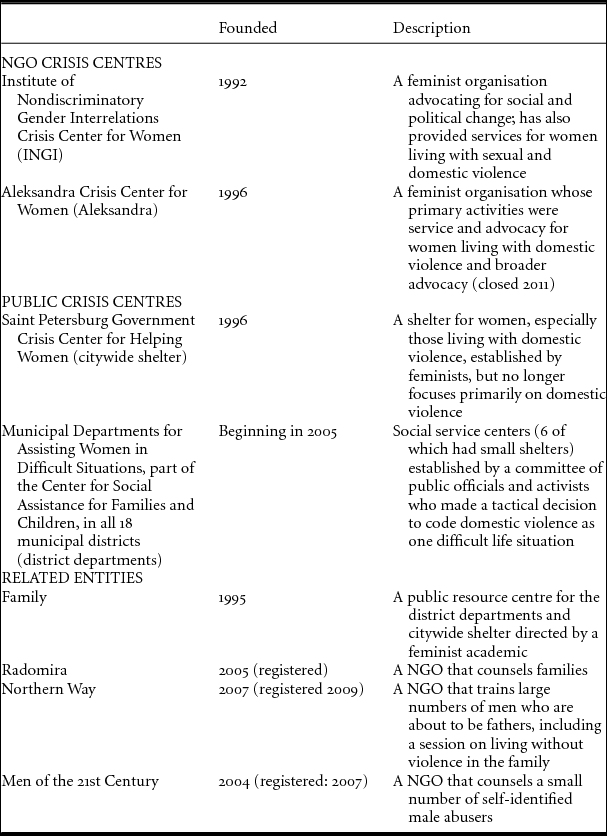
As we show, Saint Petersburg is also atypical in Russia in terms of provision of services to survivors of domestic violence. The city contains eighteen of some 120 crisis departments in family support centres, seven of the 43 estimated shelters, and five of the perhaps two dozen NGOs active in the field in Russia (see Table 1; Gentleman, Reference Gentleman2015).Footnote 6 Yet there is the foundation for such services across Russia, as family support centres exist in most of Russia's approximately 2,000 municipal districts. In 2014, Moscow authorities added a 35-bed 4,500-square metre crisis centre for women, supplementing a handful of other public and NGO crisis centres in the region. Since the mid-1990s, more than 10,000 women in Russia have been involved as employees or volunteers, and hundreds of thousands of women per year contact the centres in search of assistance (Johnson and Saarinen, Reference Johnson and Saarinen2013).
Entities Involved in Domestic Violence in Saint Petersburg, 2013

The project grows out of a long-term, mixed-method collaborative project on women's crisis centres, with new data from May 2013 fieldwork. Together, we conducted semi-structured interviews at three public crisis centres in different parts of Saint Petersburg (with a total of eight staff members) and with four NGO leaders plus one activist who had been involved setting up the public crisis centres. We also observed the facilities and analysed their printed materials as well as online information about all entities connected to domestic violence work in the city. The broader project included a set of questionnaires sent to crisis centres in 2008–9; ethnographic research in a few crisis centres in other regions of Russia; and a focus group among public crisis centres in Saint Petersburg in 2011. Long-term, in-depth research on the topic and transnational collaboration has allowed us to build multilayered and multidisciplinary knowledge on state-society relations and social policy in Russia.
The Usual State-Society Frameworks
Gloom and Doom about Civil Society
Notwithstanding some more nuanced research,Footnote 7 the most prominent approach to studying state-society relations in Russia is a ‘gloom and doom’ framework about civil society. At its most extreme in the American press and democracy-focused international NGOs, this framework is built on the Anglo-American model of civil society in which civil society represents a critical counterweight to, and is in continual conflict with, the state. This has left little room for analysis through less-adversarial models (Javeline and Lindemann-Komarova, Reference Javeline and Lindemann-Komarova2010; Kulmala, Reference Kulmala2013). From this perspective, Western scholars first embraced the collapse of the Soviet Union with an optimism that civil society would reconstruct the successor states into some kind of democracy. They quickly grew disappointed (Henderson, Reference Henderson, Prakash and Gugerty2002; Sundstrom, Reference Sundstrom2006). The NGOs that emerged, often with funds intended to promote civil society, seemed self-serving, apolitical, and disconnected from the people. Using terms such as government-orchestrated NGOs, i.e., GONGOs, or ‘Astroturf civil society’, critics pointed out that some were government entities reconstituted in order to solicit foreign funds, while others, such as the now defunct youth organisation Nashi (Ours), were created by the Kremlin to support Putin's regime (Sperling, Reference Sperling2015: 90).
As Putin consolidated his power in the early 2000s, assessments of civil society in Russia became grimmer (Orttung, Reference Orttung2008). Under a 2006 NGO law, all organisations were required to re-register with regional offices and to report their activities annually, imposing the heavy mechanisms of state bureaucracy. At the same time, the government introduced state subsidies for NGOs, often referred to as presidential grants, which, by the 2010s, were directed toward those addressing social welfare. In 2009, the government created the category of ‘socially-oriented NGOs’ and targeted support for their activities. From the gloom and doom perspective, this funding was a device of ‘selective corporatism’ (Zdravomyslova, Reference Zdravomyslova and Leppänen2005) in which the regime corporatized favoured organisations, while disrupting the activities of others, such as human rights organisations. These new policies signaled that civil society had emerged as a national concern, but was being envisioned more as a helper of the state rather than as an independent agent.
As seen through this gloom and doom framework – after a mild thaw under the Medvedev-Putin tandem (2008–12) (Kulmala, Reference Kulmala2013: 129) – Putin's third presidency threatened civil society. These fears were corroborated by the passage of a 2012 federal law requiring NGOs engaged in ‘political activities’ and receiving foreign funding to register with the authorities as ‘foreign agents’. ‘Political’ was defined as ‘advocating for policy changes or trying to influence public opinion’. With many foreign funders gone – including USAID and UNICEF, which were forced out – it seemed that Russia's civil society was doomed to failure. For feminist civil society observers, it was not just gloom and doom for civil society in general, but for women's and feminist organisations, which had been supported by foreign funds and often lacked a domestic constituency (Sundstrom, Reference Sundstrom2010: 253). The August 2012 prosecution and conviction of three members of Pussy Riot brought international attention to the threat to feminism (Johnson, Reference Johnson2014).
The Case Study: Some Decline, Some Transformation
The gloom and doom framework suggested that women's crisis centres would face repression, leading to the closure of many NGOs and the curtailing of activism against domestic violence. The activism in Russia had been driven by a mix of real problems domestically and interest among women's advocates on the global stage (Johnson, Reference Johnson2009). The first centres provided crisis hotlines and then face-to-face services such as legal counselling and psychological support. Rather than just being service providers, they were places of activism, seeking increased awareness of the problems in society, more serious and comprehensive laws, and increased responsiveness from the police. Critics had found crisis centres to be exceptions to the general rule about the weakness of Russia's civil society (Henderson, Reference Henderson, Prakash and Gugerty2002; Sundstrom, Reference Sundstrom2006).
At first glance, the gloom and doom framework explains what happened to women's crisis centres in Saint Petersburg. In the early to mid-1990s, two NGO crisis centres for women – the Institute of Nondiscriminatory Gender Interrelations (INGI), out of which was formed Aleksandra – had begun providing services in the first, self-identified feminist wave of crisis centres (Liapounova and Dracheva, Reference Liapounova, Dracheva, Saarinen and Carey-Bélanger2004; Johnson, Reference Johnson2009). By 2000, Aleksandra had a dozen paid psychologists and jurists providing direct services, was starting to win domestic violence court cases (with substantial sentences), and was training 35 students a year. Its representatives were even travelling across Russia to train personnel at centres that were sprouting up in response to international funding.
By the mid-2000s, this heyday for women's crisis centres was followed by a period of decreasing funding from abroad as donors pulled – or were pushed – out. The director of Aleksandra points to the 2006 NGO law as the crucial obstacle, suggesting that it interrupted informal funding mechanisms as well as ending grants from various foreign consulates. Lacking the money to pay consultants, Aleksandra extended its focus in order to receive funding. In 2009 and 2010 this strategy worked as, together with another Saint Petersburg NGO (Stellit), Aleksandra received two presidential grants to work with children victimized by sexual violence. But two years later, lacking resources, the centre was, for all practical purposes, closed.
INGI, the only remaining feminist-identified NGO in the field of anti-domestic violence work, has been more successful at withstanding the changes which have beset Russia's civil society. The centre quickly moved away from direct service provision for victims of domestic violence (which is expensive) and was more successful at extending its focus to other issues that foreign donors were willing to fund, such as trafficking in women. Until 2013, they continued to engage in education and prevention work, including setting up an online Russian- and English-language petition calling for a comprehensive national law and taking a Russian legislator to Sweden to show how domestic violence laws work there. As of 2015, they have only an intermittent workday hotline, dependent on whether or not specialists are on duty that day. The peer group for victims of domestic violence has been discontinued. However, they are still helping a few women through the judicial process, something that can take years.
The foreign agent law threatens INGI. In 2012, INGI was celebrating its two decades of work in the same week as the foreign agent law came into effect. Organising an anniversary seminar, they attracted some 60 participants from crisis centres across northwestern Russia. To be careful, it seems, the name of the main funder, the Swedish International Development Cooperation Agency, was removed from the programme at the last minute. In March 2013, the Saint Petersburg prosecutor requested ‘a load of information’, as part of a broad sweep of investigations. The INGI director complied with the first request, refused additional requests, and then became a vocal opponent of the law. As of November 2015, the organisation has not been prosecuted or registered as a foreign agent, but its director ‘expects it’ to happen any moment.
For those who support feminism, the pressures on the NGOs are concerning. The NGO centres were founded by activists committed to the principles of ‘feminist violence work’Footnote 8 combining social provision with advocacy (Khodyreva et al., 2002; Zabelina, Reference Zabelina1999). With Aleksandra closed and INGI under siege, there are only three other NGOs in Saint Petersburg: two organisations aimed at training better parents (Radomira and Northern Way) that address domestic violence peripherally and Men of the 21st Century which works with a handful of self-identified male abusers.
However, this gloom and doom version misses several important parts of the story of women's crisis centres in Saint Petersburg. First, as explained by several activists with whom we spoke, one of the goals of the women's crisis centres from the beginning was for the government to take responsibility for the services for violence survivors. In the mid-1990s, activists sought and found government support for a shelter to provide temporary ‘social assistance to women in danger’, fostered through regional councils on gender equality and domestic violence that included government officials, feminists and other NGO leaders. As an activist-turned-first-director explained, ‘it was important to me that the centre was part of the government budget because it was clear that the grants would not continue’, but also ‘it was important to hold the government accountable because they created the situation for domestic violence’. This shelter has lasted, as she noted with pride in 2005, ‘and it is still on the government budget’. By 2013, public crisis departments for women had also been set up in all eighteen districts of the city. Aleksandra's presidential grants were another form of state support, which they lost, according to the director's own account, because of her mistake in reporting. In contrast to the gloom and doom framework in which this is seen as an authoritarian turn, moving to the state was a tactical move by the women's crisis centres to get the state to take more responsibility. As some scholars have also noted (Hemment, Reference Hemment2012; Henry, Reference Henry2010; Kulmala, Reference Kulmala, Saarinen, Ekonen and Uspenskaia2014; Kulmala and Tarasenko, forthcoming), the gloom and doom framework has led observers to see collaboration as only state-orchestrated co-optation, downplaying the benefits of both the collaboration and the activists’ agency.
Second, the repression has not been as bad as the gloomy predictions. As others have noted (Javeline and Lindemann-Komarova, Reference Javeline and Lindemann-Komarova2010: 173–5), the 2006 NGO legislation created mechanisms for state control, but did not per se curtail civil society, and it did not lead to widespread closings of Russian organisations. While Aleksandra's director points to this legislation, it was the decline in funding that was most crucial to the organization's demise, a result of the combination of changing foreign donors’ funding priorities as well as their concerns about funding Russian NGOs after the 2006 law. Similarly, the 2012 foreign agent law, with its onerous inspections, brought difficulties for many Russian organisations, but socially-oriented NGOs (e.g., those focused on maternity assistance and childcare) are excluded from the law and increasingly supported by state subsidies (Kulmala and Tarsenko, forthcoming). Most NGO women's crisis centres, even in this often arbitrary regime, can cast themselves as socially oriented, and none have yet been closed down. The most concrete effect of the 2006 NGO and the 2012 foreign agent laws are that more foreign funders have withdrawn from Russia (Kulmala, Reference Kulmala2013: 123–144). Until recently, authorities had been less suspicious of Nordic donors, with their emphasis on social welfare, than US donors focused more on advocacy and human rights (Kulmala, Reference Kulmala2013: 136; Sundstrom, Reference Sundstrom2006: 37).
The gloom and doom framework casts Russia as authoritarian, paradoxically, and takes too seriously the proclaimed legal restrictions by assuming them to be implemented fully. In many ways, this framework is wedded to the ideologically-driven transition paradigm that marked American political science in the 1990s, with optimism turning to pessimism when things did not go as expected. Our case study shows how some NGOs can navigate the restrictions, even getting the state to take on new policy responsibilities, if they are framed to fit the given circumstances (Kulmala et al., Reference Kulmala, Kainu, Nikula and Kivinen2014; Pape, Reference Pape2014). That many women's activists advocated, and were involved in, the creation of new social services illustrates that many Russians want the state to take over several of the NGO services. This in turn complicates the high hopes of democracy advocates and donors for an adversarial civil society. (Beznosova and Sundstrom, Reference Beznosova and Sundstrom2009; Kulmala, Reference Kulmala2013; Thomson, Reference Thomson, Evans, Henry and Sundstrom2006). Russia's government is somewhat ambivalent about NGOs and, given the Soviet legacy, a model of closer state-society relations is more appropriate than a liberal one (Henry, Reference Henry2010; Kulmala, Reference Kulmala2013).
Paternalist Welfare Expansion
Given the transformation from NGO-based to state-based anti-domestic violence work, we turn to a social policy-focused explanation. As part of the story of Putin's (and Medvedev's) popularity among Russians, a second usual framework is the idea that social services have been bolstered, leading to improvements in people's lives (McFaul and Stoner Weiss, Reference McFaul and Stoner Weiss2008). The collapse of the economy in the late Soviet and Yeltsin years had been disastrous for the state's provision of health and social services as well as for people's lives; the priority was relieving pressures on the state budget by liberalising, privatising, and decentralising social obligations. In the 2000s, while still restricting the welfare state, Putin's regime designated social policy as an urgent task (Cook, Reference Cook, Jäppinen, Kulmala and Saarinen2011). This welfare statist turn was facilitated by rising state revenues – Russia was one of the fastest growing major economies – from the high prices of oil. The welfare expansion framework stressed that the budget surplus was to be used to stabilize the economy and to increase social protection. In contrast to the neoliberalism in the West, it seemed that there was a Russian social policy miracle (Cerami, Reference Cerami2009).
Russia's commitment to welfare continued even during the 2008–9 global economic crisis. There was less austerity applied to social spending than in the United States and most European countries. Welfare benefits available for citizens – especially for family and childhood protection but also pensions – increased (Kulmala et al., Reference Kulmala, Kainu, Nikula and Kivinen2014). Between 2007 and 2010, expenditures for social policy doubled, poverty rates declined and rapidly growing inequality stabilized (Cerami, Reference Cerami2009: 113). The welfare priorities are most evident in the introduction of the ‘National Priority Projects’ (implemented in 2007–2012) which, combined with ambitious demographic policies, were to address concerns about declining population (Cook, Reference Cook, Jäppinen, Kulmala and Saarinen2011: 14). When reclaiming the presidency in 2012, Putin promised to bolster social services, issuing decrees on his inauguration day requiring the regions to increase public sector salaries, including those of social workers.
For many scholars, Russia's social policymaking of the 2000s is paternalistic rather than a result of interest representation: elite-led and addressing the national concerns without attending to the citizens’ needs and concerns (Kulmala et al., Reference Kulmala, Kainu, Nikula and Kivinen2014). Feminist researchers show how this paternalism includes attempts to shape society in gendered ways, prioritizing categories of citizens, such as families with reproductive potential, in order to increase the birthrate despite the reality that the most pressing problem is working-age male mortality (Chandler, Reference Chandler2013; Rivkin-Fish, Reference Rivkin-Fish2010). Driven by a strong family-centred ideology (Kulmala et al., Reference Kulmala, Kainu, Nikula and Kivinen2014), policies have been pronatalist, reinscribing maternal roles for women with the underlying assumption that addressing the demographic crisis is women's responsibility.
The Case Study: Mitigated Welfare Success
The welfare expansion framework suggests that although social services may have been established or expanded, this was primarily in ways that suit the state. This model fits the empirical reality of the expansion of public crisis departments to all Saint Petersburg districts, six of which include shelter space for women and one even has access to a system of social housing up to five years for these women. These are remarkable achievements, though the capacity is much smaller than the international recommendations for shelter space for a city of Saint Petersburg's population.Footnote 9
There was also paternalism. As these centres were established as part of family service centres, the regime was constructing domestic violence as part of the need to protect families. While, in our interviews, NGOs leaders continued to identify as feminist in 2013, the current director of the citywide shelter identified herself as Russian Orthodox and compared feminism to ‘fascism, another annoying “ism”’. At the district departments, our question about feminism was followed by a firm ‘No’ and an explanation that they ‘work also with men’. Public crisis centres had only weak (if any) ties with the feminist organisations locally or abroad; instead, their NGO partners were local organisations providing humanitarian aid, or supporting specific groups of families like those with HIV-positive family members.
On the one hand, in contrast to the paternalist welfare expansion framework's tenet that social policy was elite-led, there was notable evidence of activist involvement. In 2004, the Saint Petersburg governor, Valentina Matvienko, invited various experts, including NGO representatives, feminists among them, to form a regional gender equality council to create a gender equality programme for 2005–15. Although this council failed to push through any programmatic gender plan, a subset of the council focusing on domestic violence-related questions proposed the idea of inserting work against domestic violence into the new social services being developed.Footnote 10 Instead of being explicit about domestic violence, activists decided to ‘speak in code’ in order to place domestic violence under family centres within departments for women facing ‘difficult life situations’, fitting the national concern about protecting Russian families. Activists’ ability and agency to navigate within the current political environment shows the importance of framing the issues to resonate in the given circumstances.
And, activists – including feminists – remained involved in the public crisis centres, for example through a domestic violence council operating under the regional government. The former director of Alexandra was working in one of the district crisis departments and conducted gender-sensitive training among the personnel. A feminist academic had taken over the directorship of the Family Center, a public resource centre for the district departments that holds monthly seminars. Women's interest representation mattered, even if there were compromises.
On the other hand, the paternalistic welfare expansion framework ignores the possible consequences on civic activism. Before the system of the district departments, the regional government provided funds for the NGO crisis centres; these funds have now dried up as officials appear to think them unnecessary. At the moment, officials at the regional level seem only to be willing to fund men's organisations involved in addressing domestic violence (such as those working with male perpetrators), which the state does not do. In this respect, these men's organisations fill the gap left by the state services, which is the role that the state seems to relegate to NGOs (Beznosova and Sundstrom, Reference Beznosova and Sundstrom2009; Thomson, Reference Thomson, Evans, Henry and Sundstrom2006).
In sum, both these usual frameworks bring important focus to the relations between state and society, instead of just to the top of the regime but, as this case study suggests, they only reveal a part of the truth about how Russia's regime and social policymaking operate. Neither allows for thinking about the impact on the other, even though there is an implicit assumption that civil society has an impact on public policy. We suggest re-orienting the question of understanding how Russia's regime operates, making it more inductive than deductive. Even the paternalist welfare state model, while getting closer to seeing what happens on the ground, tends to focus too much on inputs, not outputs, in the policy process.
A De Facto Feminist Framework
We propose that governments should be analysed, not through abstract classifications based on Western models, but as to whether they help people solve their problems. We argue for a de facto feminist framework that focuses on how much and what kind of help citizens, in this case women living with domestic violence, receive from both state and societal actors, regardless of whether those providing assistance identify as feminists. We claim that the reluctance among staff members of the public crisis departments to identify as feminist or to work with feminist organisations reveals more about the stereotypes around feminism than about their actual approach to addressing domestic violence (Sperling, Reference Sperling1999; Sundstrom, Reference Sundstrom2006). This analytical framework points to street-level practices and recognises feminist values and gender-sensitive approaches.
Our criteria are the following: First, are a sufficient proportion of the women seeking help with domestic violence being offered concrete assistance? Second, does this assistance follow feminist principles of violence work (survivor-centredness, abuser responsibility, and connecting domestic violence to the structural oppression of women)? Third, is there advocacy for broader social change that is likely to help eliminate domestic violence?
On the first criterion about concrete assistance, we found that the public crisis centres continued the work with domestic violence survivors started by the feminist organisations in the 1990s, a notable achievement given the state's initial resistance to taking on the issue. By their own accounts, one out of five clients were survivors of physical domestic violence, and one-third to one-half were survivors of psychological violence or threats of violence. The shelters were reported to be often full. Some of our informants equated the ‘difficult life situation’ – the official focus of the public centres – with domestic violence. In their brochures, violence was mentioned as one of numerous issues, while the city-wide shelter gave us printed materials devoted to domestic violence. Across the board, staff members saw work with violence survivors as an essential part of their purview and sensed that women knew that the centre provided help in cases of domestic violence. Most clients came with children, but all centres we visited in 2013 served women without children, including elderly women.
On the second criteria, although our data provide limited possibilities for analysing the helping practices directly, the indirect evidence suggests public crisis centres were providing some of what scholars see as the essential elements of feminist violence work. The staff members we met spoke about the service users in a respectful way and gave an impression of professionals committed to helping women to find ways out of their individual situation. There were a few less respectful comments, such as from one director who labelled the women coming to the crisis department as not meeting the cultural ideal of female behavior and, perhaps, causing the violence against them: ‘The violence with which they come. . . may be a response to what we see. Because they are disheveled. They do not clean, do not cook. They cannot even take kids outside. . .well, they do not evoke positive emotions’. Another department director talked about clients who misuse the service system. Blaming the victim and stigmatizing service users may keep those women who have any other options outside these centres. In the shelters we visited, the expectation seemed to be that they are contacted only by women who do not have any other options, such as personal networks or financial resources (also Jäppinen, Reference Jäppinen, Jäppinen, Kulmala and Saarinen2011; Reference Jäppinen2015). This seems to be true for social services more broadly, including women's use of legal counselling services in the case of family breakdown (Turbine, Reference Turbine and Salmenniemi2012).
On the surface, as the centres tended to view domestic violence through a family-centred orientation, it seemed that they were not holding the abuser responsible for his actions, seeing women survivors of violence as partly responsible for the ‘family conflict’. The first recommendation was always for the woman to return home to her husband; their main goal is to keep families together. But, at the same time, the staff members recognized that family reunification is not always possible and that, in these cases, women's and children's safety must be prioritized.Footnote 11
The crucial factor in the help that the service users receive is whether the assistance suggests a frame of domestic violence as resulting from societal oppression. While staff at public crisis centres reported understanding domestic violence as a violation of women's rights, their practice was to act within a framework of family violence or violence in marriage, using gender-neutral terminology, a practice common across postcommunist Eastern and Central Europe where feminist critiques of gender equality have not had strong resonance (Jäppinen, Reference Jäppinen, Jäppinen, Kulmala and Saarinen2011; Reference Jäppinen2015; Saarinen, 2004; Sundstrom, Reference Sundstrom2006). The activist-turned-first-director of the citywide shelter described how activists helped officials move from only thinking about ‘violence as related to children’ to ‘women and children’ finally to ‘women’ first and foremost. But, by 2013, most of the staff at public crisis centres framed domestic violence as a conflict of two equal spouses, for which both are responsible. In contrast to the feminist assertion that violence against women is about gendered power, the public centres in Saint Petersburg cast the problem as related to alcoholism, sometimes also to drug abuse, jealousy, sadism, or ‘manly behavior’ by policemen and war veterans. Gender inequality or patriarchal cultural models were rarely mentioned in the interviews. Whether a centre takes a de facto feminist approach also depends on the individuals working there at any given moment, an important consideration in the current environment due to high staff turnover in Russia's social services (Jäppinen, Reference Jäppinen2015).Footnote 12
The weakest of the three criteria for our de facto feminist frame is promoting broader changes in society. The public crisis centres concentrate on casework with individual clients, only sometimes doing community-based preventive actions like giving lectures or organising trainings. Public centres do not actively pursue legal changes, but recognise the need for a new law on domestic violence. Compared to NGOs, the public crisis centres rarely confront authorities, conduct public awareness campaigns, or advertise their services (Liapounova and Dracheva, Reference Liapounova, Dracheva, Saarinen and Carey-Bélanger2004; Johnson and Saarinen, Reference Johnson and Saarinen2011). Yet, they may participate in councils and working groups on gender and domestic violence issues, participate in campaigning, if they are invited by NGOs, and work with media, if approached. In these ways, they continue to push the new issue into the public social services practice and, in this way, it can be regarded as part of structural social work.Footnote 13
Combining this evaluation of the work of the public crisis centres with the assessment of the NGO centres above, reveals the complexity of how the street-level practice of social policymaking operates in Russia. The mix of state-society responses to the problem of domestic violence is not perfect, as the greatest responsiveness is seen in systems combining flourishing feminist NGOs and widespread public crisis centres (Htun and Weldon, Reference Htun and Weldon2012). However, with some input from society, the state has made important small steps in addressing problems in Russia. The inherent limitations of the voluntary sector as a mechanism for meeting public needs (i.e., the so-called ‘voluntary failure’ by Salamon and Anheier, Reference Salamon and Anheier1998) is much greater than the so-called government failure, i.e., the government's inability or unwillingness to provide social services (also Kulmala, Reference Kulmala2013). In our case, the NGO crisis centres, with limited funding and limited connection to the broader social system, have not been able to provide services to large number of women (Johnson and Saarinen, Reference Johnson and Saarinen2013). In addition to their dependency on the agenda-setting by foreign donors, the NGOs are under the pressure to respond to the state-defined social policy priorities which is why their ability to (re)frame their activities to navigate within the system becomes crucial.
The main explanatory factor for the mitigated de facto feminism in Saint Petersburg is the influence of Matvienko, governor of Saint Petersburg 2003–11, as almost all interviewees noted (though one NGO director thought that she had been an obstacle). Matvienko, the most important of only four women governors since Putin came to power, has also been one of the most powerful women in post-Soviet Russian politics. Long loyal to Putin, Matvienko cared enough about women's position and many social policy arrangements – and had enough power – to be willing and able to include feminist activists and NGOs in social policymaking. In this respect, the Saint Petersburg story shows the importance of powerful insiders at the level where actual policy implementation takes place. Comparative empirical feminist scholarship, including that in Russia, has found that elite allies, usually but not always women, are critical for the support of civil society initiatives, providing institutional support and an influential channel into the corridors of power (Htun and Weldon, Reference Htun and Weldon2012; Kulmala, Reference Kulmala, Saarinen, Ekonen and Uspenskaia2014; Sperling, Reference Sperling1999). This is even more important in hybrid and authoritarian regimes where personal relationships and informal elite networks, dominated by men, substitute for formal procedures and political parties (Gel'man, Reference Gel'man2015; Helmke and Levitsky, Reference Helmke and Levitsky2006; Johnson, Reference Johnson2014).
Conclusion
Domestic violence remains a significant problem in Russia (Johnson, Reference Johnson2009; Jäppinen, Reference Jäppinen2015; Jäppinen and Johnson, forthcoming; Gentleman, Reference Gentleman2015). Activists point to the failure to pass comprehensive national legislation – despite fifteen years and dozens of versions – that would make prosecuting domestic violence, providing social services for survivors, and preventing domestic violence government responsibilities. Resistance has been fierce, including from a resurgent Orthodox Church which sees such legislation as ‘anti-family.’ We are also not downplaying the repressive measures applied to society since Putin came to power. We recognise their severity and the coercion that results from even their arbitrary enforcement. In 2014, as Russia invaded Ukraine, it became easier to label organisations ‘foreign agents,’ and ramped-up nationalism strengthened gendered notions underlying paternalism. Due to the decline in the price of oil and the US and European economic sanctions, Russia is facing another economic recession, meaning cuts in social expenditure as in other field of the state budget, but we have no evidence that the public crisis centres in Saint Petersburg have been targeted.
Instead, we argue for a way of looking at social policymaking in Russia that is different from the usual frameworks of gloom and doom and state-led paternalism because they miss important dynamics. We argue for a de facto feminist approach based on the full picture of what the regime does in practice within specific institutions in specific localities, to detect social change. Our case study shows that, at least in one prominent region, activists have succeeded in getting the regional government to take on a new social policy responsibility, despite resistance at the national level. On social issues, important opportunities for interest articulation remain, especially if those interests are represented in the right way at the right time and at the lower levels of government (cf. Pape, Reference Pape2014; Kulmala et al., Reference Kulmala, Kainu, Nikula and Kivinen2014). When laws themselves cannot be changed through bottom-up efforts, significant changes in policies on the ground may be possible. For those concerned with social policy, especially in hybrid regimes, these findings suggest that both tactical framing of policy issues, even speaking in code to appeal to the dominant ideologies driving social policy, and using elite networks to enlist allies – using informal politics – can help get new practices adopted.
Finally, we should not assume that leaders’ proclamations of control mean that the state functions under their control. In hybrid regimes, the locus of civil society seems to be closer to (and more overlapping with) the state than one would expect in liberal democracies (especially British and American ones). There is a risk of cooptation but as we have shown, even in Russia, engagement is not necessarily cooptation. The problem with the gloom and doom civil society and the paternalist welfare expansion frameworks are that they take too much stock of top-down understandings of Russia, giving Putin authority beyond his actual impact on lower level decision-making and people's lives.
Much as the mass protests following the 2011 Duma elections revealed that there had been meaningful networking since 2005 missed by many scholars, scholars have underestimated the role and impact of citizens in Russia organised around a cause such as domestic violence. As in the women's crisis centres in Saint Petersburg, citizens in NGOs may resist by planting new ideas into the state; and staff in social services may grow more critical of the state when faced with real people's lives. Understanding state-society relations in regimes such as Russia requires going beyond ‘the usual suspects’: beyond the national-level policymaking to look at these policies in practice; beyond the non-feminist self-identification of violence-workers to look at daily practices in their work. In hybrid regimes, national policies are adapted, negotiated and modified by street-level bureaucrats through their local action.
Acknowledgements
We thank Aino Saarinen for her guidance in the research project ‘Welfare, Gender, and Agency’ (2008–2012) (http://www.helsinki.fi/aleksanteri/english/projects/wga.htm), in which we each participated and which informs this article.