Introduction
Reports of bilinguals suggest that the first language may be experienced as more emotional than later acquired languages (e.g. Dewaele, Reference Dewaele2004a, Reference Dewaeleb, Reference Dewaele2008, Reference Dewaele2010; see also Pavlenko, Reference Pavlenko2005, for a review). During the last decade, some experimental studies have investigated whether there are differences between the first language (L1) and the second language (L2) in the processing of the affective content of words. However, their results are not consistent. On the one hand, some findings suggest that the emotional content of words affects processing in L2 to the same extent as it does in L1. For example, studies using either the Affective Simon task (Altarriba & Basnight-Brown, Reference Altarriba and Basnight-Brown2011) or the Emotional Stroop task (Eilola & Havelka, Reference Eilola and Havelka2011; Eilola, Havelka & Sharma, Reference Eilola, Havelka and Sharma2007; Sutton, Altarriba, Gianico & Basnight-Brown, Reference Sutton, Altarriba, Gianico and Basnight-Brown2007) have reported an interference effect with emotional L2 words. Moreover, there are no differences in the size of the effect either between bilinguals and monolinguals (Eilola & Havelka, Reference Eilola and Havelka2011) or between L2 and L1 words (Altarriba & Basnight-Brown, Reference Altarriba and Basnight-Brown2011; Eilola et al., Reference Eilola, Havelka and Sharma2007; Sutton et al., Reference Sutton, Altarriba, Gianico and Basnight-Brown2007). In addition, recent electrophysiological data reveal a similar time course of emotionality effects on word processing in the two languages of proficient bilinguals (Conrad, Recio & Jacobs, Reference Conrad, Recio and Jacobs2011).
On the other hand, there exists some evidence that the effects of the emotional content on words’ processing are stronger for L1 than for L2. For example, Segalowitz, Trofimovich, Gatbonton and Sokolovskaya (Reference Segalowitz, Trofimovich, Gatbonton and Sokolovskaya2008) tested a group of moderately fluent bilinguals in an Implicit Affect Association task and obtained a greater emotional congruence effect in the first than in the second language. These authors considered their results an evidence of the processing of affective words’ content being less automatic in L2 than in L1. Colbeck and Bowers (Reference Colbeck and Bowers2012) obtained more results pointing in the same direction. In particular, these authors found taboo words to interfere with the detection of target words in a Rapid Serial Visual Presentation task, but this effect was only found in L1. Similarly, Degner, Doycheva and Wentura (Reference Degner, Doycheva and Wentura2012) tested bilinguals in an affective priming paradigm and obtained a clear priming effect in L1. With respect to L2, only bilinguals immersed in an L2 environment and who used the second language on a regular basis exhibited the affective priming effect. Furthermore, there is physiological evidence supporting the proposal of Segalowitz et al. (Reference Segalowitz, Trofimovich, Gatbonton and Sokolovskaya2008). Harris and co-workers (Caldwell-Harris & Ayçiçegi-Dinn, Reference Caldwell-Harris and Ayçiçegi-Dinn2009; Harris, Reference Harris2004; Harris, Ayçiçegi & Gleason, Reference Harris, Ayçiçegi and Gleason2003), as well as Eilola and Havelka (Reference Eilola and Havelka2011), obtained a stronger effect of the emotional content of words in skin conductance for L1 than for L2. However, this difference between the two languages did not include all types of emotional words, and it was restricted to late bilinguals.
Considering the above-mentioned studies, several variables can modulate the emotional effects of words in L2. Some of them refer to the words themselves, as differences between L1 and L2 in affective processing are mainly obtained with childhood reprimands and taboo words. However, these words have idiosyncratic characteristics, even in the first language (e.g. Janschewitz, Reference Janschewitz2008; Jay, Caldwell-Harris & King, Reference Jay, Caldwell-Harris and King2008). As a consequence, the experimental findings obtained with them might not be easily generalized to other types of emotional words. Other relevant variables refer to different characteristics of the bilinguals, such as age of L2 acquisition, proficiency or frequency of exposure to the second language. In addition, it is possible that the task could modulate the effects of the emotional content of L2 words, as Eilola et al. (Reference Eilola, Havelka and Sharma2007) suggest. According to these authors, tasks measuring automatic word processing may show a different pattern of results from tasks which involve more elaborative processing. The aim of the present work is to further explore the affective processing in L1 and L2 by using a memory task. We tested highly proficient early bilinguals immersed in a context in which both languages are normally used. However, these bilinguals were dominant in one of the two languages and used one of them more frequently than the other. The use of this population allows us to study the contribution of frequency of language use to the processing of affective properties of words.
There are few studies involving memory tasks conducted to date with bilinguals. Anooshian and Hertel (Reference Anooshian and Hertel1994) were the first authors who investigated whether memory for emotional words is better than for neutral words in both L1 and L2. They tested late proficient bilinguals of English and Spanish and obtained the usual advantage in memory for L1 words, but not for their L2 counterparts. Several years later, Ayçiçegi and Harris (Reference Ayçiçegi and Harris2004) conducted a similar study with late Turkish–English bilinguals, in which they examined a more diversified set of emotional words than Anooshian and Hertel (Reference Anooshian and Hertel1994). They obtained the previously-mentioned emotional effect on memory for both L1 and L2 words. In addition, the emotionality effect was stronger in L2 than in L1. This last result was surprising and clearly disagreed with Anooshian and Hertel's (Reference Anooshian and Hertel1994) findings. According to Ayçiçegi and Harris (Reference Ayçiçegi and Harris2004), this difference might be explained, at least in part, by divergences in the procedures employed.
The participants tested in the two aforementioned memory studies were all late bilinguals. We have recently conducted a study where we investigated whether variables related to bilinguals, such as age of acquisition, may play a role in the advantage in memory for emotional L2 words (Ferré, García, Fraga, Sánchez-Casas & Molero, Reference Ferré, García, Fraga, Sánchez-Casas and Molero2010). We observed that the size of the emotional effect on memory was the same in both languages. This happened not only for early bilinguals but also for late proficient bilinguals. These findings suggest that proficiency is the most relevant factor in determining the effects of emotional L2 words on memory.
The above reviewed studies, as well as many other studies investigating the effect of the affective content of words on memory, used encoding tasks in which participants are explicitly asked to focus on the affective properties of words (e.g. to rate their pleasantness). This encoding task might have contributed to the memory enhancement for emotional words, as it might have encouraged participants to use emotionality as an organizational framework either at encoding or retrieval (Talmi & Moscovitch, Reference Talmi and Moscovitch2004). If the effect of the emotional content of words on memory is a general effect and not a by-product of directing participants’ attention to emotionality at encoding, it should be obtained regardless of the type of task used. In fact, monolingual studies have reported an emotional enhancement on memory when participants focused on semantic, non-emotional characteristics of words (Luminet, Vermeulen, Demaret, Taylor & Bagby, Reference Luminet, Vermeulen, Demaret, Taylor and Bagby2006). In addition, there is a superiority in recall for emotional words when the participants’ attention is directed to their visual or formal properties (e.g. their font size or the number of vowels, Ferré, Reference Ferré2003; Luminet et al., Reference Luminet, Vermeulen, Demaret, Taylor and Bagby2006; Vermeulen & Luminet, Reference Vermeulen and Luminet2009). Thus, it does not seem necessary to intentionally process either the affective content of words or their meaning in order to obtain an emotional effect on memory. If the processing of emotional words is the same in the two languages of the bilingual, the emotional effect on memory should also be observed in L2 regardless of the task used at encoding. This is the prediction we aim to test in the present work.
There are only two previous studies which have tested memory for emotional words in bilinguals by using different encoding tasks. One of them is the above reviewed study of Anooshian and Hertel (Reference Anooshian and Hertel1994). These authors did not obtain the emotional effect on memory with L2 words, when the encoding task focused either on the phonetics of the words or on their emotional content. More recently, Ayçiçegi-Dinn and Caldwell-Harris (Reference Ayçiçegi-Dinn and Caldwell-Harris2009) conducted a memory study in which these authors manipulated the level of processing during encoding. They asked some of the participants to focus on the affective properties of words, whereas other participants focused on other features. There were two tasks which required access to meaning (a translation task and a word association task) and a third task focused on visual features of words (participants had to count the number of letters containing a closed circle in each word).
The results of this study showed that the encoding task modulated the emotional effect on memory. When the task required paying attention to features other than emotionality, the effect on memory was obtained in both languages. Furthermore, in one of the tasks (translation), the magnitude of the effect was higher for L2 than for L1. On the contrary, when participants were asked to focus on the emotional content of words, there was an advantage for emotional words only in L1.
The results of Ayçiçegi-Dinn and Caldwell-Harris (Reference Ayçiçegi-Dinn and Caldwell-Harris2009) are striking in several ways. On the one hand, the data obtained when the encoding task focused on emotionality are at odds with earlier findings obtained with the same materials and with a similar encoding task (Ayçiçegi & Harris, Reference Ayçiçegi and Harris2004). On the other hand, if the processing of emotional words is not as automatic in L2 as in L1 (Segalowitz et al., Reference Segalowitz, Trofimovich, Gatbonton and Sokolovskaya2008), one might expect differences between the two languages in tasks not focused on the affective properties of words, but not in tasks involving an explicit processing of these properties. Ayçiçegi-Dinn and Caldwell-Harris (Reference Ayçiçegi-Dinn and Caldwell-Harris2009) obtained just the opposite pattern of results. In addition, this study has some limitations that do not allow one to draw definitive conclusions about the role of the encoding task in the emotional effects of L2 words on memory. First of all, the authors did not select their experimental words from normative databases. As a consequence, their stimuli were not rigorously characterized either in valence or arousal, both variables being known to affect memory (e.g. Kensinger, Reference Kensinger2008). Furthermore, the authors did not match their experimental conditions in variables that influence word processing, such as word frequency or length. Therefore, one cannot be sure that these variables have not contributed to the emotional effects reported. Another limitation of the study of Ayçiçegi-Dinn and Caldwell-Harris (Reference Ayçiçegi-Dinn and Caldwell-Harris2009) is that they presented words of the two languages intermixed. We believe this procedure might potentiate the simultaneous activation of the two languages during encoding and encourage strategies such as covert translation. In our opinion, a blocked design is a better choice if we want to obtain reliable evidence about the processing of emotional words in L2.
The aim of the present work was to test whether the emotional effect on memory is present in both L1 and L2 regardless of the task used at encoding. We tested a group of bilinguals with different characteristics from either those tested in the study of Aycicegi-Dinn and Caldwell-Harris (Reference Ayçiçegi-Dinn and Caldwell-Harris2009) or in most studies conducted in this field. They were highly proficient early bilinguals, immersed in a context in which their two languages are strongly present, but who were clearly dominant in one of these languages. We also wanted to compare our results with those obtained in our previous study in which participants focused on emotionality at the encoding phase (Ferré et al., Reference Ferré, García, Fraga, Sánchez-Casas and Molero2010). In order to be able to draw reliable conclusions about the processing of emotional words, the presentation of words was blocked by languages, the stimuli were selected from normative databases, and the experimental conditions were matched for variables known to affect word processing.
We conducted two experiments. In the first one, we used an encoding task in which we asked participants to focus on the semantic properties of words but not on their emotional content. In the second one, we used a task which did not require access to meaning, but only to formal or structural features of words. If bilinguals can process the affective content of words in L2 to the same extent as they do in L1, we should expect to obtain the emotional effect on memory in both languages. Furthermore, we should find the effect in both L1 and L2 regardless of the task used at encoding, as in monolingual experiments (e.g. Ferré, Reference Ferré2003). However, if frequency of language use can modulate the processing of the affective properties of words (Degner et al., Reference Degner, Doycheva and Wentura2012), it would be possible to find differences between the dominant and the non-dominant language in the emotional memory effect.
Experiment 1
Method
Participants
Eighty-nine undergraduate students of Psychology (66 women and 23 men) from the University Rovira i Virgili (Tarragona, Spain), with ages ranging from 18 to 37 years (M = 19.9, SD = 2.9), took part in the experiment. They received a course credit for their participation. They were bilinguals of Catalan and Spanish who acquired both languages in their early childhood. They completed a questionnaire in which they assessed their competence in listening, reading, speaking and writing in Catalan and Spanish on a seven-point scale (1 = a very poor level of competence; 7 = a very good level). They also rated their frequency of language use on a seven-point scale (1 = only in Catalan; 7 = only in Spanish) and their preference of use (1 = only in Catalan; 7 = only in Spanish). In addition, they performed several fluency tasks in two separate classroom sessions. Half of the participants did the first session in Catalan and the other half in Spanish. In the first session, participants performed a phonological fluency task in which they had to produce as many words as possible beginning with the letters F, A and S (they were given one minute for each letter). Immediately after, they performed a semantic fluency task in the same language, in which they had to produce as many nouns for fruits, jobs and animals as they could do (they were given one minute for each semantic category). In the second session, conducted a month later, participants had to perform the same tasks but in the other language (either Catalan or Spanish, depending on the language used in the previous session).
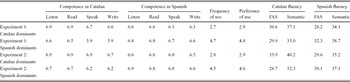
We divided participants according to their dominant language into two groups by taking into account their self-ratings in the questionnaire as well as their performance in the fluency tasks. We obtained a group of 53 Catalan dominants (42 women and 11 men, with ages ranging from 18 to 37 years, M = 20.4, SD = 3.4), and a group of 36 Spanish dominants, 12 men and 24 women, their ages ranging from 18 to 26 years (M = 19.28, SD = 1.78). Table 1 shows the characteristics of the bilinguals. Both Catalan and Spanish dominants were highly proficient in both languages although their ratings were slightly higher for their dominant language than for the non-dominant one. Catalan dominants rated themselves as more proficient in Catalan than in Spanish in listening, t(52) = 2.92, p < .01; reading, t(52) = 3.09, p < .005; speaking, t(52) = 6.28, p < .001; and writing, t(52) = 2.03, p < .05. They also produced more Catalan than Spanish words in both the semantic fluency task, t(52) = 6.23, p < .001 and the phonological fluency task, t(52) = 5.31, p < .001. The pattern of results was the opposite for Spanish dominants. They rated themselves as more proficient in Spanish than in Catalan in reading, t(35) = 2.25, p < .05; speaking, t(35) = 3.55, p < .005; and writing, t(35) = 2.52, p < .05. They also produced more Spanish words than Catalan words in the semantic fluency task, t(35) = 4.66, p < .001, although there were no significant differences between the two languages in the number of words produced in the phonological fluency task. Finally, there was a clear difference between the two bilingual groups in their frequency of use of the two languages, t(87) = 7.19, p < .001, as well as in the extent to which they preferred to use Spanish or Catalan, t(87) = 9.55, p < .001.
Characteristics of the bilinguals participating in the study.

FAS = phonological fluency task; Semantic = semantic fluency task.
Design
We used a mixed design with two within-subjects factors: Valence (positive, negative and neutral words) and Language (Catalan and Spanish) and one between-subjects factor: Dominance (Catalan-dominant bilinguals and Spanish-dominant bilinguals).
Materials
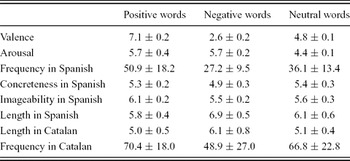
The stimuli used in the present study were the same as those used in the study of Ferré et al. (Reference Ferré, García, Fraga, Sánchez-Casas and Molero2010). They comprised a set of 36 Spanish nouns obtained from the Spanish Adaptation of ANEW (Redondo, Fraga, Padrón & Comesaña, Reference Redondo, Fraga, Padrón and Comesaña2007), as well as their Catalan translations. They were not cognates between Catalan and Spanish. In the ANEW, words are rated on a 1–9 scale in terms of affective valence (1 = very unpleasant; 9 = very pleasant) and arousal (1 = very calming; 9 = very exciting or arousing). We selected the stimuli for the present experiments according to both dimensions. As a result, we obtained 12 positive words, 12 negative words and 12 neutral words. The affective characteristics of these stimuli can be seen in Table 2. An analysis of variance (ANOVA) showed that there was a significant difference between the three sets of words in both affective valence, F(2,33) = 179, p < .001, and arousal, F(2,33) = 8.44, p < .005. Planned comparisons conducted with Bonferroni tests revealed a significant difference in affective valence between positive and neutral words, between negative and neutral words, and between positive and negative words (all ps < .001). Furthermore, both positive and negative words had a higher arousal level than their neutral counterparts (both ps < .005), although there were no differences in arousal between positive and negative words.
Affective and lexical characteristics of the experimental words (Mean ± SEM).

In addition, we matched the three sets of words as closely as possible for length and frequency of use in Spanish and Catalan. We also matched them for concreteness and imageability in Spanish. It was not possible to take into account the last two variables in Catalan because there are not available normative data in this language. We obtained the data for Spanish words from B-Pal (Davis & Perea, Reference Davis and Perea2005) and LEXESP (Sebastián-Gallés, Martí, Carreiras & Cuetos, Reference Sebastián-Gallés, Martí, Carreiras and Cuetos2000). Furthermore, we obtained the values of frequency for Catalan words from the “Diccionari de Freqüències de l'Institut d'Estudis Catalans” (Rafel, Reference Rafel1996). The ANOVA performed with length, frequency of use, concreteness and imageability revealed a successful matching, as there was not any significant difference between the three sets of words (all ps > .11). We divided the selected 36 words into two sets (set A and set B), in order to avoid the presentation of translation equivalents to the same participant. Each set comprised 18 words, divided into three subsets (six positive, six negative and six neutral words). These subsets differed in the critical affective dimensions and we matched them in the same lexical variables as words in the overall pool (for further details, see Ferré et al., Reference Ferré, García, Fraga, Sánchez-Casas and Molero2010).
We constructed four experimental lists. Each experimental list contained the 36 stimuli divided into two blocks, one containing Spanish words and the other one Catalan words. The order in which we presented the experimental sets (set A or set B first) as well as the language in which words appeared (Catalan or Spanish) were counterbalanced across the four lists. For example, for participants who began the experiment by rating words of set A in Catalan, the second block contained the words of set B presented in Spanish.
Finally, we selected an additional set of 16 words. Four of them were used in practice trials. The remaining 12 were filler items used as primacy and recency buffers. They included positive, negative and neutral words in a similar proportion as in the experimental lists.
Procedure
We randomly assigned participants to one of the four experimental lists. We told them that they were taking part in a study about how people assess different types of words. We instructed them to rate the level of concreteness of words on a 1 to 5 scale (1 = very abstract word; 5 = very concrete word) by using the keyboard. We also informed them that there would be two blocks of words, each one presented in one language. We encouraged participants to respond quickly, and we did not inform them of any subsequent memory test.
Encoding task
In all trials, each single presentation was as follows: A cross-sign fixation point appeared in the center of the screen for 500 ms. Then, 350 ms later, the word was presented in capital letters. Participants had to rate its concreteness. Once they had typed the number on the keyboard, the word disappeared, and participants pressed the spacebar to see the next item. The experiment began with four practice trials, and then the first block of stimuli was presented. Each block contained six filler items (three at the primacy portion and three at the recency portion) and 18 experimental words (six positive words, six negative words and six neutral words). Within each block, positive, negative and neutral words were presented in a random order, with the restriction that no more than two words of the same type could be consecutively presented. At the beginning of each block, participants were shown a brief reminder of the task they had to do in the same language as words in the block. In addition, before the second block started, participants were reminded that the language was to change. We used the DMDX package developed by Forster and Forster (Reference Forster and Forster2003) to control the stimulus presentation and to record the subjects’ responses during the encoding task.
Distractor task
When participants finished the encoding task, they performed a distractor task for five minutes. This was a nonverbal task in which participants had to find simple figures embedded in complex figures (Witkin, Oltman, Raskin & Karp, Reference Witkin, Oltman, Raskin and Karp1971).
Free recall task
Immediately after the distractor task, we instructed participants to write on a sheet of paper all the words they could remember from those presented on the computer, regardless of their appearance order. We did not ask them to write the words in any given language. They had five minutes to complete the task.
Results
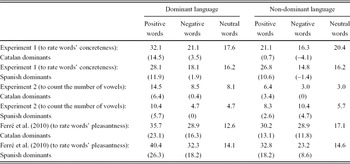
The percentages of remembered words are shown in Table 3. We performed the analyses by taking into account only the percentage of words recalled in the presented language. We did not consider words remembered in the wrong language, although we analyzed them separately.
Percentage of words remembered in Experiments 1 and 2 and in the study of Ferré et al. (Reference Ferré, García, Fraga, Sánchez-Casas and Molero2010) (and magnitudes of the effects in parentheses).

We performed an ANOVA with the percentage of remembered words. Language and Valence were two within-subjects factors and Dominance was a between-subjects factor. The only factor reaching statistical significance was Valence, F(2,174) = 20.57, p < .001, η2 p = .19. Post-hoc Bonferroni tests (p < .001) showed that participants remembered a higher percentage of positive words (M = 27.17) than either negative (M = 17.57) or neutral words (M = 17.61), although there was not any difference between the number of negative and neutral words remembered.
The ANOVA did not reveal any significant interaction between factors. Crucially, the interaction between Valence, Language and Dominance was not significant. This lack of interaction suggests that, in both groups of dominants, the emotional effect on memory is not language dependent.
Finally, we examined the pattern of incorrect recall by focusing on words remembered in the wrong language (translation equivalents). Only 22.5% of the participants remembered some translation equivalent. We conducted an ANOVA with the data from these participants. The analysis failed to show any effect of Language on the percentage of translation equivalents recalled (M = 4.7 and M = 3.1 for Catalan and Spanish, respectively). Conversely, the effect of Valence was significant, F(2,38) = 4.70, p < .05, η2p = .19. Post-hoc Bonferroni tests (p < .05) revealed that participants produced a higher percentage of positive words in the wrong language (M = 6.7) than that of negative words (M = 1.3), although there were no differences between neutral words (M = 3.7) and the other two types of words.
The present results show that bilinguals remember emotional words (especially positive ones) better than neutral words. This emotional effect on memory does not depend on language, as we found it in the dominant language as well as in the non-dominant one. In addition, we obtained the advantage in memory for emotional words with an encoding task not focused on emotionality. This finding is in line with evidence obtained in monolinguals with encoding tasks also focused on semantics (Luminet et al., Reference Luminet, Vermeulen, Demaret, Taylor and Bagby2006). However, to the extent to which emotional connotation can be a component of word meaning, making a decision about concreteness might involve, as well, the processing of emotional content. In order to demonstrate that the advantage for emotional words in memory in both languages is not a by-product of the encoding conditions, it would be more appropriate to use an encoding task not requiring access to meaning. In Experiment 2, we tested whether the affective properties of words in both languages affect memory when participants pay attention to formal properties of words during encoding.
Experiment 2
Method
Participants
Seventy-one Psychology undergraduate students (61 women and 10 men) from the University Rovira i Virgili (Tarragona, Spain), with ages ranging from 18 to 44 years (M = 20.3, SD = 4.1), participated in the experiment. They received a course credit for their participation. They completed the same questionnaire, and performed the same verbal fluency tasks, as participants from Experiment 1.
We divided participants according to their dominant language into two groups, as in Experiment 1. There were 39 Catalan dominants (34 women and 5 men, with ages ranging from 18 to 32 years, M = 19.3, SD = 2.6), and 32 Spanish dominants (27 women and 5 men, with ages ranging from 17 to 44 years, M = 21.5 and SD = 5.1). The characteristics of the bilinguals are presented in Table 1 above. They were very proficient in both languages although their ratings were slightly higher for their dominant language than for the other one. Catalan dominants rated themselves as more proficient in Catalan than in Spanish in listening, t(38) = 3.17, p < .005; reading, t(38) = 3.67, p < .005; speaking, t(38) = 4.05, p < .001; and writing, t(38) = 2.45, p < .05. In addition, they produced more Catalan words than Spanish words in both the phonological fluency task, t(38) = 3.36, p < .005, and the semantic fluency task, t(38) = 3.14, p < .005. Concerning Spanish dominants, they considered themselves as more proficient in Spanish than in Catalan in reading, t(31) = 3.48, p < .005; speaking, t(31) = 5.35, p < .001; and writing, t(31) = 4.02, p < .001. They also produced more Spanish words than Catalan words in the phonological fluency task, t(31) = 2.12, p < .05, as well as in the semantic fluency task, t(31) = 4.42, p < .001. Finally, the two groups of bilinguals were clearly different with respect to the frequency of use of their two languages, t(69) = 8.66, p < .001, as well as to which was their preferred language, t(69) = 7.96, p < .001.
Procedure
The procedure was very similar to that of Experiment 1. The only difference was the type of encoding task that participants had to perform. In this experiment, they had to count the number of vowels contained in each word (from 1 to 5). As in Experiment 1, they had to type the right number with the keyboard, and we encouraged them to answer quickly. The remaining experimental parameters were the same as in Experiment 1.
Results
Results are shown in Table 3 above. We performed an ANOVA with the percentage of remembered words. This analysis revealed a significant effect of Language, F(1,69) = 11.65, p < .005, η2p = .14. Pairwise comparisons showed that participants remembered a higher percentage of Catalan words (M = 9.38) than Spanish words (M = 5.24), t(70) = 3.55, p < .005. As the ANOVA also revealed a significant interaction between Language and Dominance, F(1,69) = 4.21, p < .05, η2p = .06, we analyzed the data of each group of bilinguals separately and observed that Catalan dominants remembered significantly more Catalan words (M = 10.39) than Spanish words (M = 4.13), t(38) = 4.25, p < .001. Conversely, there was no significant difference between the number of Catalan words (M = 8.16) and Spanish words (M = 6.59) remembered by Spanish dominants.
Concerning Valence, the ANOVA showed, once again, a significant effect of this factor, F(2,138) = 7.71, p < .005, η2p = .10. Bonferroni tests (p < .005) revealed that participants remembered a higher percentage of positive words (M = 9.92) than either negative words (M = 6.66) or neutral words (M = 5.38). Conversely, there was not any difference between the amount of negative words and neutral words recalled. Finally, as in Experiment 1, the global ANOVA failed to show any significant interaction between Valence, Language and Dominance. This lack of interaction suggests, once again, that the emotional effect on memory is not language dependent.
As in Experiment 1, we also analyzed the percentage of translation equivalents remembered. Only 15% of the participants produced some words in the wrong language during recall. The ANOVA conducted with data from these participants failed to show any significant effect of either Language or Valence. That is, the percentage of translation equivalents recalled was not different between Catalan (M = 2.5) and Spanish (M = 3.5). Furthermore, there were no differences between the percentage of positive (M = 5.3), negative (M = 3.0) and neutral (M = 0.8) words remembered in the wrong language.
The results of the present experiment clearly agree with those of Experiment 1, as bilinguals showed an emotional effect on memory that does not depend on language. That is to say, the pattern of emotional effects on memory is the same when participants pay attention to meaning during encoding as when they focus on structural or formal properties of words. Studies conducted with monolinguals have reported the same pattern of effects (Ferré, Reference Ferré2003; Luminet et al., Reference Luminet, Vermeulen, Demaret, Taylor and Bagby2006; Vermeulen & Luminet, Reference Vermeulen and Luminet2009). Furthermore, as in Experiment 1, only positive words show the emotional effect on memory. In order to obtain a broader view of the data, we compared the present results with those from our previous study in which the encoding task required participants to pay attention to the emotional properties of words (Ferré et al., Reference Ferré, García, Fraga, Sánchez-Casas and Molero2010).
Comparison of the results of the present experiments with the study of Ferré et al. (Reference Ferré, García, Fraga, Sánchez-Casas and Molero2010)
As mentioned in the introduction, an additional aim of the present study was to compare the present results with those from our previous study (Ferré et al., Reference Ferré, García, Fraga, Sánchez-Casas and Molero2010), in which we asked participants to focus on the emotional properties of words during encoding. We can make this comparison because the bilinguals’ population, the experimental materials, and the entire procedure (except for the nature of the encoding task), were the same.
The percentage of words recalled in our previous experiment is also presented in Table 3 above. We conducted an ANOVA with the data of the three experiments, introducing Encoding Task as an additional between-subjects factor. We obtained a significant effect of both Valence, F(2,458) = 71.82, p < .001, η2p = .24 and Encoding Task, F(2,229) = 121.79, p < .001, η2p = .51. Furthermore, there was a significant interaction of Language by Dominance, F(1,229) = 6.76, p < .05, η2p = .03. The interaction between Valence and Encoding task also reached statistical significance, F(4,458) = 15.68, p < .001, η2p = .12, so did the interaction between Language, Valence and Dominance, F(2,458) = 5.35, p < .01, η2p = .02.
Concerning the effect of the Encoding Task, Bonferroni tests (p < .001) showed that participants significantly remembered a higher percentage of words when they rated pleasantness at encoding (M = 25.92) than when they either rated concreteness (M = 20.78) or counted the number of vowels (M = 7.32). Moreover, the percentage of words recalled when the encoding task was to rate concreteness was higher than when participants had to count vowels. This effect of the encoding task is the well-known “level of processing” effect described by Craik and Lockhart (Reference Craik and Lockhart1972). It is worth noting here that, although both rating concreteness and pleasantness can be considered as deep encoding conditions (as both require access to meaning), the task of rating pleasantness produces a higher level of recall.
With respect to Valence, pairwise comparisons conducted with Bonferroni tests (p < .001) revealed that, overall, participants remembered a higher percentage of positive words (M = 23.95) than either negative (M = 17.54) or neutral words (M = 12.54). Furthermore, the percentage of negative words remembered was higher than neutral words. This result suggests that when we consider the data of the three experiments together, the emotional effect on memory also emerges with negative words, although its magnitude is lower than with positive words. This superiority for positive words, respective to negative words, is in accordance with a common pattern of results in monolingual studies (see Matt, Vázquez & Campbell, Reference Matt, Vázquez and Campbell1992, for a review). Moreover, we obtained a significant interaction between Valence and Encoding task because, in our previous experiment, both positive (M = 34.55) and negative words (M = 28.44) were better remembered than neutral words (M = 14.66, p < .01, Bonferroni tests). Conversely, in both Experiment 1 and 2, only positive words showed the emotional effect on memory. These results suggest that the effects of emotional content on word processing are more robust for positive words than for their negative counterparts.
Regarding Language, the ANOVA revealed two interactions which deserve further comment. The first one was the interaction of Language by Dominance. Catalan dominants remembered a higher percentage of Catalan words (M = 20.44) than Spanish words (M = 16.79), t(133) = 2.54, p < .05. Conversely, there was no significant difference between the percentage of Catalan (M = 17.16) and Spanish words (M = 19.37) remembered by the group of Spanish dominants. This difference in the pattern of results could be interpreted as suggesting that Catalan dominants are less balanced than Spanish dominants. However, neither the questionnaire data nor the results of the fluency tasks provide support to this.
The last relevant interaction was that of Language by Valence and Dominance. We conducted post-hoc Bonferroni comparisons for each group of participants and language. These analyses revealed that the group of Catalan dominants remembered more positive (M = 28.11) and negative words (M = 19.90) than neutral words (M = 13.31, p < .005) in their dominant language. Concerning Spanish words, they only exhibited the emotional effect on memory for positive words (M = 19.65, p < .01), whereas there were no differences between the percentage of negative (M = 16.42) and neutral (M = 14.30) words remembered. When we separately analyzed the group of Spanish dominants, we obtained a similar pattern of results. Pairwise tests conducted with words in their dominant language (Spanish) revealed a significant effect of emotionality for both positive (M = 26.73, p < .001) and negative words (M = 18.28, p < .01), when compared with neutral words (M = 11.88). With respect to their non-dominant language (Catalan), the emotionality effect was restricted to positive words (M = 22.94, p < .001), as there were no significant differences between the percentage of negative (M = 16.17) and neutral (M = 12.38) words recalled.
The results of this joint analysis clearly indicate that the emotional effect on memory in bilinguals does not depend on either the encoding task or language. The results also show that the only difference between languages refers to the pattern of emotional effects. If we focus on the dominant language, both positive and negative words show the advantage for emotional words in memory. Conversely, only positive words show the effect in the non-dominant language.
Discussion
The main aim of the present study was to test whether the processing of the emotional content of words in L2 has the same characteristics as in L1. We tested highly proficient bilinguals of Catalan and Spanish who live in an environment in which both languages are used, although they are dominant in one of them. We conducted two memory experiments and manipulated the encoding tasks by directing participants’ attention to either words’ meaning or their formal properties. We obtained an emotional effect on memory (that is, higher recall for emotional than for neutral words) with both encoding tasks. Most importantly, the effect did not depend on the language in which words were presented.
There are only two bilingual studies that have previously manipulated the encoding task in memory experiments (Anooshian & Hertel, Reference Anooshian and Hertel1994; Ayçiçegi-Dinn & Caldwell-Harris, Reference Ayçiçegi-Dinn and Caldwell-Harris2009). The results of the study conducted by Anooshian and Hertel (Reference Anooshian and Hertel1994) are not consistent with the present findings, as these authors failed to find an emotional effect on memory in L2. This discrepancy might be due to the bilinguals tested. On the one hand, whereas participants in the present study were early bilinguals exposed to both languages since an early age, Anooshian and Hertel's participants were late bilinguals. According to these authors, their participants might have associated their emotional experiences in their early childhood with their first language and, as a consequence, they would probably continue using this language in emotional situations as adults. On the other hand, our bilinguals were highly proficient in both languages. As Kroll and Stewart (Reference Kroll and Stewart1994) proposed and several studies have demonstrated (Ferré, Sánchez-Casas & Guasch, Reference Ferré, Sánchez-Casas and Guasch2006; Guasch, Sánchez-Casas, Ferré & García-Albea, Reference Guasch, Sánchez-Casas, Ferré and García-Albea2008; Talamas, Kroll & Dufour, Reference Talamas, Kroll and Dufour1999; Sunderman & Kroll, Reference Sunderman and Kroll2006), one of the most relevant variables modulating access to meaning from L2 words is proficiency. If we consider that affective information might be part of words’ meaning, it is reasonable to expect differences in the emotional processing of L2 words depending on proficiency. In fact, most previous studies reporting a similar affective processing in L1 and L2 tested proficient bilinguals. This is the case for behavioral studies, relying on different tasks and paradigms, such as the emotional Stroop (Eilola & Havelka, Reference Eilola and Havelka2011; Eilola et al., Reference Eilola, Havelka and Sharma2007; Sutton et al., Reference Sutton, Altarriba, Gianico and Basnight-Brown2007), the Affective Simon task (Altarriba & Basnight-Brown, Reference Altarriba and Basnight-Brown2011) lexical decision (Conrad et al., Reference Conrad, Recio and Jacobs2011), or memory tasks (Ayçiçegi-Dinn & Caldwell-Harris, Reference Ayçiçegi-Dinn and Caldwell-Harris2009; Ferré et al., Reference Ferré, García, Fraga, Sánchez-Casas and Molero2010). Moreover, the only electrophysiological evidence of a similar processing for L1 and L2 emotional words reported to date was obtained with proficient bilinguals as well (Conrad et al., Reference Conrad, Recio and Jacobs2011). On the contrary, participants in studies reporting differences between both languages in affective processing (e.g. Colbeck & Bowers, Reference Colbeck and Bowers2012; Segalowitz et al., Reference Segalowitz, Trofimovich, Gatbonton and Sokolovskaya2008) might not be as proficient in L2 as the previous ones.
Unfortunately, Anooshian and Hertel (Reference Anooshian and Hertel1994) did not describe in detail the level of proficiency of their bilinguals. The authors described them as fluent bilinguals, but they did not provide proficiency ratings, which would ease the comparison between their participants and those from other studies. Anooshian and Hertel (Reference Anooshian and Hertel1994) neither gave information about the speaking context of their bilinguals nor included data about the frequency of use of each of the two languages. However, as we know from other works, these may be relevant variables. For example, Degner et al. (Reference Degner, Doycheva and Wentura2012) demonstrated that the emotional content of words in a given language produces an affective priming effect only when participants frequently use this language. Similarly, participants in most studies reporting no differences in the processing of L1 and L2 emotional words used both languages to the same extent (Eilola & Havelka, Reference Eilola and Havelka2011), or even more the L2 than the L1 (Altarriba & Basnight-Brown, Reference Altarriba and Basnight-Brown2011; Sutton et al., Reference Sutton, Altarriba, Gianico and Basnight-Brown2007). Regarding our bilinguals, although they are very proficient in Catalan and Spanish, they use one language more frequently than the other, and also have a clear preference for it. We might have expected, therefore, to obtain differences in the processing of emotional words between the dominant and the non-dominant language. Nevertheless, we did not confirm this expectation. A possible reason might be that the difference in use between the two languages is not as noticeable in the participants of the present study as in the bilinguals tested by Degner et al. (Reference Degner, Doycheva and Wentura2012).
The other previous bilingual memory study involving a levels-of-processing manipulation is that of Ayçiçegi-Dinn and Caldwell-Harris (Reference Ayçiçegi-Dinn and Caldwell-Harris2009). According to these authors, the effect of the emotional content of words might be easier to obtain in the second language when participants live in an L2 speaking context. The present results support this proposal as people in Catalonia are regularly exposed to both Catalan and Spanish. In a similar way, in many studies reporting an effect of the emotional content of words not depending on language, bilinguals lived either in a context in which both languages are present (Altarriba & Basnight-Brown, Reference Altarriba and Basnight-Brown2011; Ferré et al., Reference Ferré, García, Fraga, Sánchez-Casas and Molero2010; Sutton et al., Reference Sutton, Altarriba, Gianico and Basnight-Brown2007), or in an L2-speaking context (Ayçiçegi & Harris, Reference Ayçiçegi and Harris2004; Conrad et al., Reference Conrad, Recio and Jacobs2011; Eilola & Havelka, Reference Eilola and Havelka2011). Conversely, most studies reporting differences between L1 and L2 were conducted in L1-speaking environments (e.g. Colbeck & Bowers, Reference Colbeck and Bowers2012; Degner et al., Reference Degner, Doycheva and Wentura2012). It is worth noting, however, that Ayçiçegi-Dinn and Caldwell-Harris (Reference Ayçiçegi-Dinn and Caldwell-Harris2009) obtained only partial support for their proposal. They tested bilinguals in their native country, immersed in an L1 speaking context, and the emotional effect on memory was restricted to L1 only when the encoding task focused on emotionality. In the other tasks, the magnitude of the effect in L2 words was the same (or even stronger) as in L1 words.
Ayçiçegi-Dinn and Caldwell-Harris (Reference Ayçiçegi-Dinn and Caldwell-Harris2009) concluded that the differences between languages in the emotional effect on memory are dependent on the task. However, as stated in the introduction, this study has some methodological limitations that make it difficult to establish clear conclusions about the role of the encoding task on emotion-memory effects. A strength of the present study is that we tried to overcome these limitations by selecting words from normative databases, by controlling variables affecting word processing, and by presenting words blocked by language. Therefore, we have firmly demonstrated with our study that the emotional effect on memory is observed across tasks. This suggests that it is a general phenomenon. The results of Experiment 1, in which participants rated concreteness at encoding, are consistent with findings reported in the monolingual domain. For example, Kensinger and Corkin (Reference Kensinger and Corkin2003) obtained the emotional effect on memory with the same encoding task. Likewise, Luminet et al. (Reference Luminet, Vermeulen, Demaret, Taylor and Bagby2006) found the emotional effect when the encoding task was to indicate whether a given definition for a word was correct or incorrect.
It could be argued, however, that we cannot be sure that those decisions based on meaning of words do not involve, as well, the processing of their emotional content. In this way, it would be more appropriate to use encoding tasks not focused on meaning in order to obtain reliable conclusions about affective word processing, as we have done in Experiment 2. The results of this experiment clearly demonstrate that the advantage for emotional words in memory in the two languages of a bilingual is not a by-product of the encoding conditions, as participants focused on formal (shallow) properties of words. These results are also in line with previous evidence obtained in monolinguals with the same encoding task used in the present study (Ferré, Reference Ferré2003), as well as with other shallow tasks, for example, deciding whether words were written in a small or a large font (Luminet et al., Reference Luminet, Vermeulen, Demaret, Taylor and Bagby2006), deciding whether the letters contained in words followed a given pattern of vowels and consonants (Vermeulen & Luminet, Reference Vermeulen and Luminet2009), or deciding which one of the two words in a pair was longer (Ramponi, Handlesman & Barnard, Reference Ramponi, Handlesman and Barnard2010).
Given the above considerations, the results of the present experiments constitute firm evidence that processing of L2 emotional words has the same characteristics in highly proficient bilinguals as in monolinguals. In order to obtain a clearer picture of the effect of the encoding task, we analyzed the present results together with those of our previous study (Ferré et al., Reference Ferré, García, Fraga, Sánchez-Casas and Molero2010), in which we asked participants to pay attention to the emotional features of words during encoding. We obtained the expected levels-of-processing effect (Craik & Lockhart, Reference Craik and Lockhart1972). That is to say, participants remembered a higher percentage of words when they performed a deep task during encoding than when they performed a shallow task. It is worth noting that there were also differences between the two deep tasks: rating pleasantness produced a higher advantage in recall than rating concreteness. This superiority suggests that the feature participants pay attention to during deep encoding tasks can modulate the effects obtained in memory. Studies conducted in the monolingual domain have reached similar conclusions (e.g., Greenberg, Tokarev & Estes, Reference Greenberg, Tokarev and Estes2012; Nairne, Thomson & Pandeirada, Reference Nairne, Thompson and Pandeirada2007).
An additional finding deserving further comment refers to the words’ valence. Positive words showed a higher recall than neutral words across tasks and languages. However, the advantage in memory for negative words was more restricted. In fact, as in some monolingual studies (Ferré, Reference Ferré2003), we obtained a significant interaction between valence and encoding task. This interaction reveals that the emotional effect on memory for negative words only appeared when participants focused on emotionality at encoding. Even in this case the effect was smaller than for positive words. Furthermore, the results of Ayçiçegi-Dinn and Caldwell-Harris (Reference Ayçiçegi-Dinn and Caldwell-Harris2009) were in the same line as ours, as they failed to obtain the emotional effect on memory for negative words. This superiority in recall for positive words is also a common pattern in monolingual studies (Ferré, Reference Ferré2003; Fraga et al., Reference Fraga, Redondo, Piñeiro, Padrón, Fernández-Rey and Alcaraz2011; Kensinger, Reference Kensinger2008; Luminet et al., Reference Luminet, Vermeulen, Demaret, Taylor and Bagby2006; Majerus & D'Argembeau, Reference Majerus and D'Argembeau2011; Phelps, LaBar & Spencer, Reference Phelps, LaBar and Spencer1997, but see, for example, Mathews & Barch, Reference Mathews and Barch2006, for discrepant results). Some explanations have been proposed for this advantage. For example, Matt et al. (Reference Matt, Vázquez and Campbell1992) attributed this positive recall bias to a mood congruency effect. As an alternative, Ayçiçegi-Dinn and Caldwell-Harris (Reference Ayçiçegi-Dinn and Caldwell-Harris2009) suggested that this superiority for positive words might be related to their age of acquisition being earlier than for negative words. Whichever is the cause of the difference between positive and negative words, it does not seem to be restricted to memory experiments, as studies conducted with other tasks, such as lexical decision, show a similar pattern of results (e.g. Estes & Adelman, Reference Estes and Adelman2008; Estes & Verges, Reference Estes and Verges2008; but see also Kousta, Vinson & Vigliocco, Reference Kousta, Vinson and Vigliocco2009, for discrepant findings).
Concerning valence, there is also a striking finding in both Catalan and Spanish dominants. If we consider the results of the three experiments together, both positive and negative words in the dominant language produce the emotional effect on memory. Conversely, only positive words exhibit it in the non-dominant language. These results suggest that the stronger and most commonly reported effect of emotionality in memory (i.e., the superiority in recall for positive words) is observed regardless of the language in which words appear. However, the weaker or less frequently reported emotional effect on memory (i.e. the superiority in recall for negative words) is only obtained in the most dominant language. Conrad et al. (Reference Conrad, Recio and Jacobs2011) recently reported results pointing in the same direction. These authors provided both behavioral and electrophysiological evidence of similar effects on processing for positive and negative words in L1. In contrast, in the second language, the effects were stronger for positive words than for their negative counterparts.
In summary, we can conclude that highly proficient bilinguals show the emotional effect on memory to the same extent in both languages and across tasks. These findings suggest that, at least with this population and experimental tasks, there are no differences between both languages in the processing of affective properties of words. Further research has to be conducted with the same type of bilinguals to test whether this conclusion can be extended to other experimental paradigms, and to explore the causes of the differential effect of positive and negative words.
Appendix. Experimental stimuli in Spanish and their Catalan and English equivalents. Affective characteristics of the Spanish words