During the early 1980s, a new group adopting the name Hizbullah, or Party of God, slowly became the most effective organization in Lebanon at conducting military operations against the Israeli army, which had occupied parts of southern Lebanon. Among these operations, an outburst of suicide attacks caught the majority of media and scholarly attention at the time. The earliest writings on the subject—many by security-focused political scientists who drew much of their source material from Israeli intelligence—argued that this new “Islamic” form of militancy, termed “jihadism” or simply “terrorism,” projected a “culture of martyrdom” that distinguished it from other “secular” resistance formations centered around “self-sacrificial” acts.Footnote 1 Yet Hizbullah was neither the first nor the last militant organization to relate to its dead in ways that were instrumental to its overall political practices.Footnote 2 Moreover, what distinguished the group was not its particular instrumentalization of some vague or essentialist concept of “jihad,”Footnote 3 but rather the cultural practices that emerged out of its suicide operations, and its military actions in general, against the Israeli occupier. In this article, I am interested in how Hizbullah's ritualistic practices of remembering its dead—martyrology—produced a repertoire or, in the memorable words of Ann Swidler, a “tool-kit for action.”Footnote 4
Much of the literature on Hizbullah has focused on capturing the ideology that is thought to drive its political practices.Footnote 5 However, social and textual rituals of commemoration are so crucial to Hizbullah's modus operandi that one could argue that the party's effectiveness at making sense of its environment and producing political action derives less from a complex, theoretically informed ideology than from its meticulous use of the past. This is not to suggest that Hizbullah has no political aims or that it does not frame these objectives in terms of certain ideological premises. Various political documents produced by the party—including the Open Letter of 1985, which declares Hizbullah's alignment with the supreme leader of Iran Ruhollah Khomeini, expresses a binary, oppressor versus oppressed worldview (also common in leftist ideologies), and calls for the demise of the Lebanese confessional political system and the creation of an Islamic state—show the opposite to be the case. Rather, it is to suggest that these aims, vague and empty of practical content, have acted more like slogans than like ideological premises. When it comes to explaining its raison d'être, or to differentiating itself from other political organizations through a core essence, Hizbullah's brandishing of an Islamic (or even national) signifier has involved in practice the relentless visiting and actualizing of the past, one facet of which is martyrology.Footnote 6
Central to Hizbullah's methodical use of the past, and thus its effectiveness at producing ideological coherence, is an elaborate history-writing effort.Footnote 7 The actions of Hizbullah's military wing, the Islamic Resistance, which is the party's foundational component,Footnote 8 are given meaning with reference to the notion of the resistance project (mashrūʿ al-muqāwama) against the Israeli occupier—a notion that is itself substantiated and given presence through the recalling of martyrs in a specific and periodic way. In these multifaceted ritualistic practices, Hizbullah-affiliated intellectuals have archived anything related to martyrs and other human legacies (i.e., the life and deeds of religious and political figures), a process that has fed into an ever-present, and at times anticipated—since involving a promise and thus an expectation for the future—era of the resistance (al-muqāwama).
On a broad level, this article seeks to contribute to our understanding of political Islam by shedding light on its infinitely complex and contextual facets across time and space. I look at the attempts of writers, orators, and other producers of cultural material, all associated with a political party and the institutional structure it deploys, to pin down the “Islamic” signifier through a particular use of the past. Moreover, through the case of Hizbullah, I show how the ideological production of Islamic political movements in the age of modern states and nationalism—to which political Islam is inextricably linked—can involve the deployment of nondiscursive imaginaries. One way that Hizbullah achieved ideological coherence conducive to political action was to develop a “martyrology” that deployed specific notions of time and space deemed essential to the transmission of an ethical line of conduct, or practices of virtuous selves. There is insufficient space to fully cover this subject here, but I hope my reflections offer new insights into the study of ideology production among “Islamic” parties and organizations that is conducive to political action.
Scholarly literature on ideology has largely discussed it as an expression of theories and belief systems that explain aspects of political behavior.Footnote 9 Even when analyses of the construction of ideology take seriously history or representations of the past, they still understand them as forms of hermeneutics that serve theory,Footnote 10 perhaps because studies of ideology focused particularly on history or memory have been concerned mostly with hermeneutics.Footnote 11 In the present study, I propose enlarging our understanding of ideology by recognizing the importance of a specific use of the past in producing ideological coherence. This is to suggest that the past is not merely interpreted through particular belief systems and theories, but rather is “lived” in a specific way, transforming conceptions of time and informing actions. Underlying this article is the premise that texts and interpretations reflect more than just one's beliefs or discursive theoretical approach; they are also traces of human emotions and sensibilities.Footnote 12
To explain this phenomenon, this article examines material from Hizbullah's main weekly newspaper al-ʿAhd, which has been published without interruption since 1984.Footnote 13Al-ʿAhd furnishes some of the earliest written traces from Hizbullah at our disposal, including editorials and columns written by future senior Hizbullah officials when the organization was still in formation. Al-ʿAhd's developing group of writers became active participants, alongside other institutions affiliated with Hizbullah such as Jihad al-Bina and Muʾassasat al-Shahid (Martyr's Association), in producing a vast amount of information on occupied and nonoccupied areas of Lebanon. As a textual repository, al-ʿAhd contains a rich collection of party declarations, clerical sermons, realpolitik editorials, inflammatory pamphlets and opinions, and political, social, and religious studies.
Al-ʿAhd's cultural production from the 1980s and most of the 1990s served as a template for Hizbullah's future ideological formulations. It contains the first interviews with the families of martyrs and martyr testaments—as well as other information on martyrs—which later became the main material disseminated by Radio al-Nour and al-Manar Television, two media outlets related to or affiliated with Hizbullah. Moreover, many of the newspaper's early contributors later came into senior roles within Hizbullah and Lebanese public institutions. For example, from its first issue, al-ʿAhd's editor-in-chief was Muhammad Raʿd, currently the leader of Hizbullah's parliamentary coalition (Loyalty to the Resistance Bloc) and a member of the party's executive committee.Footnote 14 Thus, early ideological constructions served as templates and fed into later constructions, witnessed by Hizbullah's growing institutionalization of media production and the increasingly important speeches of the party's secretary general Hassan Nasrallah. This process points to the referential character of texts, or their ability to “build” on each other over time, illustrating the importance of their form (as opposed to their content only). This brings me to my central argument: the ideological constructions of Hizbullah are but a writing process that reflects an ongoing archival relationship with a representation of the past. The “politics of remembrance,” specifically when involving recollections of martyrs, can create ideological and political coherence by witnessing a human legacy that inhabits the present and informs actions unfolding within it.
In this sense, anyone whose writing has appeared in al-ʿAhd, especially in the early period, whether a party member, a journalist, an academic, or a cleric, is someone I propose to call a “Hizbullah-related intellectual.” More specifically, a Hizbullah-related intellectual is one who, consciously or not, through the use of either texts or media, partakes in the act of transmitting ideology-as-template. When ideology is understood to involve mostly history writing rather than just theory, a text's content in and of itself is no longer the most important element for understanding political practice. What matters is how texts succeed each other, and more particularly, how they serve as templates for future texts.
The argument that Hizbullah-affiliated intellectuals produce writings on the past rather than formal theory contrasts with most previous studies on Hizbullah, which, even when they draw diametrically opposite conclusions about the organization, agree that it has a clear, theoretically informed, even totalizing ideology and political agenda.Footnote 15 Understanding ideology as a template involves moving beyond the construction of discourse to the question of how discourse acts as a trace for different phenomena, such as piety, ethics, and other embodied practices and dispositions. In the case of Hizbullah, it involves understanding calls for an Islamic state, for example, as part of a nondiscursive urge for political justice or representation achieved through the addressing of perceived grievances. Hizbullah was not merely an Iranian satellite and did not drastically “shift” in “identity”; rather, it is a product of its political environment, and in this sense it has always been Lebanese.
BETWEEN IDEOLOGY AND NATIONAL IMAGINARIES: CONCEPTIONS OF TIME
It is beyond the scope of this paper to engage in a definitional analysis of the highly contested concept of ideology.Footnote 16 But one often-overlooked aspect of ideological constructions is their connection to feelings and imaginaries of communal belonging, which in the case of Hizbullah are a prerequisite to the “coherence” required for members to make sense of the group's political action.Footnote 17 In the next two sections, I propose an explanation for how different kinds of martyrology have provided ideological coherence to Hizbullah's political actions. In the age of the modern state, this process of imagining the community through remembering its dead in a ritualized manner involves producing, interacting with, and espousing national imaginings.
Since Benedict Anderson's seminal work on nationalism, the study of the construction of national and other imaginaries has involved analyzing, amongst other things, conceptions of time.Footnote 18 The invention of print paper and press technology in the modern period enabled people to experience a feeling of simultaneity that facilitated the emergence of a horizontal sense of time, which is at the heart of not only national but also secular sensibilities, as Charles Taylor has argued.Footnote 19 Anderson and Taylor seem to agree that, in contrast with this nationalism/secularism nexus, “premodern” understandings of time centered on religious narratives were cyclical or vertical because they involved an origin or an actor who initiates the time continuum.Footnote 20
In her study on Hizbullah activists' development of ʿAshuraʾ ritual narratives, Lara Deeb argues that such a cyclical-linear time binary does not account for the more complex processes of imagining community that activists deploy. These processes involve not a “return to the past” but rather a “progressive” understanding of time in which the future might be better.Footnote 21 Anderson's “modern-national-empty versus religious-messianic (and, by extension, nonmodern) schema” does not leave space for what the partisans from Hizbullah whom Deeb interviewed elaborate through their practices of piety.Footnote 22 Deeb's argument resonates with ongoing discussions on the alleged difference between nationalist and religious imaginaries understood in terms of the difference between secular and nonsecular understandings of time; it is this latter division that I wish to transcend in this article. Talal Asad argues that nationalism, especially coupled with the modern state, “requires the concept of the secular to make sense,” as the nation is said to be “in this world” even though sometimes “under God.”Footnote 23 Discussing the Arab world in particular, Asad claims that “while the ‘Arab nation’ is inconceivable without its history, the Islamic umma [community] presupposes only the Qurʾan and sunna.”Footnote 24 Yet Islamic traditions have deployed a highly complex sense of history (as opposed to relying only on the Qurʾan and sunna) in order to legitimize different Islamic sects, schools, or trends of thought. Most importantly for political Islam, the use of history, of a particular human legacy remembered through endlessly recounted stories, is both highly contextual and highly important in envisioning social causes. Political Islamic groups use modern technological media (which also constrain them) in order to produce ritualized acts of remembrance that are conducive to political action.
In the Lebanese context, there is an ongoing negotiation between the state and Lebanon's various communities over the articulation of a legitimate national narrative, as each community has its own understandings of history.Footnote 25 In other words, at play here, to draw on Sune Haugbolle, is “Public memory” and “Private memory,” or “state-sanctioned memory” and “local memory.”Footnote 26 However, in the case of Hizbullah, its local, confessional memory has slowly become one of the dominant narratives in part due to the increasingly important role the party has played in state institutions. Through its slogans, Hizbullah aimed to redefine the historical markers of the Shiʿi community, but it ultimately rewrote imaginaries of the nation as well. Drawing on the highly polyvalent notion of the resistance project (mashrūʿ al-muqāwama), or resistance community (mujtamaʿ al-muqāwama), the organization successfully developed different imaginings of community that it has invited all other Lebanese communities to embrace.
For Shiʿi political movements, the ʿAshuraʾ ritual, which recalls the killing of Husayn (son of ʿAli and grandson of the Prophet) in the battle of Karbala, could be considered the paradigmatic act of remembrance that feeds into writings of history. As Michael Fischer has argued, Karbala “provides a model for living and a mnemonic for thinking about how to live.”Footnote 27 The act of transmitting a particular quality of life from one generation to another is what ties the community together, indeed what makes the community possible.
Strikingly, however, none of the detailed narratives of the “Karbala paradigm” developed by Iranian cultural institutions and agents (mostly clerics) and described by Fischer, especially those related to history and Sunni understandings of the Islamic past, are even mentioned in the early issues of al-ʿAhd.Footnote 28 It is not that the battle of Karbala has no symbolic value in the cultural productions of Hizbullah-affiliated intellectuals—far from it. Rather, these intellectuals' understandings of this event, other historical events, and the present are informed by different strategies, shaped in part by their particular institutional and political setting, from those resonant in Iran. Contrary to their Iranian counterparts, the writings of Hizbullah-related intellectuals are relatively basic, focused as they are on the idea of resistance against Israel and the occupation, or a related local injustice. Similarly, although the madrasaFootnote 29 (or in the Lebanese case, the hawza) has served as an important site of Shiʿi political mobilization in Iran, Hizbullah's development and success has relied more upon a series of ritualistic practices specific to Lebanon and especially its experience of occupation.Footnote 30 For understanding how Hizbullah builds ideological coherence, it is necessary to turn our gaze away from ʿAshuraʾ and toward the multitude of other commemorative events—mostly for martyrs who died in battle—that came to break up calendrical time.Footnote 31
Indeed, periodicity is another important aspect of ritualistic acts of remembrance. Hizbullah's martyr commemorations gradually came to occupy every day of the calendar year. Each martyr or group of martyrs was remembered a first time following the act of martyrdom, a second time after one week, a third time after forty days, and then again after one year.Footnote 32 Acts of remembrance eventually came to be repeated annually. As Hizbullah's military operations against the Israeli army increased and casualties were incurred, commemorations quickly began to crowd the calendar space. If on one day Hizbullah commemorated the funeral of a shahīd, by the next day it would already be commemorating the “week” of another martyr or group of martyrs. Several days later the militant group might be commemorating the passing of the “fortieth” (ʿArbaʿin al-Shahid) day since the death of yet another martyr or group of martyrs. Seen in the light of this myriad of commemorations, the often-repeated slogan, “every day is ʿAshuraʾ, every day is Karbala,” makes a good deal of sense. As the years passed and acts of martyrdom multiplied, the periodical and very real commemoration of martyrs slowly paved the way to fix the dates of two major annual commemorations—Shuhadaʾ wa-Qadat al-Muqawama (Martyrs and Leaders of the Resistance), which eventually became Yawm al-Shahid (Day of the Martyr), and Usbuʿ al-Muqawama (Week of the Resistance)—both of which, as I shall explain shortly, are linked to the legacy of the resistance. For now it is important to emphasize the point that the commemoration of martyrs benefitted the resistance by enabling the elaboration of communal or national imaginaries conducive to political action.
THE MARTYR AS WITNESS IN THE TEXT, THE PROMISE AS ERA
If martyrology, through its periodicity and breakup of the calendar year, produces particular imaginings of community, martyrs testify to a particular ethical practice that can only be understood because the martyr is never present in one time dimension—whether past, present, or future—but rather exists between dimensions.
In a very early issue of al-ʿAhd, an anonymous writer laid out his take on the notion of the shahīd and shahāda (martyrdom) in general by tapping into the meaning of the root verb shahada (to testify) and its various nominal derivations.Footnote 33 The author proposed the following revealing definition of the shahīd by connecting it to the meaning of the noun shāhid (witness): “the shāhid is one who looks at and understands his situation, and copes with it or acts upon it. . . . And the shahīd in Islamic thought is the believer who looks at his situation and his society and the realities of its scriptures, and acts upon it . . . even if this involves dying.”Footnote 34 This etymological exercise emphasizes the notion that the shahīd is a witness to a line of conduct that is determined by his social and political context. He testifies to a cause by experiencing a reality that remains abstract when encountered only in writing, and in so doing he embodies it or gives it “presence.”
But how can this experience of the martyr who “looks at and understands his situation” be communicated and transmitted? How can this line of conduct be remembered and rendered traceable? This challenge is shared by all intellectuals or political actors who create understandings, dispositions, and sensibilities framed through the “Islamic” signifier. Indeed, as the Islamic is written down, traced, and differentiated, its “presence” or fixed meaning can only be established through the coming and going of the martyr and his experience of the past, or, more accurately, his experience of the different time dimensions in which he seems to belong.
Interesting parallels can be drawn between the articulation of the martyr—the one who witnesses—in the Lebanese and Iranian cases. In her study on the Iranian culture of martyrdom, Shahla Talebi argues that shahādat, or witnessing, can be “imagined as a gift: an exchange of life and death for the sake of life and justice.”Footnote 35 This Maussian understanding cannot be more accurate, for it places acts of martyrdom at the center of communal continuity.Footnote 36 If gift exchanges happen over successive generations and involve remembering a human legacy, in what ways do they signal a process of knowledge transmission? Drawing on the discussion of witnessing by Ali Shariʿati—a prominent Iranian sociologist and one of the ideological precursors to the Islamic Revolution—Talebi emphasizes that “the shahīd continues to live on, not in body but. . .as a thought.”Footnote 37 But what is it that is “thought” when the shahīd is invoked?
In his book on martyrdom in Islamic traditions, David Cook acknowledges that the martyr acts as a witness, but he argues that the martyr “must have belief in one belief system and possess a willingness to defy another belief system.”Footnote 38 While it is true that the martyr differentiates himself through the act of witnessing, narrowing this latter idea down to belief is overly simplistic. If the word used in religious traditions such as Christianity, Judaism, and Islam is the equivalent of the English word “faith,” this cannot be equated with the narrower (and more discursive in content) notion of “belief.”Footnote 39 More important than the idea that the martyr leaves is the trace, which can be used by social actors in a myriad of ways. Revealingly, articles and other cultural productions on martyrs published in al-ʿAhd seldom discuss belief systems or doctrinal positions. Rather, they focus largely on story-telling, on describing ways of living that transmit a line of conduct espoused by a martyr. Storytelling offers the martyr the possibility “to witness.” As a medium through which ethics can be understood and embodied, it is an efficient substitute for theoretical articulations of ethics. On the rare occasions when Hizbullah-affiliated intellectuals have tried to explain their doctrinal positions in al-ʿAhd, they have tended to stop short of a full explanation and to revert to the power of the witness as a self-explanatory trace. In brief, to the question “who are you?,” a Hizbullah-affiliated intellectual or official would answer, “this is what we did”—this is the resistance project.
Jacques Derrida has elaborated the link between witnessing and the transmission of ethics through his notions of specter and debt. Derrida argues that one can learn ethics only from the “other” and “death” because this transmition of knowledge occurs through time, involving as it does a constant “hanging” of the specter—in our case, the martyr—in time.Footnote 40 The specter is able to transmit ethical lines of conduct insofar as he exists between timeframes. Because he haunts the present without really being present, the specter initiates a “politics of memory, of heritage and generations.”Footnote 41 For Derrida, however, the specter's ability to produce feelings of responsibility toward the other is what builds the possibility of a present or, to draw on Anderson, a feeling of simultaneity. The very possibility of ethics and a notion of justice depends on acts of remembering, which are also the basis for ideological coherence and continuity.
The martyr witnesses because he “exists” between timeframes, and in so doing produces imaginaries of community conducive to political action. Hizbullah-related intellectuals emphasize the concept of al-ʿahd (the promise) as the act that ties together different time dimensions, linking people to martyrs and martyrs to God or the Islamic tradition. After the martyr promises, or swears (ʿala al-ʿahd), to fulfill an oath, different social actors, such as militants, or the community at large, promise to honor that martyr's line of conduct, which becomes a tradition of practice.Footnote 42 Through the repeated honoring of promises over generations, the conduct is both re-enacted and reinterpreted. And because the notion of al-ʿahd appears several times in the Qurʾan, the paradigmatic referential text,Footnote 43 it is no coincidence that on the front page of each issue of al-ʿAhd, next to a picture of Khomeini, there appears a Qurʾanic sura that states: innā al-ʿahda kāna musʾūlan (the promise was responsible).
Al-ʿahd is the commitment to a line of conduct that has been preserved by a human legacy though the act of witnessing. Key to understanding the Islamic Resistance's fight against Israeli occupation is its attempt to control time dimensions. The ideological translation of the act of resistance is a promise that enables traceable, ethical lines of conduct in time, and that is reiterated in textual form. For this reason, the discursive component of texts is less important than the phenomena that it triggers (such as ethical practices). Witnessing plays a necessary role in bridging the epistemological gap left by intellectual transmission.
THE FIRST TEXTS IN AL-ʿAHD COMMEMORATING MARTYRS
One of al-ʿAhd's first texts on martyrs who died conducting operations against Israel paraphrases a famous statement made by Imam al-Sajjad, an important Shiʿi figure of the 1rst century hijra (7th to 8th century ce).Footnote 44 The text reads: “The two happy martyrs, Ahmad Khalifa and Nasir Mansur, two stars (kawkabayn) joining the convoy of martyrs (qāfilat al-shuhadāʾ), [were] convinced that killing/death (al-qatl) is a habit to them, and their dignity (karāma) from God is a testimony (shahāda), striving for liberty for the Islamic umma by participating in the destruction of Zionist tyranny (jabarūt).” Imam al-Sajjad's original statement was directed toward Ibn Ziyad, the Umayyad governor of Basra towards the end of the 7th century. It reads: “Do you threaten me with death, Oh son of Ziyad? Death is a habit to us, and our dignity deriving from God is a testimony of it.”Footnote 45 Noteworthy here is that the dignity to which ʿAli, son of Husayn, testifies is a line of conduct, an ethical disposition, and not merely a discursive belief in a cause. This sentence is constantly repeated by Hizbullah Secretary General Hassan Nasrallah in his speeches and is often used in the testaments of martyred fighters.
Articles on fighters from the Islamic Resistance who died in combat against the Israeli army are all titled “Sirat al-Muqawama, Dhakirat al-Shuhadaʾ,” meaning literally “The Legacy of the Resistance, the Memory of the Martyrs.” The meaning of the Arabic word sīra encompasses the sense of a line of conduct, or an ethical act. These articles compile stories that consist mostly of interviews with the families of martyrs.Footnote 46
The second article on martyrs published in al-ʿAhd, embedded in what was a new section on martyr biographies and remembering, discusses the fighter Rida al-Shaʿir. Nicknamed “the martyr of Western Bekaaʾ,” al-Shaʿir testified to the conditions under which fighters were trained and prepared to confront the enemy.Footnote 47 The article's subtitle reads: “Hamzat al-Bekaa, he took mountains as a home. His wife: he used to eat wild plants during days of confrontations.” The article itself consists mainly of the testimony of al-Shaʿir's wife, identified as Umm Muhammad (Mother of Muhammad), who suggests that al-Shaʿir provided his children “a conscious Islamic education” and played an important organizational role in the resistance. Through a description of the attitude of resistance held by al-Shaʿir and the rest of the family, she also conveys the community's difficult experiences confronting the occupying army. This family testimony and others like it in al-ʿAhd highlight the resistance as a project of being-in-action. Beliefs are seldom discussed, and when they are invoked they appear only as nominal slogans.
Published several months after the article on al-Shaʿir, the martyr biography of Ahmad Talib, also from Western Bekaa (most of the early fighters were from this region, which falls outside of the areas once occupied by Israel), sheds more light on the act of witnessing. The subtitle reads: “The day of his martyrdom he saw himself sleeping above the arms of Imam Husayn. His wife: before he left he said ‘be patient, as I am certain of my shahāda [here meaning ‘testimony’].'”Footnote 48 The article details Talib's courage through his lived experiences as a Hizbullah fighter. We read that Talib fought the cold of winter as his group prepared for battle; he insisted on leading the group into battle as he screamed “Oh Husayn”; he met his death as he threw a grenade into an outpost of the Lebanese proxy army of Israel, causing heavy damages and casualtiesFootnote 49; and, echoing the notion of haunting, “with all this, Ahmad Talib did not leave [this world]; his ghost is still chasing after the collaborators in Lusy and Sarira, and on the Dalafeh bridge, forbidding them from returning a second time (emphasis added).”Footnote 50
TYPES AND TIMES OF MOURNING THE MARTYR: MARKERS OF THE HISTORY OF RESISTANCE
Hizbullah identifies several types of martyrs classified according to the way they died. There are those who died in combat, those who died during military clashes, and those who purposefully took their own lives in order to cause damage to Israeli military property or take the lives of Israeli military personnel. Martyrs in the latter category are called istishhādiyyūn, a word deriving from the root verb shahāda, which in the age of the nation-state came to mean, “died for this or that cause.” Whereas the concept of the shahīd goes back to ʿAli bin Abi Talib's death, and in Islamic jurisprudence meant “died while fighting in the cause of God,” the concept istishhādī as used in the modern period is a complete innovation. Classically it meant “requiring someone to give evidence as in a court of law”Footnote 51—thus, similar to other words we have encountered, it carries the connotation of testifying as action.
As suicide attacks had no jurisprudential precedence in Islamic legal theory, Hizbullah-related intellectuals created new referral strategies in order to propose new readings in regard to different social realities. For example, the vice secretary general of Hizbullah, Naʿim Qassim, attempted to provide a general rationale for istishhādī operations by linking them to one sura from the Qurʾan.Footnote 52 This sura states:
Indeed God has purchased from the believers their lives and their possessions, that they expend it in obedience to Him—for example by striving in His way—so that theirs will be [the reward of] Paradise: they shall fight in the way of God and they shall kill and be killedFootnote 53; that is a promise which is binding upon Him in the Torah and the Gospel and the Qurʾan; and who fulfills his covenant (ʿahd) better than God? That is, no one is better in fulfilling it.Footnote 54
Through this verse, Qassim emphasizes that the act of testifying (shahāda) is dependent upon the notion of a contract, or covenant (ʿahd), this time between God (through the tradition of the written texts) and the believer. The believer is the social actor who becomes committed to a line of conduct that only materializes over a period of time. The promise binding the person to the group or community is also the base of its continuity. Messianic time, or time involving a promise that a line of conduct will be respected in the future, gains significance through the writings of intellectuals about the one who testifies—the shahīd.
In Lebanon, Hizbullah was not the first group to organize what have been called “suicide attacks.” The first istishhādī operation on Lebanese soil was carried out by the Iraqi al-Daʿwa party in mid-December 1981 and targeted the Iraqi embassy in Beirut. But it was not only “religious” actors who conducted such operations. “Secular” political actors such as Amal, the Syrian Socialist Nationalist Party, and the Communist Party have also conducted highly successful suicide operations that, similar to those by Hizbullah, were used to claim political legitimacy likely because of their earlier presence and thus older social ties in southern Lebanon.Footnote 55 These militant practices may have created a climate of competition or at least put new emphasis on the importance of claiming and articulating a human legacy in order to assert difference from other groups. Hizbullah, for example, has claimed to be the first militant organization to plan and execute a suicide attack targeting solely the Israeli military.Footnote 56
Yet this strategy of legitimization also involved each group delineating a distinct ethical practice. The first article to do this in al-ʿAhd was written in 1985 by Muhammad Raʿad for his column Taht al-Majhar (Under the Magnifying Glass). Reflecting on a flurry of istishhādī operations, Raʿad argued for a reconsideration of their overall purpose and effectiveness in inflicting military losses.Footnote 57 He reminded his readers that istishhādī operations are not simply a “sacrifice” but also a witnessing of a “way of doing,” by which he meant fighting for the cause with impeccable ethics. For Raʿad, a fighter should be a mujāhid, someone who strives towards excellence or perfection of being-in-action.
The first istishhādī to be claimed and remembered by Hizbullah was Ahmad Qasir. On 11 November 1982, the nineteen-year-old Qasir drove a white Mercedes packed with explosives into Israeli military headquarters in Tyre. The blast killed 141 soldiers. Qasir's identity was only revealed two and a half years after the operation.Footnote 58 In order to account for this delay, official Hizbullah statements later invoked security: Qasir had asked the party to respect the safety of his family, which lived in Israeli-occupied territory. Hizbullah only began claiming istishhādī martyrs in 1988 for the simple reason that the group did not carry out any suicide operations during the prior three years. By 1988, this slowly growing organization had developed media devices such as al-ʿAhd, as well as related cultural efforts, that made it possible to turn the claiming of such acts into successful media events.Footnote 59
In the official narrative of Hizbullah, Qasir “opens the era of the istishhādiyyīn” (fātiḥ ʿahd al-istishhādiyyīn). Notice that “era” is another translation of the Arabic word ʿahd. Hizbullah istishhādī operations and any other form of shahāda “opens” the proper history of Islamic Resistance, the resistance as a project, differentiating it through this event from other forms of militant action. Another such event was the assassination of Shaykh Raghib Harb, one of the precursors to resistance against the Israeli army. On 16 February 1984, Lebanese collaborators with Israel shot and killed Harb with a Kalashnikov. As the story goes, he had been returning home after praying the ʿishaʾ prayer when assailants attacked him in his home village of Jebsheet.Footnote 60 Harb was initially mentioned in al-ʿAhd in its very first issue of 28 June 1984, several months after the shaykh's death. The newspaper reported that the Islamic Republic of Iran had issued a stamp in his name.Footnote 61 As with Qasir, Harb's militant legacy occurred at a time when Hizbullah had not yet begun to openly claim resistance efforts against Israel since the group was still in its formative stages.
Regardless of the organizational relationship between Raghib Harb and the emerging organization of Hizbullah, Harb became “the shaykh of the shuhadāʾ,” and the anniversary of his death is commemorated every year through a series of gatherings that open the door for a profusion of articles in al-ʿAhd about Islamic Resistance. The newspaper first marked this event in a 1985 issue with the headline “Dalil al-Qafila” (The Guide of the Convoy), in which it ran several pages on Harb's life and work and a selection of his speeches.Footnote 62 The biography of Harb described his confrontational stance towards Israel and his imprisonment by Israeli forces on 18 March 1983.Footnote 63 The next four pages reported on commemorations and film screenings organized on his behalf in Beirut and Western Bekaa, where several speakers addressed the crowds and key political figures read aloud a list of quotations on his martyrdom (shahāda) and poetry by anonymous writers. Also included were several pictures of the shaykh with other ʿulamaʾ of his village, his mother, and the rest of his family. These visual traces in al-ʿAhd attested to particular ways in which the cause should be represented: women wear the black chador, Raghib's mother is draped with his ʿabāya (clerical gown), and Raghib holds his masbaḥa (rosary). This format, with pictures, symbols, and texts put together on the occasion of a remembering, is referential in the sense that it serves as a template for a myriad of acts of remembering reproduced annually, which gradually became more complex as years passed.
Most importantly, Hizbullah proclaimed its political existence, its presence, through the haunting of Harb's specter. With its “Open Letter to the Downtrodden” published on 16 February 1985—two days after Harb's martyr commemoration—Hizbullah made its first official apparition in the face of media channels and other political communities. The letter presented the party's worldview and several political objectives, including liberating occupied land and bringing down the Lebanese government, at the time presided over by Amin Gemayel who was believed to be giving in to Israeli and American demands. First communicated by Sayyid Ibrahim al-Amin, then the formal spokesman of the organization, at a press conference, the Open Letter was published in full in al-ʿAhd along with details on the press conference and Harb's commemoration.Footnote 64
Over time, Hizbullah gradually linked the resistance's military operations and main exploits to anniverseries of past martyrs and other important dates in the party's history. These linkages reinforced the idea that all operations were carried out ʿala al-ʿahd (keeping the promise). For example, on 26 February 1986, two years after the death of Raghib Harb, al-ʿAhd reported on an operation dubbed “The Gift of the Islamic Resistance to the Soul of the Shaykh of the shuhadāʾ, Ragheb Harb.” Carried out by Hizbullah fighters, this operation resulted in the capturing of two Israeli prisoners. The front page of the issue depicted an image of the prisoners lying unconscious in a room whose walls were decorated with pictures of Harb, Musa al-Sadr, Khomeini, and the dome of the al-Aqsa Mosque in Jerusalem (which later became a common sighting in Jerusalem Day commemorations).Footnote 65 The image's caption reads: “The two Israeli prisoners before the condemning of one of them.” The editorial explains why this offering was being made to Harb. On the second page were pictures of objects belonging to the prisoners, such as a kippah, personal identification papers, and two jackets.Footnote 66
Operations accumulated and dedications systematically followed. In one issue, an Islamic Resistance operation made the front page with its “gift to the shaykh of the shuhadāʾ [referring to Raghib Harb] on the anniversary of his fourth [annual] remembering.”Footnote 67 The resistance had caught two main positions (Saidun and Rimat) of the Israeli proxy army in Lebanon. The issue's front page displays images of seized weapons bearing the logo of the Phalange party.Footnote 68 In one of these images, a picture of Raghib Harb and Khomeini can be seen hanging on the wall behind the collected bounty of weapons. On the lower part of the front page, an article describes the operation and compares it to the previous operation dedicated to the memory of Harb, which I described previously. Also included was an interview with Harb's family that revealed new stories and anecdotes about the life of the shaykh. Every new act of remembering became an occasion to present more information on or knowledge of the martyr.
In al-ʿAhd's 17 October 1989 issue, the front page depicts an immense crowd gathered for what the headline calls “Day of the Shahid: Day of Commitment to the Istishhadiyyun.”Footnote 69 On the occasion of the annual remembrance of Ahmad Qasir's martyrdom, Hizbullah organized the first commemoration to pool together in one tribute all of the shuhadāʾ who died fighting Israel. The picture on the front page shows Islamic Resistance soldiers in impeccable uniforms branding their weapons. Inside the issue, details of the festivities are displayed. One picture shows the podium around which Hizbullah leaders assembled, and on which the first secretary general, Subhi Tufayli, appeared to be giving a speech. Behind him were posters of the main istishhādiyyīn, Ahmad Qasir, ʿAli Sayf al-Din, and Asad Birru. One such poster portrayed a drawing of a rose most likely symbolizing the anonymous istishhādī dubbed “Abu Zaynab.” And as the parades were taking place in Dahyeh, ʿAbbas Mussawi was in the south giving a speech, demonstrating the crowding not just of time but also of space. One learns from these early commemorations that the various divisions of Hizbullah's military units followed the names of specific shuhadāʾ. As pictured in the issue, present at the parade were the Martyr Mohammad Bajiji group, the Hassan Saaluk group, the Abu ʿAli Shahla group, the Faraj Balluk unit, the al-Hur al-ʿAmili group, the Leader Ahmad Qasir group, and others. Also demonstrating were hermetically veiled people in black representing istishhādī groups and carrying explosive devices.
Several months later, on the sixth anniversary of Raghib Harb's assassination, al-ʿAhd featured a new commemoration: Week of Islamic Resistance.Footnote 70 What had once been “Week of the Martyr” was now a yearly commemoration. This particular issue of al-ʿAhd included an unprecedented ten-page section on the history of Islamic Resistance, its various achievements, and the human legacy that gives it meaning through action. In the issue immediately prior, al-ʿAhd reported on yet another commemoration, the triumph of the “Islamic Revolution era” (ʿahd al-thawra al-islāmiyya) in Iran.Footnote 71 Its front page reads: “As their leader Ruhollah Khomeini has just passed away, the resistance fighters are commemorating the opening of the era through qualitative operations (ʿamaliyāt nawʿiyya).”Footnote 72 The intense periodicity of commemorations meant that people were frequently “interpellated”Footnote 73 to be part of the common cause, showing the link between acts of remembrance and political practice.
In February 1992, while returning from the eighth commemoration of Harb's death in Harb's natal village of Jibsheet, the then secretary general of Hizbullah, Sayyid ʿAbbas al-Musawi, as well as his wife, son, and driver, was killed by an Israeli helicopter missile strike on his car. Suddenly, Raghib Harb's commemoration gained greater substance, as al-Musawi was added to the list of human legacies being recalled (Figure 2). Just as Harb had been dubbed “the shaykh of the shuhadāʾ,” al-Musawi now became “the sayyid of the shuhadāʾ.”Footnote 74Al-ʿAhd commemorated the martyrdom of Harb and al-Musawi together every year during Week of the Resistance, with articles increasingly growing in size and covering different topics.
Sixteen years later, Hizbullah's then third-highest ranking member, ʿImad Mughniyya, was assassinated around the same time of year, on 12 February 2008, in Damascus, adding another prominent martyr to Week of Islamic Resistance (which was subsequently titled Dhikra al-Shuhadaʾ al-Qada, or Remembering of the Martyred Leaders). In a radio interview in 2013 given on the occasion of Week of Islamic Resistance, Hizbullah parliamentary member Nawwaf al-Musawi was asked if he had an explanation for why the Israelis seem to always choose that particular period to kill resistance leaders. Al-Musawi half-seriously speculated that Israel must have found it to be strategically opportune since Hizbullah's leaders always mobilize to specific areas at that time for their most important commemorations. Ironically, although al-Musawi was not conscious of this point, no matter what Israeli intentions were in choosing those dates for their assassinations, the making of these commemorations was at the heart of Hizbullah's ideological coherence.
Day of the Shahid and Remembering of the Martyred Leaders mark the beginning of the era of the resistance (ʿahd al-muqāwama), labeled as “Islamic” in Lebanon, through the legacy of Raghib Harb, Ahmad Qasir, and other martyrs who came to testify to the same political cause. Hizbullah, through the recalling of its particular human legacy, differentiates between its own particular project of resistance and a wider “Islamic Resistance” that has been taking place since the death of the Prophet, depending on the specific writings of histories with which Hizbullah-affiliated intellectuals engage. These commemorations are not stable in content and fixed in time; they constantly incorporate new manifestations depending on the different types of testimonies or martyrdoms within specific timeframes.
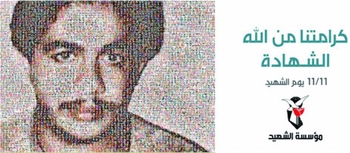
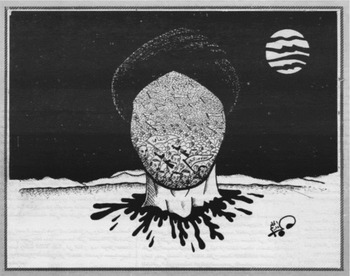
All of these early ideological formulations find resonance in the advertising banner for a recent commemoration that took place on 11 November 2009. The banner, which was plastered on most billboards of Beirut's southern suburbs and the road to the South, depicted a previously unreleased portrait of Ahmad Qasir made up of hundreds of faces of martyrs (Figure 1). This type of portrait was not without precedence. In 1992, following the annual ʿAshuraʾ commemoration, al-ʿAhd published a very similar caricature of a silhouetted face wearing the black turban of the sayyid, which was composed of a myriad of other faces representing the martyrs as legacies of the resistance (Figure 2).Footnote 75
The caption, referring to a statement made by Imam al-Sajjad, reads: “Our dignity deriving from God is a testimony.” Courtesy of the Hizbullah Media Office.

A drawing of the head of a sayyid, which is supposed to represent any of the sayyids who constitute Hizbullah's legacy, such as ʿAbbas al-Musawi or Musa al-Sadr. It was published in al-ʿAhd in 1992 following the commemoration of the first anniversary of ʿAbbas al-Musawi's assassination, as well as on the occassion of ʿAshuraʾ for that year. Al-ʿAhd, 11 July 1992.

AN INTERLUDE: “CALENDRICAL TIMES”
One way of imagining time and history is through the binding of different kinds of texts. Calendars, for example, can tie together a series of events, sayings, thoughts, prayers, and so on, in a chronological sequence. Hizbullah's Islamic Resistance Support Association (Hayʾat Daʿm al-Muqawama al-Islamiyya) issues annual calendars with famous quotes and events noted on each date. These calendars have the Gregorian and the Islamic dates juxtaposed to each other, referring alternatively to commemorations marked in either nomenclature.Footnote 76
On the reverse side of the first page of the 2008 calendar is the following Qurʾanic verse:
And We made the night and the day two signs. Then We effaced the sign of the night and made the sign of the day sight-giving; that you may seek bounty from your Lord, and that you may know the number of years and the reckoning, and everything We have detailed very distinctly.Footnote 77
This verse is followed by a text elaborating the importance of the calendar as a repository of wise sayings spread throughout its pages and thus across time, so to speak. On the front of the following page for 2 January, a saying of Imam ʿAli reads, “thankfulness is the translation of expression and the language of awareness” (al-shukr turjumān al-niya wa-lisān al-tawʿiya). The back of this page mentions two military operations that took place on 2 January 1987 against the Lebanese proxy army allied with Israel, and that resulted in the killing of several soldiers, the destruction of three vehicles, and the confiscation of weapons. On the back of the page for 3 January is a list of “the [four] main operations that took place in the year 1995” as well as their results.Footnote 78 The front side of this page displays a saying of the Prophet: “Exchange salutes so that rancor leaves your heart” (taṣāfaḥu yadhhab al-ghill min qulūbikum). Sometimes sayings include references to political positions. The page for 25 August 2009, for example, is marked with a quote by Musa al-Sadr: “Islamic and Christian coexistence is a treasure to hold on to.” In addition to religiously marked references, the calendar quotes anonymous poetry, sayings, and proverbs signed “the poet” or “Arabic sayings and proverbs.”Footnote 79
In the beginning of this article, I considered the interplay between ethical reflections and historical markers, which allows for the narration of a political cause through the coming and going of the martyr, or through injunctions of the human legacy. Calendars synthesize this process not only through their references to general rules of conduct and proverbs but also through their intensive condensation of overlapping timeframes, from what one might call prophetic historiography (e.g., the birth and death of religious figures, such as the Prophet and his family, or important battles), to the lives, deeds, and sayings of Shiʿi-related shuhadāʾ, to modern and contemporary world political issues such as the beginning and end of World War I and II or the expulsion of Palestinians and the establishment of the State of Israel in 1948. What is important in this representation of time is that every era comes to be associated with a cause. It is in this sense that time is neither strictly linear nor cyclical. Calendars mark anniversaries of events associated with resistance, from anticolonial battles to independence days, from the Lebanese National Pact to the first Israeli invasion of Lebanon in 1978.Footnote 80 Yet each era has its own promise, its ʿahd.
Because the Islamic calendar is cyclical, ʿAshuraʾ and other holidays occur “earlier” each year, sometimes overlapping with important dates in the Gregorian calendar. In 2009, for example, the ʿAshuraʾ commemorations coincided with Day of the Shahid. In 2005 and 2006, they fell on roughly the same week as the commemorations of the martyrdom of Harb and al-Musawi. As a result, the different themes articulated in these different commemorations often overlapped, melding into new styles of recalling, to saturate time with memories. For example, in February 2006, Nasrallah's speech commemorating the martyrdom of Harb and al-Musawi focused on their pious characteristics, for during the week of ʿAshuraʾ Nasrallah typically spoke about Islamic virtues and their connection to resisting oppression and injustice. One quotation from the speech stands out as further evidence of my argument. Remembering Harb and al-Musawi, Nasrallah stated that “the past becomes present with what and who is in it, so that we face the future” (yaḥḍur al-māḍī bi-mā fīhī wa-man fīhī ilā al-ḥādir li-nuwājih al-mustaqbal).Footnote 81
Hizbullah's great detail in describing past military operations and their commemoration is sometimes coupled with a description of combat phases or strategic techniques, always in the backdrop. For example, the reverse side of the page for 19 January 2008, which falls on the 10th of Muharram 1429 in the Islamic calendar and commemorates ʿAshura,ʾ contains a small text recalling the start of the use of Katyusha rockets against Israeli targets in 1995 and explaining its rationale: according to the text, it was “a reaction to Zionists' targeting of civilian positions in the South and an attempt to foster a deterrence force.” The calendars also detail the various prisoner swaps that took place between Hizbullah and Israel. For example, 29 January is “Day of the Liberation of Lebanese and Palestinian Prisoners,” following the release of Shaykh ʿUbayd, who was abducted on 28 July 1989 only to be released over a decade later. Al-ʿAhd remembered his kidnapping annually and periodically vowed to liberate him.
ANOTHER INTERLUDE: ATHĀR AL-SHUHADĀʾ (RELICS OF THE MARTYRS) AND THE QUESTION OF TRACE
Along with Hizbullah's military infrastructure, the Muʾassasat al-Shahid (Martyr's Association) was among the initial organizations to emerge through Iranian logistical aid. Al-ʿAhd first mentioned it in an article published in 1984. According to that article, the Martyr's Association was founded just after the 1982 Israeli invasion as “one of the most important Islamic institutions that participates in reducing the weight of problems and social issues incurred by Muslims in the different Lebanese regions as a result of the constant belligerent assault by the Lebanese regime, the crusaders, and the Israeli enemy.”Footnote 82 Founded with the significant support of its eponymous twin organization in the Islamic Republic of Iran, the association takes care of the families of those martyred or injured while “defending Muslims on battle fronts.”Footnote 83 In practice, it is dedicated to providing a range of facilities and services to the families of Hizbullah fighters who died in combat against Israeli military forces. On the 2008 annual anniversary of Day of the Shahid, al-ʿAhd pointed out that the association “intends to offer total care to the family of resistance martyrs in different realms—social, cultural, consultative, psychological, educative, living standards, accommodation, and health—in order to build a believing [pious] family that is independent and striving so as to protect the road followed by those who sacrificed themselves, those who dedicated their lives to build the nation, its borders, and its sovereignty.”Footnote 84
A special branch of the association has recently been set up to collect objects, mostly textual and acoustic, belonging to or produced by martyrs, or collected and created by the friends and relatives of martyrs. The collection is extensive, and includes letters, testaments, diaries, articles, studies, stories, memories, translations, plays (some written and others in video format), rosaries, books, clothes, and other items. As explained by one of the association's employees, martyrs' activities—as captured and represented by these objects—were not only military in nature but also involved sports, social practices, and artistic creations.Footnote 85
Hizbullah as an organization likely collects information on each of its fighters independently of Athar al-Shuhadaʾ. Accordingly, conflicts may occur between the two, and in some cases Hizbullah is forced to seize sensitive information possessed by Athar al-Shuhadaʾ related to the military or security. Athar al-Shuhadaʾ therefore focuses solely on “cultural” aspects of martyrs' lives. After the death of a combatant, researchers try to gather as much information as possible by approaching the martyr's family and close friends, figures from his village, and when possible his military companions.
Although only recently instituted as a sort of formal database collecting agency, Athar al-Shuhadaʾ continues a process started by al-ʿAhd's journalists, as outlined above. But this process, first elaborated in the mid-1980s, has been scrupulously enlarged to include the collection of all types of objects. Whereas al-ʿAhd did standard journalistic accounts based on one-time interviews with families, Athar al-Shuhadaʾ collects actual relics and other objects, which it stores in digital form and has made searchable by subject and type. The testimonies of martyrs or their family members that had once fit into one newspaper article in al-ʿAhd now stand on their own as archival material, and collected artistic creations, short stories, novels, poems, and so on have come to form a significant reservoir of information that is rapidly expanding.
The presence and use of traces make the transmission of knowledge-as-ethics possible. An employee at Athar al-Shuhadaʾ told me that there are two types of sources about “being a martyr” or ”living as a martyr”: primary and secondary. Whereas direct testimonies of martyrs, whether spoken words, writings, or relics, are considered primary sources, testimonies of others about martyrs or any textual or nontextual object related to martyrs are secondary sources. In his study of textual traditions in Yemen, Brinkley Messick argues that the Islamic tradition has always preferred the spoken over the written, with the Qurʾan acting as the paradigmatic text because it is the spoken word of God, and any other work, whether interpretative or a commentary, considered just “text” and thus secondary.Footnote 86 In the case of martyr testaments, although they are written, ontologically they have the importance of the “oral”: they are primary sources, the sayings of the martyr himself and/or his own artistic creations (stories, poetry, etc.). In other words, martyr testaments and any other “artifact” or “trace” that the martyr leaves behind possess a sacred element. Similarly, although the Qurʾan circulates as a written medium, it is the expression of the spoken word of God, his sayings, passed on through the Prophet. By contrast, testimonies about sayings, life episodes, and social practices of the Prophet and his close companions, although orally transmitted, have the same importance as the “written.”
But following Derrida and as pointed out by Messick, there is no fundamental ontological difference between the written and the spoken. On the contrary, oral expression is a form of writing, subject to a process of endless interpretation.Footnote 87 Social actors use traces to create hierarchies of meanings that establish continuity across time-as-era and imaginaries of community. In terms of Hizbullah-related intellectuals, they develop hierarchies of knowledge about the martyr in order to create the martyr's presence. The martyr then testifies unrelentingly, through all of these relics, all of these traces (the word “trace” is a literal translation of the Arabic word athār), and in so doing produces knowledge. He contributes to the construction of Hizbullah's ideological coherence not just as a political organization or as an abstract cultural sphere of idioms and symbols, but as a “physical” trace bearing a meaning that can be used and re-used by individuals and groups in infinite ways.Footnote 88 It is in this sense that Hizbullah's cultural backbone is the legacy of the martyrs. Recalling the martyrs and their testimonies is the main ideological anchor for Hizbullah-related intellectuals.
The presence of martyrs enables representations of land, history, and people, and invites members of the “interpellated community” to write to or about the martyrs, resulting in the interaction between community and specter. Letters dedicated to martyrs are the most common form of texts, and they are constantly published in al-ʿAhd and then catalogued in the database of Athar al-Shuhadaʾ. Important junctures in time, such as Ahmad Qasir's istishhādī operation, attract a particularly large number of letters from the public, and even invite different types of literary experiments.
In 2001, Dar al-Amir, a publishing house close to Hizbullah, released a romanticized biography of Hadi Nasrallah, the son of Hizbullah's secretary general Hassan Nasrallah, whose shahāda at the hands of the Israelis in September 1997 caused much agitation within the Lebanese political community. Authored by Nisrine Idris, the biography was titled ʿUrs ʿAylul (The Wedding of September), referring to the month in which the martyrdom of Hadi Nasrallah took place. The preface was written by Muhammad Husayn Bazzi, the editor of Dar al-Amir, an author of several books on the resistance, and a main contributor to the new cultural production around Hizbullah, the Project of the Resistance, and other “Islamic” discursive articulations. Bazzi recalled martyrs by deriving forms of conduct from Husayn, the paradigmatic martyr in Shiʿi historiography. What is remarkable for Bazzi is not just that Hadi was the son of the secretary general of Hizbullah or that his family has direct links to the Prophet (which makes Nasrallah a sayyid), ʿAli, and ʿAli's son Husayn, but that “he was Husayn” (kāna al-ḥusayn),Footnote 89 in that he faced and addressed the same ethical questions as Husayn when he confronted his enemies. In order to capture this ethical presence, he had to be him or to be haunted by him. Hadi, as well as all the other martyrs, was Husayn, the paradigmatic martyr, haunting people's unfolding present through his actions.
CONCLUSION
This article has focused on early Hizbullah writings to show how they have served as templates for new writings, thus demonstrating that Hizbullah-related intellectuals or producers of culture do not develop totalizing ideology that they amend or replicate over time. Rather, they develop ideological coherence by devising elaborate conceptions of time through the use of media technology. These conceptions of time facilitate a haunting process that has a myriad of uses. As the institutional apparatus of Hizbullah grew increasingly vast and sophisticated, a dynamic economy of intellectual production developed, with different committees, organizations, and cultural groups providing different ways of reformulating these ideological templates. The rise of Al-Manar TV is one important such phenomenon,Footnote 90 as is the development of the Hizbullah “think tank” Markaz li-l-Dirasat wa-l-Tawthiq (Center for Research and Documentation). Yet with all of these technological and institutional changes, the ideological templates developed in the early 1980s have continued to resurface, albeit in increasingly creative ways. The prevalence of the oral rather than the written is a sign of the importance that has been given to a nonintellectual transmission of ethical practice meant to be felt and emulated. And this prevalence has been a concern at the heart of communal continuity since time immemorial.