Introduction
During the months of September and October 2006, the Ministry of Health of Panama (MINSA) received several reports of ill persons who had clinical presentations of acute renal insufficiency or failure. On 01 October 2006, the MINSA and the Gorgas Institute for Health Studies (GIHS) formally asked the Pan-American Health Organization (PAHO), the US Centers for Disease Control and Prevention (CDC), and the US Food and Drug Administration (FDA) to assist with the investigation. Through a joint effort, the MINSA, GIHS, CDC, FDA, and PAHO were able to characterize the illness, identify an etiological agent, identify the population at risk, and launch an unprecedented media and social mobilization effort.
Domestic outbreak investigations can be complex, and may require a considerable amount of logistical, technical, and human resources. International setting responses in addition to these issues may require familiarity with a host country emergency response and incident command structures. This report describes the operational framework and inter-agency coordination aspects of an intensive outbreak investigation to identify the cause of an outbreak of acute renal syndrome in Panama in 2006.
Background
The leadership in a given jurisdiction ultimately is responsible for ensuring that necessary and appropriate actions are taken to protect people and property from the consequences of emergencies and disasters.1,2 Depending on the scope of the event, this leadership may be at the local, state, regional, or national level. A key element of preparedness is the development of an incident management system, such as the incident command system (ICS), that can effectively coordinate the jurisdiction's emergency response actions during an event. An ICS is a flexible framework for organizing emergency responses, and, in the past several years, it increasingly has been applied to events related to public health emergencies and healthcare facilities.3,Reference Kim-Ferley, Celentano, Gunter, Jones, Stone, Aller, Mascola, Grisgsby and Fielding4 Although its application or utility as an organizational framework for domestic and international public health responses has not been fully explored or documented, the ICS is one of the core disciplines and competencies suggested for medical and public health professionals.3–Reference Nelson, Lurie, Wasserman and Zahowski7
Public health officials are relatively new to the ICS concept, and most have limited knowledge and experience in this area. As such, there is a need for public health ICS models that can assist members of national and international response agencies to effectively coordinate with each other during emergency responses. Modern concepts of emergency management systems describe the need for effective use of ICS, which is based upon the principles of unity of command, adequate span of control, chain of command, flexibility, and scalability.Reference Christen and Maniscalco8 Within the ICS, a unified command (UC) is one way to effectively manage emergencies in which multiple responding agencies or organizations, often times with overlapping jurisdictions, share responsibility for incident management. A UC may be needed for incidents involving: (1) multiple jurisdictions; (2) a single jurisdiction with multiple agencies sharing responsibility; and (3) multiple jurisdictions with multi-agency involvement.
In ICS, the UC is a system that brings together the incident commanders of all major organizations involved in an incident to coordinate an effective response while, at the same time, carrying out their own jurisdictional responsibilities. The ICS is used widely in many countries, including the US. Other than the United Nations (UN) Health Cluster (HC) system, models for development of a single, multinational, unified command structure for responses among sovereign governments, international organizations, and national institutions are much less commonly reported.9
In September 2006, the Epidemiology Department in the Ministry of Health of the Republic of Panama (MINSA) began receiving reports of ill persons who had a clinical presentation including acute renal insufficiency, neurological symptoms, and respiratory failure, which in some cases resulted in death. The syndrome was named paralysis and acute renal insufficiency syndrome (PIRA). The initial investigation of the event involved epidemiologists from the MINSA, the Gorgas Institute for Health Studies (GIHS), and the Social Security Health System (SSHS). On 02 October 2006, MINSA formally requested assistance from the US Centers for Disease Control and Prevention (CDC). Scientists from PAHO, the FDA, and the previously mentioned organizations formed a joint international, multi-disciplinary investigation team. This team consisted of epidemiologists, laboratorians, physicians, toxicologists, environmental health specialists, and media personnel. The team ultimately determined that the cause of the outbreak was diethylene glycol (DEG) contaminated cough syrup that was produced in-country. As of April 2007, 119 documented cases of PIRA had been reported to the MINSA. However, thousands of Panamanians likely were exposed to this product.Reference Rentz, Lewis, Mujica, Barr, Schier, Weerasekera, Kuklenyik, McGeehin, Osterloh, Wamsley, Washington, Alleyne, Sosa, Motta and Rubin10
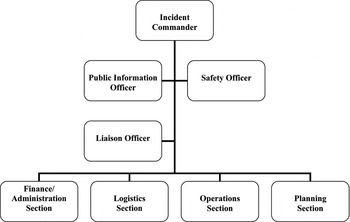
During disease outbreaks such as this, the affected country may request support from international partners in the form of technical assistance or personnel to augment local resources. Upon arrival, international teams may face unnecessary operational delays due to unfamiliarity with the host country's emergency response system, and their command and organizational structures. During the Panama outbreak investigation, an ICS-like management structure was introduced and adopted by an international outbreak investigation team. The ICS is a modular framework that calls for establishing key or staff positions or functions. These positions, including an incident commander (IC), agency liaison, public information, and safety officers; general functional areas, including finance/administration, logistics, operations, and planning, are established (Figure 1). All organizations worked together efficiently under a UC with the Panama Minister of Health as the overall Incident Commander, to identify the cause of the outbreak, which ultimately was determined to be DEG contaminated medication. This report summarizes the experience in the use of UC during an outbreak response in an international setting, describes challenges, and the potential benefits of using a UC structure during international outbreak responses.
Traditional Incident Command System Template*
*Introduction to Incident Command System (ICS 100). Available at http://www.fema.gov.

Methods
In preparation for this report, official correspondence, medical reports, news stories, situation reports, and after-action reports from this incident were reviewed. A literature search was conducted using the key terms public health incident command, emergency operations centers, and outbreak management. Articles selected were reviewed for relevant content. Country health reports, country-specific health statistics, organizational structure diagrams (organograms), and geographical information prepared by using data available from public and Panamanian health authority domains also were reviewed.
Result
Medical System Overview
The Republic of Panama is located in Central America. It borders Colombia on the east and Costa Rica on the west. Panama's population at the time of the outbreak was estimated at 3,339,781.11 Panama's healthcare system is divided into three groups: (1) MINSA; (2) SSHS: and (3) private healthcare providers. The MINSA exercises a national regulatory function and provides primary care and public health-related services.12,13 The SSHS is a semi-public healthcare system that, through various plans, provides a variety of health services to members, private companies, the public sector, contractors, and retirees. Private healthcare services are available widely for those people who can afford that level of care.
The MINSA is the agency primarily responsible for carrying out public health activities in Panama. The MINSA performs surveillance activities by using a passive disease surveillance system. Panama also is home to the GIHS, an institution created in 1921 that has contributed significantly to developing tropical medicine and laboratory services throughout Central America. The GIHS also has supported public health responses to large community and regional disease outbreaks.14–16 Other resources available in the country include the MINSA bacterial reference laboratory, the University of Panama chemistry laboratory, and a US Department of Agriculture animal disease laboratory. The PAHO Country Office located in Panama is another resource available for assisting MINSA with public health emergencies and disasters.17
Emergency Management System Structure for this Event
The Institutional Health System for Emergencies and Disasters (SISED) is responsible for coordinating emergency response functions within the MINSA. As with other public health emergency operations centers (EOCs), the SISED's EOC is staffed around the clock. It serves as the focal point for Panama's public health and medical emergencies, maintaining situational awareness and exercising medical control and coordination.Reference Mignone and Davidson18 During a disaster, SISED coordinates with the National Civil Protection System (SINAPROC), the emergency management agency of Panama.19 The SISED personnel are trained in using the ICS. During this event in Panama, the MINSA established and directed the UC. Liaison officers from various public health agencies complemented the UC structure for the incident.
The CDC team deployed to this investigation ultimately was augmented by a team from the FDA, which added expertise in tracing the origin of contamination in such incidents (commonly referred as a “trace-back” investigation), and pharmacological manufacturing processes. The PAHO Panama Office and PAHO Emergency Operations Center located in Washington, DC provided additional epidemiological and logistical support personnel. Due to the large number of international organizations involved and influx of much-needed public health personnel, an ICS-like structure for organizing the incident response was adopted by the outbreak investigation team. Upon arrival, new personnel were integrated into already established sections or teams. Additional support to the field teams was provided by the CDC, FDA, and PAHO EOCs all located in Atlanta, Georgia and Washington, DC. The CDC arranged transport of diagnostic equipment and coordinated the rapid delivery of biological samples to specialized laboratories back in the US using dedicated aircraft.
Establishment of a Joint Operations Center
The staff of the UC discussed the need for identification of a central point for coordination of the expanding operation and determined that the space allocated to SISED for emergency operations was inadequate. A large classroom adjacent to SISED's situational awareness room was retrofitted to meet this need, and became the EOC for the event. To reflect the unified nature of the international responses, the site was named the joint operations center (JOC). By 03 October 2006, the facility had transformed from an empty room to a fully equipped operations center, complete with Internet and television access, projectors, status boards, and maps.
The MINSA staffed the JOC with administrative and logistics support staff. This staff coordinated all lodging, transportation, shipping, purchasing, and customs clearance of medical equipment and supplies. A motor pool was established to facilitate transport of the teams and deliver medical materials and sampling equipment and supplies. Access to the JOC area was restricted and monitored by security personnel.
The MINSA's information technology (IT) office installed an Internet system and configured access to existing databases. Information security and confidentiality of personal and medical information were a primary concern for all agencies, and access to databases containing patient information was restricted on a need-to-know basis.
Incident Command Structure
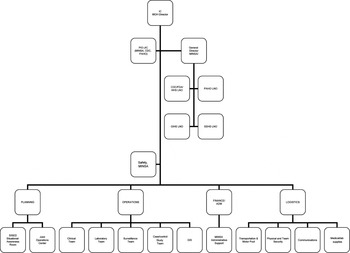
Following principles of ICS, UC leadership remained under local control, with Panama's Minister of Health serving as the overall incident commander. The organization of the public health structure is in Figure 2. The command staff included liaisons that were senior representatives or directors of the various organizations involved (i.e., MINSA, GIHS, SSHS, PAHO, CDC, and FDA). In addition, a joint information center (JIC) was established and staffed by the MINSA, CDC, and PAHO. The JIC assumed the role of the public information officer. The MINSA/SISED officials assumed the safety officer role, which included providing physical security and protection of both facilities and field teams.
Unified command structure and team organization established after an outbreak of acute renal failure, Republic of Panama, 2006
MOH = Ministry of Health; IC = Incident Commander; PIO = Public Information Officer; JIC = Joint Information Center; MINSA = Ministerio de Salud; LNO = Liaison Officer; PAHO = Pan American Health Organization; GIHS = Gorgas Institute of Health Studies; SSHS = Social Security Health System; SISED = Sistema Institucional de Salud para Emergencias y Desastres; CDC = US Centers for Disease Control and Prevention; FDA = US Food and Drug Administration; GIS = geographical information systems

Planning
General staff from MINSA supported other functional areas of the ICS, such as finance, logistics, operations, and planning. Planning was a unified command function, and, for that purpose, daily team meetings involving the principal agency liaisons from MINSA, GIHS, SSHS, PAHO, CDC, and FDA were conducted in the JOC. The JOC also provided a setting for interaction between the various teams.
Operations
The operations section (MINSA, CDC, and PAHO) organized and coordinated activities to support the field teams, and to maintain common situational awareness among the agencies involved. It also was the conduit for coordinating needs with the JOC. Team structure was organized according to the need for a sustained outbreak investigation and included surveillance, case-control study, laboratory, public communication, and clinical teams as described below
Surveillance Team—This team included epidemiologists from the MINSA, CDC, and PAHO who developed a case definition for the illness and protocols for reporting cases. They also maintained a daily case count. Teams visited patients' homes looking for clues, obtaining information from relatives, and observing living conditions and nearby hazards that may have placed people at risk. In addition, investigators collected samples of prescribed and over-the-counter medications and remedies from the patients' homes.
Case-Control Study Team—This was a joint team composed of epidemiologists from the MINSA, GIHS, CDC, and PAHO. This team was responsible for conducting a case-control study, including protecting the data and conducting data processing. The team used specifically trained medical students as interviewers for the case-control study.
Laboratory Team—This joint team, composed of staff from PAHO and the CDC, was responsible for collecting human specimens, including postmortem samples. It was responsible for collecting, labeling, documenting, and processing approximately 1,000 biological samples and raw materials, and rapidly shipping them to CDC and FDA laboratories in the US. In addition, the laboratory team was responsible for: (1) purchasing laboratory materials, shipping containers, and dry ice; (2) arranging courier services; and (3) working with customs clearance.
Public Communications Team (JIC)—This team included public information officers from the MINSA, PAHO, CDC, and the Presidential Press Office. This function allowed the MINSA to exert more control over health information, news releases, and press briefings. After the real cause and the potential scope of the outbreak were discovered, an unprecedented social mobilization effort was launched to reach communities across the republic, many with no access to radio or television, using available community resources. The massive media communications campaign targeted common traffic areas such as bus stations and markets, and included pictures of the bottles of medications implicated. In addition, radio and television spots were purchased during popular programming.
Clinical Team—The joint clinical team consisted of a neurologist, nephrologists, and medical officers responsible for developing and implementing clinical measures and treating patients. The team coordinated consultation with external agencies or specialists in treating patients exposed to diethylene glycol. The clinical team also was responsible for collecting post-mortem samples. The team continued to monitor the condition of many of the survivors and to ascertain the short- and long-term effects of DEG on certain patients.Reference Schier, Conklin, Sabogal, Dell'Aglio, Sanchez and Sejvar20
Logistics
The event's logistics section was staffed mostly by MINSA personnel. The logistics section arranged for the collection, storage, and transportation of supplies and equipment and management of the thousands of biological and material samples collected. They provided communication equipment including cell phones and two-way radios, and were responsible for managing the motor pool of vehicles assigned to the various teams. The section also coordinated with other agencies to establish sites around the country that would allow people to safely dispose of medications. These collection sites were set up in police and fire stations, schools, and other conveniently located places. This coordination required considerable effort because many communities were located in remote areas.
Finance/Administration
The finance/administrative section was responsible for: (1) coordinating authorizations and funding for purchases related to medical equipment, supplies, and meals; (2) working with customs clearance; and (3) coordinating court orders for access to facilities, etc.
Hospital Response Actions Initiated
Recent emergent disease threats, such as the outbreak of severe acute respiratory syndrome (SARS), have underscored the need for more cautiously managing outbreaks of unknown etiologies.Reference Weber and Rutala21,Reference Varia, Wilson and Sarwal22 As a result, and in the absence of a definitive diagnosis, Panamanian authorities implemented command and control measures similar to those used in the Hospital Incident Command System (HICS).Reference Zane and Prestipino23 Until a definitive diagnosis was established, the main objective was to prevent the illness from spreading among healthcare providers, patients, and their families. These actions highlighted the increased preparedness of hospital systems for controlling disease in healthcare institutions in the post-SARS era.Reference Shaw24,Reference Loutfy, Wallington, Rutledge, Mederski, Rose, Kwolek, McRitchie, Ali, Wolff, White, Glassman, Ofner, Low, Berger, McGeer, Wong, Baron and Berall25
Among the measures implemented were:
1. Representation of the various healthcare systems in UC structure;
2. Designation of a national hospital as the primary receiving center for suspected cases;
3. Establishment of a special isolation ward staffed with personnel for effectively monitoring and providing care;
4. Enforcement of mandatory use of personal protective equipment by all hospital visitors and ambulance and patient transport personnel; and
5. Enforcement of hygiene practices with special emphasis in facility infection control measures, such as hand washing, linen disposal, and regular disinfection of common surfaces in public hospital areas.
Discussion
Advantages of Using UC
Perhaps the most significant advantages of using a UC system are those attributes that are characteristically inherent to ICS in general, and as such, the UC was flexible and scalable according to the demands of this outbreak. The UC system provides a unity of command often missing in recent, multi-national disaster responses, such as that after the Indian Ocean tsunami that struck Indonesia in 2004.26 The use of a UC organizational system allowed for formal coordination of national and international assets by providing a formal structure for integration. The autonomy of the host Government was preserved and Panamanian officials retained final authority over all response investigations and interventions. The use of one integrated UC allowed for maximum efficiency, since it provided common “line” (logistics, administrative, finance, and planning) support for all operational functions reducing the need for redundant supply chains and administrative procedures. Unity of command also allowed for a more effective accounting and retained a manageable span of control of 3–5 subordinates for each of the support sections and operational teams. As a result, the UC chain of command was clear and succinct. All response actions, media reports, and public communications were directed through the government of Panama's UC structure using the JIC concept. Finally, operational delays while waiting for team assignments due to unfamiliarity with the national system were minimized because the UC provided a framework flexible enough to quickly assign personnel to where they were needed most urgently.
The coordination of multiple separate national and institutional systems under one UC posed certain challenges during this outbreak. One of these challenges included managing and directing information flow. Partner agencies were not accustomed to sharing information through common, unified channels, and required some degree of monitoring and prompting. Other issues related to patient confidentiality and forensic evidence challenged the ability of the organizational structure to compartmentalize and protect sensitive data while still offering partners transparent and seamless access to information. Finally, for obvious reasons, issues related to national sovereignty and international relations were difficult to address by means of the UC. In this case, Panamanian law regulating international importation and pharmaceutical use of DEG came into discussion, and these issues were processed best internally by the host Government. Other challenges for applying a UC system were related to scalability due to the finite amount of resources available to the host government at any given time. Although this was not the case in this disaster, there are historical examples when the sheer size and consequences of the event can exceed a host government's capacity to lead the response. While effective in establishing unity of command and an effective span of control for operations using a standardized approach, this particular application of UC does not offer an extremely high degree of scalability for large disasters that may require coordination of literally thousands of response and aid workers. Finally, the UC alone also does not effectively address the need for an efficient processing of funding and in-kind donations from international humanitarian organizations.
The Health Cluster (HC) approach to managing public health emergencies has been met with variable degrees of success.9 The most obvious advantage of using the HC system in disaster response is that of its enormous range for accommodating multinational resources. The system may be used to coordinate among a handful of stakeholders up to that of several hundred responses and multiple relief organizations. On the other hand, this lack of an appropriate span of control also creates challenges. These challenges included personnel tasking and the tracking of multiple organizations. This may create a difficult operational environment that promotes redundancy or clustering in common areas of interest (e.g., needs assessments), which may result in unmet needs.Reference Deitchman27 Perhaps the most significant challenge for the HC approach is the inherent lack of legal mandate and authority for regulation and enforcement of critical elements for a coordinative action in contrast to traditional ICS, where authority is centered with the local jurisdiction. This relative weakness in the HC system may affect the system's ability to carry out traditional incident command basic principles such as speaking with one voice, prioritization of critical tasks, and accountability.
Conclusions
The ICS is a widely accepted system for operating during large disasters. Public and fire safety agencies, emergency services, and the military all have used the ICS successfully during emergency operations. This paper describes how a number of public health organizations joined together to work under a common operational framework in Panama. The framework allowed for increased speed in establishing and integrating a number of multinational teams. During this outbreak investigation, an ICS-like system utilizing a UC provided an effective and efficient manner to organize and integrate personnel and resources from multiple countries into a common operational framework. This experience with the ICS during this outbreak investigation demonstrates that the ICS can be used effectively during public health emergencies as well. The UC concept also improved communications among the agencies and teams and through the JOC, created a focal point for Panamanian leadership to obtain timely, consistent information about cases and maintain situational awareness of all teams' activities.
Public health agencies should be familiar with the principles of ICS and be prepared to initiate such a system early in multidisciplinary public health responses, such as outbreak investigations. Before disasters occur, national governments should consider planning for the adoption of a UC system as part of their preparedness activities. Furthermore, the use of a UC-based system should empower local decision-makers with the ability to locally manage a large–scale emergency or disaster response, integrate international resources, and maintain self-governance or autonomy at the same time. The UC–based system provides both government and public health agencies with options for managing simple or complex emergencies.
Abbreviations:
CDC = [US] Centers for Disease Control and Prevention
DEG = diethylene glycol
EOC = emergency operations center
FDA = [US] Food and Drug Administration
GIHS = Gorgas Institute for Health Studies
HC = Health Cluster
IC = incident commander
ICS = incident command system
JIC = joint information center
JOC = joint operation center
MINSA = Ministry of Health Panama
PAHO = Pan-American Health Organization
UC = unified command
SARS = severe acute respiratory syndrome
SISED = Institutional Health System for Emergencies and Disasters
SSHS = Social Security Health System