INTRODUCTION
Despite the fact that the archaeological site in Novae has been known for a long time, it is difficult to determine an unambiguous, detailed chronology for particular objects, such as the legionary baths complex. The interpretation of the relative chronology is not unequivocal since the numbers of artifacts are insufficient. Mortar dating could give us answers since the production process is directly connected to the time of building construction. Taking into account the geological structure of a given area and the state of preservation of the mortars themselves, a “dead carbon” effect may also be important.
The area surrounding Novae is mainly covered with Cenozoic loess. Loess is well known as raw building material. In China, the use of loess for mortar production has been known for a long time (Yang et al. Reference Yang, Zhang, Pan and Zeng2009) and was associated with the local geological conditions. In the period 206 BC–8 AD (the Han dynasty), an inorganic hybrid gelled material called “tabia” (composed of lime, loess and sand) was invented and used (Tie Reference Tie2004). In terms of mortars properties, this material was similar to Roman mortar (Yang et al. Reference Yang, Zhang and Ma2010) and can be compared with the modern cement (Lin et al. Reference Lin, Lin and Chen2005).
A building material with loess admixture was also used in Novae, which was connected with the availability of loess in the area (Fotakiva and Minkov Reference Fotakiva and Minkov1966; Jordanova et al. Reference Jordanova, Hus, Evlogiev and Geeraerts2008; Hristov et al. Reference Hristov, Atanasova and Teoharov2010). Analyzed historical mortars contain crushed ceramic fragments, ceramic dust and silty clay fractions admixture (Michalska and Czernik Reference Michalska and Czernik2015). All these components, both crushed ceramic and loess, significantly affect the properties of mortars (Binda and Baronio Reference Binda and Baronio1988; Zendri et al. Reference Zendri, Lucchini, Biscontin and Morabito2004). Ceramic dust as well as natural clay minerals in combination with lime can act as pozzolan. Hydraulicity in the binder was often obtained by using crushed ceramics or ceramic dust (pottery and bricks) especially when natural volcanic materials were not available (Siddall Reference Siddall, Ringbom and Hohlfelder2011).
SiO2 and Al2O3, which are present in pozzolanic materials, in combination with Ca(OH)2 and water, form calcium silicates and calcium aluminates, providing mortars with hydraulic properties. Hydraulic changes in mortars and their reactivity, apart from the significant specific surface area of the ceramic material, are significantly affected by heating temperatures and the resulting amounts of silica and alumina in an amorphous state, as well as the processing time (Matias et al. Reference Matias, Faria and Torres2014). For most clays, the temperatures for this type of reaction are in the range of 600–900°C, depending on whether they are rich clay materials or poor-clay materials. This firing condition is considered as pozzolanic enhancer and found to be appropriate for developing a pozzolanic reaction by many authors (Teutonico et al. Reference Teutonico, McCaig, Burns and Ashurst1994; He et al. Reference He, Osbaeck and Makovicky1995; Faria-Rodrigues and Henriques Reference Faria-Rodrigues and Henriques2004; Matias et al. Reference Matias, Faria and Torres2014). Penetration of lime into the micropores of ceramic fragments increases the apparent density and mortars strength (Dotsika et al. Reference Dotsika, Kyropoulou, Christaras and Diamantopoulos2018). However, in context of radiocarbon (14C) dating, these types of pozzolanic materials are much more difficult than air-lime mortars (Lindroos et al. Reference Lindroos, Heinemeier, Ringbom, Brock, Sonck-Koota, Pehkonen and Suksi2011; Hajdas et al. Reference Hajdas, Lindroos, Heinemeier, Ringbom, Marzaioli, Terrasi, Passariello, Capano, Artioli, Addis, Secco, Michalska, Czernik, Goslar, Hayen, Van Strydonck, Fontaine, Boudin, Maspero, Panzeri, Galli, Urbanova and Guibert2017).
The present research provides new 14C measurement results for various samples of both mortar and charcoal from Novae. To understand and illustrate where the difficulties with dating specific mortar types originate, a group of 3 experimental mortars were subjected to the same pretreatment protocol as historical mortars from Novae. The binder of experimental mortars (Ex0, Ex1 and Ex5) were made using rock material from the vicinity of Novae, and then the rate and course of their leaching reaction in orthophosphoric acid were observed.
Archaeological Background
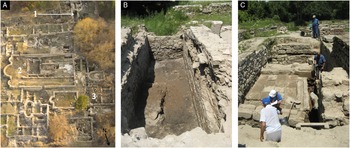
Novae (Figure 1) is an archaeological site situated on the Danube in the northern part of Bulgaria. The history of Novae (Supplement 1) dates back to the 1st century AD, when it was a military camp of Augustus’s Eighth Legion. Initially earth-and-timber defenses were quickly replaced by a stone headquarters building, the first bathhouses and stone fortifications. From the 4th century AD, the city gradually changed its military character to a civilian one. In the 5th century AD a basilica and episcopal residence were built, and the city became the capital of bishopric. After attacks by the Avars and Slavs, from the 6th to the 7th century AD, the city fell into ruin (Biernacki and Klenina Reference Biernacki and Klenina2010, Reference Biernacki and Klenina2016).
Novae excavation site. A: aerial view of Novae with: 1. excavated fragment of criptoportico; 2. visible bisphoric ruins on the oldest baths walls, and 3. “small baths”; B: part of criptoportico; C: latrine.

The analyzed material (mortar and charcoals) was collected from the walls of the Roman baths and the contact zone between the Roman baths and younger buildings. Bathhouse systems of approximately 7000 m2 in size were discovered under the ruins of a much younger, early-Christian basilica (Figure 1A).
The complex of the oldest legionary baths in Novae is archaeologically dated to the first half of the 2nd century. The southern part of the bath contained a technical zone with interconnected barrel-vaulted passages used for transport and fuel storage. The bath was heated by a central hypocaust heating system. The furnace located in the cryptoportico heated the water in the pool (caldarium) above it. The baths complex was combined with the sanitary system. The water from the pools was directed to the latrine (Figure 1C) and then into the main sewer system under the stone-paved street surface and drained outside the camp to the nearby Danube river (Biernacki and Klenina Reference Biernacki and Klenina2010, Reference Biernacki and Klenina2016).
MATERIALS AND METHODS
The mortar from the bath floor, above hypocaustum (N31) and the charcoal samples from the criptoportico (N56, 67, 72) and contact zone between latrine and younger walls (N101) were collected in order to determine the age of the bath complex. The bottom of the latrine canal reaches 46.26 m above sea level, almost 2 m lower than the cryptoportico canal. Taking into account the connection of the water and sanitation system, the latrine and the cryptoportico were built in the same period. The mortar N31 was analyzed regarding composition. The macro and microscopic observation of mortar together with the knowledge about the local geology (Stoyanow and Filipov Reference Stoyanow and Filipov1990), allow determination of the raw material provenance and verification of the nature of these historical binders (Michalska and Czernik Reference Michalska and Czernik2015).
The suitability for dating of mortars with pozzolanic admixture was analyzed. Taking into account the previous research of different mortars from Novae (N13, 14, 56 and 60; Michalska and Czernik Reference Michalska and Czernik2015), the new analyses were aimed to check the rate and course of leaching reaction following sequential dissolution of different fraction of chosen historical and experimental mortars (see Experimental Mortars section). The mortar composition, and its influence on mortars properties were also considered.
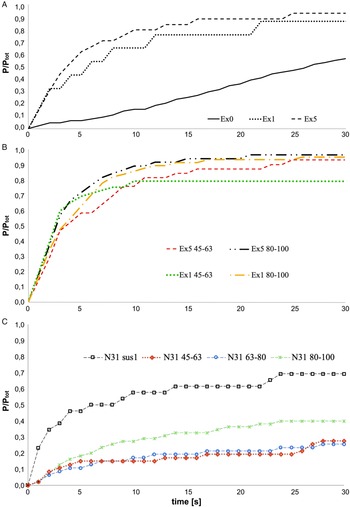
14C dating was preceded by tests of leaching reaction (Figure 2C) of four samples from N31 mortar (suspension, 45–63 μm, 63–80 μm, 80–100 μm). Additionally, the rate and course of leaching reaction of different grain fraction from tree experimental mortars was observed (Figure 2A, B). 14C measurements of mortar samples were based on the sequential dissolution methodology (Lindroos et al. Reference Lindroos, Heinemeier, Ringbom, Braskén and Sveinbjörnsdóttir2007) combined with sample characterization (Trąbska and Trybalska Reference Trąbska and Trybalska2007; Michalska et al. Reference Michalska, Czernik and Goslar2017). The mechanical and chemical separation of different grain fractions follows those described by Michalska and Czernik (Reference Michalska and Czernik2015) and preparation of suspension follows those described by Marzaioli et al. (Reference Marzaioli, Nonni, Passariello, Capano, Ricci, Lubritto, De Cesare, Eramo, Castillo and Terrasi2013) and Nonni et al. (Reference Nonni, Marzaioli, Mignardi, Passariello, Capano and Terrasi2017).
Chemical decomposition of Novae and experimental mortar samples. A & B: experimental mortars (Table 1) in different grain fractions. C: different fractions of N31 mortar from Novae bath complex (Michalska and Czernik Reference Michalska and Czernik2015); Ex5 63–80—sample names and analyzed fraction, 63–80—grain fraction of 63–80 μm, sus—suspension, ptot—total CO2 pressure at the end of reaction, p—CO2 pressure at specific time intervals for a given reaction.

The sample N31/sus1 (named previously N31/<63/sus/II/de) was initially frozen with liquid nitrogen to disintegrate its structure and to separate components. Then, 30% hydrogen peroxide was repeatedly poured over the sample to eliminate its external layer and to remove any organic matter trapped in pores. The sample was placed in ultrasonic bath and delicately stirred, and the suspension was decanted. Approximately 40 mg of the powdered sample was taken for further preparation steps. The chemical separation was performed in a vacuum system with an excess of orthophosphoric acid (at 80°C) in order to release CO2 for dating.
During the stepwise hydrolysis of grain fractions, stepwise samples of CO2 after different reaction times were considered for dating. Finally, the CO2 portions from the first 10 and 30 s of leaching reaction of 45–63 μm grain fraction and the CO2 collected from the end of reaction for suspension sample were chosen for dating (Table 2). The collected CO2 was purified and graphitized according to the standard procedures in the Poznań Radiocarbon Laboratory (Goslar et al. Reference Goslar, Czernik and Goslar2004). In the case of charcoals, the chemical pretreatment follows the procedure used in the Oxford Radiocarbon Accelerator Unit (Brock et al. Reference Brock, Higham, Ditchfield and Bronk Ramsey2010). The identification of the selected charcoal samples was performed on the basis of the internal structure of the wood, with the first phase differentiating coniferous and leaved, ring-porous and diffuse-porous wood. Subsequently, on the basis of characteristic spatial arrangement of tissues, the tree type was determined (Table 2).
Characteristics of experimental samples of lime binders with brick admixture (temperature 900°C).

Analyzed samples with archaeological context, identification and 14C measurements results; DP—diffuse-porous wood; RP—ring-porous wood.

14C dating was performed in the Poznan Radiocarbon Laboratory using accelerator mass spectrometry (AMS). The conventional 14C dates were calibrated using OxCal v4.3.2 program (Bronk Ramsey Reference Bronk Ramsey2017). The brick fragments used as an admixture for experimental mortars were macro and microscopically examined using polarized light microscopy (Olympus Ax70Provis) and scanning electron microscope with electron dispersive spectrometer (SEM-EDS, HITACHI S-3700N).
Experimental Mortars
The binder of experimental mortars was made of Cretaceous marly limestone, collected from the Novae site. The firing temperature for those mortars was 900°C, and the proportions of the components are presented in Table 1. Crushed fragments of brick and brick dust were added to the mortars (Ex1, Ex5). The bricks fragments were treated with 1M hydrochloric acid to remove any carbonate content before using them for the production of experimental mortars.
In transmitted light, the groundmass of brick used in experimental mortars (Ex1, Ex5) is reddish-brown, partly anisotropic, with a moderate (less than 10 vol. %) content of quartz silt (Supplement 2B). The sand admixture comprising 30% of the volume and is mostly monocrystalline quartz accompanied by less than 5 vol. % of K-feldspars, plagioclases and some heavy minerals. The SEM/EDS technique revealed that silicon, oxygen, aluminum and iron are the major elements of this brick sample, which corresponds mainly to quartz and aluminosilicates (Supplement 2C).
The experimental samples were stored in the laboratory during the hardening process (in room temperature). Two years after production, these experimental mortars were subjected to the dissolution reaction of carbonates with orthophosphoric acid, the same as archaeological mortars prepared for 14C measurement (Figure 2). Before dissolution, the experimental mortars went through the cryobreaking and ultrasound separation procedure.
A sample of pure binder (Ex0, without any admixture) obtained from marly limestone, together with other experimental samples (Ex1, Ex5) based on the same lime material, but with different proportion of crushed brick admixture, were used to investigate the influence of potential pozzolanic components on the course of and rate of leaching reaction (Figure 2).
Material Characteristics
The mortar N31 contained limestone aggregate, carbonaceous type of binder with loess admixture and fine ceramic fragments with traces of reaction between those components. These types of components indicate the pozzolanic character of mortars (Lancaster Reference Lancaster2005). The main component used for this historical mortar production was probably the marls of the Svishtov Formation or Marly Limestones of the Trambesh Formation, both of the Aptian age (Stoyanow and Filipov Reference Stoyanow and Filipov1990; Stykova and Ivanov Reference Stykova and Ivanov2004; Nikolov and Minkovska Reference Nikolov and Minkovska2012; Michalska and Czernik Reference Michalska and Czernik2015). Binders made of this type of carbonate rock has a slightly hydraulic character (Boynton Reference Boynton1980; Siegesmund and Snethlage Reference Siegesmund and Snethlage2011; Michalska Reference Michalska, Michalska and Szczepaniak2014). Additionally, the calcareous loess of Danube plain (Fotokieva and Minkov 1966; Hristov et al. Reference Hristov, Atanasova and Teoharov2010; Jipa Reference Jipa2014) and ceramic fragments was used as an admixture in Novae mortars (Supplement 2A). Such ingredients can significantly affect the strength parameters of the mortar and its hydraulic properties (Binda and Baronio Reference Binda and Baronio1988; Elsen et al. Reference Elsen, Van Balen, Mertens, Válek, Hughes and Groot2012). The mortar admixture influences also the rate and course of leaching reaction in orthophosphoric acid (Figure 2).
In addition to mortar samples, charcoal fragments were also analyzed (N56, 67, 72, 101). For three out of the four samples deposited at different depths, species identification was successful (Table 2). Sample no. 67 was identified as birch (Betula sp.), sample no. 72 as beech (Fagus sp.) and sample no. 101 as oak (Quercus sp.) (Table 2). After identification, the samples were dated by 14C.
14C DATING RESULTS AND DISCUSSION
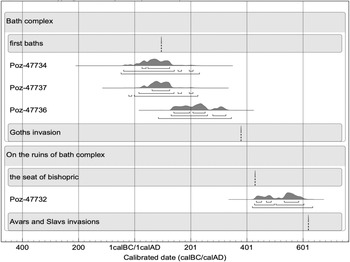
Three different fractions of the N31 mortar sample were measured by AMS in the Poznan Radiocarbon Laboratory (Table 2). Considering the composition of mortars and difficulties in separating the appropriate portion of gas for measurement, fragments of charcoal were also dated (Table 2, Figures 3 and 4).
Results of 14C measurements of mortar and charcoal samples from Novae site: charcoal N56 (Poz-47734, Michalska and Czernik Reference Michalska and Czernik2015); 63–80—grain fraction of 63–80 μm; sus—suspension; ch—charcoal.

Calibration of 14C dates for the Novae samples that fall into the time range of sites existence.

The 14C results were calibrated to absolute ages using OxCal v4.3.2, the IntCal13 calibration curve (Bronk Ramsey Reference Bronk Ramsey2009, Reference Bronk Ramsey2017; Reimer et al. Reference Reimer, Bard, Bayliss, Beck, Blackwell, Bronk Ramsey, Buck, Cheng, Edwards, Friedrich, Grootes, Guilderson, Haflidason and Hajdas2013). 14C dating of mortars was preceded by tests of their chemical decomposition in acid. To investigate whether the pozzolanic admixtures can affect 14C measurement results, tests of leaching reaction were carried out also for experimental mortars (Figure 2A, B).
A test of the leaching reaction in orthophosphoric acid of these experimental mortars showed that the samples with the admixture of clay or brick dust and brick fragments (Ex1, Ex5) dissolve more intensively and give seemingly larger portions of gas at the beginning of the reaction than the pure lime binder (Ex0), without any admixture (Figure 2A). The reaction of mortars enriched with an admixture of ceramics is intense at the very beginning, although the real content of calcium carbonate has not been increased. Regardless of the grain fraction, the reaction rate is very fast for experimental mortars with an admixture of brick. The course of reaction for these mortars (Ex1, Ex5 in grain fractions) indicates the release of almost all CO2 from the binder within the first 5–10 s of reaction. The selection of an appropriate fraction or portion of gas for 14C dating with such a rapid rate of decomposition reaction is impossible, especially when considering additional presence of unburnt limestone fragments, common in historical mortars.
For the archaeological mortar N31, the coarser grain fractions (e.g. 80–100 μm) dissolved more intensively than the finer one (e.g. 45–63 μm; Figure 2C). We interpret this to be due to the presence of carbonaceous unburnt fraction (probably from the calcareous loess admixture) in the coarser grain fractions, whereas for the finer ones (45–63 μm and 63–80 μm) the reaction rate is lower. For the suspension sample from N31 mortar, the dissolution starts with a very rapid release of CO2 (Figure 2C). The 14C measurement result of this suspension sample (Poz-48191) showed an age only slightly different from the measurements results for grain fractions 45–63 μm (Poz-48183; Table 2, Figure 3).
The results of 14C dating of Novae mortar are significantly older that the expected age, regardless of the grain fraction or time interval of gas collection (Table 2, Figure 3) used. However, the 14C measurement result for the grains fraction of 45–63 μm with the gas collected during the first 10 s of leaching reaction are closest to the expected time range of this site (Supplement 1; Biernacki and Klenina Reference Biernacki and Klenina2010). Leaching time shorter than 10 s did not allow to collect a sample sufficiently large for 14C measurement. For this type of pozzolanic mortar, it is difficult to select the appropriate gas portion for dating (from various grain fractions and collected from different time intervals of leaching). Due to the pozzolanic nature of the Novae mortars, the use of these mortars for dating does not allow for verification of the relative chronology. All mortar components, both silty clay as well as ceramic dust and fragments of crushed ceramics, significantly affect the properties of mortars and the course of their leaching reaction in orthophosphoric acid (Figure 2C).
The course and rate of leaching reaction of Novae mortar N31 and experimental mortars shows the influence of pozzolanic admixture on its behavior (Figure 2). The phosphoric acid used for leaching reaction of mortars (a standard pretreatment in 14C measurement of carbonates) is very soluble in water and also it acts as chelating agent. As described by Hernandez et al. (Reference Hernández, García, Hernández Cruz and Jacuinde2015) the phosphate anion reacts strongly with complexes of both ferric and ferrous ions from clay minerals. At the same time, the pozzolanic additives react with Ca(OH)2 during mortar-production process and form the calcium silicatehydrate (CSH), a material chemically more resistant with more refined structure of micropores (Roy et al. Reference Roy, Arjunan and Silsbee2001; Ghrici et al. Reference Ghrici, Kenai and Meziane2006; Pesce Reference Pesce2010). This type of material may cause the resistance in diffusion and contact between leaching agent and leaching nucleus (Tantawy and Alomari Reference Tantawy and Alomari2019) and delay the decomposition (Yang et al. Reference Yang, Che and Leng2018). These properties together, the reactivity of clay minerals and new chemical bonds between e.g. silica and calcium ions, mean that the reaction is intensive from the beginning, but it is not possible to distinguish or separate carbonates of different origin, i.e. between those from binder dissolution and from the dissolution of aggregate or admixtures.
A similar phenomenon, but for a different type of material (soils), was observed by Woszczyk and Szczepaniak (Reference Woszczyk, Szczepaniak, Bajkiewicz-Grabowska and Borowiak2008). In their work, the presence of FeS intentionally added to the samples, caused significant errors in the Scheibler method, to assess the amount of calcium carbonate. Hence, this research presents also the identification and then dating of charcoal samples. 14C dating of the charcoal fragments allows us to distinguish different stages in the existence of the Novae site. The obtained results showed the first phase of expansion of the legionary bath buildings (Roman period; N56, Poz-47734) and the younger period represented by the episcopal complex erected on the ruins of the bathhouse (N101, Poz-47732; Figure 4).
The result of dating of the charcoal sample collected from the cryptoportico floor (N67, Poz- 47736), indicated the time of its use, not the period of its construction. The charcoal sample collected from the southern wall of the episcopal complex (N72, Poz-47737) reflected the age of the reused cryptoportico layer. This episcopal complex with the Christian basilica was erected on the ruin of the Roman bathhouse. The age of the basilica itself was estimated by the archaeologists on the basis of the relative chronology at 5th–6th century AD and was confirmed by the dating of the N101 sample (Poz-47732). Even though the sample was extracted from the latrine canal, lying almost 2 m below the canal of the cryptoportico, the obtained result indicates the bishopric complex age. This result must be connected with the 60-cm fundamental trench of the basilica walls, between the canal inlet and the wall.
CONCLUSIONS
Experimental mortars, analyzed through controlled composition, showed the influence of pozzolanic admixtures on the course of stepwise hydrolysis. The rate of leaching reaction is much higher for the mortars with brick admixture (Ex1, Ex5) than for the pure binder sample (Ex0; Figure 2A, B). Historical mortar N31 contained crushed ceramic fragments, ceramic dust, silty clay fractions admixture from calcareous loess from the vicinity, as well as crushed limestone fragments. Such pozzolanic and carbonaceous components, together with the reactions between these components, make it impossible to select the appropriate gas portion for measurement and to obtain the real age of mortar production. The presence of different pozzolanic admixtures (ceramic dust, brick fragments, natural clay minerals) in mortars affect the 14C dating results by overestimating the gas portion obtained from the leaching reaction.
Regardless of the preparation, the obtained 14C results for N31 mortar from Novae indicate a “dead carbon” effect. However, 14C dating of the charcoals allows us to verify the relative chronology and to indicate three different phases of Novae complex existence. The oldest phase represented by samples N56 and N72 indicates the period of the first bath constructions in Novae (Roman period). The slightly younger phase of bathhouse existence is represented by sample N67. Sample N101 gives an estimate of the age of the fundamental trench of the western wall of the early Christian basilica, erected on the ruins of the bath complex. The results obtained from the 14C measurement can be cross-checked with a stone inscription—Antoninus Pius (86–161 AD) found at the excavation site. The inscription was found at the depth of 1.5 m within the cryptoportico. This can confirm the possible existence of an extensive bath system already in the 2nd century AD.
ACKNOWLEDGMENTS
The authors would like to thank Kimberley Elliott, Timothy Jull and Michael Toffolo for their help, valuable comments, patience and kindness. Many thanks to Justyna Czernik, Tomasz Goslar and the entire team from the Poznań Radiocarbon Laboratory and the Faculty of Physics for the great support, devoted time and fruitful discussions. Sincere thanks go to our beloved families. This work was supported by the Faculty of Geographic and Geological Sciences, Adam Mickiewicz University, Poznań.
Supplementary material
To view supplementary material for this article, please visit https://doi.org/10.1017/RDC.2020.55