While the majority of infants are born at term, data from Canada (Reference Kramer, Demissie and Yang1) and the United Kingdom (2) report that approximately 6 percent to 7 percent of all infants are born preterm (i.e., before 37 completed weeks of gestation). Respiratory problems are one of the most common causes of morbidity in preterm infants (Reference de Winter, de Vries and Zimmermann3). Many preterm infants, therefore, require respiratory support, which is usually provided by mechanical endotracheal ventilation, nasal cannula positive airway pressure (NCPAP), oxygen by incubator, headbox or low-flow nasal cannula (hereafter referred to more simply as “oxygen”), and noninvasive positive pressure mechanical endotracheal ventilation (NIPPV). All of these interventions have both long- and short-term risks, in particular nasal trauma, lung injury, infection, and bronchopulmonary dysplasia (BPD) (Reference de Winter, de Vries and Zimmermann3–Reference Garg and Sinha7).
Heated humidified high flow nasal cannula (HHHFNC) offers an alternative mode of respiratory support and is gaining popularity (Reference Shetty, Sundaresan, Hunt, Desai and Greenough8). In 2016, we published a review of the effectiveness of HHHFNC versus standard treatments on behalf of the National Institute for Health Research Health Technology Assessment Programme (Reference Fleeman, Mahon and Bates9). We found a lack of evidence to suggest that HHHFNC is superior or inferior to standard treatments. We concluded that more randomized controlled trial (RCT) evidence comparing HHHFNC with standard treatments was required to inform the evidence base. Given that further RCTs have been published since 2016, in the current study, we update the evidence for HHHFNC versus standard treatments.
Methods
Search Strategy
We searched PubMed, MEDLINE, Embase, the Cochrane Library, and trial and research registers from 2000 to January 2015 (original review (Reference Fleeman, Mahon and Bates9)) and PubMed, MEDLINE, Embase, the Cochrane Library to March 2018 for the updated search. Search terms included a combination of index terms (for the study population of preterm infants) and free-text words (for the interventions involved). No study design or language filters were applied. Bibliographies of previous reviews and retrieved articles were searched for further studies. The search terms used for each database are presented in Supplementary Tables 1 to 4.
Study Selection
Retrieved citations were assessed for inclusion in two stages. Two reviewers independently scanned all titles and abstracts. Full-text copies of the selected studies were subsequently obtained and assessed independently by two reviewers for inclusion (Supplementary Figure 1). Studies were included if they were RCTs of HHHFNC in preterm infants (i.e., before 37 completed weeks of gestation). Studies were excluded if they did not include preterm infants (or a subgroup analysis of preterm infants) or did not include a comparison of HHHNFC with a standard treatment (NCPAP, oxygen, or NIPPV). Importantly, studies of interventions, which did not clearly state that they used heated high flow were excluded. Disagreements were resolved by discussion at each stage.
Data Extraction and Assessment of Risk of Bias
Individual study data relating to study designs and findings were extracted by one reviewer using a pretested data extraction form and independently checked for accuracy by a second reviewer. When studies included preterm and non-preterm infants, only data for preterm infants were extracted and study authors were contacted for missing data as necessary. The risk of bias assessment was conducted by two reviewers independently using criteria adapted from the Centre for Reviews and Dissemination (CRD) at the University of York (10). Disagreements were resolved through consensus (10).
Data Synthesis
To be consistent with our original review (Reference Fleeman, Mahon and Bates9), we aimed to conduct two separate analyses with a range of outcomes. First, we aimed to consider the evidence for preterm infants treated following mechanical endotracheal ventilation (post-extubation). Second, we aimed to consider the evidence for preterm infants not previously ventilated (primary respiratory support). The primary outcome for both analyses was treatment failure. For post-extubation, we defined this as the need for reintubation. For the analysis of primary respiratory support, we defined this as the need for intubation. Secondary outcomes included BPD, death, air leak, and nasal trauma.
Where data permitted, a meta-analysis of primary and secondary outcomes was conducted using Review Manager 5.3 software (The Cochrane Collaboration, London, UK). For these outcomes, the risk ratio (RR) and the corresponding 95 percent confidence intervals (CIs) were reported. Heterogeneity was explored through consideration of the study populations (e.g., differences in gestational age [GA]), interventions (e.g., starting flow rate for HHHFNC), outcome definitions (e.g., different definitions for reintubation) and in statistical terms by the Chi2 test for homogeneity and the I2 statistic (Reference Higgins, Thompson, Deeks and Altman11). The I2 statistic with a level of >50 percent was considered to indicate moderate levels of heterogeneity, and the Chi2 test, p < .10 to indicate statistically significant heterogeneity. Based on these assessments, a decision was made on whether to combine the results using a fixed-effects model (in the case of minimal heterogeneity) or a random-effects model (in the case of substantial levels of heterogeneity).
For each outcome, to summarize the findings in the context of the quality of the studies, we applied the Grading of Recommendations Assessment, Development, and Evaluation (GRADE) criteria (Reference Atkins, Best and Briss12). These criteria enabled us to assess the size, precision, and consistency of findings alongside the risk of bias and indirectness across studies.
Results
Included Studies
Twenty-six records (Reference Chen, Gao and Xu13–Reference Murki, Singh and Khant38) reporting on nineteen separate RCTs (Reference Chen, Gao and Xu13;14;Reference Collins, Holberton, Barfield and Davis16–Reference Iranpour, Sadeghnia and Hesaraki19;Reference Kadivar, Mosayebi, Razi, Nariman and Sangsari21–Reference Lavizzari, Colnaghi and Ciuffini25;Reference Manley, Owen and Doyle27;Reference Mostafa-Gharehbaghi and Mojabi30;Reference Nair and Karna31;Reference Roberts, Owen and Manley33;Reference Shin, Park, Lee and Choi35–Reference Murki, Singh and Khant38) were included in the systematic review (Supplementary Figure 1). Ten studies (Reference Chen, Gao and Xu13;14;Reference Collins, Holberton, Barfield and Davis16;Reference Elkhwad, Dako, Jennifer, Harriet and Anand17;Reference Kadivar, Mosayebi, Razi, Nariman and Sangsari21;Reference Kang, Xu and Liu22;Reference Manley, Owen and Doyle27;Reference Mostafa-Gharehbaghi and Mojabi30;Reference Soonsawad, Tongsawang and Nuntnarumit36;Reference Yoder, Stoddard and Li37) met the criteria for post-extubation analysis, and ten studies (Reference Glackin, O'Sullivan, George, Semberova and Miletin18;Reference Iranpour, Sadeghnia and Hesaraki19;Reference Klingenberg, Pettersen and Hansen23–Reference Lavizzari, Colnaghi and Ciuffini25;Reference Nair and Karna31;Reference Roberts, Owen and Manley33;Reference Shin, Park, Lee and Choi35;Reference Yoder, Stoddard and Li37;Reference Murki, Singh and Khant38) met the criteria for the analysis of primary respiratory support. We included one of the studies in both analyses as the study included infants who had been treated following mechanical endotracheal ventilation and those who had not been previously ventilated (Reference Yoder, Stoddard and Li37). For the update, we used data reported for this study in a previous Cochrane review (Reference Wilkinson, Andersen, O'Donnell, De Paoli and Manley39).
Study Characteristics
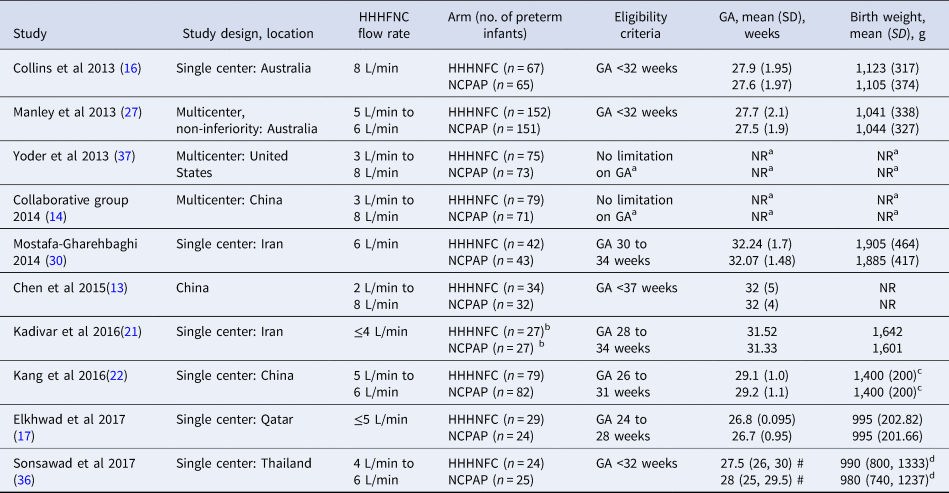
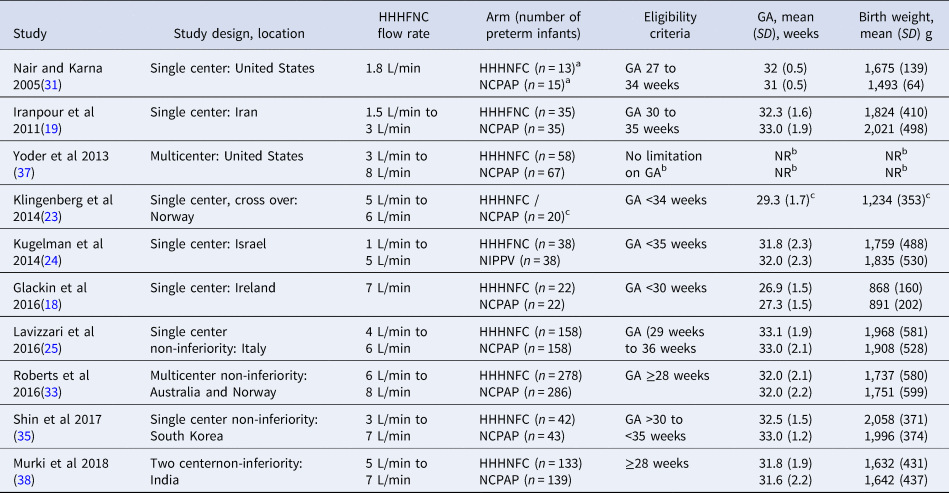
The characteristics of the studies included in the post-extubation analysis are summarized in Table 1, and the characteristics of the studies included in the analysis of primary respiratory support are summarized in Table 2. The flow rates for HHHFNC varied across studies included in both the post-extubation analysis and analysis of primary respiratory support. Generally, flow rates were lower in the earlier published studies. As expected, birth weight was generally lower in those studies relevant to the post-extubation analysis than those in the analysis of primary respiratory support.
Study and Infant Characteristics (Post-extubation Analysis)

GA, gestational age; HHHFNC, heated humidified high-flow nasal cannula; NCPAP, nasal cannula positive airway pressure; NR, not reported; SD, standard deviation.
aStudy included both preterm infants and infants born at or after term (data not reported for preterm infants only).
b The PRISMA flow diagram for this study indicates 108 participants were in fact randomized, 54 in each arm.
c Data reported as kilograms in published paper.
dMedian (interquartile range).
Study and Infant Characteristics (Analysis of Primary Respiratory Support)
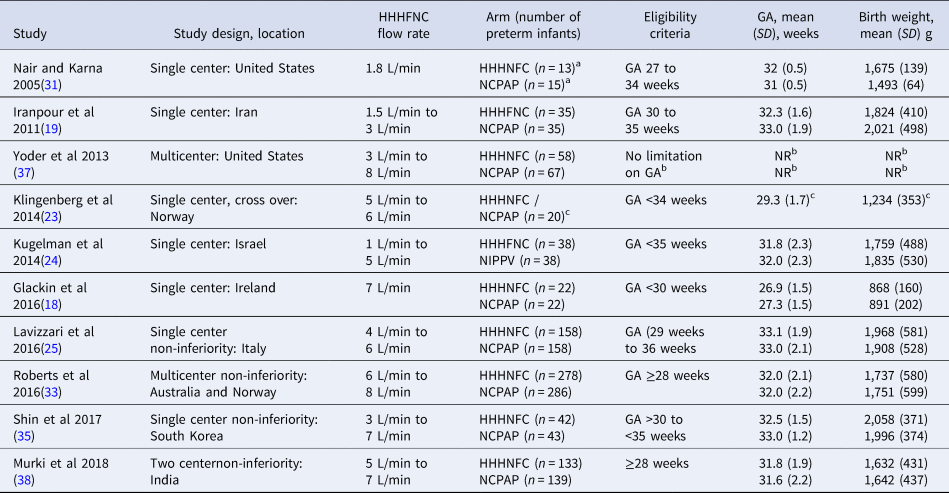
GA, gestational age; HHHFNC, heated humidified high-flow nasal cannula; NCPAP, nasal cannula positive airway pressure; NIPPV, noninvasive positive pressure mechanical endotracheal ventilation; NR, not reported; SD, standard deviation.
aData reported here are taken from the abstract.
bStudy included both preterm infants and infants born at or after term (data not reported for preterm infants only).
cKlingenberg et al 2014 (Reference Klingenberg, Pettersen and Hansen23) was a cross-over study in which twenty preterm infants were randomized to 24 hours of treatment with NCPAP or HHHFNC followed by 24 hours of the alternate therapy; relevant data by arm (including the number initially randomized to each arm) not reported.
Characteristics of Studies Included in the Post-extubation Analysis
A total of 1,201 preterm infants were included in the ten studies (Reference Chen, Gao and Xu13;14;Reference Collins, Holberton, Barfield and Davis16;Reference Elkhwad, Dako, Jennifer, Harriet and Anand17;Reference Kadivar, Mosayebi, Razi, Nariman and Sangsari21;Reference Kang, Xu and Liu22;Reference Manley, Owen and Doyle27;Reference Mostafa-Gharehbaghi and Mojabi30;Reference Soonsawad, Tongsawang and Nuntnarumit36;Reference Yoder, Stoddard and Li37) relevant to the post-extubation analysis. All studies compared HHHFNC with NCPAP. Two of the studies included both preterm infants and infants born at or after term (14;Reference Yoder, Stoddard and Li37) where we only reported data relating to preterm infants. The size of the populations of preterm infants included in the studies ranged from 49 (Reference Soonsawad, Tongsawang and Nuntnarumit36) to 303 (Reference Manley, Owen and Doyle27). Where reported, the GA of study participants varied across studies. In four studies the mean or median GA was approximately 27 to 28 weeks (Reference Collins, Holberton, Barfield and Davis16;Reference Elkhwad, Dako, Jennifer, Harriet and Anand17;Reference Manley, Owen and Doyle27;Reference Soonsawad, Tongsawang and Nuntnarumit36), 29 weeks in one study (Reference Kang, Xu and Liu22) and approximately 32 weeks in three other studies (Reference Chen, Gao and Xu13;Reference Kadivar, Mosayebi, Razi, Nariman and Sangsari21;Reference Mostafa-Gharehbaghi and Mojabi30). Participants in nine studies included in the post-extubation analysis received surfactant before trial entry (Reference Chen, Gao and Xu13;14;Reference Collins, Holberton, Barfield and Davis16;Reference Elkhwad, Dako, Jennifer, Harriet and Anand17;Reference Kadivar, Mosayebi, Razi, Nariman and Sangsari21;Reference Manley, Owen and Doyle27;Reference Iranpour, Sadeghnia and Hesaraki30;Reference Soonsawad, Tongsawang and Nuntnarumit36;Reference Yoder, Stoddard and Li37), whereas it is unclear in one study (Reference Kang, Xu and Liu22).
Characteristics of Studies Included in the Analysis of Primary Respiratory Support
The ten studies relevant to the analysis of primary respiratory support (Reference Glackin, O'Sullivan, George, Semberova and Miletin18;Reference Iranpour, Sadeghnia and Hesaraki19;Reference Klingenberg, Pettersen and Hansen23–Reference Lavizzari, Colnaghi and Ciuffini25;Reference Nair and Karna31;Reference Roberts, Owen and Manley33;Reference Shin, Park, Lee and Choi35;Reference Yoder, Stoddard and Li37;Reference Murki, Singh and Khant38) included a crossover trial in which preterm infants were only treated for 24 hours before crossing over to the other treatment arm (Reference Klingenberg, Pettersen and Hansen23). Nine studies compared HHHFNC with NCPAP (Reference Glackin, O'Sullivan, George, Semberova and Miletin18;Reference Iranpour, Sadeghnia and Hesaraki19;Reference Klingenberg, Pettersen and Hansen23;Reference Lavizzari, Colnaghi and Ciuffini25;Reference Nair and Karna31;Reference Roberts, Owen and Manley33;Reference Shin, Park, Lee and Choi35;Reference Yoder, Stoddard and Li37;Reference Murki, Singh and Khant38), and one pilot study compared HHHFNC with NIPPV (Reference Kugelman, Riskin and Said24).
A total of 1,600 preterm infants were involved in the studies of HHHFNC versus NCPAP and the study sizes ranged from 20 (Reference Klingenberg, Pettersen and Hansen23) to 564 (Reference Roberts, Owen and Manley33). The trial comparing HHHFNC with NIPPV included seventy-six infants (Reference Kugelman, Riskin and Said24). In most studies, where reported, the mean GA at baseline was approximately 32 to 33 weeks (Reference Glackin, O'Sullivan, George, Semberova and Miletin18;Reference Iranpour, Sadeghnia and Hesaraki19;Reference Kugelman, Riskin and Said24;Reference Lavizzari, Colnaghi and Ciuffini25;Reference Nair and Karna31;Reference Shin, Park, Lee and Choi35;Reference Murki, Singh and Khant38). In the crossover trial by Klingenberg et al. (Reference Klingenberg, Pettersen and Hansen23), the mean GA was 29 weeks, and in Glackin et al. (Reference Glackin, O'Sullivan, George, Semberova and Miletin18), the mean GA was 27 weeks.
Only the study by Yoder et al. (Reference Yoder, Stoddard and Li37), which also included preterm infants (included in the post-extubation analysis), included participants who had received previous treatment with surfactant. Two studies explicitly excluded preterm infants who had previously received surfactant (Reference Roberts, Owen and Manley33;Reference Shin, Park, Lee and Choi35). Surfactant was permitted for preterm infants who met prespecified criteria as part of their treatment in three other studies (Reference Iranpour, Sadeghnia and Hesaraki19;Reference Lavizzari, Colnaghi and Ciuffini25;Reference Murki, Singh and Khant38). It is unclear if participants received prior or concurrent surfactant in four studies (Reference Glackin, O'Sullivan, George, Semberova and Miletin18;Reference Klingenberg, Pettersen and Hansen23;Reference Kugelman, Riskin and Said24;Reference Nair and Karna31).
Assessment of Risk of Bias
The findings from the risk of bias assessment are presented in Supplementary Tables 5 and 6. There were concerns regarding the risk of bias in one study by Kadivar et al. (Reference Kadivar, Mosayebi, Razi, Nariman and Sangsari21) included in the post-extubation analysis. It was unclear from this study how many preterm infants were enrolled or included in the analysis as the CONSORT flow diagram indicates that there were 108 patients randomized in the trial, of whom 90 were included in the analysis. However, it is reported elsewhere in the study that only fifty-four patients were enrolled (which is also reported to be the required sample size). Analyses were reported for fifty-four patients (twenty-seven participants in each arm). We, therefore, consider this study to be at high risk of reporting bias.
Findings
Efficacy Findings from Post-extubation Analysis
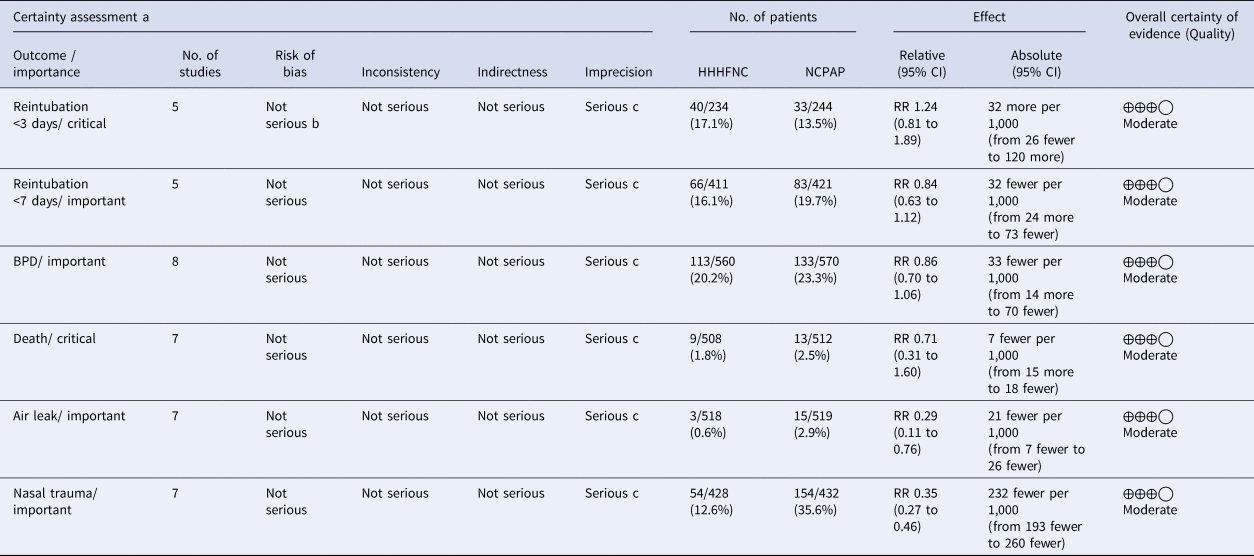
There were no statistically significant differences between HHHFNC and NCPAP in terms of efficacy (Table 3; Supplementary Figure 2). There were few deaths in either arm: nine (1.7 percent) of 508 preterm infants treated with HHHFNC and 13 (2.5 percent) of 512 preterm infants treated NCPAP.
GRADE Ratings for Each Outcome for HHHFNC Versus NCPAP (Post-extubation Analysis: Preterm Infants Treated Following Mechanical Endotracheal Ventilation)

BPD, bronchopulmonary dysplasia; CI, confidence interval; HHHFNC, heated humidified high-flow nasal cannula; NCPAP, nasal continuous positive airways pressure; RR, relative risk.
Note. The GRADE criteria for the certainty assessment also include an assessment of publication bias. It was not possible to test for publication bias by use of funnel plots as we did not include ten or more studies in any analysis, however, we do not consider there are any reasons to suspect there is any evidence of publication bias. While there was high risk of reporting bias in one study which reported this outcome (Reference Kadivar, Mosayebi, Razi, Nariman and Sangsari21), we found that excluding this study from analysis made little difference to the pooled relative effect. Therefore, we did not downgrade the quality of the evidence. For most outcomes, there are relatively few events and consequently wide confidence intervals, therefore, we downgraded the quality of the evidence. Although for nasal trauma, confidence intervals are reasonably narrow, we considered it conservative to downgrade the quality of the evidence for this outcome as a result of the relatively few events identified across the studies
Since the study by Kadivar et al. (Reference Kadivar, Mosayebi, Razi, Nariman and Sangsari21) was considered to be at high risk of reporting bias and only included a maximum flow rate for participants randomized to HHHFNC of 4 L/min, this was excluded from a sensitivity analysis of reintubation within 3 days. This had minimal impact on the results (RR 0.92; 95 percent CI 0.57 to 1.51; I2 = 0 percent).
Safety Findings from Post-extubation Analysis
As evident from Table 3 and Supplementary Figure 3, HHHFNC reduced the incidence of air leak and nasal trauma versus NCPAP (RR 0.29; 95 percent CI 0.11 to 0.79; I2 = 0 percent and RR 0.35; 95 percent CI 0.27 to 0.46; I2 = 5 percent, respectively). However, air leak rarely occurred in either arm: 3 (0.6 percent) of 518 preterm infants treated with HHHFNC and 15 (2.9 percent) of 519 preterm infants treated with NCPAP.
Efficacy Findings from Analysis of Primary Respiratory Support
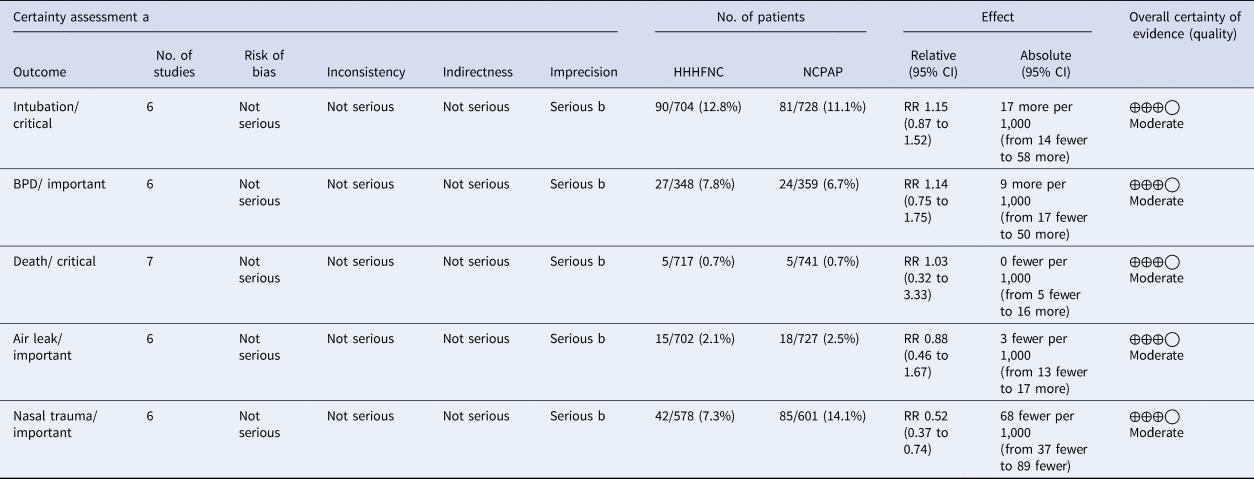
There were no statistically significant differences between HHHFNC and NCPAP in terms of efficacy (Table 4; Supplementary Figure 4). As with the post-extubation analysis, there were few deaths in either arm: 5 (0.7 percent) of 717 preterm infants treated with HHHFNC, and 5 (0.7 percent) of 741 preterm infants treated NCPAP. There were no statistically significant differences in efficacy outcomes for HHHFNC versus NIPPV (Supplementary Table 7).
GRADE Ratings for HHHFNC Versus NCPAP (Analysis of Primary Respiratory Support: Preterm Infants with No Prior Mechanical Endotracheal Ventilation)

BPD, bronchopulmonary dysplasia; CI, confidence interval; HHHFNC, heated humidified high-flow nasal cannula; NCPAP, nasal continuous positive airways pressure.
Note. The GRADE criteria for the certainty assessment also include an assessment of publication bias. It was not possible to test for publication bias by use of funnel plots as we did not include 10 or more studies in any analysis, however, we do not consider there are any reasons to suspect there is any evidence of publication bias. For all outcomes, there are relatively few events and consequently wide confidence intervals; therefore, we downgraded the quality of the evidence. Although for nasal trauma, confidence intervals are reasonably narrow; we considered it conservative to downgrade the quality of the evidence for this outcome as a result of the relatively few events identified across the studies.
Safety Findings from Analysis of Primary Respiratory Support
Safety findings are reported in Table 4 and Supplementary Figure 5. HHHFNC reduced the incidence of nasal trauma versus NCPAP (RR 0.52; 95 percent CI 0.37 to 0.74; I2 = 27 percent); but there were no statistically significant differences between arms in the incidence of air leak. As with the post-extubation analysis, there were few occurrences of air leak in either arm: 15 (2.1 percent) of 702 preterm infants treated with HHHFNC and 18 (2.8 percent) of 727 preterm infants treated with NCPAP. There were no statistically significant differences for either air leak or nasal trauma for HHHFNC versus NIPPV (Supplementary Table 7).
GRADE Rating of Evidence
Using the GRADE criteria, for the majority of outcomes comparing HHHFNC with NCPAP, the quality of evidence for each outcome (for HHHFNC versus NCPAP) is considered to be moderate (Tables 3 and 4). For the comparison of HHHFNC versus NIPPV, because evidence is derived from only one relatively small pilot study, the quality of evidence is considered to be very low (Supplementary Table 7).
Discussion
Our updated literature search identified an additional twelve studies (Reference Chen, Gao and Xu13;Reference Elkhwad, Dako, Jennifer, Harriet and Anand17–Reference Iranpour, Sadeghnia and Hesaraki19;Reference Kadivar, Mosayebi, Razi, Nariman and Sangsari21;Reference Kang, Xu and Liu22;Reference Lavizzari, Colnaghi and Ciuffini25;Reference Mostafa-Gharehbaghi and Mojabi30;Reference Roberts, Owen and Manley33;Reference Shin, Park, Lee and Choi35;Reference Soonsawad, Tongsawang and Nuntnarumit36;Reference Murki, Singh and Khant38) to those included in our previous review published in 2016 (Reference Fleeman, Mahon and Bates9) and an additional ten studies (Reference Chen, Gao and Xu13;Reference Elkhwad, Dako, Jennifer, Harriet and Anand17;Reference Glackin, O'Sullivan, George, Semberova and Miletin18;Reference Kadivar, Mosayebi, Razi, Nariman and Sangsari21–Reference Klingenberg, Pettersen and Hansen23;Reference Lavizzari, Colnaghi and Ciuffini25;Reference Roberts, Owen and Manley33;Reference Shin, Park, Lee and Choi35;Reference Soonsawad, Tongsawang and Nuntnarumit36) to those included in the other most recently published systematic review, a Cochrane review published in 2016 by Wilkinson et al. (Reference Wilkinson, Andersen, O'Donnell, De Paoli and Manley39). Our update has not found any consistent and statistically significant differences between HHHFNC and NCPAP (or NIPPV) for the majority of efficacy outcomes, including the primary outcome of treatment failure; similar findings have been reported from previous meta-analyses (Reference Fleeman, Mahon and Bates9;Reference Wilkinson, Andersen, O'Donnell, De Paoli and Manley39;Reference Kotecha, Adappa and Gupta40). However, we found that meta-analysis of adverse event rates from studies indicates statistically significantly fewer adverse events with HHHFNC than with NCPAP as measured by air leak (for the post-extubation analysis) and nasal trauma (for both the post-extubation analysis and analysis of primary respiratory support). The reduced incidence in nasal trauma identified by our review is one of the expected benefits of HHHFNC, as previously reported by the authors of two meta-analyses (Reference Wilkinson, Andersen, O'Donnell, De Paoli and Manley39;Reference Kotecha, Adappa and Gupta40). A statistically significant reduction in air leak has not, however, been previously demonstrated by meta-analysis. This reduction in air leak using HHHFNC for post-extubation compared with using NCPAP is an important finding. Air leak may cause hypoxia and increase the risk of intraventricular hemorrhage.
Given the apparent lack of difference in efficacy outcomes (treatment failure, BPD, death) between HHHFNC and NCPAP, the decision to use HHHFNC post-extubation will be a clinical one depending on the individual baby, perhaps taking into account their GA and size. The numbers of preterm infants needed to treat (NNT) with HHHFNC versus NCPAP to prevent occurrences of nasal trauma or air leak may also be a consideration. The NNT can only be meaningfully interpreted where there is a statistically significant difference between treatments (Reference Muthu41). From the results presented in our review, as a post-extubation treatment, four (95 percent CI 4 to 5) preterm infants should receive HHHFNC versus NCPAP to prevent nasal trauma. The NNT for air leak is much larger and associated with greater uncertainty: forty-nine (95 percent CI 39 to 144) preterm infants should receive HHHFNC versus NCPAP to prevent air leak. As a treatment for primary respiratory support, fifteen (95 percent CI 11 to 27) preterm infants should receive HHHFNC versus NCPAP to prevent nasal trauma.
While we found no evidence of statistically significant differences between HHHFNC and NCPAP (or NIPPV) for the efficacy outcomes, this does not necessarily mean that the two interventions are equivalent or that HHHFNC is noninferior to NCPAP (or NIPPV). Indeed, in our previous review (Reference Fleeman, Mahon and Bates9), we highlighted the need for large noninferiority trials to be conducted. Our original review did include one reasonably large (n = 303) noninferiority trial comparing HHHFNC with NCPAP for post-extubation conducted by Manley et al. (Reference Manley, Owen and Doyle28). This reported HHHFNC to be noninferior to NCPAP, using a composite outcome for treatment failure (Reference Manley, Owen and Doyle28).
Our updated review includes three additional noninferiority trials, all of primary respiratory support, from the large HIPSTER trial (n = 564) (Reference Roberts, Owen and Manley33) and RCTs conducted by Lavizzari et al. (n = 316) (Reference Lavizzari, Colnaghi and Ciuffini25) and Murki et al. (n = 279) (Reference Murki, Singh and Khant38). The results from the study by Lavizzari et al. (Reference Lavizzari, Colnaghi and Ciuffini25) found HHHFNC to be noninferior to NCPAP for the primary outcome (need for intubation within 3 days) (Reference Lavizzari, Colnaghi and Ciuffini25). However, the HIPSTER trial and the trial by Murki et al. not only failed to show HHHFNC to be noninferior but found the difference between arms to be statistically significant in favor of NCPAP, again using a composite outcome for treatment failure (Reference Roberts, Owen and Manley33;Reference Murki, Singh and Khant38). As a result of the large difference between interventions in treatment failure in both these studies, the trials were stopped early. It should, however, be noted that intubation rates were relatively similar between arms in both studies.
Aside from the previously cited systematic reviews, we are aware of a recently published rapid review of HHHFNC (Reference Conte, Orfeo, Gizzi, Massenzi and Fasola42). This review was more limited than ours both in scope (as it focused on HHHFNC as a treatment for primary respiratory support) and eligibility (the review was limited to studies in English). Searches were also conducted in June 2017, whereas ours were last conducted in March 2018. It, therefore, included fewer studies. As with our review, it found no statistically significant differences between HHHFNC and NCPAP in the need for intubation or BPD. It did, however, find that HHHFNC used for primary respiratory support resulted in a higher rate of treatment failure than NCPAP, using the study-defined outcomes of treatment failure in each study.
For our review, we have used a simple of definition of treatment failure for both the post-extubation analysis (need for reintubation) and analysis of primary respiratory support (need for intubation). For the post-extubation analysis, four studies used a composite outcome for treatment failure (Reference Collins, Barfield, Horne and Davis15;Reference Elkhwad, Dako, Jennifer, Harriet and Anand17;Reference Manley, Owen and Doyle27;Reference Soonsawad, Tongsawang and Nuntnarumit36). Six studies used a composite outcome for treatment failure in the analysis of primary respiratory support (Reference Iranpour, Sadeghnia and Hesaraki19;Reference Kugelman, Riskin and Said24;Reference Nair and Karna31;Reference Roberts, Owen and Manley33;Reference Shin, Park, Lee and Choi35;Reference Murki, Singh and Khant38). Five of these studies (Reference Glackin, O'Sullivan, George, Semberova and Miletin19;Reference Kugelman, Riskin and Said24;Reference Nair and Karna31;Reference Roberts, Owen and Manley33;Reference Shin, Park, Lee and Choi35) were included in the recent rapid review (Reference Conte, Orfeo, Gizzi, Massenzi and Fasola42). Only the study of HHHFNC for primary respiratory support by Lavizzari et al. (Reference Lavizzari, Colnaghi and Ciuffini25) (also included in the rapid review) used a similar definition of treatment failure (the need for intubation). Unlike the authors of the rapid review (Reference Conte, Orfeo, Gizzi, Massenzi and Fasola42) and Cochrane review (Reference Wilkinson, Andersen, O'Donnell, De Paoli and Manley39), we did not pool data into a meta-analysis for study-defined treatment failure because the definitions varied across studies. We note, however, that aside from these trials (Reference Roberts, Owen and Manley33;Reference Murki, Singh and Khant38) there were no statistically significant differences reported for treatment failure between HHHFNC and NCPAP reported in any other individual trial (Reference Collins, Barfield, Horne and Davis15;Reference Elkhwad, Dako, Jennifer, Harriet and Anand17;Reference Iranpour, Sadeghnia and Hesaraki19;Reference Kugelman, Riskin and Said24;Reference Manley, Owen and Doyle27;Reference Nair and Karna31;Reference Shin, Park, Lee and Choi35;Reference Soonsawad, Tongsawang and Nuntnarumit36).
Another important consideration, however, is that in many instances where treatment failure was defined, it was reported that “rescue” treatment was permitted before the need for reintubation or intubation. For post-extubation treatment, this constituted NCPAP (Reference Manley, Owen and Doyle27;Reference Murki, Singh and Khant38) NCPAP with additional ventilation delivered breaths (Reference Collins, Barfield, Horne and Davis15) NIPPV (Reference Elkhwad, Dako, Jennifer, Harriet and Anand17) and bilevel CPAP or NIPPV (Reference Soonsawad, Tongsawang and Nuntnarumit36). “Rescue” treatment rates varied from 3 percent (Reference Collins, Barfield, Horne and Davis15) to 75 percent (Reference Soonsawad, Tongsawang and Nuntnarumit36) for infants treated with HHHFNC compared with 7 percent (Reference Collins, Barfield, Horne and Davis15) to 65 percent (Reference Soonsawad, Tongsawang and Nuntnarumit36) for infants treated with NCPAP. For primary respiratory support, where reported, “rescue” treatment constituted surfactant for participants treated with HHHFNC or NIPPV (Reference Kugelman, Riskin and Said24), NCPAP for participants treated with HHHFNC (Reference Roberts, Owen and Manley33) and bilevel CPAP for participants treated with HHHFNC or NCPAP (Reference Shin, Park, Lee and Choi35). “Rescue” treatment rates varied from 19 percent (Reference Shin, Park, Lee and Choi35) to 39 percent (Reference Roberts, Owen and Manley33) for infants treated with HHHFNC and were 11 percent for infants treated with NCPAP (Reference Shin, Park, Lee and Choi35) and 34 percent for infants treated with NIPPV (Reference Kugelman, Riskin and Said24). Given the use of “rescue” treatment in some of the trials, the authors of a recent narrative review state that “rescue” treatment is an important part of the treatment pathway in both post-extubation treatment and primary respiratory support (Reference Roberts and Hodgson43).
The main strength of our review is that it includes the most up-to-date published evidence from nineteen studies (Reference Chen, Gao and Xu13;14;Reference Collins, Holberton, Barfield and Davis16–Reference Iranpour, Sadeghnia and Hesaraki19.Reference Kadivar, Mosayebi, Razi, Nariman and Sangsari21–Reference Lavizzari, Colnaghi and Ciuffini25;Reference Manley, Owen and Doyle27;Reference Mostafa-Gharehbaghi and Mojabi30;Reference Nair and Karna31;Reference Roberts, Owen and Manley33;Reference Shin, Park, Lee and Choi35–Reference Murki, Singh and Khant38). We have also applied the GRADE criteria to each outcome. There are, however, two potential limitations. First, while there was little statistical heterogeneity detected in the analyses we conducted; there were, however, minor notable differences in baseline characteristics across studies in terms of GA of included participants and HHHFNC flow rates. Nonetheless, using the GRADE criteria, we considered there to be no serious issues with the quality of the evidence in relation to consistency. Second, while studies included in the post-extubation analysis included participants who had received surfactant before trial entry (Reference Chen, Gao and Xu13;14;Reference Collins, Holberton, Barfield and Davis16;Reference Elkhwad, Dako, Jennifer, Harriet and Anand17;Reference Kadivar, Mosayebi, Razi, Nariman and Sangsari21;Reference Kang, Xu and Liu22;Reference Manley, Owen and Doyle27;Reference Mostafa-Gharehbaghi and Mojabi30;Reference Soonsawad, Tongsawang and Nuntnarumit36;Reference Yoder, Stoddard and Li37) two studies included in the analysis of primary respiratory support explicitly excluded preterm infants who had previously received surfactant (Reference Roberts, Owen and Manley33;Reference Shin, Park, Lee and Choi35).
It is unclear to what extent, if any, these differences impact on the outcomes. However, the low number of participants with GA <28 weeks in the studies included, particularly in the analysis of primary respiratory support, raises questions about the suitability of using HHHFNC for this subgroup of preterm infants. Three studies of post-extubation treatment have examined efficacy in preterm infants with very low GA, <26 weeks (Reference Manley, Owen and Doyle27) or ≤28 weeks (Reference Collins, Barfield, Horne and Davis15;Reference Soonsawad, Tongsawang and Nuntnarumit36). Findings appear to favor NCPAP in relation to composite outcomes of treatment failure (Reference Manley, Owen and Doyle27;Reference Soonsawad, Tongsawang and Nuntnarumit36) and HHHFNC in terms of the need for reintubation (Reference Collins, Barfield, Horne and Davis15). However, findings were not reported as being statistically significantly different in these studies. For primary respiratory support, similar subgroups have not been defined (these studies typically including participants of greater GA than in studies of post-extubation treatment). Hence, it has been recommended by the authors of recent reviews that HHHFNC is most suited for more mature infants (Reference Conte, Orfeo, Gizzi, Massenzi and Fasola42;Reference Roberts and Hodgson43).
There are also methodological issues that warrant some discussion. First, for the outcomes of death and air leak, there were relatively few events. It has been recommended that for rare events, analyses are conducted using the Peto one-step odds ratio (OR) method (Reference Higgins and Green44). We made no provision for analyzing rare events in our protocol, but we did ratios (ORs derived from the analyzes using the Peto method were very similar to those of the RRs we found from our original analyses. A second methodological issue to note is that including crossover trials in meta-analyses can be problematic. In the crossover trial included in our review, the outcomes were reported at two 24-hour intervals and were not relevant to this review. A third methodological issue was that in two studies (14;Reference Yoder, Stoddard and Li37), we only included relevant subgroup populations of the overall trial populations in our meta-analyses. Neither trial was designed in such a way that it was stratified for these subgroups and, therefore, randomization was broken. Thus, we conducted post-hoc sensitivity analyses excluding these two studies to determine if their exclusion altered the results. Sensitivity analyses yielded very similar results to those we found from our original analyses.
Finally, aside from the consideration of the clinical effectiveness of HHHFNC versus standard treatment, other key factors to take into account when considering which intervention to use for preterm interventions include evidence regarding the quality of care and cost effectiveness of treatment. Findings from surveys of practitioners have found HHHFNC enables family members to be more involved in the care of their infants (Reference Hough, Shearman, Jardine and Davies45) and to be better tolerated by infants (Reference Ojha, Gridley and Dorling46) than other treatment options. Evidence from a small crossover trial (n = 20) also found parents preferred HHHFNC to NCPAP for these reasons (Reference Klingenberg, Pettersen and Hansen23). Survey findings (Reference Hough, Shearman, Jardine and Davies45) and findings from a small RCT (n = 70) (Reference Iranpour, Sadeghnia and Hesaraki19) also found HHHFNC to be easier to use compared with other modalities, allowing healthcare practitioners to more easily handle and care for infants (Reference Hough, Shearman, Jardine and Davies45). Our previous review found that, while the capital cost of HHHFNC was lower than of NCPAP, consumable costs were higher (Reference Fleeman, Mahon and Bates9). Therefore, at machine lifespans over 5 years, as the difference between interventions in consumable costs decrease, usage rates would also have to decrease in order for HHHFNC to remain cost saving. The HIPSTER trial has since reported the difference in total treatment costs for an inpatient admission for primary respiratory support (Reference Roberts, Owen and Manley33). The study authors found the cost difference of the treatment specific consumable equipment between the two interventions to be neither statistically nor economically significant, with HHHFNC being US$17 cheaper on average.
In conclusion, since our last review, a large number of RCTs have been published comparing HHHFNC to NCPAP. There appears to be at least moderate quality evidence indicating that, compared with NCPAP, the incidence of air leak and nasal trauma is reduced using HHHFNC for post-extubation as is the incidence of nasal trauma for HHHFNC used as primary respiratory support. However, there remains a lack of convincing clinical effectiveness evidence to suggest a difference between HHHFNC and NCPAP for most of the other outcomes, including all efficacy outcomes for post-extubation, and efficacy outcomes and air-leak for primary respiratory support. Evidence for an effect between HHHFNC and NIPPV is seriously lacking. There is, therefore, still the need for further research examining these efficacy outcomes and also for investigating outcomes of HHHFNC versus NIPPV. We would also recommend that further consideration should be given to future research including the quality of care and costs of treatment. Further research is also needed into the efficacy and safety of HHHFNC for infants with GA ≤28 weeks.
Supplementary material
The supplementary material for this article can be found at https://doi.org/10.1017/S0266462319000424
Author ORCIDs
Yenal Dundar, 0000-0002-9847-1622.
Conflicts of interest
The authors have no conflicts of interest to disclose.