INTRODUCTION
As forest landscapes are fragmented by natural events and anthropogenic disturbances, populations of some tree species have become more isolated with decreasing population spatial distribution, numbers of subpopulations, stem densities within fragments and increasing distances between fragmented subpopulations (O'Connell et al. Reference O'CONNELL, MOSSELER and RAJORA2006). Fragmentation, decrease in stem densities within fragments and isolation of plant populations can affect demographic processes as a result of reduced pollen receipt and increased pollen limitation (Ashman et al. Reference ASHMAN, KNIGHT, STEETS, AMARASEKARE, BURD, CAMPBELL, DUDASH, JOHNSTON, MAZER, MITCHELL, MORGAN and WILSON2004, Pauw Reference PAUW2007, Wang et al. Reference WANG, SORK, WU and GE2010).
Studies on the effects of population fragmentation on viable seed output of particular plant species reported contrasting results, depending on the biological and ecological characteristics of the species concerned. Seed from smaller populations of Pinus strobus had a lower ratio of filled seed than from larger populations in Canada (Rajora et al. Reference RAJORA, MOSSELER and MAJOR2002). Similarly, the percentage of viable seeds per cone significantly decreased with decrease in patch size in Pinus tabulaeformis in China (Wang et al. Reference WANG, SORK, WU and GE2010). Population fragmentation in the conifer tree Picea jezoensis increased the total number of viable seeds per cone, resulting from enhanced pollen movement (Tomita et al. Reference TOMITA, SAITO and SUYAMA2008).
Widdringtonia whytei naturally has a fragmented distribution pattern on Mulanje Mountain but the fragments have further been impacted on by wildfires and human resource use (Chapman Reference CHAPMAN1995). In these fragments W. whytei stands comprise scattered trees of both smaller and larger stem diameters. Both suppressed and emergent tree canopies exist in the stands (pers. obs.). However, very low natural regeneration has been reported in recent surveys (Bayliss et al. Reference BAYLISS, MAKUNGWA, HECHT, NANGOMA and BRUESSOW2007). To date, no studies have examined viable seed output per cone in W. whytei. This study examined the impact of population fragmentation on viable seed output. It also assessed whether tree stem diameter and crown position of trees in relation to the forest canopy affected viable seed output per cone. Our first hypothesis was that viable seed output per cone in W. whytei trees decreased with increased population fragmentation. Our second hypothesis was that tree stem diameter and crown position in the forest canopy positively influenced viable seed output per cone.
STUDY SITE
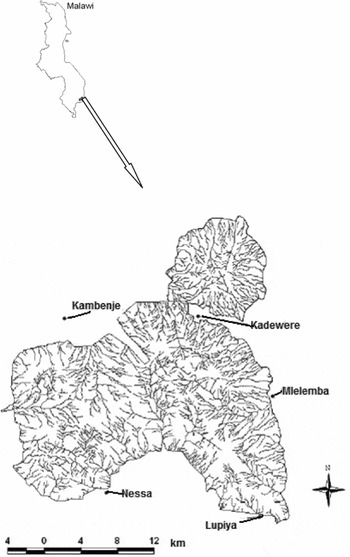
This study was conducted on Mulanje Mountain in Malawi (Figure 1) at three sites, namely Sombani (15°52ʹ41ʹʹS; 35°40ʹ89ʹʹE), Chambe (15°62ʹ40ʹʹS; 35°30ʹ72ʹʹE) and Lichenya (15°62ʹ33ʹʹS; 35°30ʹ73ʹʹE). The altitude of these sites ranges from 1660–2265 m asl (Lawrence et al. Reference LAWRENCE, OSHINO and CHINGUWO1994). These sites are characterized by W. whytei forest fragments of different sizes ranging from 0.8–1779 ha, with most of them confined to ravines and hollows.
Location of Mulanje Mountain in Malawi.

STUDY SPECIES
Widdringtonia whytei is a wind-pollinated coniferous tree endemic to Malawi and valued for its fine timber and attractive fragrance (Bayliss et al. Reference BAYLISS, MAKUNGWA, HECHT, NANGOMA and BRUESSOW2007). Its commercial exploitation began in 1898 and continued until 1955, with large areas of forest cleared. Today W. whytei has highly fragmented populations on Mulanje Mountain. This species was originally thought to be synonymous with W. nodiflora which in turn was thought to be synonymous with W. cupressoides. This has been disputed (Pauw & Linder Reference PAUW and LINDER1997). It is now well established that both W. nodiflora (multi-stemmed, narrow crowned tree) and W. whytei (taller, wide crowned) occur on Mulanje Mountain (Bayliss et al. Reference BAYLISS, MAKUNGWA, HECHT, NANGOMA and BRUESSOW2007). In this study the species circumscription follows that of Pauw & Linder (Reference PAUW and LINDER1997). Widdringtonia whytei grows up to 40 m in height and c. 1 m in stem diameter at breast height (dbh). Male and female cones are borne on the same tree (Chapman Reference CHAPMAN1995) and sometimes on the same branch (pers. obs.). Cones are globose, 1.5–2 cm in diameter, dark brown with four scales (Chapman Reference CHAPMAN1995). The number of cones per cluster is much less variable, with generally two cones per cluster. Female cones seldom remain closed for more than 2 y (Pauw & Linder Reference PAUW and LINDER1997). A cone generally contains 4–8 seeds (Pauw & Linder Reference PAUW and LINDER1997). Widdringtonia whytei seed is 25 mm long and 12 mm wide on average with a wing (Pauw & Linder Reference PAUW and LINDER1997) and is wind-dispersed (Chapman Reference CHAPMAN1995).
METHODS
Sampling of trees and seed
Two sets of data were collected. In the first study, a stratified random sampling method was followed to select trees to assess the effect of W. whytei fragment size on viable seed output per cone. At each selected study site on the mountain, all W. whytei population sizes were recorded and grouped into four categories (isolated trees, small, medium and large). Small fragments consisted of groups of ≤10 cone-bearing (reproductively mature) trees in an area either surrounded by other tree species or grassland vegetation. Medium-sized fragments consisted of groups of 11–20 cone-bearing individuals while large forest fragments comprised groups of >20 cone-bearing trees. Only trees in the small and medium fragments were physically counted. A tree was considered isolated if it was separated by more than 500 m from the nearest individual or group of W. whytei trees either surrounded by grassland or other vegetation types.
Other factors were considered during forest fragment selection, such as accessibility, distance between forest fragments (1 km was considered the minimum distance between selected forest fragments) and comparable stand characteristics such as orientation, elevation and slope despite most fragments being confined to the ravines (slopes) and hollows (plateaux). In each size group (small, medium and large) in each site, after excluding potentially unsuitable fragments, one fragment was randomly selected, and one tree from the isolated trees. A total of nine fragments and three isolated trees were selected for the study.
In each selected fragment, four cone-bearing trees were randomly selected, based on accessibility, distance between trees (25–30 m apart), presence of cones and tree health. Cones were also collected from one isolated tree on each study site. Each selected tree was recorded by location, fragment number and tree number for easy identification.
Mature cones which were about to open were collected in 2008 and 2009 following a pre-determined sampling plan. Sample size (number of cones) was determined using the Cochran (Reference COCHRAN1963) formula: no = Z2pq/e2 where no = sample size; z2 = standard deviation of normally distributed population (1.96); p = maximum variation (0.5); q = confidence interval (0.5) and e2 = standard error (5%). Based on this formula, 385 cones from 39 trees (approximately 10 cones per tree) were supposed to be evaluated in a year. In this study, however, 20 mature cones were collected and evaluated from each tree giving a total of 780 cones per year. Sample size was deliberately doubled to capture maximum variation in viable seed output per cone.
A tree climber collected the cone using an arm pruner. The crown of each sample tree was divided into north, east, south and west portions. From each portion, the crown was also subdivided into top, middle and lower. Where possible, five cones per branch and one cone per cluster were collected from one or two randomly chosen middle branches of each portion. Cones collected from each tree were bulked.
A separate study was conducted to investigate the effect of stem diameter and crown position on the viable seed output per cone in W. whytei. Initially, a subsample of trees at each site was selected to determine the diameter distribution of the population and crown position of each tree to guide the selection of trees to ensure sampling of a broad range of sizes. This study focused only on the Sombani site because the Chambe site had inadequate numbers of accessible small trees and Lichenya lacked large trees. A sample of 86 trees was selected from which 20 mature cones were collected per tree. The stem diameter at breast height (dbh) of sampled trees ranged from 13 to 61 cm. The crown position of each selected tree within the canopy was scored as: (1) understorey or suppressed (no direct light) (CP1); (2) intermediate (some overhead or side light) (CP2); (3) co-dominant (full overhead light) (CP3) and (4) dominant or emergent (full overhead and side light) (CP4) (Snook et al. Reference SNOOK, CAMERA-CABRALES and KELLY2005).
Seed viability determination
Each cone was placed in the shade and allowed to open separately in order to determine total number of seeds per cone. Seed viability was determined through germination tests followed by tretrazolium and cutting tests (ISTA 1993). All seeds from each cone were placed in separate plastic Petri dishes filled with solid culture media prepared from agar-agar granules (10 g l−1). Germination experiments were performed in a germinator with a day and night light cycle of 12 h at 20 °C. Germination counts were made daily for a period of 30 d. At the end of the experiment, the ungerminated seeds were soaked in water for 24 h and tested in a tretrazolium solution to check if the seeds were still viable and this was followed by cutting tests for confirmation.
Statistical analysis
An exploratory analysis of the effect of fragment size on proportion of viable seed per cone was conducted using SAS version 9.1 (SAS Institute Inc. Cary, NC, USA). This involved plotting the kernel density and normal probability density functions for each fragment. Thus the data were subjected to a linear mixed modelling, where fragment size, site and year were entered in the model as the fixed effects and trees as the random effect. The statistical power of the test was also calculated. The statistical power of a significance test is the long-term probability (given the population effect size, alpha and sample size) of rejecting a false null hypothesis. The statistical power of the test for the fixed effects of site and fragment was sufficiently high (>0.99). While the mixed model analysis shows the mean effect of population size, it does not reveal how seed viability is distributed in each fragment. Therefore, the probability (P) of obtaining a given seed viability value was estimated for each fragment using categorical models. Then the cumulative probability distribution of seed viability was plotted to allow examination of the stochastic dominance of one fragment over the other (Sheather & Jones Reference SHEATHER and JONES1991). In order to evaluate the effect of tree stem diameter and crown position on proportional seed viability, a linear regression analysis was conducted.
RESULTS
Effect of population size on seed viability
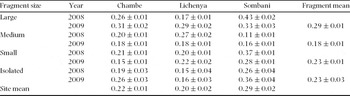
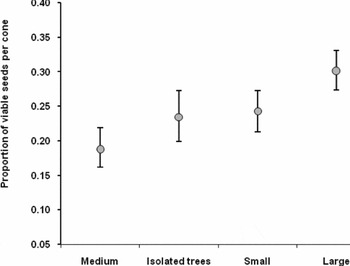
Seed viability was highly variable among fragments (F = 30.4; P < 0.0001). Large population sizes produced the highest proportion of viable seeds per cone (30.1%), while medium-sized populations produced the lowest (18.7%) (Table 1; Figure 2). Cones at Sombani produced a significantly higher proportion (F = 20.7; P < 0.0001) of viable seeds (29%) compared with those at Chambe and Lichenya (22% and 20% respectively). Although the effect of year was not significant (Table 1) some inter-annual variation in the proportion of viable seeds per cone was apparent within fragments of the same size. For example, large fragments at Chambe and Lichenya produced higher proportion of viable seeds per cone in 2009 compared with 2008 whereas the large fragment at Sombani produced higher proportion of viable seeds per cone in 2008 compared with 2009. Isolated trees produced higher proportion of viable seeds per cone in 2009 compared with 2008 at all sites (Table 1).
Proportion of viable seed produced per cone in different fragment sizes at three sites on Mulanje Mountain, Malawi. Figures were calculated from 20 cones per tree taken from four cone-bearing trees per fragment.

Variability in the mean proportion of viable seeds per cone of different Widdringtonia whytei fragment sizes on Mulanje Mountain. Vertical bars indicate 95% confidence intervals.

Effect of stem diameter and crown position on seed viability
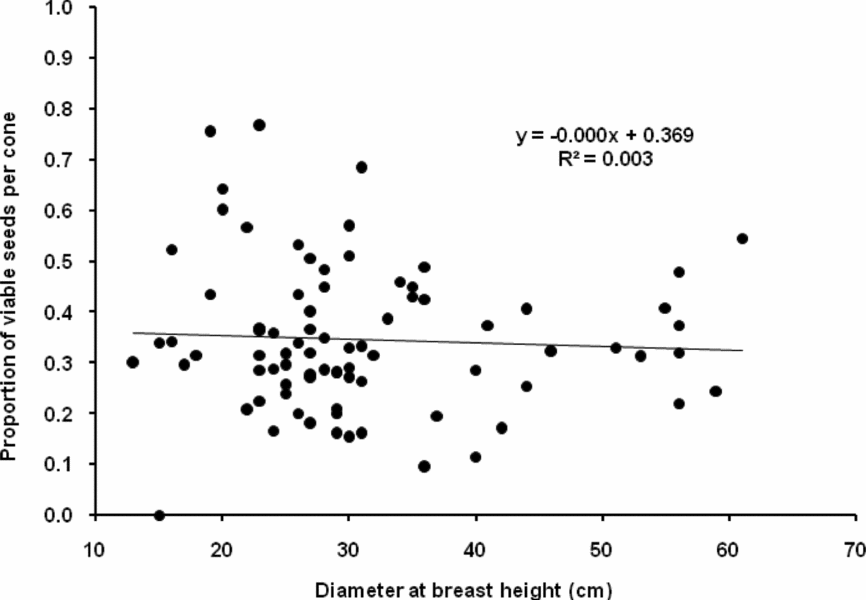
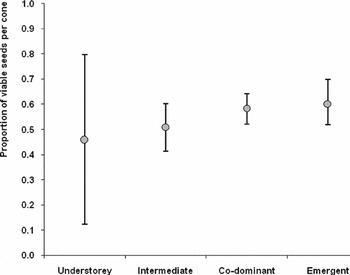
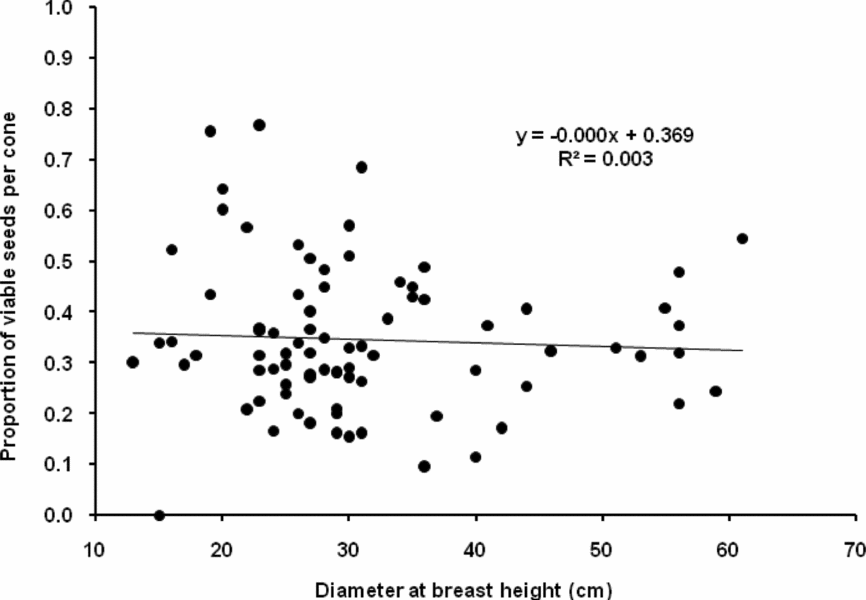
The proportion of viable seeds per cone did not significantly vary with tree size (R2 = 0.0032; n = 86). Cones in trees with smaller stem diameters produced slightly higher proportion of viable seeds than cones in trees with larger stem diameters (Figure 3). Similarly, crown position did not have a significant influence on the proportion of viable seeds per cone (F = 1.02; P = 0.382). Cones from the emergent and co-dominant trees produced higher seed viability (60% and 59% respectively), but they were not significantly different from those produced by understorey and intermediate trees (47% and 51% respectively). Cones from understorey trees had the lowest seed viability, while being the most variable (Figure 4).
The relationship between the proportions of viable seeds per cone and tree stem diameter at breast height in Widdringtonia whytei on Mulanje Mountain.
The relationship between the proportions of viable seeds per cone and crown position in Widdringtonia whytei on Mulanje Mountain. Vertical bars indicate 95% confidence intervals.

DISCUSSION
According to our results, the proportion of viable seeds per cone was not related to population size and thus might be governed by different ecological processes. Studies conducted elsewhere reported similar findings (Cascante et al. Reference CASCANTE, QUESADA, LOBO and FISCH2002, Dick Reference DICK2001). These results and earlier studies (Aizen & Feinsinger Reference AIZEN and FEINSINGER1994, Wang et al. Reference WANG, SORK, WU and GE2010) highlight the complex nature of predicting the outcome of fragmentation on seed viability in fragmented plant populations. The proportion of viable seeds per cone was generally very low and this is evidence as to why W. whytei seed collection expeditions turn out to be very expensive. The observed low proportion of viable seeds per cone could probably result from pollination failure due to lower pollen quantity or quality produced by this species. Our field observations on the flowering phenology on W. whytei indicated that male cone production was irregular on most trees with the highest number of cones being produced during the months of November and December. In addition, male cones were observed on very few branches during the same period. Similarly, low pollen production was associated with low proportion of viable seeds per fruit in a naturally fragmented population of Parnassia palustris (Bossuyt Reference BOSSUYT2006). The most important attributes determining pollination efficiency are the timing, duration and intensity of flowering in plants simplified as synchronous or asynchronous flowering (Bronstein Reference BRONSTEIN, Hansson, Fahrig and Merriam1995). However, little is known on the flowering pattern of W. whytei. Further research is therefore required to establish whether synchronous or asynchronous flowering pattern occurs in this species.
Our results showed variations in the proportion of viable seeds per cone among sites and this could be attributed to differences in environmental conditions. Sombani has been described as sheltered from strong winds, warmer and drier while Chambe and Lichenya are exposed to strong winds, and colder and wetter conditions (Chapman Reference CHAPMAN1995, Lawrence et al. Reference LAWRENCE, OSHINO and CHINGUWO1994). Warmer temperatures, sheltered and drier conditions could probably favour a higher proportion of viable seeds per cone in W. whytei, and this needs to be further investigated.
Despite the lack of annual variation in viable seed output between 2008 and 2009, there was high annual variation in the proportion of viable seeds per cone in some fragments of the same size within sites. These observations probably suggest reproductive isolation among different W. whytei populations on Mulanje Mountain. Similarly, Herrerias-Diego et al. (Reference HERRERIAS-DIEGO, QUESADA, STONER and LOBO2006) reported that trees in one habitat condition experienced reproductive isolation from trees found within other habitats on the same site each year.
Although cones produced by emergent and co-dominant trees had higher seed viability, they were not significantly different from those produced by understorey and intermediate trees. Cones produced by understorey or suppressed trees produced the lowest number of viable seeds. Cones from isolated trees that resembled the emergent trees failed to produce higher proportions of viable seeds compared to all fragment sizes. Again, our findings suggest that the proportion of viable seeds per cone in W. whytei might be governed by other ecological processes. Prevalence of adverse weather conditions such as high winds or storms particularly during key phenological events such as pollination can reduce viable seed output (Stephenson Reference STEPHENSON1981).
Conclusions
Our results have shown that the proportion of viable seeds per cone in W. whytei is not affected by population fragmentation, tree diameter and crown position in the forest canopy. It appears other ecological factors such as pollen limitation and environmental conditions are possible causes of the low proportion of viable seeds per cone observed in this study. Further studies are therefore needed to identify the factors that lead to the observed low proportion of viable seeds per cone, and how this influences whole-tree seed production in W. whytei.
ACKNOWLEDGEMENTS
This work was supported by The Millennium Seed Bank Project (MSBP) of the Royal Botanic Gardens – Kew and Mulanje Mountain Conservation Trust (MMCT) research fund. Special thanks are due to Carl Brussow, David Nagoma, J. Juwawo, F. Chakanja, E. Makawa and K. Likunda for providing logistical and personal support during the entire study period.