





No CrossRef data available.
Article contents
Understanding wind farm power densities
Published online by Cambridge University Press: 01 March 2023
Abstract
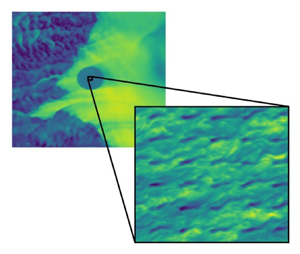
Kirby et al. (J. Fluid Mech., vol. 953, 2022, A39) adapted the two-scale momentum theory (Nishino & Dunstan, J. Fluid Mech., vol. 894, A2) to large finite-sized farms. They demonstrated that analytical estimates agree excellently with large eddy simulations, and that the model provides a good upper limit of the power production for a given array density. Crucially, they introduced the concepts of farm-scale losses, caused by the atmospheric response to the whole farm, and turbine-scale losses, owing to internal flow interactions in the wind farm. These two new theoretical concepts offer a novel way to analyse the performance of extended wind farms. For large offshore wind farms, losses at the wind-farm scale are typically twice as high as at the turbine scale. This demonstrates that there is limited potential for layout optimizations of extended arrays. Instead, optimization strategies should focus on developing methods to increase the energy entrainment into the wind farm. This work provides an exciting roadmap for analysing the effective efficiency of large wind farms.
Information
- Type
- Focus on Fluids
- Information
- Creative Commons

 This is an Open Access article, distributed under the terms of the Creative Commons Attribution licence (http://creativecommons.org/licenses/by/4.0), which permits unrestricted re-use, distribution and reproduction, provided the original article is properly cited.
- Copyright
- © The Author(s), 2023. Published by Cambridge University Press.
References
Abkar, M. & Porté-Agel, F. 2013 The effect of free-atmosphere stratification on boundary-layer flow and power output from very large wind farms. Energies 6 (5), 2338–2361.CrossRefGoogle Scholar
Antonini, E.G.A. & Caldeira, K. 2021 Atmospheric pressure gradients and Coriolis forces provide geophysical limits to power density of large wind farms. Appl. Energy 281, 116048.CrossRefGoogle Scholar
Bastankhah, M. & Porté-Agel, F. 2014 A new analytical model for wind-turbine wakes. Renew. Energy 70, 116–123.CrossRefGoogle Scholar
Bleeg, J., Purcell, M., Ruisi, R. & Traiger, E. 2018 Wind farm blockage and the consequences of neglecting its impact on energy production. Energies 11 (6), 1609.CrossRefGoogle Scholar
Calaf, M., Meneveau, C. & Meyers, J. 2010 Large eddy simulations of fully developed wind-turbine array boundary layers. Phys. Fluids 22, 015110.CrossRefGoogle Scholar
Fischereit, J., Brown, R., Larsén, X.G., Badger, J. & Hawkes, G. 2022 Review of mesoscale wind-farm parametrizations and their applications. Boundary-Layer Meteorol. 182 (2), 175–224.CrossRefGoogle Scholar
Frandsen, S. 1992 On the wind speed reduction in the center of large clusters of wind turbines. J. Wind Engng Ind. Aerodyn. 39, 251–265.CrossRefGoogle Scholar
Frandsen, S., Barthelmie, R.J., Pryor, S., Rathmann, O., Larsen, S., Højstrup, J. & Thøgersen, M. 2006 Analytical modeling of wind speed deficit in large offshore wind farms. Wind Energy 9, 39–53.CrossRefGoogle Scholar
Jensen, N.O. 1983 A note on wind generator interaction. Risø-M-2411, Risø National Laboratory, Roskilde.Google Scholar
Kirby, A., Nishino, T. & Dunstan, T.D. 2022 Two-scale interaction of wake and blockage effects in large wind farms. J. Fluid Mech. 953, A39.CrossRefGoogle Scholar
Li, C., Liu, L., Lu, X. & Stevens, R.J.A.M. 2022 Analytical model of fully developed wind farms in conventionally neutral atmospheric boundary layers. J. Fluid Mech. 948, A43.CrossRefGoogle Scholar
Luzzatto-Fegiz, P. & Caulfield, C.P. 2018 Entrainment model for fully-developed wind farms: effects of atmospheric stability and an ideal limit for wind farm performance. Phys. Rev. Fluids 3, 093802.CrossRefGoogle Scholar
Meneveau, C. 2012 The top-down model of wind farm boundary layers and its applications. J. Turbul. 13 (7), 1–12.CrossRefGoogle Scholar
Meneveau, C. 2019 Big wind power: seven questions for turbulence research. J. Turbul. 20 (1), 2–20.CrossRefGoogle Scholar
Meyers, J., Bottasso, C., Dykes, K., Gebraad, P.A., Flemingnd, P., Giebel, G., Göçmen, T. & van Wingerden, J.-W. 2022 Wind farm flow control: prospects and challenges. Wind Energ. Sci. 7, 2271–2306.CrossRefGoogle Scholar
Meyers, J. & Meneveau, C. 2012 Optimal turbine spacing in fully developed wind farm boundary layers. Wind Energy 15, 305–317.CrossRefGoogle Scholar
Newman, B.G. 1977 The spacing of wind turbines in large arrays. Energy Convers. 16, 169–171.CrossRefGoogle Scholar
Nishino, T. & Dunstan, T.D. 2020 Two-scale momentum theory for time-dependent modelling of large wind farms. J. Fluid Mech. 894, A2.CrossRefGoogle Scholar
Peña, A. & Rathmann, O. 2014 Atmospheric stability-dependent infinite wind-farm models and the wake-decay coefficient. Wind Energy 17, 1269–1285.CrossRefGoogle Scholar
Segalini, A. & Dahlberg, J.-Å. 2020 Blockage effects in wind farms. Wind Energy 23 (2), 120–128.CrossRefGoogle Scholar
Sescu, A. & Meneveau, C. 2015 Large eddy simulation and single column modeling of thermally stratified wind-turbine arrays for fully developed, stationary atmospheric conditions. J. Atmos. Ocean. Technol. 32, 1144–1162.CrossRefGoogle Scholar
Starke, G.M., Meneveau, C., King, J.R. & Gayme, D.F. 2021 The area localized coupled model for analytical mean flow prediction in arbitrary wind farm geometries. J. Renew. Sustain. Energy 13 (3), 033305.CrossRefGoogle Scholar
Stevens, R.J.A.M., Gayme, D.F. & Meneveau, C. 2016 Generalized coupled wake boundary layer model: applications and comparisons with field and LES data for two real wind farms. Wind Energy 19 (11), 2023–2040.CrossRefGoogle Scholar
Stevens, R.J.A.M., Hobbs, B., Ramos, A. & Meneveau, C. 2017 Combining economic and fluid dynamic models to determine the optimal spacing in very large wind farms. Wind Energy 20 (3), 465–477.CrossRefGoogle Scholar
Stevens, R.J.A.M. & Meneveau, C. 2017 Flow structure and turbulence in wind farms. Annu. Rev. Fluid Mech. 49, 311–339.CrossRefGoogle Scholar
Veers, P., et al. 2022 Grand challenges: wind energy research needs for a global energy transition. Wind Energ. Sci. 7, 2491–2496.CrossRefGoogle Scholar
Veers, P., et al. 2019 Grand challenges in the science of wind energy. Science 366 (6464), eaau2027.CrossRefGoogle ScholarPubMed

Figure 1. Comparison of turbine-scale loss (TSL) and farm-scale loss (FSL) with what is known as wake loss (WL) and farm blockage loss (FBL). Here  $C_{p,1}$ is the power coefficient recorded by a farm's first row of turbines. Adapted from Kirby et al. (2022).
 You have
Access
 Open access
- 5
- Cited by
1. Introduction
Wind energy is one of the leading renewable energy technologies and is key to the renewable energy transition. When wind turbines are placed together in a wind farm, they produce less energy than when placed in isolation. The harvesting of wind energy leads to the formation of wind turbine wakes, a region with reduced wind speed, behind each turbine. These wind turbine wakes affect the performance of downstream turbines in the farm. In addition, large wind farms act as additional resistance to the atmospheric boundary layer (ABL). This reduces the wind speed upstream and inside the farm, which affects the power production of the wind farm compared with the ideal situation where the upstream wind speed is not affected (Nishino & Dunstan Reference Nishino and Dunstan2020). This effect is known as farm blockage (Bleeg et al. Reference Bleeg, Purcell, Ruisi and Traiger2018; Segalini & Dahlberg Reference Segalini and Dahlberg2020) and its importance has only been recognised recently as large wind farms began to operate. Understanding the interactions between wind farms and flow in the ABL flow is one of the grand challenges the wind energy community faces (Veers et al. Reference Veers2019, Reference Veers2022), and is a prime example of a 21st century fluid dynamics problem for which more fundamental insight needs to be developed.
Two main analytical approaches are employed to model wind farm performance, which is crucial to optimise their design. The first approach is based on modelling wind turbine wakes and can be considered a bottom-up or wake modelling approach (Jensen Reference Jensen1983; Bastankhah & Porté-Agel Reference Bastankhah and Porté-Agel2014). Wake models generally work well for the entrance region of the wind farm and are commonly employed to optimise wind farm design. However, field and wind tunnel data comparisons have demonstrated that wake models have limitations in capturing wake–wake and wind farm–ABL interactions.
The second approach is known as the top-down or single-column approach, in which momentum analysis and horizontal averaging are used to estimate the flow inside the wind farm. Seminal works (Newman Reference Newman1977; Frandsen Reference Frandsen1992; Frandsen et al. Reference Frandsen, Barthelmie, Pryor, Rathmann, Larsen, Højstrup and Thøgersen2006) show that including a resistive force at the turbine height and the resistive force at the ground allows for crucial insights into the vertical velocity profile inside the wind farm. Calaf, Meneveau & Meyers (Reference Calaf, Meneveau and Meyers2010) developed an improved top-down model by including an additional wake layer with enhanced turbulence levels. Later works have extended this approach to finite-length wind farms (Meneveau Reference Meneveau2012), and included atmospheric stratification effects (Abkar & Porté-Agel Reference Abkar and Porté-Agel2013; Peña & Rathmann Reference Peña and Rathmann2014; Sescu & Meneveau Reference Sescu and Meneveau2015; Li et al. Reference Li, Liu, Lu and Stevens2022). Although top-down models include the response of an idealised ABL to a large wind farm, this approach cannot account for layout effects.
Efforts at combining top-down and bottom-up approaches include the work of Frandsen et al. (Reference Frandsen, Barthelmie, Pryor, Rathmann, Larsen, Højstrup and Thøgersen2006). This work developed a novel coupling between wake and top-down models, which considers a single column of turbines in a farm. However, this limits the applicability of the model to regular arrays. The coupled wake boundary layer (CWBL) model (Stevens, Gayme & Meneveau Reference Stevens, Gayme and Meneveau2016) widens the applicability of coupled models by introducing a two-way coupling between a wake model and a top-down model. This approach agrees well with large eddy simulations (LES) and field observations and has been extended to general wind farm layouts (Starke et al. Reference Starke, Meneveau, King and Gayme2021).
An important question is whether there is a theoretically derivable maximum power density for large wind farms. For single turbines, the German physicist Albert Betz showed, using the principles of mass and momentum conservation of the airflow through an idealised actuator disc, that no turbine can capture more than $59.3\,\%$ of the kinetic energy in the wind. In reality, most turbines are placed within large wind farm clusters. For wind farms, no fundamental performance limit has been derived yet as the underlying mechanism depends on turbulence. For extended wind farms the primary source of kinetic energy is the flow energy entrained from the geostrophic wind above the farm. Hence, the turbulence entrainment sets a physical limit to power output density that can be obtained with wind farms. This limit should not be confused by the optimal wind turbine spacing, which results from the balance between economical considerations and the wind farm fluid dynamics (Meyers & Meneveau Reference Meyers and Meneveau2012; Stevens et al. Reference Stevens, Hobbs, Ramos and Meneveau2017).
Although deriving a fundamental limit for the performance of wind energy clusters from first principles has remained elusive, various modelling approaches have been explored. As top-down models estimate the energy flux from above they can be used to estimate the maximum wind farm power density (Meneveau Reference Meneveau2019). Luzzatto-Fegiz & Caulfield (Reference Luzzatto-Fegiz and Caulfield2018) developed a two-interface entrainment model for fully developed wind farms to analyse the power output density of wind farms. Their main result is that the wind farm power density is proportional to the rate at which energy is entrained from the ABL. The predicted power output agrees well with field measurements when tailoring the model to reflect current wind farm designs. Furthermore, they showed that the performance of a wind farm can be about an order of magnitude higher in the idealised situation where the boundary layer mixes perfectly with the flow inside the wind farm. Antonini & Caldeira (Reference Antonini and Caldeira2021) showed with mesoscale simulations and model calculations that the maximum achievable power output density of wind farms is primarily determined by the strength of the geostrophic wind that drives the boundary layer flow. Kirby, Nishino & Dunstan (Reference Kirby, Nishino and Dunstan2022) introduced a combined theoretical and computational approach to analyse fluid mechanics processes that determine the optimal performance of extended wind farms. This approach provides new estimates for optimal wind power density and a novel way to study the effective efficiency of extended wind turbine arrays.
2. Overview
Kirby et al. (Reference Kirby, Nishino and Dunstan2022) employed the two-scale momentum theory introduced by Nishino & Dunstan (Reference Nishino and Dunstan2020) to estimate the power production of large wind farms. This theory splits the multi-scale flow into external and internal subproblems. The external farm-scale determines the amount of momentum available to the bottom resistance of the ABL. The internal turbine scale describes this resistance in terms of wind turbine drag and land/sea surface friction. The two subproblems are coupled to each other through a non-dimensional parameter known as the farm induction factor. Using LES, they demonstrate that the model accurately predicts the power output of infinite wind turbine arrays, even though the theory does not account for the wind farm layout. The observation that the layout does not affect the performance of extended wind farm arrays is in line with previous LES (Stevens & Meneveau Reference Stevens and Meneveau2017). An exciting contribution is the extension of the two-scale momentum theory to estimate the optimal power density of large finite-sized farms with the same layout. They demonstrated that the power production of such farms depends on both the array density and turbine layout and that the analytical model provides a good upper limit of the power production for a given array density.
Crucially, Kirby et al. (Reference Kirby, Nishino and Dunstan2022) provided a novel analysis of the underlying fluid dynamics. They introduced the concept of turbine-scale losses $\varPi _T$, due to internal flow interactions in the wind farm, and wind-farm-scale losses
 $\varPi _F$, which indicate the overall performance loss due to the interaction between the wind farm with the ABL. Farm-scale losses estimate the optimal wind farm performance that can be expected for a given array density. Turbine-scale losses indicate the losses that can be prevented by optimising the wind farm layout. This novel approach introduces an exciting new concept to assess the effective efficiency of extended wind turbine arrays, i.e. how well does a wind farm perform compared with the estimated optimal performance for the given array density.
Kirby et al. (Reference Kirby, Nishino and Dunstan2022) demonstrate that for large offshore wind farms, losses at the wind-farm scale are typically twice as high as the losses at the turbine scale. Furthermore, the ratio between the farm- and turbine-scale losses increases with wind farm size. Figure 1 shows that these turbine-scale losses are smaller than traditional wake losses, which also include effects induced by the response of the ABL to the flow resistance imposed by the wind farm. This novel analysis demonstrates that the performance of large turbine arrays is mostly determined by the overall interaction between the wind farm and the ABL rather than by direct interactions among the turbines. This convincingly shows that the potential for layout optimisations of extended arrays is limited. The two-scale momentum theory thus correctly captures the effect of the energy entrainment from higher atmospheric layers into the wind farm. Furthermore, the analysis indicates that the turbine-scale losses depend on the strength of the large-scale atmospheric response, i.e. how much momentum can be extracted from the higher atmospheric layers, and the wind farm size. Additional insight into these dependencies will be crucial to assess the effective efficiency of large wind farms.
Comparison of turbine-scale loss (TSL) and farm-scale loss (FSL) with what is known as wake loss (WL) and farm blockage loss (FBL). Here $C_{p,1}$ is the power coefficient recorded by a farm's first row of turbines. Adapted from Kirby et al. (Reference Kirby, Nishino and Dunstan2022).
3. Future
The insights of Kirby et al. (Reference Kirby, Nishino and Dunstan2022) provide an exciting roadmap to study the performance of extended wind farms. The present study focused on neutral atmospheric conditions and statistical stationary situations. Given that the model relies on momentum theory, the general observations are expected to extend to a wider range of atmospheric stability conditions. However, more investigation will be required to quantify how momentum extraction depends on atmospheric conditions and wind farm layout and size. In addition, the momentum entrainment into the wind farm may be affected by the dynamic changes in geostrophic forcing that drive the ABL. Numerical weather prediction models provide an excellent avenue to study this, although it should be realised that an accurate representation of wind farms in such models is challenging (Fischereit et al. Reference Fischereit, Brown, Larsén, Badger and Hawkes2022). Furthermore, the insight that layout optimisations will not be effective in larger wind farm arrays confirms that other optimisation strategies urgently need to be pursued. A key question, for example, is whether dynamic wind farm control strategies (Meyers et al. Reference Meyers, Bottasso, Dykes, Gebraad, Flemingnd, Giebel, Göçmen and van Wingerden2022) can increase the wind farm's overall momentum entrainment.
Declaration of interests
The author reports no conflict of interest.