Identifying the scribe responsible for the compilation of a music theory manuscript may not be seen as a particularly crucial matter. It can turn out to be fairly relevant, however, in the case of sources that have acquired some weight and centrality in scholarly discussions, because it may cast light on the intellectual context in which those sources were compiled, and on their intended readership. In this article, I wish to offer a hypothesis concerning the identity of the elusive ‘G de Anglia’, the scribe who identifies himself in the manuscript that is now Chicago, Newberry Library, 54.1, reconsidering some assumptions that have been made about this manuscript in relation to historiographical questions not exclusively pertaining to the realm of music theory.
The Chicago manuscript is generally believed to have been copied in Pavia in 1391–92 on the basis of the colophon placed at the end of the first treatise (fol. 6v). From this we learn that a ‘F[rater] G de Anglia’ copied the treatise in the Lombard city on 2 October 1391 (‘Papie scriptum 2. octobris 1391’); the consistency of scribal hand and decoration throughout lends support to the view that the whole manuscript was completed in Pavia within a short period of time.
Chicago 54.1 has been the object of much scholarly interest, largely because of the presence of two items: the Ars subtilior song La harpe de melodie by Jacob Senleches, famously notated in the shape of a harp,Footnote 1 and the Tractatus figurarum, a treatise on note shapes reflecting notational and rhythmic developments of the late stages of Ars Nova.Footnote 2 Other contents of the manuscript include the Lucidarium and Pomerium by Marchetto da Padova, treatises on mensural music associated with Johannes de Muris and Philippe de Vitry, and shorter materials on proportions and intervals.Footnote 3 Scholars have directed their attention primarily to the presence in the manuscript of the Tractatus figurarum and La harpe de melodie, mainly in the context of discussions concerning the geography of the so-called Ars subtilior. In fact, in the past two decades Pavia has emerged in the consideration of musicologists as a major centre of cultivation of this repertory, in view of the links with the house of Valois and consequent Francophile tastes of the court of Gian Galeazzo Visconti (r.1385–1402), and of the Visconti connections which have been pointed out in compositions represented in sources such as the Lucca and Modena manuscripts.Footnote 4 In an influential essay, Reinhard Strohm proposed that much of the repertory originated within the Visconti court.Footnote 5 He and other scholars have also indicated in Gian Galeazzo's Pavia the possible place of compilation of the Chantilly codex.Footnote 6 Part of Strohm's hypothesis and his later discussion are based on conjectures about the careers and circulation of works of major figures of the Ars subtilior, including Philipoctus de Caserta and Jacob de Senleches.
No documentary evidence is extant for Philipoctus's whereabouts and activity. Hypotheses concerning his biography so far have been based on references in the texts of a few of his songs to events in the early years of the Great Schism (late 1370s and early 1380s) and to Bernabò Visconti, Louis I of Anjou and the Avignon Pope Clement VII. The assumption that Philipoctus was active in AvignonFootnote 7 was revised by Strohm, who argued that the composer may never have left Italy, and suggested that he was probably active at the court of Gian Galeazzo Visconti instead sometime in the 1380s–90s. For the group of songs starting with the words ‘En attendant’ by Philipoctus de Caserta, Jacob Senleches and Galiot, Strohm proposed an origin within the Visconti court (mainly in view of the presence of Bernadò Visconti's motto in Philipoctus's En attendant souffrir). The citation of three songs by Philipoctus in Ciconia's Sous une fontayne has also led Strohm to suggest that the two composers met in Pavia (building on an earlier interpretation by Ursula Günther of the ‘fountain’ as a symbol of Visconti patronageFootnote 8). Recent scholarship has argued against this hypothesis, associating the origin of the intricate nexus of textual and musical allusions in these songs with purely literary practices, and Yolanda Plumley has reproposed for Philipoctus an association with French princely circles or papal Avignon.Footnote 9
The presence of La harpe de melodie in Chicago 54.1 has provided a further element in support of the Visconti hypothesis and suggested a connection between Senleches and Pavia in the years around 1390. Nothing is known of Senleches except that he was a jongleur de harpe in the service of Eleanor of Aragon, queen of Castile, in 1382 and of Cardinal Pedro de Luna, future Pope Benedict XIII, in 1383. It is very likely that the song was conceived to be associated with a sophisticated pictorial representation, such as the one in the Chicago manuscript, to please performer and reader alike, as its text indicates. This is why the copy in Chicago 54.1, compared with the usual layout of the other known version in the Chantilly codex, is regarded as the closest to the author.Footnote 10 Strohm proposed a direct connection between the composition of the song, its notation in the Chicago manuscript and Visconti patronage.Footnote 11 Other hypotheses on the origin of the song have also assumed a Visconti connection.Footnote 12
Similarly, the inclusion of the Tractatus figurarum has seemed to provide evidence of the centrality of Pavia (both court and university) in theoretical discussions concerning notational and compositional practices of the late fourteenth century. The treatise, believed to date from the third quarter of the fourteenth century, presents a system of new note shapes intended to allow for the notation of complex rhythms. Chicago 54.1 contains the earliest known dated copy and therefore has acquired a central importance in the discussion of the treatise's authorship – even, as recently observed by Giuliano Di Bacco, overshadowing other sources that may be as relevant.Footnote 13 The Tractatus figurarum is transmitted anonymously in some manuscripts, and in other sources is attributed either to Egidius de Murino (the author of a treatise De motettis componendis), or to the composer Philipoctus de Caserta. Wulf Arlt showed in the 1970s that the attribution to Egidius is erroneous, and also rejected that to Philipoctus;Footnote 14 other scholars have also raised doubts on the attribution to Philipoctus, mainly because of the incongruity between the notational systems and rhythmic style of his extant works and the system proposed in the Tractatus figurarum.Footnote 15 To complicate the matter further, Chicago 54.1 is the only source that attributes the treatise to ‘Phillipoctus Andree’, leading Strohm to suggest (also in view of the conjectured links of Philipoctus de Caserta with Visconti Pavia) that Phillipoctus Andree is identical with the composer.Footnote 16 In his reconsideration of the transmission of the Tractatus figurarum and short texts on counterpoint also attributed to Philipoctus de Caserta, Di Bacco inclines towards the hypothesis that the Philipoctus ‘from Caserta’ and the Philipoctus ‘son of Andreas’ were probably the same person as well, and that because of the fame of Philipoctus as a composer, his name was associated with the Tractatus figurarum and other theory treatises.Footnote 17 However, Di Bacco also points out that there seem not to be enough elements to assume that the copy in Chicago 54.1 is the closest to the author, and therefore, even if ‘Andree’ was the composer's patronym, this could still not be regarded as evidence of the presence of Philipoctus de Caserta in Pavia.Footnote 18
Turning now to ‘G de Anglia’, it has been suggested that, as a mendicant friar, he may have had contacts with university circles, and also that he may have been a student or scholar himself (though no candidate for a ‘G de Anglia’ is to be found in the published extant documents of the University of Pavia).Footnote 19 An association of Chicago 54.1 and its scribe with both the Visconti court and the university (which was founded and supported by the Visconti) has therefore been assumed and largely remained unquestioned. Affirming this connection, Lucia Marchi suggested recently that the collection responded to the teaching needs of an academic music curriculum that was taking shape at the University of Pavia during Gian Galeazzo's rule and was stimulated by the advanced musical practices cultivated at the Visconti court.Footnote 20 This perspective may now need to be adjusted.
Colophons should always be treated with some caution: after all, they only provide a terminus ante quem for the copying of a given text. In the case of the Chicago manuscript, however, the indications in the colophon are supported by a piece of documentary evidence. As it happens, there is a possible candidate for ‘G de Anglia’ in the person of an English friar by the name of Guillelmus, who was among those present at a chapter of the Hermits of St Augustine in Pavia, which gathered on 1 February 1392. The chapter was summoned by the then prior, Giovanni da Genova, to settle some legal transactions involving a member of the monastery, a certain Zanino Formaggiari, who believed himself to have suffered an injustice on the occasion of the inheritance of his brothers Franceschino and Agostino. The crucial document is kept in the State Archives of Milan together with a few other documents concerning the administration of properties and inheritances that involved the Augustinian friars. It seems to have been overlooked by scholars, and in fact it may not be of great relevance in itself; but it becomes significant when considered alongside other elements, as shall become apparent below. As is customary, the document begins with the names of the members of the chapter present that day:Footnote 21
Anno a nativitate domini millesimo trecentesimo nonagesimo secondo, Indicione quintadecima die primo mensis Februari in cittadella civitatis Papiae videlicet in capitulo fratrum heremitarum Sancti Augustini sito in porta pallacii in parrocchia Sancti Andree … Idcirco convocato et congregato capitulo dicti conventus predictorum fratrum heremitarum Sancti Augustini de mandato domini Johannis de Janua prioris dicti ordinis et conventus in quo quidem capitulo fuerunt et sunt infrascripti fratres videlicet ipse dominus prior et frater Johannes de Alemania bachalarius, frater Gregorus de Cremona subprior, frater Michael de Terdona lector, frater Johannes de Astrexia de Novaria, frater Ludovichus de Becharia, frater Johannes de Saglinbenis, frater Augustinus de Ferrariis, frater Guillelmus de Anglia, frater Benedictus de Tagliabovibus, frater Antonius de Terdona, frater Luchinus de Comitibus, frater Augustinus de Sancta Agatha, frater Symon de Salla, frater Dominichus de Mediolano, frater Thomas de Anglia, frater Zaninus de Montezucho, frater Cominus de Cremona et frater Facinus de Fortunagho qui omnes sunt et se esse diserunt plus quam tres partes tocius dicti capituli dicti conventus predicti.
It is worth giving an overview of the context in which this English Guillelmus is found. The Augustinian house in Pavia was an important spiritual centre for the order, because the relics of their patronal saints were buried in the basilica attached to it, San Pietro in Ciel d'Oro. The basilica was also renowned as Boethius's burial. The church had been the base of the regular canons of St Augustine since 1222, but in the first half of the fourteenth century the Hermits of St Augustine were transferred to San Pietro in Ciel d'Oro by order of Pope John XXII (r.1316–34) and, together with the canons, were entrusted with the custody of the saint's relics and the jurisdiction of the church.Footnote 22 A studium generale was established in the Augustinian house in the 1340s. As was common for most of the larger Augustinian houses in Europe, which had developed scriptoria since the outset (especially the ones which maintained studia generalia), there was a renowned scriptorium attached to San Pietro in Ciel d'Oro, which produced several books for influential patrons connected with the Visconti court, and for Gian Galeazzo himself. The workshop of friar Pietro da Pavia (fl. 1385–90) in particular is known to have executed lavishly decorated books, the most famous of which are probably a copy of Pliny's Historia naturalis, produced for Gian Galeazzo's secretary, Pasquino Capelli,Footnote 23 and a copy of a law book containing the De feudis by Baldo degli Ubaldi (the outstanding jurist who taught in Pavia in 1393) for Gian Galeazzo.Footnote 24 The texts of other famous books, such the Offiziolo decorated by Giovannino de’ Grassi, were copied by Augustinians of San Pietro in Ciel d'Oro.Footnote 25 Other more modest books are also known to have been produced in the Augustinian scriptorium for patrons who were connected with the university. For example, another famous illuminated copy of the De consolatione philosophiae of Boethius is believed to have been decorated by Pietro da Pavia and his workshop for Baldo degli Ubaldi.Footnote 26 The Hermits also sustained major works to embellish the basilica of San Pietro in Ciel d'Oro, including an altarpiece and frescoes with histories of St Augustine (all lost today), and the celebrated arca, or shrine, of St Augustine, believed to have been begun in 1365.Footnote 27
It is possible that Guillelmus de Anglia studied for a while in the Augustinian house in Pavia. Indeed, the main reason for members of the mendicant orders to spend a certain length of time at a monastery abroad was to study or teach. Although regulations differed for each of the mendicant orders, a fixed number of students from foreign provinces could be appointed (usually by the general master on recommendation of the provincial priors) to read at each of the studia generalia, in preparation either for the highest academic degree, the magisterium theologiae with the licentia ubique docendi (the licence to teach everywhere), or for lesser degrees enabling them to teach at provincial schools of their respective orders. From about 1360 onwards, the highest degree, which until then could be granted only by the universities of Paris, Oxford and Cambridge, could be conferred by other universities in Europe. Indeed, once the mendicants’ academic system was consolidated in the late thirteenth and early fourteenth centuries, the exchange of students and professors appointed to the various studia of each order was one of the crucial factors for cultural contacts and exchange in medieval Europe.Footnote 28
The internationality of the mendicants’ academic system was undermined by the division of the Church during the Great Schism (1378–1415), which caused most of the orders to divide and declare obedience to either the Roman or the Avignon pope. Decrees were issued that prohibited the friars from going to studia that adhered to the rival obedience. Nonetheless, this situation brought about further opportunities for contacts between Englishmen and Italians, since England maintained obedience to the Roman pope and, for some time, mobility and travel connected with academic appointments between Italy and England intensified. With regard to the Augustinian friars, the general chapter of the order that reunited at Würzburg in 1391 prohibited the friars from reading for a degree at Paris University so long as the institution supported the Avignon pope. Thus more students from the continent were assigned to English studia; after the Germans, the Italians appear to have constituted a relatively sizeable number. Among the insular Austin friars sent to continental studia, a fair proportion appears to have been sent to Italy.Footnote 29
Around the same time as Guillelmus, another English friar by the name of Thomas, also mentioned in the Ciel d'Oro document, was in the monastery. He may be the same Thomas of Evysham [Evesham?] who on 28 November 1391 had been appointed by the prior general to be a student in the monastery.Footnote 30 A year later, on 4 September 1392, a Thomas Skyle (probably the same person) was appointed in Pavia as a conventualis. Although we do not have for Guillelmus the same information that we have for Thomas, it is likely that the former was also assigned to the Pavia monastery as a student. Specifically, he may have been sent there for the customary three years of theological training that were required to advance to the next academic stages, those of cursor (three years) and then lector (three years). Cursores and lectores were required to teach on the Bible and Sentences besides pursuing their own studies, in order eventually to be admitted as bachelors of theology and finally, after another four years, become eligible for the magisterium theologiae. Guillelmus de Anglia may have stayed at the Pavia monastery for a period of three to five years; the period spent as a student at a studium generale was usually three years and could not exceed five, and the student had to provide for his own expenses after the first three years.Footnote 31
While the presence of this English Guillelmus in Pavia in February 1392 – that is, only four months after ‘G de Anglia’ copied the first treatise in the collection – is no doubt intriguing, it might be just a coincidence. Other English friars (with the initial ‘G’) of the Augustinians or other orders, of whom no record is extant (or has been found), may well have been in the city around that time.Footnote 32 It would be naive to consider it a sufficient identification simply to find an English Guillelmus at the right place and time. It is therefore the Augustinian connection, coupled with the right place and time, that makes him a highly plausible candidate for ‘G de Anglia’.
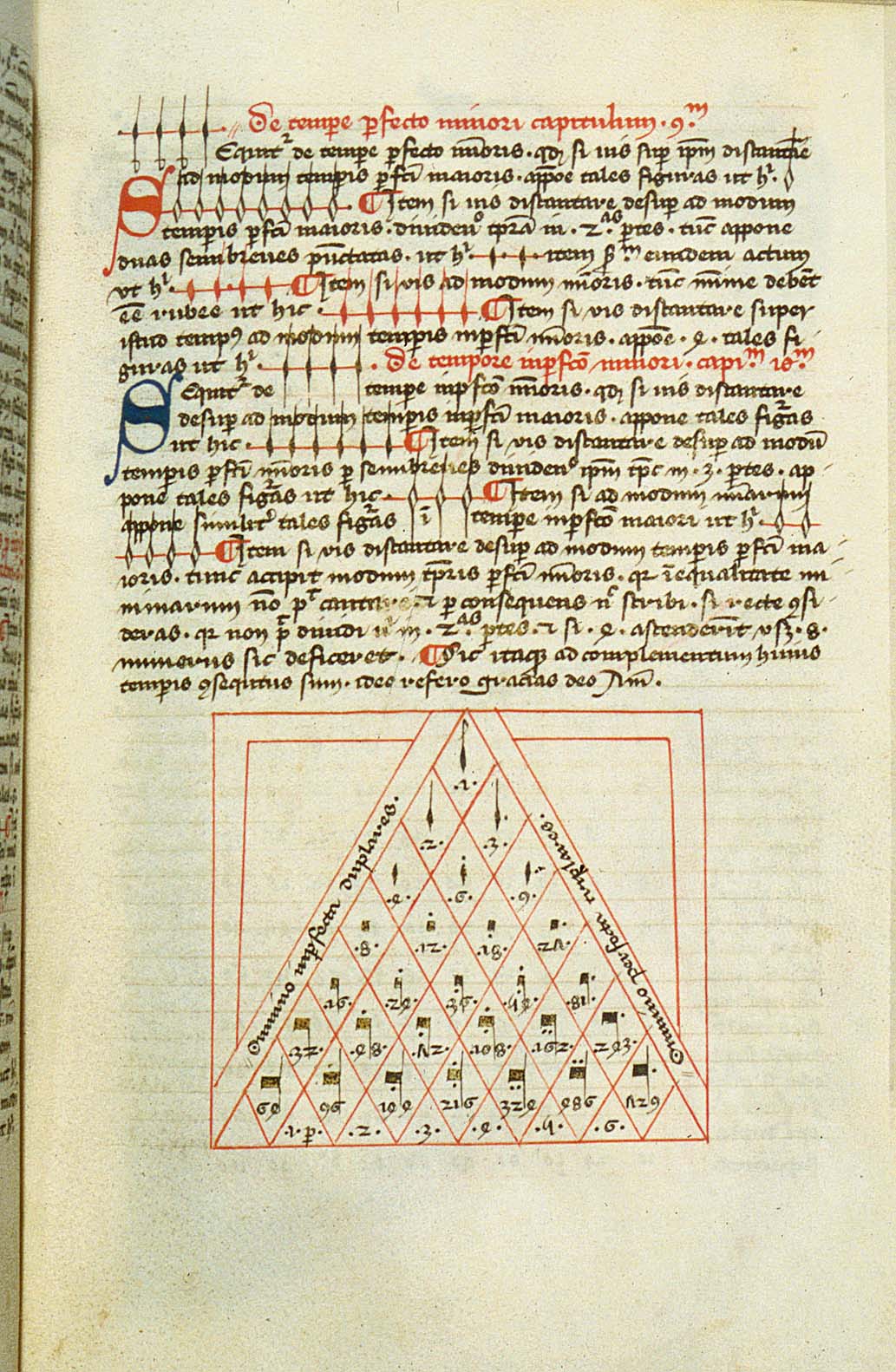
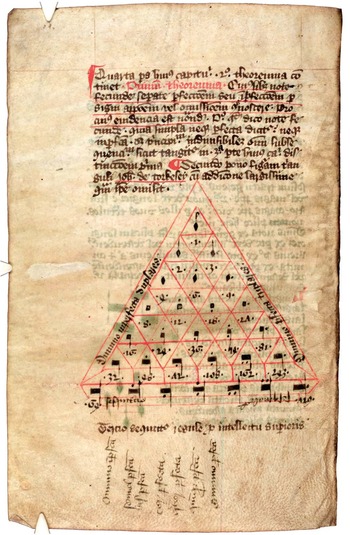
It is worth looking closer at an item whose inclusion in the manuscript has been considered simply as an obvious choice given the English origins of the copyist. On fol. 9v Chicago 54.1 includes a full-page illustration of the so-called Triangle of Torkesey, a diagram of note shapes and corresponding values which was part of the Declaratio trianguli et scuti of Johannes Torkesey.Footnote 33 This short treatise is concerned with the expansion of the system of note values, something which had interested many English theorists after the 1320s – that is, after de Muris's systematisation in the Notitia artis musicae. The French theorist had set a system of five figures or partes prolationis (maxima, longa, brevis, semibrevis, minima), organised into four levels or gradus, where each notational value appeared as simple, double or triple. From the smallest possible figure, the minima, which was considered indivisible, the system proceeded up to the largest, the maxima, which was equivalent to a maximum of eighty-one minims. Most of the fourteenth-century English theorists who discussed de Muris's system and its expansion tended to favour augmentation towards larger values, and many proposed a new system based on six figures, adding beyond the longa (the English equivalent to de Muris's maxima) a ‘largissima’ or ‘longissima’ worth 243 minims.Footnote 34 Torkesey's treatise represented a divergent trend, in that it proposed a system which also expanded in the direction of values smaller than the minima, introducing the semiminima, also called ‘crocheta’ or ‘simpla’, an indivisible value smaller than the minima of the systems ascribed to de Muris and de Vitry. The expanded set of values in the Declaratio proceeded from the smallest simpla to the largest (which was called ‘larga’), equivalent to 243 simplae. This system was represented through a diagram which usually combined a figure of a triangle with another figure in the shape of a shield. The triangular figure showed all the possible combinations of perfections and imperfections in the mensural system, and the shield accompanying the triangle showed the six figurae from the simpla to the larga.Footnote 35
The popularity of Torkesey's Declaratio in England is attested to by its several copies, dating from the late fourteenth to the sixteenth century. The triangle-plus-shield diagram seems to have enjoyed even more popularity than the treatise itself, since it is found in a fair number of manuscripts without the Declaratio, and such is also the case with Chicago 54.1, where only the diagram is copied. Various versions and modifications of the treatise and attached diagram existed; in fact, the triangle is also found with seven and eight figures. The version copied in Chicago 54.1 (Fig. 1) shows a triangle with seven rows and corresponding figures, and a set of values from 1 to 729.
Triangle of Torkesey in Chicago 54.1, fol. 9r
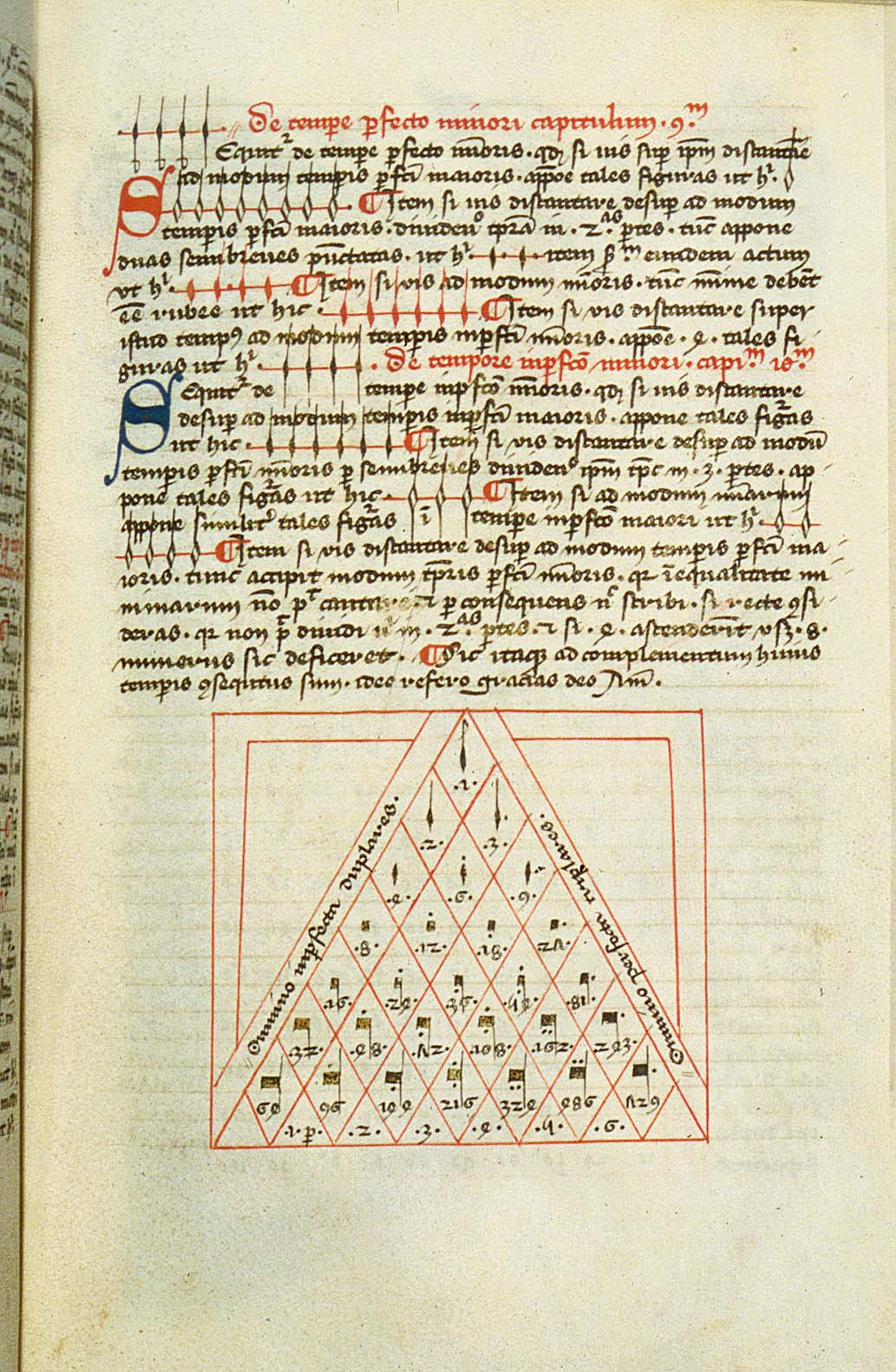
Given the popularity of the diagram in England, it is surely not surprising to find it in a collection copied by an English scribe. However, it is significant that ‘G de Anglia’ inserted a particular version of the diagram – the one with seven figures, otherwise known only from the Breviarium regulare musicae by Willelmus. In the Breviarium, Willelmus discusses Torkesey's system and brings the set of figures from six to seven, claiming that he has introduced a value larger than the larga, the largissima, with a resulting set of values from the simpla to the largissima comprising 729 simplae. The only known extant copy of the Breviarium with the relevant diagram is preserved in the English manuscript Oxford, Bodleian Library, Bodley 842 (see Fig. 2).Footnote 36 The diagram with the seven rows of values is virtually identical to that copied in Chicago 54.1.
Triangle of Torkesey in Bodley 842, fol. 71v

It is from an Augustinian context that we know the name of the author of the treatise. A copy of the Breviarium appears in a catalogue of the Augustinian priory of York drawn up in 1372. The treatise, anonymous in Bodley 842, is there ascribed to a Willelmus. The volume containing it appears among the over 220 books donated to the friars’ library by John Erghome, who was then a member of that monastery and eventually became its prior in 1385.Footnote 37 According to Montague R. James, the modern editor of the catalogue, the books donated by Erghome were added sometime after the initial production of a catalogue in 1372; they entered the library in the course of a few years and they were all listed under the heading ‘Libri magistri Johannis Erghome’. Erghome's book collection was probably one of the most important in England at the time; it formed more than a half of the entire holdings of the York library.
A scholar, theologian and book collector, John Erghome (c.1330–after 1386) was a prominent figure among the English Austin friars. As a writer, he authored a commentary on some Latin prophetic verses that refer, in a deliberately enigmatic language, to English political affairs during the reigns of Edward II and Edward III. These verses circulated widely in England with an attribution to John of Bridlington and in a few manuscripts are accompanied by Erghome's commentary in prose, which provides an explanation of the poem's cryptic allusions.Footnote 38 We know that Erghome was a member of the York priory in 1372, as his name appears among those friars who witnessed the official approval of the catalogue. He became magister theologiae at Oxford and in 1385 he is documented as prior of the York monastery and master regent of its studium. In May of that year, having been appointed master regent of the Augustinian studium at the Papal Curia, he set out to Italy. The papal court resided in the vicinity of Naples at that time, and the Augustinian house of that city, Sant'Agostino Maggiore, functioned as studium curiae for the order. Shortly after, he became magister antiquus – that is, senior regent – of Sant'Agostino Maggiore.Footnote 39 No documents concerning Erghome are extant after this appointment,Footnote 40 but other evidence has given rise to the assumption that he probably died in England in either 1406 or 1408.Footnote 41
Erghome's wide-ranging interests are reflected in his collection, which boasted several texts on theology and philosophy (with an almost complete set of Ockham's works), logic, mathematics, physics, astronomy and astrology, and a notable section of occult literature, on alchemy, necromancy and geomancy. Prophetic writings are also well represented, including two copies of the prophecies ascribed to John of Bridlington. There are also historical writings, and books on civil and canon law and medicine. Moreover, Erghome possessed a sizeable collection of literary and classical texts, most of which he probably acquired while in Oxford and during his travels in Italy. Among these were rare items such as a copy of Caesar's Commentaries, a Psalter and Canticles in Greek, a Bible in Hebrew, and also a volume containing the Genealogia deorum gentilium by Boccaccio.Footnote 42
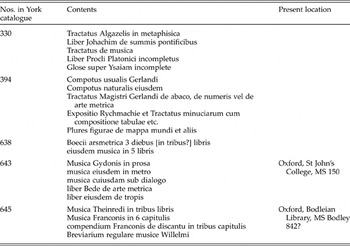
A small group of books contain writings about music (see Table 1). The item listed as number 330 in the inventory includes an unidentifiable ‘Tractatus de musica’ and also contains a number of dissimilar items, among which are works (presumably extracts) by al-Ghazzāli and Proclus, and a ‘liber Johachim de summis pontificibus’, the prophetic texts on the popes that circulated widely under the name of monk and theologian Joachim of Fiore.Footnote 43 While the item listed as number 394 does not contain works that are strictly about music, but mainly about calculus and fractions, it deserves interest for preserving a copy of the Rithmomachia (a treatise concerning a game on proportions, which is known to have circulated within clerical and university circles since the twelfth century).Footnote 44 A few volumes are grouped in the catalogue under the heading ‘Arsmetrica Musica Geometria Perspectiva’, including a volume with Boethius's De arithmetica and De musica (number 638),Footnote 45 and a book concerned with the more practical aspects of music, containing Guido's works (including the Regulae rhythmicae) alongside Bede's treatise De arte metrica (number 643).Footnote 46 Number 645, the one containing the ‘Breviarium regulare musicae Willelmi’, is the only manuscript in the list devoted entirely to treatises on music theory in a strict sense. It also includes a ‘Musica Theinredi in tribus libris’, a ‘musica Franconis in 6 capitulis’ and a ‘compendium Franconis de discantu in tribus capitulis’. This is exactly the same content as Bodley 842, and the sequence of the treatises is the same in both manuscripts.
Books with writings on music in Erghome's library

The first treatise copied in Bodley 842 is the De legitimis ordinibus pentachordorum et tetrachordorum by Theinred of Dover (on the species of consonances, now generally accepted to date from the twelfth century), unique to this manuscript, together with the Breviarium;Footnote 47 this is followed by the Ars cantus mensurabilis by Franco of Cologne and a compendium based on Franco; and finally by the Breviarium. The four main works in Bodley 842 form the core content of the volume and appear to have been copied by the same hand.Footnote 48 The same hand also copied the two-voice setting of a poem beginning ‘Ut pateat evidenter monochordi’.Footnote 49 It is worth noting, at least in passing, this curious coincidence between Bodley 842 and Chicago 54.1: both contain a single musical composition that, in different ways, is meant to provoke or amaze the intended reader (and listener) through the encoding of sophisticated musical–theoretical principles.
Going back to the York catalogue, James identified the music theory volume listed as no. 645 with Bodley 842. This has been questioned, mainly because of uncertainty with respect to the date of compilation of the Oxford manuscript. The rather conservative character of the script in the area where the manuscript was compiled, Yorkshire or Eastside, makes it difficult to date. Some scholars have suggested the early or mid-fourteenth century, others the very end of the century, and this later date is in conflict with the 1372 date of the catalogue.Footnote 50 Gilbert Reaney believed the Oxford manuscript to be a later copy of the York volume.Footnote 51 In the 1992 RISM entry, Christian Meyer assigned Bodley 842 to the first half of the fourteenth century, therefore lending more support to James's idea. Peter Leffert's discussion of the song ‘Ut pateat evidenter’ proposed an English authorship and a possible date of composition in the middle or perhaps the third quarter of the fourteenth century.Footnote 52 This would be in line with a date in the early 1370s for the compilation of the whole manuscript. Moreover, when considering the rarity of the work of Theinred of Dover (and its limited influence and circulation) and of the Breviarium, there seem to be more elements in support of James's identification.
Whether or not Bodley 842 is the original volume of the York catalogue, ‘G de Anglia’ was evidently familiar with the particular version of the Torkesey triangle discussed in the Breviarium, a copy of which was in the hands of Erghome in the 1370s and for some time in an Augustinian library.Footnote 53 Thus the treatise seems to have attracted some interest, and to have found a major channel of transmission, within an Augustinian milieu. For this reason, the inclusion of this version of the diagram in Chicago 54.1 is more meaningful than has been assumed so far; it certainly takes on more weight when considered alongside a possible identification of ‘G de Anglia’ as an Augustinian.
In this context, one further item of interest in Chicago 54.1 is de Muris's Notitia in the version of Petrus de Sancto Dionysio. Until recently this Petrus was believed to have been a monk of the Abbey of St Denis, but it has recently been shown that he was in fact an Augustinian Hermit. Carla Vivarelli convincingly identified him with the Augustinian Petrus de Sancto Dionysio, recorded as chaplain to King Robert of Sicily in Naples in 1317 and 1318 (the same years in which Marchetto da Padova is also documented as being clericus in the royal chapel in Naples). Petrus was in the entourage that accompanied King Robert to the residence of Pope John XXII in Provence (where the Neapolitan court sojourned until 1324), and it is likely that he did not return to Naples, but rather stayed in France.Footnote 54 He may be the ‘P de Saint Denis’ mentioned in the motet in praise of musicians of the Augustinian order Alma polis religio/Axe poli cum artica, preserved in the Chantilly codex.Footnote 55
Petrus was writing soon after the Notitia (after 1324–25) and was obviously aware of the current debates about the expansion of de Muris's system, which was a particular concern of English theorists. Petrus's reworking of the Notitia contains references to a not otherwise known Philipoctus who is said by Petrus to have expanded de Muris's system from five to six figures by adding a larger value (an innovation which Petrus deems unnecessary), the same system described in the English Tractatus de figuris sive de notis.Footnote 56 Signs of contacts with English theory are evident also in a set of rests, identical to the system of English theorist Robert de Brunham, advocated by Petrus (with some amendments).Footnote 57 It is worth noting that this copy of Petrus's work contains insertions on ligatures and rests (referred to as ‘Chicago Anonymous’ by Peter Lefferts). In these the term ‘larga’, current in the terminology of English gradus theory, appears, and they can overall be associated with a distinct English tradition.Footnote 58 These interpolations perhaps represent the contribution of ‘G de Anglia’.
Apparently Petrus's reworking of the Notitia had a narrow circulation. It is extant in only three manuscripts, of which Chicago 54.1 is the earliest; the other two sources were compiled no earlier than the middle of the fifteenth century.Footnote 59 It is reasonable to suppose that Petrus's reworking had a special channel of transmission within the Hermit friars – another piece of evidence pointing towards the identification of ‘G de Anglia’ as an Augustinian.
The Guillelmus of the Pavia document appears as the best candidate for ‘G de Anglia’, not simply because he is the only one to have emerged thus far in the meagre records, but also in light of these hints of a special connection with an Augustinian milieu in the Chicago manuscript. These suggestive clues help to bring into better focus the context of compilation of the collection. They support the hypothesis that the Chicago manuscript was written in the scriptorium of San Pietro in Ciel d'Oro, as Marchi conjectured.Footnote 60 They also lend the suggestion that ‘G de Anglia’ was in Pavia as a student – albeit at the Augustinian studium rather than the university – further credibility. Indeed, both in Italy and elsewhere, cases are known of foreign student friars (especially Augustinians) who worked professionally as copyists while reading for a degree.Footnote 61 ‘G de Anglia’ may well have been active as a copyist in a semi-professional way in order to support himself during his studies, and perhaps even beyond the three customary years for which his expenses were presumably paid by the English province. An activity as a professional scribe, coupled with an extended sojourn in Italy, would account for his fluency in the use of Italian script – which is striking and otherwise difficult to explain – and for his expertise in copying musical notation and the overall accuracy and beauty of the manuscript.Footnote 62
This Augustinian perspective also invites a reconsideration of the manuscript's acquired role in the discussions concerning the ‘geography’ of the Ars subtilior. The scribe's choices may have been determined not so much by specific musical practices current at the Visconti court as by his own familiarity with materials that circulated quite independently of that context. He may, for example, have been interested no less in mensural theory and the gradus system than in the visual aspect of notational and compositional sophistication of La harpe de melodie, a suggestion possibly confirmed by the interpolations in Petrus's reworking of the Notitia. The scribe may have intended to provide materials representative of the various systems of note shapes and their expansion in the first section of his collection (Petrus's work, the Tractatus figurarum, Torkesey triangle), reproducing Senleches's song as an apt exemplification of an expanded and refined system.Footnote 63
It needs to be conceded, though, that the manuscript on the whole represents a fairly standard collection, not too dissimilar from other contemporaneous sources of music theory. Substantial space is devoted to widely copied writings representative of the Italian and French fourteenth-century traditions. These are, first and foremost, the Lucidarium and Pomerium of Marchetto, followed by writings linked to the names of de Muris and de Vitry: the Ars practica mensurabilis cantus (formerly known as the Libellus cantus mensurabilis), which was copied in many versions and reworkings and circulated with an attribution to de Muris; and the treatise beginning Omni desideranti notitiam (edited by Coussemaker as the Ars perfecta of Philippe de Vitry).Footnote 64 The Tractatus figurarum itself enjoyed a fairly wide circulation, being extant in fourteen copies. As mentioned above, there seem to be no strong reasons to regard the Chicago copy as the closest to the author. If one has to pinpoint a truly distinctive item in the collection, it would be Senleches's song. Although it is not a unique case, it is certainly uncommon to find a musical composition alongside theory treatises. This is even more interesting if the version copied into a theory manuscript, as mentioned earlier, is the one that is regarded as the closest known to the author, suggesting a direct association with Pavia or, at the least, a fast pace of transmission. If the presence of Senleches in the city is not supported by documentary evidence, we know, for example, that the French harpist Jaquet de Noyon (whose name appears together with that of Hasprois in the attribution of the ballade Je suis fumeux in the Chantilly codex) was employed by Gian Galeazzo in the 1380s; the song may have travelled to Pavia with himFootnote 65 or other French visitors to the court. However, it could also have circulated within other contexts, and the possibility that the Augustinians represented a further channel of transmission is worth entertaining. Indeed, in light of what is already known about the Augustinian contribution to the production and, presumably, circulation of polyphonic music (including the Ars subtilior repertory), it may not be surprising to find an accurate copy of Senleches's song in a manuscript that originated in an Augustinian context. At least three composers who were Augustinian friars are known to have been active in the late fourteenth century: Conradus de Pistoria, author of one Latin- and one French-texted ballade in ModA, is referred to as ‘frater ordinis heremitarum’ in the manuscript.Footnote 66 Another Augustinian represented in ModA, with two French ballades, is ‘Magister Egidius ordinis heremitarum’, probably identical with the ‘Magister Egidius Augustinus’, author of yet another French ballade in the Chantilly codex.Footnote 67 In the Squarcialupi codex, works on Italian texts are jointly ascribed to two composers, ‘M. frater Egidius’ (possibly also the same composer) and ‘Guillelmus de Francia’; the latter has been identified with a friar present in the monastery of Santo Spirito in Florence in the 1360s.Footnote 68 The already mentioned French motet Alma polis/Axe poli in the Chantilly Codex offers further testimony to the musical expertise of the Hermit friars. While the role of the Augustinians of Santo Spirito in the transmission of French musical culture to Italian centres has been emphasised,Footnote 69 other Augustinian monasteries, such as San Pietro in Ciel d'Oro, would also have played some role in this respect.
A final observation concerns the association proposed between Chicago 54.1 and the University of Pavia. Despite contacts that undoubtedly existed between the secular university and the mendicants’ studia, this connection should now be reconsidered. There is precious little evidence to confirm that the teaching of music in medieval European universities may have been based on anything more advanced than standard texts in the Boethian tradition, discussing music as a quadrivial art. This would in any case have been confined to the liberal arts curriculum – that is, the preparatory stage for higher degrees in medicine, law or theology – and to speculative approaches to music. In this respect, the only text of which we have some indication is de Muris's Musica speculativa, known to have been a required reading in some universities of central and eastern Europe, and possibly Paris and Oxford.Footnote 70 The Musica speculativa, however, is absent from Chicago 54.1, and the other de Muris titles included (as well as the majority of the treatises of the collection) deal mainly with mensural music. This is not to deny the influence of university culture on musical thought, or the importance of musically related problems in the writings of university scholars, but simply to suggest that mensural music does not seem to have had an institutional and formal place in the Arts curricula of most European universities until well into the fifteenth century.Footnote 71 Equally, there are no elements to suggest that the teaching – if there was any – of aspects of music in the Arts curriculum at Pavia involved questions concerning mensural music and the more complex notational practices associated with late fourteenth-century polyphony. It seems difficult, then, to see in the content of Chicago 54.1 an academic projection of the musical tastes of the Visconti court.
Even if it had been commissioned by a patron in the entourage of the Duke of Milan, or by someone who was in some way associated with the university, the collection copied into Chicago 54.1 should still be seen as a reflection of interests and tastes of an individual or of a narrow group of readers. The materials copied were transmitted through various channels, and the compilation may not necessarily have responded to, or been influenced by, the musical and intellectual trends of the court or the university. Considering Chicago 54.1 only in relation to certain musical tendencies of the late fourteenth century has been a hindrance to the deeper study of the manuscript as a whole and its relation to other sources. This led us to overlook other possible intellectual and musical contexts that probably constituted points of reference for the compiler of the manuscript, such as discussions on aspects of music theory that interested various circles within the religious orders. Now one such context has emerged – that of the Augustinian Hermits, whose contribution to the polyphonic repertory is already reasonably well known. It would not be surprising if the collection was produced for the Pavia Augustinians, or perhaps (considering the higher quality of the manuscript in comparison with other extant collections of music theory) for an influential member of the order. This adjusted perspective might open up fresh lines of enquiry towards both the analysis of Chicago 54.1 as a whole and the further study of the role of the Augustinians in the production and transmission of music theory in the later Middle Ages.