Introduction
Emergencies and disasters are on the rise in the world, affecting millions each year. Mortality, injuries, economic losses, and affected populations are the most important disaster consequences in the world. Reference Safarpour and Khorasani-Zavareh1,Reference Safarpour, Sohrabizadeh and Malekyan2 Iran has a high diversity of emergencies and disasters and is at least one of the first few countries in the world in terms of disaster mortality index. 3,Reference Ghomian and Yousefian4 Triage systems are one of the first steps in the disaster response phase of the disaster management cycle and are one of the key principles to provide timely effective health services. Reference Jenkins, McCarthy and Sauer5–Reference Vassallo, Beavis, Smith and Wallis7 It is based on the triage system that health care providers determine when to begin treating the patient, that is to say, the emergency treatment pathway is under triage decisions, Reference Gerdtz and Bucknall8 and so one of the important outcomes is that the critical mortality and outcomes of injuries are potentially affected by triage decisions. Reference Croskerry9 The triage is dedicated to limited resources throughout a disaster. Reference Koenig and Schultz10,Reference Rådestad, Montán and Rüter11 Triage processes enable disaster responders who do not have sufficient resources to treat everyone, to prioritize health care and make the best use of available resources and services for a large number of victims, and this is the philosophy of triage in disasters. Reference Lerner and Schwartz12,13
The main goal of mass casualty management is to reduce deaths and disabilities by prioritizing those who benefit most from actions and to receive lifesaving interventions in the shortest possible time, using triage. Reference Benson, Koenig and Schultz14 According to the evidence, to date, no single triage system has been superior concerning clinical outcomes, improved scene management, or resource allocation over other systems, Reference Koenig and Schultz10 and it appears that the use of a standard and single triage system in 1 area can improve interoperability and understanding of health system staff when responding to disasters and mass casualty incidents. Reference Koenig and Schultz10,Reference Gaul15
The existence of hospital triage protocols in mass casualty events is one of the important indicators of hospital resilience in disasters, and it is essential that all hospitals design and develop a triage system for disaster and mass casualty events within the framework of the Hospital Emergency Operation Plan. Reference Ranse, Zeitz, Powers, Daily and Libby16–Reference Bazyar, Pourvakhshoori and Safarpour19
Nowadays, to prioritize patients according to the age group of the injured individuals, cause of injury, geographical area, and other characteristics of the affected people, different systems are used in the world and it seems that there is no agreement on a single comprehensive and uniform triage system in the world, and each country or region of the world uses a different system for triage or develops a context-bound model based on its local conditions, resources, facilities, and types of disasters. Reference Cross and Cicero20–Reference Horne, Vassallo, Read and Ball22 Various sources have highlighted the necessity of formulating a context-bound triage system for disasters and mass casualties, especially in hospital. Reference Abbasi Dolat Abadi, Hosseini and Atighechian23–Reference Jannat, Ardalan and Masoumi25 Therefore, this study aimed to develop and present a context-bound model of hospital triage in disasters and mass casualties in the health system of Iran.
Methods
Type of Study and Research Environment
This study was done using the sequential mixed method, and the research environment was based at Iranian hospitals.
Statistical Population and Inclusion and Exclusion Criteria
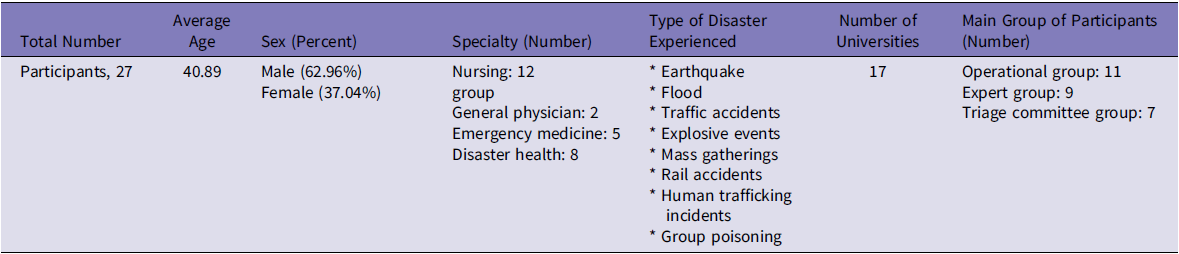
To take in the most available experiences possible in the study, we used maximum variation sampling to find out all key informants with the hospital triage specialty, including the following criteria: gender, age, work experience, having experience in dealing with different types of disasters, and covering different parts of the country. More details about the participants are presented in Table 1. The statistical population in our study consisted of 3 main groups. The first group included those with operational experience out of the nursing and medical group, the second group included experts, and the third group encompassed the members of the Hospital Triage Committee of disaster and mass casualty incidents in the Ministry of Health. The inclusion and exclusion criteria for each of these groups are elucidated below.
General characteristics of participants in the qualitative phase of the study for selecting triage indices

Criteria for the inclusion of operational persons included (1) having at least 3 years of experience of working as a triage expert in the hospital emergency department and (2) having at least 1 experience with a disaster or mass casualty incident.
Criteria for the inclusion of academic experts included (1) having health expertise in emergencies and disaster and (2) having sufficient knowledge and skills in the triage field with either an educational background (having a university teaching experience on triage or conducting at least 1 triage workshop per year) or outstanding research records (at least 1 published article or book related to triage in disasters).
The members of the National Hospital Triage Committee in the disasters and mass casualty incidents of the Ministry of Health also participated in this research. Operational participants, experts, and the members of the National Hospital Triage Committee, who met the inclusion criteria but were reluctant to participate further in the research for any reason and at any stage, were excluded from our study.
Method of Data Collection and Sampling
The method used for data collection included semi-structured interviews and field notes. Systematic review methods were also used to review and collect the required data in order to identify existing triage systems and extract their indices. After scoping review and extracting international indices from literature, a qualitative content analysis was done with Iranian experts to determine context-bound indices. Finally, both results were mixed and were explored by health experts to finalize indices. Informed consent was obtained from all participants, then interviews were conducted individually in a quiet environment at the appropriate time and place, which have been chosen by study participants (see Table 1). Interviews lasted between 45 and 60 minutes. If necessary, subsequent interviews were arranged based on the agreement of the participants, and all interviews were recorded with the consent of the interviewee. The sampling method in this study was purposive sampling with maximum diversity. It should be noted that ethical approval was obtained from the University of Social Welfare and Rehabilitation Sciences.
Data Analysis
The first phase of the research (qualitative part) is based on the result of review study by the research team on identifying triage systems around the world. The list of all models along with their indices and their priorities was provided to the participants, and all were asked during a semi-structured interview to extract the appropriate criteria for hospital triage in disasters and mass casualty incidents in Iran according to the triage criteria that exist in the world, the local conditions, diversity of incidents and disasters, facilities and resources of the hospitals, and the participants’ real experiences. To achieve this goal, after the introduction, participants were interviewed with the following questions, “What do you think about triage in disasters and mass casualty incidents? Do you have any experience in this area? What are the important indices that should be taken into account when dealing with triage in disasters and mass casualty incidents?” After obtaining the opinions of all individuals, the indices, which were agreed upon by at least 70% of the participants, were finalized. Reference Zhong, Clark and Hou26 Then, after the finalization of the indices, it was important to determine the index with which the evaluation of the injured individuals should begin; so, in the second phase of the study (quantitative method), weights and rankings of the indices were evaluated using the multi-criteria decision-making matrix and with the help of the pairwise comparison matrix and decision matrix. Weighting and ranking of indices were obtained by Expert choice software in both the analytic hierarchy process (AHP) and Technique for Order of Preference by Similarity to Ideal Solution (TOPSIS) methods. Reference Tzeng and Huang27 To do so, competing criteria are required. According to the AHP and TOPSIS models, 3 to 5 competing criteria are required. For this study, 3 competing criteria, including clinical importance, lack of complexity and simplicity in implementation, and speed, were extracted from a previous study by the authors, entitled, “The Principles of Triage in Emergencies and Disasters: A Systematic Review” Reference Bazyar, Farrokhi, Salari and Khankeh28 and the 2011 study, entitled, “Model Uniform Core Criteria for Mass Casualty Triage” 29 based on the decision of the research team. Based on the result of this phase, the context-bound model was algorithmically designed.
Results
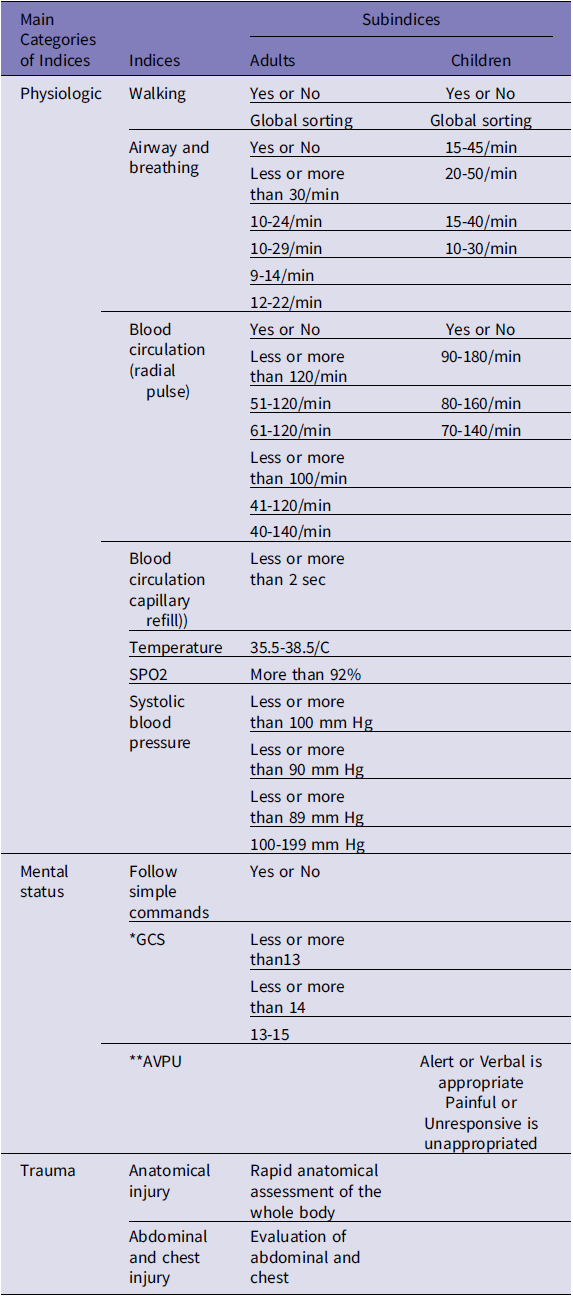
After identifying triage models in the world, based on the research team’s systematic review, all indices and their subindices in the models identified for all ages, including 26 identified models, 3 main categories of indices, 12 indices, and 39 subindices, were extracted (Table 2).
Indicators extracted from the study of systematic review of triage models

* GCS: Glasgow Coma Scale
** AVPU: Alert, Verbal, Painful, Unresponse
In a study conducted in 2011, it has been stated that any model designed for mass casualty triage should have 24 specific criteria, including 4 general considerations with 7 criteria, general classification with 5 criteria, lifesaving interventions with 3 criteria, and individual reviews with 9 criteria. We also included these features in the model design. 29 According to the inclusion and exclusion criteria, 27 participants were interviewed from 17 universities of medical sciences in the country (see Table 1).
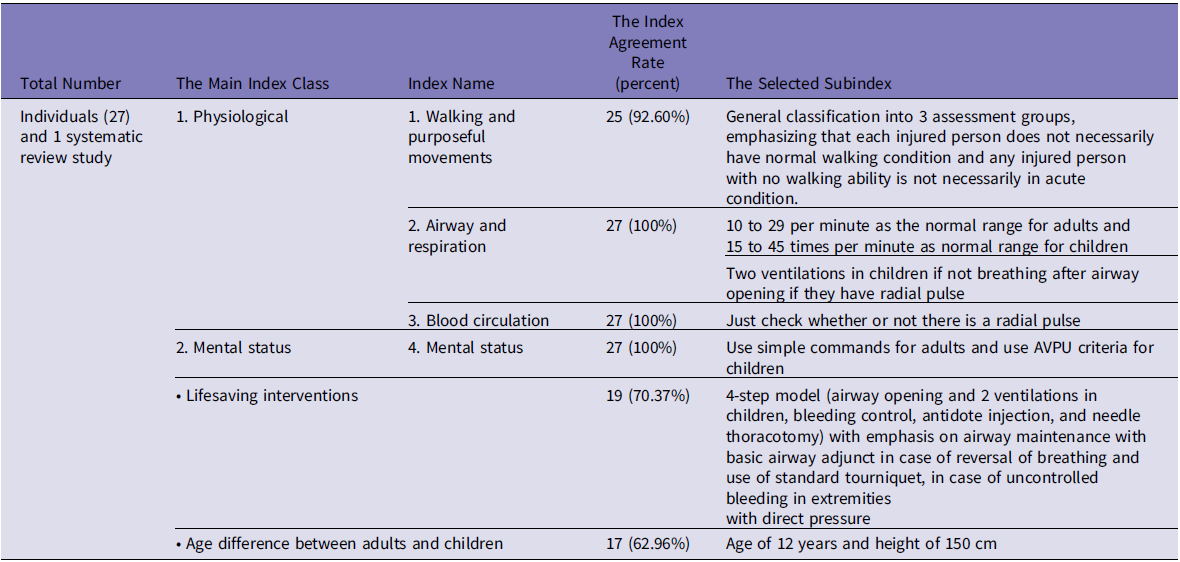
Through a semi-structured interview (qualitative content analysis with deductive approach) with individuals, participants were provided with a list of all the common indices in triage models around the world, and, after the questions posed in this part, all their views on indices selected for the context-bound triage model in incidents and mass casualties were obtained. The indices that participants agreed upon above 70% were finalized. Systolic blood pressure (7.4%), trauma (7.4%), and blood glucose (3.7%) were eliminated from our final list. Therefore, at the end of the qualitative phase of the study, we reached 2 main categories of index, 4 main indices, and 5 subindices (Table 3).
Final indices of hospital triage in disasters and mass casualty events based on participant feedback and systematic review

After defining the final indices, to determine the order and priority in which these indices fit into the model, we used the AHP and TOPSIS multi-criteria decision-making method. AHP is a technique that, in its mathematical logic, combines quantitative and qualitative criteria to compare multiple options and helps the decision maker combine team members’ decisions so that optimal decisions incorporate the views of all members. Since there is definitely a disagreement among experts and this disagreement can be very valuable in the decision-making process, and these disagreements should not be restricted or eliminated, AHP helps direct these disagreements in a correct duct to obtain the final result. Reference Saaty30,Reference Amini, Baniasadi and Vahidi31 In this regard, a standard questionnaire based on the pair matrix comparison matrix and decision matrix Reference Tzeng and Huang27 was designed and sent to all participants who had identified and introduced the indices in the qualitative phase, as shown in Table 2.
Matrix of Pairwise Comparisons of Criteria
The items in this matrix express the importance of 1 criterion over the other in terms of the purpose of the problem. For this purpose, the research team, based on a systematic study, entitled, “Principles of Triage in Disasters and Mass Casualty Incidents,” evaluated 3 criteria of clinical and operational importance, lack of complexity and simplicity in implementation, and speed of execution for the above 4 final indices (walking and purposeful movements, blood circulation, airway and breathing, mental status). To fill this table, the preference values were also used (Saaty9 degrees).
Decision Matrix
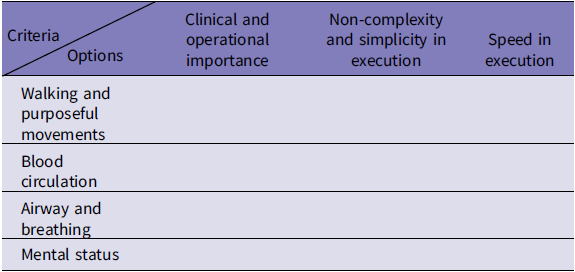
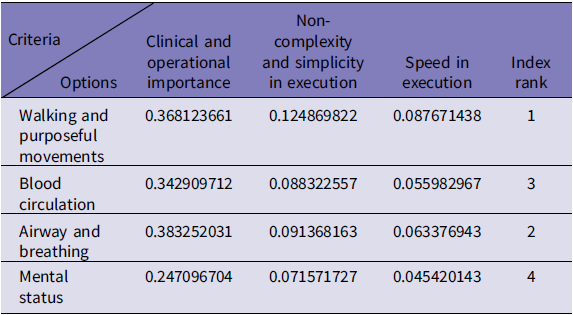
With the help of this matrix, we determined what the score of each index would be for different criteria. Numbers ranging from 0 to 4 were used to rate the indices. For example, if the circulation score is too high for the lack of complexity and simplicity in execution, the number 4 will be written in the box. If there is no score, zero will be used. Scores of 1, 2, 3, and 4 correspond to little, average, high, and very high values (or scores), respectively (Table 4). At this stage, 21 participants answered the weighting questionnaire. Analysis was done in Expert choice software. The results of the weighting of the competing criteria and the final indices are presented through the following AHP method (Table 5). As it can be seen in Table 4, the inconsistency rate is equal to 100th, meaning that the participants prioritized the indices at 99% agreement, which should be ideally below 10%. Reference Bazyar, Farrokhi and Khankeh24,Reference Jannat, Ardalan and Masoumi25 The TOPSIS method is one of the most commonly used multiple attribute decision-making methods. The TOPSIS method or prioritization, which is based on similarity to the ideal solution, is one of the methods with a deductive logic. This method is used to rate options and select the best option. This approach is based on the notion that the chosen option must have the least distance to the positive ideal solution and the maximum distance to the ideal negative solution. The input of this method is the decision matrix and the weight of the criteria. Based on this method, we obtained the weight and the rank of the indices (Table 6).
Sample Matrix Decision Table

Weight calculated for competing criteria and final indices in the AHP method

Weighted matrix and index rank attained by TOPSIS method

The results of the analysis showed that we achieved the same results in both the AHP method and the TOPSIS method, and both methods confirmed each other for ranking and weighting the indices. Therefore, based on the weight of the indices and their rank, we designed a context-bound model of hospital triage.
Discussion
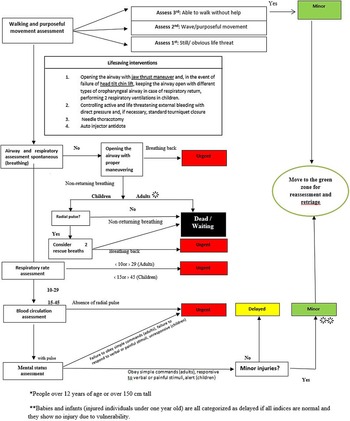
This study aimed to develop and present a context-bound model of hospital triage in disasters and mass casualties in the health system of Iran. Walking and purposeful movement, airway and respiration, blood circulatory status, and mental status indices were included in the finalized model (Figure 1).
Context-bound model of hospital triage in disaster and mass casualty incidents in Iran.

The first index of our model evaluating walking and purposeful movements consists of a combination of all the models available in the world. There are 2 main approaches to evaluating this index. In 1 approach, such as the START triage system and similar models, injured persons with walking ability fall into the green group and the other individuals without walking ability are evaluated for other indices, Reference Vassallo, Beavis, Smith and Wallis7,Reference Bhalla, Frey and Rider32–Reference Hodgetts, Hall, Maconochie and Smart36 and the second approach is a global sorting approach such as the SALT and MASS triage models in which injured individuals are classified into 3 groups of assessment and then individually reviewed according to priority. Reference Bhalla, Frey and Rider32,Reference Coule and Horner37 In our model, the participants agreed (with 72% agreement) that the injured persons should initially be classified into 3 groups (other alternative items include placing in 2 groups Yes or No in terms of walking with 24.3% agreement and operational evaluation of 3 group and 2 group with 3.7% agreement), but those with the ability to walk should immediately be categorized into the green group and transferred to the green triage zone of the hospital for reassessment and retriage. The other 2 groups are assessed based on prioritization with those who are not capable of walking and those who do not have purposeful movements (non-responsive), because these groups are likely to require rescue interventions. It seems that our combined approach not only does not delay speed of execution as an important criterion during disasters, but also prioritizes those in need of critical interventions. In this regard, 2 studies suggest that the purpose of hospital triage in disasters and primary triage in accidents with mass casualty is to identify the required rescue services to initially provide the hospital with limited resources and facilities. 29,Reference Kleber, Cwojdzinski and Strehl38 The lifesaving interventions of our model are also consistent with the 4 essential SALT actions pattern, but, in addition, our model emphasizes keeping the injured person’s airway open after proper airway maneuvering using a variety of basic airway adjuncts and, if needed, controlling external bleeding using standard tourniquet in cases where direct pressure has not been successful to control the bleeding in extremities. In the START model, 2 essential measures, including bleeding control with direct pressure and airway opening, are recommended.
Concerning the airway index, doing 2 ventilations with 74% agreement for children was consistent with the SALT model, Reference Bhalla, Frey and Rider32 and our participants believed that 2 ventilations were more operative due to the importance of time and the high number of injured individuals in disasters. It was also stated that the quality of ventilation will be more effective than the number and quantity of ventilation. It should be noted that, in the JumpSTART model designed for pediatric triage, 5 ventilations are provided, Reference Romig39 and, in the physiological triage tool (PTT) triage model, children fall into the group of dead (black), if they do not breathe after opening the airway without any artificial ventilation. In our proposed model, the normal respiratory range, which is between 10 and 29 per minute, is fully consistent with the sieve and sort triage patterns for adults, Reference Smith34 and the respiratory range for children is consistent with the JumpSTART triage pattern. Reference Smith34,Reference Romig39 In the START and Homebush triage models for adults, breathing up to 30 is normal. In Careflight and Smart models, only the existence or lack of respiration is important. Reference Garner, Lee, Harrison and Schultz33,Reference Cone, Serra and Kurland40 In the Sacco model, the range of 10 to 24, Reference Jenkins, McCarthy and Sauer5 the range of 9 to 14 Reference Gottschalk, Wood and DeVries41 in the TEWS model, and a range of 12 to 22 in the modified physiological triage tool (MPTT) model are normal. Reference Vassallo, Beavis, Smith and Wallis7 This indicates different ideas for how respiratory and airway control in different triage models at the international level is concerned.
In evaluating the circulation and perfusion index, participants’ overall view was on radial pulse assessment. More than 85% of the participants believed that, during disasters and mass casualty incidents, only “(not) having a radial pulse” should be checked, and so determining the scope for pulse assessment is not operational in disasters. Of all participants, 14.82% believed in setting a range for pulse control, whereas 7.4% of the participants believed in taking SPO2 index and capillary filling as support for radial pulse, which was eliminated due to very poor agreement. In some models, the pulse has a range Reference Jenkins, McCarthy and Sauer5,Reference Hodgetts, Hall, Maconochie and Smart36,Reference Gottschalk, Wood and DeVries41,Reference Cannon, Roitman, Ranse and Morphet42 ; in MPTT models, this range is up to 100 per minute, and in sieve models it is up to 120 per minute. In evaluating this index, our model was based on the START triage.
In evaluating the mental status index, our proposed model for adults is based on such patterns as START, ASAV, Smart, and SALT; in assessing this index for the children group, it is in line with JumpSTART triage. It is noteworthy that in the Careflight triage model, unlike all other triage models, this index is evaluated before evaluating breathing and circulation. The TEWS model also uses the AVPU (Alert, Verbal, Painful, Unresponsive) criterion for assessing mental status for adults, and the sort model uses the GCS (Glasgow Coma Scale) index to assess the mental state of the injured people. Our participants believed that the use of the GCS index was both complicated to implement, requiring a lot of training and also time-consuming to execute, so 100% of them suggested a simple commands index for adults. As young children may have difficulty verbalizing complaints, they also recommended the AVPU with 100% agreement to assess mental status.
At the end of our model, injured people who do not have the ability to walk but showed other normal indices with minor and partial injuries fall into the green group and, in case of more severe injuries, they fall into the yellow or delayed group, which is consistent with the SALT triage model. However, in our model, some references to minor injuries, based on the standard reference, are given in Appendix 1, which assist the triage team in making a quick decision to place the injured person in the green or yellow groups, and minimize the level of disagreement for triage experts to a great extent. In this regard, our participants believed that injured individuals that were not capable of walking might have minor injuries due to, for example, ankle sprains, mild traumas, and even emotional reactions that, given the limited resources of the hospital, should be placed in the green group and reassessed after transferring to the green zone of the hospital triage. In addition, our proposed model also encompasses group trauma burns from various trauma mechanisms, based on valid scientific references and standard reference (Appendix 1) Reference Marx, Walls and Hockberger43,Reference Lerner, McKee and Cady44 and clinical model descriptions of the task; in most triage models, there is a gap for burn injuries triage.
This model can be applied to triage for all age groups, and, based on our current knowledge and in accordance with the 24 features to design primary triage systems in mass casualty incident conditions, the SALT triage model is the only system that can be used for all age groups. In the proposed model, the age difference of adults and children is based on the TEWS triage model and equal to 12 years old and height of 150 cm; 100% of the participants agreed not to place weight to differentiate adults and children in disaster situations; the PTT model and the JumpSTART model considered the weights of 32 kg and 40 kg, respectively.
Due to the vulnerability of infants, our proposed model assigns those less than 1 year of age to be delayed (yellow), if all indices are normal. The JumpSTART model is designed for 1- to 8-year-old children, and children under 1 year of age are not specifically taken into account. In the PTT model, which is also a model for pediatric triage, children will be placed in the green group if they have purposeful movements and are alert. According to this study, Iran designed a proposed model for hospital triage in disasters and mass casualty incidents. In this regard, most countries have chosen one of the most common triage models in the world or designed a context-bound model based on their indigenous conditions, such as the development of the new TEWS triage model for South Africa, Reference Gottschalk, Wood and DeVries41 the proposed Homebush triage model for Australia, Reference Nocera and Garner45 SALT model for America at the national level, Reference Lerner, Schwartz and Coule46 sieve and sort triage models for more adults, and PTT triage model for the triage of children during disasters in England. Reference Smith34
Limitations
This model is designed for the triage of traumatic injuries caused by emergencies and disasters and is not designed for other conditions, including chemical, biological, radiation, and nuclear (CBRN) events. Obviously, triage in these circumstances requires further independent studies. Also, our proposed model for the primary triage of mass casualties is based at the entrance to hospitals, and secondary triage within the emergency department or other clinical locations requires further study.
Conclusions
This is the first study to develop and design a new context-bound model of hospital front door triage in disasters and mass casualty incidents in the health system of Iran. The design of this model uses the most common triage systems in the world, triage principles in emergencies and disasters, the views of local health professionals, and special considerations (resources and facilities, hospital infrastructure, cultural conditions, and the variety of disasters). To what extent our proposed model will be accurate in prioritizing injured individuals and how operational it will be for the triage providers in terms of simplicity and speed will require an independent study to evaluate its accuracy and compare it with the other tested models, which will be taken into account by this research team in the future. However, the development of new triage models is an ongoing process, and changes will be required to upgrade the models. The authors of this study believe that the proposed model is operationally applicable in prehospital conditions and in the field of incidents. So, they propose this model for use in prehospital settings, too.
Conflict(s) of Interests
The authors declared no potential conflicts of interest with respect to the research, authorship, and/or publication of this paper.
Ethical Standards
Ethical approval was obtained from the University of Social Welfare and Rehabilitation Sciences.
Appendix 1 Examples of minor injuries:
-
Minor soft tissue injuries
-
Blunt trauma of the organs without any obvious symptoms of fracture or dislocation (deformity, dislocation, severe swelling, crepitus, neurological disorder, and circulation)
-
Simple sores with need for outer layer sutures
-
Half thickness burns less than 10% in adults and less than 5% in children and the elderly and full thickness burns less than 2% in all ages
Red Burn Group:
Half thickness burns more than 20% in adults and more than 10% in children and elderly and full thickness burns more than 5%
-
Burns of the face, eyes, ears, genitals, joints, and inhaled burns
-
Pregnant mothers with any burn percentage
Yellow Burn Group:
-
Mid-thickness burns of 10 to 20 percent in adults and 5 to 10 percent in children and the elderly, and full-thickness burns between 2 and 5 percent in all ages
-
Associated with underlying diseases
-
Burns around the body regardless of the percentage of burns