Introduction
Bipolar disorder (BD), a type of mood disorder, is a common mental illness. It is characterised by recurrent episodes of manic and depressive, and sometimes mixed episodes, with an incidence as high as 5% and its most common manifestation is the depressive episode (Association, 2013; Benazzi, Reference Benazzi2007; Grande, Berk, Birmaher, & Vieta, Reference Grande, Berk, Birmaher and Vieta2016). One of the characteristics of BD is mood regulation deficit, which can seriously affect emotional control and executive functions (Green, Cahill, & Malhi, Reference Green, Cahill and Malhi2007). Additionally, the exact pathophysiology of BD is unclear, with high comorbidity rate (Keck, Kessler, & Ross, Reference Keck, Kessler and Ross2008). Thus it would result in misdiagnosis and inappropriate treatment, which is not conducive to the remission of the disease.
Since BD is a lifelong disease with a high risk of persistent disability and recurrence, long-term medication maintenance is one of the most important treatments (Kowatch, Sethuraman, Hume, Kromelis, & Weinberg, Reference Kowatch, Sethuraman, Hume, Kromelis and Weinberg2003). Mood stabilisers are considered as a key treatment for BD (Paris & Black, Reference Paris and Black2015). Although mood stabilisation drugs have shown compelling empirical evidence in the treatment of BD, 60% of those who start outpatient maintenance treatment will relapse within two years (Gitlin, Swendsen, Heller, & Hammen, Reference Gitlin, Swendsen, Heller and Hammen1995). Therefore, it makes sense to use psychological interventions to treat them in order to avoid recurrence or reduce their frequency and promote the restoration of social functions (Hautzinger & Meyer, Reference Hautzinger and Meyer2007). Some studies have shown psychotherapy performed better. Therapies like cognitive behaviour therapy, or psychoeducation, probably can be helpful in adjuvant pharmacotherapy to prevent recurrence in stable patients and effective in relieving depression and anxiety of BD (Beynon, Soares-Weiser, Woolacott, Duffy, & Geddes, Reference Beynon, Soares-Weiser, Woolacott, Duffy and Geddes2008; Scott, Colom, & Vieta, Reference Scott, Colom and Vieta2007; Xuan et al., Reference Xuan, Li, Qiao, Guo, Liu, Deng and Zhang2020). Hence, in this present research study, we investigated the effect of drug therapy and psychotherapy on BD. At present, the treatment effect for BD is not ideal and the underlying neurological mechanism for the treatment of BD is unclear. Therefore, it is particularly important to explore the neural mechanisms of the treatment of BD, which may help improve the effectiveness of treatment.
There are following neurological abnormalities in BD patients. BD patients have difficulties in learning, memory and executive function, which is related to abnormalities in the prefrontal cortex and temporal lobe (Adler, Holland, Schmithorst, Tuchfarber, & Strakowski, Reference Adler, Holland, Schmithorst, Tuchfarber and Strakowski2004; Chen, Suckling, Lennox, Ooi, & Bullmore, Reference Chen, Suckling, Lennox, Ooi and Bullmore2011). Prefrontal cortex is related to cognition control and memory, and temporal lobe is also considered to be associated with memory and emotion (Macoveanu et al., Reference Macoveanu, Kjærstad, Vinberg, Harmer, Fisher, Knudsen and Miskowiak2021). In addition, previous studies showed overactivation of the limbic regions and a hypoactivation of the prefrontal area in BD compared to healthy controls (Strakowski et al., Reference Strakowski, Adler, Almeida, Altshuler, Blumberg, Chang and Townsend2012; Strakowski, Delbello, & Adler, Reference Strakowski, Delbello and Adler2005). The hippocampus, the core part of the limbic system, plays a key role in cognitive processes such as learning and memory (Eichenbaum, Reference Eichenbaum2013), was found to have increased activation in BD patients after psychotherapy in some studies (Deckersbach et al., Reference Deckersbach, Peters, Shea, Gosai, Stange, Peckham and Nierenberg2018; Diler et al., Reference Diler, Segreti, Ladouceur, Almeida, Birmaher, Axelson and Pan2013a). While in another study, decreased activity was found in the same area after psychoeducation (Favre et al., Reference Favre, Baciu, Pichat, De Pourtalès, Fredembach, Garçon and Polosan2013). It can be seen that the results of these studies were mixed. These inconsistencies may be due to different kinds of therapies and task paradigms. Although there are some studies focused on brain activity after treatments, it still remains inconsistent among these results. Thus, one of the aims of the present study is to explore changes in brain activity alterations after treatment for BD. Neuroimaging studies can provide novelty perspectives on the physiological pathology of BD, in order to exploit potential biomarkers (Houenou et al., Reference Houenou, d'Albis, Vederine, Henry, Leboyer and Wessa2012).
Functional magnetic resonance imaging (fMRI) research generally uses two methods: resting state and task state. These two imaging conditions result in different research results and most studies utilised task state. In the task-based studies in BD, researchers found brain activation changes, after treatment in the dorsolateral prefrontal cortex (DLPFC), cingulate gyrus (CG), insula and temporal lobe (Garrett et al., Reference Garrett, Chang, Singh, Armstrong, Walshaw and Miklowitz2021; Haldane et al., Reference Haldane, Jogia, Cobb, Kozuch, Kumari and Frangou2008; Jogia, Haldane, Cobb, Kumari, & Frangou, Reference Jogia, Haldane, Cobb, Kumari and Frangou2008). Moreover, due to the diversity of neuropsychological tasks as well as task-based activation of specific brain regions, the consistence and applicability were lacking in the task-based state studies. FMRI studies of brain activity of BD usually use two types of tasks: emotional tasks and cognitive tasks to explore brain activity of BD patients (Chen et al., Reference Chen, Suckling, Lennox, Ooi and Bullmore2011). Thus, in this study, we also divided the tasks into these two categories. During emotional tasks, the brain activity in the inferior frontal gyrus (IFG), anterior cingulate cortex (ACC) and amygdala changed (Favre et al., Reference Favre, Baciu, Pichat, De Pourtalès, Fredembach, Garçon and Polosan2013; Garrett et al., Reference Garrett, Chang, Singh, Armstrong, Walshaw and Miklowitz2021), while studies found that the brain activation in hippocampus, superior frontal gyrus (SFG) and CG changed during cognitive tasks (Deckersbach et al., Reference Deckersbach, Peters, Shea, Gosai, Stange, Peckham and Nierenberg2018; Haldane et al., Reference Haldane, Jogia, Cobb, Kozuch, Kumari and Frangou2008). We aimed to identify brain activation changes in task-specific activation for emotional tasks v. cognitive tasks at pre and post treatment, whilst combining both aforementioned treatments (psychotherapy and drug therapy).
This meta-analysis is to explore the neural mechanism of psychotherapy and drug therapy in BD and to investigate the differences in brain regions activation for different task paradigms. This study can help clinicians to clarify the neural mechanisms of treatment for BD in order to find a more effective treatment.
Methods
This meta-analysis is reported according to the Preferred Reporting Items for Systematic Reviews and Meta-Analysis (PRISMA) statement (Moher, Liberati, Tetzlaff, & Altman, Reference Moher, Liberati, Tetzlaff and Altman2009); this study was organised by adhering to previously recommended guidelines for transparent and comprehensive reporting of methodology and results. The PROSPERO ID of this Systematic Review's protocol is CRD42022298124.
Literature search
Articles were identified by searching PubMed, Embase, Cochrane Library, Web of Science databases. Eligible studies on BD were published up until 10 June 2021, and were identified based on the following keywords: ‘bipolar disorder’, ‘fMRI’, ‘drug therapy’ and ‘bipolar disorder’, and ‘fMRI’ ‘psychotherapy’. When using psychotherapy keywords, we also added specific keywords commonly referring to psychotherapy, such as cognitive behaviour therapy, dialectical behaviour therapy and mindfulness-based cognitive therapy. The complete search strategy has been provided in online Supplementary materials.
Procedure
To ensure that we do not lose literature that meets the screening criteria, a manual search of existing meta-analyses or references related topics is conducted. After the removal of duplicate articles, two independent raters filtered the abstracts of all the articles.
Criteria
The inclusion criteria were as follows: (i) patients with a clinical diagnosis of BD according to the DSM-5; (ii) neuroimaging studies using fMRI; (iii) the entire brain was employed and not just a region of interest analysis; (iv) the three-dimensional (3D) coordinates of the peak activations in the stereotactic space of the Montreal Neurological Institute (MNI) or Talairach were reported; (v) The study requires drug or psychological intervention on BD; (vi) reported the results of changes in brain activation after treatment assessing the effects of therapy relative to a baseline condition (placebo condition or before-treatment condition); (vii) using task-state imaging. A study was excluded if it: (i) was a review or a meta-analysis; (ii) used a single case report format or (iii) used resting-state imaging; (iv) was not an fMRI study; (v) studied BD comorbidity or other disorder rather than BD.
Data extraction
It was evaluated the inter-rater reliability of the title and abstract screening (k = 0.90) and full-text screening (k = 0.91). They both reflected great agreement. Data extraction was completed by two researchers (J. L. and M. L.). The two researchers independently selected, extracted, and checked the data. In addition to extracting basic information about the study (sample size, average age, sex, educated years, disorder type, imaging state, treatment, treatment time), the coordinates of the results and coordinate space were also extracted.
Activation likelihood estimation (ALE)
Activation foci were first collected from included studies, where activation foci were assumed to be randomly distributed throughout the brain, and their spatial convergence in the voxel direction was modelled after modelling in a common stereotactic space. This method is modelled as a 3-dimensional Gaussian probability distribution for activation probabilities of all foci reported for each experiment (Eickhoff et al., Reference Eickhoff, Laird, Grefkes, Wang, Zilles and Fox2009; Eickhoff, Bzdok, Laird, Kurth, & Fox, Reference Eickhoff, Bzdok, Laird, Kurth and Fox2012). The width of the probability distribution is determined by empirical estimates of the between-subject or between-template variance associated with each single focus, resulting in a random-effects analysis.
GingerALE software (version 3.0.2) from the BrainMap Project was used to conduct the ALE meta-analyses of the eligible studies (Laird et al., Reference Laird, Eickhoff, Fox, Uecker, Ray, Saenz and Fox2011). This meta-analysis was conducted in MNI space (Laird et al., Reference Laird, Eickhoff, Fox, Uecker, Ray, Saenz and Fox2011; Lancaster et al., Reference Lancaster, Tordesillas-Gutiérrez, Martinez, Salinas, Evans, Zilles and Fox2007). For coordinates that use different spaces, the function provided by GingerALE was used to convert the coordinates from Talairach space to MNI space.
Procedure
All the peak voxel coordinates were reported in MNI space. For consistency, the peak voxels reported in Talairach space in the reviewed studies were converted into MNI space using the icbm2tal transformation function implemented within Ginger ALE. Based on Eickhoff et al. (Reference Eickhoff, Nichols, Laird, Hoffstaedter, Amunts, Fox and Eickhoff2016)’ s recommendations (Eickhoff et al. Reference Eickhoff, Nichols, Laird, Hoffstaedter, Amunts, Fox and Eickhoff2016), we applied a p value threshold at p < 001, and a minimum cluster of 250 mm3.
To conduct the ALE meta-analysis, specialised software GingerALE was used to combine the activation coordinates from these studies. We analysed different treatments and imaging tasks. This study reports the activation clusters of brain regions and their maximum ALE values for each meta-analysis. The maximum ALE value represents the activation probability of the brain area (Turkeltaub et al., Reference Turkeltaub, Eickhoff, Laird, Fox, Wiener and Fox2012). ALE results were displayed on the MNI brain template by using the Mango software package (Lancaster et al., Reference Lancaster, Cykowski, McKay, Kochunov, Fox, Rogers and Mazziotta2010).
Results
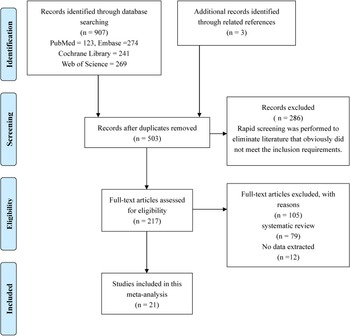
An initial search identified 913 articles, followed by a search reference search for 3 more articles. When duplicate articles are removed, 503 studies remained. By reading titles and abstracts, 286 of them did not meet the criteria for inclusion and were excluded. Then 196 articles were excluded based on the inclusion criteria through the full-text. Ultimately, 21 papers met the inclusion criteria and were considered eligible after evaluating the full text, all of which are written in English (Fig. 1).
Flow diagram of study selection.

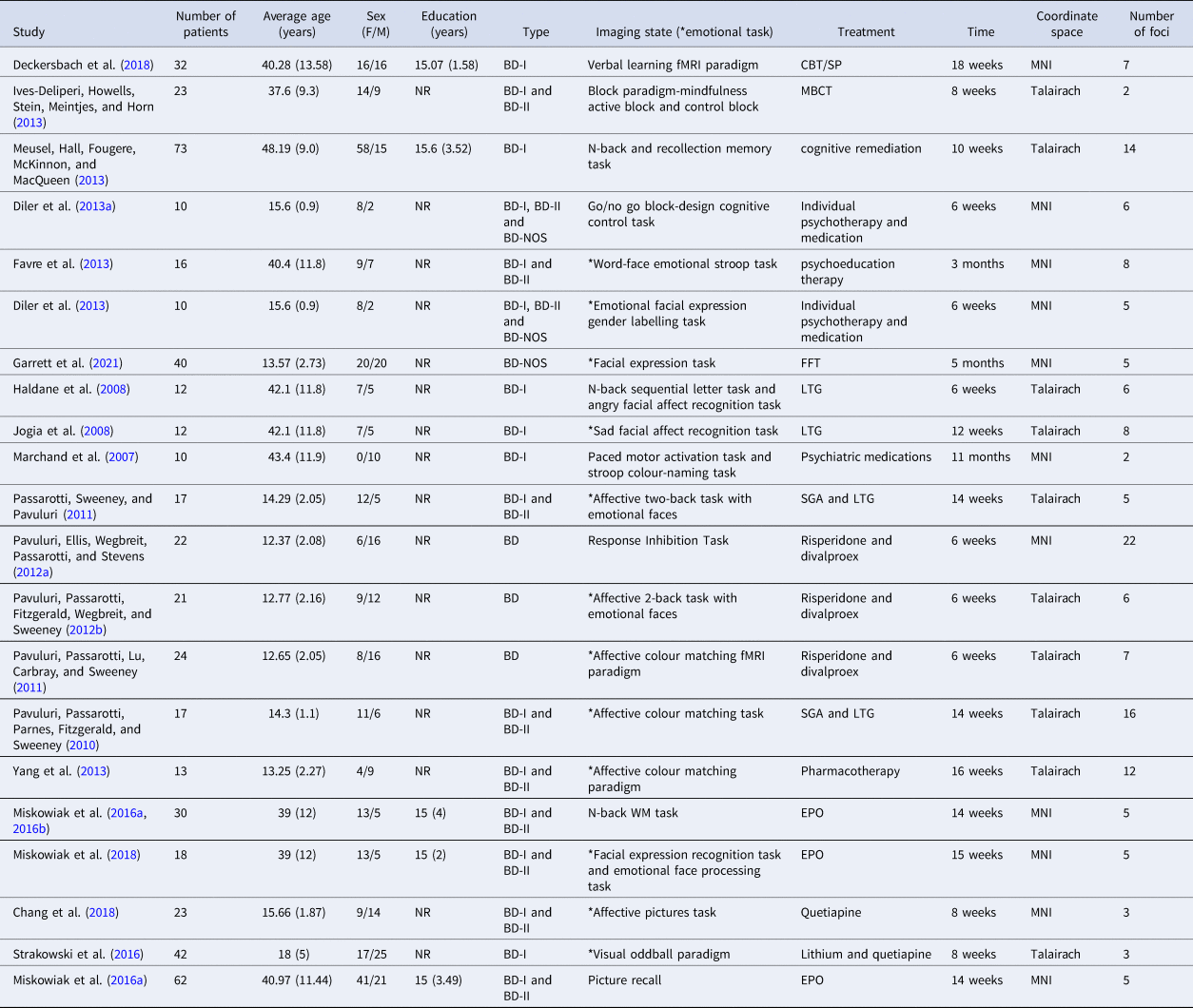
The characteristics of the included studies are summarised in Table 1. Two of the studies used both psychotherapy and drug therapy (Diler et al., Reference Diler, Segreti, Ladouceur, Almeida, Birmaher, Axelson and Pan2013a, Reference Diler, Ladouceur, Segreti, Almeida, Birmaher, Axelson and Pan2013b). All results report the coordinates of changes before and after treatment. The total literature contains 21 small studies. Based on treatment type, 7 studies used psychotherapy, 12 used drug therapy, and two used a combination of the two treatments. Classification according to imaging task, 12 studies used emotional tasks and nine used cognitive tasks.
Demographics and clinical details of included studies

Abbreviations: BD, bipolar disorder; F, female; M, male; NR, not reported; MNI, Montreal Neurological Institute; fMRI, functional magnetic resonance imaging; CBT, cognitive behavior therapy; SP, supportive psychotherapy; MBCT, mindfulness-based cognitive therapy; FFT, family-focused therapy; EPO, erythropoietin; LTG = lamotrigine; SGA, second-generation antipsychotics.
Changes in brain regions modulated by treatments
A total of 21 studies were included in the ALE meta-analysis, comprising in 527 subjects. A total of 127 increased activation points and 21 decreased activation points were extracted from these studies. After combining the calculations, there were 10 increased activation clusters and 1 decreased activation clusters.
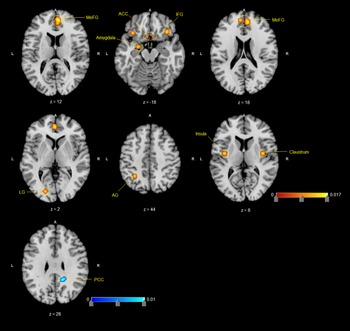
To elucidate the brain regions modulation by treatments, it was first conducted through meta-analyses to identify the brain regions with convergent increased or decreased activation. Treatments were associated with increased activation in the right ACC, bilateral medial frontal gyrus (MeFG), bilateral IFG, left amygdala, left LG, left AG, left insula and right claustrum. Treatments were associated with decreased activation in the right PCC (Fig. 2, online Supplementary Table S1).
Brain regions that show changes in activity after treatments. The red part represents the area with increased activation, and the blue part represents the area with reduced activation. The colour ruler represents the ALE value.

Different brain regions modulated by psychotherapy and drug therapy
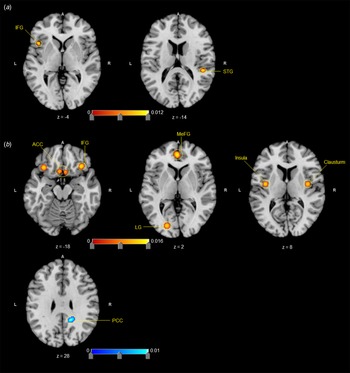
The studies were categorised based on the type of therapy: psychotherapy or drug therapy. Information about the activated brain regions after treatment is presented in online Supplementary Table S2. After receiving psychotherapy, the activation of the IFG and the superior temporal gyrus (STG) increased (Fig. 3a). After drug therapy, the activation of the ACC, MeFG, IFG, amygdala, LG, AG, insula and claustrum increased, and the activation of the PCC decreased (Fig. 3b). These results suggest that there are differences in brain regions activation between psychotherapy and drug therapy. Thus they might modulate brain regions using different therapy mechanisms.
Brain activity after different treatments. (a) The area with increased activation after psychotherapy; (b) The area with increased activation after psychotherapy; (c) The area with decreased activation after drug therapy. The red part represents the area with increased activation, and the blue part represents the area with reduced activation. The colour ruler represents the ALE value.

Results of different imaging conditions
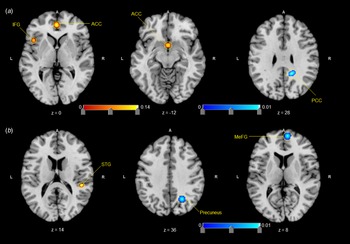
Neuroimaging studies usually evaluate two different imaging tasks: the emotional task and the cognitive task. Among these studies we included, 12 emotional tasks studies and 8 cognitive tasks studies. Compared to pre-treatment, emotional tasks are associated with increased activation in the ACC, IFG, and decreased activation in the PCC (Fig. 4a). Cognitive tasks are associated with increased activation in the STG and decreased activation in the precuneus, MeFG (Fig. 4b). Information about the activated brain regions of the two types of tasks (emotional and cognitive) is presented in online Supplementary Table S3. The results of this study have shown that there are significant differences in the activation in the brain regions activation at different imaging task conditions.
Brain activity in different type of tasks. (a) Increased brain activity in emotional tasks; (b) Decreased brain activity in emotional tasks; (c) Increased brain activity in cognitive tasks; (d) Decreased brain activity in cognitive tasks. The red part represents the area with increased activation, and the blue part represents the area with reduced activation. The colour ruler represents the ALE value.

Discussion
In the current study, the ALE meta-analysis was used to study in the distinction of activated brain areas between psychotherapy and drug therapy in BD to explore the neural mechanism of two treatments and the differences in activation of brain regions between the two different task paradigms. Twenty-one studies met the filtering criteria. The distinction at different conditions was further explored by taking treatments and imaging states as variables. This meta-analysis had some interesting findings which indicated psychotherapy and drug therapy might follow their respective patterns to have an effect on BD.
Changes in the brain regions after treatments
The results of the psychological and drug analysis were combined and it was found that after treatments, the increased activation of brain regions where the treatments produced focused on MeFG, ACC, IFG, amygdala, LG, AG, insula and claustrum, accompanied with decreased activation of PCC.
Studies have shown that the ventral lateral prefrontal cortex (VLPFC), medial prefrontal cortex (mPFC), ACC, insula, and amygdala constitute a network of adaptive emotion regulation in healthy participants. IFG is part of VLPFC, which is related to emotional response inhibition and reassessment of negative emotions (Phillips, Ladouceur, & Drevets, Reference Phillips, Ladouceur and Drevets2008). The frontal cortex (including IFG) has an important impact on emotion regulation, impulsiveness, self-consciousness, and self-monitoring of BD (Morgan et al., Reference Morgan, Dazzan, Morgan, Lappin, Hutchinson, Suckling and David2010). IFG is identified as a brain region for regulating and integrating emotional intensity and information (Foland-Ross et al., Reference Foland-Ross, Bookheimer, Lieberman, Sugar, Townsend, Fischer and Altshuler2012). Increased activation of IFG may indicate that treatments help BD to sort out emotional information, revaluate negative emotions, and balance its over-processing of negative emotions. Normalisation of hyperactivity and hypoactivity in frontal cortex of BD after treatment (Drevets, Savitz, & Trimble, Reference Drevets, Savitz and Trimble2008), is consistent with our results. It is considered that mPFC integrates information during emotional and cognitive processes (Simpson, Snyder, Gusnard, & Raichle, Reference Simpson, Snyder, Gusnard and Raichle2001). In other studies of BD, dysfunctional deficits such as decreased metabolism have also been demonstrated in mPFC (Brooks et al., Reference Brooks, Wang, Bonner, Rosen, Hoblyn, Hill and Ketter2009). The frontal lobe is dominant in the outcome of the treatment, indicating that the treatment had a great regulatory effect on the frontal lobe. ACC is involved in working memory, attention and executive function in BD (Stevens, Hurley, & Taber, Reference Stevens, Hurley and Taber2011; Zimmerman, DelBello, Getz, Shear, & Strakowski, Reference Zimmerman, DelBello, Getz, Shear and Strakowski2006). And ACC can be regarded as a marker to predict the therapeutic response of BD (Lipsman et al., Reference Lipsman, McIntyre, Giacobbe, Torres, Kennedy and Lozano2010). Thus, it seems that ACC is a vital target brain region in BD after treatment. Amygdala and insula transport signals of sensory information (Phillips, Drevets, Rauch, & Lane, Reference Phillips, Drevets, Rauch and Lane2003), while VLPFC, mPFC and ACC integrate this information depending on situational requirements (Cabeza & Nyberg, Reference Cabeza and Nyberg2000; Ghashghaei, Hilgetag, & Barbas, Reference Ghashghaei, Hilgetag and Barbas2007). However, recent studies have found that emotional impairment in BD may be due to the imbalance between the prefrontal brain and limbic networks. Hyperactivation of limbic regions involved in emotional perception and recognition, and hypoactivation of prefrontal regions, including ACC, IFG, which are responsible for executive function, attention, and emotional regulation (Phillips et al., Reference Phillips, Ladouceur and Drevets2008; Strakowski et al., Reference Strakowski, Delbello and Adler2005, Reference Strakowski, Adler, Almeida, Altshuler, Blumberg, Chang and Townsend2012). Neuroimaging studies of BD unanimously agree that low activation of bilateral VLPFC and overactivation of limbic regions under emotional processing (Foland-Ross et al., Reference Foland-Ross, Bookheimer, Lieberman, Sugar, Townsend, Fischer and Altshuler2012; Morris, Sparks, Mitchell, Weickert, & Green, Reference Morris, Sparks, Mitchell, Weickert and Green2012). These areas in the present study showed changes in brain activity after treatment.
Deficits in fronto-limbic circuits may be responsible for difficulties in emotion regulation in BD (Miola et al., Reference Miola, Cattarinussi, Antiga, Caiolo, Solmi and Sambataro2022). The results of these studies show that the activity of BD in several neural regions associated with mood regulation, including the prefrontal cortex, amygdala, insula, thalamus, and hippocampus in patients with BD, insula, thalamus, and hippocampus, is significantly increased and decreased compared to healthy adults. The results of the study found that the function of the fronto-limbic network (MeFG, ACC and amygdala) improved after treatment. This further suggests that the treatment may change these abnormal brain neural circuits in BD.
In conclusion, it is suggested that the treatment effect can be achieved by regulating the activity of network of adaptive emotion regulation and fronto-limbic circuit. Specifically, normalising the brain regions with hyperactivity or hypoactivity will alleviate the symptoms of these diseases and achieve the therapeutic effect.
Distinct brain areas activated by psychotherapy and drug therapy
The results of psychotherapy and drug therapy were analysed separately and it was found that after treatments, only IFG was activated after both psychotherapy and drug therapy, that maybe because a limited number of psychological studies or it could also be due to IFG is an important regulatory brain region in both psychotherapy and drug therapy. These results demonstrate that the activated brain areas of the two therapies are mostly different. There are more brain areas in which the activation changes after drug therapy than after psychotherapy. The differences between the two treatments are possible because these two therapies may work through different neural mechanisms.
Psychotherapy is thought to have top-down effects on the limbic system (Mayberg et al., Reference Mayberg, Liotti, Brannan, McGinnis, Mahurin, Jerabek and Fox1999). It first regulates cortical activation and then influences limbic regions. Psychotherapy can improve symptoms more broadly and for longer after treatment (Petersen, Reference Petersen2006). In our study, psychotherapy increased activation of IFG and STG, suggesting that psychotherapy may work in the frontal and temporal lobes. Untreated patients with BD had lower activation of frontal lobe and they also observed differences in the brain activation of STG between the BD patients and the healthy control group, in BD patients, the STG is potently hyperactive (Kupferschmidt & Zakzanis, Reference Kupferschmidt and Zakzanis2011). And STG has been found to be associated with emotional processing deficits and other symptoms (Malhi et al., Reference Malhi, Lagopoulos, Sachdev, Ivanovski, Shnier and Ketter2007; Osuch et al., Reference Osuch, Ketter, Kimbrell, George, Benson, Willis and Post2000; Takahashi et al., Reference Takahashi, Malhi, Wood, Yücel, Walterfang, Kawasaki and Pantelis2010). In our analysis, the activation of STG is found to be greater that may because of different tasks used or because BD mood state differs from the subjects used in previous study.
In studies of drug therapy in depression, changes in the activation of the prefrontal cortex were uniformly reported, and drug therapy normalised the activation of the frontal cortex (Kennedy et al., Reference Kennedy, Evans, Krüger, Mayberg, Meyer, McCann and Vaccarino2001, Reference Kennedy, Konarski, Segal, Lau, Bieling, McIntyre and Mayberg2007; Mayberg et al., Reference Mayberg, Brannan, Tekell, Silva, Mahurin, McGinnis and Jerabek2000). Changes in activity also occur in the limbic and subcortical areas, including amygdala, hippocampus, PCC, and insula (Anand et al., Reference Anand, Li, Wang, Wu, Gao, Bukhari and Lowe2005; Goldapple et al., Reference Goldapple, Segal, Garson, Lau, Bieling, Kennedy and Mayberg2004). The PCC is an important part of the DMN; it plays a crucial role in memory and self-reference processing and hyperactivity of PCC is linked to depression (Leech, Kamourieh, Beckmann, & Sharp, Reference Leech, Kamourieh, Beckmann and Sharp2011; Szaflarski et al., Reference Szaflarski, Allendorfer, Goodman, Byington, Philip, Correia and LaFrance2022). Hypoactivity of PCC in our analysis may infer the effect of drug therapy.
Low activation of specific sub-regions in a cognitive control network located in the MeFG has been described in BD (Welander-Vatn et al., Reference Welander-Vatn, Jensen, Otnaess, Agartz, Server, Melle and Andreassen2013). Drug therapy increased the activity in the MeFG, which may indicate that patients with BD can more effectively regulate their more emotions regulation after undergoing therapy.
Drug therapy involves changes in activation of the limbic area, whereas psychotherapy does not. Drug therapy is more classically seen as ‘bottom-up’ (or a combination of bottom-up and top-down) (Mayberg et al., Reference Mayberg, Liotti, Brannan, McGinnis, Mahurin, Jerabek and Fox1999). First the subcortical level is regulated, followed by an effect on the higher cortical levels. Drug therapy can quickly relieve symptoms. From the results, we can see activation in both higher brain regions, which perform cognitive control, and limbic regions. One review described the effects of drug therapy on BD, finding that drug therapy can affect the activation of the prefrontal lobes of the brain in emotional processing and cognitive tasks (Laidi & Houenou, Reference Laidi and Houenou2016). This is consistent with the activation of the frontal lobe region in our results. The insula was activated after drug therapy in BD, possibly indicating that this region plays a broader regulatory role in antidepressant response and remission (McGrath et al., Reference McGrath, Kelley, Holtzheimer, Dunlop, Craighead, Franco and Mayberg2013). Additionally, we found changes in activation of CG in BD after medication. Abnormal activation of the CG can be used as a potential diagnostic marker and neurofeedback target for depression (Mel'nikov et al., Reference Mel'nikov, Petrovskii, Bezmaternykh, Kozlova, Shtark, Savelov and Natarova2018), while the activation of the CG changed after medication in our study. These findings indicate that these brain regions may be important in determining treatment outcomes.
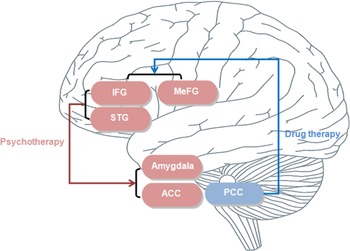
It can be speculated that both treatments work by regulating the activity of relevant brain regions, possibly ‘normalising’ brain abnormalities in specific ways. Combined with the conclusions of previous research on the brain effects of drugs and psychotherapy and the meta-analysis results of this study (Boccia, Piccardi, & Guariglia, Reference Boccia, Piccardi and Guariglia2016), this study proposed theoretical models of psychotherapy and drug therapy based on the emotional circuits (Fig. 5). Psychotherapy changes the activation of amygdala, ACC and PCC by increasing the activation of the frontal and temporal lobe regions to produce a top-down effect. And drug therapy by reducing the activation of limbic region to produce a ‘bottom-up’ effect, or a top-down effect by increasing cortical activity at the same time, and make the activation of ACC, MeFG and IFG increased. These two therapies, in their own way, affect the patient's emotional circuit, ‘normalising’ the activation of the corresponding brain region and thereby reducing symptoms.
Hypothetical model of psychotherapy and drug therapy. Psychotherapy changes the activation of amygdala, ACC and PCC by increasing the activation (red part) of the frontal and temporal lobe regions to produce a top-down effect. And drug therapy changes the activation of IFG, MeFG and STG by reducing the activation (blue part) of limbic region to produce a ‘bottom-up’ effect, or a top-down effect by increasing cortical activity at the same time.

Brain areas activated during different imaging states
Most treatments focus on the emotional and cognitive processes of BD to improve their adaptation and achieve functional recovery (Bernhard et al., Reference Bernhard, Schaub, Kümmler, Dittmann, Severus, Seemüller and Grunze2006; Honig, Hofman, Rozendaal, & Dingemans, Reference Honig, Hofman, Rozendaal and Dingemans1997). It was found that the activated brain regions are various under different imaging conditions. Under the emotional tasks, the activation of ACC and IFG increased, and activation of CG decreased. While under cognitive tasks, the activation of STG increased, and precuneus and MeFG decreased. However, no similar findings were observed in amygdala. In our meta-analysis, there were no differences in the activation of amygdala before and after treatment. This may suggest that the lack of activation of amygdala may be due to the habituation of the amygdala response after repeated reception of emotional stimuli (Breiter et al., Reference Breiter, Etcoff, Whalen, Kennedy, Rauch, Buckner and Rosen1996).
The emotional neural circuit is generally considered to consist of the PFC, amygdala, ACC, thalamus and limbic system (Dalgleish, Reference Dalgleish2004). Radaelli et al. (Reference Radaelli, Poletti, Dallaspezia, Colombo, Smeraldi and Benedetti2012) used a face matching paradigm (Radaelli et al., Reference Radaelli, Poletti, Dallaspezia, Colombo, Smeraldi and Benedetti2012). Their results showed that the activation of the right ACC and hippocampus increased in patients with BD, and the activation of the DLPFC decreased. In the present study, most of the emotional tasks were related to emotional face recognition and the relevant brain areas were activated, including the ACC and IFG, which can also be activated under normal conditions. It was also found that ACC were activated in the BD patients. Moreover, the brain regions mentioned above are all related to this emotional circuit. Therefore, it can be speculated that this emotional circuit can be activated during emotional tasks, and treatments allow the emotional circuits to work properly in BD patients. In addition, activation of right VLPFC may contribute to the successful implementation of emotion-regulation strategies, like cognitive reappraisal. This kind of strategy also reduce activation of negative stimuli in the amygdala (Lieberman et al., Reference Lieberman, Eisenberger, Crockett, Tom, Pfeifer and Way2007; Wager, Davidson, Hughes, Lindquist, & Ochsner, Reference Wager, Davidson, Hughes, Lindquist and Ochsner2008). That could also explain why our results showed lack of activation of amygdala.
It has been proved that MeFG plays a role in cognitive control (Ridderinkhof, Ullsperger, Crone, & Nieuwenhuis, Reference Ridderinkhof, Ullsperger, Crone and Nieuwenhuis2004). However, it was found decreased activation in MeFG. This may be because, before treatment, BD patients want to inhibit the processing of negative information, so they use more cognitive control resources. Therefore, the symptoms of negative information processing can be effectively alleviated and activation decreased after treatment. In patients with BD, there is a deficit in working memory and recollection memory, and decreased activation of the lateral prefrontal cortex is often shown during working memory (Kurtz & Gerraty, Reference Kurtz and Gerraty2009; Townsend, Bookheimer, Foland-Ross, Sugar, & Altshuler, Reference Townsend, Bookheimer, Foland-Ross, Sugar and Altshuler2010). Precuneus is part of DMN, and it is involved in a lot of cognitive control functions such as visual representation, episodic memory and self-directed processes. It seems to play a crucial part in the integration of mental processing (Aryutova et al., Reference Aryutova, Paunova, Kandilarova, Stoyanova, Maes and Stoyanov2021; Raichle, Reference Raichle2015). However, its activation would be decreased when people confront with external attention-capturing stimuli. During cognitive tasks, we found decreased activation in precuneus after treatment. It may indicate that BD pays more attention to external stimulation after treatment since BD patients interfere with the integration of attention, memory and other resources (Zhang et al., Reference Zhang, Liu, Shi, Tan, Suo, Dai and Liu2022).
There is a problem in the present analysis that and the effects of tasks may be confounded by treatments and also effects of treatments may be confounded by tasks. Because of the paucity of studies, like psychotherapeutic intervention with emotional task (n = 3), and psychotherapeutic intervention with cognitive task (n = 4), and pharmacological intervention with cognitive task (n = 5) were too few to be included in separate ALE meta-analyses. Paediatric bipolar disorders have more complex phenomenology and less related researches (Pavuluri, Birmaher, & Naylor, Reference Pavuluri, Birmaher and Naylor2005), in order to include more literatures, we expanded to include all BD types without adding age criteria. As more studies are published in the future, we can separate adult and paediatric studies to get more pure effect.
Limitations
Several limitations should be acknowledged in the study. First, this study was included a limited number of studies involving BD interventions using fMRI scans. Second, we included only one imaging method: fMRI. It can be considered including other neuroimaging methods such as positron emission tomography and single-photon emission computed tomography for future analysis. Third, the present study was only included two types of treatment: psychotherapy and drug therapy. In the future, we can include non-invasive brain stimulation therapies and explore the effect and mechanism of that kind of treatment. In addition, the imaging tasks were only divided into emotional and cognitive categories, and the results may also be affected by the specific task type. If there are more articles, it is hoped to analyse more similar task types. And we only analysed the effect of kind of treatment and imaging task, and there may be other factors that influence the brain region activation results. Only one condition could be controlled at a time when analysing the consistency of brain activation under different conditions due to limited number of studies. This may be influenced by the interaction of other regulatory factors such as age and gender. As more studies are included in the future, we can consider the influence of other factors on activated brain regions.
Conclusion
In summary, it was analysed the activated brain areas after treatments for BD and analysed the distinctness of different treatments. After different treatments, the activation of these brain regions also varies. Different brain regions activated by psychotherapy and drug therapy may be related to distinct therapeutic mechanisms. In addition, the analysis results of emotional tasks and cognitive tasks were inconsistent, which may be due to the different types of tasks assessed. It is suggested that medication may have a bottom-up effect, whereas psychotherapy may have a top-down effect. This meta-analysis may contribute to the clinical differential diagnosis of BD and would be helpful to improve its treatment effect as well as identify more accurate neuroimaging biomarkers for its treatment.
Supplementary material
The supplementary material for this article can be found at https://doi.org/10.1017/S0033291722003889
Acknowledgements
This research was supported by The Anhui Natural Science Foundation, No. 1808085MH291; Grants for Scientific Research of BSKY from Anhui Medical University, No. XJ201826. These funding sources had no role in the design of this study and will not have any role during its execution, analyses, interpretation of the data, or decision to submit results.
Financial support
This research was supported by The Anhui Natural Science Foundation, No. 1808085MH291; Grants for Scientific Research of BSKY from Anhui Medical University, No. XJ201826.
Conflict of interest
None.
Data availability statement
The data that support the findings of this study are available from the corresponding author upon reasonable request.