9 May 2015, Red Square, Moscow. At precisely 8:30 p.m. the Kremlin chimes strike. A trumpet salute heralds the entrance into Red Square of the notorious, Putin-endorsed, Russian Orthodox biker gang, the Night Wolves (Nochnye Volki).Footnote 1 Following closely on the Wolves and chanting a familiar refrain, several hundred young people, wearing the red, white, and blue of the Russian Federation, pour into the space from stages center, left, and right. While the Wolves peel off, the young people pinwheel and dance in perfect synchrony to heavy drums and light rock as images of 1,000 years of unrelenting Russian greatness flash across three enormous screens behind them. Thus opens the Victory Day (Den’ Pobedy) concert marking the 70th anniversary of the Soviet Union’s “great victory” (velikaia pobeda) over Nazi Germany in May 1945.
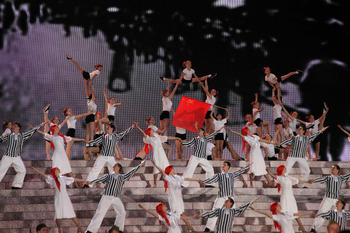
Putin Youth salute the Great Victory, Victory Day Concert, 2015. (Photo by Sergey Vedyashkin, courtesy of Moscow News Agency)

The great victory has become the enduring symbol of “Russian” greatness and for most of the past 55 years, Victory Day has been Soviet and post-Soviet Russia’s most cherished state holiday (gosudarstvennyi prazdnik), eclipsing even the anniversary of the October Revolution.Footnote 3 Joseph Stalin celebrated the first Victory Day on 24 June 1945 with a solemn parade in Red Square and a day off from work;Footnote 3 two years later, for political reasons, he discontinued the parade and ordered the people back to work.Footnote 4 Victory Day remained dormant until Leonid Brezhnev (Communist Party head, 1965–1982) resurrected it on 9 May 1965, hoping to legitimize his regime in the wake of a successful coup against Nikita Khrushchev.Footnote 5 Until the USSR collapsed in 1991, Victory Day served as a kind of nexus of Soviet identity, a celebration of communism’s triumph over capitalism. The collapse, which took with it not only communism, but also most of the rituals, rites, celebrations, and even products that fortified Soviet identity, left Russians without a core identity.Footnote 6 The USSR celebrated its last Victory Day in 1991; Russia did not celebrate it again until the Yel’tsin revival in 1995. Cleansed of communism, and inflated almost beyond recognition during the Putin regime, it has come to denote both eternal Russian greatness and “victory hysteria” (pobedobesie).
Three presidents of the USSR and the Russian Federation have amplified the great victory in an effort to, as my Ukrainian-born Wilson Center intern Anton Stalchenko explained to me, put themselves on the side of virtue, thereby legitimizing regimes that might otherwise be seen as illegitimate. This works because many Russians do, in fact, care deeply about Victory Day. Having lost as many as 27 million soldiers and civilians in the war, and believing themselves to have been singular targets of the Nazis, many suppose that they, not the Jews, were Hitler’s real victims (Merridale Reference Merridale2006:289).Footnote 7 Perhaps more importantly (and unlike other unfortunate nations occupied by the Nazis), the Soviets, according to the official narrative, pulled themselves together after Hitler’s betrayal in 1941 of the Molotov-Ribbentrop Pact to become unlikely victors over a vastly superior foe (Medinskii Reference Medinskii[2011] Reference Medinskii2018).Footnote 8 The fact that the West celebrates D-Day but not Victory Day angers Russian patriots, who are of the opinion that the battles of Stalingrad (now Volgograd) and Kursk made the Normandy victory possible (Rosenberg Reference Rosenberg2019).Footnote 9 Convinced by Soviet and post-Soviet propaganda that they saved not just the USSR, but also the world from fascism,Footnote 10 many Russians today cannot understand why, since 1991, the West has continued to belittle Russia, calling it, as Barack Obama did in 2014, not a “great power” (velikaia derzhava), but a “regional power” (in Wilson Reference Wilson2014). For Russians the great victory should have guaranteed Russia perpetual membership in the pantheon of great powers. Just ask any historian. Or maybe not, because historians (often vehemently) disagree.
The Great Patriotic War (Velikaia Otechestvennaia Voina; GPW), the great victory, and the Victory Day celebration are at the center of a war of history and memory now being played out externally with the West and internally between, among others, Kremlin politologues and liberal academics.Footnote 11 Presidents Putin (2000–2008, 2012–2024) and Medvedev (2008-2012) have been engaging in them since at least 2008. Following a brief conflict with Georgia in 2008, Medvedev, who began publicly to allege distortions of the historical record by Russia’s enemies, formed a Presidential Commission to Counter Attempts to Falsify History to the Detriment of Russia’s Interests (Medvedev Reference Medvedev2009).Footnote 12 While the commission lasted only two years, efforts to educate youth in the spirit of patriotism and ramp up the narrative of Western plots against Russia accelerated after mass protests in 2011–2012 and again after Russia annexed Crimea in 2014. They have not diminished since. At the same time, the Kremlin, which until 2012 had resisted taking firm ideological positions and discouraged public expression of ideological extremes (Lipman Reference Lipman2019), rather suddenly—and perhaps not coincidentally, with a change of leadership at the Ministry of Culture—began to supercharge its cultural politics with nationalist ideology and memory laws.Footnote 13
The former minister of culture and founding president of the Russian Military Historical Society,Footnote 14 Vladimir Medinskii, a political polemicist who, in 2011, received a dubious PhD in history (Polit.ru 2015),Footnote 15 plays a central role not only in current post-Soviet history/memory wars, but also in shaping the Kremlin’s cultural politics. Although professional historians have repeatedly challenged his credentials and public statements, from 2010 to 2012 he sat on Medvedev’s Presidential Commission before being appointed, in 2012, to serve as the minister of culture. It is Medinskii’s position on the relationship between fact and myth — particularly with regard to WWII — that outrages his critics while seeming to endear him to the Kremlin. Medinskii claimed in a 2015 interview with the state newspaper, Rossiiskaia gazeta, to be a seeker of truth, but his positions might more accurately be described as “facts be damned.” Russians, particularly youth, he argues, need affective heroic myths and a pantheon of heroes that “must be treated like canonized saints of the Church” (Medinskii Reference Medinskii2015). Russia’s war with Ukraine has particularly vexed Medinskii, who complained in January 2015 that the rogue nation had declared a “new blitzkrieg” against historical truth.Footnote 16 This new war, as deadly as the battles fought at Sevastopol, Stalingrad, and Berlin, is a war for minds. Russia must, he argued, fight back by marshalling all of its cultural resources—films, books, performance, exhibitions, contemporary videogames, patriotic internet, patriotic radio and TV — against the enemies of truth (RVIO.ru 2015). From Medinskii’s perspective, much mythologizing of imperial and Soviet history — above all, military—must be done in the interests of educating youth in the spirit of national unity and patriotism.Footnote 17
The heart of Victory Day has always been an elegant, ceremonial parade in Red Square featuring GPW veterans. From a cultural politician’s perspective, however, the problem with parades is the illegibility of the story for uninformed viewers. The need to grab the historical narrative has become more urgent as tensions escalate with both the West and Russia’s near neighbors and with the passing of the war generation. That is surely why Victory Day, the inevitable legatee of Russia’s history/memory wars, has experienced major renovations in the age of Putin, the most spectacular of which is the “Festive Concert Dedicated to Victory Day” (Prazdnichnyi kontsert posviashchennyi Dniu Pobedy) or, more simply, Victory Day Concert, staged, since 2005, in Red Square on 10-year anniversaries. The concert, a highly theatrical, televised event that not only celebrates Russian/Soviet heroism in song, dramatic narrative, story, music, and dance, but also claims to be based in carefully researched factual evidence, exemplifies the theatrical, dramatic, and affective turn of post-Soviet cultural politics.
The significance of the concerts lies in the stories they tell not only about the GPW, but also about current domestic and foreign policy. Given changes in both since 2015, many Victory Day watchers hoped for another Red Square concert in 2020 to mark the 75th anniversary, but because of the enormous human and economic capital invested in them, 2025 seems more likely. My questions about the 2005 and 2015 concerts include the following: To what degree do the stories told by the concerts meet the Kremlin’s demand for historical truth and what role might they play in its war with professional historians over history and memory? How does the theatrical apparatus operate to draw spectators into the highly politicized historical/mythological narrative of the GPW? Do the concerts succeed in creating belief, stoking patriotism, and uniting Russians around a core identity? How do the 2005 and 2015 concerts not only illuminate shifts in Kremlin policies toward the West, but also work affectively to, in Sara Ahmed’s words, make the dogma of Russian exceptionality “stick” on the Russian people and create what art historian and cultural studies scholar Alison Landsberg calls “prosthetic memory” (Ahmed [Reference Ahmed2004] Reference Ahmed2014; Landsberg Reference Landsberg2004).Footnote 18
Putin’s Embracee
Red Square 2005Footnote 19
The Kremlin and the City of Moscow stage several Victory Day concerts in parks across the city, but over many years, only two have happened in Red Square. Perhaps because Red Square cannot accommodate a mass audience, the largest usually takes place on a temporary stage in front of the Museum of the Great Patriotic War (now Victory Museum [Muzei Pobedy]) located in Victory Park (Park Pobedy), which can accommodate thousands of standing spectators—mostly average Muscovites who travel to the site on the metro. On nonanniversary years, a much smaller concert with celebrities, scenery, special effects, and an invited audience takes place in the Kremlin palace. So much human and economic capital, however, is devoted to the 10-year anniversary concerts in Red Square, that the others pale in comparison. And while foreign leaders may certainly attend off-year parades, concerts, and ancillary events, the Kremlin makes a great show of its international guests at the anniversary parades and performances. Standing next to President Putin, they reassure Russians of their leader’s status in the great power universe and remind the global community of the Soviet Union’s victory and tremendous sacrifices. Moreover, anniversary concerts portend shifting directions of the Kremlin’s political winds. If 2005 signaled a desire for cooperation with the West, 2015, the first post-Crimea anniversary parade and concert, not only immersed the domestic audience in a dramatic tale of the GPW won without the Allies help, but also stoked fear of the West.Footnote 20 While the 80th-anniversary concert remains mysterious,Footnote 21 one thing is certain: the political needs of the Kremlin will dictate its form and content.
The spectacular, enormously entertaining 2005 concert staged in Red Square transforms the venerable plot of pavestone—witness to 1,000 years of Russian history—from a sacred ritual space into an (arguably) more profane theatrical space. No longer the familiar Red Square, traditionally decked out for Victory Day with flags, enormous banners, and an unadorned VIP tribunal atop Lenin’s tomb, the space now sports a blue, white, and red stage (equipped with one enormous screen erected opposite Lenin’s now partially concealed tomb, which appears as a decorative set piece rather than a sacred relic of the Bol’shevik Revolution and Soviet communism).
Titled “We Commemorate Those Great Years” (Poklonimsia velikim tem godam),Footnote 22 the concert introduces dramatic visual narrative, period songs, celebrities, dance, and fully realized theatrical spectacle to the official Victory Day celebration. While the audience is comparatively small, the number of performers who appear in the Square is massive. The invited audience of veterans, veterans’ families, politicians, and dignitaries sits alongside and in front of Lenin’s tomb; the dancers, singers, and extras perform on and in front of a stage backed by the screen, which flashes film clips and still images, mostly from the Great Patriotic War. The concert commences with a somber song, “We Commemorate Those Great Years,” performed by folk singer Lyudmila Zykina (0:18–4:15), the first of many, mostly middle-aged celebrities who endeavor to entertain an assemblage of fragile, unsmiling veterans, their families, and politicians — less fragile, but also mostly unsmiling—for two hours. A full string orchestra, military band, and military chorus sitting or standing on either side of the enormous screen erected in front of the state universal store, GUM, provides accompaniment.Footnote 23 Although the action turns darker, a chirpy prologue intended to establish the mood, musical style, aesthetic, and motifs launches the performance (4:45–8:27). Happy, clean-cut youth dressed in white and holding pastel flags putter into Red Square on three-wheeled motor scooters. A multitude of girls and boys, some carrying pastel flags and others toy fighter planes, walk behind the scooters. Young adults bearing cheerful placards reading “children are our future” follow them. Another bevy of girls in white dresses with various colors of trim wave flowers and perform simple choreography while boys in sailor suits wave blue and red flags in imitation of semaphore signage.
This colorful procession of children and youth heralds an extended sequence of coverall-clad worker-dancers prancing to polka-like music, followed by traditional and folk ethnic dances (8:27-24:20). Each new number requires a new set of dancers, some professional, some clearly not, wearing sparkling, highly theatricalized costumes, but one quality of the aesthetic is invariable: all of the women are pretty and all of the men, good looking. Often—perhaps too often — statuesque beauties appear in the performance space with little to do except sway gracefully and wave their arms. The Soviet Union encompassed many ethnicities, all of which fought in the war, and while it’s unclear whether authentic Siberian, Caucasian, and Central Asian dancers perform their native numbers (several of the Siberian and Cossack dancers were clearly Asian), Soviet ethnicities enjoy a moment of symbolic representation—a notable omission in 2015. Finally, another flock of children pours into center stage to perform round dances — but suddenly, war interrupts this idyllic performance by joyful, ethnically assorted peoples of the Soviet Union. Darkness temporarily descends on a performance that otherwise remains cheerful.
The next third of the concert unfolds in a neat, six-part narrative: Hitler’s attack on Moscow, the siege of Leningrad, the slaughter at Stalingrad, naval actions at Sevastopol, the battle of Kursk, and finally, the taking of Berlin. Measured against the 2015 post-Crimea narrative, however, the scenarios here are comparatively abstract and loosely connected. Familiar patriotic songs performed by eminent opera, folk, and estrada entertainers introduce each,Footnote 24 while voice-over and screen images—film clips (some documentary, others from beloved fictional films) and familiar patriotic propaganda posters like “The Motherland Calls” (Rodina Mat’ zovet)—connect the scenarios thematically. Young men and women play the roles of soldiers and the girls they left behind. Period armored personnel carriers and tanks with “For the Motherland” (Za Rodinu) painted on the sides roll across Red Square. Bits of ballet punctuate foreshortened battle scenes carried out by dancer-soldiers. In striking contrast to the 2015 concert, the last third of this one feature more traditional live music and dance (1:18:35–1:28:55), followed by US jeeps filled with GIs, who play the “Colonel Bogey March” and “Alexander’s Ragtime Band,” dance the Charleston with local girls, and tap dance with Soviet soldiers (1:29:55–1:33:09). Following that unlikely bit of USO-style entertainment, a celebrated French chanteuse, Mireille Mathieu, renders “Non, je ne regrette” and “La Vie en rose” to wild applause (1:36:18–1:42). The woman can hold a note! Even President Putin smiles and applauds enthusiastically. Finally, the concert returns to popular Soviet music (“Katiusha,” sung in both Russian and French) and “Our Tenth Airborne Battalion” (Desiatyi nash desantnyi batal’on)Footnote 25 growled from a tank turret by a somber, gravelly voiced tank driver dressed in black. The battle scenario, the setting for which is projected on the screen, depicts the Soviet Union taking Berlin (red flags waving). Oddly, although this moment became the climax of later concerts, here, the scenario feels oddly anticlimactic because the producers tacked on an eclectic sequence of images, mostly, but not exclusively of domestic and international human achievements: the atomic bomb, Einstein, Yuri Gagarin, the US moon walk, the Soviet hockey team and figure skaters, the Olympics, the Beatles, Mother Theresa, Gandhi, Solzhenitsyn receiving the Nobel Prize, peaceful negotiations between Ronald Reagan and Mikhail Gorbachev, and advances in science and technology (1:48:15–1:49:43). In the context of a Victory Day celebration in Red Square, the final sequence of images of domestic and international terrorism — massive explosions, human suffering across the globe, the 9/11 attacks, terrorist train bombings, and other 21st-century tragedies—feels particularly heretical (1:49:44–1:50:40). Then, as if the concert’s producers couldn’t find an ending, an aging, but beloved pop singer of the 1970s and ‘80s, Alla Pugacheva, sings “Skimping on Love” (“My skupimsia na liubov’”), one of her signature songs, followed by Lev Leshchenko (a pop singer of Pugacheva’s generation), who finishes with what will soon become a traditional rendition of “Victory Day” (“Den’ Pobedy”), a bland, but surprisingly popular tune also dating from the 1970s.
With respect to magnitude, the 2005 concert surely qualified as a mass action-performance, and while not entirely free of symbolic storytelling, it was not obviously burdened by patriotic nationalism. Nonetheless, viewing the 2005 concert from the perspective of 2020, new questions arise about what story was being told, to whom, and for what purpose. Frequent television camera shots of the audience (with repeated shifts to Putin) suggest that the concert aimed to engage veterans, who, paradoxically, appeared to be entirely disengaged. The story might seem obvious, but a visual-aural narrative that races from innocent youth on scooters, traditional songs and dances, major battles, and patriotic songs through to GIs, the Charleston, and an astonishing chanteuse whose performance should have closed the show but then continues through another battle and a collage of loosely related still and moving images, to finally two aging estrada entertainers, can hardly be called linear or unified. One wonders how or if these hoary veterans, many in their 80s and 90s, followed the plot.
Given the number of foreign leaders who attended Victory Day 2005, and the story of international cooperation told by the concert, I surmise that the producers targeted the foreign audience (CNN.com 2005).Footnote 26 Indeed, rather than focusing narrowly on the USSR’s great victory, the concert’s narrative called for unity with the West, which caused grumblings about distortion and falsification of the facts of the Great Patriot War (Andreev and Bordiugov Reference Andreev and Bordiugov2015:45–50). The parade and concert even offended some viewers, who charged the Kremlin with pandering to foreigners at the expense of historical truth. The grumblers wanted a different narrative, presumably consistent with Stalin- and Brezhnev-era mythologies: for example, stories of heroism invented by frontline journalists; the assertion that the USSR won the Battle of Berlin sin-glehandedly; the unmatched courage of the Soviet people, and the virtuous Red Army, always heroic with no blood of innocents on its hands.Footnote 27 But to the grumblers’ dismay, the 2005 narrative purposefully highlighted cooperation between the Soviet Union and the West — and for good reason. Historical narratives told in the present generally serve the needs of the present, and in 2005 Putin wanted Russia and the West to unite in the “war on terrorism.” Thus here, the performance of unity stressed not national unity, but international alliances.
No such political ambiguity plagued the post-Crimea 70th jubilee, where fear of the other replaced optimistic internationalism. By 2015, flag-waving triumphalism had replaced the aspi-rational, international cultural politics and, for some Russians, problematic narrative of the 2005 concert.
Victory Day 2015
Concert-Action-Spectacle (Kontsert-deistvie-spektakl’)
Because a sequence of victorious battles structures each concert’s narrative, the general outline of “Roads to the Great Victory” (Dorogi velikoi pobedy) recaps “We Commemorate Those Great Years.”Footnote 28 Otherwise, the transformation since 2005 is stunning: although shorter by 25 minutes, the 2015 event sailed through a prologue, followed by 27 discrete scenarios performed by a cast of approximately 9,000 amateur and professional dancers, actors, singers, soldiers, reenactors, military academy youths, and volunteers. Transformed from what seems, in retrospect, a comparatively modest event in 2005, into a spectacular, melodramatic, agitprop performance, the 2015 concert aimed to “correct” historical falsifications invented by the West in order to diminish not only the USSR’s Great Victory, but also Russia’s 1,000-year history of military triumphs and uncompromising virtue. The event employed archival photographs and documents translated into the visual language of the stage and arranged strategically for the greatest possible emotional effect. In terms of sheer spectacle and its many made-for-television qualities, the 2015 event echoed Sochi’s lavish opening ceremony (Schuler Reference Schuler, Frederik, Marra and Schuler2017).Footnote 29 No wonder that RBK (RosBiznesConsulting) journalists characterized the event not just as a concert, but “an action, a spectacle” (Opalev, Miazina, and Makariia Reference Opalev, Miazina and Makariia2015).Footnote 30
The event, which begins at precisely 8:30 p.m. with the traditional ringing of the Kremlin chimes and a trumpet salute, rockets into action as the Night Wolves headed by Aleksander Sergeievich “the Surgeon” Zaldostanov rumble into Red Square (05:38–10:29).Footnote 31 The Surgeon’s “hog” carries a version of the Russian Federation flag designed by Zaldostanov himself,Footnote 32 while the rest of the gang carry victory banners.Footnote 33 A row of military academy snare drummers in full dress uniform emerge from the wings — not with a military march but a light rock beat. Followed by what must be several hundred young women dressed in white waving lilacs, they process down the steps in front of three ginormous screens that cover almost the entire length of Red Square to join groups of youth dressed in jeans and red and blue T-shirts. Driving rock music accompanies fierce chanting from loudspeakers:
I, you, he, she
Together we’re a whole country.
Together a harmonious family,
One-hundred thousand “Is” are contained in [the word] “we.”Footnote 34
As the red and blue youth dance vigorously and in almost perfect synchrony, the lilac-bearing girls unfold red, white, and blue banners that form POBEDA (victory) in enormous letters. On either flank, dancers pinwheel with red, white, and blue banners. As the youths dance, the screens behind them scroll briskly through images of Russia’s 1,000-year history,Footnote 35 victories at Sochi and Crimea, its cutting-edge military hardware, the Victory Parade, and even the occasional veteran. Approximately six minutes into the performance, the dancers retreat, to be replaced by a boy and a grandfatherly singer dressed in period uniform. The boy asks his Grandfather (ded) to “tell me about the war,” prompting the old man to sing, “For Heroes of Olden Days” (“Ot geroev bylykh vremen”). The song launches a coherent—but nonetheless highly selective — narrative of Soviet-Russian victory and virtue, unfolding in song, sound, word, special effects, and image.
Following grandfather’s song, a choir of jubilant Young Pioneers sings “A Grand Country Is My Motherland” (“Shiroka strana moia rodnaia”) backed visually by joyful Soviet girls practicing gymnastic routines. Singing along with the children, ecstatic, fine-looking komsomol’tsy march into the space,Footnote 36 the women dressed in white with the ubiquitous red scarf that distinguished women workers from peasants, and the men in white pants and black-and-white-striped shirts (13:13–15:00). Explosions interrupt this Stalinist arcadia as the Germans launch their (mytho-fictional) surprise attack on Moscow. Flaming letters forming the word VOINA (war) rise from the depths of the screens, while a chorus of women in black and men in various shades of drab sing the familiar dirge, “Holy War” (“Sviashchennaia voina”).Footnote 37
Apart from Dina Garipova, a striking, dark-haired beauty, who appears in a pure white frock to sing “Goodbye Boys” (“Do svidaniia mal’chiki”), terrorized women and frightened children dominate the early scenes. Dressed in black, women keen, sing, and dance behind and beneath black streamers and barricades while a collage of images — gigantic candles, battle scenes, troop trains, interiors of the deepest Moscow metro stations,Footnote 38 German bombers, explosions, a giant, tolling bell, death notices dripping with blood — scroll across the screens behind them. Blaring air-raid sirens, clicking of heels, fireworks exploding around huddled family clusters, and the phrase made familiar on Soviet radio: govorit Moskva (Moscow is speaking) constitute the sound-scape.Footnote 39 Finally, a gigantic reproduction of the “Motherland Calls” poster seems to fly up from the depths of the screen,Footnote 40 as the dancers freeze in embodied semblances of the famous image. A gentle hymn to Moscow “You Are My Hope” (“Ty moia nadezhda”) wraps up the scenario.
Komsomol’tsy and Young Pioneers affirm the joyfulness of life under Stalin, Victory Day Concert 2015. (Photo by Sergey Vedyashkin, courtesy of Moscow News Agency)

This “virtuous victim” motif continues as a stream of soldiers, box cars, and tanks — and, in an oddly postmodern touch, a dance from The Nutcracker ballet performed against the background of an imperial mansion—transports viewers to the siege of Leningrad. The scenario, which features cheerful children dancing around a decorated New Year’s fir tree, dissolves in panic as Nazi bombers suddenly begin strafing the scene. Fortunately, and while the white tutu–costumed corps de ballet continues to prance to the strains of “Leningrad,” the heroic Red Army arrives in time to distribute oranges and evacuate the women and children.
While suffering, particularly of mothers and children, features throughout, the song signals a turning point, as the action moves from victimization to victory. Images of the mass production of weaponry by Stakhanovite-like workersFootnote 41 and victorious battles are relieved by a more cheerful 25 minutes of comic songs and dances, including jolly Cossacks, sailors, and nurses at a camp somewhere near the front. Then the action moves from Stalingrad through Sevastopol to Kursk, where battalions of reen-actors shoot blanks and toss grenades at projected images of Nazi tanks. Special fire effects abound. At a stop along “the road to victory,” virtuous Red Army soldiers, looking fresh from the shower, liberate plump, supposedly Jewish children, wearing clean prison uniforms and eye shadow indicating their suffering, from a Nazi death camp.Footnote 42 From there, against a projected map of the USSR and Europe, the Red Army and the Nazis move on a collision course that will climax, after the Battle of Kursk and several more patriotic songs, in Berlin. Significantly, death — even theatrical death — remains invisible both onstage and in the film clips.
“The Motherland Calls, “ Victory Day Concert 2015. (Photo by Sergey Vedyashkin, courtesy of Moscow News Agency)

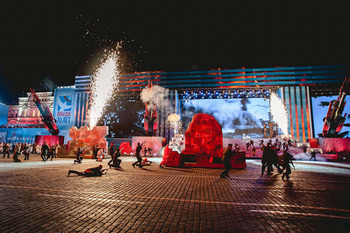
The decisive battle at Stalingrad, Victory Day Concert 2015. (Photo courtesy of PRESET-FX Multimedia)

From the perspective of spectacular storytelling, three scenarios, each representing the people united, stand out in this mythic tale of beset Soviet-Russian virtue and unlikely victory: a biomechanical rendition of home front steel production and two fierce battles with the fascist foe. The first requires dozens of worker-dancers, both male and female, moving rhythmically against projected images of a working steel factory that might have been lifted from Sergei Eisenstein’s 1924 film, Strike (39:00–43:41). Hammering, futurist-flavored music and factory sounds propel workers wearing theatrically enhanced, neo-constructivist, red and black satin “work uniforms” around the performance area, the urgency of their task manifested in the frenzy of their movement. Here, as in all of the scenarios featuring mass movement, the perfection of their bodies and faces and precision of their movement, much of which must be seen from the aerial cameras far above Red Square to be appreci-ated, is impressive.Footnote 43 Finally, in the first of two spectacular light shows, molten steel seems to pour from the screen, down the steps, and into the playing area. Simultaneously, and to the accompaniment of victorious music, an elderly worker and a boy carrying a bomb with “Za Rodinu” pasted on its side, emerge from the wings to stand before the audience.
A constructivist aesthetic: workers in the rear forging steel into weapons, Victory Day Concert 2015. (Photo courtesy of PRESET-FX Multimedia)

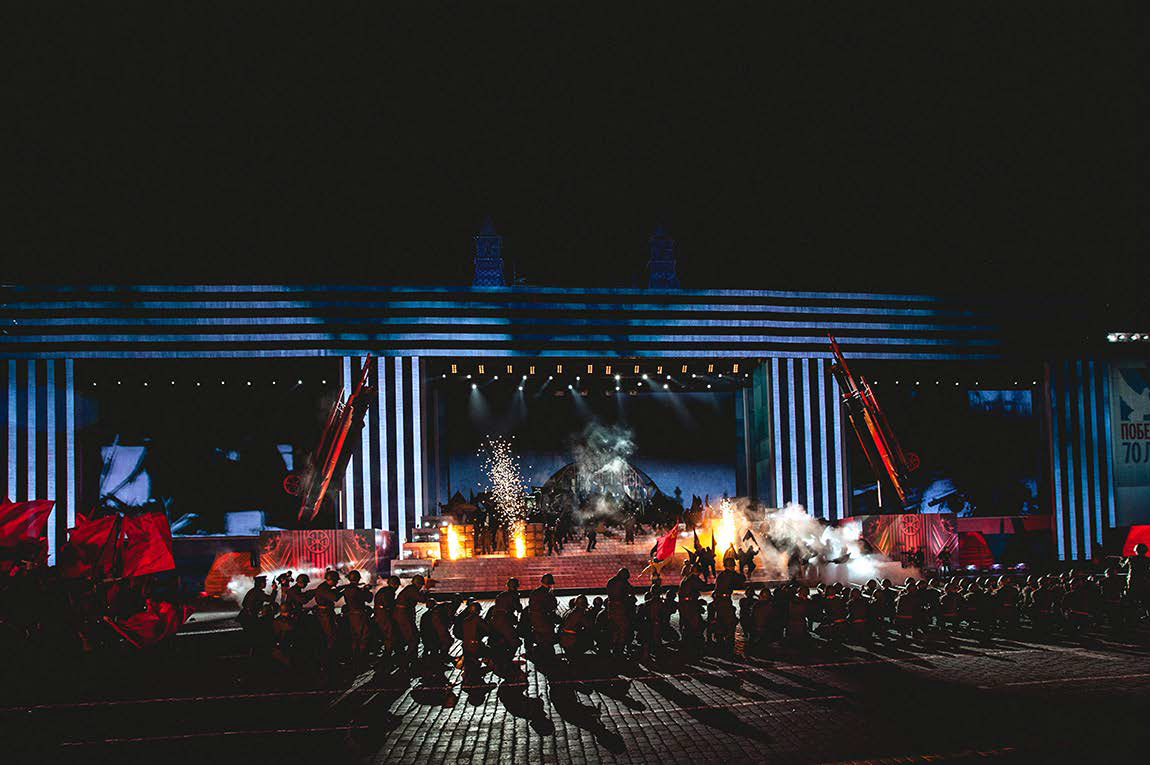
While a red-and-black aesthetic dominates both the factory and final battle scenarios, the colors signify very differently in each (1:18:42–1:23:56). Unsurprisingly, in the battles between good and evil, the Germans wear black, the Soviets bright red. Far from the snappy, Hugo Boss-designed uniforms worn by Nazi officers,Footnote 44 the German aesthetic — shiny black helmets, black uniforms, black cloaks, black flags, and black masks covering everything but the eyes — not only dehumanize the soldiers, but also seem to cite Darth Vader. In contrast, the fully human Luke Skywalker Red Army not only march barefaced but also helmetless and in uniforms that show off well-proportioned bodies. The Germans form an iron cross in the center of the playing area; the Red Army battalions, carrying their red flags, form four red arrows that attack the German iron cross twice before another flaming red arrow of soldiers, carrying only flashlights to illuminate their handsome young faces, flows down the steps in front of the center screen and somehow wipes out the Germans. The spectacle, which, like other mass special effects, would have been visible only to the television audience, is stunning. Nonetheless, the means by which the Red Army prevailed at Kursk (one of the bloodiest battles of the war)—with only flags and flashlights — remains mysterious, particularly in view of the Kremlin’s intention to reveal the absolute truth of the war.
The end of the road to victory happens in front of the Reichstag (1:28:46–1:35:10). The Soviet heroes, now equipped with facsimile weapons, battle the same head-to-toe black-clad brutes shooting flamethrowers wildly in the air. As the scenario climaxes, the two sides, fighting symbolically with red and black flags, provide the background for a lone Red Army soldier who charges the wall of black bodies and flags once, then again before finally ascending the burning Reichstag to plant the hammer and sickle at its very top.Footnote 45 The voice of Moscow — “attention, Moscow is speaking” (vnimanie, govorit Moskva) — announces the great victory of a Soviet people unified by love for the Motherland. The entire cast dances ecstatically!
A brief, patriotic address spoken by three youthful, uniformed Great Victory “heirs” (nasledniki pobedy) caps a trumpet and drum salute performed by still more of its great, great grandchildren. Accompanied by the audience and a cast of thousands, Lev Leshchenko, wearing a stylish white suit, closes the evening with yet another stirring rendition of “Victory Day.”
The Red Army’s final assault, Victory Day Concert 2015. (Photo courtesy of PRESET-FX Multimedia)

The “Sticking” Affect
Soundtrack
Experienced as an integrated whole, dramatic narrative, visual and special effects, soundscape, and soundtrack may well have had both the affect and effect of a Wagnerian total work of art, but the last merits special attention. For although the soundscape and soundtrack fit seamlessly together, I suspect that the concert-action-spectacle’s celebrity singers and poignant songs may have been its most effectively affective tool.Footnote 46 Orchestrated for greatest psychological affect and disposed strategically across the dramatic action, the songs seem calculated to draw spectators into the emotional world of the performance. The 2005 and 2015 events featured some of the same patriotic pop songs, but in different arrangements and interpretations, and repositioned in the plot, the events of which were also reordered.
The songs fall into two categories: “of the war” and “about the war” (Kobrin Reference Kobrin2015; see also Ament Reference Ament2018).Footnote 47 One, “A Grand Country Is My Motherland,” predates the war, 7 were of the war, and 11 were tunes from the 1960s, ’70s, and ’80s about the war. If strategic shots of the live audience can be trusted, the soundtrack, which brings together mood-appropriate instrumental music and familiar pop songs, provoked tears, laughter, and often spirited singalongs. In fact, even as a foreigner completely unfamiliar with the song book and celebrities, I found the soundtrack profoundly seductive and moving.
I’ve chosen representatives from several categories to dissect: those making obvious emotional appeals to certain demographics and generations; those obviously at odds with historical fact; and those most obviously at odds with the narrative itself. The most affective songs operate in and between discrete scenarios and strategic TV camera shots of the live audience, signaling to viewers what their emotional response to a given scenario should be.
The producers must have intuited a female demographic for the TV-viewing audience because almost half of the concert depicts women—mothers, wives, and girlfriends — and children in various states of fear and bereavement, and only one of the songs in the scenarios featuring women is of the war. If not in lyrics, then in arrangement and source (popular films), these are beautiful, but nonetheless desolate songs of sorrow. An idyllic scenario of happy Soviet children and youth singing “A Grand Country Is My Motherland” (a song so tuneful and popular that it almost became the USSR’s anthem), interrupted by a Nazi attack, launches a series of four such tunes: “Goodbye Boys,” “You Are My Moscow,” excerpts from the Nutcracker, and “Leningrad.”
“Goodbye Boys” is the first to bring a new arrangement together with a striking, young celebrity, Dina Garipova, a melodious soprano whose victory on the reality television show The Voice (Golos) won her a spot to represent Russia at the Eurovision song contest (17:30–20:23). Accompanied by a lone guitar, grief-stricken she sings,
Ah, war, what you’ve done is shameful:
Our homesteads have become empty,
Our boys raised their heads,
Grown up before their time,
On the threshold they appeared for a moment
And departed, soldier after soldier…
Goodbye boys!
Boys, try to come back.
Don’t hide, stand tall,
Spare neither bullet, nor grenade nor yourself
But try to come back.
War affects women as well as men. Garipova’s visual presence, the only white figure among a sea of black women, brings to life the next lyrics:
Ah, shameful war, what have you done:
Instead of weddings — separations and smoke,
Our girls gave their white dresses
To their sisters.
How can you get away from those boots
Or those green epaulets?
Spit on the gossips, girls,
We’ll settle scores with them later!
Let them babble that there’s nothing for you to believe in,
That you’re going through war blindly
Goodbye girls
Girls —
Try to come back.Footnote 48
Separating “Goodbye Boys” and “You Are My Moscow” is a marvelous “song-lament” (sukhoplias or pesnia-plach), performed in recitative against the background of gigantic death notices (24:55–26:36).Footnote 49 The singer, this time a wife or mother, advances through a crowd of keening women, the amplified click of her heels on Red Square’s paving stones the only accompaniment.
Whether literally in the lyrics or through allusion, this grouping of chant and song, which extends through the Siege of Leningrad, features women (mostly mothers and wives) and distraught children abandoned — albeit for a just cause—by heroes of the Motherland. Although a bit chunkier than he was in 2005, the still handsome operatic tenor Nikolai Baskov renders “You Are My Hope” (like “Goodbye Boys,” taken from a popular film), a graceful melody about love for Moscow, as a romance to a city gendered feminine both grammatically and in performance (27:40–31:10).Footnote 50
We hear the echo of a long-ago parade
We dream about roads bearing the main attack,
You are my hope, you are my comfort,
In the soldier’s heart — you are, my Moscow.
I need nothing in this world,
Except that in tough times, you are alive
You are my hope, you are my comfort
You’re in every Russian heart, you, my Moscow.Footnote 51
Like the battle of Moscow, the siege of Leningrad opens with artless Soviet children and a corps de ballet dancing to Tchaikovsky’s Nutcracker. The more up-tempo “Leningrad” (1930 and 1977) follows this oddity. While sensible with respect to musical affect, these choices make less sense with respect to history and memory politics. Even though lovely and beloved, which is surely the point, the “Dance of the Sugar Plum Fairy” feels, if not musically then certainly the-matically, to be operating in an entirely alien fictional world.
The lively ballad, “Leningrad,” feels even more peculiar, not for the music, but for its lyrics (36:36–38:54). Set to music by pop singer Alla Pugacheva, the words are not hers but the poet Osip Mandel’shtam’s (1891-1938). Arrested twice (1934 and 1938), Mandel’shtam died from cold and hunger in a transit camp near Vladivostok (Russian Far East) in 1938: he is one of many writers and artists jailed by Stalin who enjoyed a renaissance in the late and post-Soviet eras.Footnote 52 And while Mandel’shtam titled the poem “Leningrad,” he refers to Petersburg twice as often as the city of Lenin.Footnote 53 Pugacheva altered the lyrics, omitting the references to Petersburg and “voices of the dead” that appear in the original poem. In her rendering, this melancholy poem becomes a kind of pop, cabaret tune, replete with accordion accompaniment. In contrast, Hibla Gerzmava,Footnote 54 who sings “Leningrad” in the 2015 concert, turns it into an up-tempo, but nonetheless sentimental ballad. In Gerzmava’s rendering, “Leningrad” does not describe a wary poet’s return from exile. Rather, like “You Are My Hope,” the song becomes a nostalgic love song to a city left to decay after the revolution and where more than a million civilians starved to death during the German army’s three-year siege (1941–44). Nonetheless, the singer’s cheerful interpretation signals a shift in the concert’s action and ambiance, as it moves from victim to victory and despair to optimism.
Another odd musical moment introduces an extended comic interlude when lovely pop celebrity Pelageia and two beautiful boy sopranos sing “Dark Night” (“Temnaia noch’ “; 43:42–46:25). Perhaps because the lyrics describe bullets whizzing by and address someone assumed to be a wife or girlfriend waiting for him, male vocalists usually perform the song. Here, however, as they look lovingly into each other’s eyes, the singers perform “Dark Night” as pure pop romance, which puts the lyrics in tension with both the original and the concert setting.Footnote 55 Indeed, the performance (both visually and vocally) divorces the song from the war so completely that one wonders what logic governed its production aesthetic. Tiny tots soundly sleeping replace the forlorn expression of a solitary soldier’s desire. Apparently here, as elsewhere in the concert-spectacle, contextual and lyric consistency mattered less than affect: glancing camera shots of teary-eyed women indicate the target audience.
Throughout the concert, camera shots signal to television viewers how they should feel. From “A Grand Country Is My Motherland” through “Dark Night” — more than half the concert—the focus of the cameras is on Xi Jinping, Putin, the very attractive, stony-faced military academy lass sitting next to him, and teary-eyed women. Shots of the audience become rarer as the action advances from Stalingrad through Sevastopol and Kursk to Berlin, but although the cameras occasionally catch a male face during the comic interlude, women remain the locus of affect. The second half of the concert, which advances through the great battles won by the USSR, maintains a comparatively subdued musical atmosphere. The stirring battle sounds of screeching strings, drums, trumpets, and explosions consistently segue into tearful songs about the war, drawn primarily from cherished, Brezhnev-era films. In contrast to the 2005 concert, which tended to feature spirited marches, creating an optimistic feeling, in 2015, bereft mothers, dead soldiers transformed into cranes, birds that no longer sing, heroes dying on a nameless hill, and soldiers longing for mama all pave the road to victory.
The comic interlude offers an intriguing contrast not only to the total soundtrack, but also to the soundtrack and politics of the 2005 event (46:41–1:01:45). In terms of genre and period, music of the war predominates in this 18-minute segment. As historian Kirill Kobrin explains, in contrast to songs about the war after the fact, songs of the war written during the war offered “comfort through art” (uteshenie iskusstvom). In fact, the lyrics rarely talk about the war, but rather invoke “the ordinary feelings of ordinary people” caught in “extraordinary circumstances.” Kobrin continues, “War, especially ones like the world wars of the last century, in their ‘purest aspect’ (chistyi vid) are impossible to bear psychologically without the soothing narcotic of pop culture” (2015:224). Thus, logically, five of the six songs written between 1940 and 1947 appear here. The five songs that follow “Dark Night”—“Eh, the Front-Line Path” (“Ekh, put’-dorozhka frontovaia”), “Dark-Skinned Girl” (“Smuglianka”), “In the Dugout” (“V zemlianke”), “Mishka from Odessa” (“Mishka-odessit”),Footnote 56 and “The Blue Kerchief” (“Sinii platochek”) — are in an altogether different emotional register, as soldiers, sailors, Red Cross nurses, as well as random civilian girls, dancing Cossacks, and tap-dancing sailors gather behind the front lines for some rowdy song and dance. Despite “Eh, the Front-Line Path’s” rather bleak subject (the probability of death on the front lines), Belorussian Sergei Volchkov, another winner of The Voice, and Chechen baritone Evgenii Kungurov belt it as a jolly, up-tempo, jazz dance tune. Next, the fine-looking hunk, Dima Bilan, winner of many awards, sings “Dark-Skinned Girl” flanked on either side by two dancing beauties pretending to play an accordion accompaniment.Footnote 57 The 2015 interlude suggests that the producers targeted not veterans but the youth audience, as the camera shifts from Bilan, one of the biggest pop celebrities in Russia, to the young men and women singing along with him. While few young people would know this repertoire (songs of the war) and few of the singers in this segment performed their preferred genres, the “song + celebrity” formula seemed to achieve the intended emotional response, suggesting to youthful viewers that war can be fun. Maybe they should volunteer for Putin’s army!
Perhaps more significant is the contrast with the 2005 comedic interlude, which happens after Kursk and before Berlin, and includes lots of peppy, very popular French and American songs, marches, and dances. The point here, I think, is that the Soviets and Allies have already joined forces and the war is all but won. Ecstatic songs and dances enhance the mood of impending victory. The 2015 interlude, which takes place before Stalingrad, Sevastopol, and Kursk, excludes the Allies altogether and transitions not to optimistic cooperation, but back to the apprehensive, somber mood of the first half of the concert. The victory music and dance, which happen after the battle of Berlin, includes not the diverse peoples of the Soviet Union, but white, European Russians (with a couple of Cossacks thrown in for good measure). If the 2005 narrative extended a friendly hand to the international community, the story of 2015 was of a besieged empire that won the war single-handedly wholly detached from the Allies. Be very afraid and very prepared, it warns. The stories told by each event correspond to the trajectory of Russia’s increasingly tense relations with the West since 2008.
After the war, the Soviet Union said, “never again”; today, a popular meme tells youth, “we can do it again” (my mozhem povtorit’).Footnote 58 In this regard, the implicitly and explicitly antiwar songs in the 2015 concert—“Goodbye Boys,” “Ballad of a Mother,” “Cranes,” “Here the Birds Don’t Sing,” “The Last War”—feel at odds with the concert’s principal purpose: to fuel patriotic zeal.Footnote 59 The most peculiar of these is a rock rendition of Vladimir Vysotskii’s “Save Our Souls” (1:12:07–1:16:12),Footnote 60 which feels musically on target (for a youth audience) and tex-tually wide of the mark. As a battleship rises from the center screen, blue streamers undulate like waves, while the sounds of wind, seagulls, and crashing waves establish place and mood. Screaming guitars introduce Grigorii Leps, sporting tinted glasses and a beautifully tailored, gray, knee-length suit jacket complemented by a casually open-collared shirt. Standing on the bow of a warship, Leps half sings and half shouts Vysotskii’s lyrics that describe men who, trapped in the claustrophobia of a submarine, will soon be ordered into battle and certain death. So dissonant are they in an event that aims to stir passionate patriotism, that the lyrics must be quoted in full:
We’re going under water,
in neutral waters.
And now we don’t
care about the weather.
And if the waves cover us,
sensors will roar
About our trouble.
(Refrain) Save our souls!
We’re crazed from suffocation!
Save our souls!
Hurry to us!
You’ll hear us on the shore,
Our SOS is louder and louder.
And the horror slices our souls.
Slices them apart.
And aortas are bursting,
but no one is allowed above!
On the left side of the deck,
on the right side of the deck,
There right in front of us
our way is blocked
By horned death.
(Refrain)
But here we are free men.
Well, this is our world!
Have we gone insane,
to emerge amid the bombs?
“With no hysterics or hesitation
we will hit the shore,”
The brave captain said.
(Refrain)
We will emerge at sunrise.
An order is an order.
It’s better to die
with the light,
Our way isn’t marked.
We have no air, we have no air…
But do remember us.
(Refrain)
We made it to the top,
but still, no way out.
Get ready to arise, fight and fight.
Our nerves are strained!
The end to all sorrows,
all ends and beginnings,
We are striving for moorings,
just like torpedoes.
(Refrain)Footnote 61
One marvels at the inclusion of “Save Our Souls,” not only for its decidedly antiwar lyrics, but also, in the Putin era, because of the composer-singer’s profile. While ordinary Soviet people loved the actor/composer/shouter-singer/dissident/drug addict, he stirred controversy. Brezhnev’s Ministry of Culture only recognized Vysotskii’s artistry in 1978, and although he avoided the notorious Lubyanka prison in Moscow or commitment to a mental hospital, his songs and poetry were often censored.Footnote 62 Why, then, given the current crackdown on dissent in Putin’s Russia, would the producers of Victory Day’s most extravagant patriotic event include “Save Our Souls”? The answer, I think, is twofold: musical affect, particularly on rock-loving youth; and baby-boomer affection for a dissident hero of their times. In addition, Leps, a celebrity singer (and Kremlin favorite), seems to have cross-generational appeal. At age 53 in 2015, Leps not only enjoyed an enthusiastic youth audience, but also still had sex appeal — at least that’s what a camera shot of a young woman staring rapturously at him would have us believe.Footnote 63 As so often happens in this concert, sentiment, celebrity, and a rock and/or pop arrangement seem to matter more than history and memory.
Remaining for a moment with history and memory, several songs stand out—not so much for falsification as for mythologizing, misrepresenting the experiences of ordinary Soviet soldiers, and omitting major actions that show Stalin and the Red Army in a less than heroic light. For example, the delightful “A Grand Country Is My Motherland,” composed for the beloved 1936 film, Circus (Tsirk), itself a celebration of Soviet racial tolerance, extols a “life that has become more joyous” under comrade Stalin:
A grand country is my Motherland,
She has many forests, fields, and rivers,
I know no other such country,
Where a person breathes so freely.Footnote 64
In song and image, the concert draws from the film’s finale, which depicts a parade of proud, physically stunning, bleached-blonde Soviet people (absurdly Aryan in appearance for an anti-German film) dressed in pure white who march and sing jubilantly of the greatness of the motherland. Sung here without irony by a choir of wholesome children and youth, the song radiates nostalgia for an imagined communist utopia that existed neither under Stalin nor any other Soviet leader.
The stirring “Holy War,” composed just after the Nazi attack of 21 June 1941, urges the aggrieved Soviet peoples to rise up, revenge the dead, and show the “fetid fascists” that they can’t mess with comrade Stalin:
Arise, massive country,
Arise for mortal battle
With the dark forces of fascism,
With the vile horde!
We will not let blackened wings
Fly over the Motherland,
The enemy dare not trample
Her spacious fields!
We will put a bullet in the forehead
Of fetid fascist vermin,
We will hammer out a mighty coffin
For the scum of planet Earth!Footnote 65
While positioned at an appropriately affective moment in the concert’s narrative, it connects the viewer/listener to the battle of Moscow (2 October 1941-30 April 1942), rather than the first months of Germany’s Operation Barbarossa, when, thanks in large part to Stalin’s miscalculations, thousands of planes and tanks were destroyed as the unprepared and ill-equipped Red Army suffered 600,000 casualties and thousands of panicked soldiers deserted (Merridale Reference Merridale2006).Footnote 66 Likewise, in music and image, The Nutcracker and “Leningrad” paint a decidedly benign picture of the Siege of Leningrad, when bloated corpses floated from the sea battles down the Neva River, which ran red with blood into the city’s canals.Footnote 67 Dancing sugar plum fairies, nostalgic tunes, and the appearance of successful evacuations of women and children belie the reality of starvation, murder, and cannibalism.Footnote 68
Misrepresentation of the many roles played by women in the GPW constitutes not only the greatest omission, but also the greatest distortion of fact. Songs, stories, and images would have viewers believe that, except for nurses, women remained at home, either in mourning or awaiting the return of their heroic sons and husbands. Until the comic interlude, women tending the hearth sing or chant all but one of the songs. When “serious” combat starts, military masculinity takes center stage. Unsurprisingly, men sing 7 of the last 11 songs, all connected visually to battles. In fact, Soviet women played prominent roles on the front line in hand-to-hand combat, as snipers, bomber pilots, and partisans. Many died, were wounded, or remain missing in action. These women are invisible in the concert.Footnote 69 Perhaps the Kremlin’s current emphasis on “traditional values” does not permit representation of women outside the domestic sphere.
The formula is simple: new, often more poignant arrangements of beloved songs performed by contemporary celebrities accompany a string of heroic images. The action rises and falls as a virtuous Red Army advances along a largely bloodless road to Berlin. There’s even a bit of clean fun to be had behind the front lines with pretty nurses and civilian girls. Death appears only once in seductive, symbolic form, as Iosif Kobzon, a 1970s crooner, sings “Cranes” (1:08:23–1:11:43):
At times I think that soldiers
Who did not return from bloodied fields,
lay not in our earth, but one day
turned into white cranes.Footnote 70
The cranes, a bevy of beautiful young women dressed in white and gold satin, descend to take apparently deceased young men (left standing in tableau vivant following the battle of Stalingrad) to their just reward. In these circumstances, who wouldn’t volunteer for Stalin/ Putin’s army?
What Kind of Past Does Russia’s Future Need?
In 2017, just before I traveled to Moscow for Victory Day, professional historians working through the Free Historical Society (Vol’noe Istoricheskoe Obshchesto) released a provocative, book-length document entitled, What Kind of Past Does Russia’s Future Need (Kakoe proshloe nuzhno budushchem Rossii) (Vol’noe Istoricheskoe Obshchestvo 2017). During that trip, I visited the Victory Museum (a truly edifying institution organized around the Kremlin’s GPW narrative) where I encountered a sign reading, “Without the Past There Is No Future” (“Bez proshlogo net budushchego”). While superficially alike, the Society’s document and museum’s poster represent antagonistic sides in Russia’s war over history and memory. The historians ask a question; the Kremlin makes a statement. Both, however, understand that the Great Patriotic War remains Russia’s most “usable” history and worry that Russian youth neither know nor understand it. Coexistence stops there. Professional historians protest the Kremlin’s politicization of this history, complaining that its so-called historians—for example, Medinskii and Nikolai Starikov—don’t write history, but rather invent and/or reinvent affective myths.Footnote 71 Such critiques don’t trouble Medinskii, who purports to prefer myth to fact. For the former minister and his allies, history as told by state-sponsored and/or -produced television programs, textbooks, films, video games, and Victory Day concerts is the only history Russian youth need.
“Without the Past There Is No Future, “ Victory Museum, 2017. (Photo by Catherine Schuler)

In his analysis of World War II video games, Jerome De Groot observes that developers have no need of complex, academic accounts of the war ([2009] 2016:152–64). Few gamers, after all, play in order to acquire a better understanding of history; they just want a good game with realistic weaponry. De Groot advises developers to consult secondary school textbooks because, while such games demand high levels of realism, their historical narratives must be simple and without moral ambiguity. That principle also operates in the Red Square concerts, particularly the 2015 event. Do the concerts falsify history? Not exactly. Archival photographs and documentary film footage flash on the screens, and while celebrities mostly wear contemporary clothing, the producers otherwise require authenticity with respect to period costumes, props, and weaponry. Nonetheless, the concerts live not in the world of fact, but of romantic myths populated by stunningly attractive people and cleansed of awkward truths and provocative statistics: the Molotov-Ribbentrop nonaggression pact (1939); the costly Winter War with Finland; the Polish partition; Stalin’s many errors of judgment; the thousands of deserters; Soviet soldiers murdered by their own officers; female soldiers, snipers, and flyers on the front lines; Red Army atrocities in Eastern Europe, the Baltics, and Germany (in particular, the rape of thousands of women); the millions of lives lost (many needlessly) between 1941 and 1945; and penal battalions.
Why does the Kremlin, which, along with the city of Moscow, spends billions of rubles on Victory Day parades and concerts (Opalev, Miazina, and Makariia Reference Opalev, Miazina and Makariia2015),Footnote 72 seem so determined to grab and shape the GPW narrative? Probably because attempts after 1991 to shape a core post-Soviet identity or even revive feelings of patriotism have largely fallen flat. Today, however, Kremlin politologues face a serious problem: the impending extinction of authentic GPW veterans.
Because Victory Day has, since 1965, focused on veterans, organizers worry that, with their loss, the celebration’s core will fall out, leaving it to “museum-ify.” Thus, if the Kremlin hopes to cultivate avowed patriots and new, enthusiastic consumers of WWII mythology, the Victory Day “scenario” must be changed and quickly (Bordiugov Reference Andreev and Bordiugov2015:617–18).Footnote 73 While the loss of primary witnesses may undercut the truth claims of Kremlin historiography, there is an upside. Their absence offers the Ministries of Culture, Education, and Defense, the Russian Military Historical Society, the Kremlin, and the Duma a much freer hand to invent and shape politically efficacious myths.
If history and memory go together, so too do affect and memory. A parallel question might be: what kind of memory does Russia need? When the “authentic,” first-hand memories die with their bearers, what remains? I turn to what Alison Landsberg calls “prosthetic memories.” The Kremlin’s PR and media apparatuses work tirelessly to invent, reinvent, and circulate affective patriotic events and products for its youth audience. In order to renew and maintain the GPW as a locus of identity, the extraordinary emotional investment of veterans and their children in the GPW must somehow be transmitted emotionally, psychologically, and somatically to post-Soviet youth. By employing the tools of immersive song, dance, and spectacle, producers of the 2015 concert beckon viewers into a mythic space where war appears virtuous, heroic, and sometimes even fun. Its aestheticized war scenarios would have draft-age youth believe that death on behalf of the Motherland is not only beautiful, but also holy.
Do the concerts work? Do beautiful stories of Russian-Soviet exceptionalism stick with the Russian people? While the intended affect is clear, demonstrable effect is less so: patriotism appears to have increased since 2014, but resistance to the inflation, theatricalization, and commercialization of Victory Day flourishes primarily on internet sites like #pobedobesie, VKontakte, Facebook, and Live Journal. In an age of memory laws, dissidents seek the anonymity of the internet.Footnote 74
Because concerts cost the Kremlin dearly, presumably another won’t appear until the 80th jubilee in 2025. Victory Day mythmaking, however, proceeds apace. Speaking in Red Square on the 73rd anniversary of Victory Day (9 May 2018), President Putin continued to spin half-truths about the Great Victory. His most enduring trope—“the heroic feat of the people [podvig naroda], which saved Europe and the world from slavery and extermination and from the Holocaust”—launched a tirade against Western historians and politicians who lie about and distort Russia’s glorious history. “We will always be proud,” he continued, “that the Soviet people did not tremble, did not cave in to a cruel enemy when other states capitulated. Our people fought to the death.” All nationalities of the Soviet Union “answered the call and fought to the last drop of blood for the Motherland. Everyone had only one Motherland. 9 May unites all generations in a history of fortitude” (Kremlin.ru 2018). His 2019 speech repeated these themes: “With each year we feel more keenly the moral power of [our] immeasurable feat […]. [The people] saved the Motherland, became the hope, the bulwark of all humanity, the force that freed the peoples of Europe […]. Remembrance [pamiat’] of the Great Patriotic war, its truth is our conscience [sovest’] and responsibility [otvetstvennost’].” While others worship false heroes, “Our sacred duty is to defend the real ones” (Kremlin.ru 2019).
Coda
Victory Day 2020
Above, I expressed hope that the next Victory Day spectacular would take place in 2020, all the while knowing that tradition and economics favored 2025. When I discovered that the Kremlin was indeed planning a 2020 whopper to mark the 75th anniversary of the Great Victory, I made plans to travel to Moscow. How could I not? Between a gigantic military parade attended by many foreign heads of state, mighty displays of tanks, past and present, a spectacular concert in Red Square,Footnote 75 and an enormous Immortal Regiment procession, 2020 promised to eclipse 2015 with respect to size, splendor, historical mythmaking, and profligate spending. Then Covid-19 struck hard, leaving the Kremlin on the horns of a dilemma: go on with Putin’s show or protect the health of the Russian people.
Kremlin watchers doubted that Putin would cancel or postpone the festivities. Spring 2020 was supposed to be a season of triumphs for Russia’s president: the certainty of being given the opportunity to become president for life, a chance to reinvigorate waning patriotism and demonstrate, in spectacular fashion, Russia’s growing role in global politics (Kamyshev Reference Kamyshev2020). In a March interview with Ekho Moskvy, Oleg Kashin, a vocal Kremlin critic, opined that, while Putin might postpone an April vote on constitutional reform, which included an amendment jettisoning presidential term limits, he had too much symbolic capital invested in the Victory Day bash to cancel or move it to a later date (in Orekh and Anikina Reference Orekh and Anikina2020).Footnote 76 Writing for the Moscow Carnegie Center, Aleksandr Baunov echoed Kashin: “Putin would hardly want to cancel the 9 May parade, which, each year, demonstrates Russia’s military power and its glorious history” (Baunov Reference Baunov2020). Twenty foreign armies, including a delegation of WWII veterans from the US, planned to participate in the parade and ancillary events (Kommersant.ru Reference Eremina2020a and Reference Eremina2020b). The bevy of foreign dignitaries (most prominently, Emmanuel Macron and Xi Jinping) who had accepted the Kremlin’s invitation would further enhance Victory Day 2020’s international aura. Their presence would put Moscow’s diplomatic influence on full display. “Cancellation,” Baunov continued, “would send society a signal deeply offensive to Putin: the USSR defeated Nazism, but Putin’s Russia is losing the war on the virus. Victory Day can’t be turned into a day of defeat” (Baunov Reference Baunov2020).
President Putin wrong-footed skeptics when, on 16 April, he announced the postponement of the parade and all attendant festivities. He explained it this way: “9 May is holy for us, but the life of each person is invaluable” (in Mislivskaia Reference Mislivskaia2020).Footnote 77 A remarkable declaration from the most recent in a long line of Russian authoritarians and autocrats disdainful of civil society and human rights, but with it, Victory Day moved largely online — which is not to say that 9 May 2020 passed without a dramatic, live visual event (Eremina Reference Eremina2020 and Mozgovoi Reference Mozgovoi2020). The Ministry of Defense gifted Moscow (and other major cities) with a mighty show of air power, as squadrons of jet fighters spewing red, white, and blue smoke rocketed over the city (Kommersant.ru Reference Eremina2020a and Khalip Reference Khalip2020).Footnote 78
While neither the parade nor the hoped-for Red Square concert went online, several cities, including St. Petersburg, streamed online concerts. A concert in the Kremlin palace—without an audience — did take place on 7 May. Many museum, library, and archival exhibitions, as well as school events moved online. Kultura.ru published an online resource for fictional and documentary films, songs, interviews, and visual art, including excerpts from a theatre production (1988) of an adaptation of Svetlana Alexievich’s U voiny ne zhenskoe litso (Kul’tura.ru Reference Efofeev2020). The Immortal Regiment (Bessmertnyi Polk) launched an online “marathon” entitled Great Songs of the Great Victory (Velikie pesni velikoi pobedy). Tricolor TV, Russia’s largest direct-to-home provider based in St. Petersburg, devoted an entire channel (Den’ pobedy, operating from 3 April to 31 May) to WWII films, serials, and documentaries. Producers also invited subscribers to create a virtual Immortal Regiment. Other producers packed Russian television with even more Victory Day programming than usual. One such show, a rebroadcast of Russia’s triumph over Germany in the finals of the 2018 winter Olympics, drew criticism from Novaia gazeta. Complaining that hockey was totally unrelated to a “holiday with tears in your eyes,” columnist Vladimir Mozgovoi declared that Russian television had reached a new low (Mozgovoi Reference Mozgovoi2020).
Despite the continuing threat of new Covid-19 spikes, on 26 May, Putin fulfilled his promise to the Russian people and rescheduled Moscow’s celebration for 24 June.Footnote 79 Critics were underwhelmed. Writing for Vedomosti, Dmitrii Kamyshev suggested that, no matter how lavish the festivities, Russians will perceive the new holiday as lesser: the airshow has already happened, the procession of tanks won’t have the same aura, and, fearing rejection, the Kremlin will not re-invite Western European dignitaries. Thus, only Russians and citizens of former republics will hear a message — the Motherland “has finally risen from her knees” — drummed into their heads since the Sochi Olympics (Kamyshev Reference Kamyshev2020).
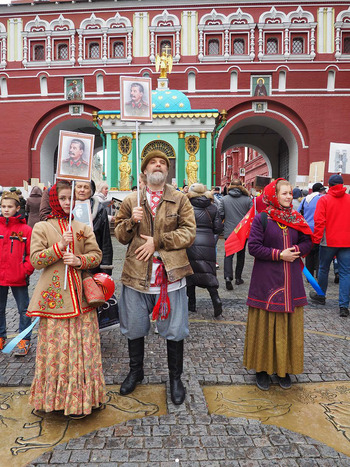
Stalin enthusiasts pose for photographs in front of the Resurrection Gates (Voskresenskie Vorota), Immortal Regiment Procession, 9 May 2017. (Photo by Catherine Schuler)

Whether a new, more spectacular Red Square concert-action will take place before the 2020 calendar year ends remains a mystery.Footnote 80 Accordingly, as I write this coda, I cannot say whether significant changes to either its aesthetic or narrative have been or will be made. I do, however, know that, far from cooling, the history and memory wars have heated up since 2015. As I’ve followed developments in the Victory Day narrative, I have begun to better understand that, while Russian mythmaking tends to echo late Soviet practice, it is also reactive, shaped in large part by an Eastern European “war of memory against Russia” (see Miller Reference Miller2020; Kolesnikov Reference Kolesnikov2020; Aptekar’ Reference Aptekar’2020).Footnote 81 Aided and abetted by the European Parliament and, more recently, Ukraine, Eastern Europeans equate Stalin with Hitler and endeavor to lay the blame for WWII equally on the Soviet Union and Nazi Germany. As Aleksei Miller points out, this narrative depicts the Soviet Union’s actions — and by extension, contemporary Russia’s — as criminal (Miller Reference Miller2020). Outraged by this slanderous “distortion” of the historical record and contempt for the “truth,” Putin’s Kremlin has dug even deeper into an imaginative counter-narrative that paints the Soviet Union and the Red Army in colors of righteous integrity. In order to drill the message into would-be dissidents, new memory laws enacted by the Duma since 2015 criminalize “deliberate” falsification—which in this instance means uncomfortable truths — of so-called facts about the war. Thus, should another spectacular concert take place before 31 December 2020, I am convinced that it will not only repeat 2015 themes, but burrow more tenaciously into them. Only one burning question remains: will Stalin finally show up for the Red Square festivities?