Introduction
Background
Airway management is a critical aspect of cardiopulmonary resuscitation. One component of effective airway management is adequate ventilation. The bag valve mask (BVM) is a commonly used tool for ventilation. The most recent Basic and Advanced Life Support algorithms released in 2015 support the use of a BVM when patients have airway obstruction or inadequate respiratory drive.Reference Kleinman, Brennan and Goldberger 1 , Reference Link, Berkow and Kudenchuk 2 A recent meta-analysis of airway management in out-of-hospital cardiac arrest found lower survival among patients treated by trained prehospital rescuers with advanced techniques (eg, endotracheal intubation) compared to basic techniques, including BVM.Reference Jeong, Ahn and Shin 3
Effective BVM use entails external placement of a mask over a patient’s face and then delivery of positive pressure breaths. Despite the frequent need for this procedure during patient resuscitation, it is a challenging skill to master,Reference Komatsu, Kasuya and Yogo 4 and it is even more challenging to perform as a single rescuer.Reference Davidovic, LaCovey and Pitetti 5 - Reference Hart, Reardon, Ward and Miner 8 Technology to improve this intervention may improve out-of-hospital cardiac arrest survival.
Novel Mask Design Literature
Several studies have examined alternative novel mask designs to facilitate effective mask seal formation. Intraoral-style masks offer a mechanism to bypass challenging facial anatomy.Reference Amack, Barber, Ng, Smith and April 9 However, most studied designs are variations of the conventional external cuffed face mask with alternations designed to maximize seal over external facial features.Reference Lee, Jeung and Lee 10 - Reference Wagner-Berger, Wenzel and Stallinger 13 External face masks pose a challenge for single rescuer scenarios in which rescuers must achieve a mask seal using only one hand. Leverage devices (eg, handles) incorporated into BVM designs offer a possible mechanism by which to better direct downward pressure to achieve a seal using only one hand.
A recent randomized crossover trial examined a modified BVM designed to facilitate single rescuer ventilation with an integrated solid internal handle situated inside the bag. The aim of the modified BVM was to achieve necessary downward pressure by allowing the single rescuer to push downward onto the face with the hand squeezing the bag via the internal handle. This study found higher received tidal volumes with this modified BVM compared to standard BVM in a manikin model.Reference Zobrist, Casmaer and April 14 However, purchase of this device on a mass-scale may be cost-prohibitive. This study seeks to determine if it is possible to modify standard BVMs with the addition of an external handle to achieve similar improvements in tidal volume delivery as previously reported for a BVM modified with an integrated internal handle.
Goals of this Investigation
This study seeks to determine whether ventilation, as measured by mean tidal volume delivery, is higher with a BVM with removable external handle versus a standard BVM in a manikin model. The hypothesis is that the mean received tidal volumes will be greater with the modified BVM during single rescuer ventilation.
Methods
Study Design and Setting
This study’s design is based upon a similar previous study comparing a BVM with integrated internal handle to a standard BVM in a manikin model.Reference Zobrist, Casmaer and April 14 This study is a prospective, randomized, single-blind crossover study comparing ventilation using a standard unmodified BVM versus standard BVM with a removable external handle. The study population comprised employee volunteers from an academic urban tertiary care hospital. Subjects delivered respirations to a manikin model. The Brooke Army Medical Center (San Antonio, Texas USA) institutional review board approved the study. The ClinicalTrials.gov registration number is NCT02800213.
Selection of Participants
Investigators recruited a convenience sample of employee volunteers to participate in the study. Inclusion criteria included health care providers >17 years old. Eligible participants included attending physicians, resident physicians, nurses, physician assistants, respiratory therapists, medics, and medical students. All participants must have previously completed a Basic Life Support curriculum to include training in bag-mask ventilation.Reference Kleinman, Brennan and Goldberger 1 Exclusion criteria included physical impairments determined by either investigator or participant to preclude performance of conventional BVM ventilation.
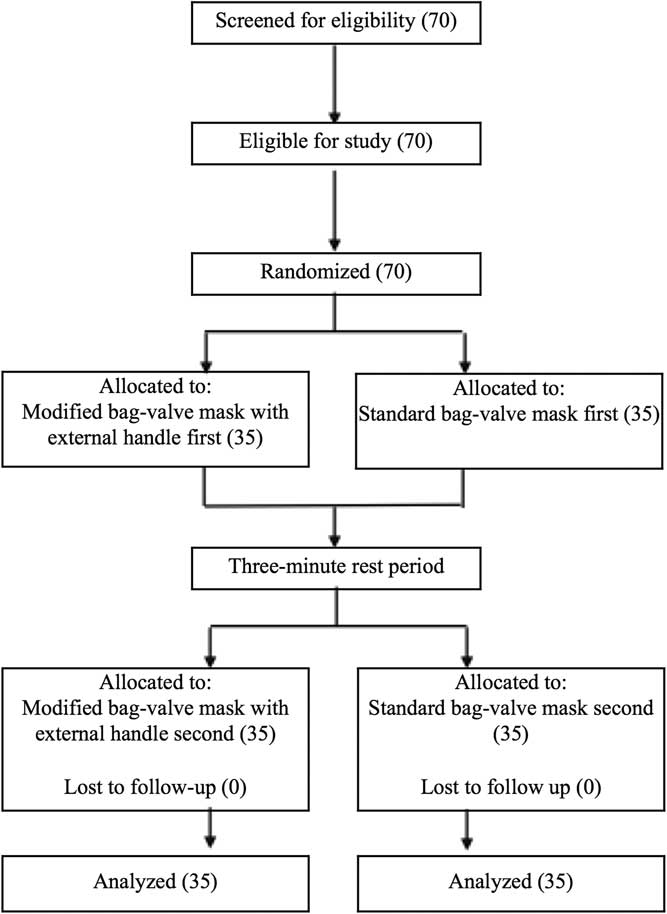
All subjects provided consent to study investigators. Investigators maintained documentation of subject flow in accordance with the Consolidated Standards for Reporting Trials Statement (Figure 1).Reference Schulz, Altman, Moher and Group 15
Consolidated Standards of Reporting Trials (CONSORT) Diagram of Subject Enrollment, Allocation, Follow-Up, and Analysis.

Interventions
This study comprised two arms. For the control arm, subjects used a standard unmodified Spur II BVM device (Ambu; Ballerup, Denmark). For the intervention arm, subjects used a Spur II BVM with the addition of a removable solid external handle affixed to the junction between the mask and the bag (Figure 2). This device modification is currently pending Federal Drug Administration (FDA; Silver Spring, Maryland USA) approval. Investigators used a randomization sequence with permuted blocks of 10. Following screening, consent, and enrollment, investigators allocated each subject to an initial study arm. This was a single-blinded study: investigators collected outcome data while physically situated in a fashion that left them blinded to subject allocation.
Schematic of External Handle Alone (Panel A) and Attached to Spur II Bag Valve Mask (Panel B).

Subjects completed a brief demographic questionnaire. Investigators obtained hand dimensions and grip strength measurements.Reference Zobrist, Casmaer and April 14 Subjects then received a brief lecture on one-handed BVM ventilation technique. Investigators instructed subjects to use their non-dominant hand to maintain head tilt and chin lift with the EC-clamp method.Reference Joffe, Hetzel and Liew 6 , Reference Hart, Reardon, Ward and Miner 8 Subjects did not receive any specific instructions regarding how best to utilize the modified device.
Subjects were allowed to practice using both devices ad lib. The manikin model was a RespiTrainer Advance manikin (IngMar Medical; Pittsburgh, Pennsylvania USA). All study procedures utilized this model, which resembles a typical adult male without any unusual airway or body habitus characteristics. Investigators advised subjects to aim for visible chest rise with each breath delivered at 10 breaths per minute (as guided by a metronome). Investigators answered all subject questions about the study prior to study initiation.
Upon study start, subjects established a one-handed mask seal. Then investigators started the metronome device. Subjects ventilated the manikin at a rate of 10 breaths per minute over three minutes (for a total of 30 breaths). Investigators allowed subjects to make adjustments to improve ventilation. Subjects repeated these study procedures using the alternative mask after a three-minute rest period. After performing ventilations using both devices, subjects completed a post-study survey soliciting their opinions on the two BVM designs. This was a hard-copy sheet based on a survey design implemented in a previous study examining a similar BVM design modification.Reference Zobrist, Casmaer and April 14 All participants completed the survey without time limits in a private setting so maintaining the confidentiality of responses.
Methods of Measurements
Investigators collected all data in a de-identified manner. Demographics collected included job description (eg, attending physician), years of medical experience, hand dominance, and height. Investigators also measured the grip strength of each subject’s non-dominant hand (ie, the hand used to squeeze the bag to deliver breaths). Investigators used the mean of three hand grip measurements in pounds per square inch (PSI) using a Jamar hydraulic hand dynamometer (Patterson Medical; Saint Paul, Minnesota USA). Investigators also obtained several measurements of non-dominant hand size on each subject, including hand length, width, and span.Reference Zobrist, Casmaer and April 14
Investigators blinded to subject intervention allocation measured the primary outcome of mean received tidal volumes from the RespiTrainer Advance manikin model monitor output. The model has internal sensors measuring volumes for delivered breaths. Investigators maintained investigator blinding by positioning research personnel such that they could view monitor output but not see the study subjects during the experiments. All participants completed post-study surveys.
Outcomes
The primary outcome measure was mean received tidal volume for the 30 breaths delivered by the subjects over three minutes. Investigators obtained this measurement via the RespiTrainer Advance manikin model monitor output. Secondary outcomes included subject responses to three statements on a 5-point Likert scale ranging from “strongly disagree” to “strongly agree.” The statements included: “The modified device is easy to use;” “The modified device provides a better mask seal than the standard device;” and “I would be willing to use the modified device in an emergency situation.” Finally, subjects provided a response to the question “Which device would you prefer to use in an emergency situation?”
Analysis
Investigators based the sample size estimate on α=0.05 and β=0.10 with two-sided testing. Based on previous research, the aim was to identify a difference in received tidal volume of approximately 90 ml with a standard deviation as high as 150 ml.Reference Zobrist, Casmaer and April 14 The resulting sample size estimate was 59 subjects serving as their own controls.
Investigators aggregated all data into an Excel database (version 14, 2010; Microsoft; Redmond, Washington USA). Investigators utilized SPSS (Version 22; IBM; Armonk, New York USA) for statistical analysis. The primary outcome analysis comprised a comparison of mean received tidal volume (ml) between ventilations using a standard BVM versus a BVM with the addition of an external handle. Investigators utilized parametric testing (paired sample t-test) following confirmation of normally distributed data, as determined by both Shapiro-Wilk testing and gross visual inspection. They also compared the primary outcome between the two devices using analysis of variance (ANOVA) with repeated measures.
Results
Characteristics of Study Subjects
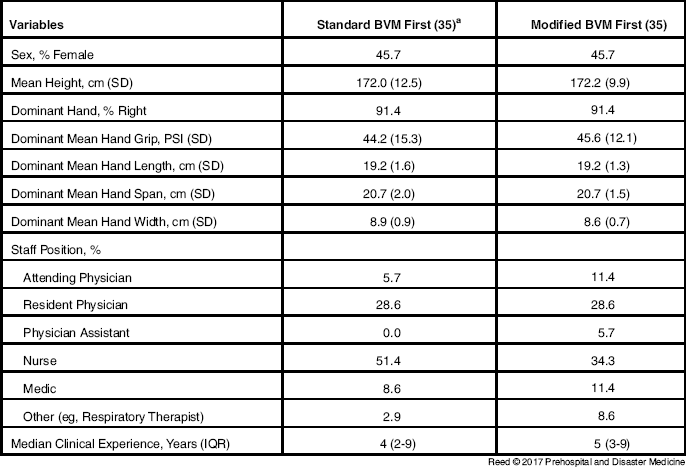
Investigators screened 70 subjects for study participation, all of whom were eligible and participated. While all of the subjects had prior experience with a standard BVM per the inclusion criteria, none of the subjects had used the device previously. One-half of the subjects experienced randomization to start with the standard BVM, whereas the other half started with the modified device. All subjects completed the study procedures and provided responses to all pre- and post-study survey questions (Figure 1). There were no significant differences in subject characteristics between subjects allocated to the standard BVM versus modified BVM (Table 1).
Subject Characteristics for Each Study Arm

Abbreviations: BVM, bag valve mask; PSI, pounds per square inch.
a Data missing for one subject in standard bag valve mask first group.
Main Results
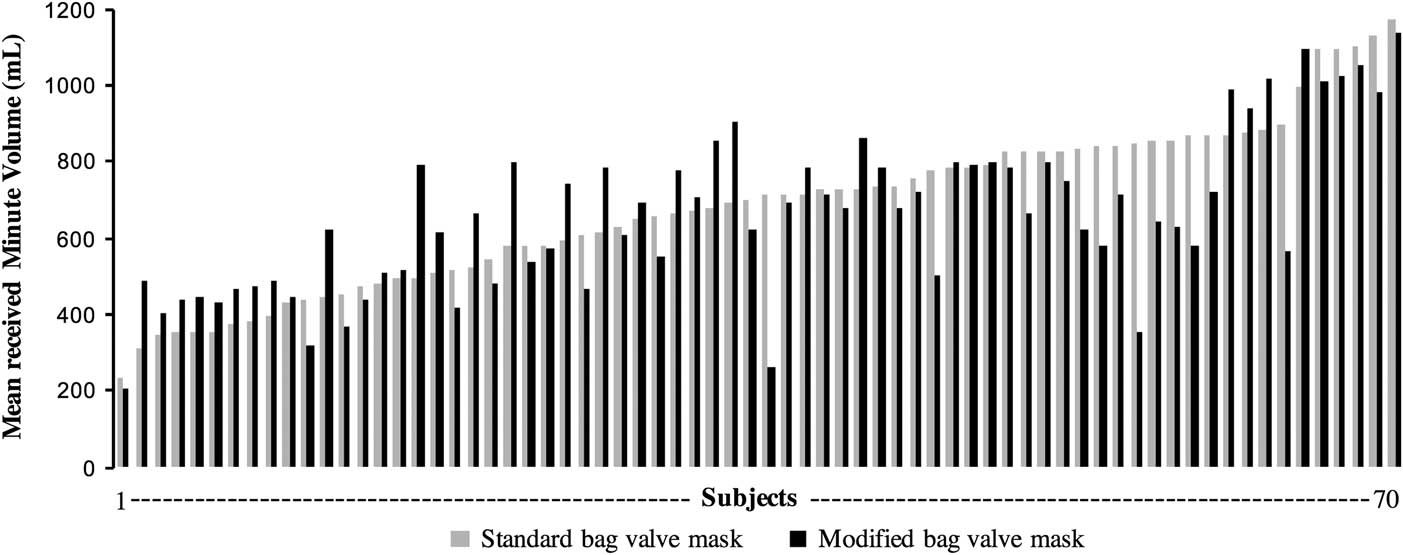
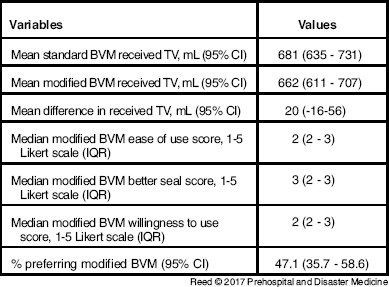
All study subjects delivered the appropriate number of metronome-guided breaths at the appropriate intervals as confirmed by the manikin monitor output. The mean received tidal volume was 681 ml (95% CI, 635 to 731 ml) for the modified BVM with integrated external handle versus 662 ml (95% CI, 611 to 707 ml) for the standard BVM. These data had a normal distribution by both visual inspection and Shapiro-Wilks testing. The difference in means was 20 ml (95% CI, -16 to 56 ml; P=.280 by paired sample t-test; Table 2). Variation in received tidal volumes was comparable between the standard (SD=214 ml) and the modified BVM with external handle (SD=207 ml; Figure 3). There was no significant difference in received tidal volumes between devices by ANOVA with repeated measures. There was no significant difference in received tidal volumes between subjects allocated to the modified BVM first versus patients allocated to the standard BVM first.
Received Mean Volumes During Single Rescuer Ventilation Using a Manikin Model (30 Breaths Delivered Over Three Minutes). Note: The vertical axis represents mean received tidal volume (mL) as measured by the RespiTrainer Advance manikin model. The horizontal axis represents individual study subjects (n=70). The subject numbers reflect ascending mean received tidal volumes with the standard BVM and do not reflect chronological order of study participation. Each pair of bars represents data for an individual subject. The gray bars represent mean received tidal volumes using a standard BVM. The black bars represent mean received tidal volumes using the modified BVM with external handle. Abbreviation: BVM, bag-valve mask.

Study Outcomes

Abbreviations: BVM, bag-valve mask; TV, tidal volume.
Thirty-three participants (47.1%) achieved higher mean received tidal volumes with the modified BVM compared to the standard BVM. There were no significant differences in subject characteristics, as listed in Table 1, between these 33 individuals and the remaining 37 subjects. Moreover, there were no significant differences between these individuals and any outcome measures to include perceptions of ease of device use or willingness to use in real patients.
Subject responses to post-study surveys yielded modest median 5-point Likert scale scores regarding modified BVM ease of use, better seal compared to standard BVM, and subject willingness to use the BVM modification on a real patient (Table 2). There was no significant difference in the proportions of participants expressing preference for the modified BVM versus the standard BVM (47.1% versus 52.9%, respectively). There were no significant associations between subject post-study survey responses and order of device allocation.
Discussion
Bag-mask ventilation is an important skill for prehospital rescuers when resuscitating patients. Effective ventilation is challenging and requires establishment of an effective mask seal to minimize air leak. New methods and devices to facilitate formation of effective tidal volume delivery would be useful to prehospital and emergency department providers. This randomized crossover study found that health care provider volunteers did not achieve superior mean received tidal volumes using a BVM with an added external handle compared to a standard unmodified BVM.
A previous study found that a modified BVM with integrated internal handle achieved higher mean received tidal volumes compared to a standard BVM.Reference Zobrist, Casmaer and April 14 This previously-studied device hence offers one potential innovation for increasing delivered tidal volumes by offering rescuers additional leverage with which to apply additional downward pressure with the non-dominant hand during bag-mask ventilation with the aim of maximizing mask seal. The current study sought to determine if a more cost-effective modification, rather than replacement of standard BVMs, could achieve similar benefits to the previous study.
The external handle design sought to create an effective fulcrum on the neck of a standard BVM. This would allow application of downward force to improve mask seal. Its design comprised an adjustable clamp designed to fit around BVM necks of various sizes as to accommodate addition to multiple different BVM designs. When articulated to a BVM, users may store the external handle device in place on the bag without the need for additional storage space. The specific handles examined in this study were the product of 3-dimensional printing using a flexible filament.
This study identified several challenges which rendered the design ineffective in increasing received tidal volumes. First, several subjects broke the handle with the force of their downward pressure. While investigators did not formally record data on handle breaks, it appeared that such device failure occurred after device re-use by multiple subjects. Nevertheless, this observation highlights the need for a stronger material than the flexible filament used to manufacture the study device.
Another challenge related to the fact that the clamp designed to fit around the BVM neck was not sufficiently tight. As a result, some subjects experienced handle displacement as they attempted to exert downward pressure. This may reflect a consequence of design flexibility such that the device could articulate with many different BVM models. Investigators did not formally collect data on these displacement events, and though this challenge was common in this study, it is possible that the external handle may articulate better with alternative BVM designs. Nevertheless, these results suggest that perhaps a customized design such that a given external handle fits to one specific BVM design may be a better engineering solution.
Of note, 33 (47.1%) of the subjects achieved higher mean received tidal volumes using the modified BVM. However, the difference in mean received tidal volumes among these 33 participants and the remaining 37 subjects was not statistically significant. Moreover, there were no significant differences in characteristics or post-study survey responses between these 33 subjects and all other participants. Therefore, no population subset was identified for whom the external handle appeared to outperform a standard BVM.
Limitations
The main limitation of this study is the use of a manikin model. Use of a model to simulate ventilation in living patients made it possible to test the hypothesis under highly controlled circumstances. Multiple previous studies used similar manikins in the airway literature.Reference Otten, Liao and Wolken 7 , Reference Menegazzi and Winslow 16 - Reference Zecha-Stallinger, Wenzel, Wagner-Berger, von Goedecke, Lindner and Hormann 19 Indeed, the prior study of the BVM with integrated internal handle upon which the external handle is based similarly used a manikin.Reference Zobrist, Casmaer and April 14 Use of a manikin model in this study makes the results more comparable to those generated by these previous papers.
However, there may be limited applicability to living patients. There does not appear to be any literature yet examining whether these manikin models accurately reflect tidal volume delivery in living patients. Manikin skin is less pliable than human tissue. Consequently, the manikin model may be less-conducive to improved mask seal via augmented downward pressure as facilitated by the external handle. Another limitation arises from the use of a single manikin for all study procedures. As such, this study does not address whether the external handle device may prove more useful in specific patient subgroups (eg, patients with beards or severe craniofacial trauma).
A related limitation is the controlled study environment. This study’s setting is not reflective of the challenges and stresses of performing ventilation during resuscitation of live patients. Also, this study’s duration was only three minutes; resuscitations of living patients may often last significantly longer. Based on this data, it is unclear whether or how those factors may alter the device performance.
Another limitation is that the study results provide little insight into the reasons for the findings. As discussed above, the reason the BVM with external handle did not outperform a standard BVM may relate to structural issues: the inadequate clamp of the handle onto the BVM neck and the weakness of the handle material leading it to break. However, investigators did not systematically collect data to record instances of device failure, so making it impossible to quantify the incidence of external handle malfunction.
A final limitation of note is that this study population may not be generalizable to rescuers most likely to benefit from use of this device. This novel design may prove most useful for rescuers with relatively little experience performing bag-mask ventilation. Yet the study population comprised volunteer health care providers. It would be interesting to repeat this investigation among individuals with more limited health care backgrounds.
Future Research
Future research should seek to improve the device design as alterations may improve performance. In particular, future studies of external handles should examine altered designs to achieve better fixation onto BVM necks and stronger material to avoid malfunction. Should these studies demonstrate efficacy, economic evaluations would be useful to compare the cost-effectiveness of the removable external handles versus integrated internal handle BVM units.Reference April and Murray 20 Until identification of an improved design which outperforms the standard BVM in a manikin model, more sophisticated studies performed on cadavers or living patients may be premature.
Conclusions
The modified BVM with added external handle did not result in greater mean received tidal volume compared to standard BVM during single rescuer ventilation in a manikin model.
Acknowledgements
The authors acknowledge the contributions of Craig Navarijo in conception of the study idea and provision of study materials.