In the tropical eastern Pacific, the Haemulidae family is represented by 36 species of fish (Robertson & Allen, Reference Robertson and Allen2006), within them the raucous grunt Haemulopsis leuciscus is found (Günther, 1864); it is a widely distributed coastal species of the eurihaline marine component and is found from Bahía San Quintín, in northern Baja California (Rosales-Casián & Ruiz-Campos, Reference Rosales-Casián and Ruiz-Campos1999) to Peru, including the Gulf of California (Robertson & Allen, Reference Robertson and Allen2006).
In general, it inhabits sandy and muddy bottoms of the coastal areas; the juveniles are common in protected areas such as lagoons and estuaries, where the raucous grunt feed and have protection (Yáñez-Arancibia, Reference Yáñez-Arancibia1978; Castro-Aguirre et al., Reference Castro-Aguirre, Espinosa Pérez and Schmitter-Soto1999). The raucous grunt is common in the by-catch from the shrimp fishery in areas near the neritic zone, and has been captured in depths of up to 134 m (Amezcua-Linares, Reference Amezcua-Linares1996; Tapia-García & García-Abad, Reference Tapia-García, García-Abad and Tapia-García1998). This species has ecological and economic importance as indicated by its catch and wide distribution.
The food habits of H. leuciscus have not been studied. The present information provides the first examination on feeding habits of this species in Bahía Almejas, Baja California Sur, an area where this species is dominant and cohabits with another four Haemulidae species (Moreno-Sanchez, Reference Moreno-Sánchez2004).
The fish were caught bimonthly during March 1998 to November 1999, in Bahía Almejas (between 24°20′–24°35′N; and between 111°18′–111°50′W). Samples were collected at six locations to cover more areas and representative environments. The organisms were caught with an 80 m long and 3 m wide gill-net with a 9 cm mesh size. The net was positioned perpendicular to shoreline during the sunset (6:00 p.m.) and recovered at sunrise (6:00 a.m.).
Each organism collected was weighed (WT), using a beam balance, and standard length (ST) was measured with a conventional ichthyometer. The stomach contents were collected and fixed in 10% formaldehyde solution for later analysis in the Laboratory of Fishes from the Centro de Investigaciones Biologicas del Noroeste (CIBNOR) in La Paz, Mexico.
During the analysis of gastric contents, the different prey species were separated according to their taxonomic group and identified to the lowest possible taxonomic level permitted by their digestion state, with aid of a stereoscopic microscope and specific taxonomic keys for each group, such as Brusca (Reference Brusca1980) and Fischer et al. (Reference Fischer, Krupp, Schneider, Sommer, Carpenter and Niem1995) for gastropods; and Parker (Reference Parker1964), Keen (Reference Keen1971) and Fischer et al. (Reference Fischer, Krupp, Schneider, Sommer, Carpenter and Niem1995) for bivalves and Brusca (Reference Brusca1980) for scaphopod.
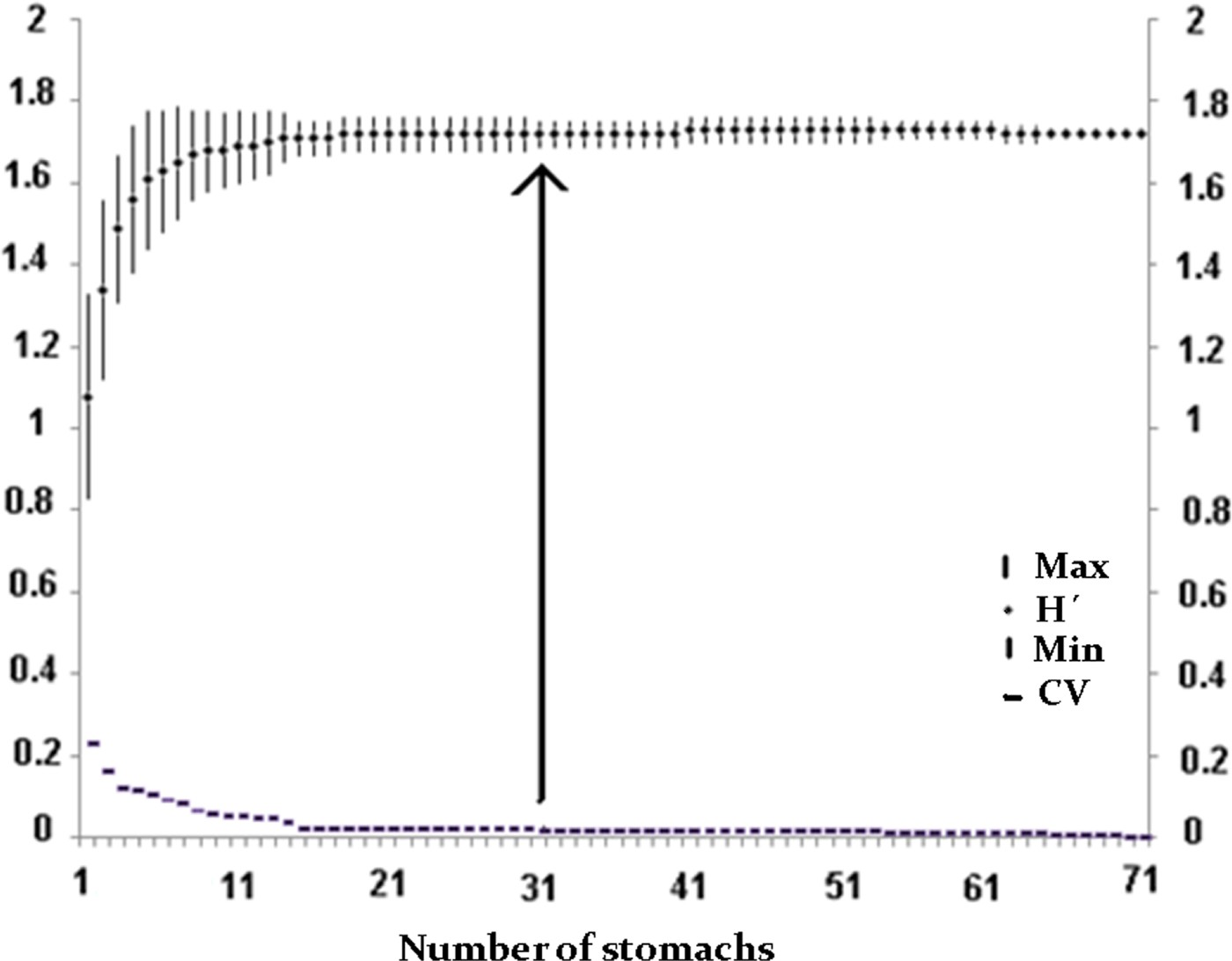
Cumulative prey curves were used to determine if an adequate number of stomachs had been sampled to characterize the diet, according to the methodology proposed by Jiménez-Valderde & Hortal (Reference Jiménez-Valderde and Hortal2003). We randomized (100 times) the observed data matrix of the stomachs number (unit effort) versus accumulated prey items to obtain a curve of species (using the EstimateS program). The sample size was considered adequate when the curve was asymptotic. The minimum simple size calculated was 31 stomachs to represent the diet of raucous grunt (Figure 1).
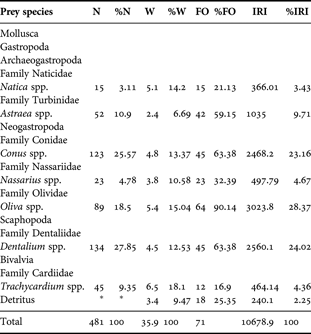
Trophic spectrum of Haemulopsis leuciscus, presented as percentage of number, weight, frequency of occurrence and index of relative importance (IRI).

The quantitative analysis of stomach contents was done by numerical (N%), gravimetric (W%), and frequency of occurrence (FO%) methods. Also to find out the preferential food, we use an index of relative importance (IRI = N% + W% * FO%) (Pinkas et al., Reference Pinkas, Oliphant and Iverson1971). The absolute values of the IRI were expressed in percentage for comparative analysis with other studies. The trophic width (Bi) was calculated using the standardized Levin's index (Hurlbert, Reference Hurlbert1978) which takes values from 0 to 1. A Bi of less than 0.6 indicates a specialist predator that uses few prey resources and prefers certain prey; while values over 0.6 indicate a generalist predator that uses all resources without preference.
A total of 81 organisms were caught, of these, 71 contained food (87%) and 10 were empty (29%). A total of eight prey-items were identified in the raucous grunt's diet: six gastropods, one bivalve and detritus (Table 1).
Summary of prey-items in the trophic spectrum of Haemulopsis leuciscus in Bahía Almejas, Baja California Sur, expressed as absolute values and percentages of number (N), weight (W), frequency of occurrence (FO) and index of relative importance (IRI). The asterisk (*) indicates the numerically non-quantifiable components.

Numerically, a total of 481 prey were quantified, of these, the most important prey was the scaphopod Dentalium spp. with 28% (134 individuals), and gastropods as Conus spp. with 26% (123 individuals), Oliva spp. with 18.5% (89 individuals) and Astraea spp. with 10.8% (52 individuals). The rest of the prey-items showed smaller values to 10% (Table 1). The most important prey-items by weight were, the bivalve Trachycardium spp. with 18.11% (6.5 g), followed by the gastropods Oliva spp. 15.03% (5.4 g), Natica spp. with 14.20% (5.1 g), Conus spp. with 13.37% (4.8) and scaphopod Dentalium spp. with 12.53% (4.5 g) (Table 1).
The most frequent prey items were the gastropods Oliva spp. which were found in 64 stomachs (90.14%), followed by Conus spp. and the scaphopod Dentalium spp. both found in 45 stomachs (63.38%). Likewise, according to the IRI, the gastropods and scaphopod were the most important prey for raucous grunt. The Oliva spp. (28.37%), Dentalium spp. (24.02%), Conus spp. (23.16%), and Astrea spp. (9.71%), contributed to more than 85% of the trophic spectrum (Figure 2).
Randomized cumulative prey curve for raucous grunt Haemulopsis leuciscus. Where H, Shannon–Wiener diversity (H′); Max, maximum diversity; Min, minimum diversity; CV, coefficient of variation.

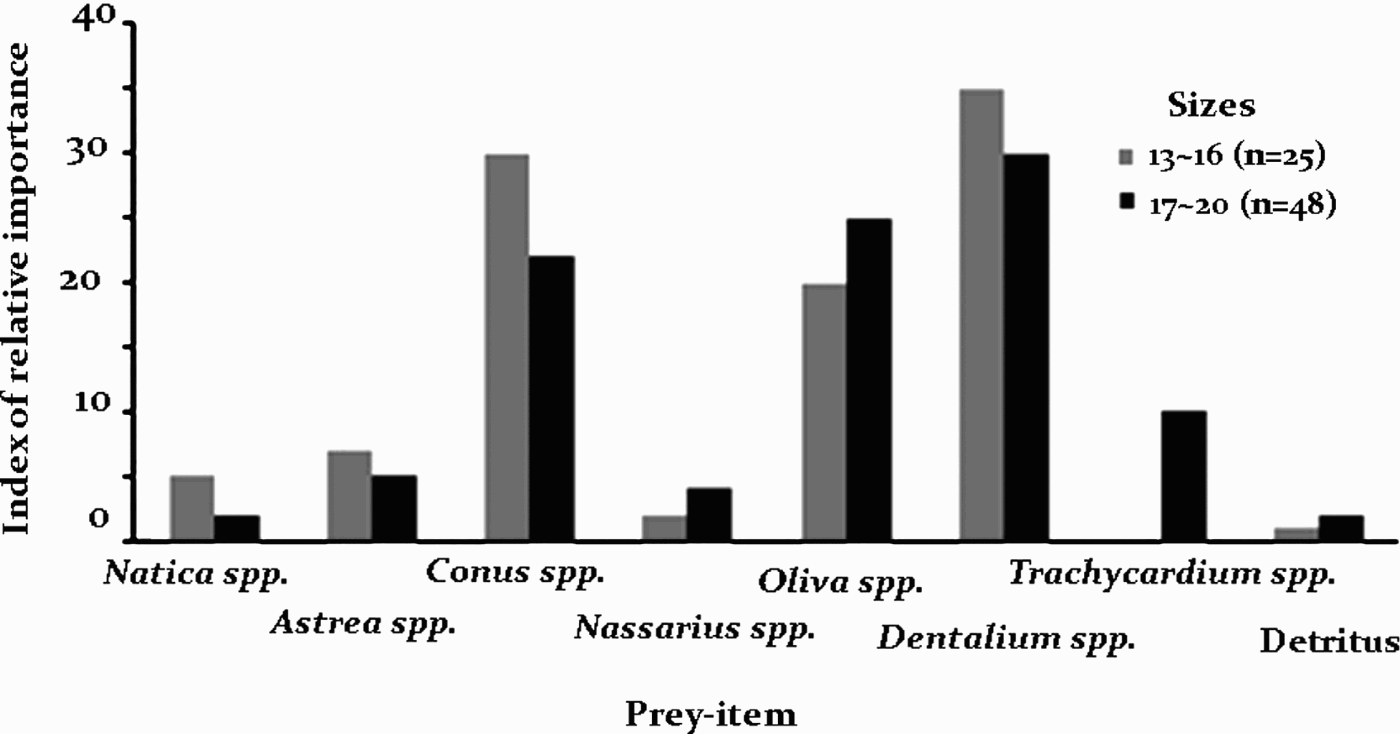
The organisms captured ranged from 13–20 cm SL and were grouped together in two intervals with amplitude of 3 cm SL. The diet of the small-sized individuals (13–16 cm SL) included only gastropods. In the 17 to 20 cm SL interval size, this species increased the consumption of the gastropods and included bivalves (Figure 3).
Variation of prey species consumed for two size intervals in the raucous grunt Haemulopsis leuciscus, determined by index of relative importance.

The fish of the Haemulidae family have ontogenetic changes in their food habits (Cocheret de la Moriniere et al., Reference Cocheret de la Moriniere, Pollux, Nagelkerken and van der Velde2003). However, they show preferential feeding habits on exclusive components from the benthic environment; while Vargas et al. (Reference Vargas, Fuentes, Hernández, Olivares and Rojas1999) determined that the Peruvian grunt, Anisotremus scapularis, off the coast of northern Chile, feed preferentially on bivalve molluscs. Also Hajisamae et al. (Reference Hajisamae, Chou and Ibrahim2003) found that two species of Pomadasys prefer to prey on crustaceans in the Strait of Johor, Singapore. Layman & Silliman (Reference Layman and Silliman2002) characterized three species of Haemulon as generalist carnivorous of benthic invertebrates in an estuary of Andros Island in the Bahamas.
Based in the number of stomachs with food, we can consider that the raucous grunt H. leuciscus, is a species of nocturnal habits. This behaviour has been described for species of the genus Haemulon from the Mexican Pacific Ocean, mainly H. flaviguttatum and H. maculidauda; these species stay during the day in protected zones, and during the night they move out of the coast to sandy bottoms to feed on small fish and benthic invertebrates and only occasionally forage on the bottom during the day (Thomson et al., Reference Thomson, Findley and Kerstitch2000).
In the area of Bahía Almejas, BCS, Mexico, raucous grunt Haemulopsis leuciscus feeds mainly on diverse marine components of the benthic environment, since 90% of its diet is constituted of gastropods and scaphopod (Natica spp., Astraea spp., Conus spp., Nassarius spp., Oliva spp. and Dentalium spp.). We conclude that raucous grunt can be characterized as a first-order carnivorous species, which feeds mostly on benthic fauna.
The trophic diversity of the diet of raucous grunt was relatively low (eight prey items), with the clear dominance of three prey items (Oliva spp., Dentalium spp. and Conus spp.). The wide tropic niche was determined with the Levin's index, where we found a low value (Bi = 0.56), as a consequence this species must be considered a specialist predator.
In the diet of one similar species, the authors found that organisms depend on prey availability of A. scapularis, which is a macrophage in one system (Vargas et al., Reference Vargas, Fuentes, Hernández, Olivares and Rojas1999), and change to euryphagous or generalist carnivores in other ecosystems (Medina et al., Reference Medina, Araya and Vega2004). For this reason, the studies of trophic ecology (types of prey consumed, diet breadth and relative importance of each nutritional component), are useful to understand the functional role of the fish as prey in the ecosystems (Wooton, Reference Wooton1990), and provide valuable insight into survivability and adaptability of species, so that the same species can realize different feeding habits depending on the environments that they inhabit, and would be adapted according to prey availability.
ACKNOWLEDGEMENTS
We wish to thank the Instituto Politécnico Nacional (IPN) for support received through COFAA and EDI. X.G. Moreno and D.S. Palacios also thank the Consejo Nacional de Ciencia y Tecnología (CONACyT) and Programa Institucional de Formación de Investigadores (PIFI–IPN). Finally, we thank four anonymous referees for their comments and suggestions.