Introduction
This article studies the role of reputation in English medieval towns. It examines the strategies used by their civic authorities to develop a good reputation, and considers the impact of these strategies on the relative growth and decline of towns. For the purposes of this article, the reputation of a town is defined as a widespread belief that its citizens and institutions could confidently be expected to behave in a certain way. For a town to have a good reputation, there needed to be a widespread belief that it was well administered and that its citizens maintained high standards of behaviour. Examples of good administration during the medieval period included the enforcement of royal statutes and the provision of swift and fair justice through the town court system, while good behaviour was associated with honesty in contracts and a high quality of workmanship.Footnote 1 Conversely, poor administration encompassed the use of the town court system to pursue personal agendas and failure to maintain law and order, while poor behaviour included failing to keep the terms of contracts and producing poor-quality items.Footnote 2
The importance of reputation to medieval English towns can be seen in the records of civic processions, in the construction of public buildings and in the use of religious imagery on civic seals. All of these, historians have suggested, represented the desire of civic officials to demonstrate to their fellow citizens, the king and God their worthiness to exercise legitimate political power. Carrel, for example, has examined how towns employed religious imagery in an attempt to demonstrate the worthiness of their political authority to citizens and to the crown.Footnote 3 Barron, Davies and Rawcliffe, meanwhile, have examined how towns improved their physical environment and infrastructure in an attempt to promote an image of order and harmony.Footnote 4
Reputation can impact on economic performance, as economic and urban theory suggests.Footnote 5 A reputation for being well administered could help medieval towns to obtain administrative privileges from the crown, while the reputation of its citizens for producing good-quality workmanship could aid prosperity by attracting local customers and foreign merchants.Footnote 6 Conversely, a poor reputation could lead to the withdrawal of administrative privileges and the loss of custom to other locations.Footnote 7
While reputation could improve economic performance, economic performance could also contribute to reputation. Civic authorities needed to give credibility to their reputation, and this required investment. Impressive pageantry and extensive local facilities required financing, and economic activity therefore had an important role in generating the surplus out of which investment could be made. Over time, a good reputation had the potential to increase the volume of trade and generate wealth that could be invested in local improvements.Footnote 8
This article focuses on the period 1250–1400, which is covered well by surviving civic records and permits an examination of the role of reputation during times of economic expansion and contraction.Footnote 9 Throughout 1250–1400, towns were in competition with their neighbours, but the nature of this competition varied between towns and changed over time. Economic expansion up to c. 1350 meant that established towns were threatened by the foundation of new market towns, new regional fairs and a growth in informal trade.Footnote 10 A new market had the potential to poach customers and cause the established market to lose its critical mass of customers, whilst a new regional fair could deter foreign merchants (either from overseas or other English towns) from visiting individual towns.Footnote 11 Informal trading by large institutions or households posed a similar threat as it diverted trade away from established towns into the countryside.Footnote 12
In the aftermath of the Black Death, population decreased and few new towns or fairs were created. Established towns, however, were obliged to compete with each other to retain their share of diminishing local trade.Footnote 13 In both periods, therefore, competition threatened towns’ revenues from market tolls and other dues.Footnote 14 For those established towns which had obtained a degree of financial and administrative independence from the crown, this situation threatened their ability to meet their obligations and raised the possibility that their privileges would be withdrawn by the crown.Footnote 15
Historians have identified two main ways in which established towns could address competitive threats. A defensive strategy involved established towns protecting their market rights by complaining to the sheriff or king that a new market had injured their established market.Footnote 16 The disadvantage was that an ensuing court case could antagonize the crown, which would have given permission for the new market to be founded. An alternative and more aggressive strategy was for the civic authorities to improve their town's reputation relative to its rivals.Footnote 17 This could be achieved by exploiting the town's autonomy in government and administration – notably its ability to produce its own civic regulations in response to local circumstances.Footnote 18
Market regulation played an important role in the pursuit of this aggressive strategy, as Davis has emphasized.Footnote 19 Davis notes that literary sources, such as Piers Plowman, illustrate the importance to potential customers of the reputation of a town's market in their descriptions of the behaviour of local traders and their emphasis on the range and quality of goods on offer.Footnote 20 Furthermore, Dyer has shown that medieval consumers were often discerning, aware of what was available at a range of trading locations and intent on obtaining items that were both good quality and reasonably priced.Footnote 21 The small but regular purchases made by consumers of modest means could collectively generate a large demand for products and services and make a significant contribution to a town's prosperity.
Market regulation was a key way in which civic authorities of established towns could emphasize the advantages they possessed over newly founded markets and new regional fairs. The institutions which regulated the behaviour of traders and the range and quality of goods on offer had evolved over many years and could not be easily imitated by new foundations. Market regulation was also useful in addressing competition from informal trade. A major advantage of a formal market over informal trade was that it lowered search, negotiation and enforcement costs. A variety of goods could be found and purchased in a single location, a multiplicity of traders competed to supply each good and so provided better opportunities for purchasers to negotiate favourable terms, while the town court system allowed legal redress for problems concerning payment and product quality.Footnote 22
Previous studies of urban market regulation have emphasized the role of guilds in maintaining the reputations of their trades, and the incentive for them to discipline artisans producing defective work.Footnote 23 In larger towns, such as London, competition between guilds has been identified as a major influence on market regulation.Footnote 24 This raises the question of how conflict between factions within a town was reconciled with the economic imperative for different groups to co-operate in promoting external reputation.
Part of the answer may lie in the fact that the civic authorities were concerned with their reputation within the town as well as outside it. The civic authorities did not just address the concerns of wealthy customers and foreign merchants, but the concerns of local citizens as well.Footnote 25 These concerns could be reflected in the sponsorship of charitable activities and the exercise of leniency and mercy in local courts, as the following discussion shows. Furthermore, the civic authorities had an important role in representing the collective interests of the town to the crown and other influential people and institutions.Footnote 26 Well-informed local citizens would be aware that the representations made on behalf of the town would be stronger if the town had a reputation for being cohesive rather than factional. A reputation for cohesiveness arguably helped to convince external parties that the town's representatives spoke on behalf of the citizens as a whole and not just on their own behalf.
This article focuses on the actions of the civic authorities and does not directly address the issue of guilds and their rivalries. For the purposes of this article, it is sufficient to note that if internal rivalries impeded external reputation-building then a town was liable to suffer in the long run relative to its more cohesive rivals. In so far as citizens recognized this, it is probable that they would have perceived an incentive to co-operate with each other in promoting their town's external reputation through civic activity.
A profile of the towns
The research in this article is based on a systematic study of archival sources from London, Norwich, Great Yarmouth, Colchester, Leicester and Nottingham across a 150-year period.Footnote 27 The six towns were already established by 1250 and were all principal urban centres.Footnote 28 According to the 1334 subsidy, they were all in the upper and middle ranks of the wealthiest towns in England. Out of 100 towns London was ranked at number 1, Norwich at 6, Great Yarmouth at 7, Nottingham at 25, Leicester at 38 and Colchester at 53.Footnote 29 As will be explained below, they were all engaged in local, national and international trade, although there was some variation in their speciality products (e.g. foodstuffs or manufactured goods).Footnote 30
The administrative framework of medieval England placed much of the responsibility for a town's administration in the hands of the civic authorities.Footnote 31 However, this responsibility was conditional on the civic authorities fulfilling certain financial and administrative requirements. Furthermore, the nature and role of the civic authorities varied to some extent between towns and also changed over time. The following paragraphs profile some of the key similarities and differences between the towns. Further explanation of the chronology of developments may be found in the references.Footnote 32
The king, as principal landowner, had lordship over all towns and was entitled to civic revenues, including income from the borough courts.Footnote 33 Over time, these revenues tended to be consolidated into a single fixed sum, known as the farm, the payment of which was the responsibility of the sheriff or his deputies, the bailiffs.Footnote 34 By 1250, the civic officers of many towns, including London, Norwich, Great Yarmouth, Colchester and Nottingham, had been granted the right to administer the farm themselves.Footnote 35 Leicester, in contrast, had been bestowed by the king on the earl of Lancaster, who received the profits from the town. However, the citizens obtained some financial independence through the merchant guild court, which administered the entry fines paid by guild members and received loans or taxes from them.Footnote 36
From the twelfth century onwards, the crown also showed a willingness to allow towns greater autonomy in how they administered their affairs. A new administrative officer, the mayor, emerged to provide representation for the citizens in any negotiations with the crown.Footnote 37 London already had a mayor by 1250 and Nottingham acquired one in 1284, but he only had an informal council of advisors as opposed to the more common formal advisory council.Footnote 38 In Leicester, the office of mayor appears to have emerged in c. 1250. The mayor of Leicester seems to have acquired autonomy from the earl by presiding not only over the borough court but also over the merchant guild court, which was relatively free from the interference of the earl and became the main institution for the creation and enforcement of regulations.Footnote 39 London, Leicester and Nottingham were therefore arguably in a particularly strong position to make new regulations in response to local problems, as well as to enforce royal statutes.Footnote 40
Norwich, Great Yarmouth and Colchester were all governed by bailiffs who, though elected by the townspeople, were ultimately royal officials.Footnote 41 In addition, Great Yarmouth shared jurisdiction of its fair court with the Cinque Ports, which may have given its civic authorities less autonomy than those of the other towns.Footnote 42 The bailiffs of Norwich, Great Yarmouth and Colchester may have focused more upon enforcing royal regulations than creating new civic ones. Towns with a mayor had a greater degree of autonomy than those which had only bailiffs, but the king retained his rights to intervene in the administration of all towns and to impose direct rule if malpractice occurred.
The sources
While a range of sources can be used to assess market regulation, this article focuses on civic administrative and court records. Local court records reveal numerous prosecutions for minor offences, such as breaches of the assizes of bread and ale. Such exercises, historians have argued, may have been motivated purely by a desire to raise revenue from fines and can therefore distort the picture of market regulation.Footnote 43 This article seeks to overcome this problem by focusing upon dishonest trading practices that were concerned with deception in weights and measures, manufactured goods and lay documents and seals. There are three particular advantages to studying this form of offence. First, dishonest trading practices are unlikely to have been prosecuted only for the purposes of raising revenue as they were often difficult to detect. Secondly, records of prosecutions for dishonest trading practices often state the commodity involved, the justification for the prosecution, the identities of the defendants and plaintiffs, the verdict and, where applicable, the punishment given to the defendant.Footnote 44 Finally, dishonest trading practices are especially effective for assessing how civic authorities used their devolved powers to improve the regulation of their town. Although some practices were covered under national royal regulations, in particular those involving dishonest weights and measures and deception in the quality of cloth, gold, silver and leather, there were many instances where the civic authorities needed to create additional regulations to target further dishonest trading practices.Footnote 45 Details of the regulations enacted by the civic authorities are recorded in the administrative and court records in addition to the prosecutions.
The dishonest trading practices examined here involved the creation or alteration of an article for the purposes of deception motivated by personal profit.Footnote 46 This definition includes practices such as the creation of a cup that was supposed to be of silver but was actually of gilded copper, the creation of fish nets with such a small mesh they enabled the volume of the catch to be inflated with small, immature fish, the alteration of an ale measure by adding pitch to bottom to reduce capacity and the alteration of a document to replace one beneficiary with another.Footnote 47 It excludes the creation of counterfeit currency, of false royal seals and presentments of the assize of ale which did not specifically mention the use of inaccurate measures.
One of the difficulties of medieval court records and administrative documents is that they are rarely extant for all the courts that existed in each town. An advantage of studying dishonest trading is that cases appeared in a wide range of courts, both within and between towns. In London, prosecutions for dishonest trading appear in the records of the court of common council, the mayor's court, the husting and the sheriffs’ court. In Norwich, dishonest trading was prosecuted in the leet court, while in Great Yarmouth, it was prosecuted in the borough court and the leet courts. In Colchester, dishonest trading was prosecuted in the court of pleas, the lawhundred and the hundred courts, and in Leicester, in the borough court and the merchant guild court, and also during the visit of the king's marshal. In Nottingham, dishonest trading was prosecuted in the borough court and the mayor's court.Footnote 48 The notes detail the courts in each town whose surviving records contained no prosecutions, as well as those courts for which records have not survived.
Medieval records are rarely fully complete chronologically, and there are missing years from the court records. In all the towns, except for Nottingham, records survive for over half of the 150-year period, and in Nottingham records survive for over a third of the period. With the exception of Great Yarmouth, where samples were taken, all surviving material was consulted for each town. A clear distinction was made during the collection of data between those years for which records survived and those years for which they did not.Footnote 49
When the definition of dishonest trading practices provided above was applied to the primary sources it identified 318 cases, compared to over 1,500 cases in the same years relating to other trade offences such as breaches of the assize of bread and ale, forestalling and illegal cartels. To allow a distinction to be made between local variations of regulations and those which applied to all English towns, royal statutes as well as local sources were consulted.Footnote 50 A total of 889 pieces of regulation related to trade were recorded in Statutes of the Realm and in the records of the individual towns, including regulations relating to quality control, wages and prices and the location and timing of trade.
The provision of a comprehensive system for the regulation of necessities and luxuries
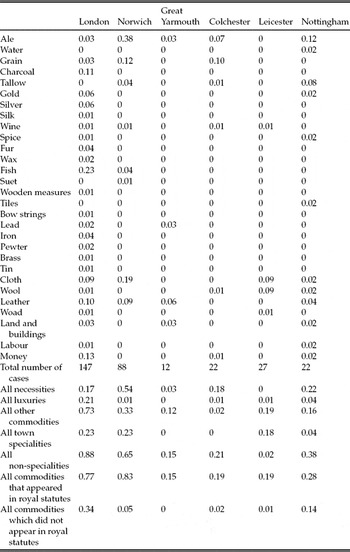
The system of regulation that underpinned a town's reputation was comprehensive in its range of commodities, as Table 1 (see Appendix) illustrates. In prosecutions, 29 different commodities appeared. Commodities in the table were classified into the groups of necessities (defined as commodities which were important for the everyday lives of their citizens, namely ale, water, grain, charcoal and tallow), luxuries (commodities which would not have been regularly purchased by the majority of the population, namely gold, silver, silk, wine, spice, fur and wax) and other commodities (shown in the table). They were also independently classified as town specialities or general commodities; and by whether or not they were of special interest to the crown. The composition of each category is explained in the notes to the table.
The evidence suggests that the civic authorities were not concerned about promoting the interests of one particular group of producers or consumers. Instead, they were interested in creating a regulatory system that covered all commodities, including everyday necessities consumed by citizens and visitors and those purchased infrequently or by wealthy citizens and merchants.Footnote 51 As Table 1 illustrates, prosecutions involving luxury goods appeared in all towns except for Great Yarmouth. In London and Leicester, prosecutions involving luxuries were more common than prosecutions involving necessities, but in Norwich, Colchester and Nottingham prosecutions involving necessities were more common than those involving luxuries.
Regulations were policed at the point of production and the point of sale, as illustrated in cases involving the fish trade. The point of production was policed by inspections of nets; in London in 1320, for example, 14 men were prosecuted for using false nets in the Thames, which caught immature fish and therefore depleted future stocks.Footnote 52 The point of sale was policed by the inspection of fish baskets, as in London in 1307 when, at the request of royal ministers and many citizens, the first recorded inspections of the baskets used to sell fish were undertaken by the fishmongers and inaccurately small baskets were confiscated and burnt.Footnote 53
For charcoal, an imported fuel used for metal manufacturing, the civic authorities were only able to regulate at the point of sale. The charcoal trade was ‘dominated by relatively small-scale producers’ who were spread around the wooded areas of Surrey, Hertfordshire, Essex and Middlesex.Footnote 54 During 1368–85, London's civic authorities faced problems from these sellers importing charcoal in inaccurately small sacks.Footnote 55 The authorities focused their efforts on intercepting the charcoal before it was sold to citizens. In 1376, for example, the servant of Richard Weker of Croydon was accused of supplying to London a load of charcoal which included three sacks, each of which held only six bushels instead of the standard eight, and were found to have been manufactured to hold only seven bushels.Footnote 56 The servant admitted guilt but, as it appeared to the court that Weker was also an accomplice in the deception, the civic authorities sentenced Weker to the pillory in his absence, and detained his horses to ensure that he came to London to receive his sentence.Footnote 57
Grain was another commodity which was imported into London, usually from Kent and Essex. The distribution method provided opportunities for dishonesty when the grain was off-loaded from ships. In London in 1375, five cornmeters, officials who measured corn imported by cornmongers, were prosecuted on behalf of the king and citizens of London for having, over the previous three years, measured corn by false quarter measures and given fuller measures for corn bought at the granaries than for that bought by the common people.Footnote 58 When found guilty, all five were fined and imprisoned, with two permanently dismissed from office.
The severity of the punishments given to the cornmeters may reflect the importance of grain as a staple food item and a lack of tolerance for corrupt officials. When contrasted with the punishments given to the charcoal sellers it can be seen that, while some of the corrupt officials were dismissed from office, none of the dishonest importers was banned from trading in London. This may indicate that the civic authorities distinguished between offenders whose services were replaceable, such as officials, and those whose services were not, for example importers. Dismissal of cornmeters was unlikely to have prevented the flow of imports into London, and may indeed have encouraged them by appeasing the cornmongers. However, if the charcoal sellers were deterred by harsh punishments or bans from importing their goods into London it would have been difficult for London citizens to fill the gap in supply. Consequently, London's metal manufacturing trade, which was one of its specialities, could have been severely damaged.Footnote 59 It was therefore in the interests of Londoners to retain the services of the charcoal sellers, and indeed the first ones to be prosecuted were even paid for their goods.Footnote 60
The specific dimensions of reputation
Having examined the comprehensive system of regulation that underpinned a town's reputation, the three specific dimensions of reputation can now be examined. The first, maintaining product standards in national and international trade, was targeted at foreign merchants. The second, reputation with the crown and nobility, was targeted at the crown and nobility. The third, leniency in the implementation of regulations, appealed to citizens.
To examine these dimensions, the 318 cases were classified. A concern with product standards in national and international trade was inferred by reference to one or more of the following: a scandal to the town; a scandal to the trade; a ban on someone manufacturing a particular product; a person's expulsion from a guild; a person's expulsion from the town; reference to the need to appoint a regulator for a trade or the town; criticism of the mayor and procedure in civic courts; or a note that the victim of the deception was from another town or country (excluding nobles who are covered in the next category).Footnote 61 Cases that expressed a concern with maintaining good relations with the crown and nobility were defined as those in which the prosecution mentioned royal interest, or royal statutes, or visiting royal officials, or members of the nobility or their servants.Footnote 62 Concern for leniency was inferred from reference to one or more of the following: a pardon or reduced fine because of poverty; a reduction in punishment because of illness, age or gender; a verbal warning or leniency because the defendant had done wrong unwittingly; leniency because it was a first offence; money put in respite if the defendant reoffended; support after a sentence from patrons, friends or colleagues; or pleas for clemency.Footnote 63
When the 318 cases were classified, 109 contained sufficient information to identify a specific concern. A single case often contained evidence of more than one concern and thus could be allocated to multiple categories. Overall, there were 157 instances in which a concern was mentioned in 109 prosecutions.Footnote 64
The first dimension: product standards in national and international trade
To maintain a credible reputation that encouraged foreign merchants to visit the town, civic authorities needed to demonstrate that they enforced national and international standards of product quality and, in the event of any disputes, provided swift and effective justice. They had to be particularly careful to do this in respect of the speciality products associated with the town, and indeed Table 1 indicates that prosecutions involving town speciality products appeared in all towns, with the exception of Great Yarmouth and Colchester. A concern with maintaining standards in product quality was expressed in 24 per cent of cases.
Regulation of town speciality products again took place at both the point of production and the point of sale. For wool and cloth, the majority of offences were detected before sale; for example, in 1269, in Leicester's merchant guild court, Roger of Kilsby was fined for defective weaving of cloth, while in Norwich in 1292/93, Roger le Halte was fined in the leet court for dubbing old clothes to alter their appearance.Footnote 65 However, for other items, especially metal ones, the civic authorities often had to work backwards from the point of sale to uncover the production chain behind the dishonest items. In London in 1376, for example, Richard Bor was prosecuted by the mayor and aldermen of London for silvering 240 buttons and 34 circlets of copper which he then sold as pure silver to be used in the manufacture of purses.Footnote 66 When questioned, Bor accused Michael Hakeneye of supplying the copper pieces. Hakeneye was brought to court for questioning and both men were found guilty of the deceit and given prison sentences. Sometimes the difficulty of detecting such alterations in metal goods meant that expert advice from guild members, for example the goldsmiths, was utilized by the civic authorities.Footnote 67
When dealing with disputes involving town speciality products, the civic authorities appear to have exercised discretion in their use of the severest punishments. In Leicester, expulsion from the town was a last resort for dealing with persistent offenders who had not been reformed by fines. In Leicester's morningspeech court in 1254, for example, Roger Aldith was charged with making a blanket that mixed good and bad warp and, additionally, with sewing good and bad cloth.Footnote 68 He pledged two casks of ale and swore not to reoffend. However, in 1258, Aldith committed a third offence, and was expelled from the guild.Footnote 69 Similarly, Robert of Lincoln, broker, after being convicted and fined for overweighing wool in 1313, received an increased fine for his second such offence in 1315, and was warned that if he offended for a third time he would be dismissed from office.Footnote 70 Expulsion sent out a clear message to people beyond the town that the town did not tolerate persistent offenders. However, expelling a person also drew attention to the presence of the offence within the town and so it needed to be used in moderation – indeed only 5 out of 196 prosecutions for which punishment is recorded involved expulsions from the town.
In addition to enforcing existing national and international standards of product quality, attempts were also made to improve a town's reputation for product standards by creating new regulations. On some occasions, this involved a dialogue between the civic authorities and other groups. In 1316 in London, for example, members of the potters’ trade complained to the mayor and aldermen that certain members had been buying pots of bad metal and putting them in the fire so that they resembled old brass pots.Footnote 71 Purchasers discovered that the pots melted when used for cooking and as this was detrimental to the trade as well as to customers, the potters appealed to the civic authorities for a remedy. The civic authorities ordered the potters to select ‘four dealers and four founders of the trade, the most trustworthy and the most knowing’ to make an assay of ‘what alloy of lead belongs to a hundredweight of brass’ so that all pots could be made to that standard.Footnote 72 This case suggests that there was a desire among customers, the civic authorities and manufacturers for improved quality control, and that an association was made at the time between product quality and reputation.
The second dimension: reputation with the crown and nobility
A credible reputation with the crown and nobility for the preservation of law and order, and for quality control in the areas of strategically important military supplies and luxury items, strengthened civic claims to a degree of local autonomy over their own affairs.Footnote 73 Of categorized cases, 28 per cent referred to the importance of maintaining good relations with the crown and nobility.
Civic authorities could maintain a credible reputation for law and order by abiding by royal statutes.Footnote 74 Of the 29 commodities that appeared in prosecutions for dishonest trading, 16 were regulated by royal statutes and are therefore classed as being of particular interest to the crown. Royal regulation appears to have targeted those commodities, including cloth, iron and ale, which delivered taxation revenue, served military purposes and provided basic subsistence. Table 1 shows that prosecutions involving commodities of interest to the crown appeared in all towns.
Co-operation with visiting royal officials allowed civic authorities to reinforce their reputation for the preservation of law and order. The royal officials with whom towns were likely to have had the greatest level of contact were the clerk of the market and the king's marshal, who were responsible for policing the accuracy of weights and measures and ensuring that they met royal standards.Footnote 75 Davis has argued that these officers provided a mechanism by which the crown checked upon ‘the activities of local markets and lords, to ensure they were operating their franchises correctly and following statute law’.Footnote 76 Failure to produce any offenders before the clerk of the market and marshal may have been a concern for the civic authorities; rather than suggesting that there was no dishonest trading in the town, it may have suggested that the civic authorities were not sufficiently zealous to detect it. This situation can be seen in the surviving records of two visits of the marshal to Leicester.Footnote 77 In 1292/93 the presentment is divided between those for false weights and those for false measures, with no further specifications.Footnote 78 However, the presentment of 1301 is interesting for its range of dishonest weights and measures. Richard Brid was found guilty of having a small, unsealed bushel, Thomas the Neatherel of having a false bushel which was small and unsealed, William of Sutton of having a false yard measure that was small and unsealed, Robert Gentle of having a false rod and Simon Virly of having a false half pound.Footnote 79 There is a sense that the authorities were ensuring that the overall number of offenders was not large, but that they represented a range of offences. Thus, they could be seen as tackling the problem of dishonest trading, while not implying that it was an excessive problem.
The civic authorities occasionally took further action to appease the crown when they believed that the actions of offenders damaged royal interests. In London in 1385, for example, a manufacturer of false bow strings, a strategically important armament, was prosecuted because of ‘the greatest damage [that] might easily be done to our lord the king and his realm’. The offender was sentenced to the pillory to act as a deterrent to others.Footnote 80 The same concern applied to cases involving the nobility. In 1382, the masters of the London goldsmiths prosecuted Robert Betoyne, goldsmith, in the mayor's court for making two pieces of copper to look like gold.Footnote 81 Betoyne claimed that John Twyford, a cutler, had asked him to make the items in that manner for the use of the earl of Buckingham. The wardens of the goldsmiths gave evidence that they had discussed the matter with the earl, who agreed that the items were deceptive and gave permission for the wardens to destroy them. The civic authorities permitted the copper pieces to be delivered to the wardens but, as they had no knowledge of the earl's wishes beyond the wardens’ evidence, they asked the wardens not to destroy the pieces. The civic authorities’ caution regarding the earl's wishes may have been influenced by the fact that four years earlier they had been ordered to pay the earl 100 marks’ compensation after an assault made by London citizens against the earl's servants.Footnote 82
Sometimes, local autonomy was used to fill gaps in royal regulation, as illustrated by the decision of the civic authorities to prosecute creators of dishonest private deeds. This was not an issue that was covered in the Statute of Treason or in common law; indeed, in 1371, a petition to parliament that the falsification of private seals should be made a felony, punishable with life imprisonment, had been rejected.Footnote 83 However, with the increased use of documents, there was a risk that forgeries would be inadvertently entered into the civic archives. The civic authorities of London particularly felt that such an event would damage their standing with the crown. In London in 1391, for example, Thomas Panter, scrivener, and William Bowyer, pelterer, were found guilty of collaborating on a forged document which was enrolled in the civic records of London. At their trial, their actions were described as ‘to the dishonour of our lord the king, and of his law, [and] in contradiction of the records of his city’.Footnote 84 Panter and Bowyer were both sentenced to the pillory and Panter was banned from following the profession of scrivener in London ‘unless he should meet with increased favour’.Footnote 85 Local autonomy was thus used to fill gaps in the royal regulatory framework. However, the authorities were apparently anxious that the crown should appreciate their efforts, and not think that they were overstepping their authority, and therefore provided a clear explanation for their actions.
The third dimension: leniency in the implementation of regulations
Leniency in the implementation of regulations was the third dimension of reputation and represented the application of the virtue of compassion to sentencing and punishment. While little material survives that explicitly links leniency to reputation, work by Carrel, Davis and Lacey suggests that leniency may be seen as part of the framework by which civic authorities developed an internal reputation amongst citizens for legitimate authority and worthy rule.Footnote 86 Leniency provided the opportunity to moderate policy. The English crown, for example, used the royal pardon as a procedure to encourage co-operation with royal policy and provide reconciliation after periods of political crisis.Footnote 87 For civic authorities, leniency helped to provide a proportional system of punishment which provided for differences in the motivations, and persistence of, offenders.Footnote 88
Of prosecutions, 24 per cent expressed a concern with leniency. Leniency was applied at sentencing, for example, by offering a pardon or reducing the sentence. It was typically applied to those who were vulnerable and who were not persistent offenders. The demonstration of leniency to the poor recognized that offences could be motivated by poverty; for example in Norwich in 1288/89, Ralph de Caister and his wife were pardoned a fine for using unsealed ale measures because they were poor.Footnote 89 In other situations, the fine was postponed until an offender's finances had improved; for example in Leicester in 1265, Roger of Kilsby's fine for defective weaving of a cloth was put in respite because he was poor, to be paid ‘when he had anything to pay with’.Footnote 90 This lends further support to arguments in the existing literature that civic authorities did not wish to drive offenders into a cycle of reoffending in order to pay fines, nor to destroy their businesses.Footnote 91
In other situations, the civic authorities recognized the physical vulnerabilities of offenders. Michael Hakeneye, for example, imprisoned in London in 1376 for passing off silvered buttons as of genuine silver, was released from prison after he became ill.Footnote 92 Meanwhile, in 1380, London's civic authorities limited charcoal seller John Bernard's time on the pillory because he was old.Footnote 93
Leniency also provided an opportunity to redeem offenders by offering them a second chance; for example, when John Godard of Hamme was arrested by wardens of the fishmongers with a false kidel net in London in 1332, he was brought before the mayor but discharged because ‘he had unwittingly done wrong and it was his first offence’.Footnote 94 Through leniency the civic authorities could therefore enhance their reputation within the town and aid civic cohesiveness through the rehabilitation of offenders.
So far, this article has covered the three specific dimensions of reputation that were addressed by civic authorities, and demonstrated that they complemented each other and were underpinned by comprehensive regulation of a range of commodities. The article has also suggested that the weights of the dimensions of reputation varied across towns. The next section will examine the extent to which that variation occurred and the explanations for it.
Comparisons across the towns
The previous section examined the three dimensions of reputation that were addressed by civic authorities. It showed that they were all of roughly equal importance, with concerns for maintaining product standards in national and international trade and for leniency both expressed in 24 per cent of cases and reputation with the crown and nobility expressed in 28 per cent of cases. There was, however, some variation of emphasis amongst the towns. This section examines how this variation was related to location, size, specialization and degree of autonomy.
The location of the town appears to have less impact than might be expected. London, Norwich and Great Yarmouth were all important ports but London and Norwich both had significantly higher numbers of prosecutions for dishonest trading than Great Yarmouth, and also a wider range of commodities appearing in prosecutions. In contrast, Great Yarmouth had the smallest overall number of prosecutions and the smallest range of commodities appearing in prosecutions out of all the towns. This suggests that it may have been the size of town, rather than its location, that was more important. Population figures for medieval English towns can be difficult to establish, but Dobson suggests that in the early fourteenth century, London may have had c. 80,000 inhabitants, Norwich c. 12,000 and the other four towns approximately 3,000 each.Footnote 95 Table 1 reflects London's position as the largest town in England because it shows that London had the widest range of commodities appearing in prosecutions for dishonest trading. However, while Norwich might have been expected to be similar to London in the range of commodities appearing in prosecutions, it was actually the smaller town of Nottingham that had the second widest range. This suggests that further factors may influence the pattern of prosecutions across towns.
Historians have suggested that towns which specialized in luxuries rather than necessities may have survived the late fourteenth-century contraction better than others because the reduced population sought a higher standard of living. They have also suggested that towns that produced goods for export would tend to prevail in the competition for a share of diminishing trade.Footnote 96 Table 1 indicates that London and Nottingham had the highest proportion of prosecutions for luxury goods, while Leicester had prosecutions for luxuries and ordinary goods but not necessities. The lowest proportion of prosecutions for luxuries was in Great Yarmouth. Prosecutions involving town specialities – which are defined as exports or imports used to produce exports – are recorded in London, Norwich, Leicester and Nottingham. If these suggestions are correct, therefore, it would appear that London, Norwich, Leicester and Nottingham were in a more favourable position to address the challenges of economic contraction than Colchester or Great Yarmouth.
It is possible that the degree of autonomy of the town government and the size of the town may have affected the ability of the civic authorities to focus regulation on luxury goods and town specialities. London, Leicester and Nottingham all possessed mayors, but Great Yarmouth and Colchester did not. This conferred a degree of autonomy on London, Leicester and Nottingham which may have enabled their civic authorities to adapt the regulation of trade to provide a greater focus on the quality and quantity of town speciality goods and luxury items. Norwich did not have a mayor but it had a larger population than Great Yarmouth or Colchester and its civic authorities may therefore have had sufficient desire for higher living standards to attempt to regulate both luxury goods and town specialities.
Conclusion
This article has examined the proposition that towns sought reputation and that they went to considerable trouble to underpin that reputation through good regulation. It has argued that when faced with competition from new foundations and competition for a share of diminishing trade, civic authorities of established towns adopted an aggressive strategy to develop a widespread belief amongst citizens, foreign merchants and the crown and nobility that the town was well administered and that its merchants and artisans maintained high standards of quality. To achieve this, the civic authorities used their local autonomy to address the area of market regulation, with autonomy playing the most important role in towns that were governed by a mayor rather than bailiffs. Local autonomy allowed civic authorities to emphasize the advantage of established markets in lowering search, negotiation and enforcement costs. Furthermore, if successful, revenue from tolls and rents could be used to improve the infrastructure of the town, including its amenities and its appearance. The regulation and prosecution of dishonest trading gave credibility to towns’ aspirations to be seen as attractive and orderly places in which to do business.
This article has used a comparative approach combining qualitative and quantitative analysis. It has reaffirmed the conclusions of historians such as Barron and Davis regarding the importance of maintaining law and order and a favourable commercial environment in towns.Footnote 97 The article has also nuanced some of the existing literature by showing that differences between towns were not only due to differences between London and the provinces or to a town's location but also to the autonomy of the town government.
Appendix
The average number of prosecutions per year for each commodity by town

Notes: Necessities are classed as ale, water, grain, charcoal and tallow. Luxuries are classed as gold, silver, silk, wine, spice, fur and wax.
Town specialities are identified either as exports or as imports used to produce exports. London specialities: gold, silver, silk, lead, iron, pewter, brass and tin; Norwich specialities: fish, wool and cloth; Great Yarmouth specialities: fish; Colchester specialties: cloth; Leicester specialities: wool and cloth; Nottingham specialties: wool and cloth.
Commodities classed of interest to the crown are those that appeared in royal statutes, namely: ale, wine, water, fish, grain, gold, silver, lead, iron, tin, cloth, wool, fur, leather, land and labour. See Statutes, vol. I, 136–41, 154–6, 157–68, 199–200, 203–4, 204–5, 206–7, 246–7, 261–5, 307–9, 311, 345–9, 353–55, 378–83; Statutes, vol. II, 76–7, 87–92. Statutes relating to money are excluded.
The figures in rows 1–29 of this table were calculated by taking the total number of prosecutions recorded for any given commodity and dividing that number by the number of years for which records were consulted for that town. Out of 318 cases, 273 cases specified the commodity involved.
Sources: column 1: R.R. Sharpe (ed.), Calendar of Letter-Books Preserved among the Archives of the Corporation of the City of London at the Guildhall A–H (London, 1899–1907); Riley (ed.), Memorials; Thomas (ed.), Early Mayor's Court Rolls; Thomas (ed.), Plea and Memoranda Rolls, vols. I–III. A sample of London cases were consulted in manuscript at the London Metropolitan Archives AD/C1/0S1/X109/018, 020 and 023, but these did not yield any further cases to add to those from the published records.
Column 2: NRO/NCR Case 5b, 1–11 leet court rolls, NCR Case 17b Book of Pleas, Liber Albus and Book of Customs. The table of contents for the Book of Customs (which contains material from 1205 to 1629) was examined in NRO's online catalogue; W. Hudson and J.C. Tingey (eds.), The Records of the City of Norwich, vols. I–II (Norwich and London, 1906–10).
Column 3: NRO/YC4/6, 7–14, 17, 18, 20, 21, 27, 28, 29, 31, 35, 39, 40, 49, 50, 58, 59, 66, 67, 75, 80, 81, 88, 97, 98, 106, 107.
Column 4: Isaac Herbert Jeayes (ed.), Court Rolls of the Borough of Colchester, vols. I–III (Colchester, 1921–41); W. Benham Gurney (ed.), The Oath Book or Red Parchment Book of Colchester (Colchester, 1907); W. Benham Gurney (ed.), The Red Paper Book of Colchester (Colchester, 1902).
Column 5: Bateson, ed., Leicester, vols. I–II; Leicestershire, Leicester and Rutland Record Office BR/II/3/1–3 The Vellum Book, Book of Contemporary Copies of Statutes, Edward I–Edward II and Edward III–Henry VI, BR II/7/8, 14, 15 assizes of bread for 1364, 1373 and 1374, BR III/1/16 mayor's accounts of Peter de Kent 1321/2, BR III/4/57 tallage for the marshal and present, BR III/7/1, 3, 7 cannemol rolls for c. 1260–70, c. 1300 and c. 1375–80, BR IV/9/5 exemplifications of earl's plea in quo warranto regarding the assize of bread and beer, BR IV/8/2 portmanmoot roll 1269/70. BR V/1/11 payment by the guild merchant to the steward of the honour of Leicester c. 1300, BR V/1/31, 37, 40 merchant guild rolls for 1319/20, 1333/4 and 1335/6.
Column 6: Nottingham borough court rolls project indices of enrolments, counts and replies, 1303–36, 1351–76 and 1378–99, W.H. Stevenson and W.T. Baker (eds.), Records of the Borough of Nottingham, vols. I–II (London and Nottingham, 1882–3).