Introduction
One of the more evident but enlightening tensions in the evolving field of global history is that between a global perspective on the movement of commodities and a focus on the local processes by which immigrant goods acquired a new economic role, social identity, and cultural signification. It is all too easy to assume that objects travelling along global trajectories retained a universal value, unmodified between one location and another, or conversely that local processes of adaptation and assimilation effortlessly rendered alien objects into ‘native’ goods. In fact, in a globalizing world, a commodity could simultaneously both be demonstrably foreign in its form and provenance and also acquire a meaning specific to the economic, social, and cultural configuration of a local society. In other words, part of the utility of global history ought to lie in its ability to comprehend wider forces of dissemination and change while simultaneously addressing the multiplicity of local meanings and usages.
India under colonial rule offers a valuable site for such a mode of enquiry. As recent historical scholarship has amply demonstrated, it possesses a remarkably rich history of global engagement. Despite the Orientalist representation of India as a society singularly averse to change, for more than two centuries under the British it functioned literally and metaphorically as a marketplace in which a great diversity of global goods (ideological as well as material) converged, were exchanged for local commodities, or were refashioned for domestic consumption or re-export. Beginning in the late nineteenth century, a period that represents a significant threshold in the transition to the modern world of global commodities and commercial organizations, India became a market for an array of new technological goods and small-scale machines, almost all of which had their origin elsewhere, in the industrial West, and had evolved their form and function in relation to a very different society.
Ranging from the domestic to the light industrial, and from the utilitarian to the recreational, these manifestations of modernity can be called ‘everyday technology’. They included sewing machines, gramophones, typewriters, bicycles, cameras, clocks, watches, radios, electric fans, buses, cars, and trucks. Before 1914 (or even 1939) hardly any of these modern goods were manufactured in India, though, significantly, many were assembled, repaired, and reconditioned in local workshops and factories. They can be cited as examples of the way in which industrialization in Britain, continental Europe, and the United States created a global market for global goods, fashioning new consumer tastes around the world and founding the international reputation of such familiar trade-names as Singer, Raleigh, Kodak, and Remington. The immediate beneficiaries of these transnational enterprises were no doubt the companies that manufactured the goods, the countries in which they were made, and the agents (themselves often Western) through which they found local markets, but this is hardly the sum of their global significance.
It is possible to see, as much of the extant literature does, the history of these mechanical commodities (along with earlier, more capital-intensive enterprises such as railways and steamships) as examples of the ‘transfer’ or ‘diffusion’ of modern (i.e. Western) technologies and hence of an essentially unilinear flow of goods and technologies from the industrial heartlands of the West to the recipient societies of the non-Western world.Footnote 1 It should be noted, however, that in most cases it was the products of new industrial processes that were disseminated rather than the capacity to make the commodities themselves. In this respect, then, what has been termed the ‘social construction’ of technology was a process that occurred elsewhere.Footnote 2 This process did not (apparently) happen in a distant colony such as India, which was the recipient of machines whose design and utility had already been established in and for a very different society.
The manner in which such technologies came to be ‘socially constructed’, or reconstructed for a second time, within a society that was not responsible for their initial creation thus calls for closer consideration of the formative role of the local. In the context of colonial territories such as India, the process of ‘technology transfer’ has often been directly linked to imperialism, whether in the sense that imperial rule created the necessary infrastructure and socioeconomic conditions through which new commodities were introduced and found their markets, or, more critically, in the sense that imperial control and the associated repertoire of commercial and political privileges marginalized or precluded rival local production. It should be noted, however, that many of the ‘everyday technologies’ having an impact on India in the late nineteenth and early twentieth centuries came not from Britain but from the United States, Germany, or even Japan, underscoring the global rather than purely colonial dimension of technological change.
The technology transfer argument helps to explain how increasingly everyday objects, such as sewing machines, came to India at the time and the manner in which they did. It also suggests some of the reasons why, under imperialism, indigenous production (where able to establish itself at all) was incapable of supplanting imported goods. But, except perhaps in its more subtle manifestations, the technology transfer argument provides little explanation as to why certain types of imported machines triumphed but others failed, why certain social groups adopted their use when others did not, or how modern machines acquired, through a dynamic that was more indigenous than exogenous, a distinctive local cultural and social significance, and so became integral to local ways of thinking, working, and being. While such modern technological goods as sewing machines, bicycles, typewriters, and cameras certainly speak to global processes of diffusion, what is no less urgently required is a locally grounded ‘social life of things’.Footnote 3 Such a ‘sociotechnical’ history combines society and technology together as part of the same ‘seamless web’.Footnote 4 However, it is sufficiently flexible to recognize that technology and its products cannot be understood without regard to the local societies and local cultures in which they came to be embedded. In other words, as C. A. Bayly, Arjun Appadurai, and others have recently argued, globalization needs to be understood as a ‘localizing process’, not simply a homogenizing one.Footnote 5
The immigrant machine
As recent work by Andrew Godley suggests, the history of the sewing machine – ‘the first mass produced and mass marketed complex consumer good’ – lends itself to an argument about ‘global diffusion’.Footnote 6 Launched in 1850, the Singer Sewing Machine Company has aptly been called America’s ‘first international company’.Footnote 7 From early in its history it was recognized that overseas sales were vital to Singer’s success, given fierce competition between manufacturers and the limited market within the United States, especially since the domestic consumers targeted by Singer were unlikely to purchase more than one or two sewing machines in an entire lifetime. By 1864, almost 41% of the firm’s output was destined for export, and by the end of the century an even larger share of Singer’s production was directed at overseas markets.Footnote 8 Singer valued having a global clientele and took pride in its worldwide market and reputation.Footnote 9 So effective was the company’s marketing that in many countries (India included) ‘Singer’ and ‘sewing machine’ became virtually synonymous. Other American sewing-machine manufacturers also gained substantial international markets, though many of these (such as Wheeler and Wilson, a major competitor in India until the early 1900s) were subsequently taken over by Singer. Several European manufacturers, notably the German firm Pfaff, also commanded a significant share of the South Asian market.
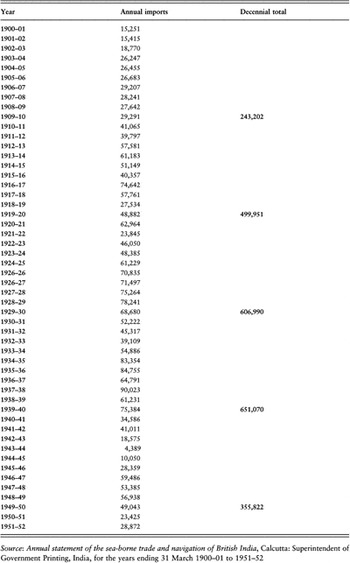
From a global perspective, India appeared to be a discouraging market, with relatively small sales compared with many European and Asian countries. Godley observes that sales in India remained ‘insignificant’ before 1914, adding that by 1916 diffusion there had barely reached even 1% of households.Footnote 10 India’s overall poverty and abundance of low-paid labour, quite as much as any assumed aversion to technological innovation, might seem to explain this. In 1905, Singer claimed to have sold over 19 million machines worldwide, but by that date India had probably imported fewer than 200,000 machines of all makes, despite having a population of over 250 million.Footnote 11 Thereafter, however, sales of Singer and other sewing machines rose steadily, and between 1900 and 1952 approximately 2.4 million sewing machines entered India (see Table 1). This is perhaps a modest tally, but it can be argued that the impact of the sewing machine in India was far greater than this raw diffusion data would seem to suggest.
Imports of sewing machines into India, 1900–01 to 1951–52

Source: Annual statement of the sea-borne trade and navigation of British India, Calcutta: Superintendent of Government Printing, India, for the years ending 31 March 1900–01 to 1951–52
As well as factors governing the internal market, the importation of sewing machines into India was substantially affected by global developments. Sewing machines were first introduced in 1859 but only began to enter the country in substantial numbers in the late 1890s. Imports quadrupled between 1900 and 1914, and, despite the impact of the First World War on both manufacturing and seaborne trade, the volume of imported machines continued to rise until 1916–17, before falling to a low point with the post-war trade slump in 1921. Along with many imported goods, sewing machines peaked in the late 1920s, when the Great Depression, which halved India’s foreign trade, forced another fall. Imports rose again in the mid 1930s, reaching a peak in 1937–38, when just over 90,000 machines entered India. The contrast with Japan is instructive, where Singer sales also peaked in 1937 (at 40,694, with a further 25,246 in Japanese-occupied Korea) but faced growing competition from local manufacturers, whose sales by the late 1930s were rapidly outstripping Singer’s.Footnote 12 In India there was no such indigenous competition. Although imports of all makes fell away dramatically during the Second World War, sewing machines (along with many other imported goods such as bicycles) reached new heights in the late 1940s and early 1950s in the years immediately following India’s independence. Only thereafter did high import duties and state aid boost indigenous sewing-machine production and reduce the availability of foreign machines.
Although Singer were slow to enter the Indian market – their first machines were only sold there in 1875, more than twenty years after the first sales in the United States – the great majority of sewing machines sold in India during the colonial period were made by this company. Whereas the earliest Singers came from America, from 1882 onwards most of those arriving in South Asia came from a factory at Kilbowie (Clydebank) in Scotland, and so entered Indian trade statistics as British manufactures. By 1900 Singer machines dominated the South Asian market, as they did most parts of the world, though they never entirely excluded other manufacturers, notably the German makers Pfaff. In 1900, 74% of sewing machines imported into India were British-made, compared to 5% from Germany, 5% from Belgium, and less than 1% from the United States. On the eve of the First World War, the British (and so predominantly the Singer) share of the market stood at just over 66% by volume, while the German portion had risen to nearly 32%. In the 1920s and 1930s the British and German shares remained fairly stable at about two-thirds and one-third each. The Second World War temporarily eliminated German competition, and in the late 1940s, when almost 90% of imported sewing machines came from Britain, Singer was said to ‘hold a semi-monopolistic position’ in the Indian market.Footnote 13 Although small by comparison with some types of machinery, this was still an economically significant trade. In 1913–14 the value of sewing machine imports was put at £238,805; by 1920–21 it had reached £552,565 (with a further £128,013 in parts and spares). In 1937–38 imports were valued at Rp6,665,809.Footnote 14
In order to understand how sewing machines found a market and a socioeconomic context in India, however, we need to turn to those who bought and operated them. And to understand the material culture surrounding sewing in India we must first engage not with the sewing machine as such, nor with the Singer sales agents or the housewives and seamstresses who are generally assumed to have been their clientele, but with the small world of India’s ‘traditional’ tailors.
Sewing cultures
In the colonial iconography of Indian castes and crafts, the darzi or tailor is a familiar figure. He – the tailor is invariably male – sits cross-legged on a mat or the veranda of a European bungalow, sewing intently, or taking orders from the white memsahib looming over him. He has few props – only the needle and thread, scissors, and thimble with which he works, and the cloth or garment on which he works alone or in a small huddle of fellow tailors. The darzi became (like many of India’s other ‘traditional’ trades) an exemplary image, used on postcards and in ethnographic studies, exhibitions, and photograph albums to illustrate the country’s ancient crafts and seemingly timeless artisanal practices.Footnote 15
The trope of the tailor emphasized the extent to which sewing as an Indian trade was essentially men’s work. The conventional image of the darzi, sitting on the floor to work, was increasingly at variance with European work practices for men,Footnote 16 and to Western eyes, accustomed to the idea of sewing as women’s work (even if tailoring had more masculine connotations), there was something weak and womanly about the darzi that conformed to the broader categorization of Indians as either ‘martial’ or, as in this case, ‘effeminate’.Footnote 17
The darzi was not highly regarded in narratives of colonial life in India,Footnote 18 or in manuals on how to manage Indian servants, in part because, like the dhobi (washerman), he was thought likely to transmit the diseases of the Indian bazaar into the sanitized space of the European bungalow.Footnote 19 The darzi served as a byword for India’s technological inertia and the unimaginative repetition of customary skills and work practices. There was seemingly nothing ‘subversive’ about the darzi’s stitch.Footnote 20 ‘[Q]uiet, intelligent, thrifty, and indolent’, he might be suspected of filching cloth or misusing his physical intimacy with female clients.Footnote 21 However, the darzi was a copyist, not an innovator. There was a well-established convention in colonial writing of the darzi bewildered by the frequent changes in European styles of dress. Asked to make a new frock by copying the design of an old garment, he does so with such unimaginative felicity that he reproduces it in its entirety – patches, darns, and all.Footnote 22 In short, the darzi was representative of the perceived temporal and spatial immobility of India’s artisan classes.
Yet neither the darzi nor the clothes on which he worked were as unchanging as the stereotype assumed. Increasingly, the darzi was accompanied by a sewing machine, one of the first modern machines to find its way into daily use in India, as in many other societies around the globe. As employers of the household darzi and the initial providers of sewing machines, Europeans were a significant means of introducing Indian tailors to the machine. Indeed, to judge by contemporary photographs, it became a matter of some pride for Europeans to display among the retinue of their liveried Indian servants a darzi sitting behind the sewing machine that served as the emblem and instrument of his trade.Footnote 23
Europeans were by no means the only site of contact or sole route of dissemination, however. While a majority of darzis across India were Muslims, there was considerable heterogeneity within the community of tailors. Many were Hindus, belonging to a loose congeries of castes from dhobis to cotton-traders and oil-sellers. Bombay had ‘Portuguese’ (Goan) tailors; some in Calcutta were Chinese; and Sikhs in Punjab and elsewhere increasingly took up the trade. Perhaps because tailoring was not an occupation confined to a single caste or community, it was more accessible to newcomers than many more caste-specific trades such as weaving or metal-working.Footnote 24 Demonstrating spatial as well as occupational mobility, some migrant labourers who left India for Burma became tailors, announcing themselves on their return as ‘Rangoon tailors’ or finding a place in the ‘Burma bazaar’. Whether on his own initiative or, perhaps more commonly, at the command of his European employer or the Indian master-tailor who provided him with the tools of his trade, the ‘traditional’ darzi was obliged to adapt.Footnote 25 His manner of working changed – often, though not always, from sitting cross-legged on the floor to working at a bench or upright on a treadle machine. The range of goods on which he worked also changed, as new kinds of commercial commodities requiring the services of the machine entered the market. In keeping with its semi-industrial nature, the sewing machine was put to novel uses, stitching umbrellas, boots and shoes, handbags, horse harnesses, and ships’ sails.Footnote 26
Given its plenitude of cheap labour, India might appear not to have needed labour- saving devices, but, as these examples suggest, the sewing machine enabled new sewing trades to develop, or, even in relation to established modes of work, allowed a greater volume of work to be carried out more quickly and with greater precision than was possible by hand. However, the decision to buy or rent a sewing machine often rested not with the individual darzi (generally illiterate and indebted) but with the memsahib, the master-tailor, or the petty capitalist who employed his services and virtually owned his labour. Nor were the costs of acquiring a machine particular high. A detailed study of darzi family budgets in Madras city in 1938 showed that it required only Rp50 to set up a tailor’s shop, and, while it cost Rp200 (the equivalent of ten months’ income) to buy a new sewing machine, one could be purchased second-hand or hired for far less.Footnote 27
Despite a colonial rhetoric of Indians’ mechanical inertia, their aversion to innovation, and their suspicion or ineptitude when confronted with new technology, there is little evidence to suggest any significant resistance to sewing machines in the country. Rather, despite their relatively small numbers before 1914, they passed fairly effortlessly into everyday use. As Jim Masselos has noted, in India the inventions of modern science and technology ‘swiftly moved from [being] objects of wonder to objects of use; they became part of the daily round of living. Neither social constraints nor the force of custom inhibited significant use of the achievements of the nineteenth-century world.’Footnote 28 Without the fanfare that greeted the coming of the railways, the sewing machine became a modest harbinger of wider technological change.
However, as with much else in relation to everyday technology, the evidence is often only anecdotal and fragmentary, and more readily gleaned from the pages of fiction than from the files of business houses and government departments. Thus, when Kipling’s technological ingénu Kim first encounters a phonograph he is immediately able to recognize it as being ‘some sort of machinery’ because it looks (and smells) like the sewing machines he already knows from the bazaars of Lahore.Footnote 29 As this literary illustration suggests, awareness of the machine and its uses was as likely to come from subaltern encounters in the bazaar as from any exposure to written texts or a slow process of downward diffusion. The visibility and audibility of the machine in bazaars and roadside tailor shops made its presence, and the dexterity of the tailor who worked it, a familiar trope in fictional representations of everyday India. Thus, in one of Mulk Raj Anand’s novels, Bakha the untouchable is absorbed in admiration of the ‘manipulation of a sewing-machine’ by a tailor in the bazaar.Footnote 30
Nor was it only urban tailors that took to sewing machines. So, too, did village darzis and shoemakers, even when their other tools appeared crude and their work methods ‘antiquated’. The machines found a particularly lucrative market in Punjab, in towns such as Amritsar and Lahore, where the number of those employed in tailoring and allied professions rose by 40% between the 1901 and 1911 censuses, and where the rising standard of living was said to be ‘driving the sewing of ordinary clothes from the home of the average townsman to the shop’. But the 1911 provincial census report also claimed that there was ‘hardly a tailor now without a sewing machine. Even in the villages a tailor would beg, borrow, or steal to equip himself with a cheap machine, and, if he cannot find enough customers in one village, he will rather set apart a certain amount of time for regular rounds and attach himself to a group of villages’.Footnote 31 There are other examples of increasing mobility and rural penetration: darzis from Chittagong in eastern Bengal followed seasonal migrant labourers into neighbouring Burma for the paddy harvest, lugging their shirt-sewing Singers with them.Footnote 32
By the 1920s darzis and their machines had become a common sight (and sound) in villages across northern India. Margaret Read noted in 1927 that ‘Almost every village tailor now has a sewing-machine, whose tick-ticking makes a strangely alien sound in the street where the thick dust muffles all sound of footsteps, human or animal.’Footnote 33 She was not alone in finding odd the sight and sound of the ‘town Darji’, his machine installed in a village hut ‘amid surroundings of apparently the most incongruous simplicity’.Footnote 34 Here, in a colonial echo of Leo Marx’s interpretation of the American pastoral idyll, was the incongruous ‘machine in the garden’, the semi-industrial sewing machine, invading the Indian equivalent of Sleepy Hollow.Footnote 35 European opinion remained divided, however, on whether the advent of the village sewing machine was indicative of more momentous processes of change or an unlikely harbinger of social and technological progress.Footnote 36
During their tour of India in January 1912, Sidney and Beatrice Webb encountered sewing machines in the classroom of a Hindu girls’ school in Allahabad, and again two months later in Peshawar on the North-West Frontier, where male tailors sat cross-legged on the floor of their tiny shops, ‘working Singer’s sewing-machines’.Footnote 37 In Malabar in south-west India, a group of enterprising Muslim Mappillas – a community more commonly associated in colonial discourse with ‘fanatical’ uprisings – used sewing machines to make the cotton caps worn by Muslim men: these were sold locally or exported. By the 1920s they had 200 machines and employed 500 women and boys.Footnote 38 In cities such as Calcutta and Dacca, large tailoring establishments sprang up to meet the expanding market for readymade shirts, coats, and uniforms.Footnote 39 In Lahore, with its railway workshops and army cantonment, the local demand for uniforms encouraged the creation of clothing factories with rows of operatives seated at sewing machines.Footnote 40
One factor behind the expanding use of the sewing machine was the shifting nature of bodily practices. Indian modes of dress were far from unchanging, despite persistent Orientalist representations of a timeless East. In 1867 J. Forbes Watson, the Reporter on the Products of India, declared that Indians lacked ‘that constant desire for change in the material and style of their costume’ that was ‘so pronounced in Europe’. ‘Some patterns’, he averred, ‘which are now favourites, have been so for centuries, and certain articles of dress were ages ago very much what they now are.’ Watson claimed that most items of Indian dress, likened to Western shawls and scarves, were ‘untouched by needle or scissors’ and were worn, unstitched, as they left the loom – as saris, dhotis, lunghis, and turbans.Footnote 41 Following the observations of Francis Buchanan early in the century, he declared that sewing was only introduced into India by the Muslims from the eleventh century onwards. Hindus accordingly regarded the wearing of stitched clothing as ‘an emblem of defeat and vassalage, and a despotic interference with customs almost sacred from their age’.Footnote 42
In fact, modes of dress – men’s as well as women’s – varied greatly across South Asia by the late nineteenth century, and were undergoing changes that directly impacted on the utility of the sewing machine.Footnote 43 Male labourers began to adopt shirts and cotton jackets bought ready-made in town, a fashion that spread across much of India, especially in relatively prosperous provinces such as Punjab.Footnote 44 The calf-length skirt worn by peasant women in Rajasthan and Punjab and itinerant communities such as the Banjaras was giving way to the all-conquering sari and the shalwar kameez, a style of dress once exclusive to Muslim women.Footnote 45 Although experimentation with tailored jackets and elaborately stitched blouses and chemises was most marked among Indian women who came into direct contact with European teachers, doctors, and missionaries, the late nineteenth and early twentieth centuries were a time when more and more women from ‘respectable’ castes and communities were appearing in public, and therefore needed forms of dress that were more appropriate than the flimsy and revealing clothes worn in the privacy of the women’s quarters (zenana).Footnote 46 As was evident, too, from the ‘breast-cloth controversy’ in the southern state of Travancore in the 1850s, Christian missionaries were determined to defy existing caste prohibitions and sartorial taboos by insisting on the right of their female converts to wear blouses, jackets, and other forms of upper-body clothing.Footnote 47 Half a century later, at a time when Hindu and Sikh reform movements were energetically targeting the appearance and conduct of women, there was a comparable drive to enforce women’s well-clothed modesty outside the home. Middle-class and high-status women adopted the respectability of a bodice (choli), a tunic (kameez), a jacket, and other tailored and often machine-made items of clothing.Footnote 48
Changing social mores and styles of dress among the Indian population thus created a new and expanding market for tailors and their machines. Fashionable Europeans might employ their own tailors, dressmakers, and milliners, but the use of stitched clothing – petticoats, shirts, uniforms, tunics – proliferated among Indians, too. Apart from the livery in which many Europeans dressed their household servants, the army (which had its own regimental tailors), the police, business houses, municipalities, railway and tram companies, the telegraph service, and the post office all required employees to dress in uniforms that needed tailors to make and repair them. In other words, part of the impetus for the increasing adoption of the sewing machine, whether by darzis, memsahibs, or urban tailoring houses, came from changes within Indian society, and not just from the impact of foreign marketing practices and exogenous processes of social change and technological innovation. Marx’s ‘revolutionary machine’ could be no less an engine of change in India than it was in nineteenth-century Britain.Footnote 49
Racial goods
In the West, where the bulk of machines were sold to women for use in the home, sewing machines became closely identified with women’s work and the rise of women as consumers.Footnote 50 Manufacturers targeted women as purchasers and users, successfully overcoming initial resistance to the idea of women operating machines in the home.Footnote 51 Singer in particular prided themselves on selling ‘family machines’, designed not just to perform a utilitarian task but also to be an attractive piece of furniture that could fit stylishly into any middle-class parlour. Apart from advertisements that stressed the primacy of women costumers, the domestic context of the sewing machine was further exemplified by the way in which – in Western countries – the salesman (or more often his wife) would visit the purchaser in her home to explain how her gleaming machine actually worked.
Initially, Singer, seeking to pursue a common sales strategy throughout their vast commercial empire,Footnote 52 thought in similar terms with respect to the Indian market, though there the assumption was that only European and Eurasian (‘Anglo-Indian’) women and their households were likely to buy and use such innovative machines. As already indicated, Europeans (and the darzis they employed) were among the first to use sewing machines in India. They either purchased them from local agents or brought them with their household effects from Britain. Others were sold or passed on second-hand among European residents. It was widely believed that the ‘stitch-less’ nature of Indian clothing, especially for women, made the sewing machine redundant, but it was further assumed that Indians in general, and Indian women in particular, were incapable of using such machines, or even comprehending their use. In 1888, John Mitchell, one of the ‘travelling examiners’ Singer periodically dispatched from New York or London to report on the progress of local sales, remarked that Indian women were so ignorant and secluded that ‘if advertisements reached their hands they would be unable to understand them’. His brief tour of India had convinced him of the ‘absolute uselessness of the Sewing Machine for the vast majority of the population’ whose dress appeared to consist of ‘one or two plain pieces of cloth wound in curious folds round the figure’.Footnote 53 It followed, to cite another Singer representative, that the ‘vast native domestic population is closed to us as yet and will be so till western ideas and western dress take a firmer hold on the masses’.Footnote 54 Since race seemed to define technological aptitude, Mitchell went through the 1881 Indian census to establish how many Europeans and Eurasians were resident in particular towns, districts, and cantonments, and hence how many machines Singer could hope to sell.Footnote 55 Given the smallness of the white population, it was not likely to be many, and in the 1880s Singer struggled to sell more than 2,000 machines a year in India.
Rhetorically, ‘civilization’ and the sewing machine often went hand in hand. To many Indian reformers of women’s dress, improper clothing was a mark of ‘decadence’ and ‘shame’, indicative of a want of true civilization,Footnote 56 a social ill for which tailored clothing and the sewing machine might help effect a cure. Equally, in the confident spirit of international capitalism, Singer liked to represent their machines as creating a more civilized world. A company trade card issued in 1892 boasted that, in its twenty years in India, Singer had ‘been a factor in helping the people of India toward a better civilization’.Footnote 57 But privately Singer representatives doubted that the sewing machine had much of a future in the country until civilization, as they understood it, had gained a more secure foothold.
There was, however, an alternative strategy. In 1875, shortly after they began operations in India, Singer acquired as their agent in Bombay an enterprising young Parsi (Zoroastrian), Nasarvanji Mervanji Patell, whose career as the company’s principal agent in the region lasted until his retirement in 1911. Patell belonged to one of the leading Parsi merchant families in Bombay and hence to the community that stood at the forefront of that city’s economic progress.Footnote 58 As commercial magnates, pioneer industrialists, and technological intermediaries between Europeans and the mass of the population, Parsis occupied a crucial role in the dissemination and popularization of India’s everyday technologies. In Bombay and its hinterland, from the Deccan in the south to Punjab in the north, and as far east as Allahabad, Parsi stores sold bicycles, motorcycles, typewriters, sewing machines, cameras, gramophones, and a host of other ‘mechanical novelties’.Footnote 59 But even in Bombay Parsi tailors were rare, and Patell’s family was at first displeased by his decision to sell sewing machines, which they regarded as ‘a common shop business’.Footnote 60 Nevertheless, Patell persisted and began to devise a new marketing strategy for a company that was, in sales terms, far behind its main British and American rivals, Wilcox and Gibbs and Wheeler and Wilson.
Patell’s career demonstrates the racial context in which Singer, as a leading international firm, sought to conduct their business in India, but also the role that Indian agency could have in selling sewing machines and other technological goods to Indians. The fact that India was clearly a difficult market for Singer gave Patell a degree of licence that he would almost certainly not have had in most other countries, and gives further prominence to the need, even with respect to global goods, to address the singularity of the local. Patell’s aim was to bypass the small number of European purchasers and focus instead on Indian customers. He particularly sought to target Indian tailors, who potentially constituted a far larger market than the European one, and on the community or caste leaders who (as master-tailors themselves) made the critical decisions about hiring or purchasing machines.
Patell’s strategy was not easy to implement. He had to fight off or take over rival agencies and contend, at times through the courts, with the sale of ‘counterfeit’ Singers. He vigorously defended the Singer brand name and the company’s ‘genuine’ products.Footnote 61 He claimed that, while European customers were primarily interested in the machine’s appearance and how efficiently it worked, Indians ‘as a rule look to cheapness’. They would buy less expensive machines, including fake Singers, unless the company sold their machines at a competitive price and were prepared (contrary to company policy) to offer discounts of at least 10%.Footnote 62 Following practices common elsewhere but still new to India, Patell and his agents drew up hire-purchase and loan agreements that would enable tailors who could not afford to buy a machine (costing at the time between Rp50 and Rp100) to rent or acquire one on easy terms. In the mid 1880s more Singer machines were disposed of by hire purchase than were sold outright.Footnote 63
Patell sought to persuade the principal tailors in Bombay and Surat, known as the ‘Chanchias’, through their headman, Bacher Ghella, to abandon the Wheeler and Wilson machines, with which they had been familiar since the 1850s, and adopt Singers instead. It is not entirely clear who the ‘Chanchias’ were, but it is likely that they were a Gujarati caste (or occupational group) more normally associated with the sale of oil for domestic use, though in south Gujarat the term ‘Ghanchi-Gola’ was used collectively for several low-ranking artisan and trading communities.Footnote 64 Winning them over to Singers entailed a protracted struggle. The Chanchias found the simpler, more open structure of Wheeler and Wilson machines better suited to the bulky cotton shirting they used and the rapid manner of their work. It took Patell more than twenty years to overcome their resistance – not to sewing machines as such, which the Chanchias had adopted decades earlier, but to Singer machines.Footnote 65
Despite the relatively small number of machines sold in India (by global standards), Patell’s strategy was highly successful. Singer sales rose steadily and the number of branches under his direction increased almost yearly. In 1885 there were about thirty-five Singer outlets; twenty years later the company had more than a hundred branches across India, Ceylon, and Burma.Footnote 66 Increasingly its shops were located where customers were most likely to be found, in ‘native towns’ and bazaars; in terms of sales, as well as use, sewing machines had become familiar bazaar goods. By the 1920s even small towns had a Singer shop, and company sales representatives roamed the countryside in search of new customers. Although the firm did little advertising of its own, publicity for Singer appeared in vernacular languages as well as in English, and by the 1930s the company produced thirty-page instruction manuals in such major languages as Urdu and Tamil.Footnote 67
If Patell helped to initiate and nurture this rapid expansion of the sewing machine, he was not without his critics, and here, too, race played a part. The itinerant inspectors sent from London to assess the progress of Singer operations in India in the 1880s took a negative view of Patell and his business methods. They found the stock in his showrooms dirty, rusty, and poorly displayed. They questioned the book-keeping practices of him and his office manager, who happened to be his brother-in-law, and were critical of the ‘narrowness’ of his marketing ideas, his failure to follow the ‘broad principles’ of company sales policy, and his apparent inability to sell machines to the customers who in their view really mattered – Europeans. They attacked Patell himself, finding him fussy, driven by ‘personal spite’ against his rivals, and obsessed with selling their machines as cheaply as possible, while appearing negligent or brusque with clients. He might be ‘energetic and earnest’, but as a Parsi (and so a member of a community that traced its origins to Persia) he was said to be a virtual foreigner, as remote from the languages and customs of the local population as Westerners themselves were. In other words, Patell’s ‘race’ was used against him and the unconventional methods (as far as Singer were concerned) by which he sold their machines in India.Footnote 68 This hostility was at variance with the common view of the Parsis as constituting one of India’s most Westernized and entrepreneurial communities, with a ‘genius for business’.Footnote 69
In June 1887 Patell was forced to resign, only to be subsequently reinstated. It was recognized that the Indian market was too challenging for Singer to dispense with Patell’s local expertise. Also crucial to his survival was the support of the company’s managing director, George R. McKenzie, with whom Patell, through his frequent correspondence, had built up a remarkably personal working relationship. Patell warned his boss about the ways in which Europeans treated Indians like himself: ‘Nine hundred and ninety-nine out of a thousand Europeans who come out to India’, he confided, as he waited anxiously for the arrival of Davidson, London’s latest emissary, ‘change their attitude, manners, and politeness and try to be Lords in India.’ Even the salesman who had recruited Patell in 1875 had turned against him and Davidson might similarly ‘in time feel my suggestion awkward and uncalled for’.Footnote 70
Despite pleading his local experience and knowledge of ‘the habits of the people here’,Footnote 71 Patell was forced to compromise. He agreed to sack his brother-in-law, improve book-keeping practices, and clean up the showroom, but he also made other concessions that ran counter to his commercial and communal instincts. He dismissed as impractical the proposal that every branch be run by a ‘smart European’, but, persisting in the belief that Europeans were the main market, Davidson obliged Patell to take on three young Eurasians to act as canvassers, even though, from racial preconceptions of his own, Patell had ‘very little confidence in these East Indian youths’. He even had to accept European and Eurasian women as shop assistants in the showrooms in Bombay, Calcutta, and Madras.Footnote 72
Just as Parsis were one kind of technological intermediaries in the racial and communal configuration of colonial India, so also were Eurasians (‘Anglo-Indians’). Seldom entrepreneurs, and never industrialists like the Parsis, they were nevertheless assumed, by virtue of their mixed-race origins and occidental lifestyles, to be closer to Europeans than Indians in their aptitude for European technology, while still having a more intimate knowledge of Indian languages and customs than most Europeans could command. In the mid nineteenth century they were given favoured employment on the railways, in the telegraph service, the police, the medical service, and other branches of the colonial state. Employed as shop assistants in the cities, Eurasian men also worked as clerks and chauffeurs, and as technicians and overseers in factories, workshops, and plantations. Singer were therefore following an established trend in believing that Eurasians could also be the key to selling sewing machines, especially if they (like their counterparts in the United States and Britain) were able to visit Europeans in their homes in a manner denied to Indian salesmen.Footnote 73 Patell did not actively sabotage this plan but he was not sorry when it went wrong. Of the three Eurasians hired, Doyle died at Trichinopoly (but not before he had misappropriated Rp83), and Allen was sent to prison for absconding with company funds. Worst of all was Arnold, of whom Patell remarked ‘I have never found such a daring rogue’. He failed to keep proper accounts, sold only two machines, and was jailed for cheating Singer of more than Rp500.Footnote 74 Thereafter, Patell was given considerable latitude, rare in the annals of Singer’s global operations, to decide how best (and to whom) to sell sewing machines in India.
Technology engendered
In 1892, as a demonstration of its global activities, Singer issued a colourful set of trade cards showing the ‘costumes of all nations’ as illustrated by sewing-machine users from different countries. Two separate designs were produced for India. One showed Patell and his office staff in Bombay with a man seated at one of the new Singer treadle machines. The other depicted a darzi and his wife but, unlike the illustrations for many other countries, including many Asian ones, where a woman was shown working the machine, on the Indian card she was depicted sitting on a chair alongside the machine, while her husband stood beside it in a kind of technological limbo, as if both were uncertain what their relationship with the machine should be.Footnote 75 In shifting the focus of Singer sales from Europeans to Indians, Patell helped to effect a gender change as well. Women, whether as consumers or as sales assistants, were not a primary part of his marketing strategy. For him, contrary to Singer policy, selling sewing machines in India was essentially about selling them to men, particularly to those who by custom and trade were tailors. The darzi’s wife was as absent from his correspondence as she was from his commercial strategy. Nonetheless, it is evident that an increasing number of women in India, even before Patell retired in 1911, had become sewing-machine users, thereby bringing India more into line with Western countries. The male darzi never ceased to be a sales target in India, however, and as late as December 1947 Indian-made ‘Usha’ machines were advertised with an image of rows of men at work, with the caption ‘The good darzi chooses it because …’Footnote 76. But gradually, from the late nineteenth century, the use of sewing machines became, to borrow Rozsika Parker’s terminology, part of a new agenda of ‘making the feminine’ and ‘inculcating femininity’.Footnote 77 How and why did this gender shift occur?
In part the answer returns us to questions of race, as well as of class and gender. From early in the colonial period sewing, embroidery, dressmaking, and millinery were seen as suitable occupations for poor white or mixed-race female orphans (as in the military orphan asylums of Calcutta), or for the destitute and ‘fallen’ women taken up by Christian charities. Female inmates of schools and institutions were expected to sew – in part to earn money for the organizations that supported them or to prepare them for the life of a wife or seamstress, but also because the discipline of sewing was seen to be conducive to patience, diligence, and approved moral conduct. Sewing, and hence in time the sewing machine, became a disciplinary instrument. But, in a convergence of different sewing cultures, it was also common for Indian women of almost every caste and community to sew or embroider as part of their household labour, making or repairing clothes for the family. As among poor whites, by the late nineteenth century sewing had become part of the wider technology of Indian women’s social reform and moral uplift.
To take an extreme case, when women from the reputedly ‘criminal tribe’ of the Bhantus (Sansis) from north India and Punjab were sent to the penal settlement of the Andaman Islands in the 1920s they were typically set to work, under the auspices of the Salvation Army, to sew and to use sewing machines.Footnote 78 In this instance, the use of sewing as a reforming regimen was all the more striking in that Sansis were renowned for being ‘nomads’ and ‘vagrants’ without a fixed place of abode. Moreover, except on ceremonial occasions, they were scantily dressed. They were even said, in a return to an idiom (already noted) linking sewing, sewing machines, and civilization, to have hitherto been strangers to ‘domiciliary civilization’.Footnote 79 In the Andamans, the sewing machine became an instrument for making Sansis ‘civilized’, impressing upon them both spatial fixity and a productive occupation. This was not a unique example. Sewing machines were sold by Singer and other manufacturers to Indian prisons and reformatories, for use by men and women alike. Along with bicycles, and later radios, they were one of a select group of goods that signified the arrival of the modern in often remote parts of India and bore a special significance for the transformation of women’s lives, notably their modes of work and dress.Footnote 80 When large numbers of women were made refugees by partition in 1947, one of the means by which they were rehabilitated and set to work was by providing them with sewing machines.Footnote 81 Post-independence rural development and welfare programmes similarly expected village women to take up sewing, embroidery, and the use of sewing machines, while men engaged in construction projects and agricultural work.Footnote 82
At the opposite end of the social scale from the ‘criminal’ Sansis, middle-class women became the target for direct appeals from Singer and rivals such as Pfaff. They presented their machines as suitably domestic goods, and not just male-operated, semi-industrial appliances. Advertisements in newspapers and journals appeared, in which smiling, sari-clad women were shown happily working at their machines; by the 1940s Indian manufacturers were selling machines with such female names as ‘Usha’ and ‘Daisy’. Use among middle-class Indian women appears to have become relatively widespread by the interwar years. Madhur Jaffrey describes how, in her parents’ well-to-do, high-caste household in Delhi in the 1930s, her mother had a sewing machine on which she made clothes for the women and children of the family, while employing a ‘bumbling’ darzi to ‘do the simple stuff’, making routine items of dress, a perhaps common division of labour.Footnote 83 In the middle ground between the ‘criminal’ Sansis and the affluent Jaffreys, sewing machines were adopted as a means of self-employment and income generation, especially by poor wives and widows who had no other means of earning a living available to them: working at home on a sewing machine was considered far more respectable and appropriate for women than toiling in a factory or office. When Mahila Samiti (women’s associations) were set up in Bengal from 1913 onwards by Saroj Nalini Dutt, the wife of an Indian civil servant, sewing was one of the activities that women were encouraged to adopt as gainful employment.Footnote 84
In the largely male Hindu, Muslim, and Sikh reformist imagery of the early twentieth century, the idealized wife and dutiful daughter-in-law was represented as sewing (and plying a sewing machine) as part of her domestic responsibilities and care of the family. In one such tract, the diligent housewife not only runs her own home efficiently but also helps a widow to organize her domestic finances by investing in an old sewing machine ‘so that she could make an independent livelihood possible’.Footnote 85
In India, the sewing machine thus became identified with approved modes of female behaviour, with ‘virtuous domesticity’ and control of female sexuality – in stark contrast to the erotic images and emancipatory associations it appears to have acquired in France.Footnote 86 There was nothing sexy about the Indian seamstress. Significantly, sewing machines were objects men gave to women – as philanthropic donations to the Mahila Samiti, or as prizes for schoolgirls and college students. By the 1940s, they had become desired dowry presents among the middle classes.Footnote 87 They were given by men, in a marriage transaction that emphasized the domestic duties of the modern Indian woman. It was partly by this matrimonial route that the sewing machine became, by the mid twentieth century, one of the most widely disseminated domestic appliances in India, one of the few machines available to, and considered suitable for, women’s use in the home.Footnote 88
Swadeshi machines
The way in which such increasingly everyday technological goods as sewing machines were introduced into India in the late nineteenth and early twentieth centuries from British, American, and continental European manufacturers, largely through the agency of foreign firms and, often, initially, with European consumers in mind, would seem to support the idea that these were in essence alien commodities and an aspect of the wider colonial (or at least foreign) domination of the Indian economy. It could be argued, too, that the relative ease with which such goods entered the Indian market and were able to take control of it, with low import duties and scant competition from Indian manufacturers, reaffirmed the lop-sided, exploitative nature of the colonial economic system and the marginalization of Indian economic enterprise. The fact that it took so long – until the 1950s – for Indian-made sewing machines, bicycles, and typewriters to capture a significant share of the Indian market seems to support the nationalist argument that the British ran the Indian economy in their own interests and stifled competition – until India gained its political freedom and gained a greater degree of control over its economic destiny.Footnote 89
It is not the purpose of this article to contest the overall picture of colonial domination, but it is necessary, from the perspective of the sewing machine and its Indian dissemination, to present some partial qualifications of this argument. As noted at the outset, a significant portion of the technological goods entering India in this period came not from Britain, the colonial power, but from American and continental European manufacturers. The technology behind the sewing machine was American, even if the bulk of imported Singers came, from the early 1880s onwards, from a Scottish factory. A smaller but not insignificant number of machines came (in peacetime) from Germany, just as the great majority of typewriters, cars, and trucks were imported from the United States. Britain did dominate the bicycle trade, but even that dominance was not immune to German and Japanese competition in the 1920s and 1930s. Thus India’s colonial economy remained in some respects remarkably permeable to outside competition. It is further necessary to recognize that, despite generally adverse market conditions, Indian industrial and commercial enterprise was able to make some headway in this period, and to gain a degree of ownership over the production, and more especially the distribution and sale, of everyday commodities. It was often able to do so in ways that enabled Indians to establish a foothold in areas of manufacturing that could be extended and developed in the more favourable post-independence era.
In the early twentieth century there was little likelihood of Indians establishing their own sewing-machine industry, though, as with many other consumer goods (such as bicycles), Indians acquired expertise in selling, servicing, and repairing such machines. The swadeshi movement, conventionally dated from the partition of Bengal in 1905 (though with earlier antecedents), aimed at inducing Indians to buy Indian-made goods.Footnote 90 However, it did little to stem the importation of foreign sewing machines. It was recognized in some quarters that, while Indians could produce and wear their own cloth, it would be a long time before they could make their own sewing machines, bicycles, and typewriters. The most that they might do patriotically would be to switch from British to German or American makes.Footnote 91
Even so, the swadeshi movement played its part in the indigenization of the sewing machine, as Indians required such machines to stitch swadeshi umbrellas or sew hand-spun, hand-woven khadi cloth into kurtas and other approved items of nationalist dress. Even such innovative forms of attire as the ‘Gandhi cap’ required stitching, and this was often done by machine. Famously, the Singer was one of the few modern machines to which Gandhi gave his personal approval.Footnote 92 To some extent the sewing machine and the charka (spinning wheel) coexisted as mutually beneficial machines and both held a particular significance for domestic labour and female employment (and so ran counter to arguments about the Indian home as a site immune to technological change), and yet they were emblematic of very different understandings of what constituted ‘civilization’. Arguably, the ‘foreign’ sewing machine was infinitely more effective than the Indian charka in penetrating home life and in stimulating the creation or revival of ‘cottage industries’.
It was not until the 1930s, however, that sustained attempts were made to create and market an Indian sewing machine. First in the field was Jay Engineering in Calcutta in 1936. Its founder, Bishandas Basil, worked as an engineer in the Post and Telegraph Department in Calcutta, but he originally came from Ludhiana in Punjab, a province where the dissemination of the sewing machine had been particularly successful and where there existed a fund of small-scale engineering and manufacturing expertise. Basil began, in his spare time, to build a prototype sewing machine, using as his model a Pfaff machine (significantly not a British Singer), which he named ‘Usha’ after his daughter.Footnote 93 Naming practices, it might be noted in passing, were a significant part of the indigenization process, just as the reverence paid to all machines in Hindu India at the time of the annual Ayudha Puja, when they were daubed with vermillion and decorated with marigolds, contributed to their cultural assimilation.
In the 1930s and 1940s, however, the raw materials needed to make even a seemingly simple small mechanical object such as a sewing machine were in short supply. The country was also deficient in machine tools, a major obstacle to the production of items such as sewing machines, bicycles, and typewriters. Under colonial rule, India’s expertise in structural engineering had not been matched by the development of the small-scale precision work needed to make everyday machines: a sewing machine typically consisted of some 220 components parts, together performing 1,800 different operations.Footnote 94 Moreover, Basil lacked the capital to develop his prototype, but this was less of a problem. In 1938, from what appear in part to have been patriotic motives, a leading Indian industrialist, Lala Shri Ram, took over Jay Engineering, injecting fresh funds into the flagging enterprise.Footnote 95
By this time, two other small-scale producers had been established: the Delhi Sewing Machine Company, whose ‘Daisy’ machines first appeared in 1938, and the Indian Sewing Machine Company based in Lahore. But all three companies remained heavily dependent on imported components (including such essentials items as steel needles) and, despite the lower prices at which they offered their machines, they struggled to compete with Singer and Pfaff in terms of quality, marketing, and after-sales servicing. Although during the Second World War India was ‘starved’ of sewing machines, the non-availability of raw materials such as high-grade steel inhibited indigenous production, and factory machinery was taken over to produce munitions and war materiel. When production resumed in 1946–47 fewer than 8,000 sewing machines were being made in India. This rose to 17,000 by 1948–49, but still amounted to less than one-third of the number of imported machines.Footnote 96 It was only in the late 1940s that Indian manufacturers were in a position to expand and to seek the active support of the new government of India. Swadeshi machines did not command an automatic dominance: indeed, the levying of high import duties against foreign machines was justified on the grounds that there was ‘a strong bias on the part of [the] consumer in favour of the imported machine’.Footnote 97 But this then gave Indian manufacturers a sufficient advantage to capture the domestic market, and to export machines to other Asian and African countries. Further stimulus came from the ready-made garment industry, which developed rapidly in India in the 1960s and 1970s.Footnote 98
The number of machines in use in India rose rapidly between 1950 and 1961, from 145 to 742 per million of the population, and sewing machines, like bicycles and radios, became one of the key indices for assessing improved living standards. Even though part of the increased internal demand for sewing machines was industrial (for use by male, and increasingly female, factory workers), the market for domestic machines (put at 60% of total demand in 1950) also rose,Footnote 99 and with it further attempts to popularize women’s use of Indian-made machines. One of the most successful ploys of Jay Engineering in the mid 1940s was to set up ‘Usha Schools’ to train women in cutting, sewing, and tailoring, and so to encourage use and purchase of ‘Usha’ machines. The schools’ popularity with ‘girls and housewives’ was said to have been ‘immediate’, with more than 2,000 students enrolled by March 1948. More than fifty years after its introduction into India, the sewing machine had become in effect an Indian good, and not merely a global one.
Conclusion
In a case like that of India’s uptake of sewing-machine technology, it would clearly be erroneous to draw an excessively stark distinction between exogenous and indigenous forces, between the global operations of an international company such as Singer and the small world of the Indian tailor or housewife. Without the conduits of trade that colonialism made possible, without the access to Indian markets that colonial rule facilitated for British, American, and German manufacturers, and without the local role of Western agents and white consumers, the early (albeit slow-moving) history of sewing machine dissemination in India could hardly have been the same. However, as this article has tried to demonstrate, it is impossible to understand how the sale and use of sewing machines in India took off around the turn of the twentieth century without looking closely at the role of Indian agency (exemplified here by N. M. Patell), at the changing nature of Indian dress in an age of social transformation and moral reform, at the occupational functions, work practices, racial identities, and gender roles associated with sewing, tailoring, and machine ownership and use, and at important local mechanisms such as dowry gifting, the growth of Indian technical expertise, and swadeshi idealism. In order to do this it is necessary to move ‘seamlessly’, to echo a word used earlier in connection with sociotechnical change, from the global world of goods to the small world of the Indian sewing machine and its local owners and users.