1. INTRODUCTION
Intense radiation sources can be generated in laser plasma interaction, such as fast electron (Bessonov et al., Reference Bessonov, Gorbunkov, Ishkhanov, Kostryukov, Maslova, Shvedunov, Tunkin and Vinogradov2008; Malka & Fritzler, Reference Malka and Fritzler2004), energetic ion (Bin et al., Reference Bin, Lei, Yang, Huang, Yu, Yu and Tanaka2009), X-ray (Hu et al., Reference Hu, Liu, Zheng, Wu, Li, Wu, Zhang, Yang, Yang, Yi, Du, Huang, Hu and Ding2007, Reference Hu, Zheng, Shen, Lei, Liu, Zhang, Yang, Yang, Ding, Hu, Huang, Du, Yi and Xu2008a, Reference Hu, Zhang, Zheng, Shen, Liu, Yang, Ding, Hu, Huang, Du, Yi, Lei and Xu2008b; Liu et al., Reference Liu, Xia, Liu, Li and Xu2009b), and far-infrared ray or microwave (Leemans et al., Reference Leemans, Geddes, Faure, Tóth, VanTilborg, Schroeder, Esarey, Fubiani, Auerbach, Marcelis, Carnahan, Kaindl, Byrd and Martin2003; Van Tilborg et al., Reference Van Tilborg, Schroeder, Esarey and Leemans2004; Li et al., Reference Li, Liu, Xu, Chen, Chang, Wan and Wen2009; Dorranian et al., Reference Dorranian, Ghoranneviss, Starodubtsev, Yugami and Nishida2005; Purohit et al., Reference Purohit, Chauhan and Sharma2009, Reference Purohit, Chauhan and Sharma2008). Terahertz (THz) radiation emitted from laser generated plasma in air has attracted considerable attention in recent years due to its potential applications in achieving high electric field of THz wave and realizing broadband emission that covers the entire THz gap (0.1–10 THz). The first reported THz radiation in air was achieved in the early 1990s by focusing an intense laser into air medium (Hamster et al., Reference Hamster, Sullivan, Gordon, White and Falcone1993, Reference Hamster, Sullivan, Gordon and Falcone1994). The nonlinear electron current driven by the pondermotive force generates the THz wave. Since then, other plasma-based THz generation schemes have been demonstrated, which provided stronger THz emission. By applying an external direct-current bias to the plasma region to generate a transient transverse electron current, Loffler et al. (Reference Loffler, Jacob and Roskos2000, Reference Loffler and Roskos2002) obtained an order of magnitude increase in the THz emission intensity. A new scheme was demonstrated in 2000s that the THz emission intensity was further enhanced by using two-color femtosecond laser fields at the fundamental and its second-harmonic wavelength (Cook & Hochstrasser, Reference Cook and Hochstrasser2000). The amplitude of the THz emission depends strongly on the phase between the fundamental wave and its second harmonic wave. The mechanism was original attributed to four-wave mixing in air plasma (Kress et al., Reference Kress, Loffler, Eden, Thomson and Roskos2004; Bartel et al., Reference Bartel, Gaal, Reimann, Woerner and Elsaesser2005; Xie et al., Reference Xie, Dai and Zhang2006; Chen et al., Reference Chen, Yamaguchi, Wang and Zhang2007; Houard et al., Reference Houard, Liu, Prade and Mysyrowicz2008), and re-explained recently with the model of combined two-color laser field induced transverse plasma electron current (Kim et al., Reference Kim, Glownia, Taylor and Rodriguez2007, Reference Kim, Taylor, Glownia and Rodriguez2008; Wang et al., Reference Wang, Sheng, Wu, Chen, Li, Zhang and Moma2008; Chen et al., Reference Chen, Pukhov, Peng and Wili2008; Karpowicz & Zhang, Reference Karpowicz and Zhang2009). More recently, additional plasma-based THz generation schemes have been reported. By focusing a few-cycle laser pulse into air medium, a spatial charge asymmetry of the photo-ionization induced plasma was produced, which excited the plasma electron current and generated the THz wave (Kress et al., Reference Kress, Loffler, Thomson, Dorner, Gimpel, Zrost, Ergler, Moshammer, Morgner, Ullrich and Roskos2006; Gildenburg & Vedenskii, Reference Gildenburg and Vedenskii2007; Silaev & Vedenskii, Reference Silaev and Vedenskii2009; Wu et al., Reference Wu, Sheng and Zhang2009). The amplitude of the THz wave now depends strongly on the carrier-envelope phase, which can be used to measure the carrier-envelope phase of few-cycle laser pulses (Kress et al., Reference Kress, Loffler, Thomson, Dorner, Gimpel, Zrost, Ergler, Moshammer, Morgner, Ullrich and Roskos2006).
The conical forward THz emission generated from a femtosecond laser filament in air was observed recently (D'Amico et al., Reference D'Amico, Houard, Franco, Prade, Mysyrowicz, Couairon and Tikhonchuk2007, Reference D'Amico, Houard, Akturk, Liu, Le Bloas, Franco, Prade, Couairon, Tikhonchuk and Mysyrowicz2008; Houard et al., Reference Houard, Liu, Mysyrowicz and Leriche2007; Liu et al., Reference Liu, Houard, Prade, Mysyrowicz, Diaw and Tikhonchuk2008). The femtosecond laser filament arises from the dynamic competition between Kerr beam self-focusing and beam defocusing by the produced air ionization (Couairon & Mysyrowicz, Reference Couairon and Mysyrowicz2007). The competition leads to a high peak intensity in a small average beam diameter (~100 µm) over a long distance. In the wake of the moving ionization front inside the laser filament, longitudinal oscillations of the plasma are excited by the ponderomotive force, and are heavily damped by the electron collisions on a sub-picosecond time scale. So the plasma electron current can only exist just behind the ionization front, its longitudinal length is on the order of plasma wave damping length, which is shorter than the emission wavelength (Houard et al., Reference Houard, Liu, Mysyrowicz and Leriche2007; Liu et al., Reference Liu, Houard, Prade, Mysyrowicz, Diaw and Tikhonchuk2008). It looks like a dipole with charge separate oriented along the propagation axis (Proulx et al., Reference Proulx, Talebpour, Petit and Chin2000). This dipole-like localized plasma electron current is therefore similar to a dipole moving at very high speed in medium. Cherenkov radiation of terahertz can be generated in the laser filament with finite length although the dipole-like electron current moves at sub-luminous speed, which is called transition-Cherenkov radiation (Zheng et al., Reference Zheng, Yu, Zheng and Tanaka2005; Jelley, Reference Jelley1958; D'Amico et al., Reference D'Amico, Houard, Franco, Prade, Mysyrowicz, Couairon and Tikhonchuk2007, Reference D'Amico, Houard, Akturk, Liu, Le Bloas, Franco, Prade, Couairon, Tikhonchuk and Mysyrowicz2008; Houard et al., Reference Houard, Liu, Mysyrowicz and Leriche2007; Liu et al., Reference Liu, Houard, Prade, Mysyrowicz, Diaw and Tikhonchuk2008; Stein et al., Reference Stein, Fill, Habs, Pretzler and Witte2004).
Although the conversion efficiency of THz through the transition-Cherenkov radiation mechanism in laser filament is relatively low, the simplicity in its implementation endues it new advantages. It requires no alignment as that of the two-color laser field scheme. The filament length and position can be easily controlled by manipulating the laser pulse or the focusing condition. For example, the THz emitter can be positioned decameters to kilometers away from the laser system (Couairon & Mysyrowicz, Reference Couairon and Mysyrowicz2007; D'Amico et al., Reference D'Amico, Houard, Franco, Prade, Mysyrowicz, Couairon and Tikhonchuk2007, Reference D'Amico, Houard, Akturk, Liu, Le Bloas, Franco, Prade, Couairon, Tikhonchuk and Mysyrowicz2008), which avoids significant THz propagation losses in air.
To increase the radiation intensity of THz in a laser filament through the transition-Cherenkov radiation mechanism, one straight method is to enhance the strength of the dipole-like plasma electron current by increasing the laser intensity. Unfortunately, laser intensity clamping exists in the laser filament (clamping intensity ~1013 W/cm2) (Couairon & Mysyrowicz, Reference Couairon and Mysyrowicz2007). If the input laser beam exceeds the clamping intensity, stochastic multiple filaments appear, which will make the THz source unstable. To get a stable THz source, a single laser filament is expected. In this article, a new scheme is proposed to increase the transition-Cherenkov radiation of THz emitted from a single laser filament in air by at least one order.
2. CALCULATION AND DISCUSSION
2.1. Proposal
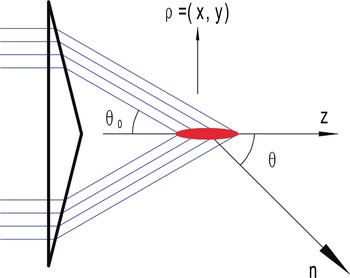
In a laser filament, the strong damped electron plasma wave driven by the ponderomotive force in the wake of ionization front produces a dipole-like localized electron current moving at the speed of ionization front (D'Amico et al., Reference D'Amico, Houard, Franco, Prade, Mysyrowicz, Couairon and Tikhonchuk2007, Reference D'Amico, Houard, Akturk, Liu, Le Bloas, Franco, Prade, Couairon, Tikhonchuk and Mysyrowicz2008; Houard et al., Reference Houard, Liu, Mysyrowicz and Leriche2007; Liu et al., Reference Liu, Houard, Prade, Mysyrowicz, Diaw and Tikhonchuk2008). The charge separate of the dipole-like oriented along the filament has been found in experiment (Proulx et al., Reference Proulx, Talebpour, Petit and Chin2000). Analogy with the Cherenkov radiation of moving dipole (Jelley, Reference Jelley1958), to enhance the transition-Cherenkov radiation of THz in laser filament, one approach is to increase the dipole moment, which is limited by the effect of laser intensity clamping unfortunately (Couairon & Mysyrowicz, Reference Couairon and Mysyrowicz2007). Another approach is to increase the velocity of the moving dipole, which is determined by the speed of ionization front. Generally, the speed of ionization front is the group velocity of light in the medium. But with special optical elements such as axicon lens, super-luminous ionization front can be obtained (Gildenburg & Vedenskii, Reference Gildenburg and Vedenskii2007; Golubev et al., Reference Golubev, Suvorov and Shalashov2004; Bystrov et al., Reference Bystrov, Vvedenskii and Gildenburg2005; Kostin & Vedenskii, 2006), which can be used to increase the velocity of the moving dipole and enhance the THz emission. As shown in Figure 1, an input laser beam is focused by axicon lens into a filament extending along its axis. The ionization wave arising along the focusing axis propagates with the super-relativistic velocity of v i = c/cosθ0, where θ0 is the lens' focusing angle, c is the light speed in vacuum. The dipole-like localized plasma electron current behind the ionization front propagates with the super-relativistic velocity and radiates intense THz wave through transition-Cherenkov mechanism. To keep simplicity in adjusting the focusing position and focusing length, a hollow laser beam is expected as the incident beam, which can be realized with combined axicon lens (Mcleod, Reference Mcleod1954; Qian & Wang, Reference Qian and Wang2004). The focusing position, focusing length, and focusing angle can be adjusted easily by manipulating the combined lens.
(Color online) The scheme of THz wave generation by using axicon lens and the configuration of calculation.

In the following section, we first calculate the electron current of the dipole-like plasma wake wave behind the ionization front. Then we study the radiation of THz by localized electron current at arbitrary speed. The results are discussed in the last.
2.2. Electron Current of the Dipole-Like Strong Damped Plasma Wake Wave
We take the coordinates ( ) in this article, where
 is the transverse dimension of the laser filament that exists in (
 ) plane, and
 is the longitudinal dimension of the laser filament. As shown in Figure 1, θ is the angle between the wave vector
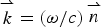 and the plasma electron current
 .
In laser filament that is strong damping for electron plasma wave, the laser ponderomotive force drives the charge separate and produces a dipole-like localized electron current in the wake of ionization front (Proulx et al., Reference Proulx, Talebpour, Petit and Chin2000). The radial component of laser ponderomotive force can be neglected relative to the longitudinal component (Sprangle et al., Reference Sprangle, Penano, Hafizi and Kapetanakos2004), so we just consider the longitudinal component. The other reason that we do not consider the radial component is that the driven electron current is circularly symmetric, so the radiation excited by radial component will be zero in the far zone. The natural oscillation of the longitudinal dipole moment P z can be described approximately by an oscillatory equation (Gildenburg & Vedenskii, Reference Gildenburg and Vedenskii2007; Golubev et al., Reference Golubev, Suvorov and Shalashov2004; Bystrov et al., Reference Bystrov, Vvedenskii and Gildenburg2005; Kostin & Vedenskii, 2006):

where νe = νen + νei is the electron collision frequency, νen is the electron neutral collision frequency, νei is the electron ion collision frequency, 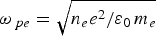 is the electron plasma frequency, and S z is the longitudinal component of the nonlinear driving term (Sprangle et al., Reference Sprangle, Penano, Hafizi and Kapetanakos2004). The calculation based on Eq. (1) is an approximate solution, which will be discussed in detail below.
The nonlinear driving term S z (ρ, z, t) is

Here, I L (ρ, z, t) is the intensity profile of the laser pulse. The effect of the temporal variation of the electron density to the ponderomotive force is neglected because it takes place only in the head of the laser pulse.
The laser pulse envelop keeps stable approximately in the entire laser filament. Making Fourier transform for Eq. (1) in the reference frame of the laser pulse t′ = t − (z/v p), that is ∂/∂t′ ~ −iω, one has

For a laser beam focused with conventional lenses, the phase velocity of laser pulse is v p = c/n ≈ c, n is the refractive index. For a laser beam focused with axicon lens, v p = c/cosθ0, θ0 is the focusing angle of the laser beam as shown in Figure 1.
The electron current of the dipole-like localized plasma wake wave is J z (t) = ∂P z (t)/∂t, there is J z (ω) = −iωP z (ω). So

Here, I L (ω, ρ) can be rewritten as I L (ρ)I L (ω, ρ = 0), where I L (ρ) is the transverse profile of the laser intensity, which determines the transverse profile of the localized electron current. So the electron current in Eq. (3) can be rewritten as J z (ω, ρ) = J(ρ)J(ω, ρ = 0), where


Then we have
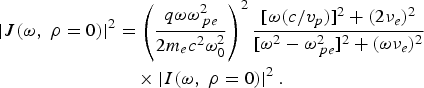
For the laser pulse profile I(τ) = I 0 exp (−4 ln 2τ2/τL2), there has
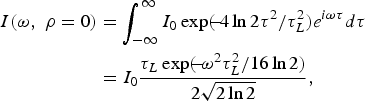
where τL is the duration of the laser pulse (full width at half maximum), and τ = t − (z/v p). Then, Eq. (6) can be written as:
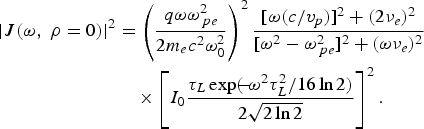
The same expression has been reported elsewhere base on electric field equation (D'Amico et al., Reference D'Amico, Houard, Franco, Prade, Mysyrowicz, Couairon and Tikhonchuk2007, Reference D'Amico, Houard, Akturk, Liu, Le Bloas, Franco, Prade, Couairon, Tikhonchuk and Mysyrowicz2008; Houard et al., Reference Houard, Liu, Mysyrowicz and Leriche2007; Liu et al., Reference Liu, Houard, Prade, Mysyrowicz, Diaw and Tikhonchuk2008). One should notice that the localized electron current in Eq. (7), which is also used in the other articles (D'Amico et al., Reference D'Amico, Houard, Franco, Prade, Mysyrowicz, Couairon and Tikhonchuk2007, Reference D'Amico, Houard, Akturk, Liu, Le Bloas, Franco, Prade, Couairon, Tikhonchuk and Mysyrowicz2008; Houard et al., Reference Houard, Liu, Mysyrowicz and Leriche2007; Liu et al., Reference Liu, Houard, Prade, Mysyrowicz, Diaw and Tikhonchuk2008), is not exactly the effective electron current that generates THz radiation. It is purely potential (electrostatic) and can not emit electromagnetic radiation for spatial uniform collision-free plasma with infinite size (Shvets et al., Reference Shvets, Kaganovich and Startsev2002; Cheng et al., Reference Cheng, Wright and Moloney2001, Reference Cheng, Wright and Moloney2002; Tikhonchuk, Reference Tikhonchuk2002). But in laser filament, the plasma is non-uniform, strongly collisional, and with finite size (transverse and longitudinal). The driven plasma electron current can generate electromagnetic radiation efficiently through gradient coupling (Sheng et al., Reference Sheng, Mima, Zhang and Sanuki2005a, Reference Sheng, Mima and Zhang2005b, Reference Sheng, Meyer-ter-Vehn and Pukhov1998; Field, Reference Field1956), tunneling effect (Cheng et al., Reference Cheng, Wright and Moloney2002; Wu et al., Reference Wu, Sheng and Zhang2008; Dong et al., Reference Dong, Sheng, Wu, Wang and Zhang2009), and collision induced rotational electron current ( ) (Hoyer et al., Reference Hoyer, Knorr, Moloney, Wright, Kira and Koch2005). Recent experimental results (D'Amico et al., Reference D'Amico, Houard, Franco, Prade, Mysyrowicz, Couairon and Tikhonchuk2007, Reference D'Amico, Houard, Akturk, Liu, Le Bloas, Franco, Prade, Couairon, Tikhonchuk and Mysyrowicz2008; Houard et al., Reference Houard, Liu, Mysyrowicz and Leriche2007; Liu et al., Reference Liu, Houard, Prade, Mysyrowicz, Diaw and Tikhonchuk2008) show that the expression in Eq. (7) can well characterize the spectrum and the amplitude of THz radiation emitted from laser filament in air that focused with conventional lenses. So we reserve the approximate expression for effective radiation electron current and do not seek the complicated exact solution since we here only focus on the influence of the speed of ionization front to electromagnetic radiation.
2.3. THz Radiation by Localized Electron Current Source Moving At Arbitrary Velocity
The spectral intensity of THz radiation emitted by moving dipole (Landau & Lifshitz, Reference Landau and Lifshitz1975) is given by

where

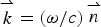 ,
 . We just consider the oscillation along the filament (J = J z). The localized electron current can be rewritten as
 , where
 is the transverse profile of localized electron current, J(ρ = 0, z, t) is the electron current at the center of filament, and there is
 . So,
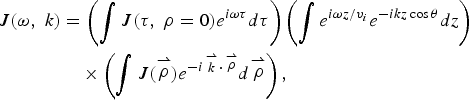
where τ = t − z/v i. Here, v i is the moving velocity of the dipole-like localized electron current, which is equal to the speed of ionization front.
In the laser filament, the localized plasma electron current only exists in the region (z 0, z 0 + L), where L is the length of the laser filament. So,

and
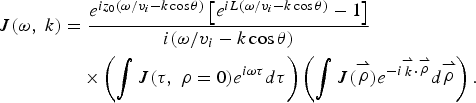
Then
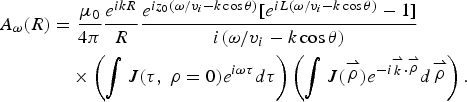
Therefore, the spectral intensity of the THz radiation can be rewritten as
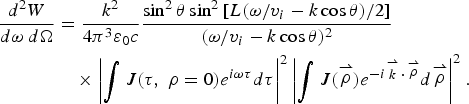
The expression of the THz radiation spectrum can be simplified as

where
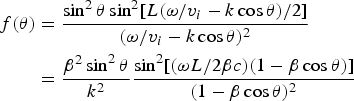
is the conventional transition-Cherenkov radiation term (Zheng et al., Reference Zheng, Yu, Zheng and Tanaka2005; Jelley, Reference Jelley1958), and β = v i /c.

is the dipole-like localized electron current term, which has been deduced in Eq. (7). The effect of the transverse profile of the localized electron current to the electromagnetic radiation is described by
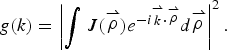
For simplicity, we suppose that the transverse intensity profile of the laser filament focused with the conventional lens and the axicon lens can be described approximately with the same Gauss function and do not consider the intensity oscillation along the focusing length (Akturk et al., Reference Akturk, Zhou, Franco, Couairon and Mysyrowicz2008; Polynkin et al., Reference Polynkin, Kolesik, Roberts, Faccio, Trapani and Moloney2008). That is,

Here, ρ0 is the half width of the laser focus spot (the radius of the filament). Then,
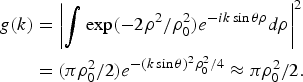
The total radiation spectrum in 4π solid angle is
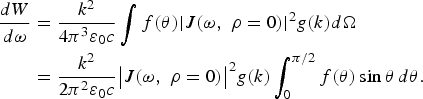
We introduce the notation I(a,b) as used by Zheng et al. (Reference Zheng, Yu, Zheng and Tanaka2005), which is defined as

The total radiation spectrum can then be rewritten as

For ωL/2βc >>1, I(ωL/2βc, β) can be expanded asymptotically as (Zheng et al., Reference Zheng, Yu, Zheng and Tanaka2005)
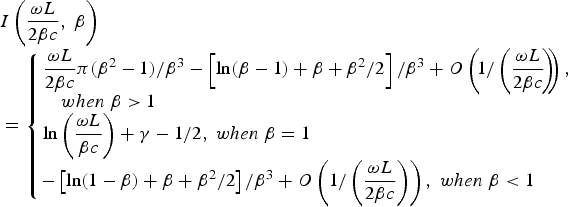
where γ = 0.577… is the Euler constant.
It's obvious that the radiation spectrum in Eq. (21) is the conventional Cherenkov radiation term (I(ωL/2βc, β)) modulated by the dipole-like localized electron current term (|J(ω, ρ = 0)|2). So the radiation spectrum of THz will display the character of the conventional Cherenkov radiation and the dipole-like localized electron current simultaneously. Here, we concentrate on the conventional Cherenkov radiation term, which can be altered by the speed of ionization front.
2.4. Numerical Results and Discussion
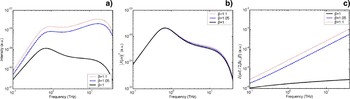
We take some characteristic parameters to calculate the radiation. The experiments show that the filament by using axicon lens has the same clamping laser intensity as that by using conventional lens (Akturk et al., Reference Akturk, Zhou, Franco, Couairon and Mysyrowicz2008; Polynkin et al., Reference Polynkin, Kolesik, Roberts, Faccio, Trapani and Moloney2008), so we do not consider the difference between the plasma parameters by using axicon lens (Akturk et al., Reference Akturk, Zhou, Franco, Couairon and Mysyrowicz2008; Polynkin et al., Reference Polynkin, Kolesik, Roberts, Faccio, Trapani and Moloney2008), and that by using conventional lens (Houard et al., Reference Houard, Liu, Mysyrowicz and Leriche2007). The filament length, electron density, electron plasma frequency, electron collision frequency, laser wavelength, laser pulse duration are L = 10cm, n e = 5.2 × 1015cm −3, ωpe = 0.65THz, νe = 0.9THz, λ0 = 800nm, τL = 200fs, respectively (Houard et al., Reference Houard, Liu, Mysyrowicz and Leriche2007). Figure 2 shows the spectrum of THz radiation calculated by using Eq. (7) and Eq. (21) that β = 1, 1.05, and 1.1. When β = 1, that is the case by using conventional lens, the radiation spectrum has a peak at the electron plasma frequency, which has been confirmed by experiments (D'Amico et al., Reference D'Amico, Houard, Franco, Prade, Mysyrowicz, Couairon and Tikhonchuk2007, Reference D'Amico, Houard, Akturk, Liu, Le Bloas, Franco, Prade, Couairon, Tikhonchuk and Mysyrowicz2008; Houard et al., Reference Houard, Liu, Mysyrowicz and Leriche2007; Liu et al., Reference Liu, Houard, Prade, Mysyrowicz, Diaw and Tikhonchuk2008). But when the ionization front exceeds the light speed slightly, the intensity of the radiation spectrum increases significantly. As shown in Figure 2a, when β increases from 1 to 1.05, the intensity of the spectrum at the plasma frequency increases by one order. Moreover, the radiation spectrum extends toward the higher frequency and covers the entire THz gap, which can be measured with broadband detection technique (Hu et al., Reference Hu, Lei, Shen, Li and Xu2009). Another peak appears at about 20THz besides the peak near the plasma frequency. As can be seen from Figures 2b and 2c, the peak near the plasma frequency is induced by the localized oscillation of plasma electron current quivering at the plasma frequency. The other peak at higher frequency is caused by the rapid increase of I(ωL/2βc, β) versus frequency when β > 1. The first term on the right-hand side of Eq. (22) is proportional to ωL/2βc when β > 1, which is the well-known Cherenkov radiation (Zheng et al., Reference Zheng, Yu, Zheng and Tanaka2005; Jelley, Reference Jelley1958). This rapid increase of the intensity at high frequency is an essential phenomena of Cherenkov radiation because the excitation of Cherenkov radiation has the same photon number at any frequency when β > 1. The higher frequency means the higher photon energy that induces the rapid increase of the radiation intensity versus frequency.
(Color online) (a) The THz radiation spectrum, (b) the localized electron current term of dipole oscillation |J(ω, ρ = 0)|2, and (c) the conventional Cherenkov radiation term I(ωL/2βc,β) versus the frequency when β = 1, 1.05, and 1.1.

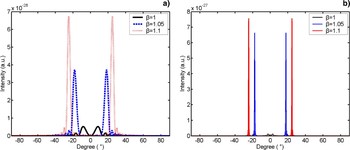
The THz radiation displays a hollow cone profile, as shown in Figure 3, including multiple lobes which are defined by the condition (ωL/2βc)(1 − βcosθ) = nπ + 0.5π, n is the integers. The strongest radiation lobe appears at the angle θmax = cos−1 [1/β − πc/ωL], at which n = 0. Most of the radiation energy locates in the strongest radiation lobe. The cone angle of the strongest radiation lobe (θmax) increases with the speed of ionization front (β) because the far-field THz electric field is the coherent superposition of the radiation electric fields emitted from different position of the laser filament. To keep the certain phase of coherent enhancement (
 must increase with β. The same reason induces the decrease of the divergence angle of the strongest radiation lobe with radiation frequency.
(Color online) The angular distribution of the THz radiation at ω = ωpe (a) and ω = 10ωpe (b) when β = 1, 1.05, and 1.1.

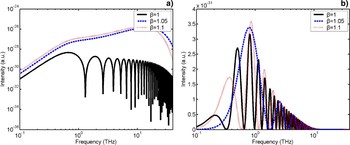
Figure 4 shows the radiation spectra at some given angles. The modulation of the spectrum is caused by the sinusoidal dependence of intensity with frequency in Eq. (13). When β > 1, the modulation period is very large, and it can not be shown in the finite frequency range of Figure 4a. The modulation can not be measured in experiment because the integral in a finite solid angle of the detector will erase the period structure. At 90° view angle (Fig. 4b), the radiation spectra have approximately the same intensity with various speeds of ionization front because the most sensitive factor 1/(1 − βcosθ)2 = 1 now, as can be seen in Eq. (15). Besides the super-luminous ionization front, very long laser plasma filament can be generated simultaneously by using axicon lens (Akturk et al., Reference Akturk, Zhou, Franco, Couairon and Mysyrowicz2008; Polynkin et al., Reference Polynkin, Kolesik, Roberts, Faccio, Trapani and Moloney2008). As seen from the asymptotic expansion of I(ωL/2βc, β) in Eq. (22), the intensity of the radiation spectrum is proportional to the length of laser filament L (the second term of the asymptotic expansion of I(ωL/2βc, β) can be neglected relative to the first term when β > 1). With the same input laser beam and using axicon as the focus lens, the length of laser filament can be easily extended by one order but keeps at the same clamping laser intensity (Akturk et al., Reference Akturk, Zhou, Franco, Couairon and Mysyrowicz2008; Polynkin et al., Reference Polynkin, Kolesik, Roberts, Faccio, Trapani and Moloney2008), which can further increase the THz radiation. But longer laser filament and faster super-luminous ionization front are incompatible unless with extending laser beam size. With a given laser beam size, there should be an optimum radiation intensity considering the length of laser filament and the speed of ionization front. The effect of self-absorption of THz radiation in gaseous medium will become significant when the laser filament becomes long enough, which will decrease the radiation intensity (Kim et al., Reference Kim, Taylor, Glownia and Rodriguez2008; Grichine, Reference Grichine2003). Applying longitudinal static electric field on the laser filament, which can enhance the localized plasma electron current, the terahertz radiation can be further amplified by some orders (Liu et al., Reference Liu, Houard, Prade, Mysyrowicz, Diaw and Tikhonchuk2008).
(Color online) The spectrum at the angle of strongest radiation lobe (a) (θmax for ω = ωpe, as shown in Fig. 3a), and (b) at the angle vertical to the laser filament (θ = 90°) when β = 1, 1.05, and 1.1.

Although the previous experiments using conventional lens (D'Amico et al., Reference D'Amico, Houard, Franco, Prade, Mysyrowicz, Couairon and Tikhonchuk2007, Reference D'Amico, Houard, Akturk, Liu, Le Bloas, Franco, Prade, Couairon, Tikhonchuk and Mysyrowicz2008; Houard et al., Reference Houard, Liu, Mysyrowicz and Leriche2007; Liu et al., Reference Liu, Houard, Prade, Mysyrowicz, Diaw and Tikhonchuk2008) confirm that the approximate solution for the effective radiation electron current in Eq. (7) is reasonable, the exact solution that considers the detailed radiation process (Sheng et al., Reference Sheng, Mima, Zhang and Sanuki2005a, Reference Sheng, Mima and Zhang2005b, Reference Sheng, Meyer-ter-Vehn and Pukhov1998; Field, Reference Field1956; Cheng et al., Reference Cheng, Wright and Moloney2002; Wu et al., Reference Wu, Sheng and Zhang2008; Dong et al., Reference Dong, Sheng, Wu, Wang and Zhang2009; Hoyer et al., Reference Hoyer, Knorr, Moloney, Wright, Kira and Koch2005) is still valuable, which can present more precise spectrum that possibly different to that in Figure 2a. Anyhow, the advantages of super-luminous ionization front that we concentrate on in this article will be preserved.
The laser filaments by using axicon lens possess some novel properties. First, the ionization front is super-luminous. This character has been used to enhance the conversion of electrostatic field to electromagnetic wave through exciting the natural wave of plasma in the scheme of applying direct-current bias to plasma for THz generation (Hashimshony et al., Reference Hashimshony, Zigler and Papadopoulos2001; Loffler et al., Reference Loffler, Jacob and Roskos2000, Reference Loffler and Roskos2002; Bystrov et al., Reference Bystrov, Vvedenskii and Gildenburg2005; Kostin & Vvedenskii, Reference Kostin and Vvedenskii2006). Second, the length of the laser filament by using axicon lens can be easily extended (Akturk et al., Reference Akturk, Zhou, Franco, Couairon and Mysyrowicz2008; Polynkin et al., Reference Polynkin, Kolesik, Roberts, Faccio, Trapani and Moloney2008). Moreover, the filament can be modulated artificially by placing grating before the axicon (Layer et al., Reference Layer, York, Antonsen, Varma, Chen, Leng and Milchberg2007). This character has been used to control or enhance terahertz radiation (Liu & Tripathi, Reference Liu and Tripathi2009a; Antonsen et al., Reference Antonsen, Palastro and Milberg2007; Golubev et al., Reference Golubev, Suvorov and Shalashov2004). Here, we use another character of the super-luminous ionization front generated by axicon lens. As can be seen from Eqs. (9) to (12), the radiation field in the far zone generated by moving dipole is the superposition of the radiation field emitted from different position of the laser filament. The temporal phase (the birth time of the dipole-like electron current at some position of the laser filament) and the spatial phase (the position of the dipole) determine the effect of coherent enhancement. The super-luminous ionization front can decrease the temporal phase difference of the radiation field emitted from the different position of laser filament, and enhances the THz radiation.
3. CONCLUSION
Super-luminous ionization front generated by using axicon lens is proposed to improve the maximum radiation intensity of THz emitted from a single laser filament through transition-Cherenkov radiation mechanism. The enhanced THz radiation attributes to the better coherent superposition of the radiation field emitted by the dipole-like electron current moving along the laser filament. Moreover, the radiation spectrum extends toward the high frequency and covers the entire THz gap. Very long plasma channel achieved simultaneously by using axicon lens can further increase the THz radiation.
ACKNOWLEDGMENTS
We acknowledge J. Zheng, Z.-M. Sheng, and M.-X. Jin for useful discussions. This work was supported by National Natural Science Foundation of China under Grant Nos. 10875158, 60921004, and 10775165, the Science and Technology Commission of Shanghai Municipality under Grant No. 08PJ14102, and National Basic Research Program of China (973 Program) under Grant No. 2006CB806000.