


Highlights
Prodromal non-motor symptoms are associated with neurodegenerative diseases (NDs).
Prodromal depression and confusion/delusional ideation are associated with dementia. Prodromal restless legs syndrome is associated with abnormal movements.
There is a 9.9 ± 12.2-year interval between the onset of non-motor symptoms and the development of NDs.
Introduction
Neurodegenerative diseases (NDs) are a heterogeneous group of pathologies whose main characteristic lies in the progressive and irreversible neuronal loss secondary to abnormal intracellular protein accumulation, mitochondrial alterations, synaptic transmission, autophagy and inflammation. Dementia, entities with movement disorders and motor neuron diseases are included within this spectrum.Reference Willson, Cookson, Den Bosch, Zetterberg and Holtzman1
Currently, the disease burden of ND has increased in recent decades.Reference Steinmetz, Seeher and Schiess2 It is estimated that by 2050, there will be 152.8 million people with dementia worldwide, surpassing the 57.4 million with dementia in 2019.3 This poses a challenge for health systems due to the increase in care costs, burden of care and the decrease in the quality of life of patients.
Parkinson’s disease (PD) is a neurodegenerative entity characterized by movement disorders; however, it is widely recognized that there are other signs and symptoms besides those caused by motor dysfunction. Non-motor symptoms (NMS) are a group of manifestations not related to bradykinesia, rigidity, tremor or gait/postural instability.Reference Tanner and Ostrem4 It has been described that 99.7% of subjects with PD demonstrate some NMS throughout the disease.Reference Rodriguez-Blazquez, Schrag, Rizos, Chudhuri, Martínez-Martín and Weintraub5 Given this, the NMS questionnaire for PD (NMSQuest) was developed by Chaudhuri et al.Reference Chaudhuri, Martínez Martin and Schapira6 in 2006 as a diagnostic support tool. The original questionnaire consists of 30 items and has been validated in different populations.Reference Rios Romenets, Wolfson and Galatas7
However, there are other NDs that exhibit NMS in the natural history of the disease. Conditions such as Alzheimer’s disease (AD),Reference Feng, Liu and Zhang8–Reference Bronner, Aharon-Peretz and Hassin-Baer14 frontotemporal dementia (FTD),Reference Morrow, Leousakos, Yan, Onyike and Kamath15 dementia with Lewy bodies (DLB),Reference Moscovich, Heinzel and Postuma16,Reference Isik, Kocyigit, Aydin and Soysal17 multiple system atrophy (MSA),Reference Moscovich, Heinzel and Postuma16,Reference Campese, Caliò and Leys18 progressive supranuclear palsy (PSP)Reference Moscovich, Heinzel and Postuma16,Reference Painous, Martí and Simonet19 and amyotrophic lateral sclerosis (ALS)Reference Shojaie, Rota, Al Khleifat, Chaudhuri and Al-Chalabi20 demonstrate NMS at some stage of the disease.
Prodromal diagnosis of ND is an area of constant research. With the advent of potentially disease-modifying therapies,Reference Beakelandt and Lobbestael21 the development of early diagnostic strategies that allow offering timely treatment is crucial. The detection of NMS in ND could be useful for the early diagnosis of these diseases, as occurs in PD.Reference Rodriguez-Blazquez, Schrag, Rizos, Chudhuri, Martínez-Martín and Weintraub5 At the moment, the diagnostic relevance of prodromal NMS in the rest of ND is unknown. This study aims to elucidate whether there is any association between prodromal NMS and ND.
We hypothesize that there is a prodromal association of non-motor symptomatology in ND. The primary objective of the study was to determine the prodromal association of NMS in adults with ND. The secondary objectives consisted of defining the mean age and gender distribution, describing the frequency, type of ND and NMS and determining the prodromal temporality of NMS in ND.
Material and methods
Study design
This was a retrospective cohort study. Subjects attending the Movement Disorders and Neurodegenerative Diseases Unit at Hospital Civil of Guadalajara “Fray Antonio Alcalde” were evaluated through a review of records of individuals evaluated between 2012 and January 2025.
Participants
Adults over 18 years of age who attended a diagnostic evaluation at the Unit, and completed the 30-item NMSQuest questionnaire (response of presence and temporality) during their initial consultation, were selected for the study, adding the item of “fatigue” as an additional NMS given its frequency in ND.Reference Carvalho, St. Louis and Boeve22,Reference Ashraf Hamad, Ehab Amer, Bushara Abbas, Zakria Alnajjar and Meshref23 Although the NMSQuest was originally developed for use in Parkinson’s disease, its design encompasses a broad range of non-motor symptoms across multiple systems.Reference Chaudhuri, Martínez Martin and Schapira6 This comprehensive structure may support its applicability in other NDs, particularly given the frequent overlap and co-pathology observed at the histopathological level of some of these conditions. Subjects with functional neurological disease or other clinical entities not relevant to the study were excluded, and those subjects with incomplete data in their records were eliminated.
Kish and Leslie’s infinite sample formula was used to estimate the sample size. Estimating a prevalence of 50% of depression (one of the most prevalent NMS) in subjects with PD, as reported by Cófreces et al.Reference Cófreces, Ofman, Estay and Hermida24 a confidence level of 95% and a maximum accepted estimation error (e) of 5% were considered. Considering a loss of 20%, a minimum of 461 subjects was estimated as necessary for the study.
Data analysis
Descriptive statistics (measures of central tendency and dispersion) and parametric inferential statistics were used based on Student’s t-test for independent samples and ANOVA. Odds ratio (OR) with 95% CI was calculated using binary logistic regression. A p-value of = < 0.05 was considered statistically significant. The IBM SPSS V27 statistical program was used.
Results
Description of the population
A total of 2,426 records of subjects attending the movement disorders and NDs unit at Hospital Civil de Guadalajara from 2012 to January 2025 were reviewed. Of these, 1,752 records were excluded, and 674 subjects were included in the study. Average age was 64.8 ± 12.6 years (age range 18–94). Female gender was 54.0% of the total (n = 364; see Table 1). NDs were classified into dementias, movement disorders and motor neuron disease, with a frequency of 22.1% (n = 149), 76.1% (n = 513) and 1.8% (n = 12), respectively.
Epidemiological characteristics of the population

Table 1 Long description
A table detailing the epidemiological characteristics of 674 subjects attending the movement disorders and neurodegenerative diseases unit. The table has 21 rows and 4 columns. Column headers are Subjects, n = 674, Mean age (SD), and Gender. Row 1: Subjects, n = 674, Mean age (SD), 64.8 years (12.6). Row 2: Gender, Female n (%), 364 (54 percent), Male n (%), 310 (46 percent). Row 3: Neurodegenerative Disease Category, n = 674, Dementias n (%), 149 (21.1 percent), Movement disorders n (%), 513 (76.1 percent), Motor Neuron Disease n (%), 12 (1.8 percent). Row 4: Specific Diagnosis by Category, n = 149, Cognitive impairment and Dementias, n = 149, Alzheimer's Dementia n (%), 60 (40.2 percent), Lewy Body Dementia n (%), 29 (19.4 percent), No Specify Dementia n (%), 20 (13.4 percent), Mild Cognitive Impairment n (%), 20 (13.4 percent), Frontotemporal Dementia n (%), 15 (10.1 percent), Primary Progressive Aphasia n (%), 3 (2 percent), Corticobasal Syndrome n (%), 1 (0.7 percent), Vascular Dementia n (%), 1 (0.7 percent). Row 5: Movement disorders, n = 513, Parkinsonism n (%), 337 (65.7 percent), Parkinson's Disease n (%), 44 (8.6 percent), Essential Tremor n (%), 41 (8 percent), Dystonic Head Tremor n (%), 17 (3.3 percent), Progressive Supranuclear Palsy n (%), 13 (2.5 percent), Huntington's Disease n (%), 12 (2.3 percent), Early-Onset Parkinsonism n (%), 12 (2.3 percent), Multiple System Atrophy n (%), 9 (1.8 percent), Dystonia n (%), 8 (1.6 percent), Hemifacial Spasm n (%), 6 (1.2 percent), Ataxia n (%), 6 (1.2 percent), Restless Legs Syndrome n (%), 4 (0.8 percent), Spastic Paraplegia n (%), 2 (0.4 percent), Corticobasal Syndrome n (%), 1 (0.2 percent). Row 6: Motor Neuron Disease, n = 12, Amyotrophic Lateral Sclerosis n (%), 11 (91.7 percent), Amyotrophic Lateral Sclerosis - Frontotemporal Dementia n (%), 1 (8.3 percent).
SD = Standard Deviation.
Gender distribution according to ND showed a difference (p = 0.01). In this way, female gender predominated in dementias (p = 0.03), without a statistically significant difference in movement disorders (p = 0.1) or motor neuron disease (p = 0.07). A difference was found between the mean age according to ND. Thus, those subjects with dementia were older and the individuals with motor neuron diseases were younger (69.8 ± 10.8 vs 62.0 ± 12.6, p < 0.001).
Diagnoses by category
Cognitive impairment and dementias
The most frequent types of cognitive impairment were Alzheimer’s dementia (AD), DLB, and unspecified dementia, with 40.2% (n = 60), 19.4% (n = 29) and 13.4% (n = 20), respectively.
Movement disorders
The most frequent movement disorders were parkinsonism, PD and essential tremor (ET), with 65.7% (n = 337), 8.6% (n = 44) and 8% (n = 41), respectively. In this sense, subjects presenting with parkinsonism depicting either typical motor/non-motor fluctuations or dyskinesias associated with dopaminergic therapy were catalogued as PD; otherwise, a diagnosis of parkinsonism was made.
Motor neuron disease
The main motor neuron diseases were ALS and ALS/FTD with 91.7% (n = 11) and 8.3% (n = 1), respectively (see Table 1).
Frequency of NMS in neurodegenerative diseases
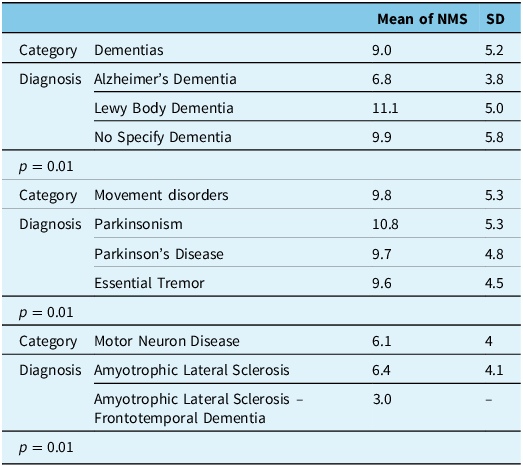
The most frequent NMS in this population were anxiety and insomnia, both with 49.6% (n = 334), followed by urinary urgency 48.5% (n = 327), constipation 47.3% (n = 319) and pain 42.7% (n = 288). The average number of NMS in dementia disorders was 9.0 ± 5.2, movement disorders with 9.8 ± 5.3 and motor neuron disease with 6.1 ± 4.0. DLB had a higher average of NMS compared to AD (11.1 ± 5.0 vs 6.8 ± 3.8). With respect to movement disorders, parkinsonism presented a higher average number of symptoms compared to ET (10.8 ± 5.3 vs 9.6 ± 4.5, see Table 2). There was a difference in age between subjects with NMS by disease category.
Mean number of non-motor symptoms by category and disease

Table 2 Long description
A table comparing the mean number of non-motor symptoms (NMS) across different categories and diagnoses. The table has 12 rows and 3 columns. The columns are labeled 'Category', 'Diagnosis', 'Mean of NMS', and 'SD'. The rows are grouped by categories: Dementias, Movement disorders, and Motor Neuron Disease. Each category lists specific diagnoses with their corresponding mean of NMS and standard deviation (SD). Notable trends include Lewy Body Dementia having the highest mean of NMS at 11.1 with an SD of 5.0, and Amyotrophic Lateral Sclerosis - Frontotemporal Dementia having the lowest mean of NMS at 3.0 with no SD provided. The p-value for each category is 0.01, indicating statistical significance.
Cognitive impairment and dementias
Among individuals with cognitive impairment, those reporting decreased libido were younger than those without this symptom (64.8 ± 9.5 vs. 71.6 ± 10.8 years; p < 0.001).
Movement disorders
Older age was observed in subjects with history of constipation (65.5 ± 16.7 vs 61.2 ± 13.4 years, p < 0.001), nocturia (65.5 ± 11.4 vs 62.1 ± 13.4 years, p = 0.004), falls (65.4 ± 13.2 vs 62.3 ± 62.7 years, p = 0.009), excessive daytime sleepiness (65.5 ± 12.0 vs 62.7 ± 12.9 years, p = 0.002) and confusion/delusional thoughts (68.2 ± 9.8 vs 63.2 ± 12.8 years, p = 0.04), compared to those who denied the symptom. Those presenting inattention (61.9 ± 13.1 vs 64.3 ± 12.5 years, p = 0.03), anxiety (62.3 ± 12.1 vs 64.7 ± 13.3 years, p = 0.003) and hyperhidrosis (60.8 ± 12.3 vs 64.0 ± 12.8 years, p = 0.004) had a lower mean age than asymptomatic subjects.
The NMS that were associated with the presence of ND globally were amnesic failures [OR 1.4 (1.2–7.7) p < 0.001] and depression [OR 1.7 (1.2–2.4) p < 0.001]. Male gender was associated with a higher probability of amnesic alterations [OR 2.0 (1.3–3.0) p = 0.001] in ND.
With respect to motor neuron diseases, it was not possible to perform a statistical analysis due to the reduced sample of subjects.
Frequency and time onset of prodromal NMS in neurodegenerative diseases
The most frequent prodromal NMS were depression, constipation, insomnia, anxiety and pain with 23% (n = 155), 19.4% (n = 131), 16.3% (n = 110), 14.7% (n = 99) and 13.9% (n = 94), respectively.
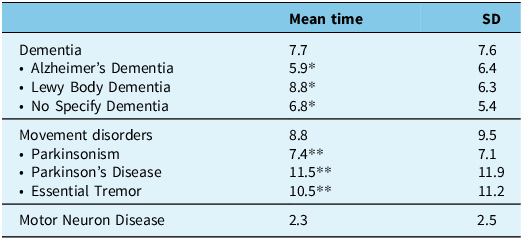
Average time onset of prodromal NMS in dementias was 7.7 ± 7.6 years. A statistically significant difference was found when comparing the times of onset of symptoms by specific disease (p = 0.027). Individuals with AD presented prodromal NMS 5.9 ± 6.4 years before diagnosis. While subjects with DLB showed NMS 8.8 ± 6.3 years before diagnosis, and when the type of dementia was not specified, symptoms took place 6.8 ± 5.4 years prior to diagnosis.
It was found that prodromal depression [OR 1.9 (1.1–3.5) p < 0.001] and confusion/delusional thoughts [OR 7.2 (1.3–39.2) p = 0.02] were associated with dementia. On the other hand, prodromal restless legs syndrome was associated with movement disorders [OR 3.3 (1.1–9.7) p = 0.02].
Regarding movement disorders, time onset of prodromal NMS took place 8.8 ± 9.5 years before diagnosis. Of these, subjects with PD presented NMS 11.5 ± 11.9 years prior to diagnosis, without a statistically significant difference when compared with individuals with ET and parkinsonism, who developed prodromal NMS 10.5 ± 11.2 and 7.4 ± 7.1 years prior to diagnosis, respectively (p = 0.2). Time onset of prodromal NMS in motor neuron diseases was 2.3 ± 2.5 years (see Table 3).
Mean time of onset in years of prodromal non-motor symptoms by category and disease

Table 3 Long description
A table comparing the mean time and standard deviation of onset of prodromal non-motor symptoms by disease category. The table has 3 columns and 7 rows. The columns are labeled 'Mean time', 'SD', and disease categories. The rows are labeled with specific diseases or conditions. Row 1: Dementia, Mean time 7.7, SD 7.6. Row 2: Alzheimer's Dementia, Mean time 5.9, SD 6.4. Row 3: Lewy Body Dementia, Mean time 8.8, SD 6.3. Row 4: No Specify Dementia, Mean time 6.8, SD 5.4. Row 5: Movement disorders, Mean time 8.8, SD 9.5. Row 6: Parkinsonism, Mean time 7.4, SD 7.1. Row 7: Parkinson's Disease, Mean time 11.5, SD 11.9. Row 8: Essential Tremor, Mean time 10.5, SD 11.2. Row 9: Motor Neuron Disease, Mean time 2.3, SD 2.5.
*p = 0.027. **p = 0.2.
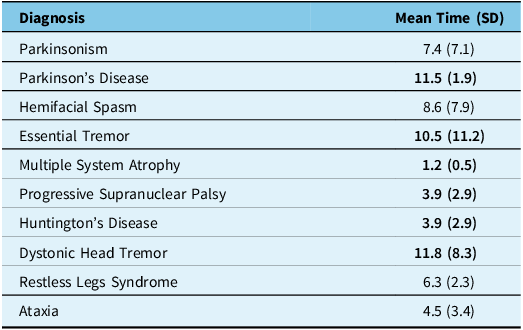
Despite not having a statistically significant difference with respect to the time of development of prodromal NMS in diseases with movement disorders, a subanalysis by specific disease evidenced that atypical parkinsonism (MSA and PSP) and Huntington’s disease (HD) present an average time of shorter onset compared to PD, other parkinsonisms and dystonic head tremor (see Table 4).
Mean time of onset in years of prodromal non-motor symptoms in movement disorders

Table 4 Long description
A table comparing the mean time of onset for prodromal non-motor symptoms in various movement disorders. The table has 2 columns and 10 rows. The columns are labeled 'Diagnosis' and 'Mean Time (SD)'. The rows are as follows: Row 1: Parkinsonism, 7.4 (7.1); Row 2: Parkinson's Disease, 11.5 (1.9); Row 3: Hemifacial Spasm, 8.6 (7.9); Row 4: Essential Tremor, 10.5 (11.2); Row 5: Multiple System Atrophy, 1.2 (0.5); Row 6: Progressive Supranuclear Palsy, 3.9 (2.9); Row 7: Huntington's Disease, 3.9 (2.9); Row 8: Dystonic Head Tremor, 11.8 (8.3); Row 9: Restless Legs Syndrome, 6.3 (2.3); Row 10: Ataxia, 4.5 (3.4).
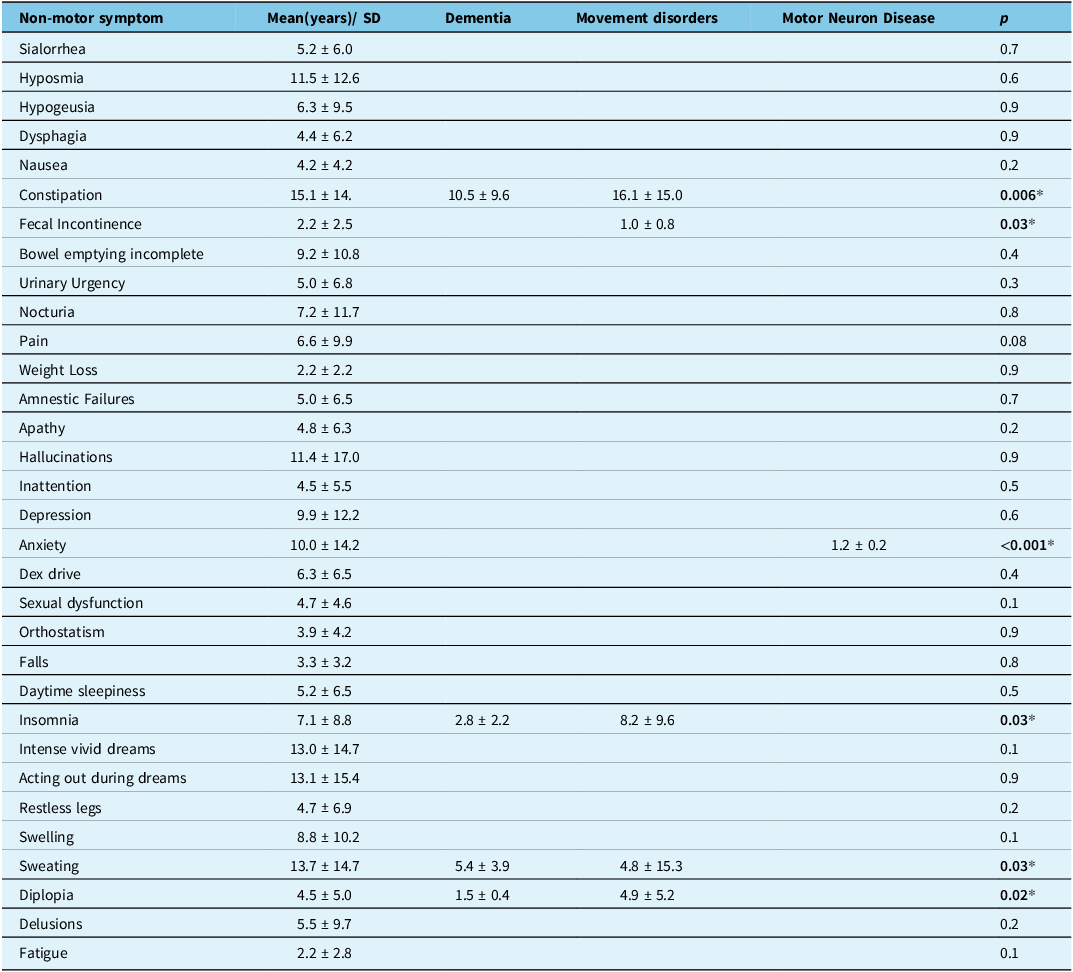
Constipation, hyperhidrosis, REM sleep behavior disorder, nightmares/vivid dreams and hyposmia were the prodromal NMS with a higher average time onset prior to the diagnosis of ND (15.1 ± 14; 13.7 ± 14.7; 13.1 ± 15.4; 13.0 ± 14.7; 11.5 ± 12.6 years, respectively). Nonetheless, symptoms with the shortest average time onset in a prodromal way were weight loss, fecal incontinence, fatigue, falls and orthostatism with 2.2 ± 2.2, 2.2 ± 2.5, 2.2 ± 2.8, 3.3 ± 3.2 and 3.9 ± 4.2 years, respectively.
Comparing time onset of prodromal NMS between the categories by type of ND, constipation (10.5 ± 9.6 vs 16.1 ± 15.0, p = 0.006), insomnia (2.8 ± 2.2 vs 8.2 ± 9.6, p = 0.03) and diplopia (1.5 ± 0.4 vs 4.9 ± 5.2 p = 0.02) showed a shorter average time onset in dementias with respect to movement disorders. In contrast, the average time onset of prodromal hyperhidrosis was shorter in movement disorders when compared with dementias (4.8 ± 15.3 vs 5.4 ± 3.9, p = 0.03). Finally, fecal incontinence in movement disorders and anxiety in motor neuron disease were observed 1.0 ± 0.8 (p = 0.03) and 1.2 ± 0.2 (p < 0.001) years before diagnosis with respect to the average time of presentation in other ND, respectively (see Table 5).
Overall mean time of prodromal onset of non-motor symptoms by disease category

Table 5 Long description
A table comparing the mean onset times of various non-motor symptoms across different disease categories, including Dementia, Movement disorders, and Motor Neuron Disease. The table has 33 rows and 6 columns. Column headers are Non-motor symptom, Mean(years)/SD, Dementia, Movement disorders, Motor Neuron Disease, and p. Row 1: Sialorrhea, 5.2 ± 6.0, , , , 0.7. Row 2: Hyposmia, 11.5 ± 12.6, , , , 0.6. Row 3: Hypogeusia, 6.3 ± 9.5, , , , 0.9. Row 4: Dysphagia, 4.4 ± 6.2, , , , 0.9. Row 5: Nausea, 4.2 ± 4.2, , , , 0.2. Row 6: Constipation, 15.1 ± 14, 10.5 ± 9.6, 16.1 ± 15.0, , 0.006*. Row 7: Fecal Incontinence, 2.2 ± 2.5, , 1.0 ± 0.8, , 0.03*. Row 8: Bowel emptying incomplete, 9.2 ± 10.8, , , , 0.4. Row 9: Urinary Urgency, 5.0 ± 6.8, , , , 0.3. Row 10: Nocturia, 7.2 ± 11.7, , , , 0.8. Row 11: Pain, 6.6 ± 9.9, , , , 0.08. Row 12: Weight Loss, 2.2 ± 2.2, , , , 0.9. Row 13: Amnestic Failures, 5.0 ± 6.5, , , , 0.7. Row 14: Apathy, 4.8 ± 6.3, , , , 0.2. Row 15: Hallucinations, 11.4 ± 17.0, , , , 0.9. Row 16: Inattention, 4.5 ± 5.5, , , , 0.5. Row 17: Depression, 9.9 ± 12.2, , , , 0.6. Row 18: Anxiety, 10.0 ± 14.2, , 1.2 ± 0.2, <0.001*. Row 19: Dex drive, 6.3 ± 6.5, , , , 0.4. Row 20: Sexual dysfunction, 4.7 ± 4.6, , , , 0.1. Row 21: Orthostatism, 3.9 ± 4.2, , , , 0.9. Row 22: Falls, 3.3 ± 3.2, , , , 0.8. Row 23: Daytime sleepiness, 5.2 ± 6.5, , , , 0.5. Row 24: Insomnia, 7.1 ± 8.8, 2.8 ± 2.2, 8.2 ± 9.6, , 0.03*. Row 25: Intense vivid dreams, 13.0 ± 14.7, , , , 0.1. Row 26: Acting out during dreams, 13.1 ± 15.4, , , , 0.9. Row 27: Restless legs, 4.7 ± 6.9, , , , 0.2. Row 28: Swelling, 8.8 ± 10.2, , , , 0.1. Row 29: Sweating, 13.7 ± 14.7, 5.4 ± 3.9, 4.8 ± 15.3, , 0.03*. Row 30: Diplopia, 4.5 ± 5.0, 1.5 ± 0.4, 4.9 ± 5.2, , 0.02*. Row 31: Delusions, 5.5 ± 9.7, , , , 0.2. Row 32: Fatigue, 2.2 ± 2.8, , , , 0.1.
Analyzed using one-way ANOVA.
Discussion
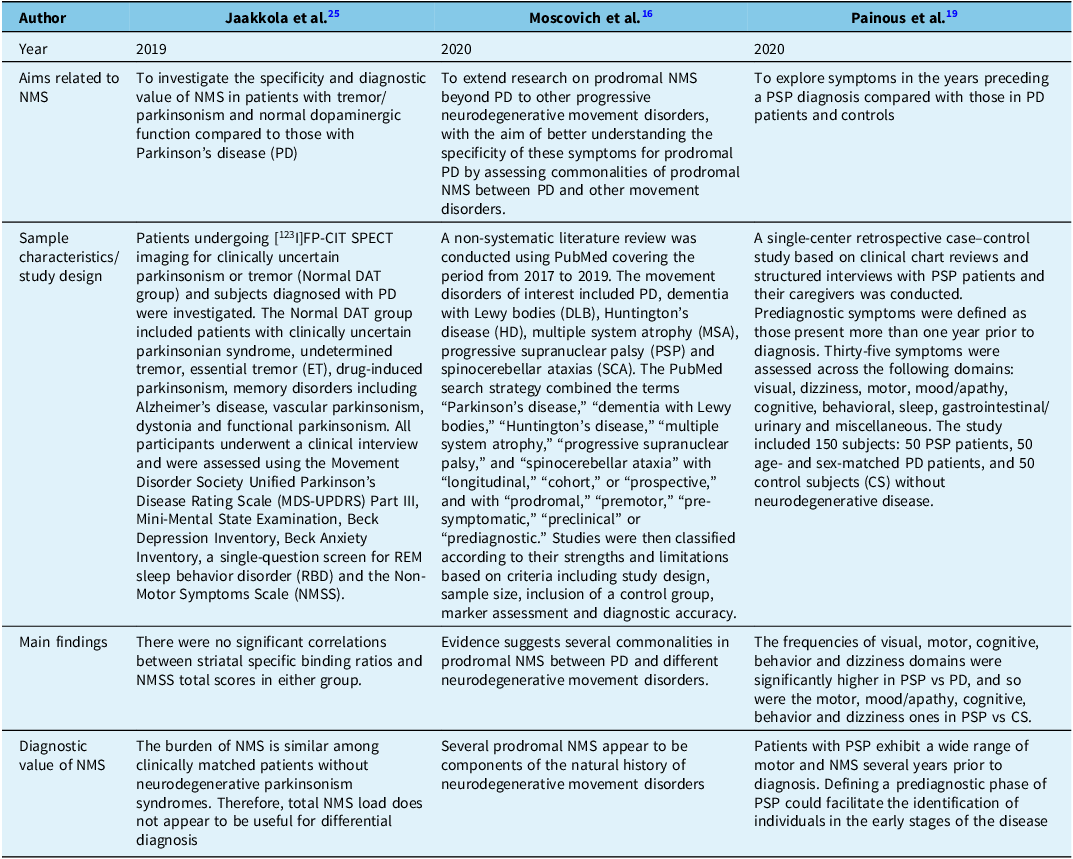
The study of prodromal NMS in ND remains a relatively underexplored area compared to other clinical domains, such as etiological and therapeutic aspects. Current evidence has yet to clarify the diagnostic utility of recognizing prodromal NMS as part of the early evaluation of ND. While studies such as those by Jaakkola et al.Reference Jaakkola, Joutsa and Mäkinen25 suggest that these symptoms may lack diagnostic specificity, other investigations, including those by Moscovich et al.Reference Moscovich, Heinzel and Postuma16 and Painous et al.Reference Painous, Martí and Simonet19, propose that prodromal NMS could play a meaningful role in the early identification of neurodegenerative movement disorders (see Table 6).
Assessment of non-motor symptoms in neurodegenerative disorders: diagnostic and clinical implications

Table 6 Long description
The table compares three studies on prodromal non-motor symptoms (NMS) in neurodegenerative disorders. It has four rows and three columns. The columns are labeled Author, Jaakkola et al., Moscovich et al., and Painous et al. The rows are labeled Year, Aims related to NMS, Sample characteristics/study design, Main findings, and Diagnostic value of NMS. Row 1: Year, 2019, 2020, 2020. Row 2: Aims related to NMS, To investigate the specificity and diagnostic value of NMS in patients with tremor/parkinsonism and normal dopaminergic function compared to those with Parkinson's disease (PD), To extend research on prodromal NMS beyond PD to other progressive neurodegenerative movement disorders, with the aim of better understanding the specificity of these symptoms for prodromal PD by assessing commonalities of prodromal NMS between PD and other movement disorders, To explore symptoms in the years preceding a PSP diagnosis compared with those in PD patients and controls. Row 3: Sample characteristics/study design, Patients undergoing [123I]FP-CIT SPECT imaging for clinically uncertain parkinsonism or tremor (Normal DAT group) and subjects diagnosed with PD were investigated. The Normal DAT group included patients with clinically uncertain parkinsonism syndrome, undetermined tremor, essential tremor (ET), drug-induced parkinsonism, memory disorders including Alzheimer's disease, vascular parkinsonism, dystonia and functional parkinsonism. All participants underwent a clinical interview and were assessed using the Movement Disorder Society Unified Parkinson's Disease Rating Scale (MDS-UPDRS) Part III, Mini-Mental State Examination, Beck Depression Inventory, Beck Anxiety Inventory, a single-question screen for REM sleep behavior disorder (RBD) and the Non-Motor Symptoms Scale (NMSS)., A non-systematic literature review was conducted using PubMed covering the period from 2017 to 2019. The movement disorders of interest included PD, dementia with Lewy bodies (DLB), Huntington's disease (HD), multiple system atrophy (MSA), progressive supranuclear palsy (PSP) and spinocerebellar ataxia (SCA). The PubMed search strategy combined the terms “Parkinson's disease,” “dementia with Lewy bodies,” “Huntington's disease,” “multiple system atrophy,” “progressive supranuclear palsy,” and “spinocerebellar ataxia” with “longitudinal,” “cohort,” or “prospective,” and with “prodromal,” “premotor,” “presymptomatic,” “preclinical,” or “prediagnostic.” Studies were then classified according to their strengths and limitations based on criteria including study design, sample size, inclusion of a control group, marker assessment and diagnostic accuracy., A single-center retrospective case–control study based on clinical chart reviews and structured interviews with PSP patients and their caregivers was conducted. Prediagnostic symptoms were defined as those present more than one year prior to diagnosis. Thirty-five symptoms were assessed across the following domains: visual, dizziness, motor, mood/apathy, cognitive, behavioral, sleep, gastrointestinal/urinary and miscellaneous. The study included 150 subjects: 50 PSP patients, 50 age- and sex-matched PD patients, and 50 control subjects (CS) without neurodegenerative disease. Row 4: Main findings, There were no significant correlations between striatal specific binding ratios and NMSS total scores in either group., Evidence suggests several commonalities in prodromal NMS between PD and different neurodegenerative movement disorders., The frequencies of visual, motor, cognitive, behavior and dizziness domains were significantly higher in PSP vs PD, and so were the motor, mood/apathy, cognitive, behavior and dizziness ones in PSP vs CS. Row 5: Diagnostic value of NMS, The burden of NMS is similar among clinically matched patients without neurodegenerative parkinsonism syndromes. Therefore, total NMS load does not appear to be useful for differential diagnosis., Several prodromal NMS appear to be components of the natural history of neurodegenerative movement disorders., Patients with PSP exhibit a wide range of motor and NMS several years prior to diagnosis. Defining a prediagnostic phase of PSP could facilitate the identification of individuals in the early stages of the disease.
Our findings suggest an association between some prodromal NMS and ND. Specifically, prodromal depression and confusion/delusional thoughts were significantly more prevalent in dementia disorders, while restless legs syndrome had a predictive value in movement disorders. In turn, the presence of amnestic failures and depression was associated with ND regardless of the time onset of symptoms.
Dementia disorders presented prodromal NMS 7.7 ± 7.6 years before diagnosis. It was found that subjects with AD, DLB and unspecified dementia demonstrated at least one NMS 5.9 ± 6.4 years, 8.8 ± 6.3 years and 6.8 ± 5.4 years before diagnosis, respectively, with this difference being significant (p = 0.027). Concerning movement disorders, the development of NMS took place 8.8 ± 9.5 years before diagnosis. However, there was no significant difference in the prodromal NMS time onset among movement disorders. As previously reported by Raj et al.Reference Raj, Beena and George26 and Painous et al.,Reference Painous, Martí and Simonet19 MSA and PSP show prodromal NMS about 3–6 years before diagnosis, whereas PD and dystonic head tremor present NMS much earlier (∼11 years); in ALS, prodromal NMS appear around 2.3 years before diagnosis.
Our results suggest that NMS have an early onset (up to 15 years prior) in ND, and that specifically the evidence of depression and delusional thoughts/confusion and restless legs syndrome should increase the clinical suspicion of a dementia or diseases with movement disorders, respectively. These results are consistent with what has been reported before in dementias. Neuropsychiatric changes in midlife are linked to later dementiaReference Livingston, Huntley and Liu27 and DLB,Reference McKeith, Ferman and Thomas28 but symptoms like hallucinations, depression and anxiety – though they may appear long before diagnosis – are often considered less clinically relevant than other cognitive or behavioral changes. Nevertheless, as highlighted by Stella et al.,Reference Stella, Radanovic, Balthazar, Canineu, de Souza and Forlenza29 these symptoms should be considered, especially when occurring after age 50.Reference Livingston, Huntley and Liu27,Reference McKeith, Ferman and Thomas28
Constipation, hyperhidrosis, REM sleep behavior disorder, nightmares/vivid dreams and hyposmia were the NMS with the earliest prodromal presentation in ND. On the other hand, weight loss, fecal incontinence, fatigue, falls and orthostatism demonstrated a later appearance in the prodromal stage of the disease. In the sub-analysis of the prodromal onset time by disease category, only constipation, insomnia and diplopia demonstrated a shorter evolution time in dementias compared to movement disorders. In contrast, when present, hyperhidrosis tended to have a shorter evolution time in movement disorders compared to dementias. Prodromal fecal incontinence and anxiety had a lower average evolution time before diagnosis in movement disorders and ALS, respectively. These results suggest that the development of certain NMS should alert the clinician to the possibility of an underlying ND in the individual exhibiting them, requiring closer monitoring or a timely referral to a NDs center. Systematic screening for prodromal NMS in individuals at high risk for ND should be implemented in routine clinical practice.
Despite the frequent report of NMS in other movement disorders such as spinocerebellar ataxias and dystonia, our study did not demonstrate a prodromal association between NMS and ataxiaReference De Silva, Makawita, Al-Sami, Aslanyan, Ananthavarathan and Malek30 or dystonia.Reference Peall, Kuiper, de Koning and Tijssen31
NMS impose a significant burden in ET,Reference Louis32 though further research is needed to confirm this. In our study, ET was common and showed a high frequency of NMS both before and after diagnosis; on average, subjects had 9.6 ± 4.5 NMS with prodromal onset about 10.5 years prior.
Despite not being originally designed for other ND, the NMSQuest questionnaire can be a useful, quick and easy-to-apply tool to detect promptly non-motor features during daily consultation and expand the clinical spectrum of ND.
Limitations
Our study has some limitations. The retrospective nature of the study along with a small number of subjects with specific entities included in the sample could represent a source of bias. Given the retrospective nature of the study, more than half of the subjects seen in the clinic had not completed the NMSQuest questionnaire, which limited data collection and results. This mainly affected the study of conditions such as ALS, ataxia, dystonia and atypical parkinsonism. Another limitation is the use of a questionnaire that has not been specifically validated for ND other than Parkinson’s disease. Nevertheless, the NMSQuest covers a wide range of non-motor symptoms across multiple systems (gastrointestinal, urinary, cardiovascular, neuropsychiatric, pain and miscellaneous), which supports its potential applicability to other neurodegenerative conditions – especially considering that co-pathology is often present among certain diseases. An additional source of potential bias is recall bias among study participants. In particular, considering that the questionnaire is administered to individuals potentially experiencing cognitive decline, the exact duration of symptom onset cannot be accurately determined in all cases. However, despite this, it was possible to obtain descriptive data on the number and time of presentation of prodromal NMS, as well as prodromal symptoms by disease category, which gives rise to future research with a specific focus on type of dementia, movement or motor neuron disorder and NMS. Prospective studies are needed to determine the association between prodromal NMS and ND.
Conclusion
In conclusion, an association may exist between prodromal NMS and ND. Prospective studies are warranted to further explore this relationship, as systematic screening for prodromal NMS in individuals at high risk for ND (e.g., those over 50 with late-onset neuropsychiatric symptoms or incipient parkinsonism) in routine clinical practice may help establish a timely diagnosis and facilitate earlier therapeutic intervention. Given the limited number of participants in conditions such as ALS, ataxia, dystonia and atypical parkinsonism, the findings related to these groups should be interpreted with caution.
Data availability
The datasets used and/or analysed during the current study are available from the corresponding author on reasonable request.
Authors’ contributions
1. Research Project: A: conception, B: organization, C: execution.
2. Statistical Analysis: A: design, B: execution, C: review and critique.
3. Writing: A: writing of the first draft, B: review and critique.
LVV: 1A, 1C, 2C, 3A, 3B
KCFM 1A, 1B, 2A, 2B, 3B
BDGR 1A, 1C
CZR 1B, 2A, 2C, 3B
Funding statement
This study was conducted without any financial support from public or private institutions.
Competing interests
None of the authors declares any conflict of interest.
Conflict of IA use
During the preparation of this work the author(s) used Perplexity.ai in order to translate the original paper. After using this tool/service, the author(s) reviewed and edited the content as needed and take(s) full responsibility for the content of the publication.
Ethical standards
The protocol was approved by the hospital ethics committee with local research record CEI 14/25, official letter no. HCG/FAACEI-142/25. The present study did not require informed consent, given its retrospective nature.




Target article
Prodromal Association of Non-Motor Symptomatology in Adults With Neurodegenerative Diseases
Related commentaries (2)
Reviewer Comment on Villa-Villegas et al. “Prodromal Association of Non-Motor Symptomatology in Adults with Neurodegenerative Diseases”
Reviewer Comment on Villa-Villegas et al. “Prodromal Association of Non-Motor Symptomatology in Adults with Neurodegenerative Diseases”