In October 1895, sisters Begum Jehan (age 24) and Vajir Jehan (age 16), Indian women dancers based in Bombay, travelled to England for contractual performances for six months. In November 1896, upon hearing about the respective death and disappearance of Begum and Vajir, Piaree Jehan, their grandmother and also a dancer herself, filed a petition to the Bombay police commissioner seeking redress.Footnote 1
This petition is a striking exception amongst hundreds of petitions submitted every year in the nineteenth-century Bombay Presidency. Particularly, Piaree’s petition represented, in Italian historian Edoardo Grandi’s formulation, the ‘exceptional normal’—an idiosyncratic document which revealed general trends on examination.Footnote 2 While petitioning emerged as a common phenomenon for Indians to negotiate with the colonial authorities in the second half of the nineteenth century, petitions from women, let alone women performers, from the Bombay Presidency remained negligible.Footnote 3 Moreover, Piaree’s petition seeking metropolitan legal intervention also differed from the Naikins, a prominent group of women performers from western India, whose appeals were mostly resolved locally.Footnote 4
Besides its exceptionality, Piaree’s petition also offers insights into the ‘normal’ or the larger historical, yet understudied, event of Indian women performers travelling abroad for performances—in response to the growing demands for ‘exotic’ Indian culture in the metropole in the second half of the nineteenth century.Footnote 5 The opening of the Suez Canal in 1869, easing travel between India and Europe, enabled greater participation of Indian performing women in imperial exhibitions, including the 1885 Liberty’s Fair, 1885–86 Portland Hall Exhibition, 1895–96 Empire of India and Ceylon Exhibition, and other private events.Footnote 6 Yet, as Begum Jehan and Vajir Jehan’s experiences convey, life on these Victorian entertainment circuits was precarious, especially as women performers from the colonies. They dealt with broken promises of lucrative salaries and foreign travel, fraudulent managers, governmental apathy, adverse climatic conditions, long overseas journeys, and unfamiliar and (sometimes) hostile audiences, which routinely made the everyday life of Indian women performers in imperial exhibitionary spaces challenging.Footnote 7
Circling in and around the tragic death and disappearance of Begum Jehan and Vajir Jehan, respectively, this article, therefore, provides glimpses of the trajectories of Indian women performers as they navigated the racialised and sexualised spectacle of imperial performance circuits of Victorian Britain. Through a close reading of Piaree’s petition and contemporary British newspaper reports, it writes a microhistory of Indian women performers’ experiences in the late nineteenth-century imperial circuits of performance. In this endeavour, the article makes three core interventions. First, it argues that the everyday precarity experienced by the Indian women performers was structurally embedded within the ‘politics of convenience’ of the empire—which discriminated against the performers, as distinctive from other South Asian travellers, along the intersecting axes of race, gender, and labour.Footnote 8 While the racialised and gendered politics of the empire is well-known, the article specifically examines the impact of such politics on mobile women performers from India—illuminating a new dimension to the understanding of empire’s intersection with gender, mobility, and performance. Second, it examines how the different representations of the sexuality of the Indian women performers—as respectively sinister and desirable—in the colony and the metropole contributed to their historical invisibility as skilled transcultural workers.
Finally, foregrounding Piaree’s strategic usage of legal and affective language in her argumentation, the article documents how Indian women performers asserted their agency and identity within the exploitative logics of imperial exhibitions. It shows how, as rights-bearing subjects of the British empire, the dancers challenged their hypersexualised portrayal in imperial discourses and reclaimed their identity as professional performers and skilled workers. By writing legal petitions, claiming unpaid wages for their labour, refusing inappropriate sexual offers, and forging kinship ties, they simultaneously exposed the exploitative logic of the imperial exhibitionary spaces while bringing the unacknowledged contributions of naachwalis to the fore of late nineteenth-century British stage histories.Footnote 9
The article places Piaree’s story in conversation with—and seeks to contribute to—the fields of empire studies, South Asian gender and labour mobilities, and performance histories. It borrows its central thematic from Antoinette Burton’s contention of empire being routinely troubled by the acts of the colonised. It builds on the works of Nadja Durbach, Loren Kruger, Adria Imada, Sadiah Qureshi, Saloni Mathur, and Prarthana Purkayastha, among others—who provide rich accounts of the individual and collective ‘trouble making’ of African, Hawaiian, and South Asian participants within imperial exhibitionary spaces.Footnote 10 While recent scholarship on South Asian mobilities in Britain too has focused on agentive acts of touring South Asians, mostly privileged by class, gender, and education, this article foregrounds the experiences of Indian women performers—who have been largely overlooked in the current studies—as transcultural workers in the metropole.Footnote 11
This article argues that, despite overlapping with other South Asian travellers in Britain, the experience of Indian women performers followed a different trajectory in the metropole—owing to their unique gendered social location and skills. Unlike other Indian participants—who were predominantly male—Indian dancing women, existing in quasi-matrilineal communities, led contractual negotiations, and determined the logistics of performance on their own.Footnote 12 The experience of Indian women performers also differed from the ayahs—the other prominent mobile group of women professionals in the metropole.Footnote 13 In contrast to the ayahs, the dancers’ sexuality engendered a unique contradiction in the imperial psyche. Given their financial independence, and their public and peripatetic lives as professional performers, Indian women dancers posed a considerable threat to the Indian government, leading to their criminalisation as ‘common prostitutes’ in the second half of the nineteenth century.Footnote 14 However, despite such defamation in India, Indian dancing women remained very much in demand in England till the very end of the nineteenth century.Footnote 15 Placing this contradiction at the very centre, this article offers a different history of sexuality plotted across the colony and the metropole.
The article also brings the unacknowledged aesthetic and embodied labour of Indian women performers to the fore of understanding labour and mobility histories of the nineteenth-century British entertainment industry. Instead of ‘erotic entertainers’, this article considers Indian women performers as transcultural aesthetic workers—earning their wage through performative labour on semi-formalised contracts in the metropole. Historiography on South Asian mobile labour networks has mostly focused on male-centric indentured, industrial, seafaring, and artisan labour across colonies.Footnote 16 Lately, Arunima Datta and Satyasikha Chakraborty redirect the emphasis to foreground the under-recognised contribution of the gendered domestic labour of Indian travelling ayahs in sustaining colonial families.Footnote 17 Unlike other South Asian migrants to the metropole—whose labour benefited the empire either materially or via the care economy—the Indian women performers did not generate direct material benefit for the imperial government. Instead, the dancers fulfilled a different kind of demand: the metropolitan desire to witness the exotic live—thereby visualising the embodied difference of civilisational hierarchy between the coloniser and the colonised. The aesthetic labour of the Indian women performers was utilised to ideologically legitimise the empire—a contribution conveniently elided in their hypersexualised representation as exotic entertainers rather than skilled contract-bound workers in imperial discourses.Footnote 18
The article’s framing of the naachwalis as transcultural aesthetic workers seeks to further democratise South Asian dance and performance historiography. As the ‘classical’ in South Asian dance forms became invented, institutionalised, and globalised through postcolonial nation-building and multicultural narratives, the embodied labour of nineteenth-century naachwalis was often erased or delegitimised.Footnote 19 As Sitara Thobani contends, these women fell through the cracks—unacknowledged by the colonial archives as well as the nationalist discourses that redefined tradition through a moralised and sanitised lens.Footnote 20 The article not only brings the unacknowledged contribution of travelling naachwalis to the fore but also provides fresh insights by contextualising their mobility in the shifting socio-cultural context of rising anti-dance sentiments in India. In doing so, the article offers a more textured and nuanced understanding of the entanglements between empire, gender, and performance.
Petitioning the archive: reading gendered histories
Petitions are neither random nor singular in their historical significance. In ‘Chandra’s death’, Ranajit Guha argues that traditional historiography, while focused on larger events and institutions, tends to obfuscate the everyday histories of people. A critical historiography, instead, bends ‘closer to the ground’ and maps the ‘traces of subaltern life’, especially when broader historiographical practices fail to do so. This article considers Piaree’s petition as providing such ‘traces of subaltern life’.Footnote 21 A close reading of such legal petitions enables a more granular view of the quotidian subversive acts of common people, as opposed to large-scale, theatrical contestations by exemplary individuals or groups—which exposed the contradictions of the empire.Footnote 22
Yet, how can one write histories of Indian women performers from this petition located in the colonial archive, famously known to elide subaltern histories? Ranging from the Subaltern Studies’ focus on reading the colonial archive ‘against the grain’Footnote 23 to Ann Stoler’s emphasis on unpacking the logic of the colonial archive by reading ‘along the grain’,Footnote 24 all grapple with the tension of understanding individual and collective subjectivities within the constraints of the colonial archive. Seeking evidentiary ‘facts’ in Piaree’s narrative, therefore, may be fulfilling a self-defeating prophecy, as we cannot know the exact experience of the Jehan sisters in England. Given that Piaree’s narrative was probably first narrated orally—as her thumb impression indicates her possible lack of (English) literacy—to a Dubash scribe (adept in both the local language and English) and then translated into English, it already permits multiple layers of erasures and misinterpretations.
Anjali Arondekar cautions against the historiographical practice of archival loss and recovery for minoritised histories of sexuality though—as the recuperative history, thus produced, upholds the voice of the historian at the cost of the marginalised. Instead of being characterised through erasure, Arondekar finds ‘abundance’ in the subaltern archives, especially when one redefines the parameters of acceptable historical evidence.Footnote 25 While Arondekar’s discussion mostly concerns the archives of the Maratha Gomantak Samaj—a caste-oppressed, devadasi diasporic community of western India—the analysis of Piaree’s petition, placed in the colonial archive, benefits from this framing of plenitude.Footnote 26 Instead of moving from a place of ‘lack’ (‘just one petition’, ‘not enough data’), the article considers Piaree’s petition to be bountiful enough to imagine an unfinished history of travelling women performers. Further, it does not seek veracity in Piaree’s claims about her granddaughters vis-à-vis W. H. Guest and the imperial officials. Instead, it explores the possibilities that such a petition (and its rebuttals) opens up for understanding the socio-political power structures that shaped the lives of Piaree, Begum, Vajir, and other women performers at home and in the world of the British empire.
The article also pushes back against the impulse of locating the agency of the travelling woman performer either in complete passivity on the one hand or in absolute resistance on the other.Footnote 27 Drawing on the literature foregrounding agency of individuals and groups in world fairs and relation to the British empire in general, this article interprets dancers’ agency as complex, fleeting, and situational.Footnote 28 It foregrounds dancers’ agency in the intentions behind and execution of everyday acts of lodging legal petitions, demanding wages, rejecting sexual advances, and forming emotional and kin-based solidarities. By doing so, it argues and shows that daily acts of subversion were no less effective or important than expressive forms of resistance, regardless of the inherently ephemeral and incomplete nature of these acts and their limited success.
Itineraries of precarity: Begum Jehan’s travels
On 15 May 1895, an English gentleman named W. H. Guest, resident of Shimla in British India, sought the ‘dancing performance’ of Begum Jehan, her minor sister Vajir Jehan, and three musicians named Abdul Aziz Rasoolbux, Husainbux Abdulla, and Gulam Husain Nabibux in England for six months.Footnote 29 As remuneration, Guest proposed to pay a sum of 800 rupees per month or ‘the equivalent thereof in English money’.Footnote 30 On 1 November 1895, Begum Jehan, her ‘paramour’ Syed Imam Hussain, Vajir Jehan, and three musicians arrived in London.Footnote 31 There they gave several private performances over the next two months. On 8 February 1896, they performed at the Free Trade Hall in Manchester. On 11 February 1896, W. H. Guest extended their contract for eight more months on the same salary and conveyed his intention of recruiting additional performers and musicians from India. In March 1896, Guest left with Syed Imam Hussain for India.Footnote 32
While W. H. Guest left with Syed Imam Hussain, Begum Jehan and her troupe were left stranded in Manchester without any financial support. In the absence of any communication from W. H. Guest, Begum Jehan and her associates were soon reduced to penury. Finding them in a condition of destitution, the Manchester police booked them a return ticket to London, where John Guest, W. H. Guest’s son, made arrangements for their food and accommodation.Footnote 33 Considering their precarious financial condition, Begum Jehan signed a new contract with a certain Glym James, who offered to pay them £5 a week for their performance on the Isle of Man in July 1896.Footnote 34 However, in the middle of the tour, Begum Jehan terminated her contract and returned to London since she was given the false information that W. H. Guest was finally arriving in London.Footnote 35
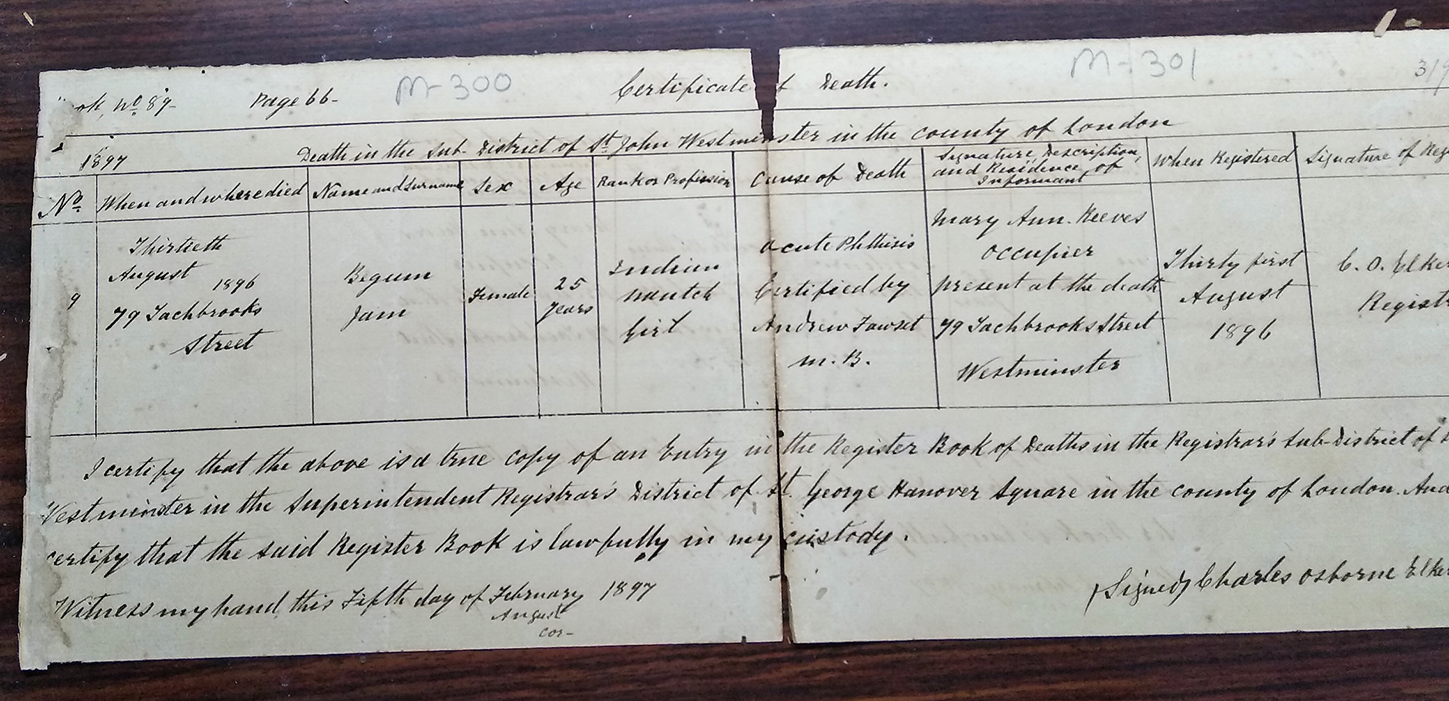
On her return to London, however, John Guest accommodated Begum Jehan and Vajir Jehan separately from the remaining two musicians, who sought refuge at the Strangers’ Home.Footnote 36 At the intervention of the superintendent of the Stranger’s Home, the musicians returned to India.Footnote 37 But John Guest objected to the sisters returning with the musicians, citing Begum Jehan’s inability ‘to bear the exertions of a voyage’.Footnote 38 On 30 August 1896, three days after the musicians departed, Begum Jehan died of acute phthisis (tuberculosis) (see Figure 1), leaving Vajir Jehan behind.
Death certificate of Begum Jehan. Source: Maharashtra State Archives, Mumbai.

Figure 1 Long description
The document is a historical record listing details of individuals. It includes columns for names, ages and causes of death. The text is handwritten, with specific entries for each individual. The document appears to be a formal record, possibly a death register, with additional notes written at the bottom. The handwriting is cursive and the document is laid out in a tabular format.
Politics of convenience: individual manoeuvrings, state complicity, and racial politics of non-intervention
Piaree’s detailed description of the doomed tour of Begum Jehan offers a glimpse into the lived realities of Indian women dancers navigating imperial performance circuits in Victorian Britain. Sadly enough, Begum Jehan’s experience was not exceptional. Several incidents of Indian performers getting stranded, duped, and assaulted were recorded in the second half of the nineteenth century. This article argues that much of the continued suffering of Indian performers in the imperial performance circuits was caused due to the ‘politics of convenience’ of the British government. By ‘politics of convenience’, more specifically, I imply the motives behind colonial policies and attitudes regarding Indian participants, including women performers, which shifted according to the economic, cultural, and political needs of the empire. A cursory glance at the catalogues of the Portland Hall Exhibition (1885–1886), the Empire of India and Ceylon Exhibition (1895–1896), and the Franco-British Exhibition (1908) demonstrates how Indian participants contributed significantly to generating economic profit and cultural mileage for both the British government and private individuals.Footnote 39 Yet, the government refused to build effective regulatory regimes to address several instances of exploitation, harassment, and fraud that the Indian participants experienced repeatedly in these imperial circuits of entertainment. Such reluctance of the government to safeguard the interests of the Indian participants laid bare the hypocritical politics of British liberal ideology, which, despite its tall claims of equality and fairness guaranteed to all British subjects, unequally discriminated against its colonised subjects.
The contradiction and opportunism of the ‘civilising’ mission of the British empire manifested time and again in the imperial exhibitionary spaces of the nineteenth century. On the occasion of the much-hyped 1885 Liberty’s Fair, for instance, the Lord Mayor of London expressed that ‘considering how important it was to bind Great Britain to her great Indian empire, guests … would create a good impression on their minds’.Footnote 40 In fact, the directors of the Albert Palace, where the Liberty’s Fair was scheduled to happen, wanted to ‘show what our Indian fellow-subjects were able to accomplish in the way of trade and manufacture, with a view of bringing about a better understanding and communication between the two nations’.Footnote 41 Instead of just entertainment, the objective of bringing this Indian troupe to London was, therefore, to strengthen imperial ties while also economically benefiting from the ‘show’.Footnote 42 Despite such lofty announcements, the Indian participants of the same Liberty’s Fair, including women performers, suffered because of the mismanagement and fraudulent behaviours of the organisers. The situation worsened so much that the performers finally sought and successfully wrested redress and compensation from the court of law.Footnote 43
Such duplicitous politics of the imperial government were an expression of the racialised nature of the display economy of imperial exhibits. Extensive scholarship on world fairs and expositions has shown how imperial exhibitionary spaces functioned within the ‘self’ and ‘other’ logic of orientalism.Footnote 44 Edward Said defined ‘orientalism’ as a Western tool of discrimination discursively produced through ‘domination, restructuring and authority’ to dominate the orient ‘politically, sociologically, militarily, ideologically, scientifically, and imaginatively during the post-Enlightenment period’.Footnote 45 By portraying the ‘exotic’ images of the ‘orient’ in the form of commodities, architecture, artworks, and the performing bodies of dancers, international exhibitions reified the ‘difference’ between the colonies and the metropole—by converting human beings into inert objects of consumption, shorn of basic human rights and dignity.Footnote 46
The imperial government in question here was not monolithic in character. Antoinette Burton, Frederick Cooper, and Ann Stoler describe empire as an essentially scattered entity—spread across multiple layers of bureaucracies, both in the metropole and the colony.Footnote 47 Moving forward with this understanding of the imperial fabric as essentially decentralised, the article uses ‘politics of convenience’ as an analytic to unpack the opportunistic politics of imperial exhibitionary spaces as implemented through and across three arms of empire: the showmen (W. H. Guest in Piaree’s case), British metropolitan authorities (Henry Moore, the police commissioner, London), and the British print media.Footnote 48
Showmen
The showmen or the exhibition managers like W. H. Guest played an important role in the functioning and promotion of the display economy of imperial exhibits. These showmen bridged the gap between the market demand for human variety and the supply of foreign people in late nineteenth and early twentieth-century Britain.Footnote 49 They capitalised on the existing desire to observe the ‘noble savage’ across London’s streets and among Britain’s elites and converted it into a profit-making business. But while the early nineteenth-century London culture of observing the different ‘other’, which constituted the urban poor, immigrants, and sex workers, did not allow breaching of physical distance between the observer and the observed, the ticketed ‘show’ format of the exhibits collapsed that boundary.Footnote 50 In the systematic display of human ‘difference’ in imperial exhibits in the second half of the nineteenth century, these showmen provided the unique opportunity to the audience to directly interact—both verbally and bodily—with the participants, especially those from the colonies, at only the price of a ticket.
Regardless of motivations—which ranged from entrepreneurial to philanthropic to evangelical to entertainment—impresarios were mostly driven by a profit mentality.Footnote 51 Since the showmen generally acted out of a profiteering incentive, they were hardly concerned with violations of human rights or poor working conditions of the performers.Footnote 52 As a result, it is not surprising that the celebrated Liberty’s Fair, which involved 40 craftsmen, including a mother–daughter pair of ‘nautch’ performers, recorded incidents of serious negligence towards the performers.Footnote 53 While the show flopped due to hostile weather and inept organisation, the poor conditions the performers endured became the talk of the town. Contemporary British newspapers reported how the performers ‘shivered’ during their acts.Footnote 54 Despite being promised safe travel, comfortable accommodation, four hours of working, London sightseeing, and salary profits, Liberty performers were ‘cruelly deceived’.Footnote 55 The organisers not only made them work longer hours but also did not provide adequate clothing for the winter months. Being unable to cope with such adverse circumstances, one of the troupe members also passed away.Footnote 56
In December 1885, a troupe of 44 Indian performers—who faced similar hostile working circumstances—arrived in London to perform at the Gaiety Theatre.Footnote 57 The organisers accommodated the entire troupe in a two-storey house with minimal furniture, located in a ‘dark, narrow passage’.Footnote 58 As a reporter of the Pall Mall Gazette noted, the performers seemed particularly ill-equipped for the London winter as they were becoming visibly uncomfortable in the new accommodation (‘rubbing their hands to get them warm’, ‘not being prepared for visitors’).Footnote 59 The lack of adequate heating arrangements along with limited living space for 40-plus performers in a narrow, dimly lit house shows, once again, how the show organisers subjected Indian performers to unfavourable circumstances in imperial exhibitionary spaces.Footnote 60
Governmental apathy and complicity
While the fraudulent behaviours of exhibit showmen, coupled with their unidirectional power over the lives of the performers, contributed to the precarity the performers experienced during the tour, governmental apathy made it worse. Government officials routinely refused to intervene even when instances of mistreatment were brought to the fore—signifying their complicity in furthering the exploitation of their colonial subjects. Even when government officials were not directly involved in recruiting Indian performers for small private shows, as in the case of Begum Jehan and her troupe, they continued to provide support to the individual agents, mostly British and European subjects, by not intervening in their problematic acts. Such examples of, as Arunima Datta would say, ‘performance of inertia’ can be recognised in Begum Jehan’s case too.Footnote 61
Following the approval of R. H. Vincent, the police commissioner of Bombay and secretary of the state for India, London police commissioner Henry Moore recorded W. H. Guest’s statement.Footnote 62 However, in his final report, Moore significantly toned down Guest’s narrative. In the original statement appended to the report, W. H. Guest had boldly refuted every allegation of Piaree Jehan and, instead, claimed to be a victim of a fraud himself—referring to the instance of Begum Jehan’s agreement with Glym James in July 1896. Further, he denied abandoning the troupe in Manchester and keeping the copies of the contract to himself.Footnote 63 Finally, he claimed that he personally arranged for the repatriation of Vajir Jehan with all her belongings and submitted a copy of her ticket.Footnote 64
In his report to the secretary of state, Moore seemed to suggest that whatever unfortunate circumstances the dancers faced were accidental and not anyone’s fault in particular. For instance, he highlighted how Guest was apologetic for the unfortunate experiences Begum Jehan and her troupe faced. In Moore’s words,
He (Guest) expressed regret for any neglect that had been caused Wazir Jehan or any other member of the troupe whilst he had been away; although he repudiates any liability after they broke the agreement in July last by engaging themselves to other showman [sic] … with whom they went to the Isle of Man.Footnote 65
Guest, however, made no such apologies in his statement and was, in fact, quite blunt in his response. In Moore’s version, Guest appeared to be a helpful person, flexibly accommodating the requirements of the troupe members. But in his statement, Guest begrudgingly exclaimed that ‘they (the dancers) cost more than they took in’—displaying his pecuniary attitude towards the performers, as opposed to what Moore was suggesting.Footnote 66
Moore’s covering up of Guest’s supposed negligence and toning down his dismissive attitude demonstrates British government officials’ complicity in the mistreatment of Indian performers in imperial exhibitionary spaces.Footnote 67 By prioritising the testimony of a European man over an Indian dancing woman, the officials acted as enablers of their racial discrimination in the hands of fraudulent managers. The indirect support from the state machinery through the conscious and deliberate acts of non-intervention encouraged agents like Guest to continue their trade without any repercussions. Guest’s statement seemed to be quite decisive in this case, as no other official inquiry was ordered after that. The presiding senior officer, Richmond Ritchie, stated, ‘Apparently the story is now complete’— implying the closure of the case.Footnote 68
Morality, selective sexualisation, and labour: the curious case of the Indian naachwalis
The ‘politics of convenience’ of the empire impacted the women performers in a specific gendered way. Unlike the ayahs’ circumstances of serving the private colonial home, the women performers functioned in the public sphere. While the travelling ayah’s sexuality was never a problem as her role as a caregiver and a nurturer conformed to the Victorian ideals of womanhood, the dancer’s non-normative sexuality went against the very basis of it. Indian women performers functioned in matrilineal communities, engaged in non-conjugal patron–client sexual relationships, travelled and publicly performed for money—none of which suited the ‘respectable’ parameters of nineteenth-century British society. This ‘deviant’ sexuality and lifestyle of Indian women made them equally desirable and threatening to the imperial order—across the colony and the metropole—though in differing degrees.Footnote 69 Unpacking those differences lays out the complex ways in which the scattered arms of the empire tried to comprehend, surveil, and exploit the dancing labour of Indian performing women in the late nineteenth century.
In the context of imperial exhibits, the British print media was instrumental in representing Indian women performers as erotic bodies to cater to the imperial fetish of the sexualised ‘other’. Their non-normative sexuality—and implied promiscuity—was exaggerated to make the performances more attractive to the audience.Footnote 70 Between the 1850s and late 1890s, British newspapers’ coverage of Indian ‘nautch dancing’ shifted from initial reviews on the performance to moral commentaries on the ‘illicit’ lifestyle of the performers.Footnote 71 In a sarcastic take on Indian women performers looking for ‘unobjectionable young men’ to marry in Madras, for instance, a reporter of Globe in 1894 contended how efforts at domesticating Indian dancers were futile as they would eventually be back to their ‘profession’ of courting multiple men.Footnote 72 Undoubtedly, such moralistic jibes regarding the non-normative lives of the dancers fitted well into the overall antagonistic ideas generated around dancers, especially in the wake of the implementation of the Contagious Diseases Act and the rise of the Anti-Nautch movement in India.Footnote 73
At the same time, as Littell’s Living Age in 1886 reported, the ‘Nautch girls from India now exhibited at two or three places of amusement in London’ constituted ‘one of the chief items of the Christmas bill of entertainment’—indicating the sustained interest in Indian dance performances in Victorian London.Footnote 74 Yet, the Indian woman performers’ unconventional sexuality—and not her dance—remained at the centre of these discussions. Either interpreted through the lens of the exotic or decried from the perspective of morality, her identity remained as an eroticised figure in most media representations—ready to allure the foreign audience with her (supposed) seductive charm and lascivious movements.
This projection of the dancer as an essentially eroticised body involved depersonalisation, whose adverse effects shaped the experiences of Begum Jehan, Vajir Jehan, and several other travelling women performers in the British metropole. In a rare interview of Indian dancers in the Pall Mall Gazette in 1885—the same year as the Liberty’s Fair debacle—the reporter, for instance, continuously described Indian dancers as ‘dark-skinned beauties’ and, without naming them, focused primarily on their physical features (‘jet-black hair’, ‘gazelle-like eyes’, ‘ivory teeth’).Footnote 75 Even when the reporter went on to narrate specifically about his encounter with another ‘dark sister, from the flowery East’, he did not mention her name and credentials. Interestingly, the omission of names of the dancers stood in sharp contrast to repeated mentions of the names of Dr Poole, the impresario, and Mr Nazir, the troupe organiser, in the report. Mentions of ‘nautch dancers’ without names continued in the advertisements for government-sponsored international exhibitions as well, including the first India and Ceylon Exhibition in 1898.Footnote 76
Sexual advances
I argue that such an endeavour of reducing the creative contributions of Indian women performers to an overtly sexualised spectacle increased the vulnerability of Indian dancers to predatory sexual advances in the exhibitionary circuits. The idea of the dancers having ‘loose morals’ encouraged the audience and the agents to misbehave with the performers. For instance, during the Liberty’s Fair, two primary dancers of the troupe were inappropriately touched during a scuffle with audience members.Footnote 77 As a particular episode in Piaree’s petition documents, Begum Jehan and her sister also became targets of such pervasive subtext of lascivious sexuality during their tour.
In July 1896, when the Jehan sisters returned from the aborted tour of the Isle of Man, John Guest accommodated them separately from the musicians. One of the musicians noted that around the same time, John Guest also started spending entire days at their residence. One day, John Guest expressed his interest in having Vajir Jehan as his mistress, which Begum Jehan immediately and sternly rejected.Footnote 78 Begum Jehan was ill when this incident happened and was under John Guest’s supervision.Footnote 79 Piaree alleged that John Guest’s ‘medicine’, which he insisted on administering himself, only worsened Begum Jehan’s condition, resulting in her death.Footnote 80 While summarising her allegations, Piaree hinted at the connection between John Guest’s ‘proposal’, its outcome, and the sudden death of Begum Jehan. She categorically wanted to investigate if John Guest had possibly poisoned Begum Jehan for her refusal to let Vajir Jehan be his mistress.Footnote 81 Regardless of the exact circumstances of Begum Jehan’s death and John Guest’s involvement in it, this incident points out how the perceived notions about the promiscuous sexuality of the Indian women performers placed them in unsafe situations, often leading to tragic circumstances, including death.
This depersonalisation and sexualisation was deliberate and was imbricated within the colonial capitalist logic of the imperial exhibitionary spaces. As Qureshi argues, ‘paying a shilling or more’ made the racial difference between the observer and the observed malleable.Footnote 82 Money enabled the collapsing of the boundaries of social conventions—which was absent in earlier observational practices of early nineteenth-century London. In exchange for tickets, the exhibitors offered urban Londoners the opportunity ‘to stare at, talk to, shake hands with’ and also touch the body parts of certain performers.Footnote 83 Unwanted touches and sexual advances, akin to John Guest, therefore, were hardly surprising.
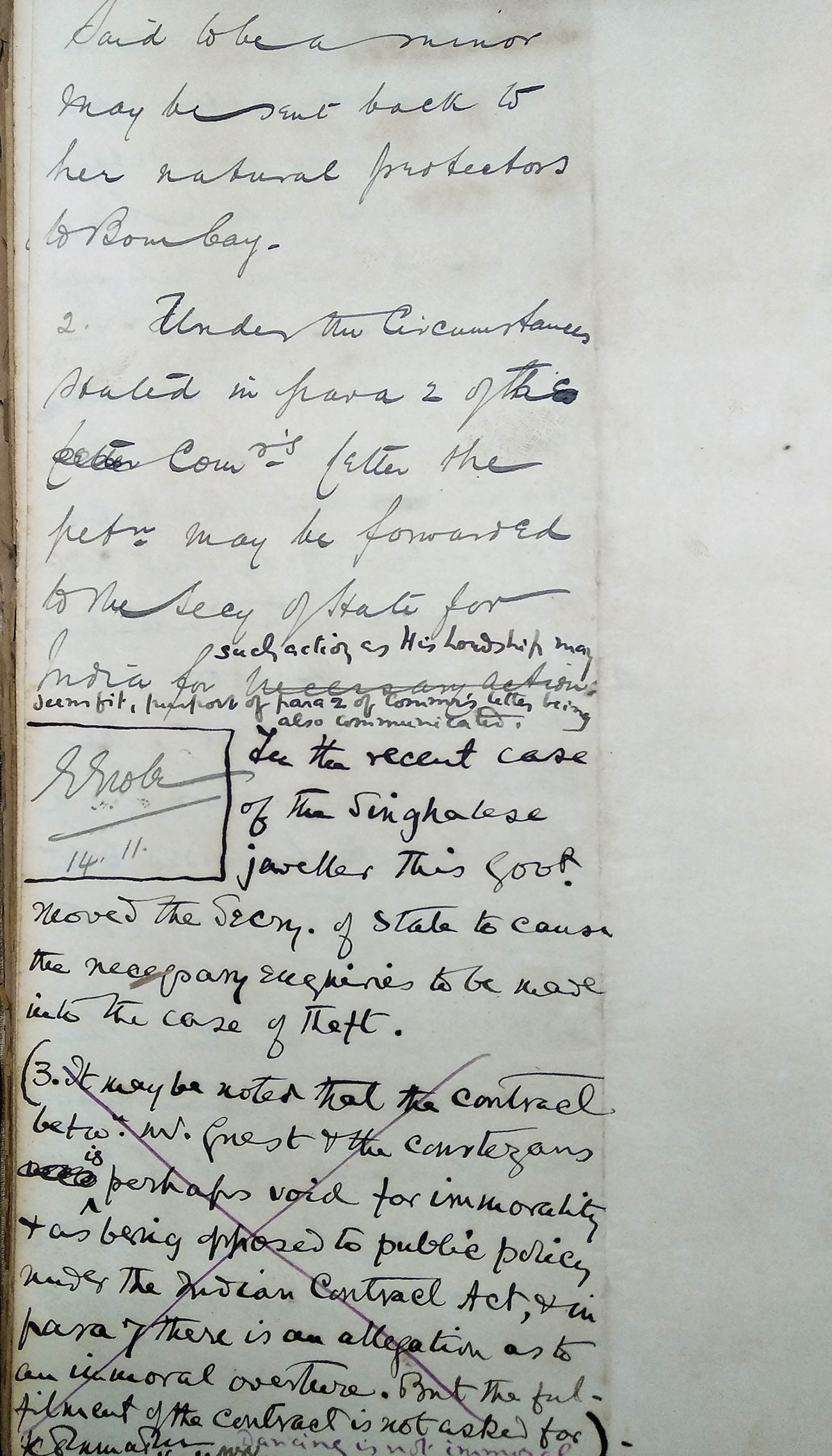
Such prejudicial views about the Indian women performers informed official discourses too. S. Nobb, the officer forwarding Piaree’s petition to the secretary of the state in India, for instance, was inclined to invalidate Piaree’s claims based on the supposed sexual promiscuity of Indian women performers and rule in favour of W. H. Guest. This happened despite the initial clearance issued by R. H. Vincent, the Bombay police commissioner, who found Piaree’s claims to be true.
In the crossed-out section (Figure 2), S. Nobb, writing from Bombay, added a paragraph, almost as an afterthought, stating that the contract between W. H. Guest and Begum Jehan (whom he addressed as ‘courtezans’—mostly synonymous with prostitutes at the time of the writing of this petition) could be dismissed on the grounds of immorality and for ‘being opposed to public policy under the Indian Contract Act’.Footnote 84 Nobb argued that since paragraph seven of Piaree’s petition hinted at immorality—pertaining to John Guest’s offer of having Vajir Jehan as his ‘keep’—this contract could very well be nullified.Footnote 85 But apparently, nobody appealed for the fulfilment of the Indian Contract Act. Interestingly, this paragraph was again crossed out by a different person or at a later date—given the difference in the ink colour—and a sentence stating ‘dancing is not immoral’ in pencil was added.Footnote 86
The crossed-out section of the official proceedings following the forwarding of Piaree’s petition to the secretary of the state. In the very last line, it is written that ‘dancing is not immoral’. Source: Maharashtra State Archives, Mumbai.

Figure 2 Long description
The document contains handwritten text discussing legal proceedings and public policy. It includes references to a minor returning to her protectors, circumstances under which letters may be forwarded and a recent case involving the vigilance of the state. There are annotations and notes in the margins, addressing issues of immorality and public policy opposition. The text is written in a formal style, with specific references to legal cases and actions required by the state.
Nobb’s line of argument about the dismissal of Begum Jehan’s contract on the grounds of immorality demonstrates how the premise of the inherently sexually promiscuous nature of Indian women dancers could be utilised in delegitimising their legal claims. It is important to note here how the ground for immorality was solely derived from the singular event of John Guest’s proposal to have Vajir Jehan as his mistress. Even though Begum Jehan sternly rejected the proposal, the implication of the charge of immorality still fell on the dancers, for the virtue (read, vice) of being ‘courtezans’.
If proven right, such implications could have served two purposes. First, grounds of immorality would have nullified the contract between Vajir Jehan and W. H. Guest. According to the Indian Contract Act, ‘immoral’ behaviours were against public policy, which could have made it impossible for Piaree to claim their dues of 8,000 rupees.Footnote 87 This, in turn, would have, once again, provided the justification for stereotyping Indian women dancers as sexually promiscuous—thereby, rendering their claims as false and justifying denying the wages of their labour. Only that, this time, it did not work out, as other officials declared that the act of dancing was not immoral. Second, portraying independent performing women as licentious would have legitimised John Guest’s advances as well as Guest’s narrative about dancers being inherently fraudulent and promiscuous and, therefore, unreliable.
Labour
Besides adversely impacting them on a day-to-day basis, the deliberate sexualisation of the Indian woman performer in both media and official discourses also effected the erasure of their identity as creative labourers. The colonial gaze—enabled through multiple arms of the empire—reduced the aesthetic and corporeal labour of dance to sexual role play. For instance, deliberate omission of names in newspaper reviews and promotional materials denied the reader and the audience any insight into their subjective locations as performers—like their place of origin, expertise in any particular dance form, communities they belonged to—all of which contributed to the formation of their identity as professional performers.Footnote 88 Focusing only on specific body parts of the woman performers in reviews generated scopophilic pleasure for the reader-audience and reduced the entire performative repertoire to just a sexualised spectacle.
But such emphasis on (hyper)sexuality decentres the labour and affective impact of dance that the body-as-a-whole—and not in parts—produces. The act of dancing is ultimately an act of labour. The production of a dance performance involves and requires intense bodily training of muscle tissues, neural and cognitive alignment, and shedding of sweat and (sometimes) blood. The neuromuscular labour that a dancing body entails over the years could neither be understood nor constrained within the exoticised oriental category of the hypersexual ‘nautch’ dancer.
The erasure of the identity of Indian women performers as labouring creative workers started with the non-recognition of their skilled work. In the context of the Liberty’s Fair exposition, Prarthana Purkayastha notes how the Illustrated London News relegated dancing to the domain of non-work, distinguishing them from the ‘workers’ who included artisans and craftsmen engaged in their respective ‘trades’.Footnote 89 A similar distinction can be discerned in the cataloguing of the General Department files on emigration at the Maharashtra State Archives, which categorised ‘jugglers’ and ‘dancers’ separately from the ‘artisans’. While the category of the ‘artisans’ was further distinguished from ‘labourers’ (in the sense of manual labour) or ‘emigrants’ in the catalogues, their contribution to the colonial economy was directly acknowledged and appreciated, unlike the dancers.Footnote 90
But cultural performance is neither separate nor epiphenomenal to materiality.Footnote 91 Building upon Raymond William’s critique of the neglect of traditional Marxist understanding of labour towards art-making, Priya Srinivasan proposes dance to be considered as a unique form of labour. She explains that the uniqueness of dance lies in the fact that the dance as a product cannot be separated from the means of its production.Footnote 92 The ‘dancing body’s very “liveness” and the display of its labour in performance’ produces dance as the product.Footnote 93 Even though the spectator is not trained to see the labour—visible through the sweat marks in the costumes and occasional spilt blood on stage—they remain its consumers.Footnote 94
Following Srinivasan, I, therefore, frame dance as a form of ‘productive labour’ which enables viewing Indian performing women as transcultural workers—performing and drawing wages on semi-formalised contracts within the economic logic of imperial exhibits.Footnote 95 It helps to restore, albeit partially, the erased contributions of Indian women performers in the British history of the imperial exhibits in late nineteenth and early twentieth-century Britain and India.Footnote 96 After all, Indian women performers contributed to the cultural economy of the empire in multiple ways. While not considered to be ‘productive’ enough for the colonial economy directly, the labour of the dancers, regardless, was utilised to perpetuate and promote the imperial ideology and ambitions in the metropole. One of the chief goals of imperial exhibits for Britain was to also showcase its acquisitions—thereby seeking justification and further encouragement for expanding its overseas empire. The display of the ‘nautch’ performer, along with the exhibition of arts and crafts from the colonies, provided an opportunity for the British government to advertise its colonial acquisitions and generate profit. At the same time, displaying them as commodities whetted the imperial appetite for the exotic while simultaneously legitimising the imperial ideology of racial superiority.
The politics of selective sexualisation
The hypersexualised depictions disregarded the creative contributions of the Indian women performers and undermined their identity as professional performers in the imperial economic circuits of exhibitions. Yet, the sexualised representation was carefully curated and only teased out to the extent that the British audience could digest. The sexual appeal of the Indian ‘nautch’ dancers was highlighted only to the level where it was able to generate interest and revenue and never stretched to the extent where people would be threatened by it and reject the shows altogether.
In the second half of the nineteenth century, the sexuality of the Indian woman performer was considered to be threatening enough to be punished with criminality in India. The implementation of the Indian Contagious Diseases Act (henceforth, Indian CD Act) in 1868 instituted the legal category of the ‘common prostitute’, which sought to criminalise all Indian women—outside the fold of heterosexual monogamous marriages—as potential sex workers.Footnote 97 British administrators especially feared that the public accessibility of the performing communities—who often travelled places in search of patronage—made them more available to British soldiers. The officers believed that such encounters were primarily responsible for the alarming rise of venereal diseases among European soldiers stationed across the subcontinent. In order to safeguard the health and interests of the empire, the category of the ‘common prostitute’, therefore, encompassed women performers too.Footnote 98 Evidently, in such a framework, the dancing body of the Indian woman performer was essentially sinister, disease-carrying, and criminal.
The supposedly ‘criminal’ side of the sexuality of the Indian woman performer, however, remained muted in the British media representations and advertisements. Not a single government-sponsored exhibition pamphlet—including ‘nautch’ performances and media advertisements till the last decades of the nineteenth century—mentioned the controversial association of Indian women dancers with prostitution and Indian dancers.Footnote 99 The sexuality of the travelling performer was, in this context, not sinister, despite the potential of occasionally breaching the moral boundaries of British society. How can one explain why the apprehension surrounding Indian women performers disappeared in the context of imperial exhibits in the metropole?
I suggest that such contradiction can, once again, be explained through the imperial government’s ‘politics of convenience’. The flavour of exoticism surrounding the dancing figure of the Indian ‘nautch’ performer arguably would have been marred by the spectre of venereal disease. Nadja Durbach, in her important work on nineteenth-century freak shows, notes how the managers cautiously made a distinction between ‘disabled’ and ‘diseased’ bodies.Footnote 100 Pathologising the disabled body on display, Durbach argues, would have undermined their market value.Footnote 101 Information about the ‘nautch’ performers’ association with sexual malaises could have generated similar apprehension among the audience, leading to the failure of such ‘shows’, primarily capitalising on the bodily encounters of the metropolitan audience with the colonial performer.
The sexuality of the Indian woman performer was, therefore, carefully curated and promoted only to a certain degree that was digestible to the metropolitan audiences. This explains, albeit in a roundabout way, why the same artistic identity of the Indian woman performer, which was relegated to the background in her criminalisation as a ‘common prostitute’ in India, was carefully curated and highlighted in the metropole to satiate the orientalist desires of the audience while also generating economic profit. Despite the contradiction in appearance, both sets of representations, therefore, collaborated and converged in expanding respective imperial agendas in the colony and the metropole—highlighting yet again the opportunistic and unique ways in which the imperial order treated the Indian women performers.
Reclaiming the narrative: Piaree’s argumentation
Despite the hostile circumstances, the dancers spoke back. Reading ‘against’ the official proceedings surrounding Piaree’s petition captures, albeit fleetingly, how Indian women dancers claimed spaces for themselves as well as participated in ‘everyday resistance’ that challenged colonial power through ‘small’ and overt acts.Footnote 102 Piaree’s petition, narrating the everyday lives of Begum Jehan and Vajir Jehan in late nineteenth-century Britain, contains several glimpses of such ‘everyday resistance’ to imperial power.
The very act of Piaree’s writing to the state demonstrates her sense of belongingness as a rights-owning subject of the British empire. Piaree’s utilising of the legal apparatus to address her grievances conveys that she was aware of her legal rights as well as the process of achieving them. It essentially stems from her simultaneous desire (of receiving justice as equal citizens) and discontent (for being routinely denied the same). In that sense, Piaree’s petition qualifies as what Julia Stephens would argue as ‘personal pleas’ to the colonial state for justice.Footnote 103 Stephens contends that visualising the state as an ‘imperial guardian’ was often a ploy of the poor to redress grievances and also breach the distance posed by the concept of an abstract state. While such personal pleas hardly succeeded, they fulfilled an ‘emotive’ function while exposing the contradictions embedded within the juridical structure of the empire. By forcing the government to pay attention to her problem, Piaree not only asserted her rights as a citizen of the British empire but also exposed, in the process, the hypocritical practices of the imperial government. It documented how, despite tall claims of liberalism and impartiality in front of the law, the British discriminated among its subjects along the lines of race, gender, and sexuality.
Piaree’s usage of the ‘emotive’ language of kinship, affect, and moral outrage was also strategic on multiple fronts. Drawing upon Arunima Datta’s method of foregrounding emotional language in examining the colonial archive, this section closely reads Piaree’s petition to restore the agency and humanity of the travelling women performers, albeit partially.Footnote 104 It builds upon Datta’s contention that the presence of emotions does not automatically negate rational strategising and can, in fact, coexist to make compelling arguments effective in generating favourable responses from the readers.Footnote 105 At the same time, employing emotions as a strategic narrative device for legal appeal does not mean that the performers did not experience those feelings. Rather, I suggest that both the emotional state of feeling and rational strategising informed Piaree’s articulation of her grievances and demands for justice.
Understanding the emotional stakes of Piaree’s petition is not difficult. Given that Piaree lost one of her granddaughters to death under mysterious circumstances while the other remained missing, feelings of grief, gross injustice and a sense of betrayal were normal. Moreover, Piaree’s relationship with her granddaughters was simultaneously familial and professional. The quasi-matrilineal structure of dancing communities enabled the transmission of artistic practices and property from the mother to the daughter. In such an equation, the mother (or the grandmother) was a parental figure, the mistress of the household, as well as the guru/teacher to the disciple-daughter. Piaree was not appealing as their kin (as a grandmother) only, but also as their teacher, seeking justice on the account of losing a family member as well as a disciple.
But Piaree refused to be a passive victim of grief alone. Piaree creatively deployed particular phrases, emotional expressions, and details to build a compelling narrative aimed at claiming justice for her granddaughters. Thematically, Piaree’s narrative sought to convey four distinct, but related, messages to the authorities: the unequal relationship of the performer and the manager, the helplessness and precarity of everyday life on tour, reclaiming agency over body and labour, and asserting the identity of professional creative workers.
Piaree’s narration instils a tone of foreboding in the very first paragraph when she mentions that the copy of the first contract between Begum Jehan and W. H. Guest remained ‘into the possession of the said Mr. W. H. Guest’ because of which she was ‘unable to annex a copy thereof hereto’.Footnote 106 Mention of this detail was deliberate as it informed the authorities about the power inequality existing between Begum Jehan and W. H. Guest. But Piaree complicated this picture further by bringing a gendered dimension too. Throughout her narration of events in the petition, Piaree, at least, mentioned thrice that Begum Jehan did not retain the copies of both contracts, despite being the leader of the troupe.Footnote 107 Instead, Syed Imam Hussain, Begum’s ‘paramour’, kept the copies. Piaree directly exposed the alliance between Imam Hussain and W. H. Guest when she stated how Imam Hussain ‘conspired’ with W. H. Guest and left the copy of the March 1896 contract with Guest, which Piaree ‘believes’ Guest destroyed at the earliest opportunity.Footnote 108 Since no written document existed, no accountability could be demanded from Guest henceforth—thereby making the situation of the Jehan sisters all the more dire. Through this nuanced portrayal, Piaree conveyed that the inequality did not exist only between Guest and Begum in matters of race, but also between Begum and Imam Hussain in matters of gender.Footnote 109 Piaree’s attention to detail highlights the dual discrimination—in terms of race and gender—and how the collusion of patriarchies, across race, contributed to the further marginalisation of Indian women performers in the imperial entertainment circuits. This lens of inequality also provided the authorities with a cue and framework for understanding the tragic events that followed afterwards.
Piaree’s skilful reconstruction of the precarious everyday circumstances of Begum Jehan and Vajir Jehan aimed at generating feelings of empathy among the authorities. She used the terms ‘being deserted’, ‘been exhausted’, and ‘unprovided for’ to express the emotional states of possible distress, anxiety, and fear of Begum Jehan and her troupe in Manchester.Footnote 110 The situation was so dire, Piaree emphasised, that they had to ‘pledge ornaments and clothes’ and ‘no assistance was sent to them either the [sic] said Mr. W. H. Guest or by said Sayed Imam Husain’.Footnote 111 Besides evoking empathy, highlighting the helpless situation of Begum Jehan also contextualised as well as legitimised her subsequent choice of signing a new contract with Glym James in July 1896. Piaree possibly anticipated that this step might be construed as a breach of contract—which Guest accused them of in his rebuttal—given their contract with Guest was yet to be over officially. Explaining Begum’s actions pre-emptively as a survival strategy, when no other alternative arrangements were available, would have addressed such a concern.Footnote 112
Piaree’s words were very much political in essence, crafted to reclaim space and assert the rights of her granddaughters. It is most evident in the closing section of the petition when Piaree offered a clear analytical summary of the events and firmly articulated her expectations from the colonial authorities. She flagged the conduct of W. H. Guest and John Guest as ‘suspicious’ on four counts: not leaving the original contract (May 1895) with Begum Jehan, abandoning the troupe in Manchester, resisting the return of the Jehan sisters, and preventing Begum Jehan from being admitted to a hospital.Footnote 113 Taken together, Piaree found these actions, along with Begum Jehan’s sudden death, to be evidently conspiratorial. Piaree alleged that these tragic circumstances were driven by Guest’s desire to avoid the payment ‘of a sum of Rs. 8000 due and owing to the said Begum Jehan under the aforesaid writing of the 15 May 1895’.Footnote 114 She also apprehended that if Vajir Jehan was not ‘immediately brought to India … she will either be illused by the said J. Guest or meet with the fate like that of her sister the said Begum Jehan’—communicating her concern and anxiety about her remaining granddaughter. Most importantly, Piaree even urged the authorities to exhume Begum Jehan’s body and analyse her viscera for poison—thereby making a direct accusation of murder against John Guest. These statements reveal her understanding of the imperial medical and legal system and her refusal to be silenced within it.
In framing her charges, Piaree centred Begum’s voice. She emphasised how Guest obtained the copies of the second contract (February 1896) from Imam Hussain ‘without the knowledge and consent of the said Begum Jehan’.Footnote 115 In doing so, Piaree foregrounded her granddaughter’s agency, reiterating that contractual agreements must rest on mutual benefit and informed consent—conditions absent in this case. Piaree also centres Begum’s agency when she mentioned categorically how Begum rejected John Guest’s proposal ‘with scorn’—thereby expressing her non-consent explicitly to such an arrangement.Footnote 116 Despite relying on John Guest for food, accommodation, and medical facilities in a foreign country, Begum firmly stood her ground. In no uncertain terms, Begum communicated their desire and right to be treated as professional performers—unavailable for casual sexual arrangements—even when offered in the guise of material support. By doing so, Begum Jehan (and Piaree by extension) reclaimed agency over their bodies and refuted the imperial perception of Indian women performers as perennially promiscuous. Begum Jehan’s standing up for Vajir Jehan, much like Piaree’s advocacy on behalf of her granddaughters, also shows how female-centric kinship emerged as a powerful tool for forging community, asserting identity, and resisting injustice. Kinship formed the bond across generations and provided strength in the face of danger.
Finally, Piaree’s claiming of dues on behalf of Begum Jehan—which both W. H. Guest and his son deprived them of—further affirmed their desire to be recognised as professional creative workers. In the final paragraph of the petition, Piaree sought compensation of 8,000 rupees, which remained unpaid to Begum Jehan.Footnote 117 Piaree’s claiming of dues by referring to the initial contract of May 1895 establishes that, irrespective of whether or not the Indian Contract Act or the organisers of international exhibitions considered dance as labour, Piaree and her granddaughters considered performance as skilled, contractual, and waged labour. While dancers, entertainers, and artists participating in the imperial exhibitionary spaces were not considered to be labourers for ‘hire’,Footnote 118 Piaree’s repeated claims of their dues demonstrate a different idea of their self and communitarian identity.Footnote 119 The sustained emphasis of Piaree on the professional identification of her granddaughters as creative workers refutes the racialised and sexualised stereotype of erotic entertainers and acknowledges the contribution of Indian women performers in nineteenth-century South Asian and British performance histories.
Piaree’s strategic ways of emotionally articulating her grievances were, to a certain extent, successful in generating sympathetic treatment from R. H. Vincent, the Bombay police commissioner. After initial investigations, Vincent found Piaree’s allegations to be true, and it was only at his behest that the case was forwarded to the London authorities via the Office of the Secretary of State for India. R. H. Vincent stood in sharp contrast to Henry Moore, the acting superintendent of London police, who was more inclined to believe W. H. Guest’s narrative than Piaree’s. Such moments of opposition across the different arms of the empire—as exposed through Piaree’s petition—point out the inconsistencies and fragility imbricated within the very structure of the empire.
Conclusion
This article examines Piaree’s petition to trace the often-overlooked trajectories of Indian women performers within the racialised and sexualised circuits of imperial entertainment circuits of late nineteenth-century Britain. It offers a critical reading of colonial petitions not for factual certainty but for the rich possibilities they open up in imagining subaltern subjectivity and historical agency, particularly for deviant and marginalised women whose lives straddled the limits of archival visibility. Performers like Piaree, Begum, and Vajir Jehan occupied a unique and precarious social location vis-à-vis the British empire, owing to their peripatetic and non-normative lives. They were simultaneously desired and vilified, hypersexualised as imperial spectacles while rendered invisible as skilled workers in Victorian entertainment spaces. Yet, far from being passive victims, these women performers actively negotiated the terms of their participation in the cultural economy of the empire—asserting their professional identity as skilled workers, demanding due compensation, and resisting exploitative practices through legal appeals, rejection of predatory advances, and building kinship solidarities. Piaree’s emergence as a rights-claiming subject, in this regard, charts a different trajectory of mobility for the Indian women performers—from powerlessness to agency.
In conceptualising Indian naachwalis as transcultural aesthetic workers, the article invites rethinking of South Asian mobile labour histories, which have often privileged agrarian, industrial, or male-dominated forms of work while overlooking the creative labour of Indian women performers. It challenges the dominant narratives of British entertainment and Indian nationalist histories, which disregard the professional and political presence of the unnamed Indian women performers—simultaneously sustaining and subverting the empire. Finally, it shows how the empire’s cultural regimes were frequently unsettled by the very subjects they sought to objectify—thereby marking the very limits of its control. The attempts of the women performers, however fraught or limited, make visible the creative dissent embedded in everyday acts of survival, artistry, and negotiations. In foregrounding such partial yet important histories from the margins of the colonial archive, the article contributes to the existing historical understanding of how the minoritised imperial subjects talked back to empire—not always through open defiance, but through quotidian assertions of rights, resilience, and professional identity, while moving in between the colony and the metropole.
Acknowledgements
I am deeply grateful to Sanchia DeSouza for leading me to Piaree’s petition, to Radha Kapuria, Jennifer Howes, and Shweta Sachdeva Jha for their painstaking efforts in curating this special issue, and to Jessica Hinchy, Judy Wu, Heidi Tinsman, and Antoinette Burton for their invaluable feedback on earlier drafts. I thank the editor Daud Ali and the anonymous reviewers for their useful suggestions, as well as Haimanti Mukhoti, Priyambada Sarkar, S. K. Ritadhi, and Maitreesh Ghatak for their insights. All remaining errors are my own.
Conflicts of interest
None.