Psychology and physiology
ASL was proposed from a psychological perspective to explain the “causes and consequences of imitation” (Heyes Reference Heyes2001). In contrast, the Hebbian Learning account was independently developed from a neurophysiological perspective to explain the emergence of mirror neurons. Single cell physiologists, Keysers and Perrett (Reference Keysers and Perrett2004), unaware of ASL, recorded neurons in the superior temporal sulcus (STS) and the premotor (PM) cortex. The unexpected similarity in the sensorimotor properties encountered in these two regions begged for a mechanistic explanation of how neurons acquire such action sensitive responses, and they harnessed a modern understanding of Hebbian Learning, based on the known physiology of Spike Timing Dependent Plasticity, to explain how such neuron sensitivities could be wired up, because, when you hear/see your actions or others imitate you, STS and PM neurons have the firing statistics to become interconnected (Keysers & Perrett Reference Keysers and Perrett2004).
Hebbian Learning is not simply contiguity
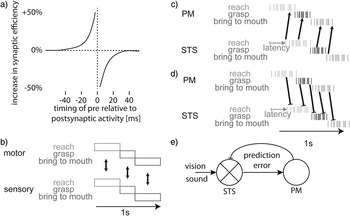
Cook et al. depict the Hebbian account of MN development as one of “contiguity,” that is, when neurons “fire together” (see target article, sect. 3.2, para. 3, point 3). However, this is not accurate. The Hebbian Learning account of mirror neurons draws on our contemporary understanding of Spike Timing Dependent Plasticity (Caporale & Dan Reference Caporale and Dan2008). Hebb (Reference Hebb1949) stated that synapses become stronger “when one cell repeatedly assists in firing another” (p. 63), emphasizing causality, and neuroscience shows synapses are potentiated if the presynaptic input precedes but not follows postsynaptic activity (Fig. 1a). Additionally, intermixing trials in which postsynaptic spiking occurs without presynaptic input prevents synaptic potentiation (Bauer et al. Reference Bauer, LeDoux and Nader2001). In summary, physiologists and neuromodellers (http://lcn.epfl.ch/~gerstner/SPNM/node70.html) understand Hebbian Learning to depend on contingency/causality, not simple contiguity. Cook et al.'s critique of Hebbian Learning in this and other articles is a misunderstanding of what physiologists and modellers understand it to mean. Ironically, the authors' new attempt to define ASL in neural terms – “The kind of learning that produces MNs occurs when there is correlated […] excitation of sensory neurons and motor neurons [… that] increases the strength of the connection between them […] when we observe our own actions” (sect. 3.2, para. 2) – is thus actually an adoption of a Hebbian Learning account of mirror neurons.
Figure 1.
(a) Temporal asymmetry in Hebbian Learning. (b) ASL predicts associations between corresponding phases of an action sequence. Hebbian Learning predicts associations between subsequent phases, that is, predictions (c), and utilizes inhibitory feedback (d) for prediction errors (e).
Hebbian Learning and ASL are not “synonyms”
According to Cook et al., the “canalization” hypothesis posits “Hebbing Learning” and “associative learning” as synonymous terms (sect. 8.1, para. 1). Again, this isn't accurate. ASL takes a holistic, systems perspective. When I reach for a peanut, grasp it, and bring it to my mouth, I have three separate episodes of correlated sensorimotor experiences. ASL predicts associations within action phases (Fig. 1b and their Fig. 1c and vertical connections in Heyes Reference Heyes2001). In contrast, Hebbian Learning takes the microscopic perspective of individual neurons and their spiking (Fig. 1c). STS neurons start firing ~100 msec after their favorite stimulus (Keysers et al. Reference Keysers, Xiao, Foldiak and Perrett2001), and hundreds of milliseconds lapse between PM spiking and overt movement (and even more before imitation by others); the assumption that sensory and motor representations are simultaneous is therefore an approximation (Keysers Reference Keysers2011) – STS activity occurs ~250 msec after PM activity for the same action (gray arrows in Fig. 1c). With synaptic plasticity temporally asymmetric (Fig. 1a and 1c), Hebbian Learning, unlike ASL, predicts that synaptic plasticity will also occur between action phases, connecting reach-STS to grasp-PM neurons, and grasp-STS to bring-to-mouth-PM neurons. Viewing reaching should then activate grasp-PM neurons. Predictive coding (Keysers Reference Keysers2011; Keysers & Perrett Reference Keysers and Perrett2004) and active inference (Friston et al. Reference Friston, Mattout and Kilner2011) are fascinating outcomes of Hebbian Learning. Indeed, predictive coding is apparent: Still images of reaching increase the excitability of muscles involved in grasping (Urgesi et al. Reference Urgesi, Maieron, Avenanti, Tidoni, Fabbro and Aglioti2010) and grasping mirror neurons respond to the sight of reaching behind an opaque screen (Umilta et al. Reference Umiltà, Kohler, Gallese, Fogassi, Fadiga, Keysers and Rizzolatti2001).
Connections from PM to STS also exist and have a net inhibitory influence. The Hebbian Learning account suggests the information flow from PM back to STS may cancel predicted sensory consequences and thereby compute action prediction errors (Fig. 1d) (Keysers & Perrett Reference Keysers and Perrett2004). Indeed, we showed that as people increasingly predict the gestures of others, the flow of activation indeed shifts from STS -> PM to PM -> STS (Schippers & Keysers Reference Schippers and Keysers2011).
Hence, unlike ASL, Hebbian Learning predicts the dynamic details of the neural circuitry that emerge during self-observation and imitation. The Hebbian Learning account matches modern theories of predictive coding or active inference (Fig. 1e). While ASL refers to sensory or motor representations, Hebbian Learning describes a flow of information between STS and PM with both coming to contain hybrid sensorimotor representations. This opens intriguing parallels with ideomotor theories (Hommel et al. Reference Hommel, Müsseler, Aschersleben and Prinz2001) (see also the commentary by Brass & Muhle-Karbe in this BBS issue).
ASL and Hebbian Learning are descriptions at different levels, and arguing that ASL accounts for mirror neurons better than Hebbian Learning seems as idle as arguing that psychology is better than neuroscience. Instead, asking how the circuitry-level predictions of contemporary Hebbian Learning relate to, implement, and inform the systems-level predictions of ASL are more fruitful approaches.
Finally, Cook et al. argue that MNs are not a social adaptation because domain-general mechanisms suffice to explain them – yet, parents' peculiar motivation to imitate their child's facial expressions, a domain-specific social behavior, is argued to be essential for, hence to canalize (Del Giudice et al. Reference Del Giudice, Manera and Keysers2009) mirror neurons. This social force merits more analysis before accepting the argument against hybrid models.





There is much to like about Cook et al.'s article. Asking how mirror neurons (MNs) emerge is indeed different from asking what MNs are good for. The authors' richness of stimuli argument is well made. Their experimental evidence shows that experience can have an effect on sensorimotor associations. Unfortunately, it also presents the Hebbian Learning account of MNs (Keysers Reference Keysers2011; Keysers & Perrett Reference Keysers and Perrett2004) as an inferior alternative to Associative Sequence Learning (ASL) based on contiguity alone. Here, we argue instead that Hebbian Learning and ASL represent different levels of description – neural and cognitive, respectively – by showing that (a) Hebbian Learning is sensitive to contingency and causality, and (b) Hebbian Learning generates valuable predictions about the neural properties of mirror neurons.
Psychology and physiology
ASL was proposed from a psychological perspective to explain the “causes and consequences of imitation” (Heyes Reference Heyes2001). In contrast, the Hebbian Learning account was independently developed from a neurophysiological perspective to explain the emergence of mirror neurons. Single cell physiologists, Keysers and Perrett (Reference Keysers and Perrett2004), unaware of ASL, recorded neurons in the superior temporal sulcus (STS) and the premotor (PM) cortex. The unexpected similarity in the sensorimotor properties encountered in these two regions begged for a mechanistic explanation of how neurons acquire such action sensitive responses, and they harnessed a modern understanding of Hebbian Learning, based on the known physiology of Spike Timing Dependent Plasticity, to explain how such neuron sensitivities could be wired up, because, when you hear/see your actions or others imitate you, STS and PM neurons have the firing statistics to become interconnected (Keysers & Perrett Reference Keysers and Perrett2004).
Hebbian Learning is not simply contiguity
Cook et al. depict the Hebbian account of MN development as one of “contiguity,” that is, when neurons “fire together” (see target article, sect. 3.2, para. 3, point 3). However, this is not accurate. The Hebbian Learning account of mirror neurons draws on our contemporary understanding of Spike Timing Dependent Plasticity (Caporale & Dan Reference Caporale and Dan2008). Hebb (Reference Hebb1949) stated that synapses become stronger “when one cell repeatedly assists in firing another” (p. 63), emphasizing causality, and neuroscience shows synapses are potentiated if the presynaptic input precedes but not follows postsynaptic activity (Fig. 1a). Additionally, intermixing trials in which postsynaptic spiking occurs without presynaptic input prevents synaptic potentiation (Bauer et al. Reference Bauer, LeDoux and Nader2001). In summary, physiologists and neuromodellers (http://lcn.epfl.ch/~gerstner/SPNM/node70.html) understand Hebbian Learning to depend on contingency/causality, not simple contiguity. Cook et al.'s critique of Hebbian Learning in this and other articles is a misunderstanding of what physiologists and modellers understand it to mean. Ironically, the authors' new attempt to define ASL in neural terms – “The kind of learning that produces MNs occurs when there is correlated […] excitation of sensory neurons and motor neurons [… that] increases the strength of the connection between them […] when we observe our own actions” (sect. 3.2, para. 2) – is thus actually an adoption of a Hebbian Learning account of mirror neurons.
(a) Temporal asymmetry in Hebbian Learning. (b) ASL predicts associations between corresponding phases of an action sequence. Hebbian Learning predicts associations between subsequent phases, that is, predictions (c), and utilizes inhibitory feedback (d) for prediction errors (e).
Hebbian Learning and ASL are not “synonyms”
According to Cook et al., the “canalization” hypothesis posits “Hebbing Learning” and “associative learning” as synonymous terms (sect. 8.1, para. 1). Again, this isn't accurate. ASL takes a holistic, systems perspective. When I reach for a peanut, grasp it, and bring it to my mouth, I have three separate episodes of correlated sensorimotor experiences. ASL predicts associations within action phases (Fig. 1b and their Fig. 1c and vertical connections in Heyes Reference Heyes2001). In contrast, Hebbian Learning takes the microscopic perspective of individual neurons and their spiking (Fig. 1c). STS neurons start firing ~100 msec after their favorite stimulus (Keysers et al. Reference Keysers, Xiao, Foldiak and Perrett2001), and hundreds of milliseconds lapse between PM spiking and overt movement (and even more before imitation by others); the assumption that sensory and motor representations are simultaneous is therefore an approximation (Keysers Reference Keysers2011) – STS activity occurs ~250 msec after PM activity for the same action (gray arrows in Fig. 1c). With synaptic plasticity temporally asymmetric (Fig. 1a and 1c), Hebbian Learning, unlike ASL, predicts that synaptic plasticity will also occur between action phases, connecting reach-STS to grasp-PM neurons, and grasp-STS to bring-to-mouth-PM neurons. Viewing reaching should then activate grasp-PM neurons. Predictive coding (Keysers Reference Keysers2011; Keysers & Perrett Reference Keysers and Perrett2004) and active inference (Friston et al. Reference Friston, Mattout and Kilner2011) are fascinating outcomes of Hebbian Learning. Indeed, predictive coding is apparent: Still images of reaching increase the excitability of muscles involved in grasping (Urgesi et al. Reference Urgesi, Maieron, Avenanti, Tidoni, Fabbro and Aglioti2010) and grasping mirror neurons respond to the sight of reaching behind an opaque screen (Umilta et al. Reference Umiltà, Kohler, Gallese, Fogassi, Fadiga, Keysers and Rizzolatti2001).
Connections from PM to STS also exist and have a net inhibitory influence. The Hebbian Learning account suggests the information flow from PM back to STS may cancel predicted sensory consequences and thereby compute action prediction errors (Fig. 1d) (Keysers & Perrett Reference Keysers and Perrett2004). Indeed, we showed that as people increasingly predict the gestures of others, the flow of activation indeed shifts from STS -> PM to PM -> STS (Schippers & Keysers Reference Schippers and Keysers2011).
Hence, unlike ASL, Hebbian Learning predicts the dynamic details of the neural circuitry that emerge during self-observation and imitation. The Hebbian Learning account matches modern theories of predictive coding or active inference (Fig. 1e). While ASL refers to sensory or motor representations, Hebbian Learning describes a flow of information between STS and PM with both coming to contain hybrid sensorimotor representations. This opens intriguing parallels with ideomotor theories (Hommel et al. Reference Hommel, Müsseler, Aschersleben and Prinz2001) (see also the commentary by Brass & Muhle-Karbe in this BBS issue).
ASL and Hebbian Learning are descriptions at different levels, and arguing that ASL accounts for mirror neurons better than Hebbian Learning seems as idle as arguing that psychology is better than neuroscience. Instead, asking how the circuitry-level predictions of contemporary Hebbian Learning relate to, implement, and inform the systems-level predictions of ASL are more fruitful approaches.
Finally, Cook et al. argue that MNs are not a social adaptation because domain-general mechanisms suffice to explain them – yet, parents' peculiar motivation to imitate their child's facial expressions, a domain-specific social behavior, is argued to be essential for, hence to canalize (Del Giudice et al. Reference Del Giudice, Manera and Keysers2009) mirror neurons. This social force merits more analysis before accepting the argument against hybrid models.