Introduction
Hong Kong's African population has grown in recent years (Amoah, Koduah, Anaduaka, Addae, Gwenzi, & Amankwaa Reference Amoah, Koduah, Anaduaka, Addae, Gwenzi and Amankwaa2020:542; Chow-Quesada & Tesfaye Reference Chow-Quesada and Tesfaye2020:384). Though there are no official data, an estimated 3,000 Africans from thirty African countries (Shum Reference Shum2020:284), including Ghana, Kenya, and Nigeria, reside in Hong Kong. This population is mainly engaged in education or trade, or they are asylum-seekers (Bertoncello & Bredeloup Reference Bertoncello and Bredeloup2007:94–105; Bodomo Reference Bodomo2012:151–84; Yu & Kwan Reference Yu and Kwan2015:66–83). Studies examining Africans’ social exclusion experiences show that their lives in Hong Kong are plagued with adversity (Wong, Cheung, Miu, Chen, Loper, & Holroyd Reference Wong, Sealing, Hai Miu, Julie, Loper; and Holroyd2017:1–9; Amoah et al. Reference Amoah, Koduah, Anaduaka, Addae, Gwenzi and Amankwaa2020:542–59; Bodomo Reference Bodomo2020:151–84). Socially, Africans in Hong Kong are often confronted with discrimination in daily interactions and face various social constraints in housing, social networks, and employment (Bodomo Reference Bodomo2012; Zheng & Leung Reference Zheng and Leung2018; Amoah et al. Reference Amoah, Koduah, Anaduaka, Addae, Gwenzi and Amankwaa2020:542–59). Psychologically, identity confusion, perceived discrimination, poor relationships with locals, lack of family and social support, and their status as asylum-seekers and refugees trigger psychological distress and depression (Wong et al. Reference Wong, Sealing, Hai Miu, Julie, Loper; and Holroyd2017:1–9; Amoah et al. Reference Amoah, Koduah, Anaduaka, Addae, Gwenzi and Amankwaa2020:542–59). Discursively, representations of blackness in Hong Kong media, where Africans are discursively constructed as criminals, inferior others, disease carriers, evil, and needy aid recipients, reinforce the socially and culturally embedded misperception of Africans that partly constitutes social exclusion (Saavedra Reference Saavedra2009:760–76; Siu Reference Siu2015:1–11; Chow-Quesada & Tesfaye Reference Chow-Quesada and Tesfaye2020:384–406). Together, the studies listed above have indicated the adverse situations that many Africans in Hong Kong are in, and these need to be addressed to improve their well-being.
However, the former studies have not adequately investigated the role of language in the social exclusion process. Language constitutes a major problem during immigration. To list but a few, as language functions as a link enabling humans to coordinate in collective human activity, an individual lacking the necessary linguistic competence may be easily excluded or condemned to silence (Bourdieu Reference Bourdieu1991; Piller Reference Piller, Martin-Jones, Blackledge and Creese2012:282–86). Moreover, language indexes identity (De Fina, Schiffrin, & Bamberg Reference De Fina, Schiffrin and Bamberg2006:1–23), and the heard ‘otherness’ may induce prejudice toward immigrants (Fu Reference Fu2021). As such, language plays a vital role in the social exclusion process. An expanded knowledge of how African immigrants are linguistically excluded in Hong Kong society is thus required to deepen our understanding of the nuanced mechanism of social exclusion in Hong Kong, further enriching our knowledge of Hong Kong's current social fabric.
Distinct from previous studies, this study investigates the bidirectional nature of social exclusion represented by Africans’ social exclusion experiences through the lens of language. Specifically, it focuses on African economic and student migrants in Hong Kong. Admittedly, African asylum seekers are more susceptible to social exclusion, given the low allowance they receive from the government and the prohibition that prevents them from working (Loper Reference Loper, Francis and Maguire2013:75–93). However, it is still important to investigate other African migrants to triangulate our understanding of the whole African community in Hong Kong.
Drawing on Wesselmann, Grzybowski, Steakley-Freeman, DeSouza, Nezlek, & Williams's (Reference Wesselmann, Grzybowski, Steakley-Freeman, DeSouza, Nezlek, Williams, Riva and Eck2016:3–23) social exclusion framework, this study found that African immigrants lacking linguistic capacity are ostracised in the job market, workplace, parenting community, and social services. In response, several participants adopted linguistic assimilation as a coping mechanism to alleviate their disadvantaged status. Nonetheless, the lived experience of participants also indicated that multilingualism is less helpful when the speakers are not Asian Cantonese speakers, pointing to a more insidious factor—race—in reproducing social exclusion. Accordingly, we employed the concept of raciolinguistics (Flores & Rosa Reference Flores and Rosa2015:149-71; Rosa & Flores Reference Rosa and Flores2017:621-47), which examines the co-naturalisation of race and language. By investigating African migrants in Asia, this study enriches the current scholarly discussion on raciolinguistics, which typically focuses on the US context. Theoretically, we aim to broaden the scope of raciolinguistics from ‘white listening subjects’ to ‘Chinese listening subjects’ (in this case, referring specifically to ‘Hong Kong Chinese’).Footnote 1 The study calls for the denaturalisation of the co-naturalisation of language and race as a part of the global structural project (Rosa & Flores Reference Rosa and Flores2017:621–47) to contest not only white but also Chinese supremacy. Specifically, we address three questions:
(i) How are African economic and student migrants linguistically ostracised in daily life?
(ii) How does language use degrade, stigmatise, and dehumanise African economic and student migrants?
(iii) How do African economic and student migrants contest and alleviate the existing social inequalities?
The discourse of race and the racist situation in Hong Kong
Social constructionism suggests that ‘race’ is not the inborn nor ontologically objective feature of a group of people but rather an artificially invented category based on their phenotypical traits (Lee & Law Reference Lee and Law2016:83–84). It is an ongoing process that is subject to negotiation, legitimation, and naturalisation. Nevertheless, though socially constructed, ‘race’ also carries material consequences (Fenton Reference Fenton2003). It is intrinsically a political resource deployed to (re)produce the social realities of poverty, injustice, and marginalisation (Hutchinson & Smith Reference Hutchinson and Smith1996).
Historical evidence reveals that the Chinese harboured prejudice against people of various phenotypical features long before the arrival of the Western concept of ‘race’ (Dikötter Reference Dikötter2015). Skin colour played a vital role, but more in the sense of class than ‘race’: Dark skin was generally devalued and disdained, as it was usually associated with peasants who developed darker skin while working in fields (Lun Reference Lun1975:242–58). Subsequently, with the introduction of the discourse of ‘race’ from the West around the time of the Qing Dynasty (1636–1912), the global hierarchy of race was staged in China, in which white and yellow were considered noble while black was contemptible (Dikötter Reference Dikötter2015).
Once a British colony, Hong Kong internalised the Western racial hierarchy to some extent. Though denied, racial discrimination constitutes a serious problem in Hong Kong (Loper Reference Loper2001:2). Abundant studies have examined the racist situation as an everyday reality in Hong Kong (e.g. Loper Reference Loper2001:11; Mathews Reference Mathews2011; Crabtree & Wong Reference Crabtree and Wong2013:945–63; Bhowmilk & Kennedy Reference Bhowmik and Kennedy2016; Fleming Reference Fleming2017:25–43; Bhowmik, Chan, & Halse Reference Bhowmik, Kennedy, Chan; and Halse2022:13–27, among others). Investigating the Pakistani community in Hong Kong, Crabtree & Wong (Reference Crabtree and Wong2013:945–63) observed the existence of ingrained racial discrimination against minority ethnic groups. Specifically, the Pakistani community encounters daily difficulties that stem from negative attitudes towards them at the micro level, denied access to public resources and services at the meso level, and ineffective legal protections at the macro level. Additionally, Bhowmilk & Kennedy (Reference Bhowmik and Kennedy2016) conceptualised ethnic minority students’ vulnerability to school failure in the Chinese context. They found that academic failure is intertwined with citizenship status and racism in Hong Kong. They also suggested that the government's focus on Chinese proficiency is a limited response to ameliorating the issue. Moreover, deploying discourse analysis, Bhowmik et al. (Reference Bhowmik, Kennedy, Chan; and Halse2022:13–27) explored the emergence of racism in Hong Kong internet users’ responses to news articles about ethnic minorities published in the South China Morning Post, unpacking how online forums foster racism, disrespect, and hatred. They observed that the circulation of racist discourse online serves to authorise and institutionalise racism, thereby reducing equity for ethnic minorities in Hong Kong. For instance, using the ‘discourse of responsibilisation’ (Bhowmik et al. Reference Bhowmik, Kennedy, Chan; and Halse2022:17–18), online posters blame ethnic minority students for failing to notice the need for the Chinese language, shifting the responsibility of linguistic exclusion in higher education to them and, thus, perpetuating their marginalisation. Taken together, research indicates that racism in Hong Kong is a serious social reality faced by ethnic minorities.
In late 2006, Hong Kong introduced the Race Discrimination Ordinance, which renders ‘discrimination, harassment and vilification, on the ground of race, unlawful’ (Hong Kong e-Legislation 2008). Nevertheless, due to its various defects, such as excluding discrimination based on the right of abode and immigration status from the scope of racial discrimination (for details, see Crabtree & Wong Reference Crabtree and Wong2013:952–54), the enactment of this ordinance did not achieve multiculturalism and racial tolerance. Ethnic minorities still commonly experience social exclusion in Hong Kong (Lee & Law Reference Lee and Law2016:81–116), which impedes its progress towards achieving a multicultural society and weakens its economic performance (Loper Reference Loper2001:7–11). This study is one of the efforts to draw attention to discrimination against Africans in Hong Kong.
Conceptual framework
Social exclusion
The term social exclusion was coined by French socialist politicians to describe those excluded from the social security system (Taket, Crisp, Nevill, Lamaro, Graham, & Barter-Godfrey Reference Taket, Crisp, Nevill, Lamaro, Graham and Barter-Godfrey2009:6). Today, it covers all excluded groups experiencing deprivations and inequities, including older people, ethnic minorities and migrants, and those with disabilities. Regarding this, racism and social exclusion are closely interrelated. For one, being a normative belief system, racism asserts the superiority or inferiority of groups based on race (Nash Reference Nash1962:285), leading to systematic deprivation and exclusion of the inferior. For another, being a discriminatory practice, racism also socially excludes particular racial groups from equal opportunities and access to resources.
Early definitions of social exclusion tended to highlight ‘a never-ending shopping list of things’ (Popay Reference Popay2010:295) that people were excluded from. Recent definitions, however, suggest a bidirectional process (Kronauer Reference Kronauer and Andreß2019:51–76; Fu Reference Fu2021). They acknowledge unequal power relations in multiple dimensions and emphasise the drivers of inequality while also foregrounding the agency of those excluded, viewing them not only as the subjugated but as agents actively engaged in mitigating social inequalities. Taking exclusion/inclusion as a continuum rather than a dichotomy, current definitions avoid the reductionist labelling of people, focusing more on relational power dynamics in the exclusionary process.
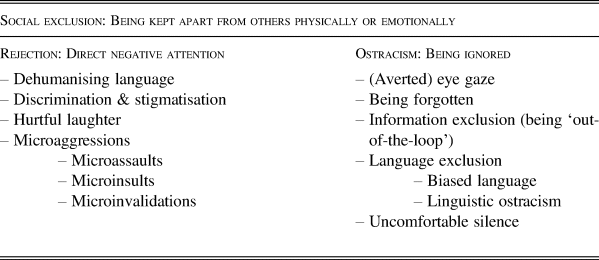
Recent years have seen increasing attention to the role of language in social exclusion (Fleming Reference Fleming2017:25–43; Fleming Reference Fleming, Jaspers and Madsen2019:122–45; Fu Reference Fu2021), which is comprehensively summarised in Wesselmann and colleagues’ social exclusion model (see Table 1; Wesselmann et al. Reference Wesselmann, Grzybowski, Steakley-Freeman, DeSouza, Nezlek, Williams, Riva and Eck2016:3–23). This model features two major social exclusion experiences—rejection (being explicitly or implicitly told that one is not wanted) and ostracism (being ignored by others)—that elicit adverse psychological outcomes.
Taxonomy of social exclusion experiences and outcomes in everyday life (Wesselmann et al. Reference Wesselmann, Grzybowski, Steakley-Freeman, DeSouza, Nezlek, Williams, Riva and Eck2016).

According to this model, dehumanising language refers to language use that degrades the target as inferior to the ‘human being’. Discrimination and stigmatisation occur when someone ascribes negative values to a target and treats them unjustly. Hurtful laughter refers to exclusive practices that make people feel excluded (Klages & Wirth Reference Klages and Wirth2014:8–13). Microaggressions—exclusionary everyday comments or behaviour—involve microassaults (verbal and non-verbal discriminatory acts), microinsults (insensitive communication that subtly degrades race/ethnicity), and microinvalidation (implicit invalidation and negation of an individual's experiences and thoughts). Averted eye gaze involves eye contact avoidance, inducing feelings of ostracism, and ‘being forgotten’ refers to either deliberate or unintentional non-inclusion. ‘Information exclusion’ is exclusion from important information, and ‘biased language’ is using exclusive language that disregards other social groups. ‘Language ostracism’ occurs during communication in which individuals or groups are ostracised or condemned to silence due to language inability. Finally, ‘uncomfortable silence’ involves unexpected pauses during communication, disrupting the conversation flow and threatening the solidarity between social actors.
While collecting data, we found that most episodes mentioned during the interviews fit into the taxonomy of Wesselmann and colleagues’ model; therefore, we deductively analysed and categorised our data according to the a priori themes provided by this model. However, we observed that the model generally summarises the types of social exclusion that are mostly triggered by language inability or realised by language use. The inductive examination of the data pointed to a more insidious factor—race—that leads to the social exclusion faced by African migrants in Hong Kong. To examine this, we also adopted raciolinguistics as a complementary framework to help present a holistic account of race, language, and social exclusion in the current context.
Raciolinguistics
For decades, sociolinguists have documented, parsed, and classified race and language, emphasising how linguistic signs index racial identities, inducing prejudice towards immigrants (Fu Reference Fu2021; Choi, Poertner, & Sambanis Reference Choi, Poertner; and Sambanis2021:236). Nevertheless, recent discussion has turned to indexical inversion, shifting the analytic attention from the speaking practices of racial minority subjects to the hearing practices of listening subjects (Cushing & Snell Reference Cushing and Snell2023:367). Theorised by Flores & Rosa (Reference Flores and Rosa2015:149–71; Rosa & Flores Reference Rosa and Flores2017:621–47), raciolinguistics interrogates the co-naturalisation of language and race historically and contemporarily, considering how the associations between language ideologies and social categories produce the (imagined) perception of linguistic signs in speaking subjects’ utterances. In raciolinguistic ideologies, the racialised speaking subjects are heard and stigmatised as deficient by the listening subject based on the racial positioning, regardless of the extent to which they approximate the ‘linguistic norms’ (Flores & Rosa Reference Flores and Rosa2015:149–71). For instance, Cushing & Snell (Reference Cushing and Snell2023:379) showed that school inspectors in England, most of whom are white, heard the linguistic practices of working-class children as ‘non-standardised’ and racialised this community as ‘limited’ and ‘deficient’ accordingly. Furthermore, Subtirelu (Reference Subtirelu2017:477–505) hypothesised that the Spanish-English bilingualism of US Latinxs is assigned less value and may even be associated with wage penalties, reflecting deficits that employers ‘hear’ in the linguistic repertoires of this group.
Therefore, race and language are inextricably intertwined, and their intersection is embedded in the broader systems of power structures and social inequality. As such, we need to approach race and language together, rather than treating them as two discrete processes, to contest the broader structures of supremacy (Alim, Rickford, & Ball Reference Alim, Rickford and Ball2016:5). Based on such theorisations, this study examines how Africans in Hong Kong are positioned as raciolinguistic others vis-à-vis the Chinese listening subjects. It argues that it is the racialised ideology of inferior language, rather than language itself, that serves as an essential mediating factor in social exclusion, and this positioning of ‘African English’ as inferior reflects the ongoing colonial logic of ‘Standardised English’ in the postcolonial setting of Hong Kong.
Materials and methods
Data collection
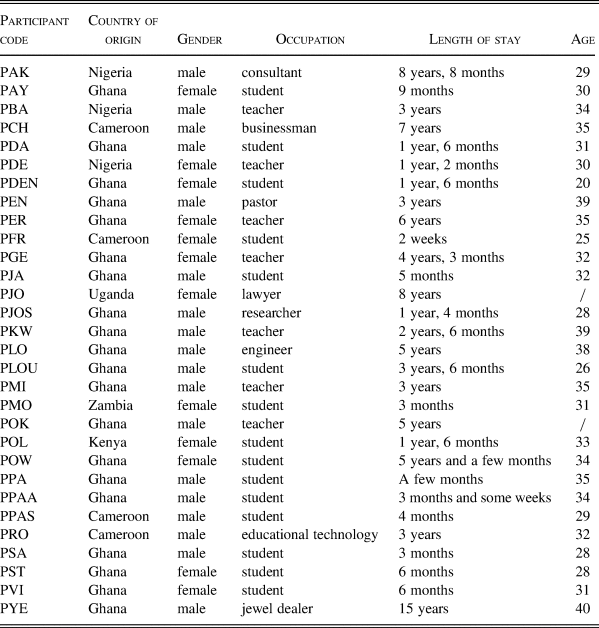
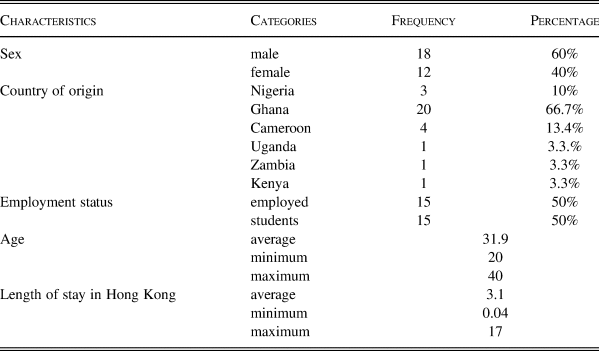
We recruited thirty African immigrants from October 2021 to April 2022 using our social network and snowball sampling. Some participants were acquaintances of the researchers; others were recruited at a multiracial Pentecostal church that hosts African migrants in Hong Kong. Network sampling was then employed, given that the number of African economic and student immigrants is relatively small compared with other racial and ethnic groups in Hong Kong. Subsequently, quota sampling was conducted based on participants’ age and origin, determining and excluding unsuitable candidates. The study focussed only on Black African adults aged above eighteen who were living in Hong Kong at the time of the interviews. We selected this sample since their identifiable phenotypical feature may easily render them the targets of social exclusion (Lee & Candela Reference Lee and Candela2020). In line with Bernard, Wutich, & Ryan's (Reference Bernard, Wutich and Ryan2017:46) observation that twenty to sixty participants constitute sufficient data, this study reached saturation when we interviewed approximately thirty participants. Participants’ demographic characteristics are listed and summarised in Tables 2 and 3 (all names were anonymised before being imported to NVivo 12: ‘P’ represents ‘participant’, and the following letters are their initials). Among them, 60% were men and 40% were women. They had migrated from Nigeria, Ghana, Cameroon, Uganda, Zambia, and Kenya. Half were working, and the other half were studying in Hong Kong. Their average age was 31.9; the youngest was twenty, and the oldest was forty.
Participants’ demographic characteristics.

* ‘/’ indicates that the participant wanted the information to remain confidential.
Summary of demographic characteristics.

We conducted semi-structured interviews using a list of similar questions with minor variations for each participant (see the appendix). This flexible interview mode allows interviewers to adjust the details and order of the questions according to the situation and lets interviewees elaborate their narratives at will (Bernard et al. Reference Bernard, Wutich and Ryan2017:76–77). Five interviews were conducted face-to-face prior to Hong Kong's fifth COVID-19 outbreak (November 2021); the remaining twenty-five were conducted via Zoom (December 2021–April 2022). Each participant presented their face during the small talk before the interviews. There were no observable differences between the face-to-face and Zoom interviews in terms of length, depth of discussion, or the richness of the content, though we could not capture facial expressions from those who disabled Zoom's video function. Interviews lasted forty minutes on average and were conducted in English, the only common language the interviewers and interviewees shared. We began with an introduction to the study and probed the participants’ basic immigration information. We then delved into their experiences in Hong Kong, their acculturation process, and the dynamics of their identity (re)construction. All interviews were recorded and transcribed using the online AI transcriber Wang Yi Jian Wai. We checked the transcribed texts afterwards for errors.
After fifteen interviews, we conducted a preliminary analysis and imported the data into NVivo 12. Based on Wesselmann and colleagues’ (Reference Wesselmann, Grzybowski, Steakley-Freeman, DeSouza, Nezlek, Williams, Riva and Eck2016:3–23) social exclusion model (see above), we first established the nodes representing different categories. We then truncated and categorised the texts into corresponding categories: A text was dragged into more than one node when it contained two or more themes. Each selected text was annotated with investigators’ notes and analysis. Subsequently, we re-examined the data inductively to determine if there were any missing themes in the model. Additionally, we double-checked the validity of the previous categorisation. We re-categorised, modified, or discarded any texts that did not fit. Throughout the analysis, we re-read the data concurrently. The two investigators then reached a consensus on the categorisation.
Note that the two authors are not members of the African community in Hong Kong and can, therefore, be considered ‘outsiders’ to the research community. However, one author, being a Mainland Chinese immigrant herself, shares similar, though less intense, social exclusion experiences when migrating to Hong Kong. The other author, though being a local Hongkonger, has been involved in research on migrant domestic workers’ social exclusion experience in Hong Kong for five years. Thus, she understands the social exclusion problems. Given those, we also have an ‘insider’ view to some extent, as we have similar experiences and are interested in their lived experiences. To ensure the utmost possible objectivity, we examined the data closely, embedded this data in the social context, clarified our positionality and that of our participants, and remained constantly self-reflective and self-critical.
Ethical considerations
The study was approved by the Sub-Committee on Research Ethics of the Lingnan University Research Committee. Signed informed consent was obtained from all participants. Participants were informed that all data were strictly confidential and would be used only for research purposes.
Findings
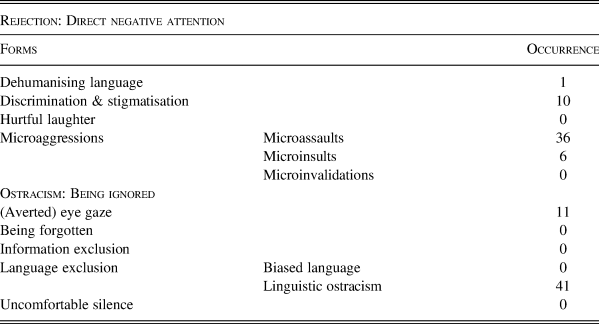
Linguistic ostracism and microassaults were the two most-mentioned forms of social exclusion (see Table 4). Accordingly, in this section, we first explicate the social exclusion led by a lack of language ability, followed by the social exclusion realised by language use. We then investigate the agency of African migrants in Hong Kong in ameliorating linguistic exclusion. However, we argue that linguistic assimilation seems to be helpless in resolving racial differences when the language has been systematically racialised (Flores & Rosa Reference Flores and Rosa2015; Rosa & Flores Reference Rosa and Flores2017). Our observation of the exclusionary language of silence further provides empirical evidence to support this point. At the end, we describe how African migrants manifest their agency through efforts to promote intercultural communication.
Occurrence of different types of social exclusion.

Linguistic ostracism and social disadvantage
Our study showed that linguistic ostracism, a communication experience in which people are ostracised because of limited language ability (Hitlan, Zárate, Kelly, & DeSoto Reference Hitlan, Zárate;, Kelly; and DeSoto2016:422–36), was common in participants’ daily encounters. The three official languages in Hong Kong are Cantonese, English, and Putonghua; English is widely used in the government and legal, professional, and business sectors, and Cantonese is the mainstream language (88.9% of the population speaks Cantonese; Hong Kong – The facts 2024). Though Hong Kong is an English-speaking society, lacking Cantonese speaking skills still limits opportunities and social circles.
Linguistic ostracism was an issue in the workplace as participants were ignored due to a lack of Cantonese ability.
(1) And they speak Cantonese, and I can't figure out what they are saying. It's just once in a while they say, “Oh yeah, oh sorry, and this is what we are saying”. And then they say [it] in English. … I'm still facing the challenge at my current workplace. I can't participate in everything. My colleagues in the office, and of course, officially, when we go for a class to teach, we use English. But, for communicating with colleagues in an informal setting, they seem to use Cantonese. (PBA, male, 34)
Excerpt (1) illustrates how PBA was not actively engaged in daily office interactions due to the linguistic barrier. PBA came to Hong Kong for a master's degree and stayed after graduation. After three years in Hong Kong, he was teaching economics at a university when interviewed. With limited skills in Cantonese, PBA could not understand his colleagues’ conversations as they preferred using Cantonese to English in the workplace. Consequently, he could not engage in certain activities with his colleagues and, thus, felt left out and disconnected. Human beings have a social need to interact with work colleagues to affiliate themselves and nurture a sense of belonging. In multilingual workplaces, language ostracism occurs when co-workers speak a language that the target is unfamiliar with in their presence, thwarting their need to belong. As Hitlan, Kelly, Schepman, Schneider, & Zárate (Reference Hitlan, Kelly, Schepman, Schneider; and Zárate2006:56–70) suggest, this loss of social engagement in the workplace may lead to lower levels of commitment to the workgroups or organisations, as well as fewer organisational citizenship behaviours. Notably, this exclusion may not be motivated by malicious intent but by inadvertent obliviousness (Robinson, O'Reilly, & Wang Reference Robinson, O'Reilly; and Wang2013:209–10): People may naturally form social bonds with those who share similar backgrounds while unintentionally leaving out those with (linguistic) dissimilarities.
Another participant, a mother of schoolchildren, was ostracised from the school's parenting programmes due to language barriers.
(2) There are a lot of things that … exclude parents, because … me and my husband can't speak Chinese. If they have some programs, they'll say, “Oh, the medium of communication in this program is Cantonese, so I guess you can't come”. Being excluded from most of the school activities is really challenging for us because we try to be as involved in our kids’ education as possible. (PER, female, 35)
PER had come to Hong Kong six years earlier to pursue her PhD degree and was a lecturer when interviewed. Her youngest daughter was born in Hong Kong and was attending a Chinese-speaking kindergarten. Given their inability to speak Cantonese, the kindergarten organiser automatically assumed she and her husband (also African) could not come to the parenting programs, ostracising these ‘burdensome’ group members as they might disrupt group functioning. In so doing, the organiser also disallowed PER and her husband's subjectivity in choosing whether to attend or not.
Africans are also denied or ignored in various services, confronting a discrepancy between what they anticipated and what actually happened. Twelve out of the thirty participants mentioned experiencing denials of service during the interviews. One salient example was PYE, a jewel dealer from Ghana who had lived in Hong Kong longer than any other participant. When a dispute arose with a local, he called the police to settle the conflict. Unexpectedly, the police, who had poor English, went to the offender for information. This failure to engage with the informant due to the language barrier greatly disadvantaged PYE in the police investigation, triggering a sense of unpredictability and ostracism.
(3) I called the police, … and [they] would not come to me, the one who called 999. … they went to the local Hong Kong person. They started talking in front of me. And I said, “Hey, officer, I am the one who called you. I'm the one calling; you should listen to me”. I understand that because they don't speak English, sometimes they need an interpreter. [It] makes things complicated. (PYE, male, 40)
Using impolite language to exclude
As social animals, people value social connections with others. However, interpersonal bonds are not easy to form or maintain. Rejection occurs when others do not want to develop a relationship or engage with someone (Wesselmann et al. Reference Wesselmann, Grzybowski, Steakley-Freeman, DeSouza, Nezlek, Williams, Riva and Eck2016:5–7), resulting in a series of mental and physical issues (Sjåstad, Zhang, Masvie, & Baumeister Reference Sjåstad, Zhang, Masvie; and Baumeister2021:116–25). In social exclusion, rejection cues can be found in various verbal forms.
First, dehumanising language involves derogatory verbal expressions used to label individuals or groups, which suggest the target's innate inferiority (Wesselmann et al. Reference Wesselmann, Grzybowski, Steakley-Freeman, DeSouza, Nezlek, Williams, Riva and Eck2016:5). In hate speech, dehumanisation is a common discursive strategy that distinguishes ingroups from outgroups, legitimising the controversial practices of social exclusion (Lee Reference Lee2020:335). PJO listed a series of experiences of discrimination in Hong Kong, one involving being discursively excluded from humanity.
(4) And they like to use the word hak gwai (黑鬼), which means black ghost or something. It's a Chinese word that they normally call the Black people here. I've had it before, like on the train … they normally say it to Africans. (PJO, female, /)
Hak gwai, literally meaning ‘black ghost’, is a common Hong Kong racial epithet that reduces Black people to creatures on the border of humanity. The person who used hak gwai not only described PJO as black and ghost-like but also identified her as a ‘non-human being’. This diabolising process reinforced the hierarchical consciousness of ‘race’ and potentially justified the social exclusion against the diabolised (Dikötter Reference Dikötter2015:24–26). PJO expressed that when she heard somebody call her something like that, she would usually tell them she could understand the word. This act reflects that the excluded are not merely passive recipients of social exclusion but can also be resisters who courageously confront discrimination.
Second, microassaults, which involve explicitly offensive verbal actions, were observed in the data, with twenty-two out of thirty participants mentioning a relevant experience.
(5) The dog came towards me …. The dog wanted to jump on me, so I shouted and said, “You know, you need to hold your dog. Your dog is going to bite me”. She came and held her dog, and then she told me, “It's just a dog. How can you be so scared?” … I told her, “But you need to hold your dog; otherwise it will bite me”. …. Then she said, “Oh, maybe, because you're so black, [the dog] can't see you. (PJO, female, /)
Here, an unleashed dog rushed at PJO and scared her. However, instead of apologising, the Chinese dog owner put the blame on the victim for being so black that the dog could not see her at night, thereby constructing PJO's skin colour as the cause of the incident and a dog attack as a natural outcome. Accordingly, the dog owner unabashedly turned herself from victimiser to victim, absolving her own responsibility for unleashing the dog. This victim blaming humiliated and disadvantaged the victim, reflecting the inferiority of blackness in Hong Kong, which was easily scapegoated in the conflict.
Another form of verbal microaggression reported by four out of the thirty participants was microinsult, that is, insensitive communications that implicitly devalue race/ethnicity.
(6) As soon as you walk in, they say, “No, no, no”, like “[Do] you have … papers?” …. Because they perceive Africans to all be refugees. …. So, if you say, “No, I'm not a refugee”, they're like, “Oh, so you have an ID?” When you say, “Yes, I have an ID”, they all look at you … like they're very surprised that you have an ID. (PJO, female, /)
While seeking an apartment, PJO visited property agents in Hong Kong. However, some immediately asked her for papers when she walked in, communicating a demeaning message that all Africans are refugees. When PJO showed her ID, they were surprised because Africans’ legal identity in Hong Kong counters their typical stereotype, which degrades Africans as unwanted and poverty-stricken ‘underdogs’ who cannot afford to pay rent. This instance of a microinsult belittled PJO's race, conveying the racial insensitivity of the perpetrator.
Addressing linguistic exclusion
Rejection and ostracism are the two major types of social exclusion. In confronting social exclusion, many participants felt offended, rejected, and ignored, resulting in self-doubt, low self-esteem and confidence, and a widening disparity between them and the local community. Nevertheless, their narratives also indicated they did not merely accept this; they also exhibited agency in ameliorating social disadvantages. We identified three solutions adopted by Africans in Hong Kong to alter social exclusion: learning the local language, taking initiative, and promoting intercultural communication, which is illustrated at the end of this section.
Acknowledging the communicative utility of Cantonese, eighteen of the thirty participants manifested positive language attitudes. They began learning Cantonese via various means, such as YouTube, attending language training courses, or picking up the language from colleagues, friends, and church members. Ten participants received institutional support from both schools and the church.
(7) At my church, they teach us Cantonese. I've registered my name, and I want to learn it. It's difficult living with people whose language you don't understand. (PST, female, 28)
(8) My church, the Church of Pentecost, has started a Cantonese class … and we will learn the language. I think that will be a big solution to some of our major problems here if we learn the language. (PVI, female, 31)
In addition, parents’ ideologies about language affect family language planning for children (Seo Reference Seo2021:105–24). As a mother, PJO experienced the social barriers that a lack of Cantonese created and saw the benefits of acquiring it. In her view, multilingualism is instrumental in improving her family's well-being in Hong Kong. She planned to raise her children speaking both Chinese and English.
(9) I'd like him to speak Chinese, [to] speak Cantonese and Mandarin, because I see the benefits of knowing the languages here. Because for me, I find it difficult in some places, …. I want my son to learn and be able to mix freely with people here. If he knows the language, then I think life will be much easier for him. I want him to learn Chinese, [to] learn how to speak it and how to write it. (PJO, female, /)
Additionally, PYE, who experienced language exclusions when dealing with the Hong Kong police, also displayed agency in improving the situation. In particular, he took the initiative to urge the Hong Kong police to improve their English skills, especially in Tsim Sha Tsui and Kowloon, where ethnic minorities congregate. According to him, linguistic ostracism was consequently alleviated.
(10) [Now their] English grammar is very good, better than before [in] 2004, 2005 2006, when it was horrible. It's horrible to have a police officer who doesn't speak English. The initiative was … so good. I'm so proud of it. We've done a good job. (PYE, male, 40)
Raciolinguistics: It is race, per se
Though most participants believed that narrowing the language barrier would solve some of their problems, unfair treatment went beyond communication issues. POW expressed that her friends’ children were rejected because of their race. Born in Hong Kong and of African descent, they speak native Cantonese, but their language proficiency could not shield them from discrimination.
(11) Their kids can speak Cantonese because [they] were born here. Then, they asked their kids to speak to these people. They speak to them in Cantonese; they tell them there is a place available, you can check it out. The moment they get there, and they see they are Africans, they tell them there is no vacancy here. You cannot rent the place here. It's something most … Africans who have stayed for longer periods have experienced. (POW, female, 34)
At first, the children of POW's friends, who are native-born and fluent Cantonese speakers, were easily accepted when looking for a house online. This was potentially because, in the online space where appearance loses its visibility, language replaces race to temporarily serve as the identity marker. However, when they arrived in person and disclosed their race, language lost its distinguishing function once blackness became visible. The rejection they later received indicates that language, at least in Hong Kong, is not the essential identity marker. Even a person speaking perfect Cantonese (indistinguishable from a native) is still at risk of being excluded if they are not an Asian Cantonese speaker. Arguably, this debunks the assumption that the modification of the linguistic practices of the racialised speaking subjects is key to eliminating racial hierarchy (Flores & Rosa Reference Flores and Rosa2015:155).
Another instance also exemplified how the linguistic practice of a racialised person is stigmatised, although the practice corresponds to the ‘standardised norms’ to a large extent (Flores & Rosa Reference Flores and Rosa2015:149–71).
(12) In my first semester, it was bad. Even [in] my teaching evaluations, the students didn't give me a chance. They evaluated me very poorly. “I just don't understand when she speaks; I can't understand the accent”. (PER, female, 35)
PER, a lecturer, was evaluated poorly in her teaching due to her ‘accented English’. However, her English was fully understandable during the interview and comprehensible to the AI transcriber. Moreover, the common language of instruction in Hong Kong universities is English. This poor performance evaluation articulated a raciolinguistic ideology from the perspective of the Chinese listening subjects—Africans’ linguistic practices of English deviated from the ‘standard English’, a colonial and social construct based on the language of the white bourgeoisie (Cushing & Snell Reference Cushing and Snell2023:364–67). Even when the subject complied with the ‘standard language’, her English continued to be positioned as deficient and incomprehensible. As such, PER and her language use were racially stigmatised.
Our data also shows that this racialisation of language leads to a disadvantaged position in job-seeking for minorities. Seven out of fifteen non-student participants opined that the requirement for Cantonese during job hunting made them less competitive. Three chose the teaching profession due to language limitations, though their majors were not teaching-related. Furthermore, their inability to speak Cantonese or Putonghua excluded them from high-paying jobs and limited them to positions below their qualification level.
(13) Those jobs, you tend to take them, but they are below your qualifications … and your professional needs. But you tend to take them … because that's what is available. (PLO, male, 38)
At the time of the interview, PLO was engaged in engineering. He recounted the problems he experienced while job-hunting. He estimated that 80–90% of Hong Kong jobs require Chinese, even those where employees do not have to communicate with people, making finding jobs difficult for individuals who do not speak Chinese. Before obtaining ‘an international and professional job’, PLO took an unspecified low-paying job for ethnic minorities but later quit due to communication challenges with his colleagues who had limited English skills.
However, not all immigrant groups face similar barriers in Hong Kong, a global city where English is officially the mainstream language. Tong, Su, & Fong (Reference Tong, Su and Fong2018:79–108) observed that white immigrants, who are normally from more developed countries, seem to enjoy a labour market advantage over their counterparts from peripheral countries, though they are also largely unskilled in Chinese. This challenges the assumption that Africans are disadvantaged in the labour market due to inadequate linguistic skills. Rather, the phenomenon must be further contextualised into the global structure of power. Though English is associated with elite status by the dominant language ideologies in Hong Kong (Fleming Reference Fleming2017:28), through the lens of raciolinguistic ideology, Africans’ linguistic repertoires are racialised and assigned less value than the unmarked speech produced by the white speakers of ‘standard English’. This results in unequal opportunities in job-hunting. As such, African immigrants’ disadvantage in the labour market may be more related to their lower status within Hong Kong's social and racial hierarchies than their linguistic skills.
Exclusionary language of silence
This raciolinguistic assumption was further evidenced in situations where language was absent. Non-verbal microassaults against Africans were the most reported form of social exclusion in public spaces, such as trains, lifts, and buses. Seventeen of the thirty participants mentioned people moving away from them on the train or not wanting to sit next to them. Four participants reported people pinching their noses closed when they came near or walked into a lift. Two typical examples were:
(14) When you take a bus, nobody wants to sit near you …. When you are in an elevator or lift, they hold their nose like you smell. And a lot of [other] very nasty stuff. (PYE, male, 40)
(15) I was sitting down [on the train], a lady was there …. I sat beside her, and she just stood up. I was like, “Whoa”. (PGE, female, 32)
Then, participants also indicated that intensive staring could induce a feeling of exclusion. In Wesselmann et al.'s (Reference Wesselmann, Grzybowski, Steakley-Freeman, DeSouza, Nezlek, Williams, Riva and Eck2016:8–9) model, averted eye gaze is ‘a primary cue for communicating ostracism to others’; however, this study found that intense eye gaze can serve the same role. Eleven out of fifteen participants reported that they had been stared at in public; some pinpointed the alienating effect the gaze had on them. POW noted that people's constant staring made her conscious of being foreign.
(16) The other aspect was … everybody kind of stares at you. It is like you are foreign being here. …. Why is everybody staring at me? It makes you self-conscious about being different. (POW, female, 34)
Excerpt (16) exemplifies the process whereby others’ gaze led POW to reflect on the Self. This ‘looking glass self’ (Cooley Reference Cooley, O'Brien and Kollock1997:303–305) mirrored POW's foreignness in Hong Kong society, reinforcing the imagined alien-ness in her mind. Eye gaze can, thus, also be a powerful social cue to alienate ‘Others’ and make them feel ostracised. However, what one person experiences as exclusion may be inconsequential to another. While three participants stated feeling uneasy, others claimed they became used to the gaze and ignored it after a while or never even noticed it. This implies there is no single narrative about social exclusion: its experiences and outcomes vary among the recipients for various reasons and depend on different situational cues (Wirth, Sacco, Hugenberg, & Williams Reference Wirth, Sacco, Hugenberg and Williams2010:878–79). One possible reason for this variation, as Gerber & Wheeler (Reference Gerber and Wheeler2014:14–27) explain, is that those who expect rejection appear to be less distressed when rejection occurs.
Interestingly, one participant deployed impolite stares as a resistance strategy.
(17) I think once I was on a bus … one lady looked at me, and she just [PST rolls her eyes]. I was like, “Hmm, is that deliberate?” … so I turned again, and then she [PST rolls her eyes] again. I was like, “Okay, then it means that is deliberate”. So, when I also looked at her I also [PST rolls her eyes]. And when she looked at me, she [PST rolls her eyes] again. Okay, you want a war. I'll give it to you. So, I was also [PST rolls her eyes]. I was basically fighting her all the way and everything. (PST, female, 28)
When PST noticed a Hong Kong Chinese person roll their eyes at her, an act that communicates judgment and disdain, she rolled her eyes back. She metaphorically constructed this mutual eye-rolling as a war between her and the Hong Kong Chinese individual, portraying herself as a brave warrior. In so doing, PST manifested her agency in resisting social exclusion.
Non-verbal rejection also occurred because of the ‘invisibility’ related to blackness in Hong Kong society. As shown in excerpt (18), when POL tried to hail a cab, Hong Kong taxi drivers would not stop for her but stopped for her Chinese friend. POL proposed two theories: (i) her ethnicity was not welcomed, and (ii) they thought she could not afford the fare. She also wondered whether the drivers could not ‘see’ her because her skin was dark.
(18) You can spend a very long time trying to stop the taxi drivers. That has happened to countless of us. …. You can see the taxi is available. So, you try to stop it. It will not stop for you. But they will maybe stop for a Chinese friend …. Sometimes you ask yourself questions: “Is it that I am too dark that the person cannot see I'm stopping them?” or “Do they think I don't have the money to pay or am I not a person?” …. I can pronounce my destination in Chinese or Cantonese. … So, it has nothing to do with you not knowing where you're going. (POL, female, 33)
POL underlined that she was denied service because of race and its affiliated stereotypes, not a language barrier. Blackness is visually conspicuous in Hong Kong society since most of the population is Asian. Nevertheless, socially speaking, blackness sometimes causes ‘invisibility’. Thus, Africans in Hong Kong are paradoxically trapped in this interplay of visibility and invisibility, which marginalises them socially.
Addressing racial exclusion
Contrary to the discourse of integration, which argues that linguistic assimilation is essential for immigrant integration and reducing social exclusion, our study suggests that race, not language, is the root cause of social exclusion, at least in Hong Kong. Accordingly, the reduction of social exclusion should not merely emphasise language training but also fundamentally improve racial sensitivity. In this context, two participants mentioned their efforts to promote cultural sensitivity by engaging in intercultural communication with Hong Kong police stations and schools.
(19) I used to train Hong Kong police [on] cultural sensitivity issues, long before the protest. We used to have a meeting with the Tsim Sha Tsui police station. … Every year, we have three or four meetings with [them]. (PYE, male, 40)
(20) I volunteer with a social enterprise teaching cultural education. A lot of times, what I end up doing is going to different local schools … and chatting with some of the high school students, … primary school students, and even university students, just helping them have better cultural awareness. (PAK, male, 29)
Discussion and conclusion
Using interview data from thirty participants and adopting a qualitative approach, this study examined the role of language in the social exclusion that African immigrants experience in Hong Kong. We investigated how African immigrants are excluded in their daily lives both ‘because of the language’ and ‘by the language’ and their agency in contesting this social exclusion.
First, given that language serves as a communication tool (Chen Reference Chen2015:88–93), African immigrants lacking linguistic competence were, unsurprisingly, ostracised in the job market, workplace, parenting, and social services since they were unable to communicate effectively with locals. Their difficulties in communicating with local people lead to socioeconomic challenges in securing a comfortable life in Hong Kong. This finding is consistent with Bourdieu's view that ‘speakers lacking the legitimate competence are de facto excluded from the social domains’ (Bourdieu Reference Bourdieu1991:55), which has also been empirically evidenced in other studies (Hitlan et al. Reference Hitlan, Kelly, Schepman, Schneider; and Zárate2006:56–65; Bodomo Reference Bodomo2012:175–76; Crabtree & Wong Reference Crabtree and Wong2013:945–63; Amoah et al. Reference Amoah, Koduah, Anaduaka, Addae, Gwenzi and Amankwaa2020:542–59; Fu Reference Fu2021). Alongside ‘exclusion because of the language’, this study also observed ‘exclusion by the language’. In particular, using dehumanising language downgraded the targets as ‘non-human beings’. Biased questions stereotyped African immigrants as poor and as refugees and the victim-victimiser reversal essentialised their skin colour as the cause of the conflict. Our insights reflect the findings of Chow-Quesada & Tesfaye (Reference Chow-Quesada and Tesfaye2020:384–406) regarding the rooted misperceptions of African immigrants as poor, subordinate, and refugees. These labels, intentional or mindless, induced feelings of exclusion, destabilising the interpersonal relations between African immigrants and Hong Kong locals.
Nevertheless, as Fu (Reference Fu2021) suggested, the status of social exclusion was not static but was rather subject to fluid change based on the participants’ efforts, the process of which manifested their agency in resisting exclusion. In the present study, the agency of African migrants mainly emerged in three forms: (i) Language learning: Recognising the rewarding outcomes of language learning, some participants indicated an interest in and motivation for learning Cantonese as a method of acquiring access to ‘cultural capital’ and empowerment. Many engaged in language training by themselves or supported by institutions like the church. (ii) Social service: Confronting their disadvantaged position in social services, some participants took the initiative to urge Hong Kong institutions to improve their English capacity so that their linguistic needs would be met. Meanwhile, other participants strived to promote intercultural communication to improve racial sensitivity among the Hong Kong Chinese. (iii) Daily individual acts of resistance: These acts included telling offenders that they knew the meanings of racial slurs and rolling their eyes in response when receiving an eye roll. In such episodes, African migrants actively exercised their agency by resisting racist actions directed at them. As such, this study further demonstrates that the exclusion process is bidirectional: The subjugated not only passively receive social exclusion but also intentionally subvert marginalisation (Kronauer Reference Kronauer and Andreß2019:51–76).
However, from the raciolinguistic perspective, the first form of agency, language learning, which was also the most mentioned form, was effective only in alleviating linguistic ostracism, but not social exclusion per se. First, African immigrants who spoke fluent Cantonese or fluent English were still socially rejected based on their appearance, indicating that skin colour is the essential identity marker in Hong Kong society rather than language. These results corroborate Fleming's (Reference Fleming2017:25–43; Reference Fleming, Jaspers and Madsen2019:122–45) and Gu & Patkin's (Reference Gu and Patkin2013:131–41) studies on South Asians in Hong Kong, which argue that racial ideology embedded in language, not the language, is the key mediating factor structuring the social order. Second, PER was heard as linguistically deficient despite her linguistic capacity, reflecting the rearticulation of colonial logics of ‘Standardised English’ in the postcolonial setting (Rosa & Flores Reference Rosa and Flores2017:622), whereby the Africans’ English use was regarded as ‘linguistically inauthentic and inadequate’ by the Chinese listening subjects. Significantly, with this linguistic-racial hierarchy in Hong Kong, the racialised speakers of African English were easily constructed as linguistically inferior, which consequently justified various forms of social exclusion in Hong Kong. Third, while white immigrants, who are largely able to speak English but not Cantonese, are privileged in the job market in Hong Kong, African immigrants, whose linguistic repertoires are constructed as deficient, are disadvantaged. This imbalance in labour market outcomes manifests a hierarchy of superiority and inferiority that has little to do with language ability but is, rather, based on skin colour. By extending the scope of the investigation to Hong Kong's African community, this study further delegitimises the overemphasis on the transformative power of language in social exclusion and endorses the assertion that race is the root cause of social exclusion. Moreover, by extending the ‘white gaze’ to the ‘Chinese gaze’, this study goes beyond the study of raciolinguistics in the US to the context of Hong Kong.
However, by highlighting the ‘Chinese gaze’, we do not claim that the concept of ‘white gaze’ has no relevance here. On the one hand, as proposed by Rosa & Flores (Reference Rosa and Flores2017:629), the ‘white gaze’ does not refer to ‘white people’, per se, but people of any race who occupy a particular ‘structural position’. As such, the ‘Chinese gaze’ is, in essence, still a case of ‘white gaze’. On the other hand, the ‘Chinese gaze’ has been, both consciously and unconsciously, informed by the ‘white gaze’. According to Said's (Reference Said2003) Orientalism, the stereotypical racial assumption embedded in the colonial discourse frames the minds of the colonised through various means, with the superiority of the colonisers being gradually justified and believed among the colonised; while the colonised, selectively internalising the coloniser's supremacy and negative stereotypes of other social groups, mimic the coloniser's practice and discriminate against others. In this case, the Hong Kong Chinese internalise the white supremacy introduced by British colonialism, take up this structural position, ‘mimic’ (Bhabha Reference Bhabha1994) the othering practices against people of darker skin, and assume the superiority of Chineseness in relation to the inferiority of blackness (Lee & Law Reference Lee and Law2016:81–116) while language performs as a vital medium in this construction of ‘Hong Kong Chinese Orientalism’ (Lee & Law Reference Lee and Law2016:81–108). As such, the concept of the ‘Chinese gaze’ is deeply inscribed in the concept of the ‘white gaze’.
Lastly, we also found that the language of silence, including eye gaze, non-verbal discrimination, and non-verbal microassaults, play vital roles in social exclusion. As reported by our participants, eye gaze mirrored their ‘difference’ in Hong Kong society, leading them to reflect on themselves in the gaze of others. This finding aligns with Thomson's (Reference Thomson2000:334–38) remark that staring is the social enactment of exclusion. However, eye gaze was not previously included in Wesselmann and colleagues’ (Reference Wesselmann, Grzybowski, Steakley-Freeman, DeSouza, Nezlek, Williams, Riva and Eck2016:8–9) model, which focusses on averted eye gaze as a cue to convey social exclusion. Thus, we suggest revising the category ‘averted eye gaze’ to ‘(averted) eye gaze’ to enrich this model.
In all, our study observed that racism is not uncommon in Hong Kong despite the city's rhetoric of multiculturalism and internationalism. Priding itself on being ‘Asia's World City’, Hong Kong still fosters prejudice against minority groups (Ladegaard Reference Ladegaard2013). As Nartey (Reference Nartey2022:459–64) advocates, our task as researchers is not merely discovering, documenting, and informing of social inequalities but, more importantly, ‘adopting an activist-scholar posture in order to push for positive social change’ (2022:463). As such, this study serves merely as a starting point. More needs to be done to incorporate our findings into broader social projects that benefit the African community in Hong Kong.
This study has some limitations. Interviews were conducted with African economic and student migrants; therefore, caution must be applied in generalising the findings to other African groups in Hong Kong, such as asylum-seekers and refugees. Future research should increase the sample size and variety of participants to generate more comprehensive and representative results. Moreover, future studies could also consider different variables (e.g. past experience, education level, and marital status) to examine why Africans in Hong Kong react differently to similar social exclusion experiences.
Appendix: Interview questions
Part 1. Basic participant information
1.1 How long have you been in Hong Kong?
1.2 Why did you come to Hong Kong?
Part 2. Experiences in Hong Kong and acculturation
2.1 What is your impression of Hong Kong before/after coming?
2.2 During your stay, what problems have you encountered?
2.3 What languages can you speak? Does a language barrier constitute a problem for you and in what ways? How do you deal with it?
2.4 Have you encountered any discrimination or prejudice in your daily interactions with Chinese people in Hong Kong? How do you feel and respond to it?
2.5 Are you stared at in public places? If so, how do you feel and react?
2.6 What do you do to ease stress when living here and what social support do you receive?
Part 3. Identity (re)construction
3.1 How do you deal with these cultural differences? Do you think you can ‘fit into’ Hong Kong's cultural setting?
3.2 What is your religion? Does being a member of this religious community help you adapt to a new environment?
3.3 (For students) Do you plan to stay in Hong Kong after graduation and, if so, why?
3.4 How do you identify yourself? Do you identify more with Hong Kong or your home country and why?
3.5 To what degree do you think you have adapted to Hong Kong society?
3.6 What do you think could be done to improve your experience in Hong Kong?
Part 4. Ending questions
4.1 What is your name, age, and nationality?
4.2 Do you have any questions for researchers?