


%20--%3e%3c!DOCTYPE%20svg%20PUBLIC%20'-//W3C//DTD%20SVG%201.0//EN'%20'http://www.w3.org/TR/2001/REC-SVG-20010904/DTD/svg10.dtd'%3e%3csvg%20version='1.0'%20id='Layer_1'%20xmlns='http://www.w3.org/2000/svg'%20xmlns:xlink='http://www.w3.org/1999/xlink'%20x='0px'%20y='0px'%20width='64px'%20height='64px'%20viewBox='5.5%20-3.5%2064%2064'%20enable-background='new%205.5%20-3.5%2064%2064'%20xml:space='preserve'%3e%3cg%3e%3ccircle%20fill='%23FFFFFF'%20fill-opacity='0'%20cx='37.785'%20cy='28.501'%20r='28.836'/%3e%3cpath%20fill='%23595959'%20d='M37.441-3.5c8.951,0,16.572,3.125,22.857,9.372c3.008,3.009,5.295,6.448,6.857,10.314%20c1.561,3.867,2.344,7.971,2.344,12.314c0,4.381-0.773,8.486-2.314,12.313c-1.543,3.828-3.82,7.21-6.828,10.143%20c-3.123,3.085-6.666,5.448-10.629,7.086c-3.961,1.638-8.057,2.457-12.285,2.457s-8.276-0.808-12.143-2.429%20c-3.866-1.618-7.333-3.961-10.4-7.027c-3.067-3.066-5.4-6.524-7-10.372S5.5,32.767,5.5,28.5c0-4.229,0.809-8.295,2.428-12.2%20c1.619-3.905,3.972-7.4,7.057-10.486C21.08-0.394,28.565-3.5,37.441-3.5z%20M37.557,2.272c-7.314,0-13.467,2.553-18.458,7.657%20c-2.515,2.553-4.448,5.419-5.8,8.6c-1.354,3.181-2.029,6.505-2.029,9.972c0,3.429,0.675,6.734,2.029,9.913%20c1.353,3.183,3.285,6.021,5.8,8.516c2.514,2.496,5.351,4.399,8.515,5.715c3.161,1.314,6.476,1.971,9.943,1.971%20c3.428,0,6.75-0.665,9.973-1.999c3.219-1.335,6.121-3.257,8.713-5.771c4.99-4.876,7.484-10.99,7.484-18.344%20c0-3.543-0.648-6.895-1.943-10.057c-1.293-3.162-3.18-5.98-5.654-8.458C50.984,4.844,44.795,2.272,37.557,2.272z%20M37.156,23.187%20l-4.287,2.229c-0.458-0.951-1.019-1.619-1.685-2c-0.667-0.38-1.286-0.571-1.858-0.571c-2.856,0-4.286,1.885-4.286,5.657%20c0,1.714,0.362,3.084,1.085,4.113c0.724,1.029,1.791,1.544,3.201,1.544c1.867,0,3.181-0.915,3.944-2.743l3.942,2%20c-0.838,1.563-2,2.791-3.486,3.686c-1.484,0.896-3.123,1.343-4.914,1.343c-2.857,0-5.163-0.875-6.915-2.629%20c-1.752-1.752-2.628-4.19-2.628-7.313c0-3.048,0.886-5.466,2.657-7.257c1.771-1.79,4.009-2.686,6.715-2.686%20C32.604,18.558,35.441,20.101,37.156,23.187z%20M55.613,23.187l-4.229,2.229c-0.457-0.951-1.02-1.619-1.686-2%20c-0.668-0.38-1.307-0.571-1.914-0.571c-2.857,0-4.287,1.885-4.287,5.657c0,1.714,0.363,3.084,1.086,4.113%20c0.723,1.029,1.789,1.544,3.201,1.544c1.865,0,3.18-0.915,3.941-2.743l4,2c-0.875,1.563-2.057,2.791-3.541,3.686%20c-1.486,0.896-3.105,1.343-4.857,1.343c-2.896,0-5.209-0.875-6.941-2.629c-1.736-1.752-2.602-4.19-2.602-7.313%20c0-3.048,0.885-5.466,2.658-7.257c1.77-1.79,4.008-2.686,6.713-2.686C51.117,18.558,53.938,20.101,55.613,23.187z'/%3e%3c/g%3e%3c/svg%3e)
%20--%3e%3c!DOCTYPE%20svg%20PUBLIC%20'-//W3C//DTD%20SVG%201.0//EN'%20'http://www.w3.org/TR/2001/REC-SVG-20010904/DTD/svg10.dtd'%3e%3csvg%20version='1.0'%20id='Layer_1'%20xmlns='http://www.w3.org/2000/svg'%20xmlns:xlink='http://www.w3.org/1999/xlink'%20x='0px'%20y='0px'%20width='64px'%20height='64px'%20viewBox='5.5%20-3.5%2064%2064'%20enable-background='new%205.5%20-3.5%2064%2064'%20xml:space='preserve'%3e%3cg%3e%3ccircle%20fill='%23FFFFFF'%20fill-opacity='0'%20cx='37.637'%20cy='28.806'%20r='28.276'/%3e%3cg%3e%3cpath%20fill='%23595959'%20d='M37.443-3.5c8.988,0,16.57,3.085,22.742,9.257C66.393,11.967,69.5,19.548,69.5,28.5c0,8.991-3.049,16.476-9.145,22.456%20C53.879,57.319,46.242,60.5,37.443,60.5c-8.649,0-16.153-3.144-22.514-9.43C8.644,44.784,5.5,37.262,5.5,28.5%20c0-8.761,3.144-16.342,9.429-22.742C21.101-0.415,28.604-3.5,37.443-3.5z%20M37.557,2.272c-7.276,0-13.428,2.553-18.457,7.657%20c-5.22,5.334-7.829,11.525-7.829,18.572c0,7.086,2.59,13.22,7.77,18.398c5.181,5.182,11.352,7.771,18.514,7.771%20c7.123,0,13.334-2.607,18.629-7.828c5.029-4.838,7.543-10.952,7.543-18.343c0-7.276-2.553-13.465-7.656-18.571%20C50.967,4.824,44.795,2.272,37.557,2.272z%20M46.129,20.557v13.085h-3.656v15.542h-9.944V33.643h-3.656V20.557%20c0-0.572,0.2-1.057,0.599-1.457c0.401-0.399,0.887-0.6,1.457-0.6h13.144c0.533,0,1.01,0.2,1.428,0.6%20C45.918,19.5,46.129,19.986,46.129,20.557z%20M33.042,12.329c0-3.008,1.485-4.514,4.458-4.514s4.457,1.504,4.457,4.514%20c0,2.971-1.486,4.457-4.457,4.457S33.042,15.3,33.042,12.329z'/%3e%3c/g%3e%3c/g%3e%3c/svg%3e)
Introduction
Surveillance definitions developed by the Centers for Disease Control and Prevention’s National Healthcare Safety Network (NHSN) serve as the gold standard for hospital-acquired infection reporting in the United States. These definitions, including the PNEU2 criteria for pneumonia, are foundational for benchmarking, public reporting, and institutional accountability. 1 Their strength lies in providing standardized, objective, and reproducible criteria that allow comparison across institutions and over time.
However, the pursuit of objectivity can introduce unintended rigidity. When definitions rely on narrow or outdated terminology, they risk diverging from contemporary clinical practice. This tension between standardization and clinical reality is increasingly apparent in the imaging criteria for NHSN-defined pneumonia. As medical language evolves, surveillance systems must adapt or risk misclassifying clinically meaningful events.
Methods
We conducted a retrospective review of central line-associated bloodstream infections (CLABSIs) within a surgical intensive care unit at a tertiary academic medical center over a 12-month period. Cases were screened for those meeting all NHSN PNEU2 clinical and laboratory criteria, including signs/symptoms and microbiologic data. Radiographic reports associated with these cases were reviewed independently by infection prevention specialists and clinicians.
Cases were identified in which radiographic findings were clinically consistent with pneumonia but did not meet NHSN criteria due to the absence of specific terminology (“infiltrate,” “consolidation,” or “cavitation”) or inclusion of differential diagnoses such as “atelectasis.” We quantified the number of such cases and performed a qualitative review of radiology report language. Informal input was obtained from radiologists regarding terminology preferences and interpretation of equivalency.
Results
We identified 10 cases (25%) over a 12-month period in which patients met all clinical and laboratory criteria for NHSN-defined pneumonia but were excluded solely due to radiographic wording. Figure 1 illustrates a representative case in which the discrepancy between contemporary radiologic terminology and NHSN imaging criteria affected surveillance classification. In each instance, radiology reports described findings such as “bilateral opacities,” “airspace disease,” or “patchy opacities,” without using the specific terms required by NHSN criteria.
Clinician review determined that these radiographic findings were consistent with pneumonia in the appropriate clinical context. Radiologists confirmed that terms such as “opacities” are frequently used as part of modern reporting practices and are often intended to describe findings historically labeled as “infiltrates.” The shift reflects a broader movement toward more precise and standardized radiologic language. Reference Kanne, Little, Chung, Elicker and Ketai2
Discussion
Our study highlights how semantics can drive misclassification of hospital-acquired infections. Specifically, discrepancies between contemporary radiologic terminology and the NHSN definition for pneumonia contributed to a falsely lower rate of hospital-acquired pneumonia and a falsely increased rate of CLABSI within the ICU.
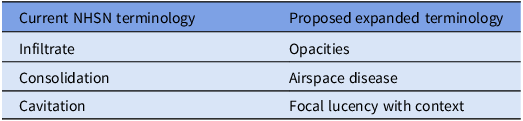
The NHSN PNEU2 definition requires explicit radiographic documentation of “infiltrate,” “consolidation,” or “cavitation.” 1 Although this requirement aims to standardize case identification, it fails to account for the evolution of radiology reporting and is contradictory to current radiologic lexicon. For example, the term “infiltrate” has fallen out of favor as evidenced by the 2024 Fleischner Society Glossary of Terms for Thoracic Imaging, which calls the term infiltrate “now obsolete and non-recommended.” Radiologists increasingly favor terms such as “opacity” or “airspace disease,” which indicated areas of abnormally increased lung density but acknowledge the nonspecific nature of the finding that may be due to pneumonia or numerous other causes and require clinical information for a more specific diagnosis. Table 1 summarizes the current NHSN terminology and corresponding contemporary terminology that we propose for inclusion in an expanded imaging lexicon. “Opacity” falls outside of the NHSN’s current accepted lexicon. Reference Kanne, Little, Chung, Elicker and Ketai2,Reference Bankier, MacMahon and Colby3 Moreover, terminology on chest radiographs differs from that on chest CT, and either modality can diagnose pneumonia with many different appearances.
This semantic mismatch creates a situation in which clinically evident infections are excluded from surveillance definitions—not because of clinical ambiguity but because of terminology alone. In our experience, this issue is not rare and disproportionately affects high-acuity settings such as intensive care units.
Misclassification due to terminology has several important implications. First, it undermines surveillance validity. Infection rates may be artificially deflated or inflated depending on documentation practices rather than true clinical events. Reference O’Grady4 These compromise both internal quality improvement efforts and external benchmarking. In this example, ICUs may use the surveillance data to focus more on CLABSI prevention activities as opposed to ventilator-associated pneumonia prevention activities and not see improvements due to lack of understanding of root cause and resultant ineffective countermeasure development. Second, institutional consequences may follow. Healthcare-associated infection metrics are increasingly tied to public reporting and reimbursement. Reference Magill, OLeary and Janelle5 When case classification hinges on wording rather than clinical reality, institutions may be inadvertently penalized or rewarded based on documentation patterns. Finally, these discrepancies erode trust among frontline clinicians and infection prevention teams. When surveillance definitions appear disconnected from bedside medicine, they risk being viewed as arbitrary rather than meaningful. Reference Schrank, Branch-Elliman and Leekha6
This challenge reflects a broader issue: the evolution of medical language. Radiology has undergone substantial transformation toward structured reporting and standardized descriptors. Reference Kanne, Little, Chung, Elicker and Ketai2 These changes are driven by a desire for clarity, reproducibility, and improved communication. In contrast, NHSN definitions are relatively static. Although stability is necessary for longitudinal comparison, it can create misalignment with current clinical practice. The issue extends beyond pneumonia and highlights a fundamental tension between fixed surveillance criteria and dynamic medical language.
Other infection definitions offer potential models for addressing this challenge. For example, intra-abdominal infection criteria allow for greater flexibility by incorporating clinical correlation alongside imaging findings. Reference Mazuski, Tessier, May and Sawyer7 Rather than requiring specific wording, these frameworks recognize that interpretation occurs within a clinical context. Applying a similar approach to PNEU2 could involve accepting an expanded set of radiologic terminology that includes any findings that could represent pneumonia on radiography or CT or allowing clinician interpretation to supplement imaging descriptions.
We propose two potential approaches for improving the PNEU2 surveillance definition:
-
1. Expanded Terminology List
NHSN could develop a standardized list of acceptable radiographic synonyms in collaboration with radiology societies. This would preserve objectivity while reflecting contemporary language.
-
• Opacity
-
• Airspace Disease
-
2. Ability for Clinical Correlation
Cases with equivocal or consistent imaging descriptions and supporting clinical data could be adjudicated based on documented clinician interpretation and antimicrobial treatment, even if the specific terminology is absent similar to other surveillance definitions that incorporate radiographic findings (ie, IAB 3b, GIT3c).
Addressing this issue requires collaboration across disciplines. Infection prevention specialists, radiologists, and frontline clinicians must work together to ensure that surveillance definitions reflect real-world practice. The inclusion of radiologists in NHSN revision processes and validation studies would be particularly valuable.
Surveillance systems must evolve alongside clinical practice. We encourage re-evaluation of PNEU2 imaging criteria and pilot studies to assess the impact of expanded terminology. Aligning definitions with contemporary language is essential to maintaining the credibility and utility of infection surveillance.
Patient vignette. CT, Computed Tomography; ICU, Intensive Care Unit.

Current vs proposed imaging terminology

Table 1. Long description
A table comparing current and proposed imaging terminology with two columns and three rows. The first column is labeled ‘Current NHSN terminology’ and the second column is labeled ‘Proposed expanded terminology’. Row 1: Infiltrate, Opacities. Row 2: Consolidation, Airspace disease. Row 3: Cavitation, Focal lucency with context.
Acknowledgments
None.
Financial support
None reported.
Competing interests
All authors report no conflicts of interest relevant to this article.


 Open access

