Introduction
There are many examples of placer PGM around the world as summarized in Cabri et al. (Reference Cabri, Harris and Weiser1996) and Weiser (Reference Weiser2002). Placer PGM exhibit variable shapes, commonly form flakes or are rounded or knobbly, and more than 90% of placer PGM are alloys of Pt–Fe and Os–Ir–Ru–Pt. Ophiolitic placer PGM tend to be dominated by Os–Ir–Ru alloys (Cabri et al., Reference Cabri, Harris and Weiser1996).
There is a long standing debate about whether placer PGM erode mechanically from PGE-bearing rocks or whether they grow in situ in stream banks draining from PGE-bearing sources. One of the main lines of evidence for mechanical erosion comes from PGM nuggets that contain inclusions of igneous silicates and exotic PGM that may have been preserved in the matrix of the nuggets. Commonly, placer nuggets are much bigger than the PGM in the source rocks. The argument here is that large PGM in the streams represent the few large PGM concentrated from extensive erosion of the host rocks (Cabri and Harris, Reference Cabri and Harris1975) and are overlooked in geochemical and petrological surveys. The alternative view is that placer nuggets may grow in situ in streams. Destruction of PGM by weathering and erosion of the host rocks would liberate the PGE, which may travel downstream in solution and re-precipitate due to changes in the geochemistry of the PGE-bearing solutions (e.g. Bowles, Reference Bowles1986; Bowles et al., Reference Bowles, Lyon, Saxton and Vaughan2000). PGM in the host rocks often show evidence of being broken down and oxidized as they weather (Bowles et al., Reference Bowles, Suárez, Prichard and Fisher2017), thus destroying the PGM for later re-precipitation in the streams. The secondary precipitation of placer PGM has been evidenced by reworking and concentric growths (e.g. Cabral et al., Reference Cabral, Lehmann, Tupinambà, Schlosser, Kwitko-Ribeiro and Abreu2009; Zaccarini et al., Reference Zaccarini, Pushkarev, Garuti, Krause, Dvornik, Stanley and Bindi2013), or by delicate arrangements of PGM (e.g. Bowles et al., Reference Bowles, Suárez, Prichard and Fisher2018) inconsistent with pervasive mechanical and hydraulic erosion of the grains.
Podiform chromitites in ophiolite complexes are typically enriched in IPGE (Ir, Ru, Os) over PPGE (Pt, Pd, Rh) and are characterized by Ru–Os–Ir-dominant PGM (IPGM), mainly laurite–erlichmanite (RuS2–OsS2), irarsite (IrAsS) and Os–Ir–Ru alloys. Relevant examples are compiled, for example, in Prichard and Brough (Reference Prichard, Brough, Li and Ripley2009) and O'Driscoll and González-Jiménez (Reference O'Driscoll, González-Jiménez, Harvey and Day2016). Some other ophiolitic chromitites are however significantly enriched in PPGE and contain Pt-, Pd- and Rh-bearing minerals (PPGM), e.g. sperrylite (PtAs2), stibiopalladinite (Pd5Sb2), isoferroplatinum (Pt3Fe), cooperite–braggite (PtS–PdS) and Pt–Pd–Rh±base-metal alloys (González-Jiménez et al., Reference González-Jiménez, Griffin, Proenza, Gervilla, O'Reilly, Akbulut, Pearson and Arai2014). Some well known examples are chromitites from Thetford Mines (Corrivaux and Laflamme, Reference Corrivaux and Laflamme1990) and Newfoundland (Baie Verte Peninsula; Escayola et al., Reference Escayola, Garuti, Zaccarini, Proenza, Bédard and Van Staal2011) in Canada, Leka in Norway (Pedersen et al., Reference Pedersen, Johannesen and Boyd1993), Cabo Ortegal in Spain (Moreno et al., Reference Moreno, Prichard, Lunar, Monterrubio and Fisher1999, Reference Moreno, Gibbons, Prichard and Lunar2001), Bragança in Portugal (Bridges et al., Reference Bridges, Prichard, Neary and Meireles1993), Albanian ophiolites (Ohnenstetter et al., Reference Ohnenstetter, Johan, Coherie, Fouillac, Guerrot, Ohnenstetter, Chaussidon, Rouer, Makovicky, Makovicky, Rose-Hansen, Karup-Moller, Vaughan, Tumer, Pattrick, Gize, Lyon and McDonald1999), Pindos in Greece (Grammatikopoulos et al., Reference Grammatikopoulos, Kapsiotis, Zaccarini, Tsikouras, Hatzipanagiotou and Garuti2007; Prichard et al., Reference Prichard, Economou-Eliopoulos and Fisher2008a), Berit in Turkey (Kozlu et al., Reference Kozlu, Prichard, Melcher, Fisher, Brough and Stueben2014), Al'Ays in Saudi Arabia (Prichard et al., Reference Prichard, Neary, Fisher and O'Hara2008b), Acoje in the Philippines (Bacuta et al., Reference Bacuta, Lipin, Gibbs, Kay, Prichard, Potts, Bowles and Cribb1988; Orberger et al., Reference Orberger, Fredrich, Woermann, Prichard, Potts, Bowles and Cribb1988) and Pirogues in New Caledonia (Augé et al., Reference Augé, Legendre, Maurizot, Laverov and Distler1998).
The Shetland ophiolite situated on Unst, the most northerly of the Shetland Islands, northeast of Mainland Scotland, was one of the first ophiolite complexes found to contain chromitites enriched in both IPGM and PPGM, with all six PGE being present at ppb or ppm levels (Prichard et al., Reference Prichard, Neary, Potts, Gallagher, Ixer, Neary and Prichard1986). The history of their discovery is described in Brough et al. (Reference Brough, Prichard, Neary, Fisher and McDonald2015). Prichard et al. (Reference Prichard, Neary, Fisher and O'Hara2008b) and Prichard and Brough (Reference Prichard, Brough, Li and Ripley2009) concluded that the PPGE-rich chromitites in ophiolites formed from magmas that were close to sulfide liquid saturation, resulting in the local accumulation of traces of strongly PGE-enriched sulfide liquid.
The Shetland ophiolite consists of mantle harzburgite overlain by crustal dunite, wehrlite, pyroxenite and gabbro, with a few dykes intruded into the gabbro at the top of the sequence (Fig. 1) (Prichard, Reference Prichard, Gee and Sturt1985; Flinn, Reference Flinn, Gee and Sturt1985). The mantle and crustal ultramafics contain disseminated chromite and there are a number of podiform chromitites in the mantle that are surrounded by an envelope of dunite enclosed in harzburgite. Not all of these pods are enriched in PGE with concentrations of only 10–100 ppb. The exceptions are localities at Cliff and Harold's Grave where enrichment is at ppm levels (up to ~58 and 14 ppm total PGE, respectively). The Cliff locality is enriched in all six PGE and is the main focus of this study whereas the Harold's Grave locality is enriched in IPGE (Prichard and Brough, Reference Prichard, Brough, Li and Ripley2009).
Geological map showing the locations of the Cliff and Harold's Grave podiform chromitites in the Shetland ophiolite complex.

There have been a number of studies of the PGM in the Shetland ophiolite. Generally the PGM in the chromitites are characterized by euhedral Os-Ir-bearing laurite included within the chromite grains and Os-Ir-barren laurite of irregular shape where the laurite is in contact with the serpentine interstitial to the chromite grains. This interstitial laurite is often accompanied by native Os, irarsite and ruthenian pentlandite (Prichard et al., Reference Prichard, Neary, Potts, Gallagher, Ixer, Neary and Prichard1986; Tarkian and Prichard, Reference Tarkian and Prichard1987; Prichard et al., Reference Prichard, Ixer, Lord, Maynard and Williams1994). Occasional composite grains consisting of more varied PGM do, however, occur as for example in the chromitite pod at Nikkavord North, South Cliff, which consists of laurite, irarsite, hollingworthite (RhAsS), ruthenian pentlandite, Ni-Rh antimonide and native Os (Prichard et al., Reference Prichard, Neary, Potts, Gallagher, Ixer, Neary and Prichard1986). The PGM assemblage in the overlying crustal dunite, wehrlite and pyroxenite sequence contain IPGM in discontinuous chromite layers and PPGM in adjacent sulfide-bearing dunite including Pt-, Pd-rich stibiopalladinite, geversite (PtSb2), genkinite ((Pt,Pd)4Sb3), Pt–Fe–Cu alloys and Pt- and Pd-oxides and ochres, which are low-reflectance minerals formed during the alteration of earlier PGM (Prichard et al., Reference Prichard, Ixer, Lord, Maynard and Williams1994). The wehrlite contains a mineral assemblage formed from a more fractionated magma consisting of Pd–Cu sulfide and Pd–Pb alloys ±Pt and ±Au in unaltered clinopyroxenite, with Pt and Pd arsenides, antimonides and tellurides in adjacent serpentine (Prichard et al., Reference Prichard, Ixer, Lord, Maynard and Williams1994). The PGM located in different stratigraphic levels and in the different chromitite pods within the mantle have been summarized in Prichard et al. (Reference Prichard, Ixer, Lord, Maynard and Williams1994).
The present study focuses on the two PGE-rich localities of the Shetland ophiolite, Cliff and Harold's Grave. Both are disused chromite quarries located in the north of the ophiolite and consist of several en echelon chromitites (also including chromite-rich lenses with >10% chrome-spinel, normally 50–90%) enclosed by a dunite envelope in mantle harzburgite. Cliff is near the basal thrust (Fig. 2) and has a dunite envelope smaller than Harold's Grave. Chromitite lenses at both localities are up to 10 m long and 1 m wide (Prichard et al., Reference Prichard, Potts, Neary, Lord and Ward1988). PGM in the Cliff and Harold's Grave chromitites are described in Prichard and Tarkian (Reference Prichard and Tarkian1988) and Tarkian and Prichard (Reference Tarkian and Prichard1987). These authors observed that IPGM are often enclosed in chromite whereas PPGE-bearing PGM occur within the serpentinized silicate matrix and are predominantly interstitial to the chromite grains.
Geological map of inset in Fig. 1 showing the Cliff chromitites and associated streams in detail. Sampling sites C2–12 and CS are labelled.

PGM at Harold's Grave are dominated by laurite, ruthenian pentlandite, native Os and irarsite often rimmed by hollingworthite. Other minerals recorded include genkinite, hongshiite (PtCu), stibiopalladinite and unnamed Rh–Sb–S and Rh–Ni–Sb phases (Prichard and Tarkian, Reference Prichard and Tarkian1988). Recent studies reveal up to five generations of PGM in these chromitites (Prichard et al., Reference Prichard, Barnes, Dale, Godel, Fisher and Nowell2017). In contrast, the PGM in the rocks at Cliff are PPGM dominated. A PPGM assemblage occurs in sulfide-bearing dunites adjacent to the chromitites which contain IPGM. The very enriched PPGM-bearing dunite with disseminated chromite is thought to have been hydrothermally upgraded during the introduction of As and Sb, at a late stage as the ophiolite was emplaced (Prichard and Lord, Reference Prichard, Lord, Prichard, Alabaster, Harris and Neary1993; Lord et al., Reference Lord, Prichard and Neary1994). In this alteration assemblage all six PGE form PGM in chromite-rich dunites at Cliff. The PGM consist of sperrylite, Pd-antimonides, members of the irarsite–hollingworthite solid solution series, Pt–Pd–Au–Cu alloys, laurite, native Os, potarite (PdHg) and Pt- and Pd-oxides, with PGM diameters up to 30 µm, all accompanied by ruthenian pentlandite. Other studies have been undertaken on the Cliff PGM as for example by Derbyshire et al. (Reference Derbyshire, O'Driscoll, Lenaz, Gertisser and Kronz2012) who located mainly sperrylite.
The aim of this investigation was to examine the streams draining the Cliff and Harold's Grave sites to characterize the placer PGM present and assess their genesis. The placer PGM are compared to the primary PGM in the source rocks, and variations in the former with increasing distance from the source rocks are also assessed. This study shows for the first time the PGM in the streams draining the Shetland ophiolite and contributes to the increasing knowledge base regarding whether alluvial PGM are mechanically eroded from their source rocks, or whether they precipitate in situ as a result of chemical weathering.
Methods
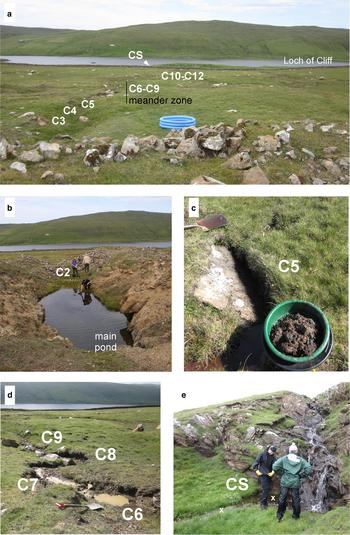
A small network of streams with a maximum width of 0.5 m drains the ponds in the disused chromite quarries at Cliff. These then coalesce to discharge into the Loch of Cliff, 400 m to the west of the Cliff quarries (Fig. 2). Rock samples were taken at the quarries and samples of sediments were collected from the streams at four separate locations (Figs 2 and 3; Table 1) and panned on site in a plastic pool. Four samples (C2–C5) were taken from the first location, at the commencement of the stream from the quarry pond. Sample C2 was taken at the immediate exit of the pond whereas samples C3–C5 were within 5 m of the Cliff quarries. A further four samples (C6–C9) were collected from the second location consisting of meanders 20–50 m downstream of the quarries. Another three samples (C10–C12) were taken downstream within 20–30 m of the exit of the meander zone and after a moderate increase in the slope gradient. Lastly, samples were collected from the stream as it plunged over the basal thrust of the ophiolite (CS).
Sampling sites at Cliff. (a) General view looking west from the disused chromitite pits showing all sampling sites. (b) View of the pond at the pit and of sample site C2. (c) Sample site C5. (d) View of the stream meanders and sample sites C6 to C9. (e) Sample site CS where the streams amalgamate and plunge over the basal thrust of the ophiolite; the site nearest to the Loch of Cliff.

Types of PGM in the Cliff chromitites and alluvial PGM recovered from the associated streams.

* PGM in the source rocks from Prichard et al. (Reference Prichard, Neary, Potts, Gallagher, Ixer, Neary and Prichard1986) and Prichard and Tarkian (Reference Prichard and Tarkian1988) for comparison purposes.
Sampling at Harold's Grave was conducted over a sloping E–W section spanning ~20 m along a stream draining outcrops of dunite cut by discontinuous layers of chromitite (Table 2). The section starts below a disused PGE-rich quarry and sampling included ten sites separated by three natural ponds, the first two aligned at the beginning of the section and the last one situated further down slope. The first five samples (HG1─HG5) were taken from the entrance and exit of the first two ponds. This area is covered largely by vegetation; it has a 10 cm topsoil with a high concentration of organic matter followed by a subsoil layer of significantly weathered rock. The soil produced negligible heavy concentrates and holes were excavated to a depth of 15–20 cm to obtain samples. The next four samples (HG6─HG9) were collected from a site with more outcrop of fractured dunite following a strong break of slope with increasing gradient. The last sample (HG10) was taken from the exit of the most distal pond, where the soil layer becomes thicker again. Overall, the dense fraction recovered from sampling sites at Harold's Grave was much smaller than that recovered from Cliff.
Types of PGM in the Harold's Grave chromitites and alluvial PGM recovered from the associated streams.

* PGM in the rocks are from Tarkian and Prichard (Reference Tarkian and Prichard1987).
Panned size fractions below 150 µm were examined for precious-metal minerals and PGM using a Cambridge Instruments (ZEISS NTS) S360 scanning electron microscope (SEM), coupled to an Oxford Instruments INCA energy plus energy dispersive X-ray analytical system (EDX) at Cardiff University. Qualitative analyses were obtained of the mineral surfaces, and polished blocks were utilized for fully quantitative analyses (Table 3). Operating conditions for the quantitative analyses consisted of a 20 kV accelerating voltage, 1 nA beam current and fixed beam size (~10–15 nm), with a live-time of 50 s for EDX. A cobalt reference standard was regularly analysed, in order to check for any drift in the analytical conditions. A comprehensive set of standards obtained from MicroAnalysis Consultants Ltd. (St Ives, Cambridgeshire) was used to calibrate the EDX analyser.
Results from quantitative EDX analyses of alluvial PGM from Cliff.

Results
Alluvial PGM at Cliff
A total of 108 PGM and 8 grains of gold have been identified in samples C3–C11 and CS collected from the streams at Cliff (Fig. 4a, Table 1). The PGM assemblage consists mainly of sperrylite (69 grains; 64% abundance), Pd-antimonides (18 grains; 17%) and members of the irarsite–hollingworthite solid-solution series (11 grains; 11%). Less abundant phases are Pd-sulfides (4 grains; 4%) and Pt-alloys, Pd-arsenide and laurite (6 grains in total; 6%). These PGM range in size from 8–110 µm and consist of single minerals as well as composite grains. The placer PGM reflect those observed in the source rocks, but exhibit less variety (Fig. 4a, Table 1). Quantitative analyses of polished surfaces of the typical PGM have been completed (Table 3).
(a) Pie diagrams showing the different PGM located in the chromite-rich rocks from Cliff (illustrative data, from Prichard et al. Reference Prichard, Neary, Potts, Gallagher, Ixer, Neary and Prichard1986 and Prichard and Tarkian, Reference Prichard and Tarkian1988), and in the streams panned in this study. (b) Bar graphs showing the number of alluvial PGM recovered with increasing distance from the Cliff quarries: pond exit zone (samples C3–C5), following meander zone (samples C6–C9), exit of the meander downstream (samples C10–11) and basal thrust (sample CS). See Table 1 for more detail.

Alluvial PGM in the streams at Cliff occur only within the first 100–150 m from the disused quarries (Fig. 2; Fig. 4b). Of the 108 PGM grains recovered, 22% are from the exit of the main pond close to the quarries, 58% are from the meander zone ~50 m away from the quarries, and 19% come from downstream of the meander exit, ~100 m away. However, only one PGM grain was recovered further downstream, where the stream plunges over the basal thrust. The type, abundance and size of the alluvial PGM do not vary significantly downstream (Table 1, Fig. 4b). Sperrylite, Pd-antimonides and sulfarsenides together with Pt-alloys and gold occur all along the stream. Palladium-sulfides and -arsenides persist closer to the quarries but are not present downstream and laurite, although scarce, appears furthest from the source (Fig. 4b). The main PGM recovered from the streams at Cliff are described next.
Sperrylite
Sperrylite is the most abundant PGM in the streams draining Cliff. It is commonly euhedral to subhedral and occurs in single cubes, octahedrons or aggregates of cubes that are more or less abraded. Single grains range in size from 15 to 110 µm and aggregates reach up to 100 µm across.
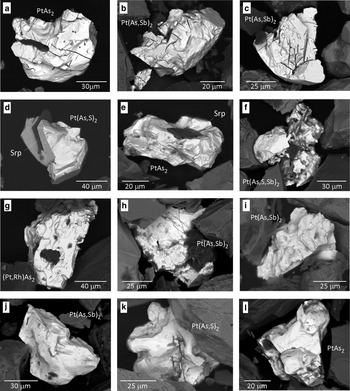
Angular sperrylite is more common close to the Cliff quarries (Fig. 5). This sperrylite is often cracked, with pits and furrows on the surface. It occasionally shows surface structures that may correspond to a cleavage (Fig. 5a–c) and it can occur intergrown with silicates preserved from the host rock (Fig. 5d–e), possibly chlorite or serpentine. Many grains of sperrylite show a more jagged and altered appearance with extensive pitting of the mineral surfaces (Fig. 5f–i). Grains or aggregates of euhedral sperrylite show more abraded edges with increasing distance from the quarries (Fig. 5j–l). In fact, ~40% of the sperrylite grains recovered from the streams are subhedral to subrounded (Fig. 6a–l) and occur mainly downstream, further from the quarries.
Back-scattered electron images of sperrylites recovered near the disused quarries from samples C3 to C5. Note the frequent cracks and jagged appearance.

Back-scattered electron images of sperrylites from further downstream to the disused quarries from samples C6 to C11. Note more rounded appearance than in Fig. 5.

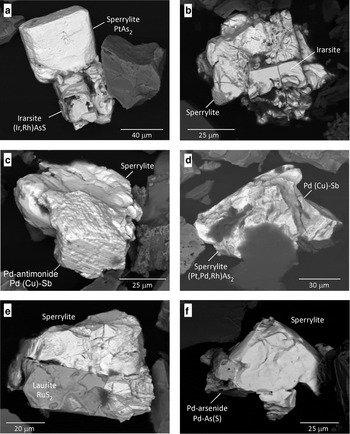
Sperrylite forms composite grains with irarsite (Fig. 7a–b) and Pd-antimonides (Fig. 7c–d). It also occurs with laurite (Fig. 7e) and with the only grain of Pd-arsenide identified (Fig. 7f), which attains a composition close to (Pd,Fe,Ni)2(As,S). Polished sections of sperrylite reveal other mineral associations (Fig. 8). These include: (1) Pt-alloys of the tetraferroplatinum type (PtFe) in elongate grains 40 µm across that are enclosed in broken sperrylite (Fig. 8a); (2) ruarsite (RuAsS) at the contact between sperrylite and stibiopalladinite (Fig. 8b); (3) platarsite (PtAsS) on the edge of abraded sperrylite (Fig. 8c); and (4) Ni-sulfides and -arsenides (millerite (NiS) – godlevskite (Ni9S8) and nickeline (NiAs)), which occur as euhedral or elongated inclusions <10 µm long within sperrylite (Fig. 8d).
Back-scattered electron images of composite grains of sperrylite located in the streams from Cliff.

Back-scattered electron images of polished sections of sperrylite and associated PGM and sulfides. (a) Elongate PtFe alloy enclosed in a broken cube of sperrylite. (b) Os-bearing ruarsite surrounded by an angular grain of sperrylite at the top and a Cu-bearing stibiopalladinite at the bottom. (c) Relicts of platarsite on the edge of an abraded sperrylite. (d) Inclusions of millerite (NiS) in sperrylite.

Sperrylite has a regular PtAs2 composition throughout the streams. Occasionally Rh (up to 9 wt.%), and minor amounts of Ru, Pd, Fe or Cu (≤ 2 wt.% each) have been detected. Antimony and S (≤ 4 wt.% each) can replace As (Table 3). This composition is similar to that of sperrylite in the source chromitites, which contain lower but regular Fe (<0.5 wt.%) and Sb concentrations (≤ 3 wt.%) (Prichard and Tarkian, Reference Prichard and Tarkian1988).
Palladium antimonides
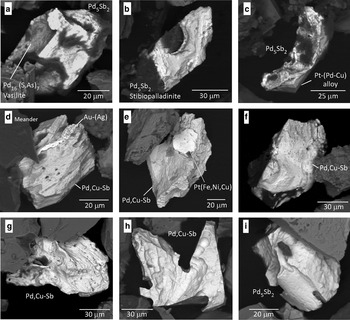
Palladium antimonides are the next most abundant PGM. The size of these PGM ranges from 20 to 105 µm in diameter. They are more altered than the sperrylites in the streams and only 23% of the grains recovered preserve a euhedral shape (Fig. 9a). This occurs normally close to the quarries, where grains are often broken (Fig. 9b–c). Within the meander zone, all the grains show a characteristic fine striation on their surfaces (Fig. 7c; Fig. 9d–g) denoting a lower resistance in the stream compared to sperrylite. The group of grains located at the exit of the meander zone all show an etched appearance (Fig. 9h–i). Polished sections of Pd-antimonide grains are smooth and internal inclusions are not observed. They typically exhibit homogeneous cores surrounded by an external rim of dismembered Pd-antimonide. Internal fractures are also common (Fig. 8b).
Back-scattered electron images of Pd-antimonides from the streams draining Cliff. (a–c) Pd-antimonides recovered near the disused quarries from samples C3 to C5. (a) Angular stibiopalladinite in a composite grain with a Pd-sulfide. (b) Stibiopalladinite with a ragged appearance and vast furrows on the surface. (c) Relict stibiopalladinite in a composite grain with a euhedral Pt–Pd–Cu alloy. (d–i) Pd-antimonides from further downstream to the disused quarries from samples C6 to 11. Note the extensive striation on the grain surfaces in the meander zone (d–g, samples C6 to C9) and the etched appearance with concave hollows further downstream (h–i, samples C10–C11). Pd-antimonides form composite grains with electrum in (d) and with tetraferroplatinum in (e).

Pd-antimonides often form composite grains with sperrylite (Fig. 7c–d, Fig. 8b), Pd-sulfides (Fig. 9a) and Pt-alloys consisting of Pt–Pd–Cu (Fig. 9c) and PtFe (Fig. 9e). The latter is a tetraferroplatinum included within a Pd-antimonide grain (Fig. 9e). In some cases, Pd-antimonide occurs with electrum (e.g. Fig. 9d) which forms a thin cover along the surface structures of the PGM.
Alluvial Pd-antimonides attain a composition that resembles stibiopalladinite (Pd31Sb12–Pd5+xSb2–x, where x = 0.04) with some compositions extending towards Pd5Sb3, according to ideal Pd–Sb phases of the Pd–Sb–Te system reported by Kim and Chao (Reference Kim and Chao1991) (Fig. 10a). Analyses of Pd-antimonides yield elevated Cu contents for most of the analysed grains (0–5 wt.% Cu; av. 2.7 wt.%), occasional contents of As (≤ 3.5 wt.%) and Ni (≤ 0.7 wt.%), and rare Fe (≤ 2.7 wt.%) (Table 3). No other PGE have been recorded other than Pt. Similar compositions are reported for Pd-antimonides in the host rocks at Cliff (mertieite-II – stibiopalladinite, Fig. 10a), although these contain more Pd, and some Pt up to 0.8 wt.% (Prichard and Tarkian, Reference Prichard and Tarkian1988).
Ternary diagrams (at.%) showing the composition of PGM from chromitites vs. streams at Cliff, Shetland ophiolite complex. (a) Pd–Sb–Cu ternary plot showing the composition of Pd-antimonides and Pt-alloys. Ideal phases within the Pd–Sb system are those reported by Kim and Chao (Reference Kim and Chao1991). (b) Ru–Os–Ir and Rh–Pt–Ir ternary plots showing the composition of laurite and sulfarsenides, respectively.

Sulfarsenides
End and intermediate members of the irarsite–hollingworthite–platarsite solid solution series have been located throughout the streams draining Cliff.
Irarsite is the most abundant phase (n = 6 grains) and occurs in single or composite grains and aggregates with sizes ranging from 30 to 84 µm in diameter. Irarsite in composite grains can be euhedral (Fig. 7a–b) and aggregates with etched surfaces also preserve the euhedral shape of the grains (Fig. 11a). More often irarsite occurs as subhedral, etched grains (Fig. 11b–c). In two cases it forms composite grains with sperrylite (Fig. 7a–b) and in one case with hollingworthite (Fig. 11c). Alluvial irarsite shows two compositional trends, one with increasing Rh content and the other with increasing Pt content (Fig. 10b). Normally, irarsite attains a (Ir,Rh)AsS composition, with average Rh contents of ~7 wt.% (Table 3). Some Sb is also detected (< 1.5 wt.%). Less often, irarsite contains elevated Pt up to 22 wt.% and Ru up to 10 wt.%. Iridium end-members have not been located in the streams although they are present in the rocks from Cliff (Tarkian and Prichard, Reference Tarkian and Prichard1987; Fig. 10b). Exceptionally, one grain of platarsite (PtAsS) and another of ruarsite (RuAsS) have been located in polished sections of the alluvial PGM. Platarsite occurs on the edge of a sperrylite grain (Fig. 8c, Table 3). Ruarsite is in a polyphase grain with sperrylite and Pd-antimonide and contains elevated Os up to 37 wt.% (Fig. 8b, Table 3). It is of note that irarsite in the rocks from Cliff is unusually Pt poor (Prichard and Tarkian, Reference Prichard and Tarkian1988) whereas Pt-bearing irarsite is observed in the streams (Fig. 10b).
Back-scattered electron images of sulfarsenides located in the streams from Cliff. (a) Aggregate of irarsite (IrAsS) grains with altered and pitted surface. (b) Single grain of irarsite with an etched appearance. (c) The only composite grain of irarsite and hollingworthite (RhAsS) found in the streams. Hollingworthite surrounds irarsite in the core. (d) Single grain of hollingworthite, subhedral and largely altered on surface. (e) Composite grain of hollingworthite and Pd-antimonide. (f) Composite grain of hollingworthite and a subhedral Cu–Pt–Pd-bearing particle of gold.

Hollingworthite occurs as subhedral grains (n = 5) with sizes from 10 to 80 µm across (Fig. 11c–f). Two of these are single grains (e.g. Fig. 11d) and the other three form composite grains with irarsite (Fig. 11c), Pd-antimonide (Fig. 11e) or gold (Fig. 11f). One grain was identified as end-member hollingworthite (RhAsS, Fig. 11d) whereas the others contain Pt (≤ 6 wt.%) and rarely Ir or Os up to 11 wt.% and 6 wt.%, respectively. Similarly to irarsite, hollingworthite contains more Pt in the placers than in the source rocks (Fig. 10b).
Less abundant PGM
Palladium sulfides (n = 4 grains) occur both as subhedral grains with Pd-antimonides close to the disused quarries at Cliff (n = 2 grains, Fig. 9a) and as single, broken grains 10–70 µm long in the meander zone. The two grains close to the quarries resemble vasilite in composition (Pd, Fe, Cu)16 (S, As, Sb)7 and the grains in the meander resemble vysotskite (Pd, Fe, Ni) (S, As) with low Fe and Ni contents (0–7 wt.% in total).
Platinum alloys (n = 3 grains) are different from each other in texture, composition and location along the stream. One grain close to the quarries is a relict euhedral Pt–Pd–Cu alloy (Pt0.78Pd0.15Cu0.07), 20 µm across, that occurs in a composite grain with a broken Pd-antimonide (Fig. 9c). The second grain is a 50 µm long tetraferroplatinum (Pt1.05(Fe,Ni,Cu)0.95) included in a wrinkled Pd-antimonide from the meander zone (Fig. 9e). Another particle of similar composition was also located enclosed by sperrylite in polished sections (Fig. 8a). The third grain is a subrounded, single tetraferroplatinum (Pt2.7(Fe,Cu,Ni)1.3), 60 µm across, that contains lower Ni and Cu totalling < 5 wt.%. This last grain belongs to sample C10, downstream, after the meander area. Only one analysis of a 5 µm sized Pt–Pd–Cu–Sb alloy from the source chromitites is available in the bibliography (Prichard and Tarkian, Reference Prichard and Tarkian1988) and comparatively, the alluvial Pt–Pd–Cu alloy found is larger and contains more Pt and less Pd (Fig. 10a).
Laurite (n = 2 grains) is rare in the alluvial assemblage. One grain with Pd-antimonide (Fig. 7e) in the meander is euhedral and has a pure composition of RuS2. The other grain is the only PGM recovered from sample site CS (Fig. 2), the furthest from the Cliff quarries. This is a subhedral single grain with a composition similar to (Ru,Os) (S,As)2, with up to 14 wt.% Os. The presence of both Os-Ir-bearing laurite and Os-free laurite with inclusions of native Os was also noted in the source rocks (Tarkian and Prichard, Reference Tarkian and Prichard1987; Fig. 10b). Much of this Os is likely to be derived from the alteration of Os-laurite to pure RuS2 during serpentinization of the ophiolite (Prichard et al., Reference Prichard, Barnes, Dale, Godel, Fisher and Nowell2017). Both types of laurite remain in the placers.
Other less abundant PGM in the placers include one grain of palladoarsenide (Fig. 7f), and one grain of ruarsite and another of platarsite (Fig. 8b–c) found only in the polished sections of the alluvial PGM.
Gold
Eight Au-bearing grains from 30 to 80 µm in diameter have been identified. Five of these occur as single particles of electrum with up to 25 wt.% Ag (Table 3). Only one irregular grain of electrum was recovered close to the Cliff quarries (Fig. 12a). Electrum in the meander zone occurs as subhedral pitted grains (Fig. 12b), round smooth grains (Fig. 12c) and as a porous grain with a delicate structure (Fig. 12d). Gold-bearing phases also occur as thin covers on the surfaces of PGM and Au. For example, pitted electrum is observed on the surface of a Pd-antimonide (Fig. 9d) and pitted Au-(Cu–Pt–Pd) occurs on the surface of a composite grain of hollingworthite and Au (Fig. 11f). Downstream, a Au–Pd cover with up to 2.6 wt.% Pd was observed on a composite grain of Pd-antimonide and sperrylite. Some placer gold particles at Cliff (Fig. 12a–d) mimic the textures of the gold grains located in the source rocks, where rounded and porous particles were detected (Fig. 13a–b).
Back-scattered electron images of gold grains in the stream from Cliff (a–d) and from Harold's Grave (e–f). (a) Irregular grain of electrum located close to the Cliff quarries. (b) Subhedral grain of pure gold with a very pitted surface located downstream, in the meander zone. (c) Rounded and polished grain of electrum downstream. (d) Porous grain of electrum with a delicate texture. (e, f) Globular grains of pure gold from the alluvial sands at Harold's Grave.

Back-scattered electron images of gold and rare PGM in the source rocks. (a, b) Rounded porous primary Au, similar to the detrital electrum found in the placers. (c) Pt-Cu-Ni oxidized phase. (d) Pd-Cu-Ni oxidized phase on the edge of sperrylite and in stringers extending from the sperrylite. (e) Sperrylite and Pd antimonide with Cu both broken by chlorite laths. Sperrylite is partially altered to a Pt-Cu-Ni-oxide. (f) Breithauptite (NiSb) containing ~1% Pd coated on the edge by Pd antimonide which contains a small grain of geversite (Pt–Sb). These altered PGE-bearing phases (c–f) are all absent in the placer assemblage.

Alluvial PGM at Harold's Grave
The results from panning at Harold's Grave were less successful and the source rocks here are dominated by IPGM (Table 2). Platinum-group minerals and gold were recovered from samples HG1, 2, 7 and 10 (Table 2), so they are erratically distributed though the sampling sites. One euhedral composite grain of 40 µm laurite (Ru0.98S2.02) with iridium (Ir–Fe–(S,As)), as well as one 60–μm grain of osmium (Os0.9Ir0.06Ru0.04) with subhedral shape and pitted edges were recovered from the panned material.
In addition, four Au grains up to 300 µm × 400 µm in size were also recovered. They are all relatively pure in terms of composition. Two grains of Au, both with minor contents of Cu (4–17 wt.%), exhibit the same fine porous texture on their surfaces, although one is euhedral and the other is subrounded. The other two grains (Fig. 12e–f) are subhedral and very porous aggregates. They consist of subrounded particles of Au with minor amounts of Ag in composition (6 wt.% on average) and show formations of pure dendritic Au on their surfaces.
Discussion
Examination of the placer PGM derived from the Shetland PGE-rich chromitites at Cliff and Harold's Grave allows for the comparison between PGM assemblages in the source rocks and streams in order to identify the most relevant modifications of the alluvial minerals and assess their origin.
Evolution of placer PGM from the rocks
The source rock PGM assemblage is represented by those listed in Tarkian and Prichard (Reference Tarkian and Prichard1987) and Prichard and Tarkian (Reference Prichard and Tarkian1988), and it is also described in Prichard et al. (Reference Prichard, Neary, Potts, Gallagher, Ixer, Neary and Prichard1986, Reference Prichard, Potts, Neary, Lord and Ward1988, Reference Prichard, Ixer, Lord, Maynard and Williams1994, Reference Prichard, Barnes, Dale, Godel, Fisher and Nowell2017). Estimation of the percentages of each type of PGM given in Tables 1 and 2 and in Fig. 4a, is illustrative and for comparison purposes only. Prichard et al. (Reference Prichard, Ixer, Lord, Maynard and Williams1994) also observed oxidized Pt and Pd phases in the chromite-rich rocks at Cliff. More recently, an extensive study of the PGM was carried out to find Os-bearing minerals for Os isotope analysis (e.g. Prichard et al., Reference Prichard, Barnes, Dale, Godel, Fisher and Nowell2017). This revealed, in addition to those PGM already described, significant oxidation of the PGM including oxidized Pt–Pd–Ni–Cu-alloys and sperrylite. One grain of Pd–O, 60 µm in diameter, was also located. There is also the occurrence of breithauptite (NiSb) containing ~1% Pd as well as geversite (PtSb2), Pt–Fe alloy and one Pd–Te–Sb–Bi (Fig. 13c–f). In the more recent survey it became clear that many of the laurite and clusters of PPGM grains have sizes in the rocks of 30–40 µm, reaching up to 60 µm.
Cliff
The placer PGM assemblage recovered at Cliff reflects the type and abundance of those PGM in the rocks but there is less variety in the alluvial concentrates (Fig. 4a). Alluvial PGM are equally dominated by sperrylite, Pd-antimonides and sulfarsenides. In addition, Pd-sulfides, Pd-arsenide, platarsite and ruarsite (totalling 8 grains only) were also recovered from the streams. Millerite and nickeline are barren of PGE and occur only as internal inclusions in sperrylite. Scarce Pt-alloys (Pt–Pd–Cu, Pt–Fe) and laurite complete the alluvial PGM assemblage. Electrum and Cu–Pt- and Pd-bearing gold also occur as both single grains and coatings on detrital PGM. Alluvial PGM and associated gold have average sizes of 21 µm × 76 µm, and range from 5 to 110 µm in diameter.
Compared with the source rocks, there is a clear increase in sperrylite (>24%) and decrease in stibiopalladinite (<10%), irarsite and hollingworthite (<7%), and Pt-alloys (<2%) in the streams. Composite PGM of sperrylite with Pd-antimonide, irarsite and laurite occur in both the source rocks and placers. Laurite is equally scarce in rocks and streams (Fig. 4). The least abundant PGM in the rocks such as native Os, Rh–Sb–S, geversite (PtSb2), potarite (PdHg) or rare Pd–Te phases are absent in the streams. Nickel- and Cu-bearing phases in the rocks such as ruthenian pentlandite, hongshiite (PtCu), Ni–Cu alloys and native Cu, have not been located in the alluvial concentrates either. Likewise, oxidized Pt- and Pd-phases are absent in the streams.
The composition of the common PGM between rocks and streams is rather similar, although some alluvial PGM such as irarsite, hollingworthite and Pt-alloys exhibit increase Pt contents while alluvial Pd-antimonides show a progressive loss of Pd. Increased Rh content is also observed in alluvial irarsite (Fig. 10a,b). Gold-bearing particles have a similar composition (Au–Pd, Au–Cu–Pt), although electrum dominates the alluvial assemblage.
Placer PGM are concentrated mainly where the stream meanders have formed, from which 58% of the PGM found were recovered (Fig. 4b). Only one grain of laurite was located towards the basal thrust. At this point the slope gradient and the water flow are intense, forming a waterfall under which loose sediment is deposited (Fig. 3e) and where a greater accumulation of heavy minerals is expected. Thus, it is clear that a great part of the alluvial PGM has been concentrated close to the quarries, particularly in the suitable meander zone, but PGM have not been able to travel further downstream.
The types of placer PGM do not vary significantly downstream. The most abundant PGM persist throughout the stream and have similar sizes. However, the shape of the alluvial PGM does vary and the PGM often show signs of disintegration downstream. Sperrylite and Pd-antimonides exhibit these variations most clearly as they are the most common PGM observed. Sperrylite, where it occurs close to the source rocks, retains its euhedral and angular form (Fig. 5) whereas further downstream it shows smoother surfaces and becomes progressively more rounded (Fig. 6). Pd-antimonides, where they are observed close to the quarries, are subhedral and have silicates attached to their surfaces whereas in the meander zone, these silicates are absent and the PGM may show lamellar structures. Further downstream, etching of Pd-antimonides is common in the form of concave faces or irregular surfaces (Fig. 9). The same is observed for Pd-sulfides, which are euhedral close to the quarries but appear broken down in the meander zone. Also for Pt-alloys, which are enclosed by other PGM close to the source rocks but appear as single, subrounded Pt–Fe particles downstream.
Harold's Grave
At Harold's Grave, PGM are dominated by IPGM (Tarkian and Prichard, Reference Tarkian and Prichard1987; Prichard et al., Reference Prichard, Potts, Neary, Lord and Ward1988, Reference Prichard, Barnes, Dale, Godel, Fisher and Nowell2017). The IPGM assemblage in the rocks (Table 2) consists of laurite, osmium, irarsite and IrSbS. The size of the IPGM in the rocks ranges from a few micrometres to 500 µm, as found by Badanina et al. (Reference Badanina, Malitch, Lord and Meisel2013, Reference Badanina, Malitch, Lord, Belousova and Meisel2016) from concentrates of the rocks produced using the hydroseparation technique, and by Prichard et al. (Reference Prichard, Barnes, Dale, Godel, Fisher and Nowell2017) using 3D X-ray tomography. The PPGM are hollingworthite and scarce hongshiite (PtCu), Pt-alloy (Pt–Pd–Cu), genkinite and Pd-, Rh- and Ni-bearing antimonides totalling 9 grains only (<10%; Table 2). The survey by Prichard et al. (Reference Prichard, Barnes, Dale, Godel, Fisher and Nowell2017) corroborates that PPGM, including minor sperrylite, Pt–Fe alloys and platarsite, typically occur in clusters with Ru-pentlandite and some IPGM interstitially to chromite grains.
The placer PGM located at Harold's Grave (n = 3 grains) consist of laurite, iridium alloy and osmium alloy, with sizes ranging from 20 µm to 60 µm. No PPGM or pentlandite were recovered (Table 2). Despite the scarce PGM recovered, these represent the most abundant PGM in the IPGE-rich chromitites at Harold's Grave. The presence of gold is noteworthy. Detrital grains of Au–Cu have been detected but electrum and native Au also occur in porous aggregates up to 400 µm across with dendritic growths of native Au on surface. The sizes of the alluvial PGM and Au at Harold's Grave are in the range of those in the source rocks. No other statistically significant conclusions can be drawn due the low recovery of placer PGM in the panned samples.
Modification of PGM and PGE mobility
Overall, only slight differences are observed between the PGM assemblages of the rocks and streams:
(1) Those PGM enclosed by or in the edges of chromite grains in the source rocks are poorly represented or absent in the streams, suggesting that they may remain protected by their host minerals in the alluvial sands. This is mainly the case for Ru- and Os-PGM (laurite, osmium) within chromite grains in the rocks. Potarite (PdHg) also occurs in chromite, and antimonides (RhSbS, IrSbS, Rh–Ni–Sb, NiSb, Pd–Cu–Sb and genkinite) are often located in clusters within irarsite (Tarkian and Prichard, Reference Tarkian and Prichard1987; Prichard and Tarkian, Reference Prichard and Tarkian1988). The lack of these PGM in the streams is more evident at Harold's Grave, where the source chromitites are IPGE-enriched. In this case, however, the small dense fraction recovered may reflect lower erosion and a more restricted liberation of the host minerals and PGM into the streams.
(2) PGM that occur in the silicate matrix interstitial to chromite grains in the rocks, less protected against weathering, are largely represented in the streams at Cliff. These are sperrylite, stibiopalladinite, irarsite–hollingworthite–platarsite and Pt-alloys. Of these, sperrylite is the most resistant whereas Pd-, Ir-and Rh-PGM decrease in number and show slight changes in their composition (Figs 4, 10). Their abundance and composition suggest some progressive Pd-loss and Pt-gain in the streams. For example, alluvial stibiopalladinite grains extend towards Pd5Sb3 compositions and show a loss of up to 14 wt.% Pd. The alluvial Pt–Pd–Cu alloy contains less Pd (< 8 wt.%) and more Pt (>25 wt.%) than its counterpart in the rocks, and isoferroplatinum (Pt3Fe) only occurs in the streams. Irarsite and hollingworthite also contain more Pt (>4%) in the streams than in the rocks (Fig. 10b).
(3) There are some losses of PGE-bearing phases from the rock assemblage into the streams. The most notable of these is the loss of all Pt and Pd oxides, which are poorly resistant compounds typically on the edges of broken PGM (Fig. 13d–e) that are not preserved during the transportation process. The disappearance of PGE-oxides or -hydroxides from source rocks in the fluvial environment has been reported previously from rivers draining the Great Dyke in Zimbawbe (Oberthür et al., Reference Oberthür, Weiser and Gast2003, Reference Oberthür, Weiser, Melcher, Gast and Wöhrl2013) and the Freetown layered complex in Sierra Leone (Bowles et al., Reference Bowles, Suárez, Prichard and Fisher2017). Bowles et al. (Reference Bowles, Suárez, Prichard and Fisher2018) also noted the low stability of Cu-bearing sulfides and PGM such as tulameenite (Pt2FeCu) during weathering of the rocks.
The low stability of Cu- and also Ni-bearing phases is also inferred from the eroded chromitites at the Shetland complex, as most of them (e.g. Ru-pentlandite, hongshiite PtCu and Cu-bearing alloys) are largely absent in the streams. All these phases occur in interstitial positions to chromite grains in the rocks. For example, hongshiite occurs at the edge of sperrylite and intergrown with Ni–Cu alloys, while Pt–Pd–Au–Cu and Pd–Cu alloys occur in composite grains with native Cu (Tarkian and Prichard, Reference Tarkian and Prichard1987; Prichard and Tarkian, Reference Prichard and Tarkian1988). Of all these, only sperrylite and one Pt–Pd–Cu alloy in stibiopalladinite remain in the streams. It is worth noting that Cu-bearing phases are scarce in the source rocks (Table 2) and some of them could have been missed during preparation of the panned samples. However, Ni- and Cu-intermetallic compounds and sulfides, and moreover pentlandite, are highly unstable phases in supergene conditions, and Ni and Cu can be lixiviated in a wide range of oxidizing Eh and acid to neutral pH conditions (Garrels and Christ, Reference Garrels and Christ1965; Williams, Reference Williams1990; Takeno, Reference Takeno2005). Thus, Cu-bearing PGM from the Shetland chromitites, if not protected by their host (e.g. Fig. 8a,d; Fig. 9e), may have been destroyed during weathering.
(4) The textures and composition of the gold grains (Au–Pd, Au–Cu) in the rocks almost exactly mimic those in the placers with both rounded grains and spongy textured grains observed (Fig. 13a,b). They are clearly an integral part of the precious-metal occurrence at Cliff as they are located in the rocks and have not been derived from carriage by e.g. boulder clay from outside the area. Only dendritic growths of pure Au over Au-(Ag) grains at Harold's Grave may reflect some remobilization of Au at the grain scale (Fig. 12e–f). These particles satisfy the model for secondary Au formation described in Hough et al. (Reference Hough, Noble and Reich2011), which integrates a primary origin of the Au grains with secondary mobilization and aggregation processes on grains surfaces. This secondary Au typically displays high purity, very fine crystallinity, and a wide variety of morphologies, resulting from Au/Ag dissolution and Au precipitation acting simultaneously on the surface of the grains.
Although it is difficult to evaluate the metal mobility based on mineralogical observations alone, these data suggest that there is a preferential mobility of Pd, Cu, Ni and some Au over other metals (i.e. Pt, Rh, Ir, Os, Ru) in the secondary environment of the Shetland ophiolite complex.
Origin of the PGM
The overall similarity of the PGM assemblages of the PGE-rich rocks and the associated streams suggests that the PGM have weathered from the rock and their short transport distances have allowed them to preserve largely their compositions and often euhedral shapes. There are some losses from the rock assemblage, but the PGM assemblage in the rocks is very similar to that in the streams. The PGM in the streams are of a similar size to the larger PGM in the rocks reflecting a mechanical transportation process rather than a growth in situ of the PGM. This suggests early stages of dispersal of the PGE from the quarries.
The long-standing debate concerning the mechanical erosion of PGM from the source rocks versus the growth of PGM in situ downstream of the source has been a point of controversy for years. The sometimes contrasting mineralogical assemblages and PGM composition between sources and placers, the delicate morphologies and larger size of placer nuggets compared to primary PGM in the rocks or their isotopic signatures, all have been used in discussion to support both models.
It is considered that placer PGM are normally primary and are mechanically eroded from the source rocks (e.g. Cabri et al., Reference Cabri, Harris and Weiser1996; Weiser, Reference Weiser2002; and references therein). In some complexes they may indeed be large PGM that are simply eroded from the rocks, as for example in some Ural-Alaskan type complexes. Some large PGM have been located in lode placers from the Nizhni Tagil and Kachkanar dunite massifs in the Uranium Platinum Belt, in the Vetnaya-Vyvenka Belt of Kamchatka, Russian Far East, or in the dunite core of the Pt-rich Alto Condoto Complex in Colombia (Weiser, Reference Weiser2002 and references therein). Rare, large PGM also occur in the oxidized Main Sulfide Zone of the Great Dyke, Zimbabwe (Oberthür et al., Reference Oberthür, Weiser and Gast2003) and also in the Shetland chromitites (Badanina et al., Reference Badanina, Malitch, Lord and Meisel2013).
Doubt was cast when Ottemann and Augustithis (Reference Ottemann and Augustithis1967) proposed that polyphase Pt–Fe nuggets in a laterite capping the massif of Yubdo (Ethiopia) formed at low temperatures by ‘element agglutination’. Later, it was proposed that weathering of the rocks aided by organic acids in the soils alter and break down primary PGM liberating the PGE, which can be transported in solution through the soils down slope. Soils close to rivers or stream banks where Eh and pH conditions change allow for the precipitation of the PGE and the growth of PGM (Bowles, Reference Bowles1986; Reference Bowles, Prichard, Potts, Bowles and Cribb1988; Bowles et al., Reference Bowles, Giże and Cowden1994a,Reference Bowles, Giże, Vaughan and Norrisb, Reference Bowles, Giże, Vaughan and Norris1995). Selective metal leaching during weathering to form supergene PGM has been documented for the perfectly crystallized eluvial and alluvial PGM from the Freetown Igneous Complex, Sierra Leone (e.g. Bowles Reference Bowles1995; Bowles et al., Reference Bowles, Prichard, Suárez and Fisher2013, Reference Bowles, Suárez, Prichard and Fisher2017, Reference Bowles, Suárez, Prichard and Fisher2018). Also for the oxidized Main Sulfide Zone of the Great Dyke, Zimbabwe and associated Pt-dominated alluvials (Oberthür et al., Reference Oberthür, Weiser and Gast2003), as well as for the botryoidal and arborescent Pt–Pd aggregates and the Pt-enriched rims on detrital PGE-alloys from the Bom Succeso stream in Minas Gerais, Brazil (Cabral et al., Reference Cabral, Beaudoin, Choquette, Lehmann and Polônia2007, Reference Cabral, Lehmann, Tupinambà, Schlosser, Kwitko-Ribeiro and Abreu2009).
There are many other examples of PGE-bearing phases that apparently formed in low temperature conditions (~100–25°C) in varied deposits. One example are the internally zoned Au–Pd arborescent grains from Hope's Nose, UK (Leake et al., Reference Leake, Bland, Styles and Cameron1991) and Serra do Espinhaço, Minas Gerais (Cabral et al., Reference Cabral, Tupinanbá, Lehmann, Kwitko-Ribeiro and Vymazalová2008). Another example are the rosettes of native Pd on the surface of gold nuggets from Gongo Soco Fe-ores, Minas Gerais (Cabral and Kwitko-Ribeiro, Reference Cabral and Kwitko-Ribeiro2004) and the Pd–Cu rosettes coating goethite in the Limoeiro Ni–Cu–(PGE) deposit (Mota-e-Silva et al., Reference Mota-e-Silva, Prichard, Suárez, Ferreira Filho and Fisher2016). Neoformed Pt–Ir–Fe–Ni alloys and layers of Ir-rich alloys on multistage PGE-grains are reported from Ni-laterites in the Falcondo mining area, Dominican Republic (Aiglsperger et al., Reference Aiglsperger, Proenza, Font-Bardia, Baurier-Aymat, Galí, Lewis and Longo2016). It appears that supergene precipitation of PGE could be aided by both biogenic activity (Reith et al., Reference Reith, Zammit, Shar, Etschmann, Bottrill, Southam, Ta, Kilburn, Oberthür, Bail and Brugger2016; Bowles et al., Reference Bowles, Suárez, Prichard and Fisher2018) and inorganic processes such as bioreduction or electrochemical accretion of metals (e.g. Cabral et al., Reference Cabral, Radtke, Munnik, Lehmann, Reinholz, Riesemeier, Tupinambá and Kwitko-Ribeiro2011; Aiglsperger et al., Reference Aiglsperger, Proenza, Font-Bardia, Baurier-Aymat, Galí, Lewis and Longo2016).
The resolution to this controversy may be partially explained in that both ideas are correct in certain circumstances. Mechanical erosion may be more prominent in high latitudes where mechanical erosion dominates over chemical weathering. However, in tropical conditions, chemical weathering dominates and PGM may precipitate in situ, perhaps in soils or stream banks distally to the source rocks following the chemical disintegration of the primary PGM. Rock-weathering conditions in humid and temperate zones, with high rainfall and abundant organic material would enhance PGE mobility and redeposition. It is clear that both primary (magmatic or hydrothermally modified) PGM mechanically liberated from the rocks and secondary, reworked or neoformed supergene PGE-bearing minerals, can coexist in some eluvial and alluvial placers.
In the Shetland Islands mechanical erosion dominates and is operating only on a small scale very close to the source. The PGM in the streams reflect the source rocks as they are very close to them. There are signs of disintegration of the PGM as they travel downstream. Pd-antimonides weather to produce furrowed surfaces and concave etched surfaces whereas sperrylite starts with jagged edges that become rounded downstream. The greater initial disintegration of Pd-bearing phases over sperrylite observed at Cliff may be a result of the greater mobility of Pd over Pt which has been consistently observed, including in surficial weathering environments (e.g. Fuchs and Rose, Reference Fuchs and Rose1974; Wood and Vlassopoulos, Reference Wood and Vlassopoulos1990; Prichard and Lord, Reference Prichard and Lord1994; Salpéteur et al., Reference Salpéteur, Martel-Jantin and Rakotomanana1995; Prichard et al., Reference Prichard, Sá and Fisher2001; Suárez et al., Reference Suárez, Prichard, Velasco, Fisher and McDonald2010, Bowles et al., Reference Bowles, Prichard, Suárez and Fisher2013). Sperrylite is harder than Pd-antimonides and has proved to be considerably more durable and resistant to weathering and mechanical erosion (e.g. Oberthür et al., Reference Oberthür, Weiser and Gast2003, Reference Oberthür, Weiser, Melcher, Gast and Wöhrl2013; Suárez et al., Reference Suárez, Prichard, Velasco, Fisher and McDonald2010), which also appears true in this study of placer PGM at the Shetlands ophiolites.
Conclusions
The PGM assemblage in the streams at Cliff consists dominantly of sperrylite and Pd-antimonides and this is reflected by the PGM found in the rocks. The extreme proximity of the source to the streams and the well documented PGM assemblage in the rocks allows a comparison of PGM compositions and sizes in the rocks against those in the streams. This reveals that the assemblages are very similar although there are notable absences of some PGM types in the streams. The Pt and Pd oxides in the rocks are missing in the streams, demonstrating that they are very fragile and unlikely to survive erosion. Nickle sulfides and Cu-bearing PGM and alloys are also unstable phases that remain in the streams only when protected by their original host minerals. Thus there is a continuum from magmatic formation and hydrothermal upgrading of the PGM assemblage in the rocks through to initial weathering and oxidation of the PGM in the rocks through to erosion into the streams. Within the streams there is further evidence of change in the PGM assemblage. More resistant minerals such as sperrylite persist downstream becoming more rounded whereas Pd antimonides can be observed in the early stages of disintegration with concave etching on their surfaces. Laurite and members of the irarsite–hollingworthite–platarsite solid-solution series are also preserved in the streams. The common Pt–Fe alloys observed in many placer deposits are largely absent. The gold grains in the streams are eroded from the Cliff assemblage in the rocks as indicated by the close similarity of the textures that they show in both the rocks and in the streams. The presence of Au–Pd and Au–Cu layers over primary PGM and of native Au in dendritic growths may indicate a local remobilization of these elements in surface conditions, at least on the grain scale. Otherwise the PGM assemblage preserved in the streams at Cliff is early stage with PGM having been mechanically eroded from the nearby source rocks and there is no evidence of growth in situ of PGM in the placers rather mechanical disintegration. This is early stage mechanical erosion and so the usual Os–Ir–Ru alloys that characterizes ophiolitic placer PGM are not present. This is more evident at Harold's Grave, where the few IPGM found in the streams reflect the restricted release of the PGM enclosed by primary minerals in the source rocks. In general, the alluvial PGM assemblage found in the streams draining the Shetland complex mimics the rather unusual suite of PGM in the PGE-rich ophiolitic rocks.
Acknowledgements
We would like to thank The Department of Education, Universities and Research of the Basque Government (Refs. IT762-13, BFI-2011-254) for additional funding and Dr. R.S. Garcia (UPV/EHU) for her technical support. We also thank the helpful comments by Dr. F. Zaccarini and another anonymous referee, which greatly improved the quality of the manuscript, and Drs. B. O'Driscoll and I. McDonald for the editorial handling. The coauthors of this work are very grateful to D.R. Sharp, A. Colling and Dr. J.F.W. Bowles for their contributions to this manuscript. We dedicate this work with all of our love to Prof. Hazel M. Prichard and John S. Watson.