


Introduction
In our early 21st century, information-rich, social media-driven environment, concerns over conflicts of interest (COI) in medicine have intensified, blossoming into frank public distrust of both physicians and the health care system at large. A 2024 study by Perlis et al. found that trust in physicians and hospitals plunged from approximately 72% in April 2020 to just 40% by January 2024.Reference Perlis1 Recent data from the 2025 Edelman Trust Barometer revealed that nearly two-thirds of respondents believe establishment leaders, including medical experts, frequently mislead the public.2 Findings from the American Board of Internal Medicine Foundation similarly underscore severe challenges and gaps in public trust toward health care providers and institutions in the United States.3
In this climate, political dynamics across the spectrum have at times amplified public distrust, whether through ideological skepticism of science or institutional failures to communicate transparently with the public. Some political figures have responded to growing public distrust by appointing individuals without formal scientific or medical training to influential roles to reshape health policy. Driven by ideological skepticism, these appointees have in turn restructured Food and Drug Administration scientific advisory boards, often replacing established experts with heterodox commentators or laypersons, while seeking to curtail government funding for investigators publishing in peer-reviewed journals with longstanding academic pedigrees.Reference Glenza, Ciruzzo, Marish and Wang4 These actions have occurred alongside a growing hostility toward evidence-based governance and the national scientific institutions charged with it. In August 2025, that hostility turned violent when a shooting at the Centers for Disease Control and Prevention (CDC) occurred.Reference Mandavilli and McFadden5 In the wake of this tragedy, more than 750 employees at the Department of Health and Human Services signed a letter urging the department’s leadership to stop spreading misinformation.Reference Kekatos6
While the causes of the crisis of trust are multiple,Reference Ansberry7 the work of physician experts, commonly referred to as Key Opinion Leaders (KOLs), on behalf of pharmaceutical and medical device companies is a prominent factor.Reference Ansberry and Sismondo8 KOLs leverage professional expertise, status, and peer influence to accelerate the dissemination and implementation of medical innovations. Their positive, albeit weak, influence is reflected in the dissemination and uptake of evidence-based practices, such as statin prescribing among patients with diabetes and colorectal cancer screening (systematic reviews demonstrate that the use of local opinion leaders can modestly, but consistently, improve clinicians’ adherence to recommended practices).Reference Awad, Zauber and Flodgren9 Conversely, strongly adverse outcomes linked to KOL activity, such as the mid-20th-century thalidomide tragedy and the ongoing opioid crisis, stand out in public memory and scholarly literature.Reference Sah, Fugh-Berman, Vanderbes, Keefe, Attkisson, Abramson and Goldacre10
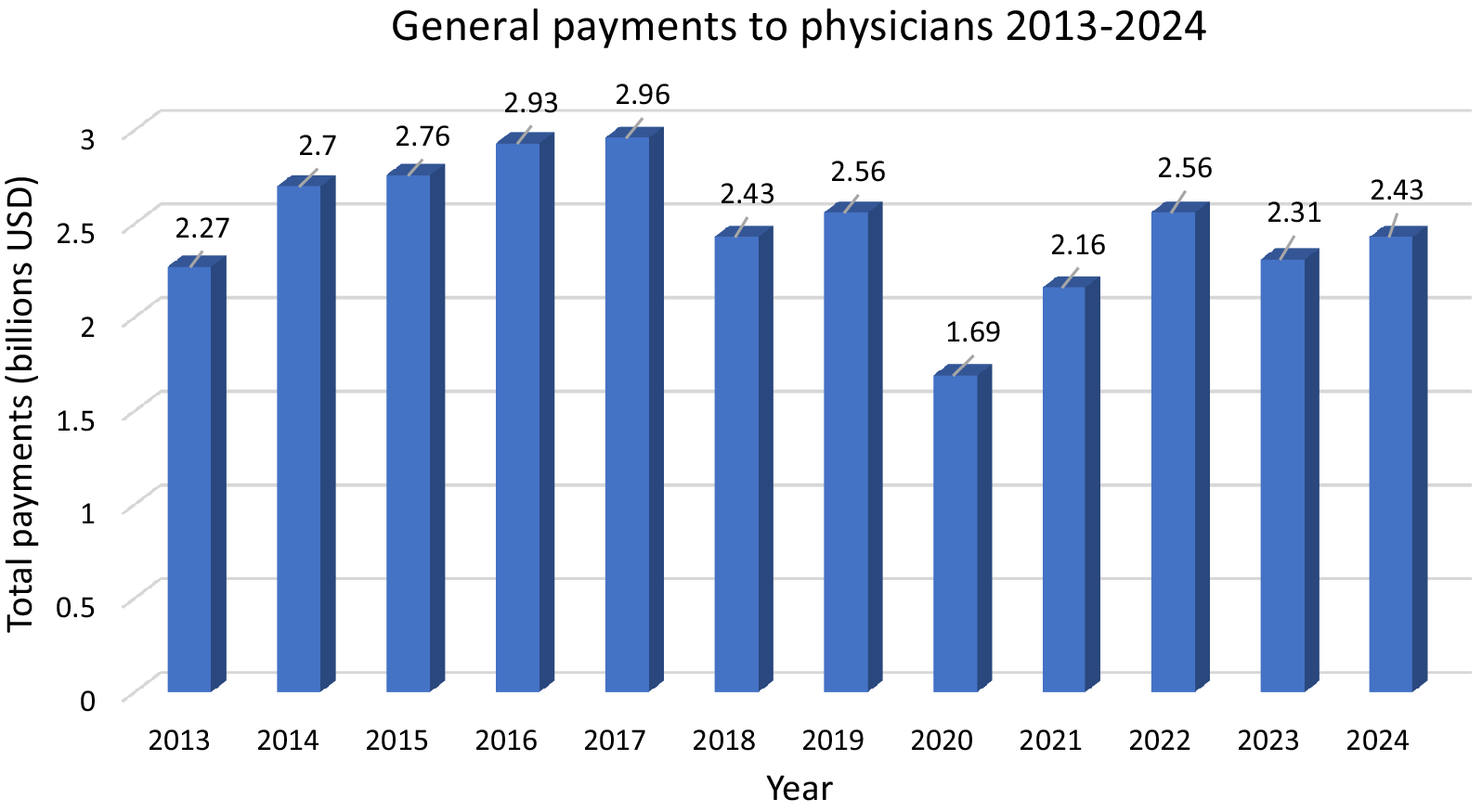
Industry payments to physician KOLs in the United States, covering consulting, speaking engagements, and other services, total roughly $2.5 billion annually (Figure 1).11 A systematic review by Mitchell et al. found consistent positive associations between increased prescribing and industry payments to physicians (binning all payments together rather than addressing payments to KOLs specifically), with evidence of both temporal precedence and dose-response relationships.Reference Mitchell12
General payments to physicians from industry in billions of USD by year, as reported in the CMS Open Payments database.

Figure 1. Long description
The X-axis is labeled Year and ranges from 2013 to 2024. The Y-axis is labeled Total payments billions U S D and ranges from 0 to 3 in increments of 0.5.
Twelve blue vertical bars represent the data points with specific values printed above each bar:
* 2013: 2.27
* 2014: 2.7
* 2015: 2.76
* 2016: 2.93
* 2017: 2.96
* 2018: 2.43
* 2019: 2.56
* 2020: 1.69
* 2021: 2.16
* 2022: 2.56
* 2023: 2.31
* 2024: 2.43
The trend shows a steady increase from 2013 to a peak in 2017, followed by a decline that reaches its lowest point in 2020, and a subsequent partial recovery through 2024.
Against this backdrop, for-profit, industry-aligned credentialing programs have begun to define and train KOLs, insidiously and without public accountability. The Accreditation Council for Medical Affairs (ACMA), for example, offers KOL credentialing wholly within a commercial framework,13 while the Collaborative Institutional Training Initiative (CITI), originally developed as an academic consortium, was later acquired by a for-profit entity.14
Such examples demonstrate that both newly created and long-standing programs can be controlled by commercial interests. Without independent alternatives, these models risk entrenching standards that serve corporate interests over the public good. There is an urgent need to establish a credible, academically and patient-governed alternative KOL credentialling pathway.
An important caveat is the acknowledgement that there is a central structural limitation of any KOL reform. KOLs are selected by companies not only for clinical expertise but for alignment with strategic messaging and influence.Reference Hadland15 Analyses of pharmaceutical marketing practices and internal industry documents demonstrate that firms systematically identify and engage influential physicians to shape prescribing behavior.Reference Steinman16 Independent certification of KOLs alone cannot alter this underlying selection logic. However, mitigation of corrupted KOL practice is a better solution than inaction. The purpose of independent KOL certification will be to establish standards that institutions, patients, and professionals can use to define credible KOL practice and to mitigate KOL-caused societal harm.
To address these challenges, we propose formal KOL training and certification in Public Scholarship (PS). PS, understood broadly as academic work carried out in partnership with nonacademic communities to advance the public good,Reference Ellison and Eatman17 will provide a framework and boundaries for ethical dissemination and implementation of industry led advances in medical therapies and interventions. We will argue that it is not feasible for physician scientists to sever ties with industry or eliminate the KOL role; rather, through PS training we will guide KOLs to operate within a clearly defined ethical framework grounded in beneficence, trust, transparency, accessibility, reciprocity,18 and civic accountability.
This commentary begins by tracing the historical origins and evolution of the KOL role, detailing its emergence from foundational theories in communication and sociology to its central place in contemporary health care marketing. It then explores the intellectual foundations of PS, articulates core principles applicable to KOL practice, and proposes a certification model governed by academics and patients. Finally, it examines the value this certification offers to patients, academic institutions, and the health care industry, positioning it as a timely mechanism for restoring public trust and strengthening the integrity of physician-industry collaboration.
Evolution of the Key Opinion Leader
The role of the modern KOL did not originate within the medical profession itself but evolved from foundational concepts in communication theory and sociology. To understand the current challenges associated with KOLs in health care, it is necessary to trace their roots back to the mid-20th century, when social scientists began critically evaluating how public opinions and behaviors were shaped, emphasizing interpersonal influence over direct mass media impact.
Seminal research by Paul Lazarsfeld and colleagues at Columbia University laid the theoretical groundwork. Their influential 1944 study, The People’s Choice, suggested that mass media messages did not exert direct control over individual decisions.Reference Lazarsfeld, Berelson and Gaudet19 Instead, certain highly engaged and respected individuals functioned as opinion leaders within their communities, absorbing information, interpreting it, and disseminating those interpretations through personal communication. This phenomenon was termed the “two-step flow of communication.” An important admonition here is that Lazarsfeld’s work is historical. It should not be interpreted dogmatically; in fact, contemporary investment in direct-to-consumer pharmaceutical advertising indicates that mass media plays a significant role in shaping patient awareness and expectations.Reference Kravitz20
Building on Lazarsfeld’s work, James Coleman, Elihu Katz, and Herbert Menzel conducted a landmark empirical study in 1957, funded by the Pfizer Corporation, that examined the diffusion of knowledge of a new antibiotic, tetracycline (termed “gammanym” in the study), among physicians in four Illinois communities.Reference Coleman, Katz and Menzel21 They found that prescribing behavior was shaped by local professional peer networks rather than direct marketing from pharmaceutical companies. Physicians identified as local opinion leaders were early adopters of the new antibiotic and influenced their peers through informal discussions and consultations. This insight remains true in our current era. A 2019 Cochrane review by Flodgren et al. reinforces these early findings, concluding that interventions using local opinion leaders produces modest but consistent improvements in physicians’ adherence to best practice guidelines.Reference Flodgren22
The Pfizer “Medical Innovation” or “Tetracycline” study was considered profound. It became a foundational text within medical sociology and a practical blueprint for health care marketing, demonstrating that an effective way to encourage uptake of new medical products was to identify, engage, and leverage the influence of physician opinion leaders. Pharmaceutical companies quickly recognized the commercial potential of this model and systematically built marketing strategies around it.
During the blockbuster drug era of the 1980s and 1990s, these strategies matured into an elaborate infrastructure for managing KOL relationships. Companies developed extensive speaker bureaus, advisory boards, and sponsored continuing medical education (CME) events.23 KOLs were recruited to deliver company-sponsored lectures, publish review articles, participate in sponsored research, and advise on product development. This formalized marketing ecosystem amplified the reach and financial value of KOL influence, embedding it deeply into industry operations.Reference Sismondo24
By the late 2010s, the pharmaceutical industry began extending this influence model into formal credentialing. The for-profit consulting entity Apotheker Group LLC, operating under the trade name Accreditation Council for Medical Affairs (ACMA), introduced a portfolio of credentialing programs aimed at Medical Science Liaisons (specialized industry representatives that often serve as scientific intermediaries between companies and clinicians), medical affairs executives, and most recently, industry-engaged KOLs. Public business records confirm that ACMA is a privately held limited liability company, not an independent nonprofit, and thus not subject to the public accountability mechanisms (e.g., IRS Form 990 reporting) that govern tax-exempt professional associations. The ACMA KOL Speaker Certificate focuses narrowly on compliance and presentation skills for company-sponsored activities, aligning content with industry operational needs rather than broader public interest objectives, and operates wholly within a commercial framework.25
This trajectory, from peer-to-peer influence to organized marketing infrastructure to commercially governed credentialing, illustrates the steady consolidation of KOL definition and training within industry-controlled systems. Without intervention from the academic PS community, for-profit, industry-aligned models such as ACMA risk becoming the de facto standard for KOL credentialing. Once entrenched, such governance structures can be difficult to dislodge, potentially cementing standards that serve corporate interests over the public good. Establishing an independent, academically and patient-governed certification now offers a time-limited opportunity to improve KOL credibility, preserve the weak potential of KOLs to advance public health, and to decrease the number of KOLs with purely commercial aims.26
Public Scholarship Is the Art of Ethical Communication of Science
PS offers both a foundation and a framework to support the development of KOL training and certification. Because PS is a relatively new, still-evolving discipline, and remains largely unfamiliar within the medical ethics literature, a brief review of its intellectual origins and definitional debates is warranted before we explain its suitability for our purpose.
PS emerged in the late twentieth century as a response to concerns that universities had become too specialized and insulated from social needs. Ernest L. Boyer’s Scholarship Reconsidered: Priorities of the Professoriate (1990)Reference Boyer27 marked the formative moment, broadening the definition of scholarship beyond basic research to include discovery, integration, application, and teaching. His notion of the “scholarship of application” legitimized academic work that engaged directly with communities and civic concerns.
Following Boyer, forward-thinking universities revised promotion and tenure guidelines to recognize PS, often grounding their reforms in principles of reciprocity. Minkler and Wallerstein’s Community-Based Participatory Research for Health (2003)Reference Minkler and Wallerstein28 articulated reciprocity as a defining feature: Communities are not passive subjects of research but active partners and co-creators of knowledge. This ethical commitment became central to PS as practice.
Yet the precise definition of PS remained unsettled. Randall G. Bowden (2007)Reference Bowden29 noted that Boyer’s four domains expanded the scope of faculty work but did not yield a comprehensive framework for PS. He reminded readers that Boyer’s intent was not merely academic taxonomy but a civic mandate: scholarship dedicated “not only to the renewal of the academy but, ultimately, to the renewal of society itself.”
In 2008, Julie Ellison and Timothy Eatman sought to consolidate the field through the Imagining America Tenure Team Initiative. Their report, Scholarship in Public: Knowledge Creation and Tenure Policy in the Engaged University,Reference Ellison and Eatman30 offered a broad consensus definition of PS: “scholarly or creative activity integral to a faculty member’s academic area … [that] contributes to the public good and yields artifacts of public and intellectual value.” While influential, their formulation remained necessarily broad, reflecting the difficulty of reconciling multiple stakeholder perspectives.
Drawing from this lineage, we adopt a working definition tailored to the medical ethics context of this paper. We understand PS to be beneficent, transparent, accessible, and reciprocal academic-public communication intended to create trust, disseminate important scientific knowledge, and promote new therapies while also ensuring academic civic accountability.
Defined in this way, PS resonates with the ethical foundations of medicine, which rest on a social contract prioritizing patient and community welfare. Its principles align with established models such as Community-Based Participatory Research and Patient-Centered Outcomes Research, both codified into law under the Affordable Care Act,31 which emphasize patient-defined priorities and outcomes. Institutions such as Imagining America at the University of California, Davis, the Center for Public Scholarship & Engagement at Emory University, and the Alan Alda Center for Communicating Science at Stony Brook University, demonstrate how PS can be integrated into academic practice to produce measurable societal impact.32
The Value of Public Scholarship Training and Certification
The communication techniques of PS successfully break through academic opaqueness, exclusivity, and elitism, but they are also used, instinctively and unconsciously, by KOLs to manipulate both providers and the public. Our intention, in calling for formal KOL PS training and certification (KOL-PSC), is that KOLs learn to apply ethical principles to techniques of scientific oratory and that KOL learning of ethics and oratory becomes intertwined and inseparable. After KOL-PSC, our hope is that KOL scientific communications will remain aligned to public interest when public interest and commercial goals diverge.
It is important to acknowledge that while aspirational, KOL-PSC will only mitigate, rather than remedy, the worst excesses of KOLs. Aspirational training as a solution to an ethical problem can fail just as easily as legislated regulations (see below). Furthermore, KOL-PSC is unlikely to change industry selection logic for KOLs until (if ever) it becomes widely disseminated and implemented.
The current regulation of mandatory COI (discussed below) can paradoxically erode trust, either by placing interpretive burden on audiences ill-equipped to adjudicate them or via unprincipled rationalization of the conflicts by the KOLs that are disclosing them.Reference Hwong, Sah and Lehmann33 As stated above, KOLs need to be made aware of the power of their persuasive techniques and trained to use them ethically and within formal guiderails.
Regulatory Context
While PS provides a conceptual framework for aligning KOL activity with the public good, the current regulatory environment demonstrates why this framework is urgently needed.
KOLs are seen as a commodity, their professional authority as a tradable asset.Reference Christiansen34 The KOL system is therefore vulnerable to corruption by predictable market forces in addition to individual bad actors. Consequently, both existing and proposed regulations addressing KOL practice have until now focused on the KOL economy rather than education, consciousness raising, or ethical commitment.Reference Sismondo35
Existing regulatory frameworks aim to guide physician behavior.36 For instance, the Physician Payments Sunshine Act (2010) was intended to increase transparency in relationships between physicians and manufacturers of pharmaceuticals and medical devices.37 It requires manufacturers to report financial relationships with institutions and individual physicians to the Centers for Medicare and Medicaid Services (CMS) if the drugs, devices, or supplies they produce are covered by federal health programs. The resulting Open Payments database was designed to shape prescribing and usage behavior by revealing potential conflicts of interest.Reference Lexchin and Fugh-Berman38
Five other federal statutes create civil fines or criminal penalties for fraud and abuse related to medical care: the False Claims Act, the Anti-Kickback Statute, the Physician Self-Referral Law (Stark Law), the Exclusion Authorities, and the Civil Monetary Penalties Law.39 These statutes aim to protect federal funding from sub-optimal decision-making by experts whose recommendations will be paid for by the government. In the health care context, they are meant to prevent referrals or prescriptions that provide financial benefit to providers or their industry partners.
However, none of these statutes address the governance or training of KOLs, leaving the definition and oversight of this influential role vulnerable to industry capture. They also do not address the underlying psychological mechanisms by which KOL-related marketing exerts influence, such as social norming and framing bias.Reference Sismondo40 These mechanisms operate lawfully, often beneath conscious awareness, and can shape clinical decision-making even when formal compliance rules are met.
Despite their transparency goals, these regulations have produced unintended and counterproductive effects. While ostensibly enacted with public access in mind, the resulting data have been used primarily by policymakers, regulators, and institutions, not the public. When patients encounter raw payment disclosures on sites like CMS Open Payments, the figures often appear opaque or alarming, presented without interpretive context. Without clarity on what constitutes acceptable engagement versus corruption, many interpret all industry relationships as suspect. This perception aligns with a randomized study by Hwong, Sah, and Lehmann, which demonstrated that patients rated physicians with higher industry payments as less honest and less faithful to their interests.Reference Hwong, Sah and Lehmann41 This information asymmetry has fueled anti-science sentiment and deepened public mistrust, further complicating efforts to sustain confidence in medical expertise.
Paradoxically, the collapse in public trust has undermined the academic independence these regulations sought to protect. As politically hostile administrations reduce federal research funding, academic investigators increasingly turn to industry support, heightening the potential for COI. This reliance reflects the long-term trend of declining federal investment and rising industry dominance in research and development.42 Without mechanisms for public-facing interpretation and contextualization of industry relationships, even the most ethical collaborations remain vulnerable to cynicism.
To break this cycle, COI regulation must evolve beyond disclosure and deterrence toward active trust-building. This is the gap that self-regulatory, independently governed KOL training in PS is designed to bridge, equipping physician leaders with the ethical vocabulary, contextualization skills, and patient engagement strategies needed to explain their roles transparently, persuasively, and with accountability.
KOL-PSC Overview
The KOL-PSC is a voluntary, non-regulatory certification and does not constitute a licensure requirement. Its influence is intended to operate through reputational and institutional mechanisms rather than legal compulsion. Comparable professional frameworks demonstrate that voluntary standards can exert meaningful normative influence. For example, the Council of Medical Specialty Societies (CMSS) Code for Interactions with Companies, although not mandatory, has been widely adopted and has shaped professional standards across medical societies.43 The KOL-PSC program is grounded in the core principles of PSReference Ellison, Eatman, Boyer, Minkler and Wallerstein44 and the primacy of patient welfare as articulated in both the Physician Charter and the AMA Code of Medical Ethics.45 The ethical foundation of the program rests on beneficence, transparency, civic accountability, and active engagement with patients and the broader community. In this context, transparency means more than passive disclosure; it requires proactive and contextualized discussion of COI in ways that allow audiences to understand and assess potential bias. Civic accountability expands the physician’s role beyond individual patient care to include responsibility for public trust, while patient engagement ensures that community perspectives shape communication and decision-making.
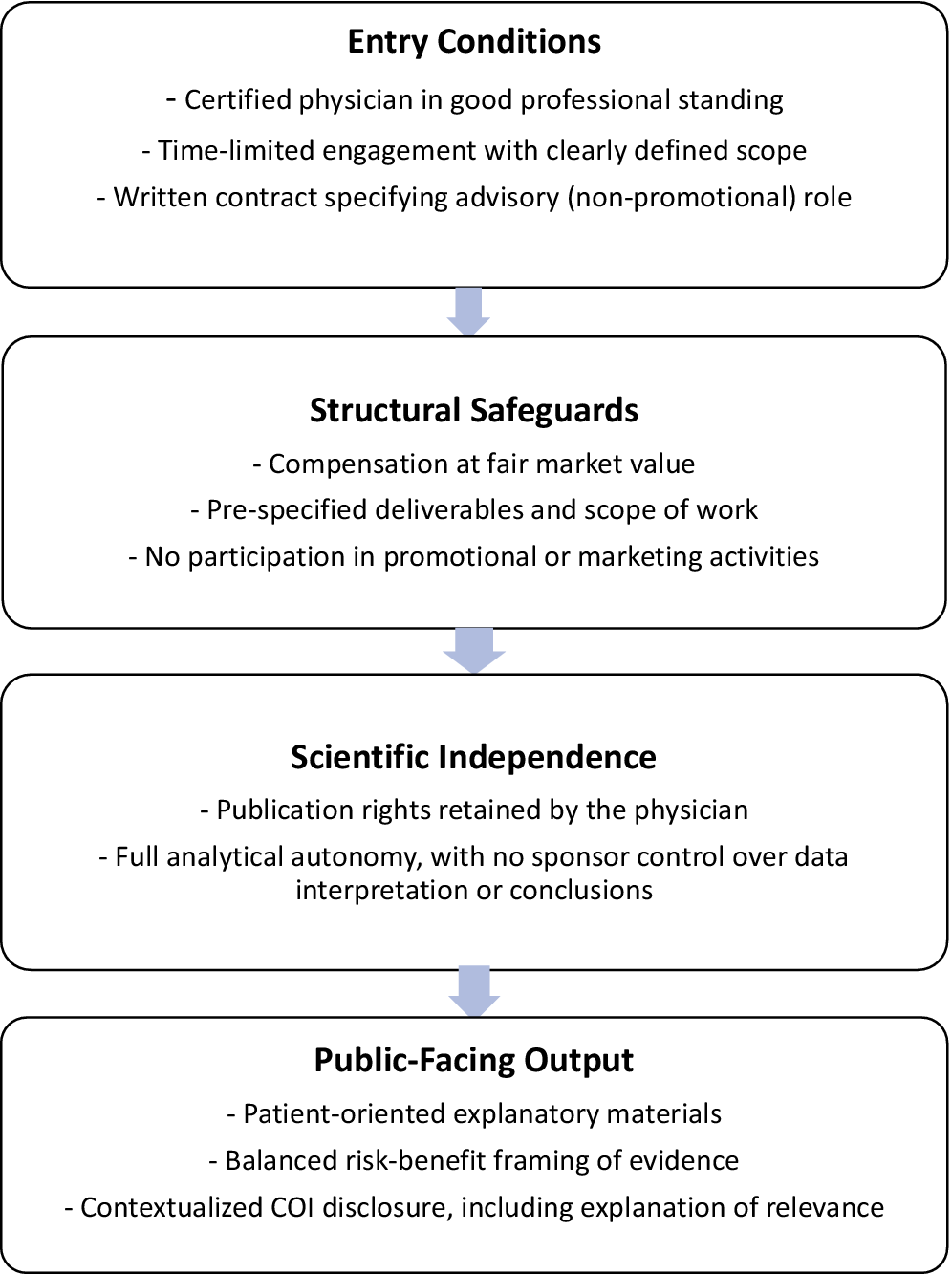
The KOL-PSC program was envisioned with well-established theories of both curriculum development and certification in mind: Kern’s Six-Step Approach and Wiggins’ Authentic Assessment Theory respectively.Reference Thomas and Wiggins46 The curriculum aims to develop practical competence in four broad domains: (1) the ability to communicate science ethically and clearly for lay audiences; (2) the capacity to work productively with patient advocacy groups and other community stakeholders; (3) the skill to engage COI in ways that prevent mistrust and cultivate reciprocal trust; and (4) the capacity to exercise independent judgment and ethical refusal when requested communications are misaligned with public interest obligations. Together, these areas of focus are intended to equip physician leaders with the communication, relational, and ethical tools necessary to align their professional influence with the public good. A structured pathway for ethical KOL engagement under the KOL-PSC is outlined in Figure 2.
Structured Pathway for Ethical KOL Engagement Under KOL-PSC.

Figure 2. Long description
The flowchart consists of four rounded rectangular boxes stacked vertically, connected by downward-pointing blue arrows.
1. Entry Conditions (Top Box):
- Certified physician in good professional standing
- Time-limited engagement with clearly defined scope
- Written contract specifying advisory non-promotional role
2. Structural Safeguards (Second Box):
- Compensation at fair market value
- Pre-specified deliverables and scope of work
- No participation in promotional or marketing activities
3. Scientific Independence (Third Box):
- Publication rights retained by the physician
- Full analytical autonomy, with no sponsor control over data interpretation or conclusions
4. Public-Facing Output (Bottom Box):
- Patient-oriented explanatory materials
- Balanced risk-benefit framing of evidence
- Contextualized COI disclosure, including explanation of relevance
While ethical communication (domain one) provides the foundation, it is not sufficient on its own. Even accurate and transparent disclosures can inadvertently erode credibility if they convey condescension, emphasize professional hierarchy, or appear scripted. Domain three addresses this relational challenge directly: it trains KOLs to approach COI not as a compliance exercise but as a dialogue with patients and the public. This requires presenting oneself as a peer rather than an untouchable expert, listening to concerns before and after disclosing, and avoiding rhetorical techniques that mimic rather than embody sincerity. As Williamson and colleagues argue in It Takes Two,Reference Williamson47 trust in medicine is not unidirectional but dyadic: physicians must also demonstrate trust in patients if they hope to be trusted in return. Building this reciprocity is essential for sustaining credibility in contested public arenas, and it is a distinct competency rather than a byproduct of ethical speech alone.
KOL-PSC differs from existing programs in both intent and scope. Compliance-oriented courses such as the CITI48 or remediation programs like the Center for Personalized Education for Professionals’ PROBE course49 are designed primarily to meet regulatory requirements or address prior misconduct. The for-profit, industry-aligned credentialing offered by the ACMA50 serves corporate operational needs rather than public trust. In contrast, KOL-PSC is proactive and aims to strengthen public-facing leadership before problems arise. This will establish an independent professional standard that reinforces credibility. Maintaining independence from commercial influence will be essential to the program’s legitimacy and sustainability (the full governance framework and its safeguards are presented after the pilot description).
KOL-PSC Pilot
The pilot program is designed to test whether the competencies and commitments described in the preceding section can be translated into measurable improvements in ethical awareness, public communication skill, and perceived trustworthiness among physician KOLs. The pilot will serve both as a proof of concept and as a structured opportunity to refine the program before broader implementation. A full stepwise rationale for curriculum design is presented in Appendix A.
The initial cohort will comprise twelve physicians selected to ensure diversity in specialty, career stage, demographic background, and prior industry engagement. The decision to begin with a small class size and a single-institution launch reflects pragmatic considerations of program capacity, faculty availability, and evaluation logistics (see Feasibility and Implementation Considerations below). Participation will be voluntary, with learners receiving CME credit upon completion. Faculty will be drawn initially from a single major academic medical center and will include experts in ethics, science communication, public health, and media relations. Later iterations will broaden both the participant and faculty pools, progressing from a single-institution launch to regional and then national offerings.
The program will be delivered in three sequential stages. In the pre-course phase, participants will complete asynchronous assignments introducing foundational concepts in PS, COI ethics, and the current landscape of public trust in medicine. Readings and recorded modules will establish a shared vocabulary and conceptual grounding, enabling more advanced discussion during the immersive workshop.
The in-person workshop will be held over a long weekend in a setting conducive to focused learning and peer exchange. Morning plenary sessions will be interspersed with small-group discussions and scenario-based simulations in which participants practice communicating complex evidence, addressing potential bias, and engaging with diverse audiences. Afternoon sessions will emphasize applied skill development, including structured media interviews, balancing benefit-risk messaging, effective use of social media, and creation of public-facing educational materials. Faculty will provide guided, critical feedback throughout, emphasizing both content accuracy and relational effectiveness.
The post-course phase will extend over four weeks of structured, asynchronous work culminating in the PS Portfolio, which serves as the program’s capstone project. Each participant will produce one or more public-facing work products, such as an op-ed, policy brief, patient handout, community presentation deck, or short educational video, crafted for non-specialist audiences. The portfolio must demonstrate clarity of language, balanced framing of benefits and risks, and explicit, intelligible COI disclosures tailored to the intended audience. At least one work product must demonstrate a balanced, evidence-based discussion of uncertainty and limitations alongside an explicit statement of what the KOL will not do, providing a documented example of independent judgment and ethical refusal grounded in public interest obligations. It will also include a reflective narrative of 500–750 words in which the participant explains the rationale for the chosen format and audience, discusses evidence selection and framing choices, identifies potential sources of bias, and considers the ethical implications of their communication approach.
The detailed syllabus for the KOL-PSC pilot program, including settings, topics, and associated learning objectives, is shown in Table 1.Reference Alda51
Syllabus

Table 1: Long description
The table consists of four columns: Setting, Topic, Readings, and Learning Objective.
* Row 1: Pre-course setting. Topic: History of the KOL in Health Care. Readings: Lazarsfeld et al., The People’s Choice; Coleman et al., Medical Innovation. Objective: Understand the origins of the KOL construct and its adoption by commercial entities.
* Row 2: Pre-course setting. Topic: Psychology of Marketing. Readings: Sah and Fugh-Berman, Physicians under the influence. Objective: Develop awareness of psychological processes that can affect KOL behavior.
* Row 3: Pre-course and workshop setting. Topic: Ethics of Public Scholarship. Readings: Boyer, Scholarship Reconsidered; Eatman and Ellison, Scholarship in Public. Objective: Define and contextualize Public Scholarship, analyzing its normative principles and relevance to academic professionalism in medicine.
* Row 4: Pre-course, post-course, and workshop setting. Topic: Trust, Credibility, and the Public Sphere. Readings: Perlis et al.; Edelman Trust Barometer; Bracco v. Amersham; Attkisson. Objective: Evaluate contemporary declines in public trust toward medicine and interpret implications for personal and institutional credibility. Applied skill: Identify and avoid inadvertent signals of condescension and practice peer-to-peer framing.
* Row 5: Pre-course and workshop setting. Topic: COI: From Disclosure to Dialogue. Readings: Lexchin and Fugh-Berman, A Ray of Sunshine. Objective: Transition from traditional disclosure approaches to dynamic, contextualized conflict-of-interest communication strategies. Applied skill: Role-play COI disclosures in Q and A format.
* Row 6: Post-course and workshop setting. Topic: Science Communication Strategies. Readings: Alan Alda, If I Understood You, Would I Have This Look on My Face? Objective: Apply principles of relational science communication and participatory ethics. Applied skill: Practice humanizing communication.
* Row 7: Post-course and workshop setting. Topic: Shared Trust in the Physician-Patient Relationship. Readings: Williamson et al., It Takes Two. Objective: Analyze the bidirectional nature of trust in physician-patient interactions and apply reciprocal trust principles to KOL communication with the public.
* Row 8: Post-course and workshop setting. Topic: Developing Public-Facing Deliverables. Readings: JAMA Patient Pages; NEJM Perspective articles. Objective: Create public-facing content using evidence-informed message framing, health literacy principles, and visual clarity standards.
* Row 9: Post-course setting. Topic: Evaluating Impact and Reflection. Readings: N/A. Objective: Reflect on retreat experience and capstone performance, incorporate feedback into future work.
PS portfolios will be reviewed by a three-member panel including a program faculty mentor, an ethics scholar, and a patient or public stakeholder. A structured rubric will assess credibility and appropriateness of the evidence base, transparency and contextual clarity of disclosed conflicts, accessibility for a public audience, ethical orientation, and the depth of reflective analysis. In addition, participants will complete the Penn State Questionnaire on ProfessionalismReference Blackall52 before and after the program, providing validated measures of change in ethical orientation, professional accountability, and civic responsibility. Peer evaluations from fellow participants and faculty will add further insight into changes in perceived credibility and communication skill. The relationship between each evaluation domain, the principles it measures, the method used, and the timing of assessment is summarized in Table 2.
KOL-PSC Pilot Evaluation Plan

Table 2: Long description
The table consists of four columns and six rows of data.
Row 1: Knowledge acquisition. Principles: Transparency and Civic accountability. Method: Pre- and post-module assessments using objective questions and Likert scales. Timing: Baseline and post-course.
Row 2: Ethical orientation. Principles: Beneficence, Transparency, and Civic accountability. Method: Penn State Questionnaire on Professionalism. Timing: Baseline and post-course.
Row 3: Communication skill. Principles: Ethical science communication and Patient engagement. Method: Structured evaluation of Public Scholarship Portfolio by faculty mentor, external scholar, and patient or public stakeholder. Focuses on COI transparency and reciprocal dialogue. Timing: Post-course.
Row 4: Peer perception. Principles: Civic accountability and Ethical leadership. Method: Anonymous ratings from fellow participants and faculty. Timing: Baseline and post-course.
Row 5: Public perception. Principles: Patient engagement and Trust-building. Method: Structured review by patient or public stakeholder panel focusing on authenticity and reciprocal trust. Timing: Post-course.
Row 6: Reflective practice. Principles: Beneficence and Transparency. Method: Analysis of a 500 to 750 word reflective narrative regarding trust in communication choices. Timing: Post-course.
* Peers include both course participants and instructors
Validation
To address the complex causal chain between certification and restored public trust, we propose a dualistic evaluation framework focusing on the participants and the public separately. Evaluation of participant portfolios and capstone projects will be through in-depth human thematic analysis and narrative inquiry, complemented by the use of structured thematic coding, rubric-based scoring, and survey metrics (e.g., readability, completeness of communication, and numerical patient-reviewer ratings). Once the program is mature, we will continuously apply a suite of trust instruments (e.g. the Group-Based Medical Mistrust Scale, Medical Mistrust Index, Health Care System Distrust Scale, and the Health Organization and System Trustworthiness Scale) to opinion data from patients and practitioners regarding certified and non-certified KOLs, KOL activities, medical industries, health care systems, and physicians.Reference Williamson, Bigman, Anderson and Cintron53 Agentic artificial intelligences will be used to administer surveys, extract data from social media posts, and for data analysis and dashboarding. Changes and differences in global trust, transparency, clarity, reputation, and credibility of disclosures will be monitored.
For the pilot phase specifically, we will perform an experimental vignette study modeled on Hwong et al. that will randomize participants to certified versus non-certified disclosure conditions to test causal effects on trust.Reference Hwong, Sah and Lehmann54 Early on as the program scales, a difference-in-differences design modeled on Kanter et al. will compare pre to post KOL-PSC data at adopting versus non-adopting sites.Reference Kanter55
Governance
The credibility of the KOL-PSC will depend on a governance structure that is demonstrably independent, accountable, and resistant to co-optation. To operationalize these governance safeguards, the KOL-PSC framework incorporates explicit COI screening criteria across individual, organizational, and institutional levels (Table 3). The long-term vision is for the program to be administered by a consortium of academic medical centers in collaboration with respected national bodies such as the CMSS. To ensure the program remains aligned with public interests, its governance board must include not only policy experts but also an equivalent number of patient advocacy and public interest group representatives. Invitations for board participation will be sent initially to regional and eventually to national representatives of patient advocacy groups such as the National Alliance on Mental Illness and the Cancer Support Community.56
COI Screening Rules

Table 3: Long description
The table consists of three columns.
Column 1, Individual Board Members:
• No direct personal payments from relevant manufacturers above a defined cap within the prior 24 months.
• Mandatory disclosure of all relevant financial relationships and recusal for any conflicts.
Column 2, Patient Advocacy Organizations:
• Required disclosure of manufacturer funding.
• Voting representation limited to organizations below a defined industry-funding threshold.
• Organizations exceeding funding thresholds may participate as non-voting advisors to maintain balanced representation.
Column 3, Academic Institutions:
• Screening for institutional relationships, such as endowed chairs named for manufacturers or corporate investment in the certification program.
• Exclusion of institutions with direct industry funding for KOL-PSC governance, curriculum development, or faculty remuneration.
Consistent with nonprofit best practices in health care, education, and public-interest organizations, the program will adopt a multi-stakeholder board model with equal representation from these constituencies, ensuring that no single sector can dominate policy or operations.Reference Grunwald, Isaacs, Tacon, Walters and Cornforth57 Board members will be appointed through a transparent nomination and election process, with clear eligibility criteria, term limits, COI screening, and removal procedures for cause. Annual self-assessments, staggered terms, and documented succession planning will be used to maintain continuity while ensuring fresh perspectives.Reference Kugel and Mercado58 To prevent “ethics washing” by industry partners, philanthropic and institutional support will fund program development and governance operations. Industry engagement will be limited to paying standard program participation fees for their KOLs. The program will prohibit industry funding for curriculum design, faculty honoraria, or governance activities. This separation aligns with standards from the Accreditation Council for Continuing Medical Education (ACCME) Standards for Integrity and Independence in Accredited Continuing Education59 and the CMSS Code for Interactions with Companies.60
The governance board will establish and publicly post explicit credential-use policies, including licensing terms for the KOL-PSC mark, prohibitions against misleading representations of certification, and sanctions for misuse. Sanctions may include formal warnings, public censure, suspension, or revocation of certification rights. These sanctions extend explicitly to domain-four competencies: Certification may be suspended for misleading use of the credential in promotional materials or for repeated failure to provide balanced risk-benefit framing in public or sponsored communications. Certified KOLs are accountable not only for the accuracy of what they communicate, but for principled refusal when requested communications cannot be reconciled with prevailing evidence standards.Reference Sismondo61 When a certified KOL concludes that a requested communication would require materially unbalanced presentation of evidence, omission of clinically relevant risks, or advocacy inconsistent with prevailing evidence standards, KOL-PSC obligates refusal.62
Disciplinary procedures will follow due process norms observed in other credentialing and licensure bodies, incorporating clear notice, opportunity to respond, and an appeals mechanism.Reference Alvarez, Judish and Whelan63 In line with established nonprofit governance principles, the KOL-PSC will publish annual reports, audited financial statements, a current roster of board members, and summaries of board meeting decisions.64 IRS Form 990 filings will be posted in a publicly accessible location, and where feasible, summaries of deliberations related to program policy or credential standards will be made available to stakeholders. These procedures are necessary to foster the transparency and civil accountability the program seeks to teach.
The enforcement mechanisms described above are complemented by a proactive oversight framework that combines routine verification and alignment with recognized external standards. Random annual audits of a representative sample of certified KOL public-facing outputs will assess adherence to established criteria and identify areas for continuous improvement. A public facing compliance portal with clearly defined response timelines, triage processes, and periodic publication of aggregate outcomes will ensure accountability to the communities the program serves. As the program matures, we will seek formal alignment of the KOL-PSC program with the joint International Organization for Standardization and International Electrotechnical Commission (ISO/IEC) standard for certification (standard 17024), which is recognized by most accrediting bodies including the American National Standards Institute National Accreditation Board accreditable structure.65
KOL-PSC will not be a one-time credential; maintenance-of-certification activities will be required to maintain good standing. These activities will include periodic low-stakes online testing, updated COI disclosures, and documentation of continued PS.
The program will adopt a hybrid revenue model balancing philanthropic seed funding with earned income from program fees, a structure shown to sustain other nonprofit credentialing programs in public health and health care.Reference Tait, Daniel and Kim66 This model will protect mission focus by preventing overdependence on any single funding source while ensuring financial viability. Recognizing the resource requirements of an independent nonprofit, the pilot will operate within an existing university center for PS, but governance will rest with an independent, multi-stakeholder advisory board from inception. Once the model is validated, the program could transition to a broader governance structure and even implement formal credentialing, potentially under the auspices of an established nonprofit body like the Alliance for Physician Certification and Advancement.67 By codifying these governance safeguards in policy from the outset, and adhering to widely recognized best practices in nonprofit oversight, credential enforcement, and transparency, the KOL-PSC can preserve independence, inspire public trust, and resist pressures that might compromise its mission.
A side-by-side comparison of KOL-PSC with other prominent certification programs, highlighting differences in purpose, audience, and governance, is presented in Table 4.68
Comparison of KOL-PSC to other certification programs

Table 4: Long description
The table consists of five columns: Program, Audience, Duration, Purpose, and Governance Model.
* KOLPSC: Targeted at Physician Key Opinion Leaders. Duration is a hybrid multi-day workshop and online modules. Purpose is to rebuild public trust in academic-industry alliances. Governance is a proposed nonprofit with an independent board of academia, patient advocacy, and public interest groups.
* CITI: Targeted at investigators, research staff, students, and administrators. Duration is 1 to 3 hours of online modules. Purpose is conflict-of-interest compliance. Governance shifted from academic oversight to a for-profit corporate framework under BRAN Y.
* PROBE: Targeted at physicians sanctioned for ethical violations. Duration is a 3-day in-person course. Purpose is to remediate professional misconduct. Governed by the nonprofit CPEP board of physicians, lawyers, and risk managers.
* ACMA: Targeted at medical science liaisons and executives. Duration is approximately 20 hours of online modules. Purpose is credentialing for industry needs and presentation skills. Governed by for-profit Apotheker Group LLC with an advisory board of pharmaceutical executives.
* HSCM: Targeted at health supply chain managers. Duration varies by country. Purpose is to professionalize health supply chain roles. Governed by the nonprofit People that Deliver.
* IHF Leadership Model: Targeted at hospital executives. Duration varies from short workshops to months-long academies. Purpose is competency-based leadership development. Governed by the nonprofit International Hospital Federation.
Table 1: CITI = Collaborative Institutional Training Initiative, PROBE = Professional/Problem-Based Ethics Program, ACMA = Accreditation Council for Medical Affairs, HSCM = People That Deliver Supply Chain Management Professionalization Framework, and IHF Leadership Model = Internation Hospital Leadership Model
Feasibility and Implementation Considerations
Practical implementation of the KOL-PSC will require overcoming predictable barriers: ensuring physician awareness and acceptance, securing sustainable funding, managing administrative complexity, and guaranteeing equitable access across specialties and practice settings. Early-phase promotion will target professional societies, academic medical centers, and patient advocacy organizations, using peer-reviewed publication of this conceptual framework as the initial “bootstrapping” step to build credibility for future presentations and grant applications.
Reputation-based incentive models may influence corporate behavior through stakeholder and social pressures. Evidence for durable, market-mediated effects, however, remains limited. For example, recent analysis of the Access to Medicine (ATM) Index demonstrates that while companies often perform well on policy commitments, implementation in practice remains inconsistent.69 Unlike the ATM Index, which targets corporate conduct through public rankings, KOL-PSC operates primarily through physician professional identity and institutional norm-setting. Voluntary frameworks such as the CMSS Code for Interactions with Companies and the ACCME Standards for Integrity and Independence demonstrate that credentialing-based standards can shift professional norms without mandate and without relying on corporate incentive effects.70 Accordingly, we treat reputational benefit for both industry and KOLs as a hypothesis and will monitor their reputation as part of our KOL-PSC evaluation process to assess its impact on institutional adoption, public perception, and industry engagement over time.
The pilot program, as described, will be intentionally small: twelve physicians drawn from a single academic medical center, to allow for close evaluation of processes and outcomes. Baseline and follow-up assessments will measure knowledge gains, ethical orientation, and perceived credibility, with capstone PS Portfolios serving as primary artifacts for evaluating skill application. The use of patient and public reviewers in the evaluation process will reinforce program legitimacy and directly connect assessment to trust-building outcomes.
The phased rollout, from single-institution to regional, and then national implementation, mirrors the growth trajectory of other successful health-sector certification programs. Comparable voluntary models, such as the People That Deliver Supply Chain Management Professionalization Framework and the International Hospital Federation Leadership Model, demonstrate that it is possible to professionalize roles with complex industry relationships while maintaining governance grounded in public-interest priorities.Reference Brown71
Pragmatic Adoption Strategy
KOL-PSC is not designed to be formally mandated. The more plausible and durable pathway to adoption is institutional normalization, in which certification gradually becomes a professional expectation through uptake by academic medical centers, professional societies, and continuing medical education ecosystems rather than through regulatory compulsion. Academic medical centers represent the most immediate entry point, incorporating certification into faculty development programs and establishing expectations for externally facing roles such as institutional spokespersons, industry advisory participants, and CME faculty. Professional societies and the accredited CME ecosystem provide a parallel pathway, where alignment with existing independence and COI standards already embedded in ACCME frameworks would position certification as a natural complement to norms already widely enforced.72 In corporate contexts, certification can be situated within ethics and compliance infrastructures as an auditable control for managing COI and reputational risk, with any claims of financial benefit treated as testable hypotheses rather than established effects.Reference Unsal and Hippler73
Scaling from Pilot to National Standard
A scalable pathway from pilot to national standard should begin with a time-limited, multisite expansion of approximately three institutions using common eligibility criteria, standardized submission templates, and a single rubric set aligned to established personnel certification norms under ISO/IEC 17024.74 Expansion would proceed via a train-the-trainer model in which an initial cohort of master faculty, credentialed through demonstrated scoring proficiency, would deliver structured faculty development programs at participating sites, creating local capacity while preserving program fidelity. Governance should transition to a formal consortium with representation from academic departments, professional societies, and public stakeholders. Standardized analytic rubrics assessing content accuracy, methodological transparency, audience alignment, and ethical safeguards across training sites would be applied to portfolios with embedded quality assurance through routine inter-rater reliability exercises and continuous reviewer performance feedback. Transparency would be reinforced through publicly available annual reports detailing candidate volumes, pass rates, reliability metrics, revisions to standards, and aggregate validation data. Financial sustainability should combine philanthropic seed funding with a modest, tiered fee model for applicants and participating institutions, with industry support accepted for general operations but firewalled from governance, curriculum, and assessment functions.
Beneficiaries
Patients and the broader public stand to benefit most from the KOL-PSC. By offering a clear heuristic for identifying physician experts who meet rigorous, independently developed ethical standards, the program gives patients and communities a tangible means of distinguishing trustworthy voices in a crowded and often commercialized information environment. Academic medical centers gain a structured approach to training faculty in PS principles, directly addressing recommendations from the Institute of Medicine’s 2009 report on COI in medical education and research.Reference Lo and Field75
For industry, the program offers a path to rehabilitating public perception of physician-industry collaboration. While some companies may initially view independent certification as an additional constraint, those that adopt KOL-PSC-certified physicians will gain a competitive reputational advantage. Aligning with certified experts allows companies to signal a commitment to transparency and ethical engagement, reinforcing stated industry goals such as the Pharmaceutical Research and Manufacturers of America’s pledge to “build public confidence.”76
Participation in the KOL-PSC program can be positioned within pharmaceutical and medical device companies’ Environmental, Social, and Governance (ESG) reporting, particularly in the “Social” and “Governance” categories. Socially, the program’s requirement for active collaboration with patient advocacy groups and the production of public-facing educational materials provides verifiable evidence of stakeholder engagement and public health contribution. From a governance perspective, third-party certification of KOLs offers measurable assurance that industry-physician collaborations are conducted under independent, ethics-driven oversight, an increasingly scrutinized area in ESG frameworks. Companies can report quantitative metrics (e.g., percentage of sponsored KOLs holding certification, number of certified KOL-led initiatives) and qualitative outputs (e.g., case studies of PS deliverables) to demonstrate compliance with relevant standards such as GRI 413 (Local Communities) and the Sustainability Accounting Standards Board Biotechnology & Pharmaceuticals Standard on ethical marketing.77 Incorporating KOL-PSC participation into ESG disclosures provides a credible, auditable signal to investors, regulators, and the public that the company is proactively mitigating reputational risk while aligning with socially responsible governance practices.
Conclusion
The KOL-PSC represents a pragmatic and timely strategy for restoring public trust in physician-industry relationships. Grounded in the principles of beneficence, transparency, and civic accountability, it offers both a symbolic reaffirmation of medicine’s social contract and a functional mechanism for sustaining it. By integrating ethical grounding, communication skill, and independent governance, the program transforms the KOL role from a potential source of mistrust into a demonstrable instrument of public service.
The proposed pilot will test the feasibility of this integration, generating empirical data to refine the curriculum, evaluation processes, and implementation strategies. If successful, expansion to regional and national levels will establish the KOL-PSC as a durable alternative to industry-defined credentialing, one that is accountable to the public, valued by the profession, and credible to all stakeholders. In doing so, the program seeks not only to mitigate the risks of COI but to strengthen the ethical foundation on which physician influence in medical innovation depends.
Supplementary material
To view supplementary material for this article, please visit http://doi.org/10.1017/jme.2026.10279.
Acknowledgements
Brandy Ndirangu assisted with acquisition of references, merging of separately written sections, and manuscript formatting.
Artificial Intelligence Disclosure
The authors used artificial intelligence tools (OpenAI ChatGPT, Google Gemini, and xAI Grok) to support iterative drafting during the revision of this manuscript. These tools were employed for language editing, formatting guidance, structural suggestions, and mock peer review. All substantive content, analyses, and conclusions were developed independently by the authors, who reviewed and take full responsibility for the final manuscript.


 Open access

