


Introduction
Over 6,000 rare disorders impact 3.5–5.9% of individuals worldwide, with many being genetic in origin and having onset in childhood [Reference Nguengang Wakap, Lambert and Olry1]. Pediatric genetic disorders result in frequent hospital stays, long-term physical and/or neurodevelopmental difficulties, and mortality in about 30% of cases [Reference Ferreira2,3]. As part of their comprehensive medical care, children with diagnosed or suspected rare disease (RD) have complex care teams with several specialists for monitoring, testing, procedures, and therapies [Reference Navarrete-Opazo, Singh, Tisdale, Cutillo and Garrison4–Reference Zurynski, Frith, Leonard and Elliott6]. Outside of the medical system, families may also need to access social services and community resources [Reference Bauskis, Strange, Molster and Fisher7,Reference Berrios, McBeth and Bradley-Ewing8], including educational accommodations in school or at home, to further support the child’s development. Research across the U.S. shows the demands of caring for a child with RD inflict both emotional and financial hardship on families. Specifically, increased psychological distress, feelings of isolation, and lost wages due to work disruptions contribute to significant caregiver burden, yet caregivers often have difficulty finding adequate psychosocial and community support [Reference Buckle, Doyle, Kodate, Kinch and Somanadhan5,Reference Fraiman and Wojcik9–Reference Mcmullan, Lohfeld and McKnight17].
For those in underserved areas with already limited access to medical resources, additional challenges to accessing primary [Reference Sobo, Seid and Reyes Gelhard18] and specialty [Reference Redlener, Grant and Krol19,Reference Mayer20] pediatric care include transportation costs, negative patient–provider interactions, and long wait times. The Texas Rio Grande Valley (RGV) is one such under-resourced region where patients face particularly profound structural barriers to health care, as sizeable proportions of the population are from ethnic, sociolinguistic, and socioeconomic groups historically underserved in medicine. Estimates from 2024 show that 91% of RGV residents identified as Hispanic/Latino [21] and 77% of all RGV households were Spanish-speaking [22], a third (36%) [23] of which self-reported limited English proficiency (LEP). Roughly half (56%) of adults over age 25 had a high school degree or less as their highest educational attainment [24], while 33% of households with children were living in poverty [25]. Additionally, 27% of RGV adults [26] and 12% of children were uninsured [27]. Almost a fifth (17%) of RGV residents were foreign-born without citizenship [28]. Further, three of the four counties in the RGV contain some of Texas’ highest concentrations of colonias, which are residential areas that lack basic infrastructure [29].
All four RGV counties are designated by the U.S. Health Resources and Services Administration as Medically Underserved Areas for primary care [30]. Regional pediatric specialty care services, especially surgical specialists and geneticists, are even scarcer [Reference Torres31,Reference Akinpelu, Dadzie and Jacobsen32]. These shortages likely reflect broader medical workforce shortages, including limited regional specialty training opportunities [33] and a tendency for practicing specialists to be concentrated within major metropolitan academic centers [Reference Jenkins, Fischer and Polito34]. Financial pressures associated with serving a large uninsured and underinsured patient population can result in provider turnover and clinic closures, further exacerbating access challenges in the region [Reference Torres31,Reference Whitehead and Rayasam35]. Research among the broader RGV population has found that sociopolitical climate, presence of immigration checkpoints, cultural differences, and limited technology literacy may hinder care access for local patients as well [Reference Blackburn, Rico, Hernandez and Lee36–Reference Ramirez, Ojeaga, Espinoza, Hensler and Honrubia38].
In underserved regions like the RGV, empirical research has yet to examine how families of children with rare or undiagnosed conditions navigate access to medical, developmental, educational, and community services as a part of comprehensive pediatric RD care. Thus, the aims of this qualitative study were to explore and characterize the factors that influenced access to specialty medical care, social services, and community support for families of children with RD in the RGV.
Materials and methods
Project GIVE
Project GIVE (NCT05318222) was a National Institutes of Health-funded study at Baylor College of Medicine (BCM) that offered virtual genetic evaluation through a platform called Consultagene (https://consultagene.org/) and provided genome sequencing (GS) to children up to age 18 in the RGV and El Paso with undiagnosed RD. Details on Project GIVE’s study design have been published elsewhere [Reference Vuocolo, Sierra and Brooks39]. In brief, families were referred to the study by local healthcare professionals, and those who enrolled completed three study appointments: a comprehensive virtual genetics evaluation (Visit 1) with the study geneticist and genetic counselor (B.V., based in Houston, Texas), return of GS results (Visit 2), and 6-month follow-up (Visit 3). At enrollment, families selected their preferred language for healthcare visits (English or Spanish) and completed a baseline survey that collected self-reported sociodemographic information. All patient-facing study materials, including consent forms, surveys, and the interview guide, were translated into Spanish by a professional translation company and then checked for accuracy by R.S. (based in the RGV), Project GIVE’s bilingual bicultural patient navigator and Spanish interpreter who had 20 years of experience as a professional medical interpreter in genetics clinics. This study was approved by the BCM Institutional Review Board.
Participants and data collection
For this descriptive qualitative interview sub-study, parent participants over age 18 whose children were enrolled in Project GIVE and completed Visit 1 were eligible for a one-time interview. Using purposive sampling informed by baseline survey responses, we aimed to recruit an interviewee population that was relatively representative of the RGV population by language (36% Spanish-preferring LEP) [23] and geography (Hidalgo: 64%, Cameron: 30%, Starr: 5%, Willacy: 1%) [40] given the influence of these factors on care experiences in the region. We contacted parents in-person or via phone/text up to three times.
Families enrolled during the interview recruitment period completed a pre-interview survey at Visit 1 that collected information about the child’s specialists, therapists, and educational services to ensure all participants were asked the same core interview questions with personalization to their care team (Supplementary Material 1). The semi-structured in-depth interview guide was developed through an iterative process with questions adapted from our previous access to care interview project among parents of pediatric cancer patients [Reference Vuocolo, Gutierrez and Robinson41]. The guide began with broad questions about parents’ experiences caring for a child with complex medical needs. Specific questions were then asked regarding families’ access to medical care (i.e., specialty care, genetics services, and developmental therapies for physical, occupational, speech, and Applied Behavior Analysis (ABA) therapy), educational accommodations (i.e., 504 Plan and Individualized Education Program (IEP) classroom accommodations), and family support resources in the community (e.g., behavioral and mental health counseling, social assistance benefits, and support groups) in connection with their child’s medical condition (Supplementary Material 2). Deductive probes were used to elicit more detailed responses if interviewees had difficulty responding to broader questions.
Interviews were conducted from February 2023 to March 2024 via videoconference by B.V., the primary interviewer who had prior qualitative interviewing training and experience. Participants could opt to complete the interview from home or via videoconference at the RGV clinic. For Spanish interviews, the primary interviewer asked questions in English and R.S. provided real-time, sentence-level Spanish interpretation. Parents’ responses were interpreted back into English before the interviewer proceeded. To preserve interview guide structure, the interpreter did not independently probe or add content beyond direct linguistic interpretation. Interviews were audio-recorded, including capturing verbal consent to participate.
All interviews were transcribed, with Spanish interviews transcribed and translated into English by a professional translation company and then checked for accuracy by the study team, de-identified, and assigned a study ID number. Guided by the concept of information power [Reference Malterud, Siersma and Guassora42], we planned to conduct up to 30 interviews (as resources allotted) considering our broad aim of capturing a wide range of experiences across this diverse sample via exploratory cross-case analysis in a context where there is little prior theory. Given the depth and richness of the interviews as assessed by the primary coder (B.V.) during initial phases of analysis, we completed data collection once we neared our goals for geographic and linguistic representation.
Data analysis
We report descriptive frequencies for sociodemographic information. Two coders (B.V., A.M.G.) used reflexive thematic analysis to analyze interview transcripts through an iterative, systematic process [Reference Braun and Clarke43]. Coders were equity-focused access to health care scholars with personal ties to Texas, and outsiders to the RGV without personal experiences with RD. They approached analysis grounded in a critical realist-contextualist paradigm and experiential orientation, consistent with study aims to understand access to RD care in the RGV through interpretation of parents’ accounts of their experiences while acknowledging researchers’ reflexive role [Reference Byrne44].
After familiarization with the dataset, coders first collaboratively labeled data across five transcripts with inductive semantic and latent codes, creating a working codebook that helped track the broad patterns identified. The primary coder (B.V.) conducted initial coding of remaining interviews, while the secondary coder (A.M.G.) layered on additional coding. Coders met regularly to refine codes, reflect on assumptions underlying code application, and discuss initial interpretations. Once complete, coded transcripts were put into Dedoose (Dedoose Version 9, SocioCultural Research Consultants LLC, Los Angeles, CA) and exported into Microsoft Excel. Utilizing Excel, coders abstracted and interpreted key concepts captured in each coded extract and created a matrix of interpretations across all interviews to assist in further identifying patterns and relationships. They then wrote summaries for all codes that captured these interpretations, the range of concepts included, and representative quotes. Code summaries and interpretations were then further analyzed to develop candidate themes that identified meaningful cross-cutting patterns in the dataset. Coders wrote summaries that defined each candidate theme, the range of concepts captured, and representative quotes. Throughout this process, coders met to discuss assumptions shaping interpretation and iteratively refine candidate themes as needed until they reached final themes and sub-themes that encapsulated the most salient patterns in the data in relation to research questions.
Study IDs are referenced with quotes except in limited instances to protect participant privacy. Additional quotes removed from the main text for brevity are provided as Supplementary Material 3: Tables S1–S3. We refer to services obtained in the family’s hometown as “local,” within the RGV as “regional,” and outside the RGV as “outside the region.”
Results
Participant characteristics
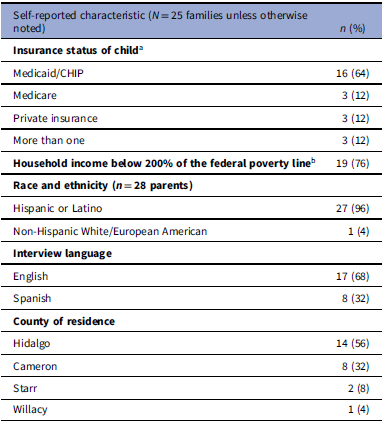
Of the 26 families invited to interview, all agreed to participate, though one family was lost to follow-up during interview scheduling. We conducted interviews with 28 parents (including three parent dyads) from 25 families. Children had myriad medical problems, including developmental/behavioral concerns, endocrine problems, and congenital anomalies, and families had an average of five medical specialists (range: 2–8 specialists). Prior to Project GIVE enrollment, 13 children (52%) had seen a genetics provider, and another three (12%) had genetic testing ordered by another specialist. Almost all families identified as Hispanic/Latino (96%) and a third completed the interview in Spanish, all of whom reported LEP (Table 1). Most had household incomes below 200% of the federal poverty line (76%) and were insured by Medicaid/CHIP (64%). English interviews lasted 43 minutes on average (range: 20–68 minutes) and Spanish interviews averaged 40 minutes (range: 19–58 minutes).
We generated four overarching themes that captured parents’ experiences accessing services for their child’s medical care and educational accommodations and family support: (1) service shortages resulted in long waits, care disruptions, and long-distance travel; (2) cumbersome administrative and insurance processes led to delays in receiving services; (3) staff-led care coordination mitigated challenges navigating and communicating across fragmented services; and (4) caregiving imposed emotional strain on families amid unmet psychosocial support needs. We use subthemes to expound on the facets of each theme.
Parent-reported demographic information

Table 1. Long description
A table summarizing demographic information of families participating in a study. The table has 10 rows and 2 columns. The columns are labeled ʼSelf-reported characteristic (N = 25 families unless otherwise noted)ʼ and ʼn (%)ʼ. The rows are labeled with various characteristics and their corresponding values. Row 1: Insurance status of child, Medicaid/CHIP, 16 (64). Row 2: Insurance status of child, Medicare, 3 (12). Row 3: Insurance status of child, Private insurance, 3 (12). Row 4: Insurance status of child, More than one, 3 (12). Row 5: Household income below 200% of the federal poverty line, 19 (76). Row 6: Race and ethnicity (n = 28 parents), Hispanic or Latino, 27 (96). Row 7: Race and ethnicity (n = 28 parents), Non-Hispanic White/European American, 1 (4). Row 8: Interview language, English, 17 (68). Row 9: Interview language, Spanish, 8 (32). Row 10: County of residence, Hidalgo, 14 (56). Row 11: County of residence, Cameron, 8 (32). Row 12: County of residence, Starr, 2 (8). Row 13: County of residence, Willacy, 1 (4).
a “More than one” category includes two families with private insurance and Medicaid and one with Medicaid and Medicare.
b Annual household income and number of people in the household were used to calculate whether a family lived below 200% of the federal poverty line based on HHS Poverty Guidelines for 2023.
Theme 1: Service shortages resulted in long waits, care disruptions, and long-distance travel
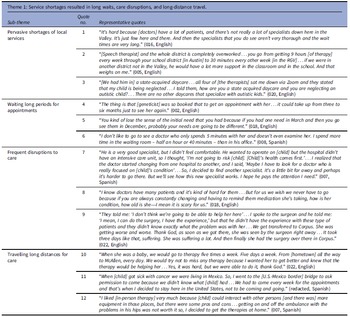
Parents described how widespread shortages of medical, educational, and community services throughout the RGV created cascading barriers to obtaining comprehensive RD care for their child. Limited availability of local and regional services and providers resulted in long wait times to obtain appointments, frequent disruptions in the childʼs care, and the need to travel considerable distances both within and outside the region to access services.
Pervasive shortages of local services
Parents described a lack of available medical specialists in the RGV (Table 2: Quote 1-016, English), explaining that “the demand [for specialists] exceeds the capabilities” (018, English). Compared to large metropolitan areas in Texas, the few existing regional clinicians/hospitals often lacked the experience and resources to provide specialized care, including certain imaging/testing protocols and pediatric surgeries:
“Here in the Valley, I see there is a very clear difference between the doctors or the services here and [children’s hospital in Houston]…I wish we could have more hospitals here, able to do more surgeries…We have specialists, but the number is very limited.” (025, English)
Representative quotes for theme 1 sub-themes

Table 2. Long description
A table titled ʼTheme 1: Service shortages resulted in long waits, care disruptions, and long-distance travel.ʼ The table has three columns: Sub-theme, Quote no., and Representative quotes. It contains quotes from individuals discussing their experiences with healthcare service shortages. The table is divided into three sub-themes: Pervasive shortages of local services, Waiting long periods for appointments, Frequent disruptions to care, and Travelling long distances for care. Each sub-theme contains several quotes from individuals, identified by quote numbers. The quotes describe challenges such as long wait times, lack of specialists, disruptions in care, and the need to travel long distances for treatment. The table captures the difficulties faced by individuals due to healthcare service shortages.
Access to in-school/external developmental therapies and educational accommodations was limited because of funding restrictions and district-wide shortages of therapists (Quote 2-005, English). While friends and social media helped families identify available local clinicians and community resources, parents described a dearth of trustworthy special needs support (Quote 3-020, English) and counseling services.
Waiting long periods for appointments
Because local and regional specialty clinics were overwhelmed, parents experienced long wait times to establish and continue care, with appointments being scheduled months in advance (Table 2: Quote 4-002, English). Missing or rescheduling appointments further elongated wait periods: “They’re always so booked here in the Valley…I missed the January appointment and I’m not gonna see [endocrinologist] ‘til May’ (004, English). Consequently, while waiting to be seen, the child’s needs sometimes evolved, thereby changing or negating the appointment purpose (Quote 5-018, English).
Once at the clinic, families often had to wait an hour or more to see the clinician given the high patient volume: “Our time window was at 11, we didn’t see [neurologist] until 3” (020, English). Moreover, when it was finally their turn to be evaluated, families had limited time with the clinician, which they perceived to worsen care quality (Quote 6-008, Spanish). One parent described this cycle as:
“I think there are not that many doctors available for all the kids that need pediatricians or specialists…the patients are just a number, a number, a number. They don’t really take their time with the patients. They go fast to finish, so they’re able to see everyone.” (022, English)
Frequent disruptions to care
Parents experienced healthcare team changes, sometimes multiple times, due to clinic closures, feeling uncomfortable with available services or clinicians (Table 2: Quote 7-007, Spanish), missing too many appointments, and clinician turnover: “[Neurologist] leaves because we’re in the Valley and if you can get out, you get out. So, now we’ve got to start all over again with a whole other neurologist and similarly long waiting times” (005, English). Changes in developmental therapists were also driven by the need to consolidate services to a single organization or in-home. Regardless of the reason, seeking out new services within or outside the RGV disrupted care because of the need for new referrals, paperwork/evaluations, and waitlists:
“[Neurologist] had a policy that if you miss two appointments, he removes you from the system. I missed two appointments…So, for a long time, we searched for a neurologist…We had to wait for a long time to get an appointment because [new neurologist] has many patients.” (023, Spanish)
Constantly having to see new providers, whether in the same or different clinics, made parents feel important care management information was missed (Quote 8-018, English). Furthermore, parents commented on how the lack of advanced resources and expertise available at local hospitals resulted in transferring care outside the region: “[Orthopedist] told me…‘Take your son to [Houston]. Here in the Valley, unfortunately, there are not enough resources to treat your son or the situation. I’m limited. I feel my hands are tied’” (025, English). Transferring care was harmful in times of acute illness as delays in receiving care could worsen the child’s condition and increase suffering (Quote 9-022, English).
Travelling long distances for care
Parents were willing to travel for their child’s care, especially given the lack of access to clinicians locally: “[Specialists are] 30-40 minutes away from where I live but none of that would stop me from taking my daughter to get her checkups” (001, English). However, doing so presented difficulties with missing work/wages, finding childcare, affording travel costs, leaving the RGV because of immigration checkpoints, and missing appointments due to unreliable transportation:
“We would have five or six appointments a month. It was hard because we had to travel to McAllen which is an hour and a half from [hometown]…I missed one appointment because I requested Medicaid for transportation and it never came.” (017, Spanish)
Travel for multiple weekly specialist and developmental therapy appointments compounded burden (Table 2: Quote 10-022, English), and some parents decided to relocate to lessen the commute (Quote 11-redacted, Spanish). Even though parents preferred in-person therapy offerings, some opted for in-home services to reduce both travel and the physical demands on the child (Quote 12-007, Spanish). Non-invasive mail-in genetic testing kits were viewed as “easy and accessible” (008, Spanish) and lessened the need to visit geneticists outside the region in Corpus Christi (∼2.5 hours by car), San Antonio (∼3.5 hours), and Houston (5 hours). Travel barriers were also mitigated by having flexible work schedules, childcare and accommodation support from family/friends, coordinated scheduling by clinical staff, and financial assistance: “I’m actually OK with traveling. I do get help from the insurance with the gas, like refund money” (024, English).
Theme 2: Cumbersome administrative and insurance processes led to delays in receiving services
Parents encountered convoluted administrative barriers that delayed access to essential medical and educational services for their child. Inadequate insurance coverage alongside onerous processes involving repeated paperwork and evaluations often led families to switch insurance plans and clinicians to attain more timely and affordable care.
Issues with insurance coverage of services
Having insurance, especially public insurance, facilitated coverage of necessary medical costs: “[Child] does have Medicaid, thank God, because otherwise I don’t think we would be able to afford all these doctors” (010, English). Parents appreciated insurance-funded transportation, ambulance services, and expense reimbursement for long trips. Despite these benefits, parents experienced delays in receiving services due to lengthy insurance approval processes:
“[Insurance company] didn’t want to cover [genetic testing], but we fought so that [child] could be tested and finally, we were able to do it. I remember the process took three or four months.” (007, Spanish)
Even with coverage, parents still paid high out-of-pocket costs for food, parking, and time-constrained visits (Table 3: Quote 13-005, English). Parents also reported denials of coverage for services including genetic testing, in-home disability accommodations, and medical devices (Quote 14-021, Spanish). Insurance plans sometimes had limited coverage of developmental therapies (Quote 15-redacted, Spanish) and mental health counseling which, coupled with few clinicians available to render those services in the first place, created challenges finding affordable care: “There is a lot of [ABA] therapy in McAllen but not where I live…for Medicaid, there really isn’t that many out there, it’s more private insurance [that covers therapy]” (012, English).
Representative quotes for theme 2 sub-themes

Table 3. Long description
A table titled ʼRepresentative quotes for theme 2 sub-themesʼ with four rows and three columns. The columns are labeled ʼSub-themeʼ, ʼQuote No.ʼ, and ʼRepresentative Quotesʼ. The table is divided into two sub-themes: ʼIssues with insurance coverage of servicesʼ and ʼBurdensome administrative paperwork and evaluationsʼ. Each sub-theme contains quotes from different sources, identified by quote number and language. The quotes describe challenges faced by individuals due to insurance and administrative issues. For example, quote 13 discusses high out-of-pocket costs for therapy sessions, while quote 14 mentions denials of coverage for medical devices. Quote 15 highlights the limited coverage of developmental therapies, and quote 16 describes the difficulties in applying for health insurance. Quotes 17 and 18 discuss the burdensome paperwork and evaluations required for continued therapy. Quotes 19, 20, and 21 cover issues related to switching plans and clinicians, including difficulties in finding and qualifying for appropriate services.
Burdensome administrative paperwork and evaluations
The process of obtaining insurance coverage was time-consuming and onerous, as requesting benefits required phone calls to the insurance company, filling out multiple forms, and coordination between clinic and insurance representatives (Table 3: Quote 16-018, English). Even after completing these steps, parents faced delays in reimbursement, after which some stopped requesting these benefits altogether to avoid the aggravation:
“There’s so much you have to go through in order to get [Medicaid transportation] approved…you have to fill out all of this paperwork and enter time and mileage…I haven’t used it [recently], because I had to come up with the money right there to put gas and then they don’t pay ‘til like maybe a month later.” (010, English)
Long, repeated evaluations and paperwork required by insurance several times per year disrupted developmental therapies (Quote 17-005, English). Similarly, for educational accommodations, lengthy evaluations were required before services could begin: “I had to go into the special education department and basically apply…I would not say it was easy. They needed countless documents, they needed referrals left and right” (020, English). Parents also described the process of setting up support services through local community organizations as hectic, slow-moving, and paperwork-intensive (Quote 18-013, English). Parents who applied for social assistance from SNAP, TANF, SSI, and SSDI independently navigated the processes for each benefit: “Nobody helped me. Then when [child] finally got approved for SSI, we got a caseworker and they’re like, ‘We’re here to help!’ And I was like, ‘F-you, I already did everything on my own’” (004, English).
Switching plans and clinicians
Parents described switching insurance plans multiple times due to lack of coverage for specific services (Table 3: Quote 19-012, English), high out-of-pocket costs, desire for higher quality or more convenient care that was out-of-network, insurance no longer covering their services, and clinicians no longer accepting their insurance: “[Child] hasn’t seen [otolaryngologist] lately because he moved elsewhere and we have to make some changes with the insurance, but he will continue seeing him” (023, Spanish). Parents struggled to find insurance plans that covered all their child’s clinicians and services:
“[Child]’s insurance, I had to change it like five times…Sometimes the insurances are not compatible or not in-network with some of the specialists. So, if I feel like it’s a specialist that I must need, then I would have to work around the insurances or change his insurances…I just wanna figure out what works best for everybody. Somebody I can keep without having to change insurance like every other month.” (015, English)
Other parents changed clinicians to remain within the network, which sometimes meant sacrificing care continuity (Quote 20-013, English). No matter the reason, switching insurance plans and/or clinicians delayed access to essential services and placed additional administrative burdens on caregivers (Quote 21-022, English). Though, some parents set up insurance for their children easily online with minimal problems or delays: “[Reapplying for Medicaid] was pretty much easy. I just had to go online and apply, and there was a waiting time frame that I had to wait to see whether she was approved or not” (010, English).
Theme 3: Staff-led care coordination mitigated challenges navigating and communicating across fragmented services
The need to obtain services from fragmented systems both within and outside the region worsened the logistical demands of managing the childʼs various appointments. Parents described how difficulties with medical record sharing and poor communication across care teams often impeded their ability to streamline care. Extensive care coordination and advocacy efforts from medical, educational, and community service providers were critical to facilitating familiesʼ access to necessary services.
Coordinating, scheduling, and attending multiple appointments
Parents faced logistical challenges with managing the high volume of specialist and therapy appointments around other life priorities including work (Table 4: Quote 22-021, Spanish), school, and childcare, especially when they had to travel:
Representative quotes for theme 3 sub-themes

Table 4. Long description
A table titled ʼRepresentative quotes for theme 3 sub-themesʼ with four rows and three columns. The columns are labeled ʼSub-themeʼ, ʼQuote no.ʼ, and ʼRepresentative quotesʼ. The sub-themes include ʼCoordinating, scheduling, and attending multiple appointmentsʼ, ʼAccessing and transferring medical records across cliniciansʼ, ʼIssues with communication impacted service qualityʼ, and ʼCare coordination by medical staff and community resourcesʼ. Each row provides a quote number and a representative quote related to the sub-theme. The quotes discuss challenges such as coordinating appointments, accessing medical records, communication issues, and care coordination by medical staff and community resources.
“[Seeing developmental therapist] is a little bit difficult now because I do have a second child, so trying to find childcare as well as the [hour] drive, getting [child] out of school, getting things done…It’s a little bit intense.” (020, English)
With limited availability of both in-school and local external developmental therapists, parents found it necessary to take the child out of school for weekly therapy appointments and often encountered resistance from schools because of frequent absences (Quote 23-011, Spanish). Missed or rescheduled appointments were common due to family illnesses, scheduling conflicts, transportation issues, and difficulties tracking upcoming visits: “I forgot [the appointment], and they don’t e-mail you…I write everything down and sometimes, I’m human…I have a lot a lot a lot” (004, English). Parents benefited from frequent communication regarding appointment reminders and changes via phone or text (Quote 24-018, English). Flexible work schedules and childcare assistance from family were crucial for parents juggling multiple clinician visits: “When the appointments are during the afternoon…I have to look for my mother-in-law…she finds the way to take care of the kids every time” (014, Spanish).
Accessing and transferring medical records across clinicians
Parents emphasized that having medical records was necessary for appropriate, timely care; however, record sharing was inefficient particularly when clinicians were from different hospital systems:
“You’d think like you’re requesting gold bullion or something. Just give me the records…[Doctors] do not [share records] very well unless they’re part of the same system…There’s been a lot of times where we’ve been told, ‘I wish I could see those records because I would do a lot better with whatever [child]’s got going on.’” (005, English)
The administrative burden of sharing medical records tended to fall on the parents who made multiple in-person trips to request records, completed paperwork for every clinician, and collected documents manually (Table 4: Quote 25-003, Spanish). To centralize records, parents prioritized clinicians within the same hospital system when possible (Quote 26-015, English). Parents appreciated when clinicians communicated with each other for record sharing (Quote 27-020, English), coordinated paperwork during existing appointments, and supplied records to parents directly: “When we got discharged from the NICU, [NICU team] gave me a whole big folder full of all her history…before we even left the hospital” (010, English). Parents found interoperable digital platforms like MyChart to be accessible solutions: “All her notes and all that are on MyChart, I have the app so it’s easy for me to just log in and get what they need” (002, English).
Issues with communication impacted service quality
Parents described how poor communication between clinicians and from staff across systems and services led to worsening of their child’s condition (Table 4: Quote 28-022, English) and delayed treatment or diagnosis: “We had been waiting for an appointment with the genetics specialist…We had a referral like in August…We sent like all his history, and we never really got a call back” (006, English). Further, unclear communication of management plans, recommendations, and test/imaging results left parents feeling they had received incomplete information or diagnoses (Quote 29-009, Spanish), and they desired more digestible information from clinicians to better understand their child’s disease (Quote 30-005, English). Parents appreciated when clinicians collaborated with others on the care team, got to know the family, helped them feel comfortable asking questions, listened to their concerns, and took time evaluating their child:
“I’m very pleased with [developmental pediatrician]. He’s been treating her since she was a year and a half, and he does take time to get to know his patients. She is not just another patient for him…he takes time to talk to you and to answer your questions.” (008, Spanish)
Parents who felt unheard by their service providers described having to independently learn about and advocate for tests/procedures, treatments, and educational accommodations, which delayed receiving appropriate care and support: “[If educational staff] would’ve listened to me when I first told them two years ago, they would’ve done something…‘I don’t want you to keep her a grade behind because you are not giving her the help she needs.’” (013, English)
Care coordination by clinical staff and community resources
Parents noted how pediatric practices routinely referred parents for outpatient services (Table 4: Quote 31-001, English) and NICU hospital staff actively coordinated outpatient follow-up appointments. While some parents still had to advocate for certain referrals, including genetic and therapy services, overall they found the referral process to be efficient: “[The NICU team] gave me all the appointments with all the different specialists that he needed to see…It was good that they helped me with the referrals” (024, English). To reduce travel burden, parents appreciated staff-led appointment coordination including scheduling testing/imaging the same day as specialist visits, consolidating appointments with hospitals outside the RGV within one to two days, and establishing follow-up services with local specialists (Quote 32-025, English). Parents also valued assistance from service provider staff and insurance service coordinators in scheduling appointments, identifying in-network clinicians and local support resources, and navigating insurance and educational evaluation paperwork:
“The PT and our [medical device] technician…they have been angels…The technician knows the center where [child] goes for the therapist and…we’ll arrange a time to meet up when [child] is over there so we can do the evaluation and the paperwork.” (018, English)
Teachers and school social workers helped parents establish in-school or at-home educational accommodations, coordinate therapies, and facilitate referrals to community services, while community advocates attended Admission, Review, and Dismissal (ARD) meetings with families to streamline educational support planning (Quote 33-022, English).
Theme 4: Caregiving imposed emotional strain on families amid unmet psychosocial support needs
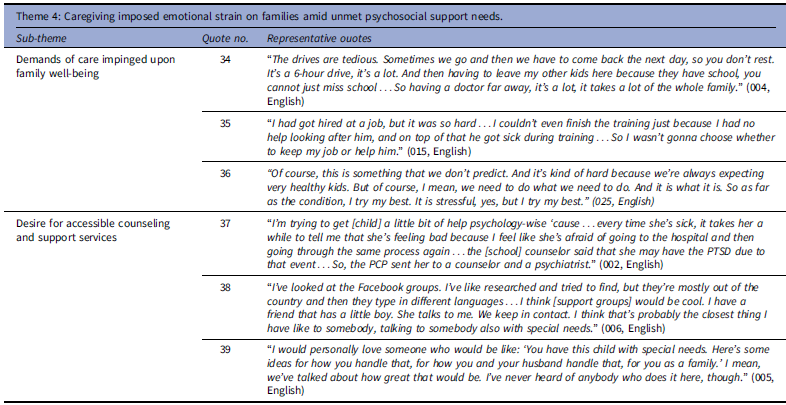
Parents described how the time and effort required to manage the demands of the child’s complex care impinged upon the emotional and financial well-being of the whole family. Parents expressed an unmet need for psychosocial support to help the family cope with this emotional strain and desired more accessible counseling and other supportive services in their area.
Demands of care impinged upon family well-being
The child’s health became a household priority, which had ripple effects for the entire family (Table 5: Quote 34-004, English). Parents sacrificed their careers to help their child full-time: “I had to quit work to take care of the child. I mean, I don’t complain, but I don’t have so many possibilities to develop professionally because the child is my priority” (008, Spanish). Along with the child missing school, frequent appointments resulted in missed work and wages for parents, which added further psychological and financial stress (Quote 35-015, English). Siblings of affected children also suffered from navigating changing family dynamics as their sibling’s health issues took priority: “[Child’s sister is] still going to therapy due to all the medical problems and the attention that she didn’t have because I was with [child] at that time. I think that’s been the hardest part” (022, English). Parents described taking these challenges in stride (Quote 36-025, English), while also acknowledging how they often struggled to cope with the reality of their child’s health needs:
Representative quotes for theme 4 sub-themes

Table 5. Long description
A table titled ʼTheme 4: Caregiving imposed emotional strain on families amid unmet psychosocial support needsʼ with two columns: Quote no. and Representative quotes. The table has four rows under the sub-theme ʼDemands of care impinged upon family well-beingʼ with quote numbers 34, 35, and 36, and corresponding quotes discussing the challenges and stress faced by families due to caregiving responsibilities. Another sub-theme ʼDesire for accessible counseling and support servicesʼ includes quote numbers 37, 38, and 39, with quotes highlighting the need for psychological support and resources for families. Each row provides a unique quote that illustrates the emotional and practical difficulties encountered by families in providing care.
“It’s hard. Sometimes there’s days that I feel really bad because just I don’t feel that life was fair because I didn’t ask for this…I get depressed, I get angry, just different emotions all the time. Sometimes I’m grateful…I have to deal with it every single day.” (019, English)
Desire for accessible counseling and support services
Families sought psychological counseling and psychiatry services for the affected child to help them cope with the trauma of their medical journey (Table 5: Quote 37-002, English). Parents also desired psychosocial support for themselves but described difficulty balancing time spent on their own well-being with caring for their family: “[Finding support services] is something that I have in my mind. I need to get better like in all possible ways…because I need to be here for my kids…The thing is, at least in my case, the time” (025, English). Those who sought local counseling services described limited resources, prohibitive out-of-pocket costs, and competing household expenses as barriers:
“That [psychological counseling] clinic that’s free, I called in September and my appointment is in April…Mental [support] is a big thing here in the Valley that’s not available. And if you don’t have insurance, you pay for it, and a lot of the families, we don’t have the money. So, either you’re gonna pay your light bill or you’re going to get your brain fixed. I’m gonna pay my light bill.” (004, English)
While parents expressed interest in engaging with community resources such as local support groups for families of children with special needs (Quote 38-006, English), they were often unaware of what was available to them locally (Quote 39-005, English).
Process of accessing care for children with RD in the Texas RGV
As demonstrated across the four overarching themes, parents described interrelated barriers and facilitators during each step of the process of accessing services for their child’s medical care and educational accommodations and support for the family. Importantly, for medical care, parents described a recursive cycle of barriers triggered by care disruptions, which could be family-initiated (e.g., switching clinicians to reduce travel), clinician-initiated (e.g., clinician left the region), and/or insurance-initiated (e.g., plan change, no longer accepted a provider) that required families to re-initiate referrals and scheduling, thereby compounding delays and access barriers. This overall process is illustrated in Figure 1.
Summary of the process of accessing services for children with RD in the Texas RGV as described by parents in Project GIVE. “Medical care” included healthcare specialists (e.g., geneticists, neurologists, etc.) and developmental therapists (e.g., speech, physical, occupational, etc.). “Educational Accommodations” included 504 Plan and Individualized Education Program (IEP) classroom accommodations. “Family Support” included other resources such as social benefits like Supplemental Nutrition Assistance Program (SNAP), Temporary Assistance for Needy Families (TANF), Supplemental Security Income (SSI), and Social Security Disability Insurance (SSDI); special needs support from community organizations; mental health counseling; and support groups. Green arrows indicate forward progression through the care access process when facilitators were present. Red arrows represent recursive navigation of the care process resulting from care barriers, delays, and disruptions.

Discussion
This qualitative study characterized factors influencing access to health care and social services for children with RD in the RGV. Parents described care delays driven by inadequate and inconsistent access to local medical, educational, and community resources, often leading to discontinuity of care, fragmented health record access, difficulties managing insurance coverage across clinicians in different healthcare systems, and the need to travel elsewhere in Texas. These findings are consistent with previous studies among adult and pediatric populations in other urban and rural areas [Reference Vuocolo, Gutierrez and Robinson41,Reference Hardy, Vivier, Rivara and Melzer45–Reference Pasquini, Goff and Whitehill49]. Accessing medical care was often a recursive process with disruptions requiring RGV families to repeatedly navigate referrals and scheduling, further delaying services. Together, these barriers coupled with the emotional demands of managing complex RD care strained the well-being of the whole family. Medical, educational, and community staff played an essential role in facilitating RGV parents’ RD care access by coordinating appointments, assisting with administrative processes/paperwork, and helping set up insurance and support services.
Our findings are consistent with previous RD literature [Reference Marshall, Gerber, Lorenzetti, MacDonald, Bohach and Currie10,Reference Vuocolo, Gutierrez and Robinson41,Reference Pisu, Ivankova and Morgan48] which identified transportation, competing life priorities, and time off work as access barriers to health care services. A distinct experience for some RD RGV families was restricted ability to travel due to the presence of immigration checkpoints, which has been described in this region in other clinical contexts [Reference Gamboa50]. We also found that local resource limitations further extended to difficulty obtaining educational accommodations and assistance from community-based organizations in this region. Specifically, RGV parents reported a scarcity of mental health counseling and other supportive services available to them locally, which has similarly been emphasized in previous RD studies [Reference Berrios, McBeth and Bradley-Ewing8,Reference Atkins and Padgett14,Reference Pelentsov, Laws and Esterman16,Reference Mcmullan, Lohfeld and McKnight17]. Also aligning with our findings, other research has highlighted appointment coordination as a facilitator of RD care, though not all families have access to this assistance [Reference Vuocolo, Gutierrez and Robinson41,Reference Claessens, Vanneste, Van Isterdael, Verbeke, Wens and Huys51].
This study provides insight into how service providers can facilitate more streamlined care for children with RD that considers the needs of families in the RGV and similar regions. Service providers should consider ways to systematically link families with external financial, logistical, and psychosocial support resources including patient navigators [Reference Lindeborg, Naugle and Wong52,Reference Genoff, Zaballa and Gany53], insurance coordinators/liaisons, travel assistance programs, and supportive community organizations/personnel. Regional clinical providers can also simplify medical record access for pediatric RD patients by coordinating record release forms at existing appointments, providing copies to families, and improving intrahospital electronic medical record (EMR) communication. Further, strategies to improve provider-to-provider communication through EMR messaging and implementation of EMR templates, specialist hotlines, and telemedicine triaging [Reference Ray, Demirci, Bogen, Mehrotra and Miller46,Reference Chou, Wiredu and Von Imhof54] may be valuable for care coordination in this region. Future research should explore whether implementing these care coordination practices improves appointment retention and quality of life for RD families in the RGV and other under-resourced regions.
This study has limitations. While not generalizable to the broader U.S. population, these findings may be transferable to similar clinical settings, under-resourced regions, and contexts with predominantly underserved patient populations by language preference, ethnicity, and socioeconomic status. Despite our sample’s linguistic and geographic diversity, the views reported may not reflect the experiences of all families in the region as they overrepresent perspectives of those who were reachable, had previous access to the health system, and agreed to participate in Project GIVE. The use of deductive probes may have influenced the experiences about which parents reported. The involvement of interpreters, while providing important language access services for Spanish-preferring interviewees, can introduce risks such as loss of nuance, selective emphasis, or interpreter-driven shaping of meaning [Reference Kapborga and Berterö55,Reference Wallin and Ahlström56]. To mitigate these risks, interpretation was provided by a professional medical interpreter well-versed in the study/genetics contexts who adhered to the interview guide and maintained interviewer-led questioning. Nevertheless, our findings generated foundational evidence on the experiences of accessing comprehensive care in the RGV for RD families.
Conclusion
In this qualitative study that characterized access to specialty medical care and social services for children with RD in the Texas RGV, the lack of adequate resources required families to navigate additional barriers that compounded the already considerable logistic, financial, and emotional burden of managing care for a child with RD. Barriers centered on care delays caused by insurance complexities and limited local availability of specialists, services, and support resources, while care coordination from service staff was integral to facilitating access. Implementation of digital health platforms and more systematic service coordination across clinical and non-clinical service providers may facilitate more streamlined care for children with RD and help alleviate the myriad challenges families face in under-resourced regions.
Supplementary material
The supplementary material for this article can be found at https://doi.org/10.1017/cts.2026.10798.
Acknowledgements
We would like to thank the participating Project GIVE families for sharing their experiences. The authors also thank Dan Brooks, MD for his contributions to Project GIVE.
Author contributions
Blake Vuocolo: Conceptualization, Data curation, Formal analysis, Funding acquisition, Investigation, Methodology, Project administration, Visualization, Writing-original draft, Writing-review & editing, Roberta Sierra: Conceptualization, Data curation, Formal analysis, Investigation, Writing-review & editing, Seema R. Lalani: Conceptualization, Funding acquisition, Resources, Supervision, Writing-review & editing, Amanda M. Gutierrez: Formal analysis, Methodology, Supervision, Visualization, Writing-original draft, Writing-review & editing.
Funding statement
Project GIVE is a research study at Baylor College of Medicine supported by the National Center for Advancing Translational Sciences (NCT05318222). Additional funding was provided by Texas Society of Genetic Counselors and the Genetic Research Association of Texas (GReAT).
Competing interests
The authors declare that they have no competing interests.




 Open access

