Do John Locke's politics rest on a theological foundation? John Dunn, Jeremy Waldron, and others say yes.Footnote 1 Leo Strauss, Thomas Pangle, Michael Zuckert, and others say no.Footnote 2 This article presents definitive evidence for the latter position. Locke insists that the Bible, if it is to govern our opinions and actions, must be interpreted literally, using the words of scripture alone. Locke's discussion of Gen. 1:28 in chapter 4 of the First Treatise is intended to show that this hermeneutic mode is impossible. The imperative of biblical literalism coupled with its impossibility means that the Bible cannot guide the life of an individual or of a political community. At a minimum, that Locke should argue such a thing is unambiguous evidence that the Bible does not lie at the root of his political thought. It also invalidates otherwise reasonable objections to evidence that has been offered for Locke's irreligion.
The relationship between Locke's political thought and his religious thought is not a trivial issue, since we rightly want to know whether liberal democracy (which is roughly Lockean) can be exported to countries that do not possess a Christian heritage. At the same time, some proponents of Locke's piety and its influence on his political thought hope to move the United States in a more pietistic direction by demonstrating this linkage. Thomas West, for example, argues in favor of Locke's theism in order to rebut Zuckert's claim that the Lockeanism of the American Puritan clergy at the time of the Revolution reflected a secularization of American society. Because Locke was a theologian, West claims, his influence cannot be considered a secularization.Footnote 3
Locke seems, however, to make a claim for the universal validity of his political thought. The religious toleration advocated in the Letter Concerning Toleration extends even to pagans and idolaters, and so presumably pagans and idolaters are not cut off from the political truths that justify the Lockean commonwealth. The claims of religion are not, of course, less universalistic than those of natural reason, especially if we do not a priori exclude natural theology, yet the basis of Lockean toleration is the assertion that we can come to universally valid political conclusions without these being the imposition of the one true faith. The universality of Lockean political theory is endangered, by contrast, if its claims turn out to be accessible and even sensible only on the basis of privileged religious insights and traditions. Locke's theological writings were and still are controversial enough that they cannot form the foundation of a shared moral consensus;Footnote 4 were they to lie at the root of his political thought, the only question remaining to scholars would be whether Locke's pretensions to toleration were naively purblind or cunningly misleading. The universality of Locke's political thought—and hence his status as the philosophic progenitor of liberal democracy—is threatened by arguments that would condemn or celebrate both him and liberal democracy as manifestations of a particular religious heritage.
If Locke were not at all religious, we could rest assured that his political theory did not rest on theology. In general, debates over the extent to which Locke's politics are reliant on his faith take the form of disputes over whether he had anything that could be called religious faith in the first place.
The question of Locke's beliefs raises several interpretive questions. Since he refers or alludes to God rather frequently, the claim that piety was not central to his philosophic thought entails the claim that he wrote esoterically. Because Locke claims that reason and revelation have identical implications (e.g., II 25),Footnote 5 there might not seem to be a problem. However, some of Locke's claims, for example, his prohibition of suicide (II 6; cf. II 23),Footnote 6 appear to be supported solely by reference to God. Such passages take on a different character depending on one's view of Locke's piety.
The meaning of particular arguments also shifts depending on whether the reader can legitimately import religious understandings in order to interpret them. For example, the plain meaning of the words “when his own Preservation comes not in competition, [one ought], as much as he can, to preserve the rest of Mankind” (II 6) privileges self-preservation over the duty to preserve the rest of mankind. The permissibility of rendering these as equal obligations or even reversing their priority relies entirely on the propriety of reading them in light of a sense of what Locke must have meant given the so-called workmanship argument. When there is scarcity that does not rise to the level of extreme distress, does Locke mean to say (without having actually said so) that one must forgo certain advantages, or does his law of nature still demand looking out for oneself first? Is there any duty of charity when someone is not on the verge of starvation (I 42)?Footnote 7 Locke says that an army has the power to compel men to fight (II 139); does this imply a corresponding duty on the soldier's part even in the absence of that compulsion? The answer to this question depends on the nature of duties in Locke, on whether powers imply duties and vice versa, and so on the ultimate source and character of the law of nature. When Locke suggests that adherence to the law of nature is judged by the appeal to heaven, with Jephthah's marching off to battle as the model (II 20–21, II 176, II 221), is he subversively revealing that the law of reason is judged by an irrational judge or assuring his readers that right makes might, if not in this world then certainly in the next?Footnote 8
Much of the evidence put forward in the debates over Locke's religious thought is question-begging, its persuasiveness generally depending on whether one already accepts the conclusions it is supposed to support. After all, both the pious and the impious can make seemingly pious statements. Both the subversive and the innocently confused might affirm arguments with deeply subversive implications.
Much of what Locke says is subject to multiple interpretations. Locke does say pious-sounding things in support of his political theory. The law of nature is the law of God, for example. Equality results from our being the workmanship of one God. God judges adherence to the law of nature. Locke's later writings are almost entirely theological; witness The Reasonableness of Christianity and A Paraphrase and Notes on the Epistles of St. Paul. By claiming that we learn the same thing whether we consult reason or revelation, however, Locke seems to replace appeals to revelation with reasoned argumentation. Pointing to what they claim is the watered-down theology of the Reasonableness of Christianity and the Paraphrase and Notes, some scholars conclude that the intention of both works is to transform or corrupt, not purify, that religion so that it is made safe for liberal democracy. Scholars who believe that Locke was sincerely religious tend also to believe that Locke's religious thought is itself serious; those who doubt that he believed also tend to think that his alleged theology is so vacuous and contradictory that it cannot have been meant seriously. Arguments that reveal the chasm between Lockean political philosophy and the Bible's authentic message rely too heavily on insight into the true biblical teaching to serve as proof regarding Locke's beliefs, especially as many professed Christians agree with Locke. As a result, the evidence ordinarily appealed to in these debates is too ambiguous to decide the question.
This article identifies one unambiguous piece of evidence. One unambiguous piece is enough to falsify the pious-Locke hypothesis.Footnote 9 Locke goes out of his way to attack the coherence of the Bible. If the Bible is to be the rule to which our actions and opinions must conform, we must be able to understand it. We must be able to interpret it without assuming that we already know what it means. In chapter 4 of the First Treatise, there are passages whose only plausible interpretation is that they are a subtle demonstration that the Bible is not written in this manner. Locke critiques the Bible on semantic grounds. Because I claim that this evidence is unambiguous, I will first try to interpret these passages in line with the pious-Locke hypothesis in order to show the impossibility of doing so.
Locke's reading of Gen. 1:28 is heterodox and peculiar to him.Footnote 10 He suggests that the King James Bible mistranslated the verse. Locke's new translation, however, creates rather than resolves textual difficulties and is ungrammatical. Locke acknowledges the problems his interpretation occasions and so we must ask why he insists on this new translation. His actions cannot be explained by the immediate task of refuting Robert Filmer. Instead, it seems that Locke is hewing to the doctrine that scripture is to be interpreted by scripture alone. Yet Locke further demonstrates that his novel interpretation of Gen. 1:28 is ultimately untenable, and he abandons it just a few sections later. These actions cannot be interpreted as the attempt to interpret scripture by scripture alone. The question arises, then, why Locke initially offered his novel interpretation at all. I argue that Locke's strange interpretation of the Bible has nothing to do with Filmer. Instead, Locke's procedure in the beginning of chapter 4 undermines the idea that the Bible can be interpreted sensibly. Orthodoxy of the sort that Locke occasionally insists on, where our moral and political opinions are submitted entirely to the test of biblical approval, is not a sustainable position given the Bible's actual text. The fact that Locke takes pains to attack the view that the Bible should be the sole guide in life, both in private and for politics, is unambiguous evidence against the pious-Locke hypothesis.
Locke's Typological Thesis regarding Gen. 1:28
The immediate context of Locke's discussion is his quarrel with Robert Filmer's assertion that there never was a state of nature. One of Filmer's arguments was that God gave everything to Adam and so the equality reputed to exist in a state of nature is a heretical fiction. Such an assertion would clearly pose an obstacle to Locke's project, since it would be difficult to persuade men of a state-of-nature argument if it were so manifestly incompatible with the biblical account. There was, then, a clear need for Locke to rebut this argument, which he does in chapter 4 of the First Treatise.
Locke initially quibbles over whether Filmer meant that Adam was merely made owner of everything by Gen. 1:28 or king as well (I 23), consonant with his later argument that property does not itself imply political dominion (I 41–43). Locke moves on, however, saying he will examine both possibilities (I 24). First, he will show that God granted no power over other human beings in Gen. 1:28. Then he will show that God did not give anything to Adam in particular but rather that the donation was to the entire species. It is the first of these arguments that has our attention.
Locke's argument is straightforward: “all positive Grants convey no more than the express words they are made in will carry,” and the wording of Gen. 1:28 simply does not cover human beings (I 25). He points us to the King James translation, where the verse reads, “And God blessed them, and God said unto them, Be fruitful, and multiply, and replenish the earth, and subdue it, and have dominion over the fish of the sea, and over the fowl of the air, and over every living thing that moveth upon the earth.”
The biblical text here presents a problem for Locke, so he proceeds to “correct” it. The King James translation might give the impression that the grant does indeed cover human beings. Adam was given dominion over “every living thing that moveth upon the earth.” Human beings are of course terrestrial living things that move. So Locke mentions a problem with the translation, derived from the fact that the conclusion of the verse should read “every living thing that creepeth upon the earth.”
But Locke's disagreement with the King James translation extends beyond the question of creepeth vs. moveth. The words in Hebrew for “living thing that creepeth” are ḥayyâ hārōmeśeṯ, Locke tells us, “of which words the Scripture it self is the best interpreter.” And, as appears from Gen. 1:24–25, he assures us, these are technical terms. “Let the Earth bring forth the living Creature after his kind; Cattle and creeping thing, and beast of the Earth, after his kind, and God made the Beast of the Earth after his kind, and Cattle after their kind, and every thing that creepeth on the Earth after his kind.” So, the brute inhabitants of the earth are called “living creatures,” and these are split into three categories, Locke says: cattle (which can be tamed and thus owned), wild beasts, and creeping things, that is, reptiles. The word for wild beast, Locke informs us, just happens to be the word for a living thing, ḥayyâ, and the word for creeping thing is hārōmeśeṯ. So the phrase in question, ayyâ ḥhārōmeśeṯ, he concludes, should not have been translated by the King James as a noun followed by a relative clause at all (“living thing that creepeth,” let alone “living thing that moveth”) but instead as a list (“wild beast and reptile”). And this is how this verse is understood by the Septuagint, Locke says.
That is, all of creation is divided into “kinds” and the donation in Gen. 1:28 must be read in light of these “kinds.” On the fifth day God created the fish and the birds. On the sixth day, prior to the creation of man, he created the brute inhabitants of the earth, comprising the cattle, the wild beasts, and the reptiles. Looking to the wording of Gen. 1:28, the donation is in these same terms: fish of the sea, fowl of the air, wild beasts, and reptiles, none of which include human beings.
The problem with Locke's argument concerning the translation of Gen. 1:24–28 is not immediately apparent. Locke responds to an objection in I 26 without rendering that objection explicit. Looking back on the text and his translation, however, we see that on Locke's reading, and only on Locke's reading, God has not given mankind dominion over the cattle, that is, over the very things that a man can own, that are good to eat, and that can be used as beasts of burden. And, again on Locke's reading alone, when God considered making man in Gen. 1:26, he intended to give them the fish of the sea, the fowl of the air, the cattle, and the reptiles, which is to say, not the wild beasts which he later gave them.
Locke resolves this difficulty by averring, “God certainly executed in one place what he declares he designed in another” (I 26). Presumably, though Locke does not say so, this logic works in reverse as well: we should read God's declaration of his intention in Gen. 1:26 in light of his actions in Gen. 1:28. Of course, one might wonder why the Bible would express the intention and the action differently if they were the same. It seems that letting scripture be the interpreter of scripture would instead suggest that, if the words are different, the meaning is different, and that we must discover the reason for that difference.
In any event, Locke sticks to his story. Despite the fact that on his reading Gen. 1:28 does not grant dominion over the useful animals, even though it was God's stated intention to have done so, he reiterates that we
have here only an account, how the Terrestrial irrational Animals, which were already created and reckon'd up at their Creation, in three distinct Ranks of Cattle, Wild Beasts, and Reptils were here, ver. 28. actually put under the Dominion of Man, as they were designed ver. 26. nor do these words contain in them the least appearance of any thing, that can be wrested, to signifie God's giving to one Man Dominion over another, Adam over his Posterity. (I 26)
It bears emphasizing that the textual difficulty with which Locke grapples in I 26 is a problem only for Locke. Neither the King James version, nor the Bishop's Bible, nor the Geneva Bible, nor the VulgateFootnote 11 translated Gen. 1:26 or Gen. 1:28 as if they referred back to the categories of created beings established in Gen. 1:20–25, and so the problem of these verses’ apparently omitting some and including others does not arise. Locke claims that the Septuagint supports his translation. It does not.Footnote 12 Nor does any modern translation, so far as I am aware.
Most importantly, Locke's translation of the Hebrew is just wrong. Ḥayyâ hā-rōmeśeṯ is unmistakably a noun followed by a relative clause. Rōmeśeṯ is the verb rāmaś conjugated in the feminine singular to accord with the noun ḥayyâ. Hā acts as a relative pronoun here. The noun for “creeping thing,” by contrast, is remeś, and there is an “and” missing from the phrase in question. In order to read “beast and reptile” the words would have to be ḥayyâ wāremeś. (Actually, in order for Locke's typological thesis to be correct, the word for “wild beast” would also have to have been ḥayyaṯ hā’āreṣ rather than ḥayyâ, but more on that later.)Footnote 13
There is, then, no avoiding the conclusion that Locke's reading is the heterodox one, the novel one, and a wrong one, so it is important to recognize that he is committed to defending it even when it gets him into further difficulties (as it does in I 26). We must therefore wonder why.
Locke's Heterodox Interpretation as Motivated by the Deepest Piety
We cannot attribute Locke's novel argument here to an immediate partisan desire to refute Filmer, as this heterodox interpretation is not necessary for the refutation of Filmer. His friend, James Tyrrell, knew that “every living thing that creepeth” cannot refer to human beings since humans do not “creep” any more than they “slither” or “canter,” in Hebrew as in English.Footnote 14 Locke knew Hebrew,Footnote 15 and moreover it is likely that he read Patriarcha non Monarcha as soon as it came out in 1681. He bought a copy of it for Tyrrell; if Peter Laslett is correct that this suggests that Locke did not know who its author was,Footnote 16 this fact at least demonstrates that Locke thought it worth reading.
We must then wonder why Locke would not rest satisfied with Tyrrell's argument for why Gen. 1:28 did not grant Adam dominion over other human beings and would instead introduce his own novel interpretation of the verse. One possibility is that Locke found Tyrrell's argument an inadequate refutation of Filmer. The other possibility, which I will pursue after having disposed of the first, is that the purpose of Locke's typological hypothesis is not the refutation of Filmer at all. Locke's concern is instead only that the Bible speak clearly.
In order to consider the first possibility, that Tyrrell did not adequately dispose of Filmer's thesis, let us consider one objection to which his argument is vulnerable and the orientation from which that objection issues. To say that rāmaś (the verb from which hārōmeśeṯ is formed) cannot apply to human beings seems to beg the question. For how do we know that it cannot apply to human beings? Such an argument should appeal to the word's use in scripture, but Tyrrell does not refer to any evidence to support his claim. Moreover, if Gen. 1:28 does include human beings, this would be evidence that we must abandon Tyrrell's understanding of rāmaś. These are issues that that should occur to someone who is seriously pious, actually attempting to live according to scripture, not willing to cease inquiry as soon as they found a merely plausible answer that they happened to like, and willing, should scripture be sufficiently clear, to sacrifice even their most cherished political commitments.
Thus, there is a reason for not resting satisfied with Tyrrell's argument. So, let us pursue this possibility—that Locke desires to know for certain that rāmaś cannot include human beings and so for this reason hews to his position that the Bible speaks consistently in the categories established in Gen. 1:20–25, describing the work of the fifth and sixth days prior to the creation of man, despite the difficulties this causes for him and that he must resolve in I 26. A problem with this possibility is that Locke does not need to say that the categories announced in Gen. 1:20–25 are preserved in Gen. 1:26 and 28 in order to show that rāmaś (and consequently ḥayyâ hārōmeśeṯ) is inapplicable to human beings. Locke, moreover, knows this. Later on, he does point to how the word is used in scripture, unlike Tyrrell. Even if he is wrong about the precise meaning of the words, he concedes,Footnote 17 “they cannot be supposed to comprehend Man … especially since that Hebrew word rāmaś … is so plainly used in contradistinction to him,” for which he cites Gen. 6:20, 7:14, 7:21, 7:23, 8:17, and 8:19 as proof (I 27). So Locke's motivation in presenting his typological thesis seems to be more than simply to establish the same point that Tyrrell makes, namely, that rāmaś cannot be used in conjunction with human beings.
Locke seems, then, to adopt his heterodox interpretation, where Gen. 1:26 and 28 speak the same language as Gen. 1:20–25, for no other reason than that he is thoroughly persuaded of that interpretation. It serves no partisan or rhetorical purpose. He is not looking to refute Filmer at all with his typological thesis. It is simply a manifestation of Locke's religious beliefs. Locke is certain that “all positive Grants convey no more than the express words they are made in will carry,” that Gen. 1:28 is a positive grant, and that he must look to scripture as “the best interpreter” of what those express words will carry (see I 25). The best interpretation is that “which best agrees with the plain construction of the words, and arises from the obvious meaning of the place” (I 32). Locke is also certain that the Bible is listing the kinds of creatures that there are, it being emphasized that the “living creatures” are to be brought forth after their kinds, the cattle after its kind, the beast of the earth after its kind, and everything that creeps upon the earth after its kind. The Bible itself presents a typology of the fifth and sixth days’ creations.
Locke is driven, it seems at this point, by the conviction that the Bible preserves these categories in subsequent grants. This is necessary, for otherwise God would not be clear about what he is granting at the very moment that he grants it. Locke's statement about what positive grants convey would be inapplicable to divine grants. Yet Locke's statement about grants arises from nothing more than a consideration of what it means to grant something; he feels no need to justify it, as though it were self-evident. Were God's grants not to conform to this, the Bible would display an ignorance of the basic requirements of communication. Unclear communication might be acceptable regarding God's own ineffable attributes, but it would be perverse when it came to his expectations of us, like Caligula writing his laws in small letters atop high columns. Filmer certainly thought the grant bore on political obedience. Yet faith in his promises relies on the trust that those promises were competently communicated. Doubting that God is clear when our reliance on him requires that he be clear is to overturn all faith whatsoever. We can say, provisionally, that Locke's idiosyncratic, heterodox, and ultimately indefensible translation of ḥayyâ hārōmeśeṯ seems motivated by an attempt to avoid this result.
Locke Pushes the Typological Thesis past the Breaking Point
Locke's attempt to interpret the Bible according to scripture alone runs into an insuperable problem. To prove that the Bible does actually continue to speak in terms of the “kinds” mentioned in Gen. 1:25, Locke turns to God's renewal of his donation to Noah and his sons following the flood in Gen. 9 (I 27). These words, ḥayyâ and hārōmeś, appear again in the phrase “every moving (sic) thing, that moveth upon the Earth,” Locke assures us, paralleling exactly Gen. 1:28.Footnote 18 And we know that these cannot include mankind, since this grant was plainly made to Noah and his sons together. Locke omits mention of the fact that, on his interpretation, God never granted mankind permission to eat cattle (nor is there any stated intention to have done so parallel to Gen. 1:26), and instead reiterates:
By all which it is plain, that God's Donation to Adam, Ch. 1. 28. and his designation, v. 26. and his Grant again to Noah and his Sons, refer to, and contain in them, neither more nor less, than the Works of the Creation the 5th day, and the Beginning of the 6th, as they are set down from the 20th, to the 26th ver. inclusively of the 1st Chap. and so comprehend all the Species of irrational Animals of the Terraqueous Globe.
In order to lend plausibility to this conclusion, however, Locke is now compelled to concede that “all the words whereby they are expressed in the History of their Creation, are no where used in any of the following Grants, but some of them omitted in one, and some in another” (I 27).
This is a stunning admission, and one wonders how Locke is to reconcile this with his statement about what positive grants convey and his repeated insistence on the plain meaning of the words. It must mean that while God intended to use all these words, he did not, or, just as troublesome, he did but the Bible is not a trustworthy record of his actions.
If anything, given this problem, should not Locke have abandoned his thesis that Gen. 1:20–25 establishes the sorts of things there are in the world (other than man) and that the Bible speaks consistently in these terms? Should he not have yielded on the proper translation of ḥayyâ hārōmeśeṯ, allowing that it really does mean “living thing that creepeth,” as everyone else who has looked at those words has immediately recognized? He hews to what he thinks the form of God's grants should be, but he elsewhere protests that “the Prejudices of our own ill grounded Opinions, however by us called Probable cannot Authorize us to understand Scripture contrary to the direct and plain meaning of the Words” (I 36).
The fact that Locke has painted himself into a corner seems especially poignant as Locke now (and only now) makes it clear that rāmaś is used in contradistinction to humanity. In Gen. 7:21, one of the verses he cites in support of the inapplicability of rāmaś to man, it is clear that rāmaś can be applied to everything other than human beings, including the cattle and even the birds, not just the remeś (creeping thing)—everything Locke would want to have been granted in Gen. 1:28. So, working solely off of what Locke knows, there is no need for Gen. 1:28 to refer back to the typology of Gen. 1:20–25 in order for it to convey “all the Species of irrational Animals of the Terraqueous Globe.” Every ḥayyâ hārōmeśeṯ would mean every nonhuman thing that is alive. There would be no problematic omission of the cattle from Gen. 1:28, and thus no need for Locke to say that the grant there must mean more than it plainly says. Moreover, this verse (and the others Locke cites in I 27) demonstrates plainly that hārōmeśeṯ is not a technical term that refers solely to the reptiles. And Locke prefaces his appeal to these verses by conceding that his identification of the referents of bəhēmâ, ḥayyâ, and hārōmeśeṯ might be mistaken.
In the next section, the last devoted to the question whether the donation of Gen. 1:28 includes human beings, Locke's thesis that the Bible continues to speak in terms of the “kinds” enumerated in Gen. 1:20–25 recedes. Psalm 8 lists the things over which God has granted dominion: “all Sheep and oxen and the Beasts of the Field, and the Fowl of the Air, and Fish of the Sea, and whatsoever passeth through the paths of the Sea” (I 28; see Ps. 8:8–9). Locke limits his point to the fact that none of these can be taken to signify man, and thus that there was no “Monarchical Power of one Man over another” granted by Gen. 1:28. Crucially, the psalmist does not here speak in the terms Locke had identified as crucial. “Beasts of the Field” (bahămwōṯ śāḏāy) is built off of the term Locke had identified as “cattle” (bəhēmâ), so the psalm would cover only various kinds of livestock, birds, and sea creatures, if we were to follow Locke's typological thesis. Wisely, Locke does not mention his thesis in relation to this psalm.
If anything, Locke concludes his argument with a text that refutes the original argument that he had to make, after having brought that argument to a point that it seems untenable. We are still left with two plausible interpretations, however. In one, having pretended to adhere literally to the biblical text, Locke announces that he cannot do so because the biblical text is incoherent. In the other, Locke's genuine attempt to interpret the word of God literally is not as cogent as he would have liked. At this point in the argument, we still do not have a way of deciding between these two theories.
Tearing Away the Veil
To someone who consulted the Hebrew text, as Locke explicitly invites his readers to do, the problems would appear to be even more severe than I have just indicated. It is not simply his typological thesis that is in trouble, but his presentation itself is deeply questionable, even fishy. Upon examining the Bible, it becomes clear that Locke has been lying. It is impossible to interpret what he says as the result of an innocent error. It becomes clear that Locke does not believe his own typological hypothesis. The fact that he does not believe this hypothesis despoils the idea that the opening of chapter 4 evinces his piety of credibility. The only remaining explanation, which I shall pursue after having shown how Locke dissembles regarding the biblical text, is that he is critiquing the Bible on semantic grounds.
Locke concludes I 27 by saying,
methinks Sir Robert should have carried his Monarchical Power one step higher, and satisfied the World, that Princes might eat their Subjects too, since God gave as full Power to Noah and his Heirs, Chap. 9. 2. to eat every Living thing that moveth, as he did to Adam to have Dominion over them, the Hebrew words in both places being the same. (I 27)
Locke's account of God's grant here is inaccurate, and probing that inaccuracy suggests that either it is a lie or else Locke has abandoned his argument, made just two sections earlier, that ḥayyâ hārōmeśeṯ is best understood as “wild beast and reptile.”
Opening up the King James, we find that Gen. 9:3 (the only verse Locke can be referring to) instead reads, “every moving thing that liveth.” Of course, if we accept that ḥayyâ hārōmeśeṯ is a noun followed by a relative clause, as every translator does, they do refer to the same thing: every living thing that creeps is the same as every creeping thing that lives. Tyrrell tells us that both verses refer to the same thing. But Locke has argued that it is wrong to take ḥayyâ hārōmeśeṯ as a noun followed by a relative clause; Tyrrell has not. Tyrrell can therefore say that they are the same thing; Locke cannot.
Locke tells us to look to the Hebrew words, that the Hebrew words are the same in both places (I 27). He implies that they are the same words as he says appear in Gen. 9:2, ḥayyâ and hārōmeś (I 27). He might even be said to more than imply this, as he claims that the grant to eat food is in Gen. 9:2 (I 27 line 39—he knows better at I 27 line 10, where he also suggests that only remeś is mentioned in the grant to eat food). In any event, the relevant passage from Gen. 9:3 reads remeś ’ăšer hû’-ḥay. One does not need to speak Hebrew to see that these are quite simply different words, if words formed from the same roots. Ḥay cannot here refer to wild beasts, however, it unmistakably being the verb “live.” So, while Locke's interpretation of Gen. 1:28 requires that we take the relative clause hārōmeśeṯ to instead be a noun, his reading of Gen. 9:3 requires that the verb ḥay be a noun, neither of which is grammatically permissible. Such grammatical chicanery, moreover, is antithetical to the trust in God's clear communication on which Locke builds his canons of scriptural interpretation. “God, I believe, speaks differently from Men, because he speaks with more Truth, more Certainty; but when he vouchsafes to speak to Men, I do not think, he speaks differently from them, in crossing the Rules of language in use amongst them” (I 46).
One might perhaps speculate, if one wished to salvage the pious-Locke hypothesis by impugning Locke's command of Hebrew, that he was taken in by Spinoza, who in his Hebrew Grammar claimed that every verb can be a noun and every noun a verb.Footnote 19Hā- is the definite article, and one can construct relative clauses by placing it in front of a verb; this might make someone trusting in Spinoza think that such a verb is actually a noun.
Aside from the dark suggestion that Locke's guide to the Bible is Spinoza, it seems that Locke could not have believed this concerning Gen. 9:3, at least. This is because ’ăšer hû’ unmistakably introduces a relative clause, and so the verse cannot possibly signify “reptile and wild beast,” even accepting Spinoza's slip or deception regarding Hebrew grammar. Moreover, the word for “and” appears in neither ḥayyâ hārōmeśeṯ nor remeś ’ăšer hû’-ḥay such that either could conceivably mean “wild beast and reptile.” Spinoza does not say that “and” is optional in Hebrew.
Errors such as these are unlikely. So, either Locke is now interpreting Gen. 1:28 in the same manner as everyone else, having abandoned his own typological argument, or he is misleading us about the text of Gen. 9:3. He certainly misleads regarding the English; the only question is whether he intends to do so regarding the Hebrew as well. Or, he could have both abandoned his novel thesis and misled his readers so as to make it seem more plausible.
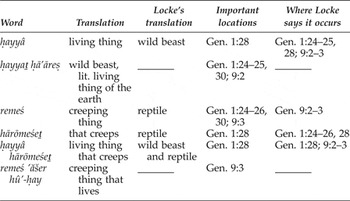
Prior to this point, Locke had been telling a host of lies, albeit small ones, in order to make his thesis that ḥayyâ hārōmeśeṯ in Gen. 1:28 refers to the “kinds” enumerated in Gen. 1:24–25 seem more plausible. It now seems worth noting them (see table 1). As mentioned above, while he does not quote the Hebrew words used in Gen. 9:3, he at the very least implies that these are the same ones as used in Gen. 9:2 for wild beast and reptile, which he lists as ḥayyâ and hārōmeś. The latter is actually tirəmōś, another form of the verb rāmaś, while the former is ḥayyaṯ hā’āreṣ. Ḥayyâ can be used to mean a wild beast, as Locke says, but on its own it means simply a living thing; the more common term for wild beast is literally “living thing of the land,” ḥayyaṯ hā’āreṣ, which (contrary to Locke's avowal) is what we find in Gen. 9:2. Similarly, Locke says that Gen. 1:24–25, on which he relies for saying that the brute inhabitants of the earth are divided into three “kinds,” use the word ḥayyâ for wild beast (I 25), when they too instead use the phrase ḥayyaṯ hā’āreṣ (or the more poetic form, ḥayəṯwō ’ereṣ). He also suggests that these verses use hārōmeśeṯ for the third rank of creatures, the reptiles (I 25); the actual word these verses employ is remeś. As noted above, the Septuagint does not support his typological thesis, yet he assures his readers that it does.
Key Differences between Locke's Presentation and the Biblical Text

Now, all of these falsifications make it more plausible that ḥayyâ hārōmeśeṯ should be taken to mean “wild beast and reptile.” But at the same time, once they are noticed, they reveal how utterly implausible Locke's suggestion actually is. They reveal that Locke advances an implausible interpretation of the Bible by outright lying about the Bible.
In light of his abandonment of his typological thesis to say that Gen. 9:3 and Gen. 1:28 refer to the same thing (I 27), we cannot say that Locke believes in this thesis. Given its utter implausibility on the basis of the text (as opposed to what Locke tells us about the text), we cannot say that Locke made an honest mistake. We are faced then with the inescapable conclusion that Locke presents in I 25 and defends in I 26 and the beginning of I 27 an interpretation of the Bible in which he does not believe. More than this: he creates an interpretation in which he does not believe, a heterodox interpretation, and advances it only to abandon it (at the end of I 27 and I 28).
One might claim that someone unable to attain or maintain the austere Protestant saintliness required to interpret the Bible in the light of the Bible alone, refusing to bend scripture to their own prejudices however cherished, might mouth the canons of interpretation while on occasion failing to adhere to them. Even the pious might slip when it comes to an interpretation that satisfies their experience of a moral cosmos. But it cannot be claimed that a genuinely pious individual would lie in order to lend credibility to an unorthodox interpretation in which they do not believe.
Locke's Trap
By the end of chapter 4, Locke is interpreting the Bible entirely in the light of his own moral reasoning. Indeed, the contrast with the beginning of the chapter is striking. After concluding his semantic case that Gen. 1:28 gave no political power (I 40), he entertains the possibility that one could parlay the verse's grant of property into political power by threatening others with starvation (I 41). If property could thus be transformed into political power, Locke says, “it would be a good Argument to prove, that there was never any such Property, that God never gave any such Private Dominion” (I 41). His evidence for this is not any biblical verse, but instead his judgment of what would be “more reasonable to think” God would do, given that he “bid Mankind increase and multiply.” But we further know, Locke says, that it is impossible to convert property into political power in this way. More than this, “we know God hath not left one Man so to the Mercy of another” (I 42). This, too, Locke does not establish on the basis of scripture, not even with a nod in that general direction, but instead through his own arguments concerning justice and charity.
In the middle of chapter 4, when dealing with the claim that Gen. 1:28 was intended for Adam alone (I 29–40), Locke at least mixes his pronouncements about what God must demand with references to the Bible. But even there, it is clear that Locke is interpreting those verses in light of what is reasonable, or seems reasonable to him, rather than by scripture alone. He argues against the subjection of Eve, for example, by asking, “shall we say that God ever made a joint Grant to two, and one only was to have the benefit of it?” (I 29). Locke's conclusive proof that Filmer is mistaken about the extent and character of Noah's dominion is Locke's own judgment that it would be absurd to put off repeopling the world after the flood for 350 years until Noah had died or to have required that his sons ask his permission to lie with their wives if this repeopling were to begin during his lifetime—seeing as Noah himself is not recorded as having contributed to the task with new children of his own (I 33). God cannot have a preference for absolute monarchy, for Locke knows that population growth requires the development of the arts and sciences and these do not flourish under absolute monarchy (I 33). It is daft to think that the creatures stood in fear only of Noah but not of his sons, so Gen. 9:2 cannot have been addressed to him alone (I 34). Locke cannot comprehend that an absolute monarch should be denied the right to eat his property, so the fact that Adam could not eat meat implies that he was no absolute monarch (I 39).
It is clear, then, that Locke does not actually hew to the pious submission to the biblical text that he declares is the only permissible hermeneutic method. Indeed, only in the first part of chapter 4 following his introductory remarks, when he is addressing the question whether Gen. 1:28 granted dominion over human beings (I 25–28), does he make even a show of an attempt to submit to the words of scripture in interpreting scripture, and there it seems his point was merely to spring a trap for such humble literalism. Locke adopts the canons of interpretation that he does there for no other reason than that one must adopt the premises of one's opponent in order to subject them to a reductio ad absurdum.
Locke must do so, for his procedure in the middle and especially at the end of chapter 4—and the rest of the Two Treatises—is vulnerable to an orthodox and eminently respectable objection. In order to interpret the Bible in light of what seems reasonable, one must presume that the Bible is nothing but the word of reason in the form of revelation. Locke does affirm that this is so, at least regarding what is commanded, but that is clearly an insufficient reply: it ignores and even denies the possibility that the Bible is suprarational or that it reveals parts of the moral law that could not be known simply by natural reason, let alone that revelation not merely supplements but also corrects even the most perfect comprehension of the law of nature that natural reason might provide.Footnote 20 A revelation that simply repeated natural theology would be superfluous, at least for the best human beings, while the Bible claims to be useful for all—indeed, that the beginning of wisdom is fear of the Lord, not a reliance on one's own natural faculties. One cannot meet this oppugnant vision of the Bible's true message by prefacing one's counteraffirmation that reason is man's “only Star and compass” (I 58) with a scandalous tale of Peruvians eating babies (I 57).
Locke puts submissive literalism to the test in order to show its impossibility. The application of such canons of interpretation as this submission to biblical authority suggests means that Gen. 1:28 should be phrased in clear terms, and we find such terms in Gen. 1:20–25. Yet this submission to scripture as its own best interpreter requires taking ḥayyâ hārōmeśeṯ against its plain meaning. Moreover, even if one is willing to sacrifice a little bit of grammar in order to preserve biblical literalism (even though God does not cross the rules of language when speaking to man), this simply generates a new problem: it would mean that God neglected to grant dominion over the cattle. So, in order to preserve biblical literalism, one must further deny that Gen. 1:28 means what it says, and instead presume that God does what he says he intends and that his statements of what he intends are also inaccurate, needing to be read in light of what he does. And the grant to Noah and his sons also does not fit the mold that it should, given the canons of biblical literalism, until Locke concedes or divulges that nowhere in the Bible do the words of God's grants adequately convey the content of those grants.
Locke further makes the Bible appear more coherent than it is, lying about its content such that the above problem is clear and relatively easy to follow. He emphasizes the importance of the Bible's coherence and makes one certain that it simply must possess that lucidity—Gen. 1:28 simply must speak in the categories established in Gen. 1:20–25, lest it be vague where clarity is required, such as in positive grants. He builds up this expectation and validates the moral impulse behind it. He thus prepares some readers to be suitably aghast when they turn to the Bible's actual text to verify what he says, for then they will discover that it is even less coherent than they had been led to believe. To say that the Bible is the revealed word of God is to imply certain things about its form apart from its message, and thus to present the reader who has thought seriously about what the concept of revelation entails with testable hypotheses about the Bible's form. The text does not take that form. Locke has set a trap for those motivated by the deep, orthodox piety he exhibits as he opens chapter 4.
Locke and Liberal Christianity
It might be objected that this conclusion, namely, that Locke's semantic critique of the Bible is irreconcilable with the pious-Locke hypothesis, understates Locke's role as a theologian of what would come to be called liberal Christianity. Moreover, for all his rhetoric condemning anything but the most literal interpretation of scripture, Locke wants the Bible to be interpreted in light of moral knowledge, or rather in light of reason. Might not someone spring Locke's trap and yet still believe? That is, one might grant that Locke writes esoterically, but could not Locke's intention be to explode biblical literalism precisely in order to free men for a more liberal approach to the Bible?
In favor of this suggestion, one may observe that Locke does promote a liberal reading of the Bible, at least by deed. One could say that Locke eases readers into this liberal reading at the same time that he springs his trap on a literal reading. Working backwards through chapter 4, one discerns ever less objectionable appeals to our presumed moral knowledge. The flow of the chapter is of decreasing appeals to scripture and increasing appeals to our moral opinions. He certainly eases and even seduces his reader into this new mode of interpretation. Perhaps Locke also subtly suggests that the only way to make sense of the Bible is by such an appeal.
Of course, there are two main problems with saying that Locke's ultimate intention is to bring his most careful readers to an acceptance of liberal Christianity. First, Locke merely demolishes the only alternative to such a reading: he does not provide any positive argument establishing that such a reading either makes sense of or is even permitted by the text. Second, to admit that the First Treatise has a theological teaching that involves interpreting the Bible in light of morality brings one up against the fact that Locke seems to suggest that the Bible is morally incoherent or, even worse, repugnant. For example, according to Pangle, Locke objects that the biblical God casts man into a world where he needs to labor in order to survive but discourages and even forbids the most productive avenues toward that survival (viz., eating meat, farming, acquisitiveness in general). The biblical God commands submission to the patriarchal family, while the rational family is not patriarchal. The doctrine of original sin itself is morally grotesque, which explains why Locke skips over the Fall in the First Treatise (which otherwise follows the order of topics as they appear in the Bible rather than as they appear in Filmer).Footnote 21 One can no longer avoid this aspect of Locke's presentation by claiming that Locke had no interest in pursuing such questions in the Two Treatises.
The semantic critique I have drawn out of the First Treatise does more than buttress interpretations that emphasize Locke's criticism of biblical morality. It also adds needed support to the further critique that Pangle ascribes to Locke. For Pangle, Locke's criticism of biblical morality is not just a sign of disagreement but rather forms a part of his refutation of biblical authority. He argues that the personal experiences of the pious suggest the importance and even centrality of divine justice to their experiences of the divine. It is their experiences, and perhaps similar ones of our own, that make us willing to take the Bible seriously in the first place. An unjust God, then, can be no God at all; ancient tales that suggest we must subordinate our rational sense of justice to divine authority can thus be known to be false. This is what Pangle says Locke argues.Footnote 22
I think that Locke's criticism of the Bible's moral teaching is present in the Two Treatises, but I do not think that there is sufficient evidence for that criticism if one does not recognize the semantic critique that this article has explored. One might otherwise object that Locke did not apply (or mean the reader to apply) what he says about justice to the actions he attributes to God. Moreover, that such a moral critique is present in Locke's text seems to be persuasive only to those who are willing to entertain the possibility that the moral critique itself might be persuasive. Those willing to insist that even God's justice is mysterious, on the other hand, tend not to see the evidence to which Pangle points. They could retort that Locke wrestled with the justice of God and so that is why God might not always seem to some to come off well.
Moreover, this sort of orthodoxy would seem immune to the moral critique that Pangle attributes to Locke (i.e., that the Bible's authenticity depends on its moral coherence and that it lacks moral coherence). One could deny that the Bible's moral intelligibility has any bearing on its authentic message or its authority. To hold God to any standard is to love that standard more than God and thus to reveal one's love of God to be conditional. One challenged by Pangle can retreat into a refuge of absolute submission to scripture, denying that one possesses the knowledge of God probed by the moral critique. Pangle's response is that holding to such a position (consistently) is humanly impossible, that the most one can (normally) do is verbally affirm it—even Kierkegaard could not refrain from a small reservation that God's justice is ultimately comprehensible in human terms.Footnote 23 Heinrich Meier's suggestion that a wise ruler would not be envious in the way that the biblical God declares himself to be also requires that we be able to assimilate God's ways to our ways and is thus predicated on a foundationless denial of God's unintelligible mysteriousness.Footnote 24 That is, the moral critique declares orthodoxy or submissive literalism to be psychologically impossible or refuses the sacrifice of the intellect that it might demand, but it does not refute it analytically.
Locke's critique of the Bible, as Pangle presents it, would presuppose the defeat of orthodoxy rather than contribute to it. Conceiving of God as a judge and holding him to that standard requires that one know beforehand what justice is. Locke's moral critique requires that one abandon humble Socratic acknowledgments of aporia and affirm instead that one has knowledge of a sort that provides a completely coherent account of justice. Yet the secular accounts of justice attributed to Locke rely on the success of his theological critique and so could not be deployed in the service of that critique. One cannot assert the innocence of our most powerful urges such that they become evidence for our rights without having reason to reject original sin, for example (see I 86, 88). The accounts of Locke's law of nature that are not secular, by contrast, rely on the fiat of omnipotence, and so certainly cannot be turned against that omnipotence. Of course, most people do not experience God as being beyond good and evil, which is to say, most people do indeed make their God cognizable rather than radically mysterious when it comes to his wisdom and justice. Pangle relies on this fact in order to dislodge evasions of the moral critique that profess an unconditional submission to scripture—it turns out that no one is willing to take their submission to the Bible so far as to transform God into a jinn or other malevolent spirit. Yet this fact does not sufficiently ground the contention that the Bible's authenticity is vouchsafed only by our experience of its moral intelligibility, for it is not clear that most people have achieved the heights of piety demanded by the Bible such that we can argue from their opinions to the standards of what ought to make the Bible credible. If anything, more interpreters of the Bible say the opposite. The expectation that God has communicated clearly enough for human purposes may itself imply a moral demand on him, insofar as belief in sufficient promulgation is an aspect of a belief in justice, but pointing this out cannot dislodge biblical literalism: one could insist that we limit the moral intuitions by which we guide our understanding of the Bible to what is required for this belief in clear communication.
What Locke does in the opening sections of chapter 4 is to render the Bible susceptible to the moral critique of religion, or at least that is his intention. The semantic critique that I describe is not simply one more way in which Locke suggests that the Bible is incoherent; it undergirds his other confutations of the Bible. The attempt to read the Bible with no moral presuppositions beyond a faith in sufficient promulgation merely demonstrates that this is not how the Bible is written, that God has not communicated so clearly with us that we can understand his word by reference to his word alone. One cannot resist the moral critique by retreating ever further into the sanctuary of a suprarational revelation, permitting even that God's justice be radically mysterious in order to preserve one's faith in him and his promises. At the very least, the hypothetical scripture that would not be susceptible to the moral critique, that could demand to be interpreted by itself alone, is not what we confront in the Bible.
Locke's semantic critique of the Bible forecloses interpretations of his political thought that rely on his orthodox Christianity. Liberal Christianity also opposes literal interpretations of scripture. If one does not surrender one's moral commitments in approaching the Bible, however, Locke would seem to go out of his way to demonstrate that the biblical God is morally grotesque and that the biblical narrative reflects moral incoherence. One cannot maintain a morally informed reading of the Bible in the face of this without jettisoning most of the Bible, and once one is willing to do that there is no way in which the Bible might challenge or inform one's convictions. One cannot resuscitate the pious-Locke hypothesis following evidence of Locke's semantic critique of the Bible by an appeal to liberal Christianity.
Conclusion
Locke's argument in I 25–27 has very little to do with Filmer, whose interpretation of Gen. 1:28 is sufficiently refuted by the fact that ramaś or “creep” cannot be used in conjunction with human beings. Locke's argument in those sections has everything to do with refuting the Bible. If the Bible was written so that our opinions were to be subjected to the test of its approval, its wording would have to be clear when it comes to things that we must understand and act on. This sort of clarity requires that God specify what is granted to mankind by employing the terms used to relate what sorts of creatures are in the world. Locke's suggestion that the Bible does indeed do this is an invention. Consequently, the problematic difference between what God is said to have intended to grant in Gen. 1:26 and what was actually granted in Gen. 1:28 is also a Lockean invention. These distortions, however, make the problem easy to understand and do not immediately signal to a potentially persuadable reader that their expectation of clarity has impious consequences—that their piety itself must result in impiety if actually taken seriously. Noticing these distortions does not release one from Locke's semantic critique of orthodoxy; it sharpens that critique. The Bible is unclear where its authority requires it to be clear. It is Locke's intention that, at this point, those readers who can be broken from orthodoxy will either abandon the Bible altogether or at least adopt a liberal stance toward it. Locke's criticism of biblical morality suggests that he does not intend the latter as more than an unstable halfway house. Locke's moral critique is meant to dislodge liberal Christianity, his semantic critique, fundamentalist Christianity; together, they are meant to act as Scylla and Charybdis. I have argued that this is the only plausible interpretation that accounts for all of the evidence. While Locke's falsifications of the biblical text fulfill a rhetorical function in his biblical critique, they are also clear evidence against the pious-Locke hypothesis. This also means that scholars cannot counter evidence that Locke points to the Bible's moral incoherence by averring that he was too pious to do so.
It might be demanded, Why would Locke include a biblical critique in a book meant to persuade even those who did not agree with that critique to support a specific political action? Even if such an argument were required for philosophic completeness, why include it in a book that does not otherwise seem to aim at philosophic completeness? Such an objection mistakes the claim I am making about the evidence for the presence of a biblical critique in the Two Treatises. I do not claim that it is simply a plausible story. It is instead a smoking gun. We must guide our understanding of what Locke thought in his rhetorical interest by the fact of its inclusion and cannot contest the fact of its inclusion by appeal to what we surmise his rhetorical purpose must have been.
Locke's irreligion does not mean that he cannot employ religious rhetoric or engage in religious debate. It is one thing to take one's cues from the Bible; it is quite another to emphasize any point of agreement that might exist. Locke is not above opportunistically scouring the Bible for support. He will cite what was accepted as sacred history insofar as it buttresses his argument (I 106–69; II 21, 24, 109, 196), even as he is viciously critical of drawing lessons from Providence (I 147).Footnote 25 If the Bible says to honor thy father and thy mother, then there must be a moral equality between the sexes, the interpretation of other verses yielding to this equality (I 40–49). When a verse argues that we ought not be concerned with acquiring property since God has given us all things richly to enjoy, Locke has no qualms about using it to say that the world is there for us to enjoy and that we therefore are justified in extracting every convenience of life from it (II 31). Many Christians held beliefs that were inimical to liberal democracy, and Locke goes to great lengths to argue that these beliefs are un-Christian. It is this task that caused him to start afresh in writing the Letter Concerning Toleration rather than revise his Essay on Toleration, the primary difference between the two being the Letter's greater concern to answer religious objections to toleration.Footnote 26 He continued this task in An Essay Concerning Human Understanding, The Reasonableness of Christianity, A Paraphrase and Notes on the Epistles of St. Paul, and the various vindications and defenses of his writings that he had to produce. None of this shows that he took religion seriously, however. It means only that he took the religious seriously.
I close by noting that, while something like Locke's gambit would be necessary to place the moral critique of biblical religion on solid ground, Locke himself does not succeed in this. The premise of his argument, on whatever level we take it, is that the grant of dominion in Gen. 1:28 is of enduring concern, that it is a command to contemporary readers of the Bible. That the verse has this importance is crucial to the argument that it ought to be clear and thus that its imprecision means that the Bible is unsuitably unclear. It does not seem necessary to attribute such importance to the verse's donation. Someone might also suggest that Locke's conception of what revelation entails presumes the prior success of Protestant arguments in favor of sola scriptura against Catholic (and also Jewish and Muslim) interpretive modes; these arguments were religious in character, and so the success of Locke's critique would undermine its foundations. Additionally, Locke's argument relies on a questionable judgment that “every living thing that creeps upon the earth” is too vague for a positive grant and that the Bible ought to have specified the donation to Adam in the terms used earlier—yet it is clear that this phrase encompasses everything Locke would have the Bible enumerate individually.Footnote 27 Locke would not be repeating the details of Spinoza's higher criticism, but the semantic critique I attribute to him would be open to the same objection: both rely on the claim that they do not understand what they think they should understand and that the text must therefore be senseless.
The success or failure of Locke's critique aside, however, its presence demonstrates that there is not a religious foundation to his political thought. We cannot therefore “take as read” what any decent Christian would believe to supplement the words Locke actually chooses. Our understanding of what he means by the law of nature and its application to property, obligation, humanitarianism, and the like cannot be informed by an extratextual sense of what he must have meant. Locke, moreover, thinks that his political thought is the work of natural reason and as such is of universal applicability. Locke does not think that he defends a parochially post-Protestant political settlement, but rather that the natural rights of man as such demand liberalism.