Introduction
Of over 20,000 named species of trilobites, the antennae are known from < 30 (Zeng et al., Reference Zeng, Zhao, Yin and Zhu2017, table 1). They are preserved in a range of orders from Cambrian Stage 3 to the Lower Devonian, recording a consistent structure that permits some ancestral character states to be reconstructed. In all of these examples, the antennae are uniramous, elongate (typically about as long as the cephalic shield), and flagelliform. They emerge from beneath the cephalic shield in a conserved position, passing through antennal notches at the sides of the hypostome. They gradually taper distally along their length and are composed of a rather large number of articles—typically 25–50. This morphology is retained across the orders Redlichiida (including the early diverging Olenellina), Corynexochida, Ptychopariida, Olenida, Asaphida/Trinucleida, and Phacopida, and thus can be inferred to have been present in the last common ancestor of Trilobita as a whole.
The flagelliform antennae of trilobites are similar in gross morphology to the antennae of many extant arthropods. We use the term ‘flagelliform’ in contrast to ‘flagellate,’ the latter being applied to antennae with short annuli that lack intrinsic musculation, as in insects and malacostracans (Boxshall, Reference Boxshall2004). Trilobites have antennal articles of variable length but at least some (or in some cases all) are sufficiently elongate to infer that each has independent musculation, reconstructed as the primitive state for the antenna across the Arthropoda (Boxshall, Reference Boxshall2004). Antennae usually bear mechanosensory sensilla on most articles and some (or many) articles can also bear chemosensory sensilla. In most cases, the sensilla of trilobite antennae are unknown, presumably due to nonpreservation rather than true absence, given that mechanosensory sensilla are considered ubiquitous on flagelliform antennae across Arthropoda. In a few trilobites, however, spiniform structures are observed at consistent locations on antennal articles, and in some instances, setae are known that presumably had a mechanosensory function based on their size and distribution. In Eoredlichia intermedia (Lu, Reference Lu1940) from the Cambrian Chengjiang biota, each antenna is composed of ~50 articles, the basal 10 or so of which each bear a small spine along its inner edge (Hou et al., Reference Hou, Clarkson, Yang, Zhang, Wu and Yuan2008). The closely allied Cambrian Redlichia takooensis Lu, Reference Lu1950 has fewer, more elongate articles but they likewise each bear an adaxially directed spine at the distal edge of the article (Holmes et al., Reference Holmes, Paterson and García-Bellido2019). The same pertains to the metadoxidid Hongshiyanaspis yilangensis (Zhang and Lin in Zhang et al., Reference Zhang, Lu, Zhu, Qian, Lin, Zhou, Zhang and Yuan1980) (Zeng et al., Reference Zeng, Zhao, Yin and Zhu2017), whereas the gigantopygid Zhangshania typica Li and Zhang in Li et al., Reference Li, Kang and Zhang1990 has a distal spine on both the adaxial and abaxial sides of proximal articles but only an adaxial spine on distal articles (Hou et al., Reference Hou, Hughes, Yang, Lan, Zhang and Dominguez2017). Although consistently described as spines in all of these members of Redlichiida, these structures might not be direct cuticular outgrowths (i.e., spines in the strict sense), but could instead be macrosetae (socketed, innervated sensory structures). In the case of the Burgess Shale dorypygid Olenoides serratus (Rominger, Reference Rominger1887), Whittington (Reference Whittington1975, p. 122) observed that “minute setae are preserved rarely along the side of the flattened antennae,” likely being mechanosensory sensilla. The Devonian Phacops (Chotecops) sp. from the Hunsrück Slate has ‘bristles’ along the distal margin of its antennal articles (Bruton and Haas, Reference Bruton and Haas1999, text-fig. 28a), the morphology and distribution of which are likewise suggestive of trichoid mechanosensory sensilla.
Here we describe a specimen of the asaphid trilobite Asaphellus from the Lower Ordovician of Morocco with short, clavate antennae. The gross form and details of its possible sensory structures demonstrate that trilobite antennae could be strikingly different from the general form. Occurrences of Ordovician trilobites preserving soft parts in Gondwana and adjacent terranes have beeb reviewed by Budil and Fatka (Reference Budil, Fatka, Hunter, Alvaro, Lefevre, Van Roy and Zamora2022) none of which are closely comparable with the new discovery described here.
Material and methods
Both antennae are preserved in situ in a single specimen of Asaphellus tataensis Vidal, Reference Vidal1998, from the Fezouata Shale Formation at Tanssikhte, Zagora, in the Anti-Atlas of Morocco. The specimen (Figs. 1, 2) is preserved as part and counterpart, consisting of the nearly complete cephalon, all or parts of all eight thoracic segments, and the right half of the pygidium. The antennae are the only exposed appendages.
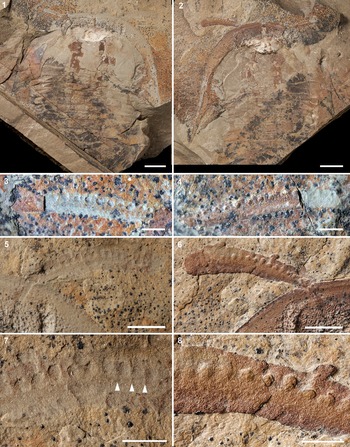
Asaphellus tataensis Vidal, Reference Vidal1998, NHM PI It 29382: (1, 2) overviews of part (1), and counterpart (2); (3, 4) left antenna on part (3) and counterpart (4); (5, 6) right antenna on part (5) and counterpart (6); (7, 8) dome-shaped structures on part (7) and counterpart (8). Arrowheads in (7) indicate possible boundaries between articles. Scale bars = 2 mm (7, 8); 5 mm (5, 6); 1 cm (1, 2), 2 mm (3, 4).

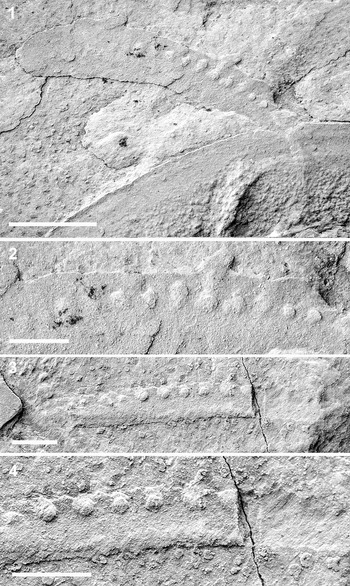
Asaphellus tataensis Vidal, Reference Vidal1998, NHM PI It 29382, antennae of counterpart photographed with ammonium chloride sublimate: (1, 2) right antenna; (3, 4) left antenna. Scale bars = 2 mm (2–4), 5 mm (1).

In the region west of Zagora from which the types of Asaphellus tataensis were described, the species occurs in the middle part of what was formerly identified as the upper Fezouata Formation (see Vidal, Reference Vidal1998, text-fig. 3 for stratigraphic range chart). However, the current stratigraphic framework recognizes an undivided Fezouata Shale Formation in the region of Zagora because a marker bed that distinguishes them in the eastern Anti-Atlas is absent. Originally dated to the Floian (Vidal, Reference Vidal1998), A. tataensis has since been found in association with typical elements of the Fezouata Konservat-Lagerstätte (Martin et al., Reference Martin, Vidal, Vizcaïno, Vaucher, Sansjofre, Lefebvre and Destombes2016a, fig. 2), to which graptolite biostratigraphy assigns a late Tremadocian age (Araneograptus murrayi Biozone) (Martin et al., Reference Martin, Pittet, Gutiérrez-Marco, Vannier, El Hariri, Lerosey-Aubril, Masrour, Nowak, Servais, Vandenbrouke, Van Roy, Vaucher and Lefebvre2016b). Preservation of the antennae in the specimen studied here is consistent with appendicular preservation of large arthropods in the Konservat-Lagerstätte (e.g., Gutiérrez-Marco et al., Reference Gutiérrez-Marco, Rábano, Sá, Poblador and García-Bellido2022 for an asaphid trilobite), whereas small arthropods more typically have appendages preserved in low relief with structures delimited by iron oxides (Pérez-Peris et al., Reference Pérez-Peris, Laibl, Vidal and Daley2021). Of the four species of Asaphellus in the Fezouata Formation (Vidal, Reference Vidal1998; Fortey, Reference Fortey2009; Martin et al., Reference Martin, Vidal, Vizcaïno, Vaucher, Sansjofre, Lefebvre and Destombes2016a), identification as A. tataensis is supported by the small, anteriorly placed eyes. The orientation of the genal spines precludes an identity as A. stubbsi Fortey, Reference Fortey2009, the other of the two Tremadocian species in the Fezouata Shale.
Repository and institutional abbreviation
The specimen is reposited in The Natural History Museum, London, UK (NHMUK), with the registration NHMUK PI It 29382.
Results
Morphological description
Length of the cephalon is 35 mm. The librigenae are not displaced along the posterior sections of the facial suture, so the specimen is identified as a carcass, as expected for appendicular preservation. The antennae emerge at the same anterolateral position on each side of the cephalon and have the same, mostly lateral orientation, their distal third flexed more than the proximal part. Both antennae are mostly in negative relief on the part (Fig. 1.1) and in positive relief on the counterpart (Figs. 1.2, 2), such that their ventral surface is mostly exposed. The incomplete left antenna preserves a small section of the dorsal side of the antenna distally. The exposed portion of the complete right antenna is 19 mm on the counterpart. The more complete antenna is clavate, 2.5 mm wide where it emerges from the cephalon, and gradually widening to 4.3 mm distally before tapering slightly near its rounded tip (Figs. 1.6, 2.1). Beneath the cephalon, the antennae are variably preserved in positive or negative relief in the same sense as the parts exposed distal to the cephalic shield. The right antenna records a gentle, even narrowing across the outer half of the preglabellar area and presumably back to a point of issue at the antennal notch of the hypostome (Figs. 1.5, 1.6, 2.1). The exposed distal part of the antenna is seen to lie slightly below the exoskeleton on the counterpart (Fig. 2.1, 2.3), presumably as a result of the antenna being more subject to compaction than the robust, biomineralized exoskeleton.
Along the length of the antenna, a row of as many as 12 round, domed impressions on the part/swellings on the counterpart is aligned with the curvature of the antenna, being closer to the anterior margin than to the posterior (Figs. 1.4–1.8, 2). Where the left antenna exposes both its dorsal and ventral sides, the swellings/impressions are in opposite relief on each side (Figs. 1.3, 1.4, 2.3), indicating that both dorsal and ventral sides bear a row of the same size and spacing. Those on the dorsal side are more faintly preserved than those on the ventral side but the alignment of the two rows suggests that the dorsal swellings and impressions are real. On the ventral side, the swellings are smallest in diameter (~0.4 mm) on the proximal part of the antenna but are approximately uniform in size along most of their extent, the largest having a diameter of 0.7 mm. They are evenly spaced, their one-to-one correspondence with very faint impressions of the boundaries between articles (Fig. 1.7, arrowheads) possibly indicating one dome-shaped structure per article.
The domed swellings are regarded as biological structures rather than taphonomic artifacts because they are preserved in the same fashion as the surrounding cuticle of the antennae rather than having a distinct mineralization. They are also regular in shape, size, spacing, and alignment, and they appear to be present on both the dorsal and ventral sides of the antenna (and thus cannot be parting artifacts), and are the same in all details on both antennae.
Discussion
Identity of the described appendages as antennae (as opposed to a chance association of nonasaphid remains) is based on their bilateral symmetry in position, proportions, and morphological details, identical curvature and the sense of curvature being typical of trilobite antennae, passage beneath the cephalic shield in the usual position of trilobite antennae, and a clavate form that is known from the antennae of varied arthropod groups.
As summarized in the introduction, all trilobite antennae known to date are surprisingly uniform and conservative in gross morphology despite the vast temporal range and phylogenetic separation of the ~30 species from which they are sampled. No other trilobite has short, clavate antennae like those of Asaphellus, nor are possible homologues of the dome-shaped swellings known elsewhere among trilobites. Until very recently, the only asaphids known from appendage preservation were two species of Isotelus from the Upper Ordovician of New York State (Raymond, Reference Raymond1920), neither of which preserves the antennae. One partial antenna was described for Megistaspis (Ekeraspis) cf. M. hammondi Corbacho and Vela, Reference Corbacho and Vela2010, from the Fezouata Formation (Gutiérrez-Marco et al., Reference Gutiérrez-Marco, Rábano, Sá, Poblador and García-Bellido2022). It is too incomplete to determine if it is flagelliform but it does not appear to be clavate. The next most closely related trilobite with known antennae is the nileid Symphysurus sp., also from the Fezouata Konservat-Lagerstätte. The one figured antenna of this species (Van Roy et al., Reference Van Roy, Orr, Botting, Muir, Vinther, Lefebvre, el Hariri and Briggs2010, fig. S2b) is too fragmentary to establish its length or morphology apart from the lengths of a few articles.
Comparison with extant arthropods
Although the flagelliform antennae of most trilobites are comparable to those of many extant arthropods, the narrow range of form seen in trilobites is somewhat surprising given the variability in their homologue, the antennules, across aquatic Pancrustacea. Conspicuous modifications of the antennules include the much-reduced form in branchiopods, biramous flagellae in malacostracans, short and sometimes horn-bearing appendages in branchiurans, and attachment organs in larval barnacles (see Schram, Reference Schram1986, for examples of all of these).
Clavate antennae evolved in different arthropod clades. They show a pattern of appearing in groups that have reduced and conserved numbers of articles. For example in Chilopoda, they are found within the order Geophilomorpha, in which numbers of antennal articles are fixed at 14, versus article numbers that are usually variable between and often within species of the other orders. Most geophilomorph species/families have slightly attenuated antennae, but club-shaped antennae characterize members of the family Ballophilidae. In such ballophilids, the expanded distal part of the antenna is separated from the narrower proximal part by a distinct bend and the distal articles bear a dense concentration of short mechanosensory sensilla on their ventral side (Pereira, Reference Pereira1996, fig. 1). Likewise, within Coleoptera, clavate antennae evolved within clades that have small, conserved numbers of articles. Examples in beetles include members of the formerly recognized grouping Clavircornia, the name derived from the clavate antennal form.
A sensory function of the dome-shaped structures might be expected, given how pervasive epidermal sensilla are on arthropod antennae. However, the large size of the structures in Asaphellus tataensis is inconsistent with most kinds of chemosensory sensilla, which are at least an order of magnitude smaller. The range of epidermal chemosensory sensilla in Chilopoda, for example, characteristically have diameters of just a few microns (Müller et al., Reference Müller, Sombke, Hilken, Rosenberg and Minelli2011).
Morphologically, the dome-shaped structures show some resemblance to the campaniform sensilla of insects. These are domed sensilla, each with a cuticular cap and usually a membranous rim around it (Cole and Palka, Reference Cole and Palka1982). They are sensitive to pressure (stress and torsion on the cuticle), such that when physical stress is applied to the cuticle, the external structure of the sensillum is compressed and the single nerve beneath the cap is stimulated. In insects, they are found on the legs, either singly or in groups, usually close to the joints. They are also on the wing bases and along particular veins of the wings (e.g., Dinges et al., Reference Dinges, Chockley, Bockemühl, Ito, Blanke and Büschges2021 for Drosophila melanogaster Meigen, Reference Meigen1830). However, like the chemosensory sensilla noted above, campaniform sensilla are far smaller (usually 5–10 μm) than the structures on the Asaphellus antenna.
Asaphid life habits
The family Asaphidae originated in the Furongian but had a distribution covering all of the dispersed paleocontinents before the time of the Great Ordovician Biodiversification Event (GOBE). Within the constraints of a stable body plan—being almost always isopygous and invariably with eight thoracic segments—asaphids evolved into many genera, although their classification has proved difficult, not least because of frequent homoplasy between forms adapted to separate paleoplates. Many species became smooth and effaced dorsally; eye size and elevation varied widely, as did length of genal spines, dorsal expression of segmentation, and the morphology of the hypostome. Asaphidae did not survive the end-Ordovician extinction event. Fortey and Owens (Reference Fortey and Owens1999) argued that Asaphidae had predator/scavenger habits, noting the strongly buttressed support of the attached hypostome ventrally, the many modifications to the posterior part of the hypostome (anterior to the mouth), and an association with Rusophycus trace fossils. The large size attained by asaphids is also appropriate; indeed, the largest trilobite known is Isotelus rex (Rudkin et al., Reference Rudkin, Young, Elias and Dobrzanski2003) at > 70 cm long. The typical ventral features are shown again in the Asaphellus species from Morocco with the hypostome in place (Vidal, Reference Vidal1998, pl. 1, fig. 3, pl. 2, fig. 1), although the posterior hypostomal fork, which is common to most advanced asaphids and has been claimed as an adaptation to manipulation of prey, is not developed. Some large asaphids with nonforked hypostomes, including species from Fezouata, have alternatively been interpreted as deposit feeders (Gutiérrez-Marco et al., Reference Gutiérrez-Marco, García-Bellido, Rábano and Sá2017). The evident success of the asaphids is reflected in their dominance in Ordovician strata in Baltoscandia (Balashova, Reference Balashova1976) and their abundance among the giant trilobites in the trilobite museum in Arouca UNESCO Geopark, Portugal (Sá et al., Reference Sá, Pereira, Rábano and Guttiérez-Marco2021). It is plausible that asaphids placed a premium on the detection of their prey species. This would be consistent with a highly specialized modification to the antennae. Because of the peculiarity of the antennal organs described herein, it is unknown whether detection was chemosensory, related to detecting movements of likely prey species, or some combination of the two. Nearly all asaphids had large holochroal eyes with crowded lenses as part of their sensory equipment, appropriate to hunting after detection of a prey species. It is considered likely that other asaphids would have had similarly specialized antennae as an important contribution to their effective behavior. Among the Moroccan asaphid specimens with antennae illustrated by Guttiérez-Marco et al. (Reference Gutiérrez-Marco, Rábano, Sá, Poblador and García-Bellido2022), there is doubt about authenticity, as faking of specimens from the Fezouata Formation is not uncommon. However, the left antenna of Megistaspis (Ekeraspis) illustrated in their figure 2D, displays a few, regular, spiky projections along its length, which invites comparison with the antennal organs described here. These structures are too delicate and serially similar to be fakery. If authentic, they could be homologues of the Asaphellus organs. Clublike antennae sensitive to prey species are important in many predatory arthropods; among the beetles, for example, staphylinids are arguably the most speciose and successful group, and have appropriately specialized antennae to enable them to be very active hunters.
Acknowledgments
We are indebted to S.E. (Sam) Stubbs for the donation of the specimen. H. Taylor and K. Webb (NHM) took photographs. A. Minelli (Università di Padova) guided us to valuable literature on clavate antennae, and the journal referees, N. C. Hughes and L. Laibl, provided constructive advice. The authors declare no competing interests.