The field of first language attrition has witnessed a tremendous growth in theoretical potential as a number of theoretical frameworks have been applied to attrition data analysis. The multitude of variables that play a role in bilingualism in general and the degree of first language loss and maintenance in particular provide an enormous challenge for researchers in the field. Many new theoretical approaches have been developed in recent years specifically to account for this variety of factors (e.g. the multi-componential view of attrition by Köpke (Reference Köpke2007); the MOGUL framework by Sharwood Smith (Reference Smith2007); Dynamic Systems Theory by de Bot (Reference Bot2007)). What all these theories emphasize most is the importance of a multi-disciplinary approach to attrition. It has been clearly recognized that a simple one-dimensional explanation of why or how L1 attrition takes place is impossible to achieve. Therefore, it is in the interests of the field to make use of the developments in other areas of linguistic inquiry.
The goal of this paper is to account for long-term selective loss of L1 (Russian) morpho-syntactic and content components in early immigrants. The analysis of naturally occurring data is carried out from the perspective of two theoretical approaches – three models developed within language contact (Myers-Scotton, Reference Myers-Scotton2002, Reference Myers-Scotton, Kroll and de Groot2005) on the one hand and the Activation Threshold hypothesis as a component of a neurolinguistic approach to bilingualism (Paradis, Reference Paradis2004, Reference Paradis2007) on the other. The study demonstrates that by crossing the boundaries of one theory and one view of language researchers can achieve a stronger explanatory power and identify the common and complementary features that both models provide.
1. The language contact approach
A systematic approach to the analysis of bilingual output is crucial for achieving an overall explanation of how two participating languages interact during bilingual production. The Matrix Language Frame (MLF) model (Myers-Scotton, 1993) along with the Abstract Level model (Myers-Scotton and Jake, Reference Myers-Scotton and Jake1995) and the 4-M model (Myers-Scotton and Jake, Reference Myers-Scotton and Jake2000) provide an opportunity for a uniform coding, analysis and explanation of the contribution of the participating languages to codeswitching and convergence in attriters.
Specifically, the MLF model is based on the premise that there is always asymmetry between the roles of the participating languages during bilingual production. One of the languages sets the morphosyntactic frame of a bilingual complementizer phrase (CP). This language is referred to as the Matrix Language (ML). The other participating language fills in some of the content morphemes and is referred to as an Embedded Language (EL). Example (1) illustrates this asymmetry in the two participating languages in the utterance – Russian and English. In (1) the grammatical frame is clearly set by Russian as it provides all the structure-building elements. English is the EL here as it only supplies the content morpheme dog.
(1)


The Abstract Level model (Myers-Scotton and Jake, Reference Myers-Scotton and Jake2000; Myers-Scotton, Reference Myers-Scotton2002) is based on the premise that lemmas in the mental lexicon involve three levels of abstract lexical structure (Levelt, Reference Levelt1989). These three levels – the lexical-conceptual structure, the predicate–argument structure, and the morphological-realization patterns – contain the grammatical information that is required for a surface realization of a lexical entry (Myers-Scotton, Reference Myers-Scotton2002). Each of these structures plays its distinct role in language production. Thus, at the lexical-conceptual level, the speaker's intentions are mapped onto semantic-pragmatic feature bundles, and language-specific lemmas are activated at this level of abstract structure (Levelt, Reference Levelt1989). At the level of predicate–argument structure, arguments are selected and thematic relations are mapped onto the grammatical structure, i.e. early system morphemes become active at this level. For example, an argument with the thematic role of Agent is mapped onto the subject position, Benefactor to indirect object position, and Patient to direct object. Finally, at the level of morphological-realization patterns grammatical relations are mapped onto the surface structure, i.e. late system morphemes are activated at this level. These include case markers, agreement markers, word order, etc.
All three levels of abstract lexical structure are present in mono- and bilingual speech. What is crucial for a meaningful account of bilingual data is that the Abstract Level model suggests that abstract lexical structure is modular, i.e. the three levels of the abstract structure can be split and recombined depending on the accessibility of the information from the languages involved in production. In other words, some parts of the abstract lexical structure may come from the intended Matrix Language while other parts are provided by the intended Embedded Language. The situation where parts of the abstract lexical structure of L1 combine with the abstract lexical structure of L2 is referred to as convergence which results when all the surface morphemes come from one language, but part of the abstract structure comes from another language. The net result is that a bilingual clause can be structured by levels from more than one contributing language. (Myers-Scotton, Reference Myers-Scotton2002, p. 22)
For example, in (2) all surface morphemes are from the ML (Russian).
(2)
However, the lexical-conceptual structure of the verb voz'mjosh’ “to take” does not come from Russian. Standard Russian requires the verb poekhat’ (na) “to go” in references to the method of transportation (for an analysis of Russian motion verbs in language contact and attrition see Pavlenko, this volume). English, on the other hand, does not differentiate between these contexts: the verb take is used with all types of transportation, including buses, cabs and cars. Thus, in order to produce this sentence, the speaker mapped the lexical-conceptual structure of English onto the Russian grammatical frame, but used a Russian verb to fill the projected slot.
The final component of this production model is the 4-M model (Myers-Scotton and Jake, Reference Myers-Scotton and Jake2000; Myers-Scotton, Reference Myers-Scotton2002, Reference Myers-Scotton, Kroll and de Groot2005), which refines morpheme classification. Under the 4-M model, four types of morphemes are established. Importantly, they are classified as either conceptually-activated or structurally-assigned on the one hand, and as able to assign thematic roles or not on the other. Both content morphemes and early system morphemes are conceptually-activated. Content morphemes are directly activated by a speaker's intentions and early system morphemes are indirectly activated to add specificity or modification of a content morpheme's meaning. They are called “early” because they are accessed at the level of the mental lexicon. Examples of these are determiners and the satellite elements in phrasal verbs (e.g. up in look up) as well as derivational affixes. In contrast, structurally-assigned system morphemes carry out language-specific requirements of well-formedness for large phrases and the full clause. They are called “late” because they are not activated until the level of the formulator (Myers-Scotton, Reference Myers-Scotton2002). There is an additional distinction within the category of late system morphemes – that between “bridges” and “outsiders”. “Bridges” depend on well-formedness conditions within the maximal projection of the constituent in which they appear. An example is of in an associative/possessive constituent of two noun phrases joined by of (e.g. friend of the family). “Outsider” morphemes have to look outside their maximal projection for the information that would allow them to receive the appropriate form. An example of an “outsider” morpheme is English 3rd person singular present tense marker -s: the verb has to go outside of its maximal projection to check which person and number the subject is in, in order to ‘decide’, whether or not to receive -s (e.g. Skalik-3rd.sgbark-s loudly) (Myers-Scotton, Reference Myers-Scotton2002).
Thus, what becomes clear from the above discussion is that the different types of morphemes are differentially accessed at the abstract levels of the production process.
Specifically, content morphemes and early system morphemes are accessed at the level of the mental lexicon, but late system morphemes do not become salient until the level of the formulator (Myers-Scotton, Reference Myers-Scotton, Kroll and de Groot2005).
The 4-M model predicts that the differential accessibility of the morphemes at the level of abstract lexical structure results in their differential susceptibility to attrition. Content morphemes that supply meaning and are not responsible for the grammatical frame of a clause are accessed early on in the production. Therefore, they can be easily replaced by content morphemes from another participating language, i.e. the EL. Late system morphemes must come from the Matrix Language as they form the grammatical frame of a sentence and are accessed at a later stage of the production process. Thus, late system morphemes are predicted to be more stable than content morphemes in bilingual speakers. However, in previous studies of child and adult first language attrition, it has been shown that even within the class of late system morphemes some are more vulnerable to attrition than others (e.g. Bolonyai, Reference Bolonyai2000; Gross, Reference Gross2000). What remains unclear is why some of the morphemes resist attrition while others do not; and why some of the morphemes are more readily available to the attriting speaker than others.
These questions are essential for our understanding of what it means to lose L1 and how we can separate different types of contact phenomena. However, they cannot be answered by a production model alone. A model that handles language processing, memory and the nature of knowledge is crucial to achieve a better understanding of attrition processes. The Activation Threshold hypothesis is an example of such a model.
2. The Activation Threshold hypothesis
Unlike the 4-M model, which looks to language dominance in a particular context to account for selective morphological attrition, the Activation Threshold hypothesis (ATH) is rooted in the frequency of use of an item or its competitors which leads to its activation or inhibition. Developed from a psycho-/neurolinguistic perspective, the ATH also accounts for a variable rate of attrition. However, in this case the differentiated access is explained not by the inherent qualities of the morphemes (“outsider” vs. early vs. content), but from the perspective of frequency of activation.
Originally developed to account for differential recovery in polyglot aphasia (Paradis, Reference Paradis1985, Reference Paradis1993, Reference Paradis2004), it has been successfully applied to language attrition data (Köpke, Reference Köpke and Fabbro2002; Gürel, Reference Gürel2004, Reference Gürel2007; Paradis, Reference Paradis2007). The ATH specifies the relationship between the frequency of use, activation and inhibition of a linguistic item, maintaining that frequency and recency of use determine how easily that item can be accessed by a speaker: “every time an item is activated, its threshold is lowered and fewer impulses are required to reactivate it” (Paradis, Reference Paradis2004, p. 28). The strength of the stimulus necessary to activate an item constitutes its activation threshold (Köpke, Reference Köpke and Fabbro2002). When the activation threshold is raised, more impulses are needed to activate the item. Thus, if the item is not used, its activation threshold becomes higher and its accessibility to the speaker diminishes. This becomes important for the analysis of language attrition as it predicts more difficult access to the linguistic items that are used less often by the speaker.
Another important factor of the ATH is recency of use: the activation threshold is low for items that have been used recently. During prolonged periods of non-use, on the other hand, the activation threshold gradually increases. This mechanism is hypothesized to play a substantial role in the attritional process.
The inhibition mechanism is the third component of the ATH that helps account for the control of bilingual processing (Green, Reference Green1986, Reference Green, Schreuder and Weltens1993; Paradis, Reference Paradis1993, Reference Paradis2004). Inhibition is the process of ‘blocking’ competitors of the item that is to be activated. Green (Reference Green2000, p. 14) hypothesizes that language task schemas “exert control by activating and inhibiting tags at the lemma level”. So when the speaker chooses to speak L2, the items from L1 are inhibited. Each instance of inhibition raises the activation threshold for future retrieval “since it takes time for the effects of prior inhibition to be overcome” (Walters, Reference Walters2005, p. 192). Conversely, when items are not inhibited their activation threshold is not affected (at least by this factor).
In support of this position, Gürel's studies (Reference Gürel2004, Reference Gürel2007) rely on the ATH to examine the vulnerability of Turkish pronominals to attrition determined by their threshold level of activation relative to the corresponding L2 properties that they compete with (Gürel, Reference Gürel2004, p. 54). Gürel clearly demonstrates that different elements of the attriting language are affected to different extents. It appears plausible that those items in L1 that are congruent in the two languages will be most affected, as they are constantly competing and therefore have to be inhibited. The frequent use of an L2 item which overlaps to some degree with the L1 necessitates that the congruent L1 item be inhibited, so that this item consequently becomes less accessible. Conversely, when there is no congruency between the two items in the speaker's languages, the competition between them is low. The speaker does not inhibit the lemmas from L1 and their activation threshold is not affected by inhibition (but continues to be affected through non-use). This results in their relative stability in the speaker's attriting language. Gürel's findings demonstrate that Turkish pronouns remain most stable where they are least congruent with English.
An intriguing study by Schmid (Reference Schmid2007) suggests that frequency and recency of use do not have as salient an impact on activation thresholds and item accessibility as does inhibition. The results of her investigation of attriters of German in two different contexts indicate that there is little or no correlation between the level of attrition and frequency of L1 use. Schmid proposes that the quantity of L1 use is an important predictor of L1 maintenance only until a “saturation point of rehearsal” (p. 150) is achieved and knowledge is stabilized. After this point, frequency, i.e. language use, may not play as important a role in language accessibility as previously assumed. It is the process of inhibition that will affect the activation threshold most.
Overall, based on the factors of frequency, recency, and inhibition, the ATH predicts that lack of language use will result in reduced accessibility and ultimately attrition (Köpke and Schmid, Reference Köpke and Schmid2004).
3. The combined models and predictions for the attrition of Russian in an English environment
Recall that the predictions of the 4-M model deal with language dominance and the level at which morphemes of different types are activated. The predictions of the ATH have to do with the factors of frequency, recency, and inhibition that apply to all morphemes regardless of their type (i.e. content, early and late system morphemes). If, however, the two models are combined, the characterization of morphemes may become more precise, helping us achieve a better explanation of why some morphemes of the same type are more vulnerable to attrition than others.
The 4-M model and the ATH can be linked if we connect the factors of frequency of use and inhibition on the one hand, and language dominance on the other. In an immigrant situation, L2 is the dominant language of the environment. It seems plausible to assume that for early immigrants L2 gradually becomes the language of choice, i.e. the dominant language in peer and other social interactions. L2 is also used more frequently than L1 outside of domestic encounters in the majority of immigrant situations. Moreover, many content morphemes are to some extent congruent in English and Russian, which leads to inhibition of L1 content morphemes when the speaker uses L2, English. Consequently, due to inhibition and decreased frequency of use the activation threshold for L1 lexical items becomes increasingly higher, and eventually accessing some items requires so much effort that a normal conversation in L1 is no longer possible. In order to maintain the flow of conversation, the speaker may resort to many communicative strategies, including circumlocution, simplification, avoidance, codeswitching and convergence.
The same may not be true for late system morphemes since inhibition is not expected to play as strong a role here as for content morphemes due to many incongruencies between morphosyntactic patterns of English and Russian. This lower level of inhibition would result in a higher level of stability of L1 late system morphemes. The combined features of the 4-M model and the ATM allow us to make the following predictions for language attrition in bilingual speakers in general and for the attrition of Russian in an English environment in particular:
a) L2 content morphemes will be most frequently activated while L1 content morphemes are expected to be inhibited and less frequently used. Inhibition and disuse will conspire to make L1 content morphemes most susceptible to attrition. Consider example (3):
(3)
In this example the speaker mapped the lexical-conceptual structure of English content morpheme “bedroom” onto the Russian near-homophone bedrennyj “rib-related” producing a non-target form in Russian. Why didn't the speaker use the Russian word spal'nja for “bedroom”? Immigrants are faced with renting an apartment early on in their new country, where advertisements and negotiations will be in the L2. Speakers whose L2 is not yet fluent immediately start using English content morphemes to discuss issues such as the number of bedrooms in the apartment. These speakers inhibit the Russian equivalents for social and practical reasons. The frequency of use of the English terms as well as the non-use and inhibition of the Russian terms conspire to achieve a higher activation threshold for the Russian content morphemes used in this context. Thus, when the speakers actually try to speak in Russian they either rely on codeswitching to express the number of bedrooms or they resort to convergence where they map the pragmatic-semantic features of the English lemma onto Russian. The result is that in (3), the speaker produced a non-target-like form.
b) Due to cross-linguistic idiosyncrasies of some late system morphemes, such as case marking in Russian and English, their activation threshold will remain low and therefore they will be less susceptible to language loss. Specifically, Russian case markers will not have to be inhibited because they do not compete with English, which has no overt case marking. Consequently, the Russian case system on the whole will remain relatively stable. However, individual case markers will show variable stability that will depend on the frequency of use of each individual case in Russian. Thus, the prediction would be that the use of the Nominative case will be most target-like due to the high frequency of its occurrence in Russian. On the other hand, the oblique cases will be more susceptible to attrition and will show various degrees of instability proportional to the frequency of their required use.
4. Participants and data
4.1 Participants
The present study is based on data collected from five bilingual speakers of Russian and English (three males and two females) who immigrated from the former Soviet Union between ages eight and 10 and are now between 32 and 34 years old. They have lived with their families in New York City for over 20 years; they know each other and sometimes use Russian for communication. All participants are college educated, and two completed a Master's degree. Their parents and other relatives also live in New York, and continue speaking Russian at home.
The participants report using both Russian and English at home, but they use only English at work and socially. All have American monolingual friends. They are generally well integrated into American society and have positive attitudes towards their life in the U.S. and their jobs.
A personal background questionnaire that was administered to the participants prior to the recording session revealed that they all grew up in Kishineu, the capital of Moldova, which at the time of their immigration was a Soviet republic. Moldova was considered a bilingual republic with Moldavian (a language which is closely related to Romanian) being the national language and Russian being the second language. However, the linguistic reality of Moldova clashed with its official portrayal, in that Russian was, in fact, the primary and dominant language of the republic (Ciscel, Reference Ciscel2002), while Moldavian was scarce both in official business and in home use. The majority of pre-schools, kindergartens and public schools functioned in Russian, and Moldavian was introduced in the 5th Grade as a second language. Students received two hours a week of instruction in Moldavian at these Russian-medium schools. Moldavian schools – where Moldavian was the primary language and Russian was taught as a second language – also existed but were less numerous (Ciobanu, Reference Ciobanu, Ichim and Olariu2002).
The participants all attended schools where Russian was the medium of instruction. This happened for two reasons. First, Russian was considered to be the language of possible economic prosperity. Families were often more inclined to educate their children in Russian schools to provide them with a solid Russian language foundation and enable them to continue their education at university where Russian-medium instruction was used. Second, the informants come from Jewish families, who were not welcome in the official structures of Moldova and who could only be professionally successful in a Russian environment. Therefore, the primary language used in the families of the informants was Russian. All participants immigrated to the United States after literacy was achieved in Russian (2nd or 3rd Grade), but before any exposure to Moldavian. Moreover, all participants come from well-educated families who spoke standard Russian in Moldova and used that standard variety for communication with their children. Thus, it is reasonable to assume that the participants’ baseline language at the moment of immigration was a standard variety of Russian rather than a southern dialect. This assumption is important for the analysis, as it suggests that any signs of language change are not due to the specific properties of the baseline dialect, but rather are a consequence of language contact in immigration.
In the United States, the subjects report that at home their parents always used and continue to use Russian for family interactions. The informants became fluent in English shortly after their arrival in the U.S., where they attended public schools in Brooklyn, NY. Their parents are also successful learners and users of English.
The particular group of participants was chosen in order to determine how much language is lost by adulthood in child immigrants. Based on previous studies of young Russian-speaking children (Schmitt, Reference Schmitt2000, Reference Schmitt2004), substantial attrition was expected. However, the preliminary questionnaire showed that the social and political circumstances of the participants in the present study were more favorable for language maintenance: they immigrated in the early 1980s along with a large wave of Soviet émigrés, stayed in New York City where their families established and maintained strong ties with the Russian community, and traveled to Russia as young adults.
4.2 Data
The data collection took place over a period of three weeks in the summer of 2004 during which the researcher informally met with the participants individually in their apartments in New York City and in groups of two and three in coffee shops in the City. All locations were suggested by the participants. The researcher initiated discussions with a statement or a question. However, the participants were very active and willing to talk about a variety of issues ranging from basic biographic information through cooking recipes to the war in Iraq and the US presidential elections. The topics therefore covered both rather simple concrete events and abstract issues that proved to be more difficult to express in Russian.
The speech produced during these discussions was spontaneous and natural. However, it is important to keep in mind that this type of production exhibits “a low degree of monitoring” (Schmid, Reference Schmid2002, p. 65), which can potentially result in a lower level of competence demonstration than more carefully structured tasks.
All conversations were recorded, transcribed and transliterated. The transcription yielded a total of 27,000 words, which were then analyzed for the presence of signs of attrition. For the purpose of the present paper, the analysis is confined to the group data. However, individual variation is very salient in the corpus and will be the subject of further analysis.
5. The analysis from the perspective of the language contact framework
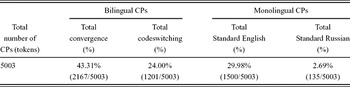
The initial analysis of the data was conducted within the framework of the MLF model, the Abstract Level model and the 4-M model as described in section 2 above and revealed that out of 5003 complementizer phrases (CPs, clauses), 3667 (73.30%) were produced fully in Russian. The rest of the CPs involved some form of overt English production. These could include intrasentential codeswitching, codemixing and fully English sentences. Table 1 summarizes the use of monolingual Russian and mixed Russian–English utterances by the participants.
Patterns of monolingual and mixed language use.

Among the 3667 clauses produced fully in Russian, 40.91% (1500) were target-like, and the other 59.09% (2167) were not. The non-target sentences largely involved convergence at some level of abstract lexical structure.
Following Myers-Scotton and Jake (Reference Myers-Scotton and Jake2000), convergence was identified at three different levels of abstract lexical structure. The three types of convergence that were present are as set out in a)–c).
a) Convergence at the level of the lexical-conceptual structure, as illustrated in (4):
(4)
In (4) the target verb is prosit’ “to request, to ask for something”. However, under the influence of English, the lemma projected to express the speaker's intention contained directions from both English and Russian. In English the act of requesting can be expressed by two verbs ask and request, where ask is more colloquial and frequent. In addition, the verb ask expresses two meanings: “to pose a question” and “to make a request”. Russian uses two different verbs for expressing each meaning sprashivat’ “to pose a question” and prosit’ “to make a request”. The speaker mapped the lexical-conceptual structure of the English verb ask onto the Russian verb sprashivat’, which resulted in a non-target like production.
b) Convergence at the level of the predicate–argument structure, which is presented in (5):
(5)
Here the speaker projected the predicate–argument structure of the verb ride onto the Russian frame. In English the verb ride takes a direct object – ride the bike, whereas Russian verb katat'sya “to ride” takes a prepositional phrase katat'sya na “to ride on”. The speaker mapped the English argument structure of the verb ride to the Russian verb katat'sya, which resulted in the production of a non-target sentence.
c) Convergence at the level of morphological-realization patterns shown in (6):
(6)
In (6) the speaker replaces the target accusative case with the nominative case on the NP zharenaja kartoshka “fried potatoes” under the influence of English, which does not have overt marking for cases.
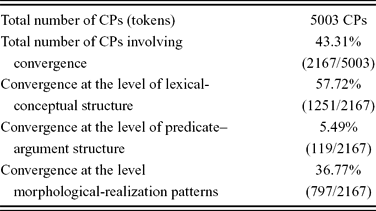
As illustrated in Table 2, a majority of 1251 non-target-like sentences (57.72%) involved convergence at the level of the lexical-conceptual structure (this is in addition to a large number of codeswitches throughout the data). The second largest group was comprised of sentences involving convergence at the level of morphological-realization patterns – 797 CPs (36.77%); convergence at the level of the predicate–argument structure only constituted 5.49% of all CPs (119). Chi-square tests demonstrate a significant difference between convergence at the three levels of abstract lexical structure (χ(4) = 4334.00, p < 0. 001).
Levels of convergence to English.
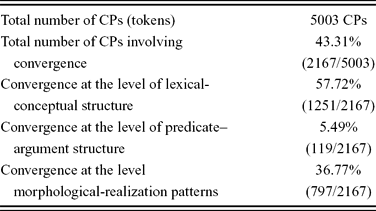
These results indicate that the lexical-conceptual structure of the lexicon is most vulnerable to attrition. When exhibiting convergence at this level, the speaker does not simply replace a Russian word with an English equivalent. Rather, the speaker produces a Russian form on the surface, but that form is filled with English and Russian content. That is, some of the semantic and pragmatic features of the word in question are mapped from English while others may be supplied by Russian.
Quite often convergence at this level leads to additional non-target like forms at other levels of abstract lexical structure. What remains unclear is why there is variability at the level of lexical-conceptual structure. In other words, why do some of the lexical items undergo convergence while others are used on target?
Another level of abstract lexical structure that undergoes considerable attrition, though somewhat less pronounced than the lexical-conceptual structure, is the level of morphological-realization patterns. As indicated in Table 2, 36.77% of CPs manifest convergence at this level. Convergence at the level of morphological-realization patterns includes non-target like agreement marking, case use, and gender marking.
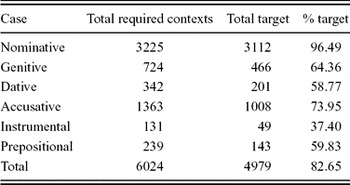
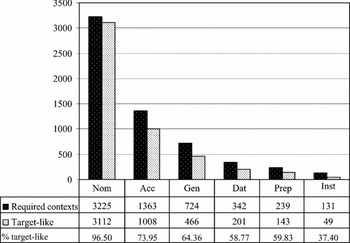
This study focuses on the non-target-like distribution of morphological case use throughout the data by the participants. Results presented in Table 3 show that all six cases are still in use. However, substantial differences between actual and standard case use are evident for all cases except for the Nominative case.
Distribution of cases.

It is notable that speakers often replace oblique case markings with non-target forms. These replacements are predominantly Nominative, but other non-target oblique cases are also used with some frequency. Within the 4-M model, case markers are identified as late “outsider” system morphemes. Recall that according to the MLF model late system morphemes must be supplied by the Matrix Language, i.e. the language that sets the grammatical frame of the utterance. Indeed, Russian continues to supply the surface forms of these case morphemes. Moreover, it is Russian that continues to project the slots for case markers, which may be filled with Russian surface forms whose underlying structure is non-target, as in (7), or may be mapped from English, as in (8).
(7)
(8)
Thus, the analysis of the data within the framework of the three models – the MLF, the Abstract Level and the 4-M models – reveals several important details about different types of morphemes. First, the attriters’ production is mostly affected at the levels of lexical-conceptual structure and morphological-realization patterns. The morphemes that undergo changes most easily at the level of lexical-conceptual structure are content morphemes, whereas “outsider” late system morphemes are mostly affected at the level of morphological-realization patterns, though to a significantly lesser degree than the content morphemes.
What needs further explanation is the selectivity of on-target production within each of the affected morpheme types. Why do some of these case markers continue to be used in a target-like fashion, while others are affected by English? Why is there variability in case use when Russian syntax is still able to project the required slots? The models of language production applied so far do not seem to help us clarify these issues. Therefore, the analysis of the data from the point of view of the Activation Threshold hypothesis is needed to provide additional insights into the behaviour and characteristics of these morphemes.
6. The analysis within the framework of the Activation Threshold hypothesis
Recall that the ATH specifies that three factors affect the activation threshold of language items: frequency, recency, and inhibition. Paradis (Reference Paradis2004, Reference Paradis2007) has shown that all three factors play an important role in the level of accessibility of language items for production. However, Schmid (Reference Schmid2007) has suggested that it is inhibition that is most salient in raising the activation threshold. In addition, Gürel (Reference Gürel2004, Reference Gürel2007) has found that different elements of the attriting language are affected to different extents depending on their congruency in the bilingual's two languages.
In order to explain why Russian speakers show selective on-target use of content and “outsider” morphemes, it is necessary to establish whether there is a correlation between those morphemes and frequency of their use and inhibition. Unfortunately, recency of use is difficult to establish when there are no longitudinal data available.
6.1 Content morphemes
Frequency of use has been discussed in the literature largely in terms of how often the first language is used by speakers in daily life (e.g. Schmid, Reference Schmid2007). This approach is most useful for identifying the frequency of use of content morphemes since languages have a much larger variety of them than that of system morphemes.
The participants in this study produced a total of 27,000 words. However, the variety of content morphemes was not equally distributed throughout the data. In order to determine why vocabulary was more diverse in some parts of discourse but not in others, the data were coded for topics of discussion. As a first step, the analysis focused only on the differences in type/token ratios between ‘domestic’ and ‘political’ topics. The former include issues of personal hygiene, food preparation and planning, and general school and work questions. The latter include discussions of topics such as the presidential elections and the war in Iraq. The reason these topics were selected for the analysis is that there is a very clear contrast in the language that these speakers use most frequently to discuss them. Based on the questionnaire, they report to frequently talk about ‘domestic’ topics in Russian with their family members, while ‘political’ topics are seldom addressed in their native language.
In order to compare the use of content morphemes and their variety according to the topic of discussion, a sample of 3000 words was identified for each topic. A type/token analysis was carried out on the lemmatized forms to determine the effect of topic on the degree of lexical variation. Following Schmid (Reference Schmid2002), proper names and numerals were not included in the count.
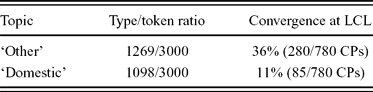
The type/token count shows that for 3000 tokens of a randomly selected ‘domestic’ discussion the speakers used 1098 different lexical items (i.e. the type/token ratio for ‘domestic’ discussions is 0.36); whereas for 3000 tokens of a ‘political’ topic discussion the speakers used 1269 different lexical items (i.e. the type/token ratio of 0.42). This type/token distribution indicates that the variety of content morphemes is higher in more complex topics that require more complex and diverse vocabulary in L1 than in topics of simpler content even though the speakers discuss ‘domestic’ issues in Russian more often than they do ‘political’ problems.
The same stretches of discourse were analyzed for convergence at the level of lexical-conceptual structure (see Table 4). The results demonstrate that the amount of convergence at the level of lexical-conceptual structure is significantly higher for ‘political’ topics than it is for ‘domestic’ issues as established by a Chi-square test (χ(1) = 4.720, p < 0.05). This is not entirely surprising since the frequency of L1 use for ‘domestic’ topics is much higher than for ‘political’ topics. This high frequency of use of ‘domestic’ content morphemes results in their lower activation threshold and more target-like production.
Topic and language use (LCL = Lexical-Conceptual Level).
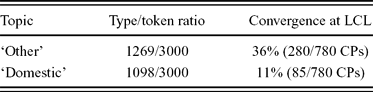
This finding indicates that frequency of occurrence of the topic in L1 correlates with the degree of target-like production at the level of lexical-conceptual structure. Frequency of occurrence, however, does not determine the variety of types used in the discourse. The higher type/token ratios seem to be dependent on the complexity of the topic, rather than the frequency of its discussion in L1. The results of convergence and type/token analysis are summarized in Table 4.
This comparison of language use by topic provides support for the first hypothesis of this study. It is evident that L1 content morphemes that are less frequently activated are more susceptible to attrition.
6.2 System morphemes
While the information about frequency of L1 use in general is useful for establishing content morpheme frequency, it does not distinguish between the frequency of use of different morpheme types and more specifically between the types of system morphemes. In order to determine if there is a correlation between frequency and target-like production of each individual case marker, a count of all the required contexts for case markers has been carried out.
The results of frequency of use of case markers are reported in Figure 1 and indicate that a total of 6024 nouns in the all-Russian corpus were marked for case. Out of these, 3225 (53.5%) required the use of the Nominative case. The Genitive case was required for 724 nouns (12%), the Dative case for 342 nouns (5.6%), the Accusative case for 1363 nouns (22.6%), the Instrumental case for 131 nouns (2.1%), and the Prepositional case for 239 nouns (3.9%). Thus, the most frequently required case in these data is the Nominative case and the Instrumental case is the least frequently required case. The analysis of target-like use of cases indicates that the Nominative case is indeed used on target most often – 96.5% of the time. The Instrumental case, on the other hand, shows the lowest percentage of on-target use – 37.4%. In fact, the number of non-target uses increases as the frequency of obligatory contexts for a particular case decreases. The number of required contexts and the number of target-like production exhibit an almost one-to-one correlation (r(6) = .996, p < .0001). From these results it is clear that frequency of the required use of late “outsider” system morphemes such as case plays a significant role in the activation threshold and consequently in target-like production by the speakers whose language is undergoing attrition.
Distribution of required contexts and target-like case marking.

The question arises, however, whether the inhibition factor also contributes to non-target-like use of cases. Gürel (Reference Gürel2007) indicates that L1 forms are not inhibited when these forms do not correspond in L1 and L2 due to the lack of competition and therefore, such L1 forms “will be preserved even after long-term disuse” (p. 104). The Russian case system does not have an overtly marked correspondence in English. While English still marks the genitive and objective cases on nouns and pronouns, the contexts and actual forms are not congruent in the two languages. Following Gürel's discussion (Reference Gürel, Skarabela, Fish and Do2002, Reference Gürel2004, Reference Gürel2007), it seems reasonable to suggest that the lack of congruency in the case system of English and Russian can account for the lack of inhibition and consequently for relative stability of the case system on the whole (83.3% of target-like use of all cases), while frequency of occurrence accounts for the differences in the rate of individual case attrition.
7. Conclusion
From the perspective of the language contact models – MLF, Abstract Level and 4-M – morphemes can be grouped into content, early system, late system (“bridges” and “outsiders”) depending on their semantic and syntactic roles and time of activation. Such a division is useful for attrition studies as it explains why content morphemes are more vulnerable to language attrition than late system “outsiders”. However, this division is not sufficient in accounting for selectivity of attrition within each morpheme type.
The application of the Activation Threshold hypothesis and its components of frequency and inhibition are helpful in explaining the less dramatic attrition in content morphemes used to address frequently discussed ‘domestic’ issues. Late system “outsider” morphemes also show variability in the rate of attrition. Frequency of use provides an insight as to why more frequently occurring case markers remain more stable in Russian whereas those that are required in fewer contexts are more susceptible to attrition. The lack of congruency between English and Russian case systems points to the overall lack of inhibition of Russian cases and their overall relative long-term stability in the attriting language.
In addition, the analysis of these data from the perspective of two approaches to language attrition indicates that it would be useful to characterize morphemes not only in terms of their semantic, grammatical and activation properties, but also in terms of their inherent frequency. More research is needed to determine this inherent factor for content and late system morphemes. In future studies it may also be essential to establish vulnerability of early system morphemes and bridges as well as other ‘outsiders’ within the combined theoretical framework.