





Medicine has consistently attracted those who demonstrate curiosity and think differently. Although diversity exists within the field, these differences are rarely acknowledged. Autistic clinicians represent a well-established yet poorly understood sector of the medical workforce, and their experiences have not been sufficiently explored in current research and literature.
Recognition of neurodiversity within healthcare has grown considerably in recent years. Autism spectrum disorder affects approximately 1–2% of the population and can present with differences in social interaction and communication, sensory processing and cognitive style. 1,Reference Baron-Cohen, Scott, Allison, Williams, Bolton and Matthews2 Although most publications have focused on autistic individuals as patients, autistic clinicians represent a significant and underrecognised group within healthcare. Reference Shaw3,4 In response to the health inequalities autistic individuals face, Reference Hirvikoski, Mittendorfer-Rutz, Boman, Larsson, Lichtenstein and Bölte5 the National Health Service (NHS) has committed to improving outcomes for autistic adults through the National Autism Strategy 2021–2026. 6
Medical training environments are often socially complicated and unpredictable and may present overwhelming sensory challenges. The UK Foundation Programme represents the transition from medical student to junior doctor – a shift that introduces new responsibilities, unfamiliar team dynamics and constantly changing clinical demands. 7 For autistic doctors, these challenges are often exacerbated owing to misunderstandings or disregard of their needs. Although the Equality Act 2010 has established legal protections, disabled and neurodivergent doctors continue to face barriers to effective reasonable adjustments 8 and report more incidents of bullying, harassment and professional isolation compared with neurotypical colleagues. 9 Despite efforts from organisations such as Autistic Doctors International, fundamental changes to NHS training pathways remain limited. 4 The aims of this review were to:
-
• summarise existing knowledge on autism in medical education and early clinical training during foundation years;
-
• explore the lived experiences of autistic doctors, including the impact of masking, late diagnosis and social exclusion;
-
• review the NHS policies and legal frameworks that exist to support disabled medical trainees; and
-
• propose the SUPPORT framework as a practical approach for improving inclusion and well-being among autistic medical students as well as junior doctors.
Autism and neurodiversity in medicine
Autism is a lifelong neurodevelopmental disorder characterised by differences in social communication and interaction, restricted and repetitive patterns of behaviour or interests, and unique sensory processing. 10,Reference Lai, Lombardo and Baron-Cohen11 The term ‘neurodiversity’, introduced by sociologist Judy Singer in the late 1990s, identifies neurological differences such as autism, ADHD and dyslexia as part of a natural spectrum of the human population rather than as pathological deviations requiring correction. Reference Kapp, Gillespie-Lynch, Sherman and Hutman12,Reference Botha, Dibb and Frost13 Adopting a neurodiversity-positive model means moving away from a deficit-focused view, recognising that autism involves both challenges and unique cognitive strengths that benefit professional environments.
The literature consistently demonstrates that autistic clinicians often possess valuable clinical strengths that remain poorly acknowledged within mainstream medical culture. Attention to detail, systematic thinking and pattern recognition are qualities documented repeatedly across the research, and the evidence linking them to more accurate information processing in clinical settings is reasonably well founded. Some researchers argue that these traits have a direct impact on diagnostic precision and patient care. Reference Shaw, Doherty and Anderson14,Reference Doherty, McCowan and Shaw15 In practice, however, most medical specialties have been slow to act on what research has long indicated. The literature has not been quiet on this. The profession has.
A longstanding tendency to prioritise social and communication styles aligned with neurotypical norms has meant that these strengths are frequently overlooked, or worse, mistaken for deficits. Workforce data probably underrepresent the true prevalence of autistic clinicians, owing to persistent underdiagnosis in high-achieving individuals, increasing rates of adult recognition and understandable apprehension about disclosing for fear of professional stigma. Reference Shaw3,Reference Leedham, Thompson, Smith and Freeth16 Recognition alone is not sufficient. Whether medical training environments, their culture, the methods by which clinical competence is measured and the support structures used are fit for purpose for neurodivergent clinicians remains a difficult question. The honest answer, for many, is that the current framework was not built with neurodivergence in mind.
Barriers for autistic medical students
The sensory environments, social norms and unwritten rules of medical training can cause hidden friction for autistic students. Recognising these hurdles during the undergraduate years, well before the transition to high-pressure clinical placements, is essential. Addressing these barriers early can allow the focus to shift from simply helping students stay afloat to building a foundation where they can thrive.
Success in clinical placements is rarely determined by medical knowledge alone. Clinical environments are heavily permeated by a ‘hidden curriculum’ of social cues, hierarchies and unspoken norms that are never explicitly taught. Reference Shaw, Doherty and Anderson14,Reference Wood and Freeth17 Autistic students are often left to navigate placements without a map, struggling to meet expectations that are never properly explained and essentially being judged on a curriculum they were never given. Hospital hierarchies, relationships with supervisors and professional self-presentation are assumed to be self-evident. Communication assessments, objective structured clinical examinations in particular, are often built around neurotypical templates of communication, emphasising eye contact and rapport-building in ways that can disadvantage autistic students. Reference Shaw, Doherty and Anderson14 There is a real risk that these assessments measure a student’s ability to mask rather than their clinical competence. Loud noise, crowding, unpredictable interactions and the relentless cognitive demands of clinical environments can accumulate into significant sensory overload that profoundly affects communication, interaction and learning. Reference Doherty, McCowan and Shaw15,Reference Strömberg, Liman, Bang and Igelström18 Yet this is scarcely understood as an access need, and without that recognition, meaningful adjustment rarely follows.
Stigma remains a significant barrier to seeking support. Many autistic students choose not to disclose their diagnosis owing to concerns about being perceived as less capable, educator bias or disadvantages in assessments. Reference Shaw, Doherty and Anderson14,Reference Cooper, Smith and Russell19 Without disclosure, no adjustments are made, and autistic students carry disproportionate cognitive and emotional burdens without institutional support. This is compounded by a lack of neurodiversity awareness among educators, with autistic behaviours such as different communication styles, a preference for written feedback and difficulty with vague tasks sometimes misinterpreted as unprofessionalism or disengagement. Reference Shaw3,Reference Wood and Freeth17
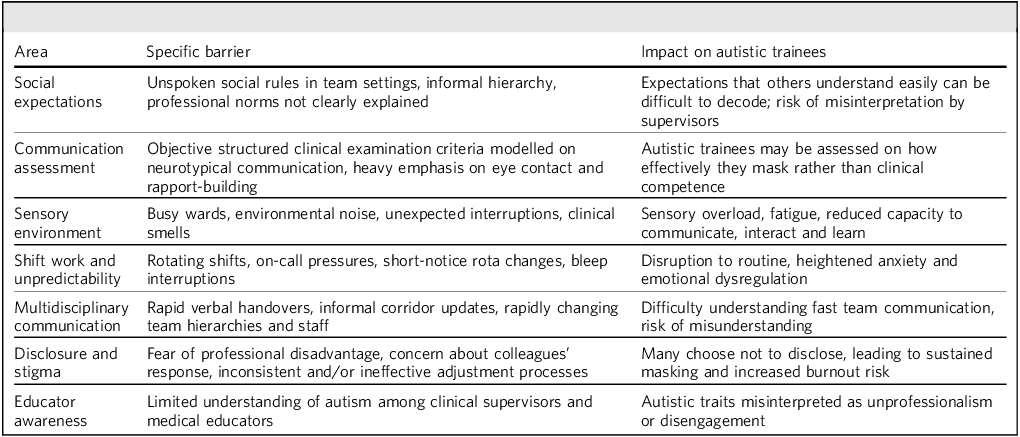
Table 1 summarises common barriers across both medical student and junior doctor contexts.
Common barriers experienced by autistic medical students and junior doctors

Table 1 Long description
A table summarizing barriers faced by autistic medical students and junior doctors. The table has six rows and five columns. The columns are labeled Area, Specific barrier, Impact on autistic trainees, and two additional columns with no headers. Row 1: Area, Social expectations; Specific barrier, Unspoken social rules in team settings, informal hierarchy, professional norms not clearly explained; Impact on autistic trainees, Expectations that others understand easily can be difficult to decode; risk of misinterpretation by supervisors. Row 2: Area, Communication assessment; Specific barrier, Objective structured clinical examination criteria modeled on neurotypical communication, heavy emphasis on eye contact and rapport-building; Impact on autistic trainees, Autistic trainees may be assessed on how effectively they mask rather than clinical competence. Row 3: Area, Sensory environment; Specific barrier, Busy wards, environmental noise, unexpected interruptions, clinical smells; Impact on autistic trainees, Sensory overload, fatigue, reduced capacity to communicate, interact and learn. Row 4: Area, Shift work and unpredictability; Specific barrier, Rotating shifts, on-call pressures, short-notice rota changes, sleep interruptions; Impact on autistic trainees, Disruption to routine, heightened anxiety and emotional dysregulation. Row 5: Area, Multidisciplinary communication; Specific barrier, Rapid verbal handovers, informal corridor updates, rapidly changing team hierarchies and staff; Impact on autistic trainees, Difficulty understanding fast team communication, risk of misunderstanding. Row 6: Area, Disclosure and stigma; Specific barrier, Fear of professional disadvantage, concern about colleagues’ response, inconsistent and/or ineffective adjustment processes; Impact on autistic trainees, Many choose not to disclose, leading to sustained masking and increased burnout risk. Row 7: Area, Educator awareness; Specific barrier, Limited understanding of autism among clinical supervisors and medical educators; Impact on autistic trainees, Autistic traits misinterpreted as unprofessionalism or disengagement.
Transition to junior doctor roles
The shift from medical student to foundation doctor is, for many, the harshest transition in their medical career – one that those outside the profession seldom understand in full. In the space of a few weeks, a medical student becomes a working practitioner expected to make consequential prescribing decisions, manage unwell patients and manoeuvre complicated clinical environments, often without the supervision that training had provided. 7 For autistic doctors, it can be something more – a time of intense vulnerability. Environmental, social and interpersonal demands arrive all at once, often without any of the preparation that might have made them manageable. Despite its length and intensity, medical school rarely equips autistic students for how that transition to foundation year feels in practice.
Increased responsibility and clinical ambiguity
The meaning of accountability in foundation training is something most doctors only understand once they are facing it. For many autistic doctors, the real difficulty lies not in the clinical decisions but in what surrounds them. Making sense of a clinical hierarchy that runs almost entirely on unspoken expectations adds a further obstacle that foundation training does not acknowledge. Reference Shaw3 These are not skills that are openly taught. They are assumed, picked up instinctively by those who find social cues straightforward, and a persistent difficulty for those who do not.
For autistic doctors, the ward itself presents difficulty, not because the work is beyond them, but because the environment offers so little of the structure and predictability many depend on to do their best work. An emergency admission rewrites the day. A staffing shortage changes expectations without notice. The wards do not pause to let anyone catch up. For those who need predictability, each shift adds to an uncertainty that becomes heavier over time, even when no one around the individual can see it.
Shift work and rota unpredictability
All foundation doctors work rotating shifts, and for most this is simply part of the job. For autistic doctors who depend on routine to regulate their emotions effectively, rota cycles can be considerably destabilising. Reference Raymaker, Teo, Steckler, Lentz, Scharer and Santos20,Reference Cage and Troxell-Whitman21 Short-notice changes with unexpected cover obligations and the unpredictable interruption of the bleep exacerbate anxiety and overstimulation that can be difficult to recover from between shifts. Add irregular eating patterns and continuous sensory demands, and the toll on autistic doctors can become considerable and goes largely unnoticed.
Communication in multidisciplinary teams
Foundation doctors spend their shifts constantly moving between nurses, pharmacists, physiotherapists, radiologists and senior colleagues across ward rounds, corridor conversations and everything in between. Nearly all of this communication is unwritten and unstructured, with the social knowledge behind it assumed and never explained. Reference Milton22,Reference Doherty, Haydon and Davidson23 When autistic doctors find this difficult to manage, their difficulty is rarely met with understanding. Communication differences are frequently misinterpreted as unprofessional, often by supervisors who lack autism awareness. The double empathy problem is the idea that communication difficulty between autistic and non-autistic people runs in both directions. This is important to consider in clinical teams: it is a two-way difficulty, not a one-sided failing. Reference Milton22
Masking in clinical practice
Masking, the suppression or modification of autistic traits to fit neurotypical expectations, is well documented among autistic adults, and the psychological cost is considerable. Reference Cage and Troxell-Whitman21,Reference Hull, Mandy, Lai, Baron-Cohen, Allison and Smith24,Reference Lai, Lombardo, Ruigrok, Chakrabarti, Auyeung and Szatmari25 In clinical practice, masking can manifest as monitoring communication style during ward rounds, suppressing sensory reactions in a corridor that is too loud or too bright, and mentally rehearsing social scripts before team interactions. Nobody around them knows it is happening, and that is exactly the intention. Reference Raymaker, Teo, Steckler, Lentz, Scharer and Santos20
Clinical learning and supervision
Clinical training has long operated on an informal model in which knowledge is passed through observation, implicit feedback and assumed understanding. For autistic trainees, this is a poor fit. Explicit objectives, structured feedback and clearly defined supervision are not accommodations; for many autistic doctors, they are simply what effective learning requires. Without them, the effort of working out what is expected can take up more cognitive space and time than the clinical work itself. Reference Shaw, Doherty and Anderson14 Yet for most autistic foundation doctors, that structured support remains out of reach – a fact that raises more questions as the evidence accumulates.
Lived experiences of autistic doctors
Qualitative research and the first-hand accounts of autistic clinicians themselves highlight the same challenges, told in different voices. Designing support that is truly impactful means starting with those accounts, not with assumptions about what autistic doctors need.
Masking
Many autistic doctors describe masking as a constant, exhausting feature of their professional life. Reference Cage and Troxell-Whitman21,Reference Hull, Mandy, Lai, Baron-Cohen, Allison and Smith24 On the ward, it goes beyond social camouflage. It reflects the pressure to manage visible signs of sensory discomfort, monitor facial expressions and body language, and suppress natural communication style to meet neurotypical expectations. For foundation doctors who do not feel safe disclosing, this continues across every hour of a 12-and-a-half-hour shift, with no room for relief or recovery.
The consequences of sustained masking are real and well documented. Although masking may temporarily reduce the visibility of autistic traits, the effort involved accumulates beyond ordinary fatigue. For some, the endpoint is autistic burnout – a state of profound physiological and psychological depletion that Raymaker and colleagues attribute directly to chronic masking without adequate opportunity to recover. Reference Raymaker, Teo, Steckler, Lentz, Scharer and Santos20 It does not arrive suddenly. It builds quietly, across shifts and rotations. For junior doctors working within high-pressure NHS environments, this is not a secondary concern. It is a pressing one.
Late diagnosis
For many autistic doctors, the diagnosis comes late, sometimes after years of struggling through training without ever understanding why. Reference Shaw3,Reference Leedham, Thompson, Smith and Freeth16 Regardless of when it arrives, a late diagnosis acts as a retrospective lens on a doctor’s professional history. It shifts the weight of responsibility from personal failing to systemic inadequacy. What looked like success was often built on disproportionate personal effort that should never have been required in the first place. Reference Shaw3
Social exclusion
The informal social dynamics of clinical life, including team social events, corridor small talk and professional relationships built on unspoken expectations, are a persistent and draining challenge for many autistic doctors. Reference Shaw, Doherty and Anderson14,Reference Cooper, Smith and Russell19 The result is often a silent professional isolation that is as invisible as it is exhausting. Colleagues and supervisors frequently read direct speech or limited small talk as disengagement or unprofessionalism. What is intended and what is received can be very different, and it tends to fall on the autistic doctor to manage the consequences. The founding of Autistic Doctors International, built by and for autistic clinicians, stands as a statement about what the profession has failed to provide. 4
Identity and well-being
The research consistently shows that those who have developed a more positive and integrated sense of their autistic self report better mental health outcomes. Reference Botha, Dibb and Frost13,Reference Pellicano, Fatima, Hall, Heyworth, Lawson and Lilley26 For autistic doctors moving through foundation training without disclosure or support, the additional pressure of forming a professional identity adds to challenges that are already significant. If autistic clinicians are to stay in the profession, the conditions under which they practise need to change. Doctors who can practise without the sustained effort of masking are more likely to fare better, more likely to stay and more likely to contribute fully. Without such change, the NHS risks losing doctors it cannot afford to lose.
Disclosure and stigma
Deciding whether to disclose an autism diagnosis during medical training is not a straightforward decision. Disclosure has a real impact on access to support, professional relationships and long-term career paths. Legal frameworks are in place. The Equality Act 2010 provides protection, and the NHS has formally committed to reasonable adjustments. 8 But protections on paper do not change the reality of how disclosure feels. For a considerable number of autistic doctors, it still does not feel safe. And that means it does not happen. Reference Shaw3,9
The fear is not unfounded. Autistic doctors consistently report concerns that disclosure will affect leadership opportunities, specialty selection and career progression. 9,Reference Shaw, Doherty and Anderson14 A report by the British Medical Association on disability in the medical profession found that a considerable number of disabled doctors who disclosed subsequently experienced bullying or mistreatment. Many faced significant challenges in securing the reasonable adjustments they were legally entitled to receive. 9 The difference between what the framework promises and what doctors actually encounter is well documented, and it is this gap – more than any failure of individual courage – that keeps many autistic doctors from disclosing at all. Without disclosure, adjustments are rarely made. Autistic doctors face the dilemma of risking stigma or facing burnout through sustained masking. Addressing this requires more than policy changes. It calls for environments in which individuals feel safe sharing their diagnoses and can expect informed, supportive and personalised dialogue. Reference Pellicano, Fatima, Hall, Heyworth, Lawson and Lilley26,27
Psychological safety, the ability to raise concerns or request adjustments without fear of negative career consequences, has become increasingly central to NHS quality and safety frameworks. 27 Supervisors and clinical leads should receive specialised training to better support neurodivergent clinicians, and requesting workplace adjustments should be normalised as a standard part of professional practice, not a sign of incapacity.
NHS policy and legal frameworks
Several laws and policies protect autistic and disabled clinicians in NHS training. The Equality Act 2010 requires NHS organisations to make reasonable adjustments for disabled employees to prevent substantial disadvantage and recognises autism as a disability when it has a substantial, long-term impact on daily activities. 8 Importantly, this duty is anticipatory. Organisations must plan adjustments before disclosure, not only in response to it.
The Welcomed and Valued guidance of the General Medical Council states that disability does not prevent safe practice and that organisations must commit to adjustments and inclusion. 27 The British Medical Association confirms that doctors should not be solely responsible for requesting or arranging their own adjustments. 9 NHS England’s Long-Term Workforce Plan identifies neurodiversity as essential to the future of the NHS. 28 NHS Employers encourages autism-aware recruitment and supervision practices, 29 and the National Autism Strategy 2021–2026 prioritises improvement of employment outcomes for autistic adults. 6
The current framework is stronger than many realise. Naming autism in the Equality Act, requiring organisations to act in advance and the clear statement by the General Medical Council that disability does not prevent safe practice are considerable advances. 8,27 The challenge is putting these changes into effect. In reality, individuals usually have to start this process themselves. The responsibility falls on the individual to disclose, explain and advocate within systems that do not make this easy. The framework cannot change workplace culture. Surveys of neurodivergent and disabled doctors consistently confirm what many recognise from experience: inconsistent adjustments, untrained supervisors, and institutions that accommodate in policy but penalise in practice. Reference Shaw3,9 Without cultural change, these barriers will continue and become harder to spot.
Practical adjustments
Practical and individualised adjustments can significantly influence how autistic medical trainees experience and perform in foundation training. Many of these modifications cost very little to implement, and most of what benefits autistic clinicians benefits everyone. Clearer communication, consistent feedback and well-structured inductions improve standards for all. Reference Luke30
Communication
Verbal instructions in busy clinical environments can be unreliable for autistic doctors – not because of inattention but owing to the real difficulty of processing complicated verbal information under sensory pressure. A written summary of daily tasks at the beginning of a shift can address this directly. Direct and specific feedback is more valuable than general praise: ‘Your documentation is thorough, but lead with the working diagnosis during handover’ is useful; ‘Work on your communication’ is not. For inductions, formal feedback and significant clinical events, advance notice and a written record reduce the risk of important information being lost. Reference Haydon, Doherty and Davidson31
Predictability
Much of the anxiety autistic doctors describe when starting new placements is not about the clinical work. It is about not knowing what to expect. Rota changes communicated as early as possible, written induction material provided before the first day, and a brief email naming the supervisor, outlining expectations and mapping the clinical environment takes minutes to write and can meaningfully reduce the anxiety that accompanies every new placement. 7
Sensory considerations
By the end of a long shift on a busy ward, everyone is tired. But for autistic doctors, the cumulative weight of environmental noise, unpredictability and sustained social demands across a 12-and-a-half-hour shift can be far more difficult to manage than it appears from the outside. Access to a quieter space for documentation costs nothing to provide and requires no formal framework. It only requires someone to make clear that such spaces are available, and that using them is unremarkable. Flexibility around break timing and the freedom to step away briefly from overstimulating environments supports emotional regulation and reduces the risk of end-of-shift exhaustion that, over time, contributes to burnout. Reference Doherty, McCowan and Shaw15,Reference Strömberg, Liman, Bang and Igelström18
Educational support
Appropriate supervision should not feel like a privilege. Structured supervision meetings with written objectives shared in advance offer clarity that can be transformative for autistic doctors in training. What changes the supervisory relationship is not specialist knowledge but the absence of assumptions. From day 1, every autistic trainee in NHS foundation training should have access to a named disability advisor or occupational health professional with neurodiversity expertise as a standard component, not something to be requested, justified and fought for. 27
Clinical vignette
Dr A knew the clinical work. What nobody had prepared them for was how much of foundation training went beyond medical proficiency.
Dr A is a newly qualified FY1 doctor who received a diagnosis of autism during medical school. During their first rotation, they found that the unpredictability of emergency admissions and the informal team communication were among the hardest challenges to navigate. Ward rounds moved fast, ran on unspoken hierarchical norms and relied on verbal updates that were difficult to follow in real time. The sensory environment added its own physiological burden. By the end of most shifts, Dr A was exhausted in a way that sleep alone could not resolve.
Colleagues noticed. Comments filtered back to Dr A that they seemed quiet, that they did not join in socially, that they did not ‘fit in’ with the team. None of it was malicious, but it settled as something that felt like a verdict, and it made the ward feel smaller.
Initially, disclosure did not feel safe. The fear of being seen as less capable kept them from sharing. Dr A managed the demands of clinical work, social performance and sustained masking. Ultimately, their anxiety increased, fatigue built and concentration began to suffer.
What changed this perspective was a conversation. Dr A’s educational supervisor, who had attended a brief neurodiversity awareness session, provided enough safety for disclosure to feel possible. A reasonable adjustments plan was agreed, including written task summaries at the start of each shift, access to a quieter space for documentation and direct feedback. With these basic adjustments, their anxiety reduced and performance improved. Finally, Dr A felt able to express a more authentic version of themselves.
One supervisor. A fundamental awareness of autism. That was what made the difference – not a specialist referral or a formal pathway. Just someone familiar enough to notice; that is what can transform the training environment of an autistic foundation doctor.
The SUPPORT framework
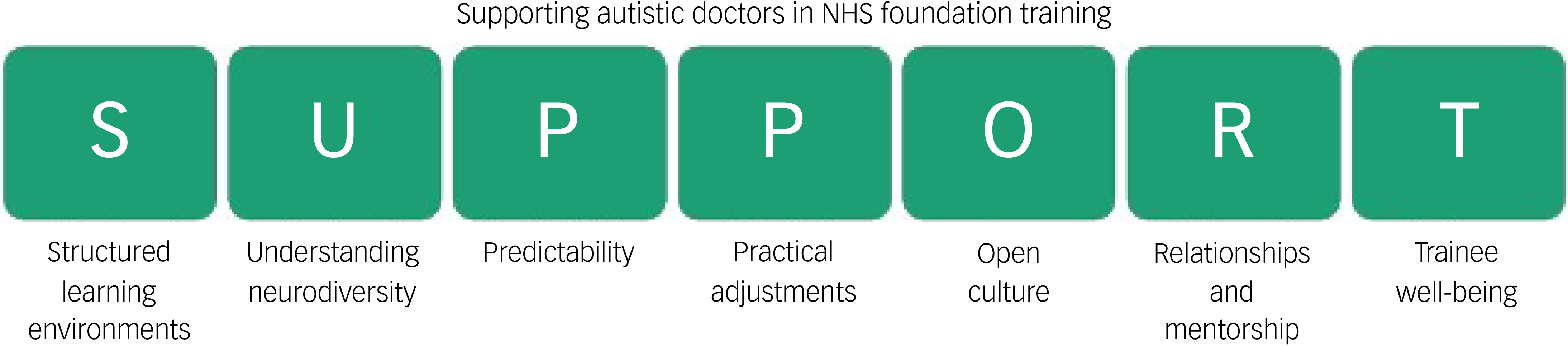
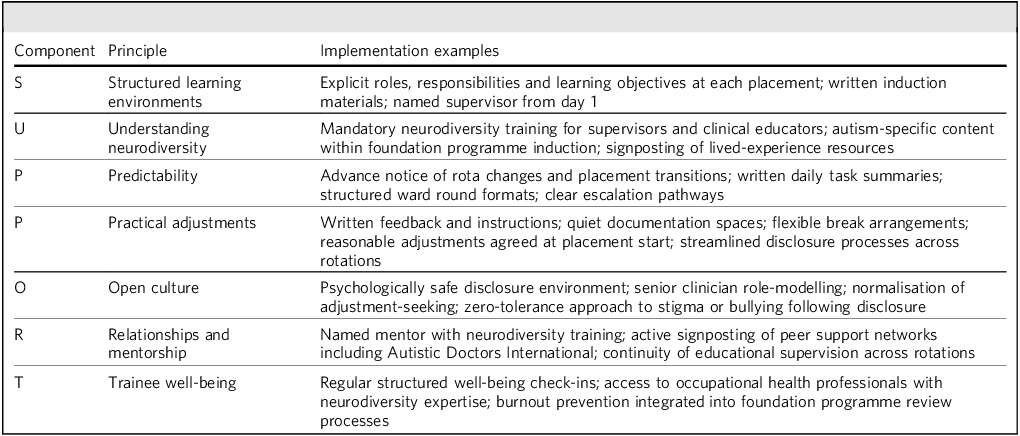
Drawing on the evidence reviewed throughout, the SUPPORT framework, shown in Fig. 1, is proposed as a practical and memorable structure for improving the inclusion and well-being of autistic medical students and junior doctors in NHS training environments. It is inspired by the approach taken by Doherty et al in developing the Autistic SPACE framework for patient care. Reference Doherty, McCowan and Shaw15 The framework, displayed in Table 2, is intended to give clinicians, educators and NHS organisations an actionable and concise reference to follow. The components are grounded in both literature research and lived clinical experience.
Visualisation of the SUPPORT framework. Inspired by the Autistic SPACE framework. Reference Doherty, McCowan and Shaw15 NHS, National Health Service.

The SUPPORT framework: components and implementation examples

Table 2 Long description
The table has 2 columns and 7 rows. The columns are labeled ‘Component’ and ‘Implementation examples’. The rows are labeled with principles: Structured learning environments, Understanding neurodiversity, Predictability, Practical adjustments, Open culture, Relationships and mentorship, Trainee well-being. Row 1: Structured learning environments, Explicit roles, responsibilities and learning objectives at each placement; written induction materials; named supervisor from day 1. Row 2: Understanding neurodiversity, Mandatory neurodiversity training for supervisors and clinical educators; autism-specific content within foundation programme induction; signposting of lived-experience resources. Row 3: Predictability, Advance notice of rota changes and placement transitions; written daily task summaries; structured ward round formats; clear escalation pathways. Row 4: Practical adjustments, Written feedback and instructions; quiet documentation spaces; flexible break arrangements; reasonable adjustments agreed at placement start; streamlined disclosure processes across rotations. Row 5: Open culture, Psychologically safe disclosure environment; senior clinician role-modelling; normalisation of adjustment-seeking; zero-tolerance approach to stigma or bullying following disclosure. Row 6: Relationships and mentorship, Named mentor with neurodiversity training; active signposting of peer support networks including Autistic Doctors International; continuity of educational supervision across rotations. Row 7: Trainee well-being, Regular structured well-being check-ins; access to occupational health professionals with neurodiversity expertise; burnout prevention integrated into foundation programme review processes.
Structured learning environments
Autistic medical trainees do not struggle with complexity. They struggle with ambiguity, and most of this is preventable. Roles, responsibilities, supervision arrangements and learning objectives should be set out in writing at the start of every placement. A structured induction that maps the clinical environment, introduces key staff and outlines what a typical day looks like can make the difference between a manageable first week and an overwhelming one. 7,Reference Shaw, Doherty and Anderson14
Understanding neurodiversity
Everything else in this framework depends on this component. Education on neurodiversity should be embedded within mandatory supervisor development programmes, not offered as an optional add-on. It should cover the diversity of autistic presentations, the harm of masking, what sensory overload involves in a clinical context and what reasonable adjustment looks like when efficiently implemented. For anyone responsible for training, this is a simple professional requirement.
Predictability
Unnecessary unpredictability is built into foundation training structures in ways that have rarely been examined. Last-minute rota changes, placements beginning without adequate warning and assessment schedules moving without explanation all carry a cost. Where advance notice and clear daily expectations are possible, they should be provided. Wherever predictability can be built in, it reduces the cognitive burden of navigating constant ambiguity. Reference Raymaker, Teo, Steckler, Lentz, Scharer and Santos20 These considerations benefit every trainee, not only those with autism.
Practical adjustments
Reasonable adjustments are a legal requirement and an ethical duty. Yet the process too often becomes its own barrier. Adjustment plans should transfer across every placement without the trainee having to restart the conversation from scratch. Written task summaries, direct communication, quieter documentation spaces and flexible break structures are not significant burdens on a team but, at present, the burden falls almost entirely on those the adjustments are supposed to help. 27
Open culture
An open culture is not a written list of values. It is a pattern of behaviour woven into the ordinary moments of clinical care. True openness is found when a supervisor asks ‘how are you finding the placement?’ not as a formality but as a sincere inquiry, and in a system in which a neurodivergent doctor’s experience is accepted as valid before they are required to prove themselves. When senior clinicians and programme directors model openness and challenge stigmatising attitudes, the culture shifts towards a safer environment. When they do not, the policies remain precisely where they were written – on paper. Reference Pellicano, Fatima, Hall, Heyworth, Lawson and Lilley26
Relationships and mentorship
A named lead who knows the trainee, understands their needs and can be reached directly when something goes wrong is very different from a general neurodiversity service. A trusted relationship in which difficulties can be raised before they become a crisis has been consistently associated with positive outcomes for autistic trainees. Peer support carries similar value. Organisations such as Autistic Doctors International offer autistic doctors what no training programme has yet managed to replicate – the experience of being understood by others who have navigated the same environment. 4 These organisations should be pro-actively signposted by training programmes early and not as an afterthought.
Trainee well-being
Autistic burnout builds quietly, across shifts, rotations and years of masking without adequate recovery. By the time it becomes a crisis, substantial harm has already been done. Pro-active well-being support means regular structured check-ins, access to occupational health professionals who understand neurodiversity, and integration of well-being monitoring into foundation programme review processes so it becomes routine rather than only triggered after something goes wrong. Providing early intervention is more effective and greatly less costly than a crisis response. Reference Doherty, McCowan and Shaw15
Recommendations for NHS organisations
NHS organisations have both a legal and moral responsibility to create training environments that are inclusive of autistic doctors. The evidence clearly shows that although policy frameworks exist, their implementation is inconsistent. Autistic trainees are left to bear the weight of those systemic inadequacies repeatedly, and rarely with adequate support. The recommendations below are addressed to NHS trusts, training programme directors and postgraduate medical education teams. Each one is evidence-informed, immediately applicable and long overdue.
-
• Integrate mandatory neurodiversity awareness training into supervisor education, incorporating content specific to autism such as masking, sensory needs and reasonable adjustments.
-
• Review and update reasonable adjustments processes to ensure they are accessible and timely and follow the trainee across rotation transitions without requiring repeated disclosure and re-negotiation.
-
• Develop mentorship programmes pairing autistic trainees with clinically experienced mentors who have received neurodiversity-specific training.
-
• Include neurodiversity within the foundation programme induction core curriculum – normalising seeking adjustment and promoting a culture of inclusion from the first day of training.
-
• Actively signpost peer support systems, such as Autistic Doctors International, as a recognised component of the support network available to autistic trainees.
-
• Collect and act on NHS workforce data categorised by neurodevelopmental conditions to enable evidence-based monitoring of the experiences of autistic trainees.
-
• Apply the SUPPORT framework as a template for organisational change, quality improvement, and assessment of how consistently neurodiversity inclusion is being put into practice.
Autistic trainees bring well-documented strengths – analytical precision, pattern recognition and detail-focused problem solving – to clinical practice. Reference Shaw, Doherty and Anderson14,Reference Doherty, McCowan and Shaw15 Training environments that fail to provide sufficient support do not only fail those doctors. They are failing the workforce, and the patients within it.
Future research
The evidence base on both autistic medical students and junior doctors continues to grow but remains limited in scope and diversity of research design. The most significant gap is prevalence data; reliable figures on how many autistic junior doctors are working within the NHS are absent. Cross-sectional studies using validated screening measures and anonymous self-reporting methods would provide vital baseline data that organisational policy currently lacks. There is an equally pressing need for prospective studies examining the real-world impact of structured adjustments on well-being and clinical performance and whether autistic doctors remain in the profession. Such evidence would also support the economic arguments for prioritising neurodiversity inclusion.
The transition from medical student to foundation doctor remains one of the least studied periods in an autistic doctor’s career. Long-term qualitative research tracking that transition, identifying the specific barriers autistic doctors face and the factors that support them, would offer something the current literature cannot: an authentic portrayal grounded in what that period actually involves. Research on the intersectionality of autistic experience also remains underexplored; experiences are shaped by gender, ethnicity, socioeconomic background and co-occurring conditions in ways that should not be flattened into a single narrative. Rather than serving as subjects to be examined, autistic doctors should be active contributors to the research that concerns them. Research designed without those it seeks to understand will always fall short. Reference Brown, Stahmer, Dwyer and Rivera32
Implications
Autistic doctors represent a valuable and underrecognised part of the NHS workforce. The cognitive strengths they bring to clinical practice are well-documented, and their perspectives can enrich education, quality improvement, and patient care. Yet the evidence indicates that autistic medical trainees continue to face considerable and largely avoidable barriers during undergraduate and early postgraduate training. Behind them lie inadequate awareness, inconsistent adjustment processes and clinical cultures that disproportionately disadvantage those whose communication and cognitive styles differ from dominant neurotypical expectations. These barriers appear in objective structured clinical examination criteria that equate neurotypical communication with clinical competence, in adjustment processes that place the burden repeatedly on the trainee and in cultures in which disclosure still carries professional risk. Each of these barriers has been documented. They persist not because they are inevitable, but because they have not yet been treated as a priority by those who have the power to address them.
Although legal protections exist, they are poorly translated into practice. Masking continues to exact a profound psychological toll. Disclosure remains a professional risk rather than a path to support. The transition into foundation training is a critically vulnerable period. The lack of appropriate support during these defining early years has consequences: burnout, progressive disengagement, and the loss of skilled doctors who should never have had to choose between their careers and their well-being.
The SUPPORT framework proposed in this review offers a starting point for supervisors, programme directors, and the organisations responsible for the environments in which autistic trainees are asked to work and learn. Frameworks, however, are only effective if those responsible for implementing them decide to do so. Implementation requires no substantial additional resources, only awareness and demonstrable institutional commitment to creating a more inclusive NHS. Reference Doherty, McCowan and Shaw15 For autistic doctors who have spent years making themselves fit an environment that was not designed to include them, that would be enough.
What the NHS loses when it neglects autistic doctors is not just their input. It is everything they would have contributed, had the system allowed them to. The evidence is there. The framework exists. What remains is the question medical training now faces: is it finally ready to include autistic doctors and medical students properly?
Key points
-
• Autism affects approximately 1–2% of the population, and many autistic doctors remain undiagnosed or undisclosed within the medical workforce.
-
• The transition from medical student to foundation doctor represents a period of acute vulnerability for autistic trainees, characterised by increased responsibility, unpredictable working patterns and demands for implicit social communication.
-
• Masking – the suppression or modification of autistic traits to conform to neurotypical expectations – is associated with exhaustion, anxiety and increased risk of autistic burnout.
-
• Legal protections under the Equality Act 2010 and NHS reasonable adjustments policies exist but are inconsistently implemented; disclosure remains associated with risk of stigma and professional disadvantage.
-
• The SUPPORT framework offers a structured, practical model for improving inclusion: structured learning environments; understanding neurodiversity; predictability; practical adjustments; open culture; relationships and mentorship; trainee well-being.
About the author
Chloë Groenewald (BSc, MSc, MBBS) is a Foundation Year 2 doctor at Northern Lincolnshire and Goole NHS Foundation Trust, Scunthorpe, UK, with a particular interest in how training environments support the doctors within them.
Data availability
Data availability is not applicable to this article as no new data were created or analysed in this study.
Acknowledgements
The author made use of Claude (Anthropic) to assist with proofreading of this manuscript. The intellectual content, analysis, arguments, and conclusions are entirely the author’s own.
Funding
This research received no grant from any funding agency, commercial or not-for-profit sectors.
Declaration of interest
None.

 Open access


eLetters
No eLetters have been published for this article.