INTRODUCTION
In dairy farming practices, rumen development and its functional improvement in calves, especially rumen epithelium, play a key role in nutrient delivery, absorption and metabolism, and have an important impact on the health of calves and future production performance (Bannink et al. Reference Bannink, France, Lopez, Gerrits, Kebreab, Tamminga and Dijkstra2008; Martens et al. Reference Martens, Rabbani, Shen, Stumpff and Deiner2012). Metabolic function changed with developmental changes in morphology and the oxidation of glucose decreased, accompanied by increased oxidation of volatile fatty acids (VFA) and ketogenesis of rumen epithelium. Ruminal fermentation products, which are important factors affecting development of the rumen, not only provide energy for the growth of epithelial tissue and muscle contraction but also directly affect the proliferation and differentiation of epithelial cells (Bannink et al. Reference Bannink, France, Lopez, Gerrits, Kebreab, Tamminga and Dijkstra2008; Martens et al. Reference Martens, Rabbani, Shen, Stumpff and Deiner2012). It has been well documented that butyrate and, to a lesser extent, acetate and propionate, are the primary chemical stimulators of rumen development (Górka et al. Reference Górka, Kowalski, Pietrzak, Kotunia, Jagusiak, Holst, Guilloteau and Zabielski2011; Plöger et al. Reference Plöger, Stumpff, Penner, Schulzke, Gäbel, Martens, Shen, Günzel and Aschenbach2012). As well as butyrate, acetate and propionate, branched-chain volatile fatty acids (BCVFA) including isobutyric, isovaleric and 2-methyl butyric acids, are also ruminal fermentation products. Supplementation of BCVFA to in vitro media has been shown to increase microbial protein synthesis (Cummins & Papas Reference Cummins and Papas1985), fermentation of plant cell walls (Kone et al. Reference Kone, Machado and Cook1989) and dry matter (DM) digestion (Mir et al. Reference Mir, Mir and Robertson1986). In field trials and university research, BCVFA improved ruminal fermentation (Misra & Thakur Reference Misra and Thakur2001; Liu et al. Reference Liu, Wang, Huang, Dong, Yang and Wang2008; Wang et al. Reference Wang, Liu, Pei, Li, Wang, Wang, Bai, Shi, Liu and Li2012), ruminal microbial enzyme activities (Yang Reference Yang2002; Liu et al. Reference Liu, Wang, Pei, Li, Wang, Zhang, Zhang, He, Wang, Yang, Bai, Shi and Liu2014), the population of cellulolytic bacteria (Liu et al. Reference Liu, Wang, Pei, Li, Wang, Zhang, Zhang, He, Wang, Yang, Bai, Shi and Liu2014), nutrient digestibilities (Misra & Thakur Reference Misra and Thakur2001; Liu et al. Reference Liu, Wang, Huang, Dong, Yang, Zhang and Wang2009a ) and increased average daily gain and milk yields (Liu et al. Reference Liu, Wang, Yang, Zhang, Yang, He, Dong and Huang2009b ; Val Neto et al. Reference Val Neto, Lana, Val, Leão and Mâncio2010) in steers, sheep or dairy cows. Up to now, the influence of BCVFA supplementation on growth and ruminal fermentation in pre- and post-weaning dairy calves has not been studied. Therefore, the aim of the current work was to evaluate the influence of isovalerate on growth, ruminal fermentation, microbial enzyme activities and relative quantity of ruminal cellulolytic bacteria in pre- and post-weaning dairy calves.
MATERIALS AND METHODS
Animals and experimental design
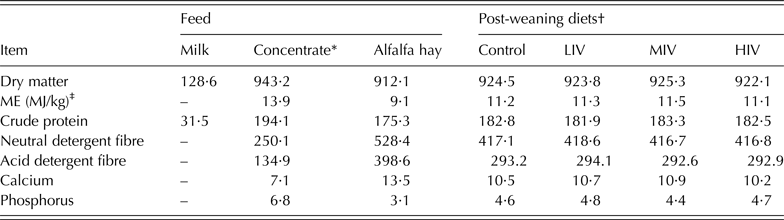
The experimental protocol was approved by the Animal Care and Use Committee of the Shanxi Agriculture University. Forty-eight male Chinese Holstein calves at 15 days old and 45·1 ± 0·36 kg body weight (BW) were assigned randomly to four groups, with 12 calves per group. The treatments were: control (without isovalerate), low-isovalerate (LIV), moderate-isovalerate (MIV) and high-isovalerate (HIV) with 3, 6 and 9 g isovalerate per calf per day, respectively. The analytical grade (985 g/kg of isovalerate) isovalerate supplement was purchased commercially and was hand-mixed into milk for pre-weaning calves and the concentrate portion for post-weaning calves. The study lasted 75 days, including a 15-day adaptation period followed by a 60-day sampling period. Weaning was conducted when calves were 60 days old. During the pre-weaning period, calves were offered whole milk (100 g/kg BW) twice daily at 08·00 h and 15·00 h for 25 days, then from days 26 to 30 the daily offer of milk was halved and calves were fed a commercial concentrate ad libitum. Post-weaning diets of per kg consisted of 600 g alfalfa hay and 400 g commercial concentrate (DM basis). During this period, diets were consumed ad libitum, allowing 10% refusal. The commercial concentrate consisted of 500 g maize grain, 200 g soybean meal, 100 g cottonseed meal, 150 g wheat bran and 50 g mineral–vitamin mixture per kg. The chemical composition of feed and diets provided is shown in Table 1. Calves were housed in individual pens (2·5 × 3 m2) and fresh water was available throughout the experimental period. During the experiment period, six calves were chosen from each treatment at random and slaughtered at 30 and 90 days of age.
Chemical composition of the feed and diet (in g/kg dry matter)

LIV, low-isovalerate; MIV, moderate-isovalerate; HIV, high-isovalerate; ME, metabolizable energy.
* The commercial concentrate was formulated with 500 g maize grain, 200 g soybean meal, 100 g Cottonseed meal, 150 g wheat bran and 50 g mineral–vitamin mixture per kg concentrate. Mineral–vitamin mixture contained 42 mg Co, 3500 mg Cu, 20 000 mg Fe, 12 000 mg Mn, 12 000 mg Zn, 1200 mg I, 600 mg Se, 3000 000 IU vitamin A, 500 000 IU vitamin D and 15 000 mg vitamin E per kg premix.
† The diet of control, LIV, MIV and HIV consists of 400 g alfafa and 600 g concentrate mixture per kg diet.
‡ Calculated from NRC (2001).
Data collection, sampling procedures and chemical analysis
The animals were weighed at the beginning of the sampling period and before slaughtering. Milk, feed offered and refusals were recorded daily throughout the experimental period to calculate DM intake. Samples of milk, feed and refusals were collected once weekly for DM determination. Milk samples were preserved with 2-bromo-2-nitropropane-1, 3-diol and pooled for each group per period before chemical analysis. Feeds and refusals were dried in an oven at 55 °C for 48 h, and ground to pass through a 1-mm screen with a mill (FZ102, Shanghai Hong Ji instrument Co., Ltd., Shanghai, China) for chemical analysis. Milk samples were analysed for fat, true protein and lactose using infrared spectrophotometry (Foss 120 Milko-Scan, Foss Electric, Hillerød, Denmark) according to AOAC (1997, method 975·16) procedures. Analytical DM content of oven-dried samples was determined by drying at 135 °C for 3 h (AOAC 1990; method 930·15). Organic matter (OM) content was calculated as the difference between DM and ash contents, with ash determined by combustion at 550 °C for 5 h. Content of neutral detergent fibre (NDF) and acid detergent fibre (ADF) were determined using the methods described by Van Soest et al. (Reference Van Soest, Robertson and Lewis1991) with heat-stable alpha amylase and sodium sulfite used in the NDF procedure, and expressed inclusive of residual ash. Content of nitrogen (N) in the samples was determined by the Kjeldahl method (AOAC 1990; method 976·05).
Ruminal fluid was collected immediately when calves were slaughtered at 30 and 90 days of age. Ruminal fluid was obtained from several sites within the rumen (reticulum, dorsal and ventral sac). Ruminal pH was measured immediately using an electric pH meter (Sartorius Basic pH Meter PB-20, Sartorius AG, Goettingen, Germany). The samples were then strained through four layers of cheesecloth and were divided into four portions: the first portion of c. 5 ml of filtrate was preserved by adding 1 ml of 250 g/l (w/v) meta-phosphoric acid to determine VFA. The second portion, again c. 5 ml of filtrate, was preserved by adding 1 ml of 20 g/l (w/v) sulphuric acid (H2SO4) to determine ammonia (NH3). All of the above samples were subsequently stored frozen at –20 °C until analyies. The third portion of c. 50 ml of filtrate was kept in a plastic bottle and stored frozen at –80 °C for DNA extraction. The last portion, again c. 50 ml of filtrate, was taken to study the activities of ruminal enzyme profile. Ruminal VFA was determined with 2-ethylbutyric acid as internal standard by gas chromatography (GC102AF; Shanghai Specialties Ltd., China) using PEG-2000/Chromosorb WAW DMCS as a fixed phase (GC102AF; Shanghai Specialties Ltd., China). Ammonia N content of ruminal samples was determined using the method of AOAC (1990; method 941·04). The samples of ruminal fluid for determination of ruminal enzyme activities were placed immediately in an ice bath and transported to the laboratory after collection. The samples were subjected to sonication at 4 °C (ice water bath, 30 s pulse rate) for 10 min and then centrifuged at 27 000 × g for 20 min at 4 °C. The supernatant was used for the estimation of enzyme activities (carboxymethylecellulase (CMCase), cellobiase, xylanase, pectinase, α-amylase, β-amylase and protease) as described by Agarwal et al. (Reference Agarwal, Kamra, Chaudhary, Agarwal, Sahoo and Pathak2002).
Extraction of DNA and quantitative real-time polymerase chain reaction
Microbial DNA was extracted from 1·5 ml ruminal fluid by the repeated bead beating plus column (RBB + C) method (Yu & Morrison Reference Yu and Morrison2004). The extracted DNA was stored at −20 °C for polymerase chain reaction (PCR). Relative quantities of Butyrivibrio fibrisolvens, Ruminococcus albus, Fibrobacter succinogenes and Ruminococcus flavefaciens were determined with real time PCR as a proportion of total bacterial 16S rDNA according to the equation:
 $$\hbox{Relative quantification}\, = \,{2}^{ - ({\rm Ct \,target} - {\rm Ct \,total \,bacteria)}}$$
where Ct represented threshold cycle. The primer sets used for real-time PCR were forward primer (5′–3′) CCC TAA ACA GTC TTA GTT CG, reverse primer (5′–3′) CCT CCT TGC GGT TAG AAC A for R. albus (Koike & Kobayashi Reference Koike and Kobayashi2001), forward primer (5′–3′) CGA ACG GAG ATA ATT TGA GTT TAC TTA, reverse primer (5′–3′) CGG TCT CTG TAT GTT ATG AGG TAT TAC C for R. flavefaciens and forward primer (5′–3′) GTT CGG AAT TAC TGG GCG TAA A, reverse primer (5′–3′) CGC CTG CCC CTG AAC TAT C for F.succinogenes (Denman & McSweeney Reference Denman and McSweeney2006), and forward primer (5′–3′) TCT GGA AAC GGA TGG TA, reverse primer (5′–3′) CCT TTA AGA CAG GAG TTT ACA A for B. fibrisolvens (Forster et al. Reference Forster, Teather, Gong and Deng1996). Real-time PCR was performed on a MxPro-Mx3005P multiplex quantitative PCR systems (Stratagene, La Jolla, CA, USA). The reaction mixture (20 µl) consisted of 10 µl SYBR Premix Taq™ II (TaKaRa Biotechnology Co., Ltd., Dalian, China), 0·8 µl 0·2 µm/l PCR Forward Primer, 0·8 µl 0·2 µm/l PCR Reverse Primer, 0·4 µl ROX Reference Dye (50×), 6·0 µl distilled water and 2 µl of the template DNA. The amount of DNA in each sample was spectrophotometrically determined in triplicate using NanoDrop ND-1000 UV spectrophotometer (NanoDrop Technologies, USA) and the mean value calculated. The PCR was performed under the following cycle conditions: 1 cycle of 50 °C for 2 min and 95 °C for 2 min for initial denaturation, and 40 cycles of 95 °C for 15 s and 60 °C for 1 min for primer annealing and product elongation (Denman & McSweeney Reference Denman and McSweeney2006).
Statistical analysis
Data were analysed using the mixed model procedure of SAS (Proc Mixed; SAS, Version 9 Edition, SAS Institute 2002). Analysis of variance (ANOVA) was used to examine the effect of treatment on ruminal fermentation, ruminal enzyme activities and relative quantity of ruminal cellulolytic bacteria. Linear and quadratic orthogonal contrasts were tested using the CONTRAST statement of SAS with coefficients estimated based on the isovalerate application rates. The main effects of treatment were compared using the Duncan's test. Effects of the factors were declared significant at P < 0·05 unless otherwise noted and trends were identified at P < 0·10.
RESULTS
Dry matter intake and average daily gain
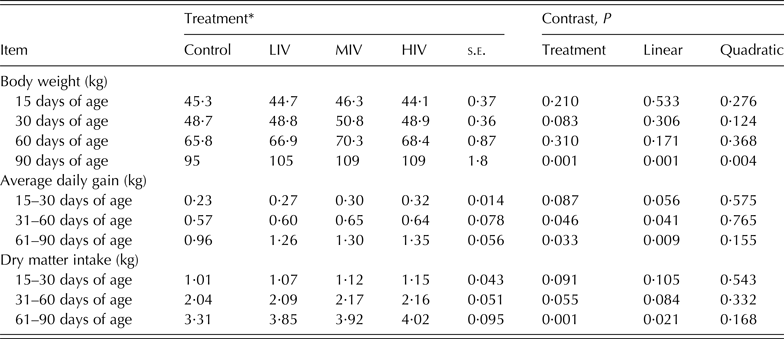
Dry matter intake and average daily gain are shown in Table 2. Dry matter intake increased linearly (P = 0·021) with increasing isovalerate supplementation from 61 to 90 days of age, and was higher for LIV, MIV and HIV than for the control (P = 0·001). Average daily gain (ADG) increased linearly with increasing isovalerate supplementation from 31 to 60 days of age (P = 0·041) and from 61 to 90 days of age (P = 0·009), and was higher for MIV and HIV than for the control (31–60 days of age, P = 0·046; 61–90 days of age, P = 0·033).
Effects of isovalerate supplementation on body weight and average daily gain in pre-weaning and post-weaning dairy calves

LIV, low-isovalerate; MIV, moderate-isovalerate; HIV, high-isovalerate.
* Control, LIV, MIV and HIV with 0, 3, 6 and 9 g isovalerate per calf per day, respectively.
Ruminal fermentation
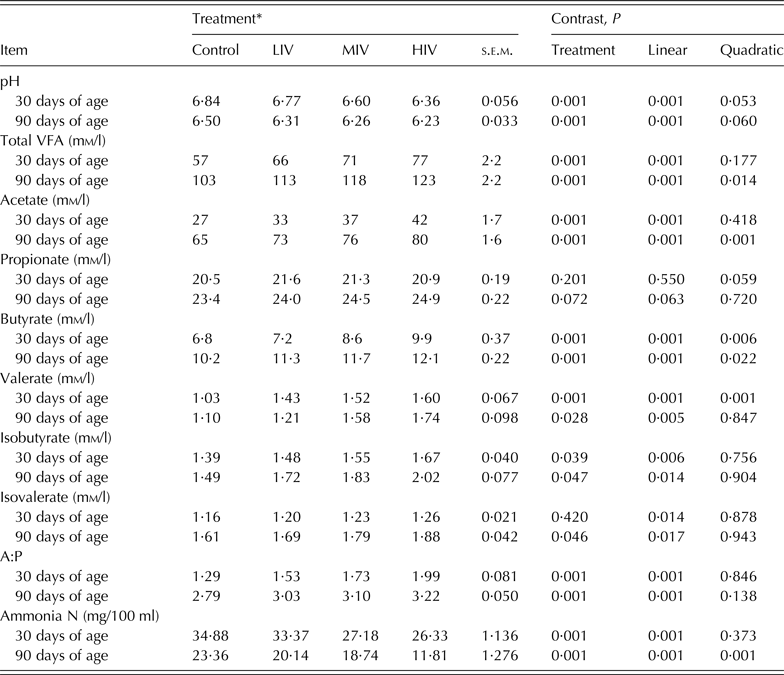
Ruminal pH, ammonia N and VFA profiles are presented in Table 3. Mean ruminal pH decreased linearly (P = 0·001) at 30 and 90 days of age with increasing isovalerate supplementation, and was lower for MIV and HIV than for the control (P = 0·001). With the exception of propionate, the concentration of other VFA increased linearly (acetate and butyrate, P = 0·001; valerate, P = 0·005; isobutyrate, P = 0·014; isovalerate, P = 0·017) with isovalerate supplementation. As a result, the ratio of acetate to propionate increased linearly (P = 0·001), and was higher for isovalerate supplementation than for the control (P = 0·001). Ruminal ammonia N content decreased linearly (P = 0·001) with isovalerate supplementation, and was lower for isovalerate supplementation than for the control (P = 0·001). Moreover, differences in ammonia N were lower for HIV and MIV than for LIV (P = 0·001).
Effects of isovalerate supplementation on ruminal fermentation in pre- and post-weaning dairy calves

LIV, low-isovalerate; MIV, moderate-isovalerate; HIV, high-isovalerate; VFA, volatile fatty acids; N, nitrogen.
* Control, LIV, MIV and HIV with 0, 3, 6 and 9 g isovalerate per calf per day, respectively.
Ruminal enzyme activities
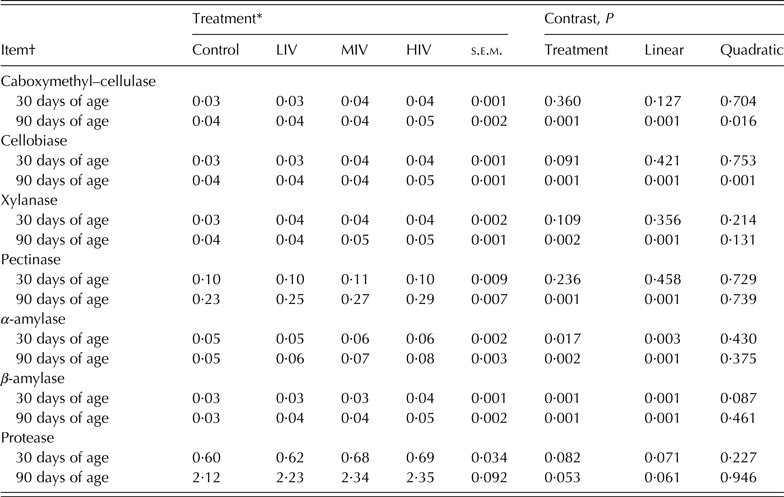
Rumen microbial enzyme activities are shown in Table 4. Activities of CMCase, cellobiase, xylanase and pectinase were not affected by isovalerate supplementation at 30 days of age, but increased linearly (P = 0·001) with increasing isovalerate supplementation and were higher for MIV and HIV than for the control (P = 0·001, 0·001, 0·002 and 0·001) at 90 days of age. Activities of α-amylase and β-amylase increased linearly (P = 0·003 and 0·001) with increasing isovalerate supplementation and were higher for MIV and HIV than for the control (P = 0·017, 0·001, 0·002 and 0·001) at 30 and 90 days of age. Activities of protease tended (P = 0·071 and 0·061 at 30 and 90 days of age) to increase with increasing isovalerate supplementation during weaning.
Effects of isovalerate supplementation on rumen microbial enzyme activities in pre- and post-weaning dairy calves

LIV, low-isovalerate; MIV, moderate-isovalerate; HIV, high-isovalerate.
* Control, LIV, MIV and HIV with 0, 3, 6 and 9 g isovalerate per calf per day, respectively.
† Units of enzyme activity are: caboxymethyl-cellulase (μm glucose/min/ml), Cellobiase (μm glucose/min/ml), xylanase (μm xylose/min/ml), pectinase (μm D-galacturonic acid/min/ml), α-amylase (μm maltose/min/ml), β-amylase (μm maltose/min/ml) and protease (μg hydrolysed protein/min/ml).
Relative quantity of ruminal cellulolytic bacteria
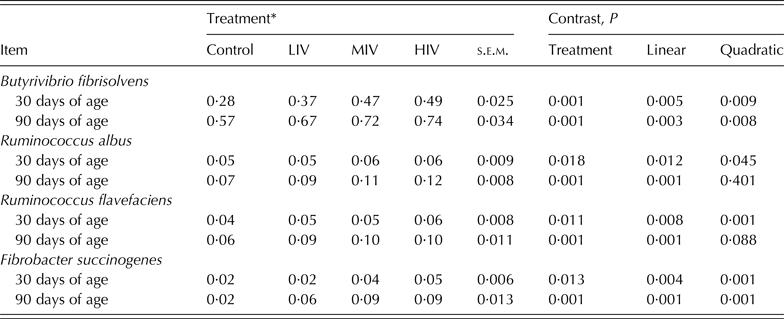
The relative quantities of ruminal cellulolytic bacteria are presented in Table 5. As a proportion of total bacterial 16S rDNA, the relative quantities for B. fibrisolvens, R. albus, R. flavefaciens and F. succinogenes increased linearly (P = 0·005, 0·012, 0·008 and 0·004 at 30 days of age, P = 0·003, 0·001, 0·001 and 0·001 at 90 days of age) with increasing isovalerate supplementation. Moreover, differences in B. fibrisolvens, R. albus, R. flavefaciens and F. succinogenes were highest for HIV and MIV, lowest for the control and intermediate for LIV (P = 0·001) in the post-weaning period (90 days of age), whereas during the pre-weaning period (30 days of age), they were higher for HIV and MIV than for the control and LIV (P = 0·001, 0·018, 0·011 and 0·013, respectively).
Effects of isovalerate level on relative quantity of of ruminal cellulolytic bacteria in pre- and post-weaning dairy calves using quantitative real-time PCR (% total bacteria 16 S rDNA)

LIV, low-isovalerate; MIV, moderate-isovalerate; HIV, high-isovalerate.
* Control, LIV, MIV and HIV with 0, 3, 6 and 9 g isovalerate per calf per day, respectively.
DISCUSSION
Dry matter intake is regulated by many factors, such as ruminal pH, rate of digesta passage from the rumen and extent of feed digestion in the rumen (Allen Reference Allen2000). Although ruminal pH reduced linearly with increasing dosage of isovalerate in the current study, ruminal pH was within the optimum level and unlikely to affect DM intake. The linear increase in ADG with increasing isovalerate supplementation from 31 to 90 days of age was attributed to the improvement in ruminal fermentation, microbial enzyme activities and relative quantity of ruminal cellulolytic bacteria.
During the weaning period, ruminal fermentation pattern was altered from propionate to acetate production by isovalerate supplementation in the milk or calf concentrate, as shown by the increase in ratio of acetate to propionate with increasing isovalerate dosages. The increase in acetate to propionate ratio and total VFA concentration was mainly due to an increase in acetate concentration (range 26·54–41·53 mm/l for pre-weaning and 65·37–80·12 mm/l for post-weaning) and unchanged propionate concentration (range 20·48–20·88 mm/l for pre-weaning and 23·43–24·87 mm/l for post-weaning). These results were consistent with most in vivo and in vitro studies, which have reported an increase in acetate production when BCVFA was fed to sheep (Brondani et al. Reference Brondani, Towns, Chou, Cook and Barradas1991; Quispe et al. Reference Quispe, Barradas and Cook1991) or when adding BCVFA at 15 mg/100 ml of culture media (Kone et al. Reference Kone, Machado and Cook1989). It suggested that growth of cellulolytic bacteria was stimulated by isovalerate supplementation, followed by higher ruminal enzyme activity and improved digestibility of fibre (Misra & Thakur Reference Misra and Thakur2001; Liu et al. Reference Liu, Wang, Huang, Dong, Yang, Zhang and Wang2009a ), resulting in increased acetate production. A linear increase in total VFA concentration and linear decrease in ruminal pH or ammonia N concentration with increasing isovalerate supplementation indicated that ruminal fermentation was stimulated by isovalerate in a dose-dependent manner. Liu et al. (Reference Liu, Wang, Huang, Dong, Yang, Zhang and Wang2009a ) also found that ruminal pH and ammonia N concentration decreased linearly, whereas total VFA concentration increased linearly with increasing isovalerate supplementation in diet of steers. It has been documented that butyrate and, to a lesser extent, acetate and propionate, are the primary chemical stimulators of rumen development (Górka et al. Reference Górka, Kowalski, Pietrzak, Kotunia, Jagusiak, Holst, Guilloteau and Zabielski2011). This suggests that linear increases in concentrations of butyrate at 30 or 90 days of age and acetate during weaning could stimulate development of the rumen. The linear reduction in ruminal ammonia N concentration with increasing isovalerate supplementation indicated that more ammonia N was converted into microbial protein. Cellulolytic bacteria derive their N exclusively from ammonia N (Russell et al. Reference Russell, O'Connor, Fox, Van Soest and Sniffen1992); therefore, the higher relative quantity of cellulolytic bacteria in the current experiment could confirm the linear reduction in ruminal ammonia N concentration. The current suggestion was supported by several in vivo and in vitro studies reporting that BCVFA improved microbial protein synthesis (Piva et al. Reference Piva, Masoero and Curto1988; Liu et al. Reference Liu, Wang, Huang, Dong, Yang, Zhang and Wang2009a ; Wang et al. Reference Wang, Liu, Pei, Li, Wang, Wang, Bai, Shi, Liu and Li2012). In addition, no significant differences in VFA, pH and ammonia N between HIV and MIV indicated that a further increase of isovalerate dose from 6 to 9 g/calf/day was not beneficial to increase the total VFA and acetate production.
During the pre-weaning period (30 days of age), the lack of CMCase, cellobiase, xylanase and pectinase with isovalerate supplementation might be due to the absence of fibre substrate in diets of calves. The result of linear increases in the activity of CMCase, cellobiase, xylanase and pectinase with increasing isovalerate supplementation observed during the post-weaning period (90 days of age) confirmed that microbial activity was stimulated by isovalerate in a dose-dependent manner. Linear increases in the activity of CMCase, cellobiase, xylanase and pectinase was attributed to the growth of cellulolytic bacteria and resulted in an increased concentration of total VFA. This result was consistent with the finding of Moharrery & Das (Reference Moharrery and Das2001), who reported that microbial enzymes, enhanced by isoacid treatment, and cellulase activity increased by 19% compared with the control. Similarly, Liu et al. (Reference Liu, Wang, Pei, Li, Wang, Zhang, Zhang, He, Wang, Yang, Bai, Shi and Liu2014) also reported that activities of CMCase, xylanase or β-glucosidase increased linearly with increasing isovalerate supplementation in steers fed on a maize stover based diet. Moreover, those results of improved ruminal degradability and digestibility of NDF, ADF, hemicellulose and cellulose by BCVFA supplementation also confirmed that the activities of CMCase, cellobiase, xylanase and pectinase could be stimulated by isovalerate supplementation (Misra & Thakur Reference Misra and Thakur2001; Yang Reference Yang2002). Similarly, Liu et al. (Reference Liu, Wang, Huang, Dong, Yang, Zhang and Wang2009a ) found that digestibilities of NDF and ADF in steers increased linearly with increasing isovalerate supplementation. Liu et al. (Reference Liu, Wang, Pei, Li, Wang, Zhang, Zhang, He, Wang, Yang, Bai, Shi and Liu2014) reported that effective degradabilities of cellulose and hemicellulose in maize stover increased linearly with increasing isovalerate supplementation in steers fed on a maize stover-based diet.
Linear increases in the activity of α-amylase and β-amylase at 30 and 90 days of age with increasing isovalerate supplementation futher confirmed that digestibilities of DM and OM in diets were improved by isovalerate supplementation. Liu et al. (Reference Liu, Wang, Huang, Dong, Yang, Zhang and Wang2009a , Reference Liu, Wang, Yang, Zhang, Yang, He, Dong and Huang b ) reported that digestibilities of DM and OM in the total tract responded linearly and quadratically to BCVFA supplementation in steers and in dairy cow. The lack of protease activity from pre-weaning to post-weaning with increasing isovalerate supplementation could be attributed to the lack of influence of isovalerate supplementation on proteolytic bacteria. This result is consistent with the findings of Moharrery (Reference Moharrery2003) who found that a 1% isoacids mixture had no influence on protease. Similarly, Liu et al. (Reference Liu, Wang, Pei, Li, Wang, Zhang, Zhang, He, Wang, Yang, Bai, Shi and Liu2014) found a linear reduction in protease and a tendency towards linear increases in the population of proteolytic bacteria with increasing isovalerate supplementation in steers fed a maize stover based diet. No further change of ruminal enzyme activities with isovalerate supplementation from MIV to HIV indicated that a high dose of isovalerate (9 g/calf/day) supplementation was not beneficial to enzyme activities.
The result of relative quantities of F. succinogenes, R. albus, R. flavefaciens and B. fibrisolvens with real-time PCR as a proportion of total bacterial 16S rDNA indicated that the growth of cellulolytic bacteria was stimulated by isovalerate supplementation and resulted in an increase in activities of CMCase, cellobiase, xylanase and pectinase during the post-weaning period. In both the pre- and post-weaning periods, F. succinogenes was found to be the most dominant cellulolytic bacteria under the experimental dietary conditions. This was consistent with Wanapat & Cherdthong (Reference Wanapat and Cherdthong2009), who found using real-time PCR techniques that the ruminal population of F. succinogenes was relatively larger than that of R. flavefacieus and R. albus. Similarly, Liu et al. (Reference Liu, Wang, Pei, Li, Wang, Zhang, Zhang, He, Wang, Yang, Bai, Shi and Liu2014) also found that F. succinogenes was the most dominant cellulolytic bacteria compared with R. albus, R. flavefaciens and B. fibrisolvens. The result of linear increase in the relative quantities of B. fibrisolvens, R. albus, F. succinogenes and R. flavefaciens with increasing isovalerate supplementation was consistent with Liu et al. (Reference Liu, Wang, Pei, Li, Wang, Zhang, Zhang, He, Wang, Yang, Bai, Shi and Liu2014), who found that predominant cellulolytic bacteria (R. albus, R. flavefaciens, B. fibrisolvens and F. succinogenes) populations increased linearly with increasing isovalerate supplementation in steers fed on a maize stover-based diet. Differences in expression of ruminal cellulolytic bacteria were highest for HIV and MIV, lowest for the control and intermediate for LIV during the post-weaning period, whereas during the pre-weaning period it was higher for HIV and MIV than for the control and LIV. This result could be due to the difference in diet between the pre-weaning period, when calves were fed only milk, and the post-weaning period when calves were fed hay and concentrate (Lane et al. Reference Lane, Baldwin and Jesse2000). Indeed, bacterial composition would adapt to the supply of high levels of dietary fibre by increasing growth of bacteria with cellulolytic and hemicellulolytic activities (Michelland et al. Reference Michelland, Combes, Monteils, Cauquil, Gidenne and Fortun-Lamothe2011).
CONCLUSION
Increasing isovalerate supplementation in pre- and post-weaning dairy calf diets led to linear increases in ruminal total VFA concentration and switched ruminal fermentation patterns into more actate and butyrate production. Ruminal ammonia N improved with increasing isovalerate supplementation. Ruminal microbial enzyme activities of CMCase, cellobiase, xylanase, pectinase and amylase also improved with isovalerate supplementation. Improvement of ruminal fermentation and microbial enzyme activities with isovalerate supplementation were mainly attributed to the linear increase in relative quantities of R. albus, R. flavefaciens, B. fibrisolvens and F. succinogenes and resulted in improved DM intake and average daily weight gain. The results suggested that isovalerate modulated ruminal microorganisms or enzymes in a dose-dependent manner during weaning. The optimum isovalerate dose was c. 6·0 g/calf/day. Increasing the dosage of isovalerate up to 9 g/calf/day was not beneficial to further improve ruminal fermentation, microbial enzyme activities and relative quantity of cellulolytic bacteria of pre- and post-weaning dairy calves in the present experimental conditions.
The current work was supported by a grant from Natural Science Funding projects of National Natural Science Fundation of China (Grant no. 31272471), Agricultural Science and Technology Research Projects of the Shanxi Science and Technology Department (Grant no. 20120311021-2), Shanxi Science and Technology Innovation Team project of the Shanxi Science and Technology Department (Grant no. 2013131024) and Academic Leader projects of Shanxi Agricultural University. The authors thank the staff of Shanxi Agriculture University beef unit for care of the animals.