Introduction
The evolution of the ambulance can be traced back to times of war, then eventually making their way into civilian service. Emergency warning signals were added to help them travel faster through traffic while transporting patients. This intuitively made sense: the faster the patient gets to definitive care, the better the outcome. It has been estimated that less than five percent of ambulance transports medically require the use of lights and sirens (L&S).Reference Murray and Kue 1 Lights and sirens use also has proven to not be as benign as once thought; emergency medical vehicle collisions (EMVCs) occur at high rates every year involving both Emergency Medical Services (EMS) providers and the general public.Reference Larmon, LeGassick and Schriger 2 Rates of EMVCs, injuries, and fatalities occur disproportionately during L&S operation versus routine driving.Reference Larmon, LeGassick and Schriger 2 , Reference Custalow and Gravitz 3
Multiple factors come into consideration in the use of L&S, as well as determining a reasonable, consistent policy for their use. One factor is the effectiveness in reducing the ambulance response time (dispatch-to-scene-arrival interval) and the transport time (scene-departure-to-hospital-arrival interval). It is important to differentiate between these two time periods when discussing L&S use, as in most cases, it is much more important for response time to be shortened rather than transport time. This is because prior to an ambulance arrival on scene, there is usually no health care professional there to care for the patient, and also limited information on the nature of said patient’s injury/illness. Once EMS has arrived on scene, critical patient care can begin, and the patient can be stabilized, possibly decreasing the need for a fast transport time to the hospital. As an example, in cases of cardiac arrest due to ventricular fibrillation or pulseless ventricular tachycardia, the likelihood of a successful resuscitation decreases by 10% for each minute that defibrillation is delayed.Reference Becker, Zaloshnja, Levick, Li and Miller 4 In other situations, transport will always need to be expedited (uncontrolled hemorrhage, STEMI, or cerebrovascular accident/CVA), but providers can effectively treat (or at least stabilize) most medical emergencies prior to arriving at the hospital. One study conducted in Syracuse (New York USA) found that the use of L&S reduced response time by an average of one minute and 46 seconds. However, it is much more difficult to determine if that time saved had a meaningful outcome on patient care. The authors noted in their conclusion that this difference was only clinically relevant in a minority of cases.Reference Ho and Lindquist 5
Delivery of patient care during transport also can be adversely affected with L&S use. One such example is the reduced effectiveness of closed-chest compressions during cardiopulmonary resuscitation (CPR) as the speed of ambulance transport increases.Reference Brown, Whitney, Hunt, Addario and Hogue 6 Higher travelling speeds would have a negative effect on patient care, as the 2010 American Heart Association (AHA; Dallas, Texas USA) guidelines state that appropriate rates and depths of compressions, as well as minimizing interruptions in compressions, have both been shown to improve clinical outcomes.Reference Chung, Kim and Cho 7 Another important factor related to the use of L&S is their effect on the safety of EMS workers, patients, and the general public. An estimated 6,500 ambulance collisions occur every year in the US, causing US$500 million worth of damage.Reference Berg, Hemphill and Abella 8 , Reference Sanddal, Sanddal, Ward and Stanley 9 A study of fatal ambulance collisions in the United States showed that 60% of them occurred during warning signal use and while going through an intersection (53%). Furthermore, the majority of fatalities were of the public, not occupants in the ambulance.Reference Berger 10
Most of the current literature regarding L&S use focuses on EMS operational aspects such as the time saved by using them during response and/or transport. A clinical leap of faith is presumed in that any efficiency gained in EMS operational parameters will result in improved patient outcomes. Other studies focusing on L&S effects on the general public and EMS providers are quite sparse, and rarer still are articles discussing their effect on patient outcome. This review aimed to examine the practice of L&S use, as well as their effect on patient outcomes, the risk they pose to the safety of EMS providers, and to the general public. Although the primary subject of discussion is the use of L&S, some closely related subjects such as driver behavior, ambulance safety, and patient care will be discussed briefly since these factors play a role in ambulance operations with L&S activation as well as the outcomes on patients, EMS providers, and the general public when a collision occurs as a result of their use.
Report
Effect of L&S Use on Ambulance Response and Transport Times
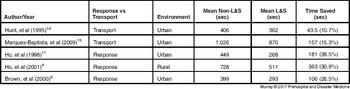
One of the more well-studied aspects of ambulance L&S use is their effectiveness on decreasing response/transport time. Most published studies demonstrate a variable, but statistically significant, reduction in response/transport.Reference Becker, Zaloshnja, Levick, Li and Miller 4 , Reference Ho and Lindquist 5 , Reference Isenberg, Cone and Stiell 11 - Reference Hunt, Brown and Cabinum 15 Where controversy remains is whether the timed saved is clinically significant, with many of these studies concluding that it generally was not.Reference Ho and Lindquist 5 , Reference Ho and Casey 12 , Reference Hunt, Brown and Cabinum 15 One study performed in Minneapolis (Minnesota USA; population: 378,000) showed an average of 3.02 minutes were saved when L&S were activated.Reference Becker, Zaloshnja, Levick, Li and Miller 4 This study examined the time it took for an ambulance to reach the emergency following receipt of the 911 call, referred to as the response time. One issue with the methods utilized in this study was that they obtained their non-warning signal response times by using a chase car that followed the vehicle utilizing L&S response instead of reproducing the route at a later time. This could cause the chase car to be affected by a phenomenon called the “wake effect.” The wake effect is the term used to describe the events caused by the passage of an emergency vehicle utilizing L&S as it passes through traffic (ie, vehicles pulling to the side of the road, vehicles moving through red lights, and so on).Reference Marques-Baptista, Ohman-Strickland, Baldino, Prasto and Merlin 16 This phenomenon easily could result in the slowing of the chase car following the ambulance, which the authors of the study did acknowledge.Reference Becker, Zaloshnja, Levick, Li and Miller 4 Interestingly enough, the wake effect also has been shown to cause a large amount of accidents itself; that is, accidents caused by the passing of the emergency vehicle but not actually involving the emergency vehicle.Reference Marques-Baptista, Ohman-Strickland, Baldino, Prasto and Merlin 16
Another study conducted in Greenville (North Carolina USA) compared the transport time (the time from leaving the scene with the patient to arriving at the emergency department [ED]) of ambulances using L&S to those not. Their results showed an average time saved when using L&S of 43.5 seconds.Reference Ross, Caputo and Salottolo 14 The authors concluded that although this was a statistically significant time period, it may not have been clinically significant since there were few situations in which such a short time interval would impact a patient’s clinical outcome.Reference Ross, Caputo and Salottolo 14 The methods applied to this study varied from those in the previous one discussed, which recorded non-warning signal response times by following the ambulance with a “chase car.” In this study, the team waited until all of the emergency runs had been completed and recorded, and then re-created the call by having a paramedic from the same department operate an ambulance without L&S along the same route. All of the runs were conducted at the same time of day (SD = five minutes) and on the same day of the week. In using this method, the researchers ensured that the “wake effect” would not affect their results.
A similar study to the Greenville study was conducted a few years later in Syracuse (population: 170,000 at the time research was conducted; 2000). The methods used to record the emergency versus non-emergency runs were the same (conducting the non-emergency runs at a later date on the identical route, at the same time, and the same day of the week). The two main differences were the location (population of 170,000 versus 46,000) and that the response time was record as opposed to the transport time. The authors found that the use of L&S saved on average approximately one minute and 46 seconds over similar responses without L&S use.Reference Ho and Lindquist 5 The authors also noted that a large limitation in all of the published literature on the topic was the small sample sizes, as well as the relatively small population of the geographical locations in which they were conducted. They stated that a large-scale study conducted in various locations (specifically large cities such as New York [New York USA] and Chicago [Illinois USA]) was needed in the future to produce more valuable results.Reference Ho and Lindquist 5 A more recent study performed in New Jersey (USA; population 800,000) aimed to not only measure the difference in time saved when transporting with L&S, but also their effect on the patient’s outcome. This study found that an average of 2.62 minutes were saved when transporting with L&S activated.Reference Hunt, Brown and Cabinum 15 Findings from this study will be discussed in a later section of review. Table 1 outlines a summary of the available studies evaluating the effects of L&S use on response or transport time.
Summary of Published Literature Results Regarding Transport and Response Times of EMVCs with and without L&S Utilization

Abbreviations: EMVCs, emergency medical vehicle collisions; L&S, lights and sirens.
Effect on EMS Provider/Public Safety
Perhaps the most important aspect of L&S usage is their effect on the safety of EMS providers, as well as the general public. As with any medical intervention, L&S use is based on a risk-benefit analysis with the premise of added mortality benefits if emergency medical care is rendered to the patient as soon as possible. This is achieved by accepting certain risks in operating an ambulance with L&S to the responders and surrounding public in order to achieve this mortality benefit. A complex set of issues, including ambulance operation, design, and driver behavior, result in EMS providers being at a higher crash risk than firefighters and police.Reference Berg, Hemphill and Abella 8 The topic of EMVCs has been published since the 1990s, and has been studied almost as well as L&S utilization’s effect on transport and response. A 2010 study aimed to evaluate characteristics of EMVCs over a period of two years utilizing data gathered from a web-based reporting site on ambulance collisions in the United States reported in the news media.Reference Berg, Hemphill and Abella 8 It is worth noting that a possible limitation of this study was that the EMVCs reported by the news media tended to be those that are more serious in nature, compared to minor accidents that may not have been reported in the news. The study analyzed 466 EMVCs over two years and identified 982 injuries (more than two per accident) as well as 99 fatalities (approximately one fatality for every five accidents). The EMS providers were the most often injured persons in the collision, as opposed to the patient being transported or the general public. However, the general public accounted for most of the fatalities, totaling 64 (65%). The patient being transported was the least often injured.Reference Berg, Hemphill and Abella 8 Saunders and Heye analyzed crash data in San Francisco (California USA) over a 27-month period and found that collisions were more likely to occur during L&S use than non-use (45.9 collisions/100,000 L&S transports and 27.0 collisions/100,000 non-L&S transports), but the difference was not statistically significant. However, the injury rates as a result of these collisions were statistically significant, with rates of 22.2 injuries per 100,000 L&S transports and 1.5 injuries per 100,000 non-L&S transports.Reference Clawson, Martin, Cady and Maio 17
A study published in 2001 retrospectively analyzed all fatal EMVCs in the United States over an 11-year period. During the time period, 339 fatal ambulance collisions occurred, resulting in 405 fatalities and 838 injuries.Reference Saunders and Heye 18 Data were obtained from the National Highway and Traffic Safety Administration (NHTSA; Washington, DC USA) Fatal Accident Reporting System (FARS). These results identified intersections as the most probable location for a fatal accident to occur, totaling 180 (53%) EMVCs. When considering how little time is spent traveling through intersections as opposed to the open road, this statistic becomes even more significant. As far as emergency versus non-emergency operation, 202 (60%) collisions and 233 (58%) fatalities occurred during L&S use. Accidents involving L&S use also were far more likely to occur at intersections than those in which L&S were not activated. A total of 316 (78%) of the fatalities were not occupants of the ambulance. This same study also compared characteristics of fatal EMVCs to fatal collisions involving the general public during 1997 (though the EMVC data are from the entire 11-year span). Fatal accidents involving ambulances were more likely to involve more than one vehicle (79.6% of EMVCs versus 41.7% of general) and to occur at intersections (53% of EMVCs versus 23.4% of general).Reference Saunders and Heye 18
Another interesting aspect of this study was the collection of data on the driving record of EMS providers involved in the fatal accidents. Various aspects of the provider’s driving history who was listed as driving at the time of the accident, including prior citations, prior collisions, and prior Driving-While-Intoxicated/DWIs were recorded and used to define whether the operator could be defined as a “High-Risk Driver.” These values were then compared with drivers involved in general population collisions (40.7% of EMVCs versus 42.7% of general collisions). Although the difference between EMS providers and the general public is not different, the authors note that since EMS providers are involved with promoting public safety, it is not unreasonable to expect them to be held to a higher safety standard.Reference Saunders and Heye 18 A position statement published in 1994 by the National Association of EMS Physicians (NAEMSP; Overland Park, Kansas USA) stated that all drivers should be screened prior to being allowed to operate ambulances.Reference Kahn, Pirrallo and Kuhn 19 Custalow and Gravitz reviewed data on EMVCs in Denver (Colorado USA) over an eight-year period and found that in 71% of the collisions, the driver of the ambulance had a history of multiple prior EMVCs.Reference Larmon, LeGassick and Schriger 2 They also noted that 91% of EMVCs occurred during L&S use, while only 75% of all transports were listed as using L&S. Another study conducted over one year in Houston (Texas USA) analyzed 86 EMVCs. The results showed that of all the crashes, five drivers, all with prior history of EMVCs, were responsible for nearly 90% of the injuries that resulted as a result of the 86 ECVs. 20
EMS Provider Safety
All EMVCs pose a major threat to safety of EMS providers, especially those providing patient care in the rear compartment.Reference Saunders and Heye 18 Maguire et al. reviewed the occupational fatalities of EMS providers between 1992 and 1997. They showed an annual fatality rate of 12.7 per 100,000 EMS providers. This was compared to rates for police and firefighters during the same time period, which were 14.2 and 16.5, respectively, as well as the national fatality rate, which was 5.0 per 100,000 EMS providers. There were 91 total fatalities, 67 (74%) of which were caused by crashes. Ten (11%) were caused by assaults and 14 (15%) were listed as other.Reference Biggers, Zachariah and Pepe 21
Slattery et al completed a comprehensive review of the occupational hazards that pose a threat to EMS providers in 2008 and grouped the hazards facing emergency medical technicians (EMTs) into three distinct categories: increased risk of EMVCs, poor ambulance safety designs, and injury while delivering critical patient care.Reference Maguire, Hunting, Smith and Levick 22 Ambulance designs make them inherently dangerous to travel in, especially in the rear compartment. The odds of sustaining a serious injury or fatality in the rear compartment are 2.7 times higher than the front compartment.Reference Saunders and Heye 18 It is not surprising that the rear compartment poses higher risk to the EMS provider given the need for mobility during vehicle movement, potentially limited use of safety restraints by an EMS provider, potential for multiple providers in the compartment, and inherent safety risk in the design given multiple cabinets and sharp edges and numerous unsecured medical equipment that become lethal projectiles if an ambulance suddenly decelerated.Reference Maguire, Hunting, Smith and Levick 22 - Reference Levick, Li and Yannaccone 27
Risk to Safety in the General Public
The effect of L&S use on the safety of the general public is clearly demonstrated by the excessive number of EMVCs that occur every year. A study of fatal ambulance collisions found that the ambulance was the striking vehicle in over 76% of accidents. Of those, over 60% occurred during L&S use.Reference Kahn, Pirrallo and Kuhn 19 These alarming statistics suggest that ambulance collisions pose a threat to the general public, but studies have demonstrated that L&S use has a more profound effect on public safety due to a seldom discussed phenomenon referred to as the wake effect. This phenomenon refers to accidents that are caused by the passage of an ambulance utilizing L&S, but not actually involving the ambulance.Reference Marques-Baptista, Ohman-Strickland, Baldino, Prasto and Merlin 16 Clawson et al. sought to define the true scope of the wake effect. Paramedics from Salt Lake City and Salt Lake County (Utah USA) were asked to complete a survey regarding EMVCs and wake-effect collisions. The results showed that the mean number of EMVCs per respondent was 0.82 (0.86 in Salt Lake City and 0.80 in Salt Lake County). The mean number of wake-effect collisions per provider was 3.49 (4.59 in Salt Lake City and 2.79 in Salt Lake County), occurring at a rate five-times higher than actual EMVCs.Reference Marques-Baptista, Ohman-Strickland, Baldino, Prasto and Merlin 16 The number of EMVCs that occur every year in the United States is estimated to be 6,500.Reference Berg, Hemphill and Abella 8 If the data found in Salt Lake City holds true across the country, that would mean approximately 32,500 wake-effect collisions occur every year. It should also be noted that these collisions could result from the passage of other emergency vehicles, such as police cars and fire apparatus as well.
Effect on Patient Outcome
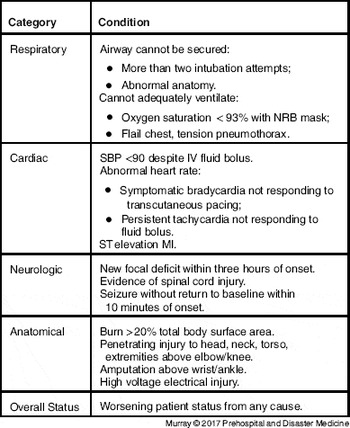
While EMS has recently shifted focus on outcomes metrics such as quality improvement, patient safety, and evidence-based medicine similar to the rest of the health care industry, there have been relatively few studies on the effects of L&S use on patient outcome. This subject can be further divided into two topics: the effect of the time saved when transporting patients with L&S, and the effect that emergency driving has on actual patient care. A study conducted in New Jersey examined how much time was saved by transporting patients using L&S and whether the time saved positively affected the patient’s outcome. The authors found a mean time saved of 2.62 minutes, which was statistically significant, but probably did not provide any clinical benefits.Reference Hunt, Brown and Cabinum 15 The study divided interventions into those that could be performed in the prehospital setting by paramedics versus hospital interventions that could only be performed by a physician in the ED. Hospital interventions included administration of thrombolytics, neurosurgical evacuation, cardiac catheterization, and transvenous cardiac pacing. One-hundred and twelve L&S transports were analyzed for the study. Only 4.5% (five patients) received hospital interventions upon arrival to the hospital. The mortality rate for these patients was 0%.Reference Hunt, Brown and Cabinum 15 None of these patients received the hospital interventions within the average 2.62 minutes saved by lights and siren use. The authors concluded that the use of L&S was unnecessary for patients only requiring prehospital interventions (which accounted for 96.4% of the transports studied). They concluded that more research was needed to even justify the use of L&S for patients requiring hospital interventions.Reference Hunt, Brown and Cabinum 15 The same group of authors then conducted another study in the same area based around implementation of a standardized protocol for the use of L&S. Eight towns were studied, four of which adopted the protocol and four that were controls. The protocol outlined specific patient conditions that warranted the use of L&S during transport (Table 2). The conditions were chosen based on the likelihood that a patient experiencing them would require hospital interventions and/or hospital admission.Reference De Graaf and Van Weperen 28 The results showed a significant decrease in L&S use in the experimental towns. A total of 808 patient transports were evaluated over the course of the study. Of the total 405 patients transported by the control towns, 201 were done so with L&S (49.6%). The experimental towns transported 403 total patients, 117 of which were transported with light and sirens (29%). The control towns were 5.6 times more likely to use L&S than the experimental towns which implemented the protocol.Reference De Graaf and Van Weperen 28 The study did not find any significant correlation between L&S use and hospital admissions in either the control or experimental towns. The authors did note that L&S use was more likely for patients that ended up requiring a trauma or intensive care unit activation.Reference De Graaf and Van Weperen 28 Interestingly, the study did not demonstrate a decrease in the use of L&S by the control towns. The authors hypothesized this as a behavioral phenomenon where EMS providers would not change their driving behavior even when surrounding towns implement standardized protocols, suggesting that the only way for L&S use to decrease is for each EMS system to have its own protocols.Reference De Graaf and Van Weperen 28 The results also did not indicate any difference in patient outcome between the two groups.
Experimental Protocol for the Use of Lights and SirensFootnote a

Abbreviations: IV, intravenous; MI, myocardial infarction; NRB, non-rebreather mask; SBP, systolic blood pressure.
a This table represents the protocol given to the experimental towns. It lists the patient conditions that the authors felt warranted emergency transport to the hospital.Reference De Graaf and Van Weperen 28
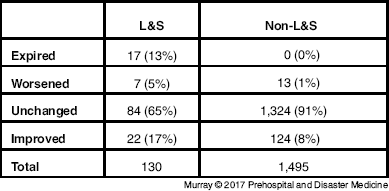
Another study conducted in 1994 also implemented a L&S use protocol, with similar criteria to the one previously discussed. The authors then tracked all patient transports to determine if the protocol resulted in increased morbidity of patients transported with L&S. A total of 1,625 patients were transported during the study; 1,495 (92%) of patients were transported without the use of L&S, 130 (8%) were transported with them.Reference Ho and Casey 12 Following each transport, the EMS providers completed a form and noted whether or not the patient’s condition had changed during transport. It was found that only one percent of the non-L&S patients worsened during transport (Table 3).Reference Ho and Casey 12 Accepting emergency room physicians reported that none of the patients who were listed as worsening during transport required any time-critical interventions upon arrival to the hospital.Reference Ho and Casey 12 The authors reported that of the 92% of patients transported without L&S, almost one-half received Advanced Life Support (ALS) interventions during transport (indicating a relatively serious illness/injury) and many had very serious chief complaints, such as chest pain or respiratory distress.Reference Ho and Casey 12
Changes in Patient Condition during TransportFootnote a

Abbreviation: L&S, lights and sirens.
a This table illustrates the differences between patient condition changes during L&S vs Non-L&S transports. Only 1% of Non-L&S patients were listed as having worsened during transport. The patients transported with L&S were generally more seriously injured/ill with 13% dying during transport and 5% worsening.Reference Marques-Baptista, Ohman-Strickland, Baldino, Prasto and Merlin 16
As previously stated, the protocol used in this study was similar to Table 2, which included a variety of patient signs and symptoms that warranted expedited transport. The last criterion in the protocol used in this study gave providers a little room to make the decision to use L&S, even for patients whose conditions did not fall under the established protocol. The criterion read:
“Emergent transport should be used in any situation which the most highly trained EMS provider believes that the patient’s condition could be worsened by delay equivalent to the time that could be gained by emergent transport. In all cases using this option, documentation of the reason for this on the trip must be recorded.”Reference Ho and Casey 12
These criteria were cited as the justification for 32% (40/130) of all the L&S transports. The authors suggest that removing this guideline from the protocol and using entirely objective (as opposed to subjective) criteria would most likely result in even fewer L&S transports. However, they note that it is essentially impossible to implement an entirely objective protocol that covers every single patient transported by ambulance. Over the course of the study, no patients were reported to have experienced increased morbidity due to non-L&S transport, and no EMVCs occurred.Reference Ho and Casey 12
Another rarely studied aspect of L&S use is their direct effects on patients in the prehospital setting. A German study aimed to characterize whether the stress of L&S use negatively impacted the health of patients being transported. They subjected 54 healthy volunteers to ambulance rides both with and without L&S. Vital signs and levels of endocrine hormones were tested at the end of the rides. They found significant differences in heart rate, blood pressure, cortisol, somatotropin, and adrenocorticotropic hormone/ACTH between the differing modes of transportation. The authors hypothesized that emergent transport increased stress levels and could increase morbidity in acutely ill patients, especially those with cardiac disease.Reference Merlin, Baldino and Lehrfield 29 A more recent study aimed to test said hypothesis, and measured blood pressure and heart rate, venous levels of epinephrine, norepinephrine, lactate, and visual analogue scores for pain and anxiety in patients with clinical signs of acute coronary syndrome before and after L&S transport. Their results showed that epinephrine and norepinephrine increased significantly during transport, but that lactate, heart rate, and blood pressure essentially remained stable. The authors interpreted this to mean that stress levels rose during transport, but not to the point where they caused any cardiac shock. A significant limitation to this study was that there was no control group of non-L&S transport patients. Thus, it cannot be determined if the increase in plasma catecholamines was due to the L&S or simply the stress of requiring ambulance transport at all.Reference Merlin, Baldino and Lehrfield 29
A 2011 study demonstrated that increased ambulance speed and acceleration (as occurs during L&S driving) resulted in worsening quality of CPR during patient care. Both the measured depth of chest compressions no-flow fraction time (the fraction of time that a pulseless patient is not receiving compressions) increased proportionally as the ambulance speed of travel increased.Reference Brown, Whitney, Hunt, Addario and Hogue 6 , Reference Weber, Reitinger and Szusz 30 Although these increases were small, the authors state they have very real negative impacts on the quality of CPR. These measurements were taken while providers administered CPR to a dummy in the back of the ambulance. The authors concluded the increase in depth of compressions was a result of the release of catecholamines (in the providers) caused by the stress of transport, fast speeds, and use of L&S.Reference Brown, Whitney, Hunt, Addario and Hogue 6
Discussion
The available published literature regarding ambulance L&S use shows that the use of L&S by ambulances can negatively impact patient care, and poses a safety hazard both to EMS providers and the general public. All of the studies that aimed to research how much time was saved by the use of L&S found that they do make a difference, although the time saved can vary to as little as 43 seconds.Reference Ross, Caputo and Salottolo 14 No study thus far has demonstrated that any time saved has resulted in a positive effect on patient outcome. Variability in time saved was seen across the published studies, and one possible cause of this is geographical differences. Studies conducted in more population-dense areas tended to show a larger amount of time saved with the use of L&S compared to those in rural areas. Further research in larger, urban EMS systems could help to further the effect of population density on time saved and patient outcome.
The first and most important way to decrease the hazards posed by L&S is to decrease their use. As noted earlier, this is unlikely to happen without nation-wide implementation of protocols that outline when the use of L&S is appropriate.Reference De Graaf and Van Weperen 28 Protocols addressing ambulance L&S use need not be complex and detailed. One study showed that a simple three-tiered protocol for dispatching calls based on their severity could cut back on L&S use by one-third.Reference Berger 10 Commercially developed dispatch systems can account for initial call type and priority, thus providing better guidance on when L&S response is most appropriate. Additionally, guidelines on determination of L&S during hospital transport can be easily determined since the EMS provider has already made contact and assessed the nature of the chief complaint.
In 2010, a collaborative “Best Practice Statement” was released by the Federal Emergency Management Agency (FEMA; Washington, DC USA) along with firefighting, EMS, and law enforcement labor unions in regards to emergency vehicle operations. The paper stated that in order to reduce the high number of fatalities sustained by emergency workers in transportation accidents, a “major cultural shift is required.”Reference Perkins, Davies and Quinton 31 They also stated that emergency services need to realize that most of the calls they respond do not warrant the risk that utilizing L&S poses. The statement cited multiple fire departments that had implemented L&S policies, and showed that the St. Louis (Missouri USA) Fire Department had experienced over a 90% reduction in collisions within a few years of the policy being put in place.Reference Perkins, Davies and Quinton 31 Calls for nationalization and research of L&S protocols have been put forth as early as 1994, when a position statement from NAEMSP was released. Among other recommendations, the authors stated that EMS physicians should be actively involved in developing L&S protocols, scientific studies should be conducted and validated to assess the effectiveness of L&S use, and that national standards for emergency medical vehicle operation should be developed.Reference Saunders and Heye 18 Another way that the use of L&S can be reduced is through the expanded use of Termination of Resuscitation (TOR) protocols. These protocols only apply to a small subset of patients, those in cardiac arrest, and have been put into use over the last few years. The TOR protocols indicate to providers when to stop attempting CPR on a patient based upon criteria that correlate with the chance the patient could actually be resuscitated. The 2010 AHA guidelines provided a standardized TOR protocol, and estimated that following it could reduce unnecessary cardiac arrest transports by up to 60%.Reference Chung, Kim and Cho 7 It is unlikely, however, there will be complete discontinuation of L&S use as they still have some limited utility for seriously injured or ill patients. Because of this, it is important that ambulances are continually made to higher standards, so as to provide patients with a safe ride to the hospital and providers with a safe workspace. Appropriate use of already available safety restraints, such as seatbelts in the rear compartment, also is paramount in lowering the risk of injury or death of EMS providers and patients during an EMVC.Reference Murray and Kue 1
Utilizing automated technologies such as mechanical ventilators and chest compression devices allow EMS providers to free-up their hands so that they can be used for stabilization and enhance crew safety. Not only can they add to the safety of providers, they’ve also been shown to deliver more consistent and higher quality care to patients than manual ventilations or CPR.Reference Biggers, Zachariah and Pepe 21 One study showed that using an automated compressor can improve compression effectiveness from 0%-33% (when done manually) to 88%-100% during highway travel. 32 Another technology to consider is use of radio headsets similar to those used by helicopter crewmembers which would allow EMS providers to free up their hands by not requiring them to reach for and hold a radio microphone.Reference Biggers, Zachariah and Pepe 21
Improving driver behavior has been discussed in multiple papers as an effective solution to EMVCs. Consider an earlier described study that found 71% of all EMVCs reviewed over an eight-year period involved an ambulance driven by an EMT with a history of prior EMVCs.Reference Larmon, LeGassick and Schriger 2 On-board computers that monitor driver performance and provide feedback have been discussed as a solution to poor driver behavior. The units are installed in the ambulance and function somewhat like the “black box” on airplanes. When a driver enters the vehicle, he or she plugs in a key fob that is uniquely tied to them, and they are then registered as the driver of the run. The computer then logs all aspects of the trip: miles traveled, speeds, acceleration, G-forces, even seatbelt use. Limits also can be set for things like speed or G-forces, and when they are exceeded an audible warning sounds in the cab to alert the driver that he or she needs to slow down.
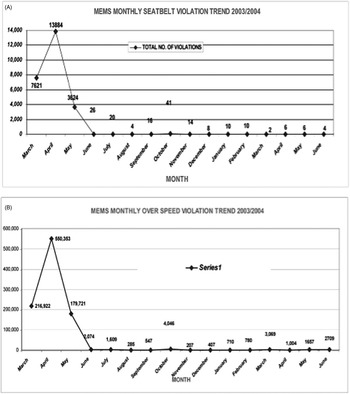
A 2005 study evaluated the effectiveness of the implementation of these devices into an EMS company’s fleet.Reference Stapleton 33 The devices were installed in March 2003, and until mid-April 2003, they only collected data and did not have any audible warnings. Starting in mid-April, the audible tones were turned on, and in June 2003, the key fob identification devices were utilized. The study ran for a total of 18 months with profound reduction in the number of seatbelt use violations (Figure 1). These results provide strong evidence that the computer system improves driver safety. The authors hypothesized that the initial spike in violations in April was probably indicative of the true baseline for the company that was studied. They further hypothesized that after learning the system would be implemented in March, providers most likely attempted to drive safer, but as time went on, they stopped worry about it as much. However, once the audible alerts were turned on in April, the number of violations dropped quite a bit. The violations finally dropped all the way down once the identification system began being used in June. There were two violations identified in October 2003 and March 2004. The authors stated that they were caused by one driver who was identified as performing poorly and reassigned, and by mechanics who drove the ambulances during maintenance, respectively. Seatbelt violations were reduced from 13,500 per month to only four, a 3,375-fold decrease. The EMS service also noted a 20% decrease in maintenance costs.Reference Stapleton 33
(A). Total Number of Seatbelt Violations by Month. This chart shows the number of seatbelt violations collected by the on-board computer over the length of the study.Reference Stapleton 33 (B). Total Number of Speed Violations by Month. This chart shows the total number of speed violations collected by the on-board computer over the length of the study.Reference Stapleton 33

Conclusion/Summary
A review of the available literature surrounding ambulance L&S use, patient and provider safety, and ambulance design has consistently demonstrated improved response and transport times, but fails to show any clinically significant impact on patient outcomes. It has, however, demonstrated unfavorable effects on the safety of patients, EMS providers, and the general public during ambulance L&S response operations. Despite this evidence, L&S use has remained a vestigial practice within the EMS community. Given the role of EMS within the public safety community, as well as an expectation the general public has for rapid, timely EMS response to medical emergencies, it is unlikely the use of L&S in EMS will ever completely go away.
Rather than considering absolute restrictions on L&S use, EMS systems should consider the best available evidence to develop appropriate protocols that minimize L&S usage in appropriate scenarios. Certain protocols such as field TOR, dispatch-based protocols to guide types of responses, and development of appropriate driver training programs are the logical steps to reducing unnecessary L&S use. On a larger scale, on-going research is needed as well as a consensus change within the public safety community and from national organizations to develop guidelines that acknowledge the limitations AND hazards of L&S use. The EMS physicians and providers must take it upon themselves to evaluate the evidence, and drive change within their organizations to better the delivery of care, and remember that they must “first, do no harm.”