One of the most complicated economic and political challenges in Europe after World War I was to decide on the principles for future monetary policy. In this regard, monetary policy became dominated by a search for the stability that before 1914 had been offered by the fixed exchange rate system based on the gold standard and its related instruments for international economic cooperation.Footnote 1
However, apart from the United Kingdom, only a number of small countries that had been neutral during World War I succeeded in restoring the gold standard at prewar parity. Among this group, the time of restoration differed considerably. Sweden completed the process in 1924, which was even before the United Kingdom did so in 1925. The Netherlands and Switzerland then followed shortly after the decision in the United Kingdom in 1925. From this perspective, Denmark and Norway may be considered as latecomers, as they returned to the gold standard in 1927 and 1928, respectively.Footnote 2
According to economist Tobias Straumann, this divergence between Sweden on one hand and the Netherlands and Switzerland on the other hand in relation to the United Kingdom is remarkable. The currencies of all three countries were near or touched upon the prewar parity in 1922. However, whereas the Netherlands and Switzerland chose to wait until the British government made its decision to return the pound to the gold standard at prewar parity in 1925, Sweden pushed ahead toward an early return of the gold standard.Footnote 3 This meant that Sweden went ahead of the United Kingdom and committed to the gold standard without waiting for the reintroduction of the arrangements for international monetary cooperation that had existed before World War I. After the war, actors on the financial markets still considered London as a world and European financial center that would function as a clearing house for monetary transactions in the international gold system.Footnote 4 Instead, Sweden seemed to disregard this fact, as well as a number of other crucial international “rules of the game” that had provided the guarantees for the stability of the pre-1914 gold standard regime.Footnote 5
Why, then, did a small country like Sweden choose such an independent path for its monetary policy? Here, the institutional position of the Swedish central bank, the Riksbank, in relation to the government must be considered. The Swedish central bank was entirely owned by the Swedish state. This meant that the cabinet appointed the chairman of the court of directors, whereas the parliament elected the remaining six directors of the court. Such a strong dependence made it more vulnerable to political pressure than its counterparts in the Netherlands and Switzerland. When it came to regime changes, then, the Parliament could overrule the position of the central bank, which was the case during the reintroduction of the gold standard.Footnote 6
Therefore, to understand the peculiarities of Swedish monetary policy making after World War I, it is also necessary to consider its domestic policy situation. As in other European countries, the rise of socialist parties, in connection with the introduction of parliamentarism and universal suffrage, had resulted in a relatively complex parliamentary structure. In the first part of the 1920s, representation in the Swedish parliament was divided among four major parties—Social Democrats, Conservatives, Agrarians and Liberals—which jointly polled more than 90 percent of the vote. Because the vote was split fairly evenly between them, however, no single party could govern without the support of another. For that reason, political interests and goals needed to be balanced; as a result, the successive Socialist and Conservative minorities that governed in the 1920s never embarked on truly individual agendas in their economic policies.Footnote 7
Accordingly, the early Swedish reintroduction of the gold standard may be related to the combined impact of two separate positions that affected policy making in a crucial way. As these two positions in their separate forms were supported by the Social Democrats and the Conservatives, respectively, they formed a crucial basis for the political support of the gold standard as these parties together formed a stable majority in both chambers of Parliament.Footnote 8
As for the Social Democratic position, political scientist Ton Notermans has argued that the Social Democrats favored a return of the gold standard as a mean to regain stability and establish more favorable conditions for the working classes in the fluctuating economic conditions that emerged after the war. This position may also be viewed as a reaction to war profiteering and the speculation that took place after the war. Furthermore, Notermans notes, for the Social Democrats, the resistance of some parts of business against their deflationary policies became a factor in determining their own position on these issues. If capitalists opposed restrictive policies, this had to mean that they were in the interest of labor.Footnote 9 Accordingly, Social Democratic monetary policy making after World War I should not be viewed as an isolated issue. Instead, it was a process in which an original position of the Social Democrats became strengthened by the alternative solutions or protests put forth by business interests.
With regard to the position of the Conservatives, it was based on the fact that monetary thought and monetary policy after World War I was greatly influenced by the experience under the classical gold standard system. This meant that these actors regarded the gold standard as the normal state of affairs and World War I as a temporary disturbance. As a way to describe the impact of this perception on monetary policy, economic historians Barry Eichengreen and Peter Temin have coined the term “gold standard mentality.”Footnote 10
Against this background, the aim of this article is to elucidate how these two positions emerged and became manifested within the political decision-making concerning the return to the gold standard in Sweden during the period 1920 through 1924. In this regard, this article centers on two different types of arenas for policy making. The first arena is the government commissions in which monetary policy was prepared and discussed. These include the Finance Experts of 1920 (1920 års Finanssakkunniga), the Economic Council (Ekonomiska Rådet), and the Tariffs and Treaties Commission (Tull-och traktatkommittén). The second arena is the Swedish Parliament, whose activities and reactions from relevant involved actors also are surveyed.
What motivates this article is that it deals with the political complexities when a country returned to the gold standard at prewar parity by including actors from both politics and business, as well as their interaction with related processes and contexts. This perspective increases the knowledge and understanding of one of the most crucial political processes to shape society and economy in Europe after World War I. As such, this article provides a political economy and business history perspective complementing previous research that has studied interwar monetary policy from a macro-oriented, quantitative perspective.Footnote 11
To this end, the article initially follows a chronological and descriptive outline as it elucidates the relevant empirical events and developments in the first part before the results are discussed and analyzed in the second and final part. The source material consists of primary sources from the archives of the government commissions in the Swedish National Archive in combination with different types of parliamentary sources, such as government bills and records of chamber debates. In addition, source material from internal policy discussions by actors within business and industry has been collected from the archive of the Swedish Federation of Industries (Sveriges Industriförbund). Some secondary sources and literature have also been used.
The Finance Experts of 1920
Against the macroeconomic situation in the spring of 1920, with rising inflation and a depreciation of the krona, concerns were raised regarding the adequacy of financial policy. Amid the confusion that occurred when Parliament was forced to suspend the central bank from note convertibility in February 1920, demands were raised for the appointment of an investigatory commission on financial and monetary policy.Footnote 12 In April 1920 this commission, the Finance Experts of 1920, was appointed by the Social Democratic government with the task to identify which measures would be necessary and possible to implement to prevent further inflation and stabilize the value of the krona.Footnote 13
Upon appointing the commission, the government stated that it wanted to avoid the stalemate produced by a similar commission in 1918. The only members of this commission had been bankers and economists, who had come into conflict with each other and therefore had not been able to produce any constructive policy recommendations. For that reason, Parliament insisted that members the commission should represent different fields and interest.Footnote 14 The chairman of the commission was Erik A. Nilson, a liberal member of Parliament and member of the board of governors of the central bank. Two other representatives from the central bank, including the chairman and the vice-charman of its board of governors (Adolf af Jochnick and Victor Moll), as well as three Social Democratic members of Parliament (Oskar Hagman, Emil Kristensson, and Anders Örne) were appointed. Furthermore, one representative from business and industry (J. Sigfrid Edström, CEO of the engineering company ASEA) and one banker (Herman Mannheimer from Skandinaviska Kreditbanken) were included in the commission. The final members were two economists (Emil Sommarin and Knut Wicksell).Footnote 15
The government gave clear instructions to the commission to focus on practical policy issues and thereby to avoid theoretical and technical discussions. In this regard, the commission was instructed to base its recommendations on a questionnaire that was to be circulated to all relevant organizational and actors that had a stake in policy making.Footnote 16 The commission circulated the survey to sixty respondents, which included not only the major industries but also agricultural and consumer organizations, as well as local chambers of commerce and a number of senior officials and economists.Footnote 17
To give a background to the following work process and decision making within the commission and to give a general picture of monetary thinking within the Swedish private sector at the time, the answers from nine of the most important organizations within business and industry in Sweden at the time are presented here. Among these are seven important trade associations, representing producing firms in their specific industries. These include the Swedish Bankers’ Association (Svenska Bankföreningen), the Swedish Steel Producers’ Association (Jernkontoret), the Swedish Shipowners’ Association (Sveriges Redareförening), the Swedish Machine Industry Association (Sveriges Maskinindustriförening), the Swedish Timber Product Export Association (Svenska Trävaruexportföreningen), the Swedish Cellulose Association (Svenska Cellulosaföreningen), and the Swedish Association of Paper Mills (Svenska Pappersbruksföreningen). Furthermore, focus will also lie on two other business organizations that functioned as peak associations in the sense that they were sector-specific national associations.Footnote 18 The first and most important of these is the Swedish Federation of Industries (Sveriges Industriförbund). A second peak association, the General Export Association of Sweden (Sveriges Allmänna Exportförening), will also be dealt with.
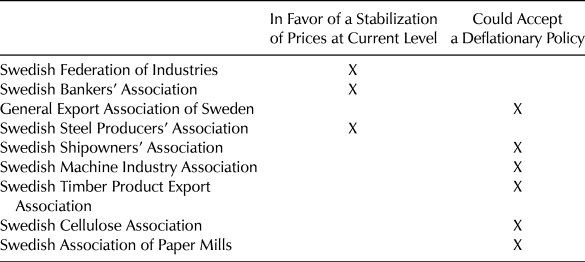
Table 1 describes the attitudes of these organizations to two questions in the survey related to their preferences with regard to the future direction of general economic policy. The respondents were asked whether they preferred a stabilization of prices and the value of the Swedish krona at the current level or if they could accept a more aggressive deflationist policy, with more significant changes within the price and currency levels.Footnote 19 As Table 1 indicates, the majority of the organizations could, in fact, accept an unspecified deflationary policy, with the Swedish Federation of Industries, the Swedish Bankers’ Association, and the Swedish Steel Producers’ Association as the only exceptions.
Attitudes toward monetary policy among nine actors within Swedish business and industry in 1920

Source: Own analysis of RA, YK 95, 1920 års Finanssakkunniga, 1: “P.M. med yttranden på cirkulärskrivelse.”
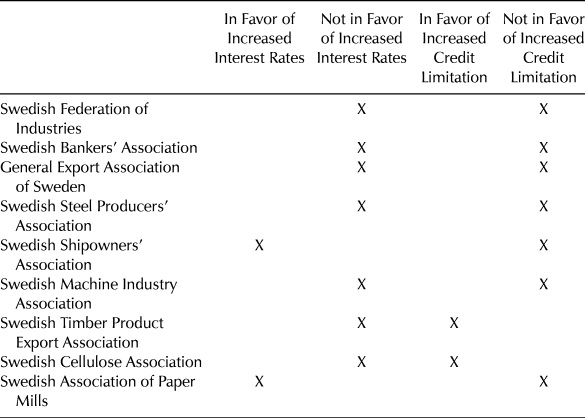
The organizations were also asked to state their views on the suitability of different policy instruments. These results are summarized in Table 2, which demonstrates a relatively inconclusive pattern. Only four organizations, the Swedish Shipowners’ Association and the three associations related to the forestry industries, were actually able to accept that monetary policy measures would be necessary to implement to affect the monetary situation.
Attitudes toward monetary policy instruments among nine actors within Swedish business and industry in 1920
Source: Own analysis of RA, YK 95, 1920 års Finanssakkunniga, 1: “P.M. med yttranden på cirkulärskrivelse.”
As a general comment on the positions of the business organizations, they were significantly influenced by and should be viewed as a reaction against the effects of the economic boom that emerged after World War I. This was manifested in a scramble for goods to replace the inventories drawn down during the war. However, as stocks and assets such as fuel and raw materials still were limited, this significantly increased demand resulted in inflation, speculation, and shortages.Footnote 20 At this point, all trade associations except for the Swedish Bankers’ Association and the General Export Association of Sweden appear to have viewed monetary policy primarily as a short-term instrument to deal with the current price and cost levels rather than as a long-term macro policy instrument. Apart from framing monetary policy into this context, they did not present any independent analysis or policy recommendations.Footnote 21
Against this background, it was only the Swedish Bankers’ Association, the Swedish Federation of Industries, and the Swedish Steel Producers’ Association that presented a more general analysis. These organizations argued that it was necessary to introduce a policy that stabilized the price level for business and industry to function properly. However, it was not possible to establish an optimal level for price stabilization such as the prewar parity. The developments since the outbreak of the war had produced such significant effects on the price level that it could not be altered without considerable risks.Footnote 22
However, when the commission submitted its report in August 1920, it reflected the comments and recommendations from business interests only to a limited degree. Instead, the commission report favored a position on monetary policy that was being devised by the Social Democratic party at the time. In this regard, it is important to note that the commission was working under conditions in which the Social Democrats became more eager to influence to influence Swedish politics by launching their own agenda. One manifestation of this intent was their decision to break up their majority coalition with the Liberal party, with whom they had been in government since 1917, opting for their own minority government instead.Footnote 23
The Social Democrats were also able to exert substantial influence on the commission. Not only were the three of the members of the commission members of Parliament for the Social Democrats, but among them, Emil Kristensson was the chairman of the parliamentary banking committee and Anders Örne was appointed undersecretary of state at the finance ministry during the work of the commission. By including economists such as Wicksell and Sommarin, they had also appointed experts who sympathized with the Social Democrats.Footnote 24 In addition, economist Eli F. Heckscher, whose ideas on monetary policy provided further inspiration to the Social Democrats at the time, was given the opportunity to lend his support to the commission through remiss comments.Footnote 25
Although the Social Democrats admitted that they needed more time to prepare a general macroeconomic policy agenda, they were still convinced of the necessity of halting inflation and establishing a new stable price level.Footnote 26 In the report, a deflationist monetary policy was primarily framed as an instrument for redistribution and social justice.Footnote 27 Here, the report pointed to the fact that the monetary and economic conditions of the war economy and postwar boom had resulted in a transfer of assets and resources between different groups of society. This had increased the wealth of a small group on behalf of most other people in society in what was considered an unnatural and unfair way. Furthermore, it was also stated that a stabilization of the price level would improve the situation on the labor market, which was suffering from the fact that employers and contractors did not honor agreements on the labor market and blamed this on the monetary situation.Footnote 28
Monetary policy was therefore in part designed not only to achieve the desired macro stabilization, but it also targeted the wealth of the groups that had benefited from the economic conditions after the war broke out. Here, the report stated that as a first step, monetary policy should aim at preventing further inflation. However, as the second step, the report advocated that a successive deflationist policy should be devised with the ultimate goal of a return of the krona to the gold standard. In this respect, the policy should be directed toward restricting the capital markets and lowering the prices as much as possible without harming the overall prospects for “decent” business and industry, which not could be accused of speculation or exploitation. Here, the most important instrument was the discount rate of the central bank which, according to the report, should be adjusted to accommodate the stricter policy. In turn, it was also expected that the commercial banks would follow the intentions of the central bank and restrict their lending.Footnote 29
The Economic Council
The subsequent development of this policy, however, would be affected by the results of the general election in September 1920. This led to the resignation of the Social Democratic government at the end of October 1920. However, because no other party was in a position to govern on its own or form a coalition, a nonpartisan caretaker government, led by Louis de Geer, was installed. His government was substantially more open to demands and arguments from business and industry than the Social Democrats had been.Footnote 30 This was reflected in the appointment of the Economic Council (Ekonomiska Rådet) in December 1920 as an independent advisory board on economic policy to the government.Footnote 31
In practice, the agenda of the Economic Council was dominated by the issue of monetary policy and the future position on the gold standard. In this regard, the decision making was dominated by one group of members with considerable political and economic influence. This group consisted of two senior officials, Viktor Moll from the central bank and Emil Kinander, chairman of the board of governors in the Swedish National Debt Office. They joined forces with three highly influential figures from business. The first of them were Josef Sachs, CEO of the department store Nordiska Kompaniet in Stockholm, who had been the representative from the trading sector in a number of government commissions. The two other were bankers Oscar Rydbeck from Skandinaviska Kreditbanken and Marcus Wallenberg Sr. from Stockholms Enskilda Bank, who were natural choices, as they already were representing Sweden in the conferences set up to manage international cooperation after World War I. This included the 1920 International Financial Conference at Brussels, at which the final member of the group, anti-deflationist economist Gustav Cassel, also had participated with an influential policy memorandum.
In its position on monetary policy, the Economic Council was substantially more tolerant of the situation of business and industry than the Finance Experts of 1920. Adopting the position of the International Financial Conference at Brussels, they argued that the restoration of the gold standard should be considered primarily to be a long-term goal. In a short-term perspective, however, it was extremely difficult to determine the relation between gold and the current paper monies in circulation. Furthermore, the Economic Council also warned against the deflation risks that a restoration of gold parity would involve. If such adjustments were undertaken too rapidly, the international trade and banking system would be brought into chaos. Instead, it would have to be a gradual and controlled process. In this regard, the Economic Council advised that politicians would have to be patient until the general conditions for a restoration of gold parity had improved. In this regard, the Economic Council recommended an intermediate policy focusing on a gradual stabilization of prices and wages. In the meantime, the central bank should keep its right to suspend note convertibility.Footnote 32
These recommendations from the Economic Council were well received by the de Geer government. In a preamble to his budget for 1921, Finance Minister Henric Tamm acknowledged the proposals and declared them to be government policy.Footnote 33 However, the continued formation of monetary policy was also affected by the contemporary changes in the real economy. The depression that began in the autumn of 1920 initiated a sharp fall in prices, which affected the value of the krona in relation to the U.S. dollar and brought it closer to the prewar parity. On November 9, 1920, the exchange rate of the krona to the U.S. dollar was SEK 5.42, which may be compared to the prewar rate of SEK 3.73. By April 12, 1921, however, the exchange rate had appreciated to SEK 4.20.Footnote 34
At this point, the Social Democrats had become convinced that it was possible to stabilize the value of the krona at the prewar parity in the near future. One of their arguments was that because prices and the general economic conditions had fluctuated so much since the outbreak of the war, it was practically impossible to make any fair valuation of the current assets within the economy by using established principles from the law of property. Rather than using a relative measure, which would prove unfair in any perspective, it was better to equalize the values of the assets in the economy at the prewar parity, which would neutralize the irregular developments from the outset of the war. In this regard, it was also stated that a pegging of the krona to the prewar parity would lead to such stabilization that it could guarantee stable and positive real wages of workers as well as safeguarding the limited earnings and investments that these groups were able to make. On a general level, a return to prewar parity would also function as a stable and just fundament for a reconstruction of European society and economy after the war.Footnote 35
The possibility for a return to the gold standard was also raised by the caretaker government of Oscar von Sydow, who had replaced de Geer as prime minister in February 1921. Even if the finance minister of this government, Knut Beskow, was an industrialist with a background in conservative local politics and had been a member of the Economic Council, he differed from the majority of the business community, as he favored a deflationist policy.Footnote 36 Despite this, his perspective on the gold standard was different from that of the Social Democrats. In its basic form, this emerging conservative perspective on the gold standard demonstrated a strong resemblance to the “gold standard mentality” as described by Temin and Eichengreen. According to Beskow, there did not exist any alternative long-term goal for Swedish monetary policy other than to strive toward a return of the gold standard as a means to produce stable conditions for the economy.Footnote 37
The Tariffs and Treaties Commission
This growing political support for a return of the gold standard at pre-war parity gained further strength after the general election in September 1921. This was the first election taking place under the condition of general suffrage, which affected the polling positively in a Social Democratic direction. As a result, the Social Democrats formed a minority government in October 1921.
As part of its ambition to regain control over monetary policy, the Social Democratic government disbanded the Economic Council. Instead, the government tasked the Tariffs and Treaties Commission (Tull-och traktatkommittén) in December 1921 to examine which future monetary policy Sweden should adopt. The Tariffs and Treaties Commission had been appointed in 1919 to deal with different aspects of Sweden’s foreign trade policy. From a political perspective, the Tariffs and Treaties Commission was relatively neutral. It was headed by the chairman of the Royal Board of Trade (Kommerskollegium). It also consisted of a number of members of Parliament, including three representatives from the Social Democrats, two from the Conservative party, two from the Liberal party, and one from the Agrarians. A number of senior officials and other experts, as well representatives from business and industry, including Josef Sachs and Oscar Rydbeck, were also represented on the commission.Footnote 38
In February 1922, the Tariffs and Treaties Commission submitted its report. Its recommendations were highly influenced by the fact that the krona had appreciated even further in relation to the U.S. dollar and stood at SEK 3.88 on February 7, 1922, the day the report was submitted to the government. Against this background, the commission recommended that monetary policy should be directed toward a pegging of the krona at prewar parity. Sweden could then return to the gold standard as soon as international monetary cooperation could be resumed and would benefit from its stabilizing mechanisms, which were more proven and reliable than the monetary instruments related to paper money.Footnote 39
It appears from the recommendations that the report from the Tariffs and Treaties Commission added very little to the current debate. In practice, none of the existing differences regarding the return to prewar parity had been resolved. Rather, it seems to have deepened the disagreement between the Social Democratic government on one hand and business on the other hand, as it caused a mobilization from a number of business interests that felt that the proposals disfavored them. Already in the committee report, Josef Sachs and Oscar Rydbeck jointly issued a protest. In their protest, Sachs and Rydbeck warned that the Tariffs and Treaty Commission had underestimated the international economic context and the position of Sweden in that regard. Sachs and Rydbeck noticed that it was uncertain when international monetary cooperation of the prewar regime could be resumed. Until then, a Swedish return to the gold standard would have a more or less unilateral character. In turn, this could mean great risks to the domestic economy. Without a functioning gold system, Rydbeck and Sachs envisaged a situation under which the central bank would continually have to make minor adjustments of the exchange rate through market operations to uphold the proper exchange rate. Rather than stabilizing prices, this would lead to such fluctuations of price and cost levels that the proposed monetary policy would be harmful to the domestic economy. However, it would be another matter if Sweden returned to the gold standard at the same time as most other countries. Under such circumstances, all economies would be working according to the same conditions within a common regime. For that reason, it was better to wait and see how the international economic relations reemerged after the war and how Sweden fitted into those, rather than to act quickly and unilaterally.Footnote 40
The Swedish Federation of Industries also formed a working group with the aim of directly influencing the government. This group, which consisted of a number of business leaders, also consulted Gustav Cassel.Footnote 41 This group formulated a letter, submitted to the Ministry of Trade in March 1922, in which the Swedish Federation of Industries distinguished between a return to the gold standard under arrangements similar to the prewar regime, which included most currencies on the one hand and the independent and unilateral actions which Sweden was about to embark on the other hand. The Swedish Federation of Industries did not object to a Swedish return to the gold standard if this was accompanied by other countries and the prewar monetary system was reintroduced. However, it was highly critical toward the unilateral policy that the Social Democrats advocated. In this regard, the Swedish Federation of Industries warned against the consequences a restoration of the 1914 parity would have for Swedish business and industry.
Here, it stated that the industry already was managing a serious economic crisis. These problems were aggravated by the fact that Swedish industry at that time was particularly sensitive to international conditions, which was related to a number of reasons. First, firms in Sweden had greater difficulties to adjust to a new price level than in other countries, as its price levels had begun to rise already during the years 1917–1918 and continued to do so until the autumn of 1920. Second, wage reductions were more difficult to achieve in Sweden than in other countries, for institutional reasons. Here, the Swedish Federation of Industries mentioned that a number of social reforms—for example, the eight-hour workday and the introduction of a relief works system—recently had been introduced, which were in the interest of the labor movement, rather than of the business community. Third, it was mentioned that owing to its operations on the capital markets, Swedish industry faced a debt situation that was difficult to deal with in an economy with strong deflation, as loans and credits became more difficult to repay over time.Footnote 42
Consequently, there was a general risk that a continued deflation would mean that a large proportion of the Swedish manufacturing and engineering industries, which had been developing since the 1890s around innovations such as bearings and the telephone, would lose their competitive advantage, as they would be unable to further consolidate their position on the world markets. This deteriorating situation for business and industry also meant that the ability for the public sector to generate revenues through taxation was undermined by sinking incomes, which affected the national wealth of Sweden.Footnote 43
Against this background, the Swedish Federation of Industries concluded that the restoration of the gold standard did not need to be connected a return to the prewar parity. Rather, and against the comprehensive interest of the future of Swedish industry, the krona could be allowed to depreciate to compensate for the new conditions that had appeared after the war. For that reason, the government needed to be patient and await the emergence of more ideal conditions with regard to the purchasing and competiveness parity for the Swedish industry before a final decision on the gold standard was made.Footnote 44
Although the finance minister acknowledged that his ministry had received this document, however, it had no real impact on the government’s policy position, as it was firmly committed to a return of the krona to the gold standard at prewar parity.Footnote 45 This ambition was also supported by the central bank through market operations and an increase of the discount rate from 4.5 percent to 5.5 percent in 1923.Footnote 46 As a result of this process, the average exchange rate of the krona to the U.S. dollar in the period between February 1922 and February 1924 was SEK 3.79.Footnote 47
However, the government also chose to act on short-term advice from the central bank to uphold the suspension of note convertibility during the next two years. The core in the central bank argument behind this policy was that Sweden should not return to the gold standard unilaterally, but rather wait until Britain and other countries made their decisions on the matter so Sweden could become a member of a coordinated international gold system.Footnote 48 Accordingly, the British position of “wait and see” regarding a return to the gold standard also influenced the Swedish policy. In this respect, the Swedish central bank favored an international monetary reconstruction in the form of a spontaneous chain reaction following a British return to free gold market. If Britain went back to gold, this would signal a stability of the leading financial powers that would generate the necessary confidence for re-linking the national currencies of the rest of Europe, including the Swedish krona, with the international gold standard.Footnote 49
If Sweden returned to the gold standard before Britain, however, this would probably result in a situation in which Sweden and the United States were the only members of the gold system, which was a scenario about which the central bank had some doubts. What worried the central bank in this regard was that the Americans were newcomers in the international financial system and therefore, unlike the British, were not the most experienced bankers and financiers in the world. As this meant unnecessary risks and uncertainties for the Swedish krona, the central bank wanted to avoid a Swedish participation within an American-dominated gold regime.Footnote 50
The Conservatives and the Return to Gold
On March 7, 1924, the Conservative minority government, which had replaced the Social Democrats in office in March 1923, announced its plans for a reintroduction of the note convertibility, effectively returning the krona to the gold standard. The finance minister of this government was again Knut Beskow. Now, Beskow returned to the Ministry of Finance as a Conservative national politician and was determined to realize his monetary vision of an early return for Sweden to the gold standard.
In line with the characterization of the “gold standard mentality” put forth by Eichengreen and Temin, Beskow once again launched the gold standard as the only option for monetary policy. On the basis of the Swedish constitution, Beskow argued, the government had no other option than to resume note convertibility. This was based on the fact that in 1834, a section (section 72) had been added to the Swedish constitution that the central bank had the power to suspend note convertibility only in the event of war or threat of war, or during a serious monetary crisis. According to Beskow, these exceptions could no longer be applied and the natural legal order would therefore have to be restored. Furthermore, Beskow argued, the resumption of note convertibility under the gold standard would also bring back stable rules and structures for economic policy making that, after World War I, had been dominated by short-term monetary decisions.Footnote 51
Beskow also demonstrated another dimension of “gold standard mentality” in the way he warned against the uncontrollable financial forces that would be unleashed by the failure to restore the prewar monetary arrangements.Footnote 52 If Sweden, for instance, chose a paper monetary standard with a fixed exchange rate, this would be associated with a number of risks. First, there was a risk of currency speculations that would result in sharp exchange rate fluctuations, which did not occur during a gold standard regime. Second, the years that had passed since the war had demonstrated that the central bank was unable to achieve politically set goals for monetary policy through its operations. In contrast, the gold standard was self-regulating and all involved actors were aware of its rules. Third, Beskow pointed out that the central bank most probably would have failed in its ambition to peg the krona to the U.S. dollar during the period after 1922 if the government had not stated its long-term commitment toward a return to the gold standard.Footnote 53
On a general level, Beskow also concluded that there existed a stable support within the cabinet and Parliament regarding the general goals for the monetary policy, and he was therefore confident that his proposal would pass through Parliament.Footnote 54 This assumption proved to be correct. On March 29, 1924, both chambers of the Swedish Parliament passed the bill and on April 1, note convertibility at prewar parity was restored as Sweden returned to the gold standard.Footnote 55
Concluding Discussion and Analysis
What distinguishes the Swedish return to the gold standard at prewar parity in 1924 was that it was the result of political decision making. However, this decision was made in a relatively complex domestic policy context, in which minority governments needed support from other parties to realize their political ambitions. In this regard, the main argument in this article is that one crucial factor behind the decision to return to the gold standard was the combined impact of two separate positions in favor of the gold standard that had emerged and gained strength during the first part of the 1920s.
Of those two positions, the Social Democratic monetary policy was the first to emerge. This article has demonstrated how the framework of their monetary policy was formulated already by the Finance Experts of 1920 and followed the pattern suggested by Notermans very closely. The Social Democrats favored a deflationist policy that aimed at a return of the gold standard because it would neutralize the imbalances related to World War I, which they considered as unfair. Furthermore, they were convinced that a stabilization of prices in that direction would preserve real wages and also safeguard savings and investments made by the working class. The fact that this resulted in sharp criticism from business interests during the following years seems only to have strengthened and consolidated their determination about the appropriateness of an early return to the gold standard. After the Tariffs and Treaties Commission had made its recommendations in the spring of 1922, the Social Democrats forcefully extended their position on monetary policy from ideology to practical policy as it actively anticipated the right time to return to the gold standard.
The conservative position that favored an early return to the gold standard emerged from 1921. In a situation of confusion and indecisiveness, in which few realistic options existed, Knut Beskow appeared from a relatively anonymous political background to become the leading monetary politician among the conservatives. In this regard, Beskow combined a belief in the rightness of deflationist policies with a strong trust in the gold standard as the natural monetary order. As such, Beskow was a typical representative for the “gold standard mentality,” as this term has been defined by Eichengreen and Temin. As soon as he was certain that the temporary disturbances and conditions related to the war had been stabilized, Beskow simply restored the gold standard, as he considered it to be the only right and available option.
Even though these positions, of course, differed substantially from each other in their basic form, it is nevertheless interesting to note that neither of them respected the position of the business interests that emerged during the policy process. These business interests included leading figures within Swedish business, such as bankers and industrialists who acted primarily under the auspices of the Swedish Federation of Industries. In this regard, the business position resembles what economic historians Anders Ögren and Lars Fredrik Øksendal have described as a “regime taker” perspective. Although a regime taker had limited influence on the gold standard regime itself, it had strong ties with the gold standard core countries such as the United Kingdom and the United States in terms of economic development, political institutions, and cultural links.Footnote 56
Against this background, business interests argued that because it would be optimal if all economies returned to the gold standard under arrangements that resembled those of the prewar regime, the Swedish return should not be unilateral. Furthermore, these actors argued that if a functioning international gold standard regime was not resurrected, it could be necessary to consider a depreciation of the krona in relation to the prewar parity. This would enhance the international competitiveness of Swedish industry and compensate for the new social and economic conditions that had emerged after the war.
These divisions between the government and business differ markedly from the business–government relations that emerged from the 1930s and that traditionally has been associated with Swedish economic policy making. This pattern rather resembled political scientist Peter Katzenstein’s concept of “social corporatism” as a central feature of small states’ behavior. According to Katzenstein, small countries such as Sweden have to pursue an open policy toward the rest of the world, which makes them vulnerable. However, this vulnerability may be countered by introducing special social and political arrangements. With regard to business–government relations, these arrangements usually include dedicated corporatist arrangements that are characterized by a high degree of consensus between the private sector on one hand, and the government authorities on the other.Footnote 57
In the Swedish case, this meant that after the reconciliation between business and the Social Democrats that occurred during the latter part of the 1930s, institutional arrangements for consulting and negotiation were introduced to safeguard the international competitiveness of the export industries. In this regard, it is important to observe that the Social Democratic governments during the 1930s in fact abandoned the gold standard and accepted a depreciation of the krona, which increased the international competitiveness for business and industry. To illustrate this, economic historian Jan Bohlin has analysed the value of the krona in relation to a trade-weighted exchange rate index representing about 85 percent of Sweden’s foreign trade during the 1930s. Here, Bohlin notes that in relation to the value under the gold standard in 1931, the value of the krona had fallen by roughly 25 percent in 1934. From this level, it appreciated slightly up to 1937, mainly as a result of devaluations in the gold bloc countries. Nevertheless, at the outbreak of World War II, the krona had depreciated more than 20 percent compared with the situation before Sweden left the gold standard in 1931.Footnote 58 From this perspective, it is then interesting to note that although the Swedish central bank continued to use exchange-rate targeting as its main instrument, it now adapted to the international conditions in a more flexible way than it did during the 1920s. One example of this is the decision by the central bank to tie the krona to the British pound sterling in July 1933, which made the depreciated value of the krona in relation to sterling permanent until the outbreak of World War II.Footnote 59
However, during the decision making regarding the gold standard, the opposite appears to have occurred. Even if representatives from the export industries repeatedly voiced their opposition to the government and warned of the risks connected with an early return of the gold standard, the politicians did not consider their arguments. There may be several motives behind this attitude. One motive may be related to the contemporary ideology of the Social Democrats as expressed in the party program of 1920. This program included a radical socialist economic policy, including nationalization and other similar steps to restructure the economy, which meant that they were reluctant to consider any arguments from the business community.Footnote 60
Another motive is related to the fact that economic thought did not offer any clear analysis of the economic conditions that had emerged after World War I that could move the perspectives of the politicians outside the gold standard regime. In a contemporary perspective, it might seem irrational that a conservative party would introduce a policy against the interest of the business community. However, against the background of the economic thought that dominated the 1920s, politicians probably could not make such considerations. According to economist Erik Lundberg, the depressions and booms in the economy were taken for granted as an intrinsic property of capitalism that the government could not influence.Footnote 61 Within this laissez-faire liberal framework, it was therefore unlikely that a conservative politician would consider the possibility of intervening in the economy to strengthen the international competitiveness of export firms through detailed currency regulation, especially as the gold standard, with its strong historical legacy and impact, was the other alternative.
These differences indicate that monetary regime changes and other major adjustments of the exchange rate are strongly influenced by their contemporary historical contexts and structures, which makes it an interesting field for future research. Only in the Swedish case does there exist a number of monetary decisions apart from the reintroduction of the gold standard that may be studied and compared with one another. Relevant case studies in this regard include the suspension of the gold standard in 1931, the recurring devaluations in the period 1977 to 1982, and the abandonment of the fixed exchange rate in 1992. Even if these decisions had a strong impact on the course of Swedish economic history, however, we know very little about the role of business and the business–government relations during the processes that preceded them. To understand monetary policy as a whole and its developments over time, it is therefore necessary to move beyond quantitative macroeconomics and ask new questions regarding the monetary decision-making processes that preceded important regime changes. It is only when we know how business actors approached and assessed such changes and how their position was related to the position and goals of the government that we fully appreciate the direction and significance of different historical outcomes within monetary policy.
Appendix Distribution of Seats in the Swedish Parliament, 1921 and 1922
Distribution of seats in the First Chamber of Swedish Parliament, 1921 and 1922

Distribution of seats in the Second Chamber of Swedish Parliament, 1921 and 1922