


BoLA-DRB genes, as belonging to the major histocompatibility complex, are naturally associated with the regulation of the immune response (e.g. Andersson et al. Reference Andersson, Böhme, Peterson and Rask1986; Juliarena et al. Reference Juliarena, Poli, Sala, Ceriani, Gutierrez, Dolcini, Rodriguez, Marińo, Rodriguez-Dubra and Esteban2008). Due to this fact, they have been studied as potential candidates for marker assisted selection against mastistis and other immune diseases (e.g. Solbu & Lie, Reference Solbu and Lie1990; Duangjinda et al. Reference Duangjinda, Buayai, Pattarajinda, Phasuk, Katawatin, Vongpralub and Chaiyotvittayakul2009) or for marker selection to enhance dairy performance as a correlated effect (e.g. Sharif et al. Reference Sharif, Mallard, Wilkie, Sargeant, Scott, Dekkers and Leslie1998; Duangjinda et al. Reference Duangjinda, Buayai, Pattarajinda, Phasuk, Katawatin, Vongpralub and Chaiyotvittayakul2009).
Modelling of BoLA-DRB loci effects assumed them fixed, and significance of gene substitution was estimated with different designs on varying with regard to size and genetic origin cow samples. Contradictory results have been reported regarding significance and positive or negative effects of allelic substitution (Sharif et al. Reference Sharif, Mallard, Wilkie, Sargeant, Scott, Dekkers and Leslie1998; Rupp et al. Reference Rupp, Hernandez and Mallard2007; Yoshida et al. Reference Yoshida, Mukoyama, Furuta, Kondo, Takeshima, Aida, Kosugiyama and Tomogane2009, Reference Yoshida, Furuta, Kondo and Mukoyama2012; Baltian et al. Reference Baltian, Ripoli, Sanfilippo, Takeshima, Aida and Giovambattista2012). Reasons of the inconsistencies could have been: high polymorphism at BoLA-DRB loci giving multiple genotypes, of which many were sampled in insufficient numbers; cow sample specificity of linkage phase between a BoLA-DRB3 locus and other coding regions; comparing deviations due to BoLA-DRB genotypes, which could be substantial relative to each other but negligible in absolute terms; epistasis; and few animals genotyped. Misztal (Reference Misztal2006) discussed ‘modest’ results of marker selection and their deviation from theoretical expectations.
BoLA-DRB3 alleles may be defined as restriction patterns obtained with 3 endonucleases (Van Eijk et al. Reference Van Eijk, Stewart-Haynes and Lewin1992). Thus, similarity of different alleles may exist due to the same restriction sites within different allelic patterns. Over 100 of BoLA-DRB3 alleles are listed at http://www.ebi.ac.uk/cgi-bin/ipd/mhc/view_nomenclature.cgi?bola.drb3 (accessed 12 July 2015) – then, hundreds of genotypes can be present in a selected population. Would it be reasonable to focus only on those few selection candidates which are carriers of frequent BoLA-DRB3 genotypes?
To answer this question we estimated the genetic variation in daily somatic cell count and daily milk yield due to the BOLA-DRB3 locus as reflecting genetic variation in mastitis and milk yield.
Material and methods
Ethics statement
Third Local Commission on the Ethics of Animal Experiments approval (III Lokalna Komisja Etyczna do Spraw Doświadczeń na Zwierzętach – permit no. 11/2006 of March 30, 2006) was obtained as genotyping for the BoLA-DRB3 locus required a non-routine collection of cows’ blood samples to be taken by a nominated veterinarian from the tail vein or from the superficial jugular vein, using disposable needles and tubes. The permission was issued for a total of 700 cattle, without indicating any particular herd as no specific permissions were required for these locations. Neither endangered nor protected species were involved. Otherwise, the data used were from an existing data base.
Out of 633 Polish Holstein cows maintained in two commercial dairy herds 619 were reliably genotyped for BoLA-DRB3 locus using the PCR-RFLP approach as proposed by Van Eijk et al. (Reference Van Eijk, Stewart-Haynes and Lewin1992) with the modification of Oprządek et al. (Reference Oprządek, Urtnowski, Sender, Pawlik and Łukaszewicz2012). Test day results (22 424) for somatic cell count (SCC) and daily milk yield (MY) were collected across the years of 1998–2010 within a routine monthly milk recording.
Two-trait model (ln SCC, MY) for variance component estimation was:
 $${{\bf y}_{{\rm ijklm}}}\, = \,{\bf \alpha} + {{\bf a}_i} + {\bf p}{{\bf e}_i} + {\bf bol}{{\bf a}_l} + {\bf HY}{{\bf S}_j} + {{\bf L}_k} + {{\bf \beta} _{\rm 1}}{d_{ij{\rm klm}}} + {{\bf \beta} _{\rm 2}}{d^{\rm 2}}_{ij{\rm klm}} + {{\bf e}_{ij{\rm klm}}},$$
where y, a, pe, bola, and e are two-element vectors of observations, additive genetic, permanent environment, BoLA-DRB3 genotype, and error term solutions, respectively for the random part, while α, HYS, L, β1, and β2 are two-element solution vectors for intercept, combined herd-year-season-of-recording, and lactation effects, as well as linear and quadratic regression coefficients on lactation day number, for the fixed part of the model. The effect of lactation had four levels of which the fourth collected lactations later then third.
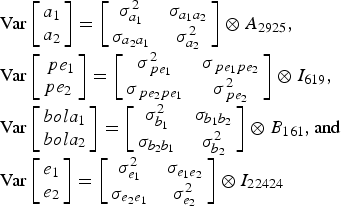
(Co)variance structures associated with the random effects were
 $$\eqalign{&{\rm Var}\left[ \matrix{{a_1} \hfill \cr {a_2} \hfill} \right] = \left[ {\matrix{ {\sigma _{{a_1}}^2} & {{\sigma _{{a_1}{a_2}}}} \cr {{\sigma _{{a_2}{a_1}}}} & {\sigma _{{a_2}}^2} \cr}} \right] \otimes {A_{2925}},\cr &{\rm Var}\left[ \matrix{\,p{e_1} \hfill \cr p{e_2} \hfill} \right] = \left[ {\matrix{ {\sigma _{\,p{e_1}}^2} & {{\sigma _{\,p{e_1}p{e_2}}}} \cr {{\sigma _{\,p{e_2}p{e_1}}}} & {\sigma _{\,p{e_2}}^2} \cr}} \right] \otimes {I_{619}},\cr &{\rm Var}\left[ \matrix{bol{a_1} \hfill \cr bol{a_2} \hfill} \right] = \left[ {\matrix{ {\sigma _{{b_1}}^2} & {{\sigma _{{b_1}{b_2}}}} \cr {{\sigma _{{b_2}{b_1}}}} & {\sigma _{{b_2}}^2} \cr}} \right] \otimes {B_{161}}, {\rm and}\cr &{\rm Var}\left[ \matrix{{e_1} \hfill \cr {e_2} \hfill} \right] = \left[ {\matrix{ {\sigma _{{e_1}}^2} & {{\sigma _{{e_1}{e_2}}}} \cr {{\sigma _{{e_2}{e_1}}}} & {\sigma _{{e_2}}^2} \cr}} \right] \otimes {I_{22424}}}$$
for additive genetic, permanent environment, BoLA-DRB3 genotype, and residual effects, respectively. In the above, A is the additive numerator relationship matrix, B reflects the degree of similarity between BoLA-DRB3 genotypes, and I denotes identity matrix; dimensions are put as subscripts. A three-generation pedigree listed 2925 animals.
The B matrix had two alternative structures, each eventually applied in a separate estimation of variance components. One structure was based on the allelic similarity between the genotypes resulting in matrix element values of 0 (no common allele), 0·5 (one allele in common), and 1 (diagonal). The other structure was based on the restriction site similarity (up to 3 similarities per a pair of alleles) giving element values of 0 (no common restriction sites) and then increasingly in steps of 1/6 up to 6/6 (diagonal), were the numerator represents the number of similar restriction sites for a pair of genotypes. No dominance or epistatic effects were assumed.
Variance component estimation was performed using the GIBBS2F90 software (Misztal et al. Reference Misztal, Tsuruta, Strabel, Auvray, Druet and Lee2002) that implements a Gibbs sampling algorithm as described by Misztal (Reference Misztal2008). A single chain of 300 000 samples was run with the first 50 000 samples discarded as burn-in, for both runs. Posterior means were calculated for each variance component and used to compute corresponding variance component ratios. Convergence was determined graphically through inspection of the posterior chain and through the effective sample size of the parameter of interest.
Results and discussion
Animal sample
The average daily milk yield amounted to 29·3 kg (sd = 11·4 kg) pooled across both herds, while the average natural logarithm of SCC was 12·44 (sd = 1·18), which corresponded with around 253 000 of the SCC. Both averages deviate in beneficial direction from the averages found in milk recorded herds in Poland (Polish Federation of Cattle Breeders and Dairy Farmers: http://www.pfhb.pl/images/pdf/wyniki_owub/wyniki_oceny_2014.pdf (accessed 12 July 2015 – in Polish).
The cows were sired by 143 bulls of which 95 had at most three daughters, 37 four to nine, five bulls had 10-20, and six more than 20 (up to 27) progenies. With some 4·3 daughters/sire on average and due to the fact that only around 13% of the dams had more than one daughter, our sample of 619 cows can be considered population representative for a polymorphism study, as it is not dominated by few big families.
BoLA-DRB3 locus
Restriction patterns obtained with three endonucleases (Rsal, BstYI, and HaeIII) yielded 161 genotypes designed of 73 alleles. Naturally, the restriction site similarity approach resulted in a much more dense B structure; the off-diagonal elements summed up to 11 052 (average similarity was 0·43) compared with the sum of 1334 (average similarity of 0·05) in the allelic approach structure.
Along 284 base pairs (267 + 17 of flanking intron) of the BoLA-DRB3 locus (Van Eijk et al. Reference Van Eijk, Stewart-Haynes and Lewin1992), we found 16 restriction sites due to Rsal, seven due to BstYI, and eight because of the HaeIII digestion. Having compiled the up till now information contained in papers reporting study results on the BoLA-DRB3 polymorphism (some of them are cited in the present paper) we found 21 restriction sites sampled by Rsal, seven by BstYI, and 15 detected with HaeIII. A dilemma exists whether the somewhat lower polymorphism found in the current study results from the specificity of the Polish dairy cattle population or, more likely, from the size of our sample. Nonetheless, an ‘average’ restriction pattern samples polymorphic sites within this region much more densely than it is possible (if at all) with a routine single nucleotide (SNP) array (some 50 K), used for genomic selection purposes in dairy cattle. As many cattle are routinely genotyped with such an array, the usage of a routine SNP array could eventually provide much more observations for a study on the amount of variance induced by the BoLA-DRB3 locus, but at least one polymorphic array SNP would be required to sample this locus. In fact, Cole et al. (Reference Cole, VanRaden, O'Connell, Van Tassell, Sonstegard, Schnabel, Taylor and Wiggans2009) scanned the SNP markers for over 5000 bulls with a 38 416 SNP panel and validated quantitative genetics postulation that most traits are due to the contributions of a large number of genes of small additive effect; they confirmed, however, two previously known major genes on BTA6 and BTA14 and revealed few other large effects. BoLA-DRB3, located on BTA23, was not on the list.
Variance components
Variance component estimates resulting from the two studied models are presented in Table 1. Using those estimates, coefficients of heritability for MY and ln SCC were calculated to further assess suitability of our dairy cow sample for population analysis, by comparing the current results with, otherwise very well known, parameters reported in the literature. The present heritability coefficients for MY ranged form 0·22 down to 0·17 and those for ln SCC from 0·12 to 0·09, depending on statistical classification. Within both groups of estimates the standard deviations were decently low – 0·03 and 0·02, for MY and ln SCC. Although (as in the case of the BoLA-DRB3 polymorphism) the estimates remain within the cited ranges for field data, they seem to fall below their typical values. The Polish national breeding programme for dairy cattle assumes heritability coefficients for lactation MY and SCC of 0·33 and 0·32, respectively http://wycena.izoo.krakow.pl/doc/methods_2012_3.pdf (accessed 12 July 2015) but daily performances should have lower heritabilities.
Variance components† estimated with two BoLA-DRB3·2 genotype (co)variance structures for daily milk yield (MY) and natural logarithm of daily somatic cell count (ln SCC)

† se in parentheses.
The variance components themselves are reliably estimated for the three routine: additive genetic, permanent environment, and residual effects (Table 1). On the other hand, the standard errors of variance components due to the BoLA-DRB3 locus, up to seven times higher than adequate estimates, indicate that these solutions are very much incidental. Most importantly, the BoLA-DRB3 locus effect amounts to only 0·003 and 0·006 of the remaining polygenic effect, respectively for MY and ln SCC. Even if the BoLA-DRB3 locus caused variance were narrowed due to a limited animal sample size, it can hardly be expected that the variance would substantially increase if the sample were larger. The magnitudes of the current genetic additive variance components do not leave much space for such an expectation, provided that they are indicative of the possible changes of other variances. A potential simultaneous increase of the polygenic and BoLA-DRB3 variances should not sizably affect their mutual ratio, either.
Conclusion
Since the BoLA-DRB3 locus effect can hardly be distinguished from the polygenic effect when explaining the variance of somatic cell count and milk yield, what would not be expected of a marker locus, its usefulness in selection for SCC and MY of a dairy cow population is doubtful provided that we do not fail to detect the causative genome sites or to properly define traits being the projection of a site.
Supported by the Polish State Committee of Scientific Research. Grant No. N31103731/0685.



