Introduction
Ward round is an integral platform for all key players of the multidisciplinary team (MDT) to communicate the assessment and treatment plan for a patient. The ward round includes the patient and representation from each discipline, including consultant, specialist registrar, ward doctor, charge nurse, pharmacist, occupational therapist, care coordinator and carer. Quality of patient care is reliant on quality of information communicated to health care professionals and relates to information discussed as well as documented in ward round. The value of the ward round is decreased if there is a lack of timely information to make informed decisions. As ward round is one of the key processes to guide patient assessment and treatment, it is vital that its effectiveness is maximised.
Ward round standards have been highlighted by the Accreditation for Inpatient Mental Health Services (AIMS) (Cresswell & Beavon, Reference Cresswell and Beavon2010) and AIMS-PICU (Cresswell et al. Reference Cresswell, Hinchcliffe and Lemmey2010). This includes a full MDT clinical review at least once a week, where actions are fed back to the patient with documentation of this (Cresswell & Beavon, Reference Cresswell and Beavon2010). Care plans reviewed and created in ward round should be based on a comprehensive physical, psychological and socio-cultural assessment, which includes a comprehensive risk and strengths assessment (Cresswell et al. Reference Cresswell, Hinchcliffe and Lemmey2010). It is emphasised that carers should have a clear role in patient care; both AIMS and the Care Quality Commission (2010) have stressed that ward rounds should be facilitated to allow carers to express their views.
PICU ward rounds differ from those in general adult psychiatry in that there tend to be fewer patients with greater complexity and the addition of acute challenging behaviour. If this leads to segregation or seclusion, patient review needs to be different.
It is important to consider the series of related processes which aim to ensure continuity of care and flow of information to and from ward round. This includes a documented daily handover between medical, nursing and other relevant members of the MDT and is highlighted as a minimum standard of care by AIMS-PICU and AIMS (Cresswell et al. Reference Cresswell, Hinchcliffe and Lemmey2010; Cresswell & Beavon, Reference Cresswell and Beavon2010). In addition there are three nursing handovers a day with individual one-to-one patient sessions.
A review of the literature revealed no other clear standards of what ward round content should be and no indicators of quality and safety. The only statement in AIMS (Cresswell et al. Reference Cresswell, Hinchcliffe and Lemmey2010; Cresswell & Beavon, Reference Cresswell and Beavon2010) indicates that managers and practitioners should have agreed standards for reviews and ward rounds.
One key process to improve effectiveness of a ward round is lean methodology. The core principle of lean methodology looks at removing activities that do not add value to patient well-being, like duplication, and ensuring reliability with standardisation. Jones & Mitchell (Reference Jones and Mitchell2006) highlighted the fact that in most organisations there is at least nine times more non-value added activity than there is work that actually meets patient needs.
At this stage it is useful to highlight some of the main processes, which some readers may not be familiar with. The core principle of lean methodology, originally used in industry, is to maximise customer or patient satisfaction and value. Lean philosophy focuses on three key issues: involvement of everyone, continuous improvement and elimination of waste. A lean system is created by a range of processes including process mapping or value stream mapping.
Process mapping, or flowcharting, is a tool used to understand, analyse and document processes and activities in an organisation and assist in identifying opportunities for improvement. It displays the sequential steps involved in converting a specific input into the required output. This is done in order to see whether steps are useful, wasteful or need improving, and then put actions in place to make improvements. A value stream map is the same as a process map but additionally distinguishes between value adding and non-value adding activities. It includes mapping the process (‘current state map’), diagnosing problems and suggesting changes to make a future state that represents a ‘future map’. Changes are then implemented and tested.
Cost benefit analysis is a tool used to list and prioritise challenges and solutions. It is useful when there is not enough time or money to implement all solutions at once. A solution or area for improvement is rated by a team consensus into four quadrants on a chart: low cost but high benefit; low cost and low benefit; high cost and high benefit; and high cost but low benefit.
A stakeholder analysis involves identifying everyone who has a stake in the change you are trying to make, including people internal and external to the organisation; for example, consultant and patients. One then identifies what level of power and influence the individual stakeholders have over the project and what level of interest they have. The aim is to fully engage and satisfy those with the highest power and highest interest. Conversely those with low power but high interest would need to be adequately informed.
Recent studies in other specialties, such as acute medicine and surgery, have concluded that using checklists reduces morbidity and mortality rates significantly in surgery (Haynes et al. Reference Haynes, Weiser, Berry, Lipsitz, Breizat, Dellinger, Herbosa and Joseph2009). Using a checklist for ward round has encouraged and enabled documented evidence of high quality and safe medical care. Anecdotally it has improved team working, communication with patients, team satisfaction and patient satisfaction (Herring et al. Reference Herring, Desai and Caldwell2011). This can be easily applied to a psychiatric setting. The use of set checklists and daily check sheets has been proven to increase the use of best practice which has subsequently improved quality of care and outcomes (Berenholtz et al. Reference Berenholtz, Milanovich, Faircloth, Prow, Earsing, Lipsett, Dorman and Provenost2004).
Aim
The aim of this project is to improve patient experience and quality of the ward round including reliability of the process.
Specific outcome measures
1. An improvement in patient experience measured by staff and patient objective questionnaire.
2. Improvement in the reliability of the ward round with staff clarity about their roles and responsibilities, goals for discharge, information coming out of the ward round and information coming in, measured by objective staff questionnaire.
3. Improved quality measured by more reliable information being brought to ward round with 100% of the key tasks carried out as per checklist to make informed patient management plans as an MDT.
4. 100% of patients to have comprehensive plans including bio-psycho-social domains, objectively measured by the checklist.
Method
The Productive Mental Health Ward is a module from the Institute for Innovation and Improvement which has provided a framework to guide an improvement program for ward rounds which incorporates some of the lean processes (http://www.institute.nhs.uk/quality_and_value/productivity_series/the_productive_mental_health_ward.html).
This project was set up on an all female 10-bed PICU at the Maudsley Hospital, South London and Maudsley NHS Foundation Trust. Quality improvement measurements were taken at different time intervals over a period of 25 weeks.
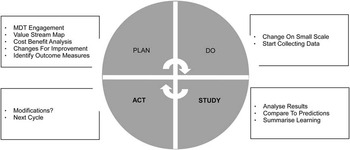
A plan-do-study-act (PDSA) cycle was used as a tool for quality improvement and is adapted from Langley et al. (Reference Langley, Moen, Nolan, Nolan, Norman and Provost2009) as highlighted in Figure 1. This cycle is repeated to ensure continuous improvement.
PDSA cycle

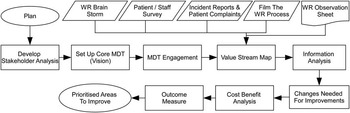
Development of the plan is highlighted in Figure 2. This incorporates more in depth methodology generated from patient and staff surveys and creation of a process map.
Initial plan phase of PDSA

Patient and staff surveys
The purpose of the surveys was twofold: firstly, to ensure that as many staff as possible were involved in the creation of the process map; and secondly, to measure staff and patient opinion before and after general changes to the ward round. Staff members were asked to give formal feedback using an online anonymous survey tool asking a series of questions. A five point Likert Scale was used for the answers. Patient feedback was sought by developing a questionnaire with six questions, both quantitative and qualitative in nature, in relation to satisfaction with ward round. The questionnaire was disseminated at the daily community group.
Analysis of information to create a value stream map
Information gathered about ward round was then presented and reviewed by the team including all of the inputs to the process map as recorded above. The team wrote down each step of the process, looking at before, during and after ward round to create a value stream map. This included a future map of what ward round should ideally look like.
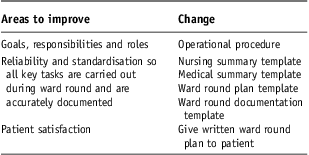
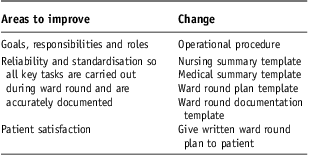
The value stream map and a cost benefit analysis highlighted key areas for improvement, as listed in Table 1. The templates for the nursing summary and ward round plan mirror the items in the checklist.
Changes needed that will lead to improvements
The ward round observation sheet highlighted what tasks were carried out during ward round. After discussion with the core team, a checklist was created with key tasks that the team wanted accomplished (Box 1). The checklist was used as a measure of key tasks carried out including information presented for nursing and medical staff, and key areas of care planning that are covered. This relates to the reliability of information coming into ward round and the reliability of plans generated.
Checklist key tasks
Nursing checklist
• Mental state and behaviours
• Medication compliance and side effects
• Psychiatric observation level and rationale
• UDS/pregnancy test
• Social issues
• Sleep/diet/toilet
• Risk incidents
• Legal and criminal issues
• Patient and family views
• Physical observations (vitals)
Medical checklist
• Admission summary
• Mental state
• Physical investigations
• Physical health and side effects
• Assessment of capacity and consent
• Drug chart updated
• Diagnosis
Other
• Pharmacy feedback (medication review)
• OT feedback
Ward round plans
• Medication
• Physical health
• Risk observation and targets
• Transfer (goals) or discharge
• Legal (MHA) and criminal
• Social
• Occupational therapy
• Psychology
Measuring significant change
A time series graph was used to measure significant change in key tasks being performed during ward rounds. A shift shows that the outcome measure in question has moved to a different level that is statistically significant. The median for all available data points is necessary to identify a pattern as a shift and requires at least six data points on one side (above or below) the median line (Lloyd, Reference Lloyd2004). These rules are based on probability theory, which means that the likelihood of meeting the criteria for any one of these rules is less than 5% without any significant change being made to the process (Provost & Murray, Reference Provost and Murray2007). In other words, if the rule above is detected in your data, it is 95% likely that there was statistically significant change to the process you are studying.
Results
Vision
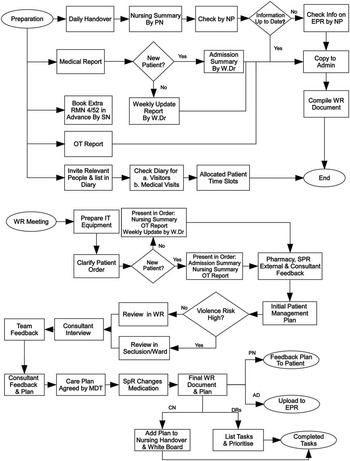
The vision created by the core MDT including the consultant, ward manager, team leader, senior doctor and all nursing staff during the brain storm stage (Fig. 3), was that ‘The ward round is a crucial collaborative MDT process, where information is shared in a timely manner to deliver an effective and reliable treatment plan. Each individual in the MDT takes responsibility for creating an effective patient centered treatment plan, which is coordinated by the primary nurse’.
Process map generated by the MDT; abbreviations: AD – admin; CN – charge nurse; EPR – electronic patient record; NP – nurse presenting in ward round; OT – occupational therapist; PN – primary nurse; SN – senior nurse; SpR – senior doctor; WDr – ward doctor; WR – ward round;

Patient and staff perception of ward round improvement
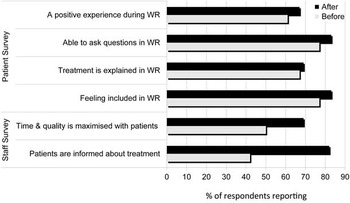
Figures 4 and 5 summarise data collected from the online staff survey and paper patient survey. They are a snapshot of the improvement process and illustrate the position before the process had started, and after the ward round changes (Table 1) had taken place. The same population of 20 staff was used before and after with a total of 15 respondents in each group. As there is a high turn over on the PICU it was not possible to get the same patient population for the patient survey; there were 13 respondents before and 12 responders after the ward round changes.
Patient experience chart

Staff perception of quality chart

There was an increased percentage of respondents reporting improvements across all parameters from the patient and staff surveys. The most marked increase of 95% was for patients being informed about treatment.
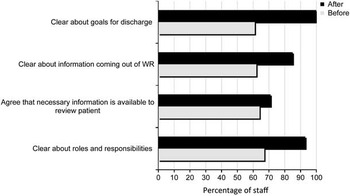
Figure 5 illustrates the reliability of ward round. This includes measures of staff perception of the four domains of: staff being clear about: goals for discharge; information coming out of ward round; their roles and responsibilities in relation to ward round; and those who agree necessary information is available to review the patient.
Figure 5 shows an increase of 50% for staff being clear about goals for discharge, 40% more staff being clear about information coming out of ward round and 40% more staff being clear about their roles and responsibilities in relation to the ward round. There was an increase of 11% in the number of people agreeing that all necessary information is available to review patients.
Reliability of ward round measured by the checklist
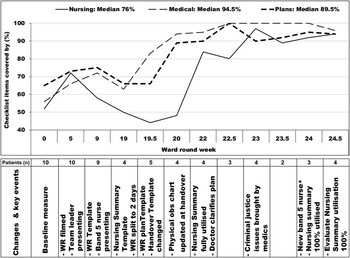
Figure 6 highlights the percentage of items that are carried out during the ward round measured by the checklist (highlighted in Box 1). There are 6 data points above the median from week 22 for all nursing, medical and plan key tasks, representing a significant shift. This means that after this week there was a significant increase in the percentage of checklist items carried out. The checklist measure also highlighted key areas which needed improvement including physical and legal information.
Time series graph of key checklist items covered in ward round; *band 5 nurse is any junior or senior registered mental health nurse who is not team leader

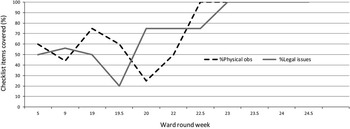
Figure 7 illustrates the upward trend as an increase in percentage of both information on physical observations and legal issues including the mental health act, section details and criminal justice issues brought to the ward round from week 20.
Physical observations and legal issues brought to ward round chart

Discussion
Embracing the tenets of lean methodology, including involvement of everyone and continuous improvement, has led to effective processes and elimination of waste. Involvement of everyone was effected by the use of patient and staff surveys which ensured engagement of all key stakeholders.
The use of weekly nursing and medical summary templates has improved the reliability of information coming into ward round and the number of key tasks being carried out. The use of a ward round plan template containing key tasks has ensured that patients have fully comprehensive plans. The templates mirror the key tasks highlighted by the checklists so that the process is sustainable and standardised. This fits with prior research showing that checklists enable documented evidence of high quality and safe comprehensive medical care (Herring et al. Reference Herring, Desai and Caldwell2011) and ensures that all domains are covered during ward round including, for example, the legal and physical issues that can be missed otherwise.
On analysis of the key nursing tasks carried out for ward round (listed in the checklist in Box 1), at the start the percentage was relatively high, being carried out by a single team leader, most likely reflecting more experience. The process map highlighted that this was unsustainable and a systematic standardised approach was needed, leading to the development of a nursing weekly summary template. At first this did not increase the number of key tasks carried out, so another PDSA cycle was done. In order to highlight the use of the nursing summary, a standard operating procedure was created from the work on the process mapping. This was likely to have engaged staff and made them aware of the need for the nursing summary and how it fitted into the whole process, but was not enough to ensure reliable information was brought to ward round. At this stage several nurses were reporting time pressures, resulting in some resistance to completing the nursing summary. A new handover document was subsequently devised following discussion with nursing staff and led by the team leader. This incorporated the nursing template, so that summaries were updated daily, enabling nursing staff to look through the handover document only rather than the whole electronic record. As soon as the nursing weekly summary was fully utilised by all staff there was a clear increase in nursing tasks completed for ward round.
On prior PDSA cycles the checklist highlighted specific areas that needed further improvement including documentation of physical observations. A PDSA cycle was done with staff involved and led to a change of bringing observation charts to be checked and updated in nursing handovers. Similar PDSA cycles were done to further improve information coming to the ward round. Clear timely feedback was given to staff in order to maintain motivation and instruct changes.
Overall, both doctors and nursing staff using the templates became clear about what information it was necessary to obtain and communicate to generate effective management plans. This reduced waste by reducing duplication (checking on information) and time taken on finding and compiling information. This also ensured that the necessary information was available in a timely manner in order to make informed patient management decisions.
In relation to patient experience, more staff reported that time with patients was maximised, and that patients were well informed about their treatment during ward rounds. This may relate to the more comprehensive plans developed and the anecdotal increase in direct patient time. There was less marked change in the numbers of patients than staff reporting improvements. This may relate to staff being more objective of the overall change as there were different patient groups surveyed before and after the changes. The severity of their illness may have precluded patients from quantifying the extent of change. The staff group was more representative of the population studied as it included all staff that attended ward round.
Although we have used the traditional ward round setting in this study, there may be more lean patient, carer, MDT approaches. This may include having the consultant interview outside the ward round, which may further streamline the process. The overall process and the tools including the checklists can still be applied in other forums.
Limitations
Firstly, conducting research on a local ward level limits the sample size for both staff and patient surveys. Therefore it would be useful to replicate the study across all four PICUs in the trust to gain more significant results. In addition the average short length of stay meant that the population being surveyed before and after changes was different, which may limit the survey results.
Secondly, during the study period there were two possible confounding factors: a new consultant was appointed and the ward round was split into two half days. However, the study accounted for these with the aid of the time series graph. The consultant was appointed before the improvement process took place limiting the confounding, although there were many other changes in processes running concurrently. Splitting the ward round allows more time and space for preparation, which could increase the key tasks being completed for ward round, however when this was started there was no improvement in the number of key tasks. This only improved when nursing summary templates and ward round plan templates were fully utilised.
Thirdly, although patient surveys were carried out, the time restrictions and a fast patient turnover limited a more extensive survey of patient views. A more in depth patient survey at the point when patients were ready for transfer to the open ward may have generated more lean processes and improved the overall process even further.
Conclusions
In summary, there was a clear increase in key task completion for the ward round reducing errors that human factors produce, by using templates as sustainable checklists. It was clear that the use of the templates alone does not improve performance but is an aid to a systematic approach, ensuring key tasks are performed at ward round. A series of additional processes ensured that the flow of information in a timely manner, including the use of handover as a checking mechanism and a source of summarised information to use for the weekly nursing summary. It is important to highlight that the ward round is multifaceted and involves many related processes for its effective running. This relates to the flow of information and relies on the accurate daily documentation of mental state, physical, family and social, legal, therapeutic and risk issues.
In order to sustain these gains and continue improving the process it is crucial that a permanent member of staff is involved in co-facilitating improvement projects as well as handing over to respective key drivers for change. To ensure this, it is important to engage key staff including the ward manger and team leaders from the start. In addition, clear documentation of the improvement process will ensure sustainability and allow testing of similar changes elsewhere.
The improvements in the reliability of ward round have laid down foundations for the building blocks of the next step to guarantee the validity of information. A major challenge that the process mapping has highlighted is that the daily documentation process limits the information that comes to ward round. Therefore, further work is necessary to ensure that medical and nursing one-to-one entries and risk information are accurately documented and seamlessly link with both the handovers and weekly summaries. There is potential to capitalise on electronic patient records as these are rarely used to maximise the effectiveness of documentation and minimise duplication. Improvements were also started on the process of information leaving ward round to ensure clear documentation of assessment and production of clear plans. This will enable the ward round plan tasks to be effectively carried out.
Finally, it would be useful in future projects to measure additional outcomes that were beyond the scope of this project. These measures could potentially include ward round time, length of stay and number of violent incidents, which eventually should decrease in relation to the quality improvement changes.