High-purity white kaolin mining reserves have become increasingly scarce. Therefore, processes have been developed to remove the contaminants from kaolin, such as sulfur, titanium, iron and heavy metals, among others. These impurities give kaolin undesirable properties for the ceramics, paper, paint, food and pharmaceutical industries: pollutants favour cavitation in the ceramic process, increase hardness, cause abrasion and give kaolin various shades of colour from off-white to red.
Treatment processes focus on eliminating these contaminants in addition to quartz. The main methods for bleaching kaolinite are wet treatments, such as flocculation with polymers, chemical solubilization, extraction and washing (Bloodworth et al., Reference Bloodworth, Highley and Mitchell1993).
Therefore, new methodologies have been developed for the removal of these contaminants (Bloodworth et al., Reference Bloodworth, Highley and Mitchell1993; Li et al., Reference Li, Jiao and Zhou2013), such as flotation (Maynard et al., Reference Maynard, Millman and Iannicelli1969; Raghavan et al., Reference Raghavan, Chandrasekhar, Vogt and Gock2004), chemical treatment by chlorination (González & Ruiz, Reference González and Ruiz2006), treatments with inorganic acids (Hernández-Hernández et al., Reference Hernández-Hernández, Legorreta-García, Hernández-Cruz and Bedolla-Jacuinde2015), organic acids (Ma & Li, Reference Ma and Li2006), organic bases (Pentrák et al., Reference Pentrák, Madejová and Komadel2018) and reducing agents (Panzhong et al., Reference Panzhong, Tao, Haiman and Jingsi2010), microbiological treatments (Shelobolina et al., Reference Shelobolina, Pickering and Lovley2005), thermal processes (Chen et al., Reference Chen, Zhou, Alshameri, Zhou, Ma, Sun and Yan2014), magnetic methods (Li et al., Reference Li, Jiao and Zhou2013) and electrochemical techniques (Lu et al., Reference Lu, Zhu, Jiang, Huang and Jiang2006; Flores-Segura et al., Reference Flores-Segura, Reyes-Cruz, Legorreta-Garcìa, Hernández-Cruz, Veloz-Rodríguez, Pech-Canul, Leal Cruz, Rendón Angeles and Gutiérrez2012).
Note that the apparatus for the kaolin-whitening process was registered in intellectual property offices in 1806 (Langenbeck, Reference Langenbeck1908). Only mechanical treatment and separation processes were considered to generate adequate particle sizes. Chemical treatments were later incorporated, including washes in water and hydrogen sulfide to separate contaminants such as iron sulfide from kaolin. The most commonly used technologies include the chemical processes of whitening kaolin (Forbus et al., Reference Forbus, Gantt, Willis and Young1993; Yildirim et al., Reference Yildirim, Pruett and Meizanis2012; Yin & Huang, Reference Yin and Huang2013; Li, Reference Li2014; Wang et al., Reference Wang, Li, Chen, Lv, Leng, Xiao and Wang2021), chemical–heat treatment (Shengwu et al., Reference Shengwu, Yujuan, Jiang-feng, Baojun, Yan and Bainian2012; Yijun et al., Reference Yijun, Bin and Jing2012), thermal methods (Berube et al., Reference Berube, Babiec, Phillip-Jameson, Negele and Willis1990), use of ion-exchange resins in solution (Thompson, Reference Thompson1982) and exchange columns (Yishui et al., Reference Yishui1989).
Our research group developed a kaolin-whitening technology (Flores-Segura et al., Reference Flores-Segura, Reyes-Cruz, Pérez-Bueno, Lozada-Ascencio and Legorreta-García2017) which uses an electrochemical technique and has filed for a patent (Reyes-Cruz & Flores-Segura, Reference Reyes-Cruz and Flores-Segura2015). Thus far, this technique has been applied to kaolinites of various origins, such as Veracruz, Hidalgo and Michoacan, which have the most important reserves and greatest variety in Mexico, considering the various concentrations of polluting iron producing kaolinites with whiteness indices of between 70 and 90 (Reyes-Cruz & Flores-Segura, Reference Reyes-Cruz and Flores-Segura2015; Flores-Segura et al., Reference Flores-Segura, Savadogo, Oishi, Reyes-Cruz and Veloz-Rodríguez2016, Melo-López et al., Reference Melo-López, Veloz-Rodríguez, Reyes-Cruz, Urbano-Reyes, Cobos-Murcia and Legorreta-García2018).
Furthermore, the process of iron mass transfer towards the electrode surface (Flores-Segura et al., Reference Flores-Segura, Savadogo, Oishi, Reyes-Cruz and Veloz-Rodríguez2016), the use of various dispersants (Reyes-Cruz & Flores-Segura, Reference Reyes-Cruz and Flores-Segura2015) and the effect of applying ultrasound waves during the whitening process have been studied (Melo-López et al., Reference Melo-López, Veloz-Rodríguez, Reyes-Cruz, Urbano-Reyes, Cobos-Murcia and Legorreta-García2018). The kaolin-whitening technology has been negotiated with companies interested in its application in Mexico, and bench-scale and pilot-scale tests have been conducted under natural conditions as part of the technology transfer of the recent patent filing for the apparatus for bleaching kaolin (Reyes-Cruz et al., Reference Reyes-Cruz, Cobos-Murcia, Veloz-Rodríguez, Melo-López and García-Hernández2017). The industry's interest in this technology is attributed to the potential competitive advantages it could bring, such as the specificity of magnetic bleaching, which is set by the fraction of the iron present as a contaminant; the use of fewer reagents than chemical bleaching; and the high costs of ion-exchange processes. However, the technology is still being adapted and conditioned under real operating system conditions.
Therefore, for the reactor-scale process of the device, the geometry, operating conditions, cost and quantity of materials have been evaluated (Nadebaum & Fahidy, Reference Nadebaum and Fahidy1980; Walsh & Reade, Reference Walsh and Reade1994). An electrochemical reactor was also used to assess factors such as the electrochemical potential and the electric current limit (Houghton & Kuhn, Reference Houghton and Kuhn1974; White et al., Reference White, Bain and Raible1983; Bisang & Kreysa, Reference Bisang and Kreysa1988; Li, Reference Li2017) as well as the distribution of both of these factors, which allowed for reductions in manufacturing costs to be realized (Nadebaum & Fahidy, Reference Nadebaum and Fahidy1980; Sulaymon & Abbar, Reference Sulaymon, Abbar, Kleperis and Linkov2012). Such work improved the removal of iron and so the whiteness of the kaolin obtained.
Computer-assisted engineering using numerical methods is a helpful tool for studying the geometry of electrochemical reactors (Rodríguez-Morales et al., Reference Rodríguez-Morales, Montes-Rodríıguez, Luna-Bustamante, Balderas-Puga and Luna-González2020). In some cases, the contribution of mass transport can be ignored (Liu et al., Reference Liu, Wainright, Huang and Savinella2004) to optimize geometries and the position of the electrodes and the separators (Lee & Selman, Reference Lee and Selman1982). In addition, a numerical analysis has been conducted to study the behaviour of kaolinite during treatments for electrokinetic remediation. The transport of pollutants through solid kaolin has been studied using various gradients of the electric potential (Yustres et al., Reference Yustres, López-Vizcaíno, Sáez, Cañizares, Rodrigo and Navarro2018). Fluid dynamics in separator hydro-cyclones have also been analysed, which has improved our understanding of the transport and separation mechanisms of the contaminating particles (Cullivan et al., Reference Cullivan, Williams and Cross2003). Note that the hydro-cyclone has been the most studied purification process (Lim et al., Reference Lim, Chen, Wang and Wu2010). A separation study has also been carried out using magnetic gradients and analysing the diffusion of pollutant particles (Okada et al., Reference Okada, Mitsuhashi, Ohara, Whitby and Wada2007). The flash-calcination process has also been simulated in which the temperature and time values were optimized to avoid the conversion of kaolin to metakaolin (Teklay et al., Reference Teklay, Yin and Rosendahl2016).
Therefore, this work focused on geometrical aspects, and the electrode array was denoted in this work by modelling the distribution of the electric current and the electric potential. The use of computational tools to justify the geometry change was done with the aim of increasing the amount of electrochemically deposited iron and at improving the bleaching process. In this regard, studying the position and the size of the electrodes used could enable us to use the least amount of material possible to construct such a reactor. Some companies in Mexico are particularly interested in this technology as the reserves of white kaolin are in shorter supply at present than the reserves of kaolin that have contaminants such as iron. The electrochemical bleaching technology developed is currently at a technology readiness level of 7 and has significant potential for industrial applications.
Materials and methods
Geometry studied
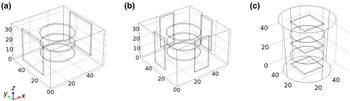
As is shown in Fig. 1, two geometries were evaluated to assess the effect of geometry on the electric current and the electric potential distribution. The geometry in Fig. 1a denotes the original geometry of the device, which has circular cathodes with diameters of 30 cm and thicknesses of 3 mm. The anodes had widths of 20 cm and thicknesses of 2.5 cm. Figure 1b shows the proposed geometry in which the anodes were placed between the cathode discs; it also presents the dimensions of the anodes. Finally, Fig. 1c shows the geometry assessed with the anodes in a parallel position to the cathodes and with the anodes having square geometries of 10, 20 or 30 cm.
Geometries that were evaluated to improve the distribution of electric current density. (a) Original design with two perpendicular anodes. (b) First proposal with four perpendicular anodes. (c) Second proposal with parallel anodes of 10, 20 or 30 cm.

Mathematical model
The electrochemical reaction on the electrodes is considered reversible (Pérez et al., Reference Pérez, Ponce de León, Walsh and Nava Montes de Oca2015) because there is no accumulation of charges in the electrolyte and the concentration gradient is negligible. Hence, uniform conductivity occurs in the electrolyte and at the electrodes. Therefore, it is possible to consider that the primary distribution of electric current density depends only on the geometry of the reactor (Vázquez et al., Reference Vázquez, Rodríguez and Lázaro2012), and the general flow equation can be expressed as in Equation 1:

where φ is the electric potential in the electrolyte concerning the geometrical coordinates, and the distribution of electric current density considers that both the load transfer and the mass transport conditions are negligible because the ohmic resistance inside the cell determines the distribution of electric current density. Thus, it is possible to set the electric current values at any reactor coordinates. For the present study, the above considerations allow us to assume that it is possible to establish the distribution of electric current density in the electrolyte inside the reactor.
The primary and secondary distribution of electric current density simulations were performed considering the data presented in Table 1 under stationery and convection conditions. These conditions were established through the experimental conditions obtained during the kaolin-bleaching process at the laboratory level (Melo-López et al., Reference Melo-López, Veloz-Rodríguez, Reyes-Cruz, Urbano-Reyes, Cobos-Murcia and Legorreta-García2018).
Parameters used in the numerical simulation.

The electric current density (j) was determined at any point in the reactor according to Ohm's law by the local electric potential gradient, where k is the conductivity of the electrolyte, which describes the distribution of the electric current and potential in the electrolyte, depending on the electrochemical potential imposed on the reactor (Equation 2). This is calculated throughout the geometry using the Laplacian operator (∇) on the function that represents the electric potential (φ) as a scalar field:

In addition, the other walls that were not electrodes were considered to be insulating, and so no electric current flow occurred; here, ξ denotes the typical surface condition (Equation 3). In the case of the kaolin-bleaching reactor, this mainly represents the walls that contain the kaolin emulsion to be bleached but that do not participate in the electronic exchange.

In contrast, processes that depended on electronic transfer, such as conditions in the electrodes and the electrochemical reaction on the electrode, were considered only in the secondary distribution because the charge transfer and the concentration gradient were considered negligible during the reactor operation.
Therefore, species concentrations were similar at the electrode–electrolyte interface and in the electrolyte bulk. The electric current density was determined from the local electrochemical overpotential in the electrode (η), which is expressed as the difference between the imposed electrochemical potential (E imp) and the electric potential of the solution at the interfacing electrode (φ), as in Equation 4:

Accordingly, the Tafel approximation determines the magnitude of the electric current density. Here, j 0 is the exchange electric current density and b c is the Tafel slope (Equation 5), which is associated with the amount of iron deposited on the cathode surface and, therefore, was removed from the kaolin emulsion.

Under controlled charge-transfer conditions, the electrochemical reaction followed Tafel kinetics on the working electrode (Equation 6). This condition was possible for the reactor operation as the process was carried out via forced convection through rotating-disc electrodes.

Moreover, the electric current density applied at the anode was considered constant (Equation 7) as the reactions on the anode surface were mainly the hydrolysis of water for the evolution of oxygen:

where j ave is the average electric current density at the cathode and A c and A a are the area of the cathode and the area of the anode, respectively. Obtaining the area and positions of the electrodes was the objective of the evaluation using numerical methods to improve the distribution of electric current density in the geometry of the reactor.
The average electric current density was the same as the electric current applied between the cathode and the anode. However, the distribution of electric current density was not uniform even when the anode electric current was considered constant. Moreover, the changes in the distribution of electric current density at the cathode were negligible (Low et al., Reference Low, Roberts and Walsh2007). Therefore, simplifying the boundary condition allowed us to maintain a fixed electric current density at the cathode (Pérez et al., Reference Pérez, Ponce de León, Walsh and Nava Montes de Oca2015). Thus, the average electric current density could be calculated using Equation 8, with the electric current imposed between the cathode and the anode:

Note that the present study aimed to improve the operation of the reactor by optimizing the geometry and position of the electrode. The concentration of iron on the surface electrode was constant because of the convection contribution caused by the rotation of the electrode, as this maintained a constant angular velocity and allowed laminar flow to occur.
Simulation
The theoretical analysis of the primary distribution of the electric current and the potential of the geometries sketched (Fig. 1) was carried out using an approximation of the Laplace equation (Equation 2) at any point inside the reactor; the approximation was determined from the gradient of the local electric potential using the software COMSOL Multiphysics® 3.5 in a WorkStation Dell® Inspiron 20 model 3048 series with Intel® Xeon™ Silver 4116 and two processors with 2.10 GHz and 256 GB of RAM. For this analysis, a mesh was constructed that considered the geometry of the electrode, including ~6 × 10⁵ total elements and 3.7 × 10⁴ contour elements.
The analysis was carried out to determine how many electrodes the reactor needed. First, this value was obtained with two electrodes (Fig. 1a) according to the original design and the first proposal, and then using the second design with four electrodes (Fig. 1b), the latter electrodes being half the size of the electrodes in the two-electrode array.
However, this first proposal only reduced the amount of material necessary for the construction of the reactor. Therefore, the position changes of the anode were evaluated using a parallel cathode instead of the original perpendicular cathode position. Similarly, the effect of anode size was analysed by considering anodes with square geometries of 10, 20 or 30 cm (Fig. 1c).
Experimental validation
The kaolinite suspension was prepared using 30 kg of kaolin in 230 L of drinking water. Subsequently, oxalic acid (H2C2O4) at 1 M and 0.5 kg of sodium silicate were added at a concentration of 0.45% (m/v) as a dispersant to improve the homogeneity of the suspension, and the solution was stirred at 800 rpm for 30 min using the cathodes (rotary disc) of the same apparatus to promote the hydrodynamic force.
A suspension of kaolin was used as the electrolyte. The electrodes were connected to a power supply, namely BK Precision model 1796, while two multimeters were connected between the power supply and the reactor to measure the electric current and the cell electric potential of the reactor. To verify the results obtained through the simulation, a prototype reactor was used for the whitening process with the geometry changes obtained from the simulation, for which discs were used as anodes with diameters of 30 cm. Furthermore, a power source was used in a two-electrode arrangement, imposing on the reactor a constant cell electric potential of 4 V, and we recorded the electric current values obtained. The electric potential imposed was established according to the results of Flores-Segura et al. (Reference Flores-Segura, Reyes-Cruz, Pérez-Bueno, Lozada-Ascencio and Legorreta-García2017) under laboratory conditions and during the escalation process as expressed in the registered patent. The electrochemical system consisted of four brass discs with diameters of 30 cm each as the cathodes and four graphite sheets of 30 cm per side and 1" thickness as the anodes.
The X-ray diffraction (XRD) analyses of the treated kaolin were carried out in an Inel model Equinox 2000 instrument with a cobalt source. Whiteness was measured using an Ocean Optics USB 4000 spectrometer and conductivity was measured using an ORION Thermo Scientific-brand potentiometer using a 013010MD conductivity cell. In addition, deposits on the surfaces of the cathodes were compared between the perpendicular and the parallel arrays using the image analysis software OriginPro 2022 version 9.9, which generated an image profile plot for the image data analysis. The image data were transformed into greyscale images or 8-bit colour images, and the minimum and maximum values for each bit of the image were determined and recorded within a matrix; a radial line was selected for the deposit thickness analysis. Finally, the data profile obtained was normalized and compared.
Results and discussion
Number of anodes in a perpendicular position
At the laboratory level, the reactor only had a single disc as the cathode and one or two plates as the anodes, placed on the sides of the reactor (Fig. 2a), whose geometry was analysed. Therefore, to improve the efficiency of the process at the pilot plant level, it was necessary to evaluate other geometries because the distribution of electric current density (Equation 1) affected directly the quantity of iron deposited on the electrode and, thus, the whitening process.
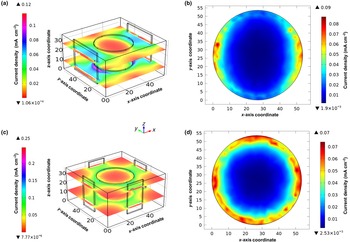
Geometry with four anodes in a perpendicular position. (a) Surface of the distribution of electric current density and surface of arrows of electric current density in the x–z plane. (b) Surface of the electric distribution of electric current density in the x–z plane. (c) Normalized distribution of the upper and lower walls of the cathodes in the x–z plane. (d) Normalized distribution of the anode wall in the x–z plane.

Therefore, the following was evaluated as the first alternative: a reactor with four relatively small-dimension electrodes. Figure 2 compares the distributions of electric current density in the electrolyte and on the surface of the appliance when using arrangements of two (Fig. 2a,b) or four (Fig. 2c,d) electrodes in the perpendicular position.
The distribution of electric current density was direct only near the cathode and the anode. Thus, the most significant distribution of electric current density of the electrolytic solution was found on the edges of the discs (Fig. 2a) with values of ~0.06 mA cm−2, and the rest of the surface disc only had values of ~0.02 mA cm−2.
The most significant distribution of electric current density on the contour disc was observed and was presented as the tangent line of the cathode disc facing the anode (Fig. 2b). While on the sides, where it did not meet the anode, the distribution of electric current density was <10%. Thus, the distribution of electric current density on the anode (Fig. 2b) showed that the maximum distribution of electric current density occurred on the upper edge of the electrode compared to the central electrode region; the distribution of electric current density was ~75% at the upper edge of the electrode, with an distribution of electric current density of 0.04 mA cm−2. While on the sides, the distribution of electric current density was <0.01 mA cm−2, as was reported experimentally previously (Melo-Lopez et al., Reference Melo-López, Veloz-Rodríguez, Reyes-Cruz, Urbano-Reyes, Cobos-Murcia and Legorreta-García2018).
The best distribution of electric current density of the cathode in this cross-section was observed in front of the anode. The distribution of electric current density decreased with increasing distance from the cathode until its value reached 5% on the sides. In addition, the anode demonstrated that its lateral and central regions were more extensive than the distribution of electric current density because of the cathode geometry effect. However, the distribution of electric current density was homogeneous, exceeding a value of 85% over almost the entire electrode length.
In contrast, in the analysis of the geometry with a pair of lateral electrodes, the non-homogeneous distribution of electric current density affected the efficiency of the reactor. Therefore, a change in geometry from the first proposal was considered by placing four separate anodes at every 90° with respect to the disc axis (Fig. 2c). However, to prevent construction costs from increasing, the width of the anodes had to be half of the value for this anode dimension in the first array with two anodes.
The distribution of electric current density in the electrolyte (Fig. 2c) was homogeneous, with values of ~0.06 mA cm−2 at the periphery of the cathodes and reaching 0.08 mA cm−2 in the region near the anodes. The distribution of electric current density on the disc (Fig. 2d) showed that the distribution of electric current density had values of >70% of the electric current over the entire periphery of the electrode. This was in contrast to the findings for the array with two electrodes, where only half of the edge of the disc presented such high values. Note that the distribution of electric current density on the anode was less than that when using two electrodes because of the decrease in the anode width; however, the distribution of electric current density of this four-anode array over the entire surface exceeded that of the two-anode array by 74%.
The results indicated that the use of four anodes could improve the distribution of electric current density. This affected the quantity of iron deposited on the cathode and the whitening process (Equation 2). In the case of the four-anode array, the electric current density doubled, achieving maximum values of 0.12 mA cm−2 at the periphery of the discs and 0.02 mA cm−2 at their centre. However, we observed that the centre of the discs had low distributions of electric current density. In contrast, in the case of two anodes, the distribution of electric current density was mainly focused at the sides of the two discs, whereas in the case of an array with four anodes the distribution of electric current density was increased at the cathode, thereby improving the distribution of electric current density in the other electrode regions and the electric current penetration into the disc.
Change of anode position: from a perpendicular to a parallel array
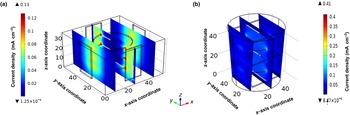
The effect of the anode position in the electrode array was analysed (Fig. 3) using anodes in perpendicular (Fig. 3a) and parallel (Fig. 3b) positions.
Section cutting the x–z plane of the distribution of electric current density in the electrolyte using (a) the array with four anodes in a perpendicular position and (b) the array with anode electrodes in parallel.

The distribution of electric current density was more homogeneous in the parallel than the perpendicular anode arrays; therefore, the distribution in the electrolyte improved significantly with a change in the anode position from perpendicular to parallel because of the closer proximity of the electrodes and their greater surface area, leading to increased amounts of iron deposited. These arrays showed an average distribution of electric current density in the electrolyte of 0.1 mA cm−2, with great values observed in regions near the edges of the discs. Some of the recorded values of ~0.2 mA cm−2 were double those observed in the same parts of the perpendicular array.
However, this array had certain disadvantages because of the number of anodes required, increasing reactor construction costs. Thus, the size of the anodes was evaluated in the parallel array to analyses its effect on the distribution of electric current density.
Effect of anode size
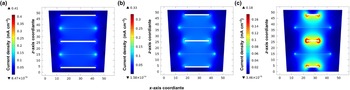
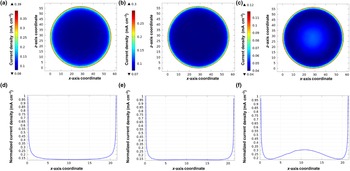
A cut in the x–z plane of the distribution of electric current density within the electrolyte was analysed for three different anode sizes: 30 cm (Fig. 4a), 20 cm (Fig. 4b) and 10 cm (Fig. 4c). The distribution of electric current density was more significant at the edges of the anode as the size of the anode increased. When the anode size decreased, the electric current density was concentrated at the centre of the reactor, decreasing the electric current density at the edges of the cathodes, and the electric current density near the anode reached values of 0.16 mA cm−2. In contrast, the electrolyte regions near the cathode were homogeneous, although there were still regions with greater distributions on the cathodes.
Section cutting the x–z plane of the distribution of electric current density in the electrolyte using anode sizes of (a) 30 cm, (b) 20 cm and (c) 10 cm.

The distribution of electric current density on the cathode surface (Fig. 5) was analysed using the same three different anode sizes: 30 cm (Fig. 5a), 20 cm (Fig. 5b) and 10 cm (Fig. 5c). The cathode showed a greater electric current density at the disc edge (0.35 mA cm−2) and a lower electric current density at the centre (0.10 mA cm−2) when the anode size decreased.
Distribution of electric current density over the cathode using three different anode sizes: (a) 30 cm, (b) 20 cm and (c) 10 cm. Normalized distribution of electric current density of the diametral line of the cathodes using three different anode sizes: (d) 30 cm, (e) 20 cm and (f) 10 cm.

However, near the anode the electric current density reached 0.16 mA cm−2, but near the cathode the distribution of electric current density was more homogeneous. The more extensive anode distribution showed maximum values of the distribution of electric current density at the edges and a value of 0.15 mA cm–2 at the centre of the disc. Therefore, as the anode dimensions decreased, the distribution increased at the centre of the disc, reaching average values of 25%.
Validation of results by evaluation of the metal deposits
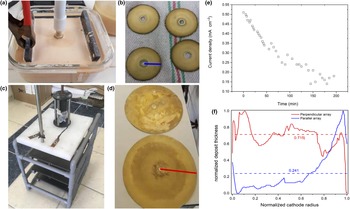
On the basis of the distribution of electric current density results, we could propose improvements to the construction of a pilot-scale reactor by relying on these results to understand behaviour at the electrode surface and not only on the empirical knowledge of the behaviour of the electrochemical system or conjectures regarding the distribution of electric current density in the reactor. The reactors (Fig. 6) at the bench-scale level (Fig. 6a) with 7 cm-diameter electrodes (Fig. 6b) and at the pilot-scale level (Fig. 6c) with 30 cm-diameter anodes (Fig. 6d) were analysed. Furthermore, chronoamperometry was conducted using 30 cm discs (Fig. 6e), and the coating was evaluated through image analysis of the perpendicular and parallel arrays (Fig. 6f).
Validation of electrochemical iron deposits using the cells (a) at the bench-scale level with (b) their respective 7-cm diameter electrodes and (c) at the pilot-scale level with (d) their respective 30 cm-diameter anodes. (e) Chronoamperometry using 30 cm discs and (f) evaluation of the coating via image analysis of the perpendicular and parallel arrays.

The metallic deposit obtained in the laboratory electrochemical cell (Fig. 6b) was thicker at the edge of the disc, displaying the characteristic burn described in electroplating. In contrast, the metallic deposit obtained in the pilot plant (Fig. 6d) was distributed over the entire electrode surface and was proportional to the distribution of electric current density on the surface of the electrode.
The observed burning zone was associated with a great electric current density in the disc region because of its proximity to the anode and the high rate of iron consumption in this region of the disc. The concomitant increase in the rate of reaction resulted in typically disordered and porous deposits. However, a geometry change was implemented during reactor scaling that prevented the occurrence of an inadequate distribution of electric current density and improved the operation of the reactor.
The electric current density curve obtained using the prototype (Fig. 6e) of the electrochemical reactor in a two-electrode arrangement and using a brass disc as a cathode and a graphite plate as an anode was plotted. An electric current density of 0.45 mA cm−1 was reached. This decreased with the modification of the electrode surface until stabilization after 2 h of operation, at which point an average electric current density of 0.15 mA cm−1 was reached. The modification of the cathode surface generated a change in the electrochemical reduction potential of the metal and affected the amount of iron deposited, which was evidenced by the decrease in the electric current density. Therefore, it was necessary to change the cathode or to clean it to refresh its brass surface.
An evaluation of the coating through image analysis (Fig. 6f) of the perpendicular and parallel arrays was carried out. The effect of the geometry of the reactor could be observed as the parallel arrangement of electrodes produced a better distribution of the deposit, which was associated with the distribution of the electric current density on the surface. This represented greater availability of the surface for the recovery of the contaminant, thereby improving the efficiency of the process of kaolin purification, as it was possible to increase the amount of iron removed.
Finally, the effect of the treatment was observed in the decrease of the iron concentration in kaolin (Table 2) and as shown by the chemical characterization results using XRD (data not shown). Similarly, an increase in whiteness after the electrochemical treatment was observed. Note that the process still needs to be optimized in terms of the concentrations of reagents and operation times to improve the whitening of kaolin.
Chemical characterization of kaolin before and after treatment using the electrochemical reactor.

Conclusion
The computational simulation revealed that the geometry of the electrode array of the electrochemical reactor was improved through visualizing the distribution of electric current density. It was possible to demonstrate that a parallel electrode array had a greater distribution of electric current density. In contrast, it was determined that the use of relatively small electrodes would not affect the distribution of electric current density at the electrode edges and would improve the distribution of electric current density at the centre of the disc. It was also necessary to avoid increasing the amounts of materials used to construct the reactor so as to limit construction costs. We achieved a distribution of electric current density of >20% over the entire surface, and regions in the electrode centre had a distribution of electric current density of ~30%. The validation of the deposition process showed that the metallic deposits obtained during start-up and evaluation were better distributed over the whole electrode surface, preventing the formation of areas with low electric current densities and increasing the electroactive area used for metallic deposition.