Introduction
Exú killed a bird yesterday with a rock he threw today. Yoruba saying
Unglued, non-linear temporalities are central to processes of racialization. This complex relation between race and time figures prominently in Ponciá Vicêncio, a novel by Afro-Brazilian author Conceição Evaristo (Reference Evaristo2003). A descendant of enslaved Africans, Ponciá is haunted by her grandfather Vicêncio to whom she bears an uncanny resemblance. Her life as a free young woman is shaped by the deceased Vicêncio's act of insurgence against bondage. In an attempt to end the ordeal of enslavement, Vicêncio assassinates his wife and tries to kill himself by severing his arm. Ponciá's body carries her grandfather's ghost limb as she walks the land to which Vicêncio was tethered by slavery. The protagonist is haunted by plantation memories (Kilomba Reference Kilomba2008) that mold her experience of time not as a chronological sequence of events but, rather, like a spiral (Martins Reference Martins, Ravetti and Arbex2002) along which past and present get enmeshed in embodied and spatial ways.
This kind of temporal implication is given nuance by race scholars who critique the political and subjective infrastructures of what Jamaican philosopher Charles W. Mills (Reference Mills2020) refers to as the Euro-chronometer, that is, the time of white modernity based on historical periodization and sequential progression. According to Mills, this is materialized through Western-centered views of a linear temporal sequence from savagery to barbarism to civilization. Critiquing the idea of temporal linearity, British scholar Paul Gilroy (Reference Gilroy1993:196) explains that the idea of modernity ‘raise[s] the problem of time and time-consciousness directly if not because the issue of where it might be possible to identify a line between the present and the past which constitutes it becomes an integral part of enlightenment understandings of progress and social developments’. Such a view of temporal progress is of a piece with racism—one effect of which is to encapsulate Black and racialized peoples’ spaciotemporal being ‘in but not necessarily of the modern, Western world’ (Gilroy Reference Gilroy1993:29).
In a similar vein, Senegalese philosopher Felwine Sarr (Reference Sarr2019) criticizes the persistence of Western frames of reference in knowledge production. Concerning African studies, he asserts that understanding sociohistorical processes through the lens of progress and development has limited their density and complexity. As a direct consequence of this temporal imaginary, understandings of Africa as uncivilized follow suit. He impugns that the use of categories based on temporal progress such as ‘third world’, ‘underdeveloped’, and ‘developing’ in reference to African countries is an outgrowth of this epistemic domination which is tied to notions of time as teleological. A modern-colonial gaze undermines African people's resilience, tenacity, and creative potential, from the transatlantic slave trade to more contemporary phenomena. Countering dominant views of African cities as underdeveloped and chaotic, Sarr explains that these places require experiences outwith the linear traps of the Euro-chronometer. According to him,
Walking in an African city—Lagos, Abidjan, Cairo, or Dakar—is first and foremost an experience for the senses. … You are immediately captured by the city's rhythm. Vitality, creativity, and energy unfurl in the streets; chaos and order are constantly grappling for space; one is confronted by signs of the future coexisting with the past and the present. (Sarr Reference Sarr2019:3)
Sarr illustrates that rival interpretations of the public space are entwined with temporality. In his analysis, understandings of the public space depend on which version of time gets validated and becomes dominant. This view ties in particularly well with linguistic landscape (LL) scholarship, according to which the ‘public space is never neutral but always somebody's historical space and therefore full of codes, expectations, norms, traditions’ (Kroon Reference Kroon2021:291). Given that conflicting temporal relations shape the public space, Sarr (Reference Sarr2019) argues for an episteme that may forge alternative senses of space and time outside and against the racialized time of linearity, progress, and development espoused by white modernity.
In this article, we follow this appeal with a view to rethinking the concept of chronotope and the timespace relations it projects. Examining the effects of the African diaspora in Brazil, we contend that the experience of radical uprooting it promoted fuses spatiotemporal dimensions that operate in complementary directions. On the one hand, a necrotope, a term we use to refer to the spacetime of death mobilized by the Atlantic slave trade, sets forth an idea of submission and destruction.Footnote 1 Necrotopes also entail visceral resistance that emerges when the timespace of encruzilhadas ‘crossroads’ is actively produced where there are cracks in colonial power. In the cosmologies of Umbanda, an Afro-Brazilian religion, encruzilhadas are places where offerings to deities are made. One of the central deities is Exú who thwarts timespace, as illustrated by the YorubaFootnote 2 saying above. The timespace of the encruzilhada conjures up images of present resilience and resistance that contrast with the withering and extermination wrought by slavery and its lingering legacies.
This article, thus, advocates for a more multifaceted approach to time in the field of linguistic landscape, one that avoids the linear traps of the Euro-chronometer to better understand the built environment as a site that (re)instantiates white modernity and its racialization processes but also provides material affordances for their contestation. We argue that examining the racialization of space and the spacialization of race through the LL requires analysts to attend to what we call, borrowing loosely from Portuguese interdisciplinary artist Grada Kilomba (Reference Kilomba2008), ghostly semiosis, that is, discourses and histories that are at times erased from view, but (in)form meaning, time, signs, and bodies in space. The phantasmagoric nature of the meanings we scrutinize is an outgrowth of the ways colonial histories haunt everyday experiences in former colonies, ‘disrupt[ing] empirical approaches to the study of communication’ (Rosa Reference Rosa2021) due to their invisible character.Footnote 3 Jonathan Rosa goes on to argue that sociolinguists’ obsession with empiricism obscures the colonial histories through which signs emerge and the modes of perception whereby they are apprehended. Analytically, investigating the coloniality that undergirds signs requires attending both to their semiotic materiality and to the immaterial dimensions that anchor possible meanings—an endeavor this article attempts to pursue through an interdisciplinary dialog between two sociolinguists and an anthropologist.
To unpack the ways such ghostly semiosis percolate the LL, we draw on our ongoing research about the memorialization of the Atlantic slave trade in the LL of Pequena África ‘Little Africa’, an area comprised of several neighborhoods that surround the port of Rio de Janeiro. The haunting nature of Rio's colonial history was laid bare by urban renovation projects that aimed to embellish the city for the Olympic games in 2016. Excavations in the area, for instance, uncovered the long-forgotten Cais do Valongo ‘Valongo Wharf’ through which millions of enslaved Africans were forced into the country. These changes in Rio's LL motivated us to record the changing landscape of Pequena África through a walking visual ethnography of the area. Since 2016, we have photographed Pequena África's LL on a regular basis, which allowed us to record the changing nature of its semiosis in an archive of images. Of centrality here is Pedra do Sal ‘Rock of Salt’, a historical and religious site at the symbolic centre of Pequena África, recognized as a quilombo settlement today.Footnote 4 In this article, we scrutinize an subarchive of images taken in 2021 that captures the most recent shape of this historically and multimodally dense part of town. As a ‘fluid memorial intertext’ (Blackwood & Macalister Reference Blackwood and Macalister2020:7), Pedra do Sal has become an epicenter for Afro-Brazilian culture and, notably, memorialization conflicts.
Two antagonist semiotic regimes coexist in Pequena África. On the one hand, the systematic erasure of African heritage in Rio's LL continues to steamroll ahead due to urban modernization projects in the twentieth and twenty-first centuries—a process Fabrício & Borba (Reference Fabrício and Borba2020) have termed regimes of forgetfulness. Simultaneously, Pedra do Sal serves as a vital memory site of countercultural practices that keep stories of Black resistance and survival alive against urban necropolitics (Mbembe Reference Mbembe2019). In fact, the friction between remembrance/visibility and forgetfulness/erasure seems to shape the LL of former Portuguese colonies as Manuel Guissemo (Reference Guissemo, Peck, Stroud and Williams2019) shows in his analysis of memorialization practices in Maputo, Mozambique. In our data, such friction emerges due to grassroots remembrance endeavours that contrast dark memories of the Atlantic slave trade (which hover over Pequena África like ghosts) and vibrant semiotic and embodied resistance practices. As such, Pedra do Sal has its own intricate spaciotemporal dynamics. The semiotic flows we detect demand that students of the LL view chronotopicity from a different epistemic angle, an enterprise that requires a radical rethinking of the way time has so far been conceptualized (or, rather, taken for granted) in the field.
Trails of modernity in LL approaches to time
Emblematized by Rodrigue Landry & Richard Bourhis (Reference Landry and Bourhis1997:25) as ‘the language of public road signs, advertising billboards, street names, place names, commercial shop signs, and public signs on government buildings’, the study of LL has been revitalizing sociolinguistics (Blommaert Reference Blommaert2013). This is mainly due to its interest in place not as ancillary to meaning-making but as integral to it. Interdisciplinary and theoretically eclectic, the field of LL has gradually incorporated tattoos (Peck & Stroud Reference Peck and Stroud2015), bodies (Milani Reference Milani2015), graffiti (Karlander Reference Karlander2019), sensory experiences (Pennycook & Otsuji Reference Pennycook, Makoni and Otsuji2015; Wee Reference Wee2016), among others. Time and temporality, however, have only recently been brought into the field's analytical remit, mostly due to Blommaert's (Reference Blommaert2013) pioneering work. As Blommaert seems to suggest, LL's inattention to time and temporality is an outcome of the field's focus on the role of semiosis in place-making, but one can hardly eye LL scholars as oblivious to temporal layers of the public space as several studies tap into such dimensions lest marginally.
In fact, time and temporality appear as the background of much LL research. Primarily concerned with the ways globalization thrusts itself into the public signage of urban localities, LL scholars have investigated processes through which English is emplaced and how it interacts (or not) with the local languages. English signs in the public space of cities as diverse as Addis Ababa and Tokyo, for instance, are taken to index (i) the gradual (i.e. temporal) effect of globalization in the localities’ social, cultural, and political configuration, and (ii) their indexical relation to modernity and, thus, to the city's past and present (see Backhaus Reference Backhaus2006; Lanza & Woldemariam Reference Lanza and Woldemariam2014). Due to their interest in the changing LL of globalized cities, scholars have been concerned with time and temporality, however indirectly.
Critiques of the field's inattention to time and temporality as analytical dimensions rather than backgrounds have, however, recently surfaced. Its synchronous view of data has become a bone of contention among scholars who advocate for an ethnographic and historical approach to the LL (Blommaert Reference Blommaert2013), on the one hand, and those who believe diachronicity matters (Pavlenko & Mullen Reference Pavlenko and Mullen2015), on the other. The growing interest in memory and memorialization has also brought the temporal dimension more squarely into the purview of LL scholarship (Ben-Rafael & Shohamy Reference Ben-Rafael and Shohamy2016; Blackwood & Macalister Reference Blackwood and Macalister2020). Whether time and temporality are taken indirectly as the background of change or as central to the analysis of emplaced public memories, research tends to frame them, however unwillingly, within the perimeter of the Euro-chronometer. This is made evident by metaphors such as the ‘arrow of time’ (Prigogine & Stengers Reference Prigogine and Stengers1984), which fractally translate as a ‘sequence of happenings’ (Tufi Reference Tufi2020a:245), showing the direct ‘role of the past in the construction of the present’ (Pavlenko & Mullen Reference Pavlenko and Mullen2015:116). Undoubtedly, past and present are somehow related. Our critique refers to the kind of temporal framework and metaphors one privileges in studying them.
Pervasive in scholarly and lay discourse, metaphors of temporal linearity follow on the heels of modernity, colonialism, and empire. Contemporary understandings of time as a practice shaped by social histories (Moran Reference Moran2013; Bastian, Baraitsen, Flexer, Hom, & Salisbury Reference Bastian, Baraitsen, Flexer;, Hom; and Salisbury2020), however, allow a denaturalization of this view. Often, metaphors of temporal linearity, causality, progress, and development are undergirded by what Mills (Reference Mills2020) refers to as white modernity's chronopolitics. This dominant understanding of time is the result of ‘power relations between groups [that] affect both the representations of the relations between these groups and the world, in their specifically temporal aspect, and the material relation between these groups to the world, in their specifically temporal dimension’ (Mills Reference Mills2020:299). Otherwise stated, the linear narrative structure of settler colonialism in which Europe is better equipped to lead (racialized) others to (white) civilization has been forcefully imposed to the detriment of non-Western understandings of time. In this narrative, Black and indigenous peoples have been either assimilated as inferiors or removed/exterminated from the path of progress. The enslavement of Africans was a constitutive dimension of this chronopolitics; racism is one of its lingering effects.
In this scenario, metaphors and concepts that do not recycle tales of modernity are needed to study the racialization of space and the spatialization of race, underattended dimensions of the public space in LL scholarship so far (see, however, Peck & Stroud Reference Peck and Stroud2015). As Jaspal Singh (Reference Singh2021:208) propounds, ‘if coloniality goes west, decoloniality must go south’. And to paraphrase him: if the Euro-chronometer speeds on a straight route onwards, a decolonial timewatch shall spiral athwart. This is especially the case for research that focuses on the LL of former slaveholding colonies such as Brazil. As is well-documented, the country has tried to erase traces of this historical tragedy from public view on the behest of a flawed narrative of racial harmony (Araujo Reference Araujo2020). The notion of the chronotope has provided LL scholars with a keen analytical perspective to unpeel the way space and time are entwined. Dialogic as it is, Bakhtin's (Reference Bakhtin, Holquist, Emerson and Holquist1981) theory should be adapted to speak more adequately to the historical and geographical specificities of the Global South and the racialization processes that have shaped it.Footnote 5 This adaptation includes aggregating the idea of constant movement to interlocked spacetime. As Gilroy suggests (1993:199), instead of moving forward through the chronotope of a road, one should zigzag through the ‘chronotope of the crossroads in order to better appreciate intercultural [and polytemporal] details’ of the modern-colonial enterprise.
To be sure, recent LL scholarship has advanced new metaphors to deal with chronotopic phenomena, attempting to eschew linear understandings of time and static descriptions of space. Analytical approaches that view the LL as an amalgamation of past, present, and future seem to be gaining ground. Interpreting the LL as palimpsests (de Barboza & Borba Reference de Barboza and Borba2018; Bundl Reference Bundl2020; Starks & Pham Reference Starks and Pham2021) or as polyhistorical multiscalar semiotic assemblages (Milani & Levon Reference Milani and Levon2016; Borba Reference Borba, Peck, Stroud and Williams2019; Lee & Lou Reference Lee and Lou2019; Fabrício & Borba Reference Fabrício and Borba2020; Tufi Reference Tufi2020b) is a fruitful way to escape the temporal linearity of white modernity. In this vein, Sjaak Kroon (Reference Kroon2021:275) argues that such a perspective allows analysts to examine the public space as ‘emerging from the assemblage of historical events, memories, and narratives reflecting these events, often handed down over generations’. This article joins these efforts. Extending recent calls for epistemic renewal in socio and applied linguistics (Pennycook & Makoni Reference Pennycook and Makoni2019; Singh Reference Singh2021), we seek to value knowledge systems and apprehension modes that have been discredited by colonization. To this end, we probe the LL in Pedra do Sal through the timespace of the encruzilhada, which we discuss in the following section.
Unwinding the Euro-chronometer
To illustrate the convoluted relations between racialization and temporality, we turn once again to Evaristo's novel. Ponciá's relationship with her grandfather's embodied spectre unwinds the Euro-chronometer, challenging the ‘arrow of time’ that gives it support and materiality. As Gilroy (Reference Gilroy1993) and Sarr (Reference Sarr2019) posit, viewing time as progress and development re-enacts a violent colonial frame that shackles Black people to ‘uncivilized’ modes of being. Afro-Brazilian scholar Leda Martins's (Reference Martins, Ravetti and Arbex2002) view of the encruzilhada allows LL scholars to understand spaciotemporal relations not merely as a sequence but as a spiral along which past, present, and future are entwined almost indistinctively.
Ponciá's reenactment of Vicêncio's insurgence against enslavement illustrates that racialization processes do not follow a straightforward route. According to Afro-Brazilian sociologist Denise Ferreira da Silva (Reference Silva2019:149–50, original emphasis),
Reverting the arrow of time—the iteration of the what-has-become makes the what-passed possible—violates three onto-epistemological pillars of the theory of knowledge, the theory of being, and the theory of modern practices, namely separability, determinability, and sequentiality, which sustain the idea of linear time and its Ordered World.
Black embodied experiences are shaped by the timelessness of racism. What Ponciá's present body-in-space means is indelibly tainted by her grandfather's past experiences. Ponciá's what-has-become conjures her what-passed. In simpler terms, racialization is a continuous process during which memories of oppression are re-enacted ex integro. In this process, ‘one experiences the present as if one were in the past … the wound of the present is still the wound of the past, and vice versa; the past and the present become interlocked as a result’ (Kilomba Reference Kilomba2008:95). The colonial wound is more than a physical heritage. It is more than mimesis. Instead, it is the material re-actualization and reenactment of colonial discourses in the present—a phenomenon Borba & Milani (Reference Borba and Milani2019) identify as colonial intertexts. Racialized peoples and the meanings attached to them are at temporal crossroads. The past does not simply precede the present but hovers over and lurks behind it. Semiotic processes that racialize space and spatialize race are haunted by such ghostly matters (Gordon Reference Gordon2008) that (in)form one's view of self and movement through the built environment.
For Martins (Reference Martins2003), diasporic Black knowledge and practices are shaped by African, European, indigenous, and Eastern symbolic systems which emerge from multiple crossings (see also Gilroy Reference Gilroy1993). She thus uses the encruzilhada as a spatial metaphor to capture meaning-making practices that spawn from ‘inter- and transcultural processes whereby performances, worldviews, and cosmovisions, philosophical and metaphysical principles, multiple knowledges confront and crisscross one another’ (Martins Reference Martins2003:69). She expounds that ‘in the Nago/Yoruba philosophies as well as in Bantu cosmovisions, the encruzilhada is… frequently represented by images that index the circular movement of the cosmos and the human spirit gravitating around the circumference of its intersecting lines’ (Martins Reference Martins, Ravetti and Arbex2002:73). The encruzilhada emerges thus as a kind of decolonial chronotope, a timespace of crossings, overlappings, and cross-fertilizations at which time moves in non-linear ways.
Instead of following a straight route like an arrow, time gravitates around the encruzilhada; it comes and goes circularly in ways that resemble a spiral and thus acts as a centrifugal force intermingling past-present-future. As Brazilian anthropologist Fátima Lima (Reference Lima2021) explains, such circular crossings forge meanings to a community that shares memories of suffering but persists against their tormentors’ time. Time is thus not viewed as a linear progression along which events are ordered. Rather, Martins (Reference Martins, Ravetti and Arbex2002, Reference Martins2003) argues that past events spiral around, hover over, and lurk behind the present, constituting it in several, often invisible, ways. In such a conception, ‘the primacy of ancestral movements… gives nuance to a spiral temporality in which events, unencumbered from a linear chronology, are in perennial transformation’ (Martins Reference Martins, Ravetti and Arbex2002:84).
Against this background, analysing timespace formations at the crossroads implies acknowledging the sharp contrast between the time of progress and civilization and the timeline of the transatlantic trade. In the shift between Africa and the Americas, one's sense of unity and belonging were lost. Possibilities of communication were suspended. Identity, language, and bonds were disarticulated entirely, and a sense of disorientation prevailed. Continuous anguish battled with the will to survive, both over water and on foreign grounds. Uncertain water streams were the sole material for recreating senses of community and belonging—a type of fluid rootedness, always about to displace itself. Such an oxymoron is constitutive of the timespace of the encruzilhada. The constant drifting of timespace motivates our analytical endeavor. We investigate how myriad signs indexically anchor the experience of Black diaspora on unstable terrain, full of interlacing collective memories. What kind of Afro-diasporic grammar does this anchorage mobilize? How does it craft fluctuating contexts? What kind of epistemic transition do they set forth? We reflect upon these questions as we examine multiple layers of spatiotemporal indexicalities with a view to inspecting both the present materiality of the signs in the LL and the ghostly dimensions that (in)form its temporal emplacement but are nevertheless immaterial.
Chronopolitics in Pequena África
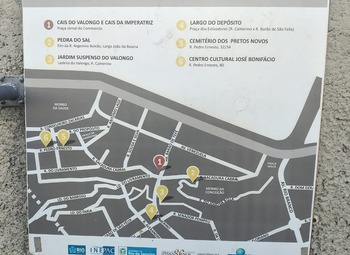
In 2011, while the city of Rio de Janeiro underwent renovations to host the 2016 Olympics, builders stumbled over Cais do Valongo. Buried under layers of modernization ventures, the wharf where more than one million enslaved Africans disembarked in Rio during the eighteenth and nineteenth centuries was accidentally discovered to the surprise of historians and archaeologists who only had faint hints of its exact location. This discovery led the city hall to establish the Circuito Histórico e Arqueológico de Celebração da Herança Africana ‘Historic and Archeological Circuit to Celebrate African Heritage’. The circuit comprises several areas surrounding the city's port around which enslaved Africans and their tormentors circulated (see Figure 1).
Map of the African Heritage Circuit (photo by Rodrigo Borba, 2021).

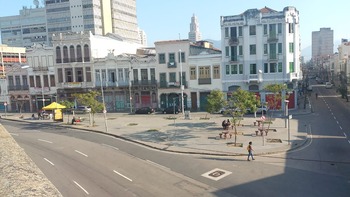
During the eighteenth and nineteenth centuries, Cais do Valongo (1 on the map) was the most important site of disembarkation of enslaved Africans in Brazil. A few blocks westward, one finds the Cemetery of the New Blacks (5) where approximately fifty thousand captured Africans were thrown in an open grave, a repository of the heinous colonial modus operandi. The Hanging Gardens of Valongo (3) were built in 1906 in the area where stock houses for enslaved Africans had stood for decades. When recovered from the horrors of the Atlantic voyage, they were commercialized at the Largo do Depósito (4 on the map). Even though this is an area of historical relevance, little is indicated in public signage apart from a couple of poorly placed plaques. Since the end of the Atlantic slave trade in Brazil in 1888, practices of memorial erasure have attempted to hide its traces in Rio's public space. Figure 2 shows Praça dos Estivadores, formerly known as Largo do Depósito. No official sign tells busy passersby that the ground on which they freely walk today used to be a place where people were sold as livestock should they survive the ordeal of the Middle Passage.
Praça dos Estivadores/Largo do Depósito (photo by Rodrigo Borba, 2021).

One could argue that such practices of memorial erasure and the regimes of forgetfulness they sustain put the time of white modernity in motion, shaping the city's LL. Otherwise stated, keeping the marks of slavery and the African heritage hidden in plain sight helped Rio portray itself as looking into the future (Fabrício & Borba Reference Fabrício and Borba2020). In fact, the friction between remembrance/visibility and forgetfulness/erasure seems to shape the LL of former Portuguese colonies as Manuel Guissemo (Reference Guissemo, Peck, Stroud and Williams2019) shows in his critique of the imperial-colonial Lusophone chronotope in Maputo, Mozambique. However, the discoveries of the Cemetery of the New Blacks in 1996 and the Cais do Valongo in 2011 show that the past reemerges in the present, emphasizing the existing debt toward the African-Brazilian population whose ancestors were enslaved in Brazil. This article focuses on Pedra do Sal (2 on the map), which we view as a crossroad where multiple layers of history, suffering, and resistance get enmeshed. In this area, official regimes of forgetfulness are confronted with grassroots politics of remembrance that conjure up histories of resistance against the progressive linearity of white modernity.
Resorting to ancestral temporalities has been an integral part of Black experiences in the face of threats to existence. In Brazil, such practices are alive in Pequena África and, more specifically, in Pedra do Sal at the foot of Morro da Conceição, a sharp hill near the sea. Because of its location, Pedra do Sal witnessed the formation of a sizeable buying-and-trading slave market. There, after the extenuating transatlantic journey, millions of Africans awaited their doom and the brutal working conditions to come. Many were to be used as human freighters of anchored ships to load or unload heavy bags of produce and spices. Salt, which was used as currency at the time, was sold in this region and carried up and down the slippery, steep hill by enslaved Africans.
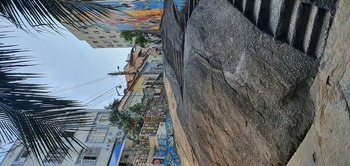
It was not until many years later that steps were cut into the rock (see Figure 3). The staircase was first carved out by enslaved Africans themselves, directly into facoidal gneiss, an abundant stone in Rio. The rigidity of the material and the lack of specialized techniques made the extraction slow and difficult for the bondspeople who were forced to do this excruciating task. Only in the nineteenth century did they start drilling holes in the rock with pointed iron bars, where gunpowder was inserted. This technological advancement did not make the strenuous work any gentler or less oppressive, however. The long hours at the quarry added more hardships to the inhumane treatment. Consequently, suffering, infectious diseases, and deaths were abundant in the area.
Pedra do Sal's staircase (photo by Rodrigo Borba, 2021).

After the human trade became illegal in Brazil in 1888, former slaves continued working in the region. At the turn of the nineteenth to the twentieth century, many Blacks from Bahia and the old plantation areas in Rio de Janeiro also went there looking for work. When they arrived, they built houses, religious centers, spaces for daily life, political and artistic mobilization, and an ever-stronger sense of belonging and community. Gradually, the area became a haven for quilombos and the stage for Afro-Brazilian religious rituals such as candomblé and Umbanda. The region was also considered a sacred place to make offerings in the traditions of African religions, which forged it as an encruzilhada marked by spatiotemporal crossings and cultural overlaps where both loss and life, past and present meet, giving nuance to the necrotopic dimensions of slavery impinged onto this area. It was in this context that samba emerged as a musical genre, gaining visibility throughout Brazil. This Afro-Brazilian chronotopic configuration coexisted in tension with religious rituals of the Portuguese settlers, many of whom were hired by slave dealers to teach the Catholic doctrine to newly arrived slaves. These different chronologies index the pervasive opposition between the ideal of ‘civility’ and the refutation of ‘primitivism’ (Mills Reference Mills2020). Because of its historical relevance, the area was declared a heritage site in 1984, being later recognized as a quilombola territory. Although both policies acknowledge Black inheritance and value, they occurred against the backdrop of territorial disputes between ‘traditional populations’, real estate agents, and projects for the recovery and revitalization of Rio's port region. Amidst such conflicts, local authorities and entrepreneurs portrayed the region as culturally empty and environmentally degraded. Moreover, they involved different paradigms concerning memory regimes.
A developmental perspective understood that heritage preservation should keep the past in its place to protect the modern city from the contagion of a time that must be remembered, not to be repeated. This is an eloquent example of how white chronopolitics ‘continues to structure our dominant understandings and normative judgments about the past and present of the contemporary world order’ (Mills Reference Mills2020:312). This version of time as periodization performs two nefarious actions. First, social differences that mold the entire city are minimized, forging a unified spatial identity to preserve the selected heritage. Second, it demarcates the city's present vanguard from the backwardness of its past. In Mills's words (2020:313), ‘dissolving the time-encrusted links of the past, ignores the denial of equal “humanity” to the racially oppressed’. In such a colonial chronotope, Guissemo (Reference Guissemo, Peck, Stroud and Williams2019:33) argues, ‘whites are visible everywhere, and often individuated [whereas] blacks are more often than not depicted as an anonymous mass’.
A different politics of remembrance, however, generated other social effects, showing how the perception of time and change affect decision-making and how concepts of time and history give meaning and legitimacy to political actors, groups, and ideas while emphasizing that ‘instead of taking time as a given, we set out to analyse how it is socially and culturally constructed through political and scholarly practices’ (Mills Reference Mills2020:299). For example, an interpretation of heritage-as-right was operationalized through inclusive actions that implemented policies of recognition and reparation. According to this view, past, present, and future are taken as intertwined temporalities with a mutual relationship. Breaking with the temporal linearity of white modernity, this paradigm understands the presence of sensitive and difficult pasts in everyday social encounters—pasts that are as indeterminate as possible futures. It thus recognizes historical repertoires as cultural assets at work in the present. Seen this way, the demarcation of Pedra do Sal as a material and symbolic heritage site contributed to recognizing the cultural presence of Afro-descendants in the area and not only in its past. This cultural presence becomes visible in the current uses of the space and its colourful LL.
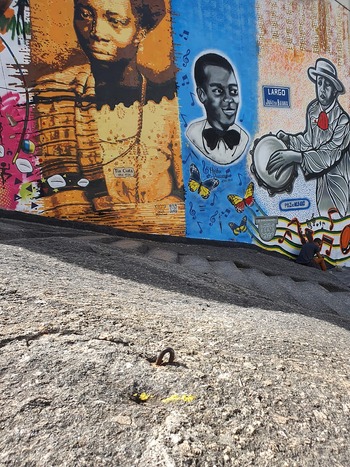
Nowadays, the region is famous for its lively nightlife, where there are samba circles and other outdoor activities that include candomblé performances, thematic cuisine, film screenings, and lectures. All of this excitement attracts tourists and local youth to the place. This lively timespace seems oblivious to the struggles over memory still at play in the area. However, attention to the surrounding semiotic landscape says otherwise. The street art on the walls, the historic stone slope, and its staircase hearken back to a tragic past. From the enmeshment of a bleak past and a resilient present, a necrotope indexically arises—a timespace where the history of racial oppression and annihilation is crisscrossed with the vibrancy of memorial and cultural resistance. Such a perspective allows us to see the LL of Pedra do Sal as mobilizing complex interlocking timespaces—an encruzilhada where past and present ‘gravitat[e] around the circumference of its intersecting lines’ (Martins Reference Martins, Ravetti and Arbex2002:73). That the racialization of space and the spatialization of race rely on spiraling movements of time is made conspicuous in Figure 4 which shows the lively street art on the walls pitched against an almost imperceptible instrument of punishment for rebellious slaves—a material legacy of a colonial past encrusted in the present or, in Rosa's (Reference Rosa2021) words, a haunting sign.
Life and death at Pedra do Sal (photo by Rodrigo Borba, 2021).

While the colourful street art portrays African-Brazilian historical and cultural icons, the shackle next to the stone staircase is a memento of horrors past. In colonial times, this shackle was used to castigate rebellious bondspeople who were chained to it for hours on end. However, this material index of colonial violence is eclipsed by the livelihood of the wall picturing the musical legacy of Pedra do Sal. In the leftmost corner of Figure 4, we see Tia Ciata, a cook and mãe-de-santo of candomblé who befriended several samba artists at the end of the nineteenth century, using her good-standing with the city mayor to get protection from the police to the religious ceremonies and samba circles she hosted in her house. Next to her, we find Heitor dos Prazeres, a samba musician who named the region Little Africa. On the rightmost corner of the image, João da Baiana, a samba composer and singer, is pictured playing the tambourine next to the plaque with his name. The crossroads of the shackle and the street art serve as a reminder that ‘for enslaved people and their descendants, the urban fabric was also a stage for drumming, dancing, singing, reveling and participating in religious and pagan festivals’ (Araujo Reference Araujo2020:230). As such, Pedra do Sal's chronopolitics is shaped by the necrotopic coexistence of lingering marks of colonial annihilation and burgeoning indexes of life and resistance.
Viewing the movement of time as a spiral allows us to interpret Pedra do Sal's LL as emerging from the juxtaposition of an ominous past and present practices of memorial resistance that repurpose space and time. Such a tension characterizes what we refer to as necrotope (see also Carvalho Reference Carvalho2020). Inspired by Cameroonian philosopher Achille Mbembe's (Reference Mbembe2019) discussion of necropolitics, that is, the capitalist expropriation of racialized lives, the necrotope is a spatiotemporal outgrowth of contemporary power/knowledge regimes predicated on a politics of death that impinges itself in the public sphere. According to Mbembe, colonialism radically reconfigured power relations, extending the sovereign's reach over the population's right to live. The concept of the necrotope refers to spatiotemporal and subjective processes of suffering and death (as indexed by the shackle in Figure 4). The necrotope is a kind of chronotope—timespaces predicated on racial, ethnic, gendered, and sexual axes of colonial oppression. Black and racialized populations’ experiences allow for a rethinking of timespace relations. Rather than a sequence of happenings (i.e. an outcome of the linear flow of white modernity), the public space in former colonies and its racial dimension enmesh past-present-future in almost indiscernible ways. The necropolitics of white modernity, however, does not go unchallenged in Pedra do Sal.
Flail and frenzy: Visceral resistances
As a spatialized form of power, however, the necrotope also harbours possibilities for what Mbembe (Reference Mbembe2020) dubs visceral resistances (see inter alia Stroud, Peck, & Williams Reference Stroud, Peck and Williams2019). Despite the centrality of destitution and death for contemporary forms of racialized capitalism, Mbembe (Reference Mbembe2020:18) also identifies the emergence of ‘new forms of resistance…, rehabilitating affects, emotions, and passions which converge to what [he] call[s] “politics of viscerality”’.
Not only do necrotopes encompass racial violence, but also the visceral quality of racial resistance to colonial subjugation. The necrotope, thus, delineates a temporal configuration that erases possible worlds: the past is over, the present is invisible, and the future is missing. This is painfully egregious in the way contemporary Brazil exploits, belittles, and exterminates Black bodies. According to the 2021 Anuário Brasileiro de Segurança Pública ‘Brazilian Yearbook of Public Security’, a young Black person is murdered every twenty-three minutes in Brazil. In such a shaping of time, a sense of exclusion and constant devastation pervades Black experiences.
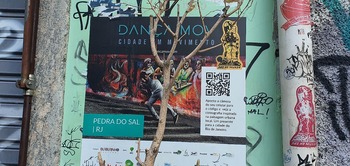
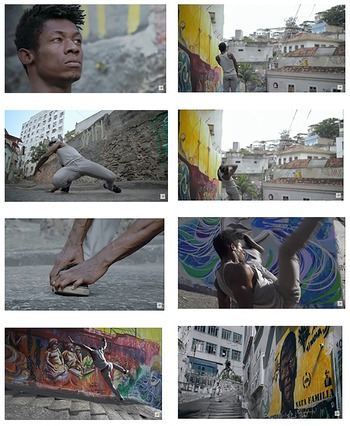
Nevertheless, timespace relations can be crafted differently. When violence is the norm, humans resort to their unlimited capacity to (re)invent ways of being. This ability can be grasped in the videodance performed by Daniel de Oliveira at Pedra do Sal (Figure 6). This production is part of the project Cidade em movimento—Dança em Paisagens Urbanas ‘City in motion—Dance in urban landscapes’, whose videos can be accessed by scanning QR-codes placed throughout the city, as exemplified by Figure 5.
Dança Mov Cidade em Movimento (photo by Rodrigo Borba, 2021). Translation: ‘Point your cell phone camera to the code and watch a choreography inspired by the local urban landscape. A gift to the city of Rio de Janeiro.’

Dança.Mov—Cidade em Movimento, 2021.

Cards such as the one in Figure 5 can be found all around the city. Each of them contains videodances inspired by and performed in specific neighborhoods in Rio where the cards are placed. In the case of Pedra do Sal, the choreography intersperses moves from various Black cultural expressions such as breakdance and capoeira. QR-codes for this dance are found in various locations of Pequena África and have become part of its LL. By entwining these cards and QR-codes with the city's street art, graffiti, road signs, and so on, the Cidade em Movimento project enriches the semiotic dimension of the space with new embodied (online) signs.
This enmeshment of online and offline space becomes obvious once the QR-code is scanned and one sees Oliveira standing atop Conceição Hill, on the edge of Pedra do Sal's crudely carved staircase.Footnote 6 He overlooks Pequena África with a somber gaze. A distinct heaviness weighs upon him. Little by little, his body moves as if overtaken by involuntary spasms. One shoulder jerks upward; his head rotates; his trunk swings; and his knees bend until all limbs flail about in a struggle between control and frenzy. Several breakdance and capoeira moves lead the dancer to freeze in balance-intensive positions between kicks and leg spins. Seeming attempts to break free inevitably succumb to the weight of the earth. Momentarily, his body prostrates. The performer grabs his foot and drags it across the ground until he regains a standing position. He faces the stairs again and resumes motion. By swiveling limbs, he descends a few steps, propelled by the repetition of these movements. A jump maximizes them. On the way down, his tortured body, invoking failure and proximal death, contrasts with the lively street art which portrays women and men chatting, playing music, and dancing. Their ethnic characterization (traits, clothes, activities) links them to the African diaspora.
Near the foot of the stairs, spasms strike once again. With new turns, the dancer's body strives to lift from the ground, but something more than gravity pulls him down. He looks ahead, his body exhausted. The final stairs lie before him. To the side, solemnly staring on from a street art image, is Zumbi, the former king of Quilombo dos Palmares—an icon of rebellion and resistance against slave owners in colonial Brazil. Zumbi is foregrounded as if he were haunting the scene. His dignified gaze crosses with the performer's, both looking chin-up onto the future while simultaneously being haunted by the horrors of the past and the unspooling present in which they meet. In his embodied interaction with Pedra do Sal's LL, the dancer encounters Zumbi at the crossroads of multiple spaciotemporal layers of subjugation and resistance. Daniel's dance at this specific place, thus, expresses life through loss and, in turn, reinscribes a bleak past into the space's colourful present through the indexical nature of his bodily movements.
A first glimpse at the dancer's actions indicates the multilayered temporal juncture he juggles. Besides his engagement with the very instance of the performance, the artist's movements display familiarity with memories of assaults and fleeting moments of ‘freedom from the burden of subjection’ (Whitehead Reference Whitehead and Croft2017:283). His aesthetic work perfectly translates US choreographer Anna Martine Whitehead's (Reference Whitehead and Croft2017) thoughts on a dance move known as ‘death drop’, widely popular among African American drag queens. For her, artistic expression can confront the danger and risk inflicted by the power of discrimination. The author detects a recurrent dramatic repertoire deployed by queer/Black artists whose existence is considered inferior (Whitehead Reference Whitehead and Croft2017:286):
The body molds itself around loss; it carries the burden of danger and grief… There are other options, more dynamic and more interesting to me in these moments of disaster: to fall down, to get back up, to fall under the weight of sorrow again, to get back up. To shake to keep from crying. To fly to keep from drowning. Freedom is the release of tension under the weight paired with the appearance of bearing no weight at all.
Whitehead argues that such assemblage index markers of social life that interpolate historical legacies, cultural production, and futurity, reproducing a virtuosic cycle of collapse-resurrection inherent in Black dance and music (see also Gilroy Reference Gilroy1993; Martins Reference Martins, Ravetti and Arbex2002). This kind of virtuosity provides a key to reading Oliveira's movements as a centrifugal force, rotating and mingling different times. His flail-and-frenzy technique freaks out linearity and, in tandem with the street art, plays a catalyst role to place-making in Pedra do Sal, (con)fusing traces of agony, (re)action, and creative imagination. We can also approach these scenes as an expression of ‘ghostly matters’ in the sense explored by Gordon (Reference Gordon2008). In her view, we must listen to the murmurs of stories that, having been forgotten or lost, keep manifesting as spectral memories in the present. Or in Kilomba's apt words, as plantation memories. This posture requires acute attention to the different paces and durations of time and to how history materializes in multiple apparitions. It finally takes some openness to knowing-experiencing nonlinear relations across and between times. Pedra do Sal, thus, emerges as an encruzilhada from polytemporal indexicalities upon which Oliveira's embodied movements, like Ponciá's ghost limb, lie.
Oliveira's meticulous choreography and its symbiotic relations to the LL engage us in such temporal and semiotic fluxes. This is because he seems to move at the crossroads of past-present-future—an encruzilhada of a tragic past, a resilient present, and a pregnant future. On the one hand, his movements seem to index the suffering of enslaved people who carved out the stone steps. On the other, he intersperses the choreography with breakdance and capoeira moves, linking his performance to contemporary Black countercultural forms. While the stone staircase on which Oliveira moves is a residue of the horrors of slavery, the street art indexes visceral forms of resistance against colonial violence and memorial erasure. Moving away from habitual chronology, he grapples with the tension between temporal fluidity and geographical ‘fixity’. Such strain is indexed by the integration of several elements. Alternating hollowed and heavy moves along the rigid rock, the street art on the wall, and emphatic gesticulation indexically interlace stasis and change in a spiral-like manner—the erasure-potential of possible worlds. The slow-motion effect adds a phantom-like quality to the overlapping of lightness and weight. Together they orchestrate a moving semiotic environment, which tells an embodied tale of deprivation-endurance, otherwise doomed invisible. Senses of loss and risk are personified. However, the video's final frame with a close-up on Zumbi functions as echoes of enslavement, weaved not only by oppression but also by forms of contestation and resistance.
‘To be haunted is to be tied to historical and social effects’, says Gordon (Reference Gordon2008:190). Ponciá's mimicry of her grandfather's severed limb was metaphorical of the violence experienced by her enslaved ancestors and its persistence over time. Likewise, Oliveira's somatic artistry is a historical flashback indexed by muscle memory and its iterative falling and rising. Whether through imitation or flail and frenzy, Ponciá and Daniel defy the linearity of white modernity and its sense of teleology. They change the shape of time and space by moving in spirals of repetition-transformation.
Final remarks
In his analysis of Black Atlantic countercultures, Gilroy (Reference Gilroy1993:36) explains that the ‘unspeakable horror of the suffering caused by slavery’ is constitutive of Black music and art, manifesting itself in present stories of ‘terror and death’ or ‘love and loss’ (1993:168). Diasporic Black cultural practices are thus at the crossroads of tradition and innovation, past and present, preserving themselves as they get transformed along the way. This is the paradox of the ‘changing same’ (1993:198), a term that vividly captures the spatiotemporal semiotic dynamics we analyse in the LL of Pequena África (see also Fabrício & Borba Reference Fabrício and Borba2020). Although race has been somewhat underexamined in LL scholarship, attending to the spacialization of race and the racialization of space requires a more nuanced view of timespace relations than well-established uses of the chronotope allow us to envisage.
Although Bakhtin's theory of the chronotope has nothing inherently linear in the way it treats time and temporality, scholars tend to approach it from a Eurocentric perspective in which time is understood as a relatively ordered progression of events. According to Sarr (Reference Sarr2019) and Mills (Reference Mills2020), such an approach (re)instantiates portrayals of racialized others as backward-looking, as in but not of the modern world. It also obscures the fact that time is experienced as an amalgamation of pasts, presents, and futures—as recent scholarship proposes (see Moran Reference Moran2013; Bastian et al. Reference Bastian, Baraitsen, Flexer;, Hom; and Salisbury2020). Such a perspective is well captured by Kilomba's (Reference Kilomba2008) analysis of the psychological effects of plantation memories in Black women's lives, as well as Gordon's (Reference Gordon2008) call for sociologists to attend to ghostly matters, that is, invisible historical layers that nevertheless (in)form actions and their interpretation. In this vein, this article argues that, if LL scholars want to bring racialization squarely into the field's remit, we should pay close attention to ghostly semiosis and the colonial histories that manifest as spectral meanings in the present. This stance entails a critical take on sociolinguistic empiricism which, according to Rosa (Reference Rosa2021, see also Deumert Reference Deumert2022), is a byproduct of coloniality in order to enliven our analytical approaches with a sensorial and embodied attention to what is invisible but nonetheless (in)forms sign-making in situ.
Analysing Pedra do Sal's LL from the vantage point of the Euro-chronometer would invariably erase multiple indexical layers of polytemporal meanings. Instead, viewing it from the perspective of the encruzilhada as proposed by Martins (Reference Martins, Ravetti and Arbex2002, Reference Martins2003) offers a richer methodological angle to capture the circular juxtaposition of stasis and mobility, repetition and transformation, death and life, oppression and resistance, debt and reparation, past and present. Our analysis suggests that thinking of time outside and against the Euro-chronometer requires a willingness to dislocate our analytical lenses to epistemologies that have been erased by colonization. As we hope to have demonstrated in this article, ‘reverting the arrow of time’ (Silva Reference Silva2019:149) through new concepts and metaphors has the potential to disrupt racist chronologies.