Implications
We studied the relationship between milk flow emission variables recorded in dairy goat herds (milk yield, maximum milk flow (MMF), milking time and time to achieve 500 g/min) with variables related to milking routine, goat physiology and milking machine characteristics. The results indicated that goat physiology characteristics are the main factors affecting the studied variables, the interaction of parity with days in milk (DIM) being significant in some of the variables studied. The effect of the milking parameters or milking practices on the tested variables was slight, and only overstripping was significantly related to milking time.
Introduction
The dairy goat industry has become very competitive and is currently an emergent alternative, considering dairy goats as a solution to the saturated cow milk market in many countries worldwide. This industry has gained a foothold in the western world in recent years, due to growing demand for high quality differentiated and gourmet transformed foods. The dairy goat industry is growing rapidly, and more in-depth information on management, milking practices and milking performance was deemed necessary, due to their influence on milk quality and udder health status.
Milking parameters (vacuum level, rate and ratio) are related to somatic cell count, udder sanitary status and milking efficiency (milk flow, strip, falling of teatcups), and the most recommended for goat milking are: 36 to 44 kPa vacuum level (Le Jaouen, Reference Le Jaouen1981; Carrotte, Reference Carrotte1983; Le Du, Reference Le Du1987 and Reference Le Du1989; Billon et al., Reference Billon, Ronningen, Sangiorgi and Shuiling1999; Sinapsis et al., Reference Sinapsis, Hatziminaoglou, Marnet, Abas and Bolou2000), pulsation rate of 70 to 100 puls/min (Le Jaouen, Reference Le Jaouen1981; Carrotte, Reference Carrotte1983; Cicogna and Sangiorgi, Reference Cicogna and Sangiorgi1983; Le Du, Reference Le Du1989; Sinapsis et al., Reference Sinapsis, Hatziminaoglou, Marnet, Abas and Bolou2000) and pulsation ratio of 50% to 60% (Carrotte, Reference Carrotte1983; Le Du, Reference Le Du1985, Reference Le Du1987 and Reference Le Du1989; Billon et al., Reference Billon, Ronningen, Sangiorgi and Shuiling1999; Sinapsis et al., Reference Sinapsis, Hatziminaoglou, Marnet, Abas and Bolou2000). Manzur et al. (Reference Manzur, Díaz, Mehdid, Fernández and Peris2012) observed that milking with mid or low line did not affect the udder health status if the milking parameters were as recommended.
Overmilking in dairy cows can worsen teat condition (Hillerton et al., Reference Hillerton, Pankey and Pankey2002) and has been related to udder health (Rasmussen, Reference Rasmussen2004). Gleeson et al. (Reference Gleeson, Jilroy, O’Callaghan, Fitzpatrick and Rath2003) observed in cows that continuous overmilking for 4 months caused more damage to the epithelial lining, higher teat sinus injury and greater keratin loss than normal milking. In addition, milking with inadequate pulsation characteristics can increase the damage to teat condition (Mein et al., Reference Mein, Williams and Reinemann2003). In dairy goats, Alejandro et al. (Reference Alejandro, Roca, Romero and Díaz2014) observed that an overmilking of 2 min caused a significant increase in teat wall thickness compared with non-overmilked goats (0.56 v. 0.61 cm) and concluded that the use of an unsuitable milking routine that leads to overmilking can cause congestion and oedema in the teat tissues, which may alter the defines mechanisms against intramammary infections.
The aim of this work was to study the relationship of the milking performance variables in dairy goat farms with variables related to physiology and milking practices, to determine the critical points that can be improved in this industry. The work was carried out on 19 different goat farms with different situations in terms of size, goat breeds, milking parameters and milking practices, in order to analyse the relationship between variables in a study carried out in real farm conditions.
Material and methods
Experimental design and variables analysed
In total, 19 farms from the Goat Association of Wisconsin (USA) were selected, being representative of the size of the total farms in the association (50 to 800 does) and uniformly distributed in every size. Farms were visited once, and records of goat milk flow emission and milking parameters in dynamic conditions were taken during the evening milking (all the selected farms milked twice a day) from 6 to 14 does/farm (n=168 does).
Milking parameters were recorded in dynamic conditions during milking in the evening (2 to 7 does/farm) with a commercial vacuum recorder (Pulsotest; DeLaval, Tumba, Sweden). Vacuum level variables (kPa) were measured at cluster (short milk tubes) for 1 min: average (AveVL), maximum (maxVL), minimum (minVL) and drops (DROP: maxVL−minVL). Pulsation rate (puls/min) and pulsation ratio (%) were measured at the short pulsation tube of the milking units. Milk flow emission variables were recorded using a Lactocorder device (Lactocorder; WMB AG, Switzerland) in the long milk tube. Tested variables were: milking time (min), milk yield (kg), MMF (kg/min), average milk flow (AVMF, kg/min) and time until 500 g/min milk flow is established (TS500, min). Doe characteristics were obtained from the database of every farm: DIM, breed (BREED) and parity (P).
Milking practices of overmilking and overstripping were obtained from milk flow curves recorded by Lactocorder. Overmilking (min) was the time at the end of milking with flow lower than 0.2 kg/min until the teatcups were removed.
Overstripping (min) occurred if at the end of milking and after the milk flow decreased below 0.2 kg/min, flow increased above 0.2 kg/min before finally decreasing. Pre-lag (min) was the time from stimulation of teats (manual cleaning or massaging) to teatcup attachment, recorded by the researchers. Milking machine characteristics related to milk pipeline height (LINE: low (milk pipeline below milking platform) or high (milk pipeline above milking platform)) and presence of claw (yes or no) were recorded.
Statistical analysis
Average and standard deviation of milking parameter variables (AveVL, maxVL, minVL, DROP, pulsation rate, pulsation ratio), milk flow variables (milking time, milk yield, MMF, AVMF, TS500), milking routine times (overmilking, overstripping) and milking machine design variables (line, claw) by farm were calculated using Proc Means (SAS V. 9.1; SAS Institute Inc., 2002). The relationship between farm and the analysed variables was studied using a one-way ANOVA (Proc GLM, SAS V. 9.1; SAS Institute Inc., 2002).
The relationship between milk yield, MMF, milking time, TS500 with independent variables related to physiological characteristics and milking practices and parameters were studied using a linear mixed model (Proc Mixed, SAS V. 9.1; SAS Institute Inc., 2002) by a stepwise procedure. Only independent variables significant at P<0.40 were kept in the final models, with farm as the random term. For these analyses, several variables were clustered in order to reduce the dimension of the problem. Goat characteristics were clustered depending on the variable: DIM was clustered in three levels (early: <60 DIM; mid: 60 to 180 DIM; late: >180 DIM); breed in four levels (Saanen, Alpine, mixed (not pure breed), other: Toggenburg and Nubian) and parity in two levels (primiparous or multiparous). Milking parameters and practices were: AveVL was clustered in two categories (⩽40, >40 kPa), overmilking was clustered in three categories (no overmilking, <0.5 min, >0.5 min) and overstripping was clustered in two categories (yes or no). Milk yield and pre-lag were included as continuous variables. In addition, the interaction of DIM with parity was considered if both effects had P<0.40 (this was the case of the milk yield and milking time variables).
Independent variables considered in milk yield analysis were: DIM, breed, parity, overstripping and the interaction of DIM with parity. Variables included in MMF analysis were: DIM, breed, parity, milk yield, AveVL, line. Considered variables in milking time analysis were: DIM, breed, parity, overstripping, overmilking, milk yield, AveVL and the interaction of DIM with parity. Considered variables in TS500 analysis were: DIM, breed, parity, milk yield, AveVL, line, pre-lag. Farm was kept as the random term for all of them.
Results
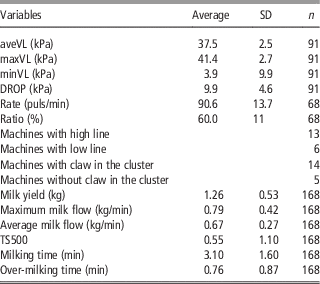
The farm effect (one-way ANOVA analysis) resulted significant (P<0.001) for all the variables. Means and standard deviation recorded are shown in Table 1. Average of vacuum level ranged from 32.8 to 40.7 kPa, being very similar between farms (37.5±2.5 kPa). Vacuum drop was more dispersed (9.9±4.6 kPa) with minimum levels of 3.8 kPa and maximum of 15.9 kPa. Maximum vacuum level ranged between 37.1 and 46.1 kPa and minVL between 12.7 and 38.2 kPa. The highest AveVL records were related to highest maxVL, and the lowest AveVL to lowest minVL. Pulsation rate ranged between 75 and 122.6 puls/min, with low standard deviations in farms. Pulsation ratio ranged between 44.3% and 100.0%, with low dispersion in farms (SD: 0.1% to 0.23%); one case of bad pulsation functioning (=1%) was recorded, so its data were not considered. Most milking machines had a high milk pipeline (n=13), low pipeline being scarce (n=6). Claw was present in 14 milking machines, and absent in only five. We should note that three machines with no claw had high milk pipelines.
Average and standard deviation for each variable considered in the study

aveVL=average of vacuum level; maxVL=maximum vacuum level; minVL=minimum vacuum level; DROP=drops of vacuum level (maxVL−minVL); TS500=time until 500 g/min milk flow is established (min).
Averages of milk flow emission variables by farm are also shown in Table 1 (evening milking). Milk yield ranged between 0.72 and 1.85 kg. Maximum milk flow ranged between 0.55 and 1.82 kg/min. Average milk flow ranged from 0.48 to 0.92 kg/min, with a very consistent SD between farms (0.13 to 0.39). The variable TS500 was greatly dispersed; the highest value was 3.99 min and the lowest was 0.05 min. Milking time ranged from 1.69 to 6.06 min. Overmilking averages ranged from 0.16 to 1.79 min.
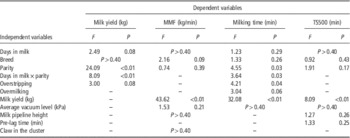
Variables related to milk yield, MMF, milking time, TS500 at P<0.40 level are shown in Table 2.
Relationship of milk flow emission variables (F and P values) with milking routine, milking parameters, milking machine characteristics and goat physiology

MMF=maximum milk flow; TS500=time until 500 g/min milk flow is established; –=variable not considered in the model.
Variable considered in the model initially, but removed from the final model because of low significant level at P>0.40.
Variables related to milk yield at P<0.40 level (Table 2) were DIM, parity, overstripping and the interaction of DIM with parity. The P value of breed was higher than 0.40, and breed effect was removed from the model. The main contribution to the model was the variable parity (F=24.09, P<0.01) with higher milk yield at multiparous than primiparous level (1.41 v. 1.01 kg). Lower contribution was obtained from DIM (F=2.49, P=0.08), the interaction of DIM with parity (F=8.09, P<0.01) and overstripping (F=3.00, P=0.08). Animals at early lactation had higher milk yield than animals at mid or late lactation (1.40 v. 1.11 and 1.12 kg, respectively). There were no significant differences between mid and late lactation. The milk yield was significantly higher (P<0.05) for multiparous than primiparous goats when DIM were lower than 60 days (1.82 v. 0.97 kg) or between 60 and 120 days (1.29 v. 0.92 kg); at over 120 DIM, no significant differences were obtained between multiparous and primiparous (1.11 v. 1.14 kg). The Overstripping trend indicates a low contribution to MY (1.14 v. 1.27 kg for not overstripping or yes, respectively; P=0.08).
Main variables related to MMF were milk yield and breed. Average vacuum level (avVL and parity were related at lower level to MMF. Variables not related (P<0.40) were DIM, milk pipeline height and claw. Maximum milk flow was positively related to milk yield; higher MMF was recorded at higher milk yield. Regarding the effect of breed, higher values were obtained for others (0.95 kg/min); Alpine and Saanen obtained 0.71 kg/min and mixed obtained 0.65 kg/min.
Variables related to milking time at P<0.40 level, were DIM, breed, parity, the interaction of DIM with parity, overstripping, overmilking and milk yield. Main variables (higher F value and lower P values) were milk yield, parity, the interaction of DIM with parity, overstripping and overmilking. AvVL was not significant and was deleted from the model. When overstripping was performed, milking time was longer (3.23 v. 2.78 min, with and without overstripping, respectively). Longer milking time was recorded when overmilking was higher than 0.5 min. At first lactation the milking time was lower than at other lactations (2.73 v. 3.28 min). Although no differences were obtained between the DIM levels, the interaction of DIM with parity was significant, as significant differences were obtained between primiparous and multiparous goats (2.61 v. 4.17 min) only in the first stage of lactation considered (<60 DIM).
The variable TS500 was related (P<0.40) to milk yield, parity, milk pipeline height, pre-lag and breed. The variables DIM and AvVL were not significant. Milk yield was related positively to TS500. Higher TS500 was recorded for multiparous does. Low line had a lower TS500 than high line, but with low significance level (P=0.26). Pre-lag was positively related to TS500; higher pre-lag was recorded at higher TS500.
Discussion
Averages of milking parameters recorded (avVL, pulsation rate and ratio) are in line with recommendations from several studies in dairy goats, mainly carried out in Europe, where the dairy goat industry is more widespread. Carrotte (Reference Carrotte1983), Le Du (Reference Le Du1989 and Reference Le Du1987), Le Jaouen (Reference Le Jaouen1981) and Sinapsis et al. (Reference Sinapsis, Hatziminaoglou, Marnet, Abas and Bolou2000) recommended vacuum level (VL) between 36 and 44 kPa; Billon et al. (Reference Billon, Ronningen, Sangiorgi and Shuiling1999) recommended levels between 38 and 40 kPa. The recommendations are related to not increasing the somatic cell count (due to higher VL) and avoiding teatcup falloff (due to low VL). In the United States, Spencer (Reference Spencer1992) recommended values between 10 and 14 Hg (33.86 and 47.41 kPa), a somewhat wider range than in European countries. In our study, only five farms obtained records below 36 kPa, none below 33 kPa, the higher AveVL recorded being 40.7 kPa. The DROP (maxVL−minVL) recorded can be considered high (average of 9.9 kPa, range 3.8 to 15.9 kPa) compared with other records published in studies carried out in goats under controlled conditions (1.49 to 3.26 kPa of Bueso-Ródenas et al., Reference Bueso-Ródenas, Romero, Roca and Díaz2014).
Average pulsation rate and ratio of the study were 90 puls/min and 60%, respectively, in line with literature recommendations. Levels of pulsation rate recommended in the literature for goat milking are between 70 and 100 puls/min (Carrotte, Reference Carrotte1983; Cicogna and Sangiorgi, Reference Cicogna and Sangiorgi1983; Darracq et al., 1978; Le Du, Reference Le Du1989; Le Jaouen, Reference Le Jaouen1981; Sinapsis et al., Reference Sinapsis, Hatziminaoglou, Marnet, Abas and Bolou2000), with 90 puls/min the most recommended (Lu et al., Reference Lu, Potchoiba and Loetz1991). In the United States, Spencer (Reference Spencer1992) recommended lower rates, between 40 and 80 puls/min. Regarding pulsation ratio, European dairy goats are milked between 50% and 60% (Billon et al., Reference Billon, Ronningen, Sangiorgi and Shuiling1999). Le Du (Reference Le Du1985 and Reference Le Du1987) and Sinapsis et al. (Reference Sinapsis, Hatziminaoglou, Marnet, Abas and Bolou2000) recommended a ratio of 60% for goats, due to a lower milking time (compared with lower ratios), interesting in animals with high production levels or low emission flows. Using ratios higher than 70% could have a negative effect on udder health status, due to its effect on congestion in the teat and worse emptying of the udder (Carrotte, Reference Carrotte1983; Le Du, Reference Le Du1987 and Reference Le Du1989).
Claw presence was observed in high and low milk pipelines, except on five farms, three of which had a high milk pipeline. Peris et al. (Reference Peris, Díaz, Segura, Martí and Fernández2003) questioned the needed to install claw in low line for small ruminants if air entrance is permitted at teatcup level (4 to 8 l/min; ISO 5707, 2007) which is recommended in high line in order to avoid vacuum level fluctuations, especially at high milk flows. Le Du et al. (Reference Le Du, De la Chevalerie, Combaud and Lambion1983) showed that claw in high line helps to improve milk evacuation in ewes through the milk pipeline reducing fluctuations.
Averages of milk yield obtained are in line with results reported in similar breeds. It must be considered that the data in this work were recorded at evening milking and the literature publishes data obtained from morning milking or total per day (Bruckmaier et al., Reference Bruckmaier, Ritter, Schams and Blum1994; Ilahi et al., Reference Ilahi, Chastin, Bouvier, Arhainx, Ricard and Manfredi1999; Komara and Marnet, Reference Komara, Giger-Reverdin, Marnet, Roussel and Duvaux-Ponter2009; Komara et al., Reference Komara and Marnet2010). The significant relationship with parity and DIM is in line with the results of Bruckmaier et al. (Reference Bruckmaier, Ritter, Schams and Blum1994) in Saanen, and Peris et al. (Reference Peris, Such and Caja1996 and Reference Peris, Mehdid, Martínez and Gómez2010) in Murciano-Granadina goats, who reported a decrease in milk yield as lactation progressed. In our study, the interaction between DIM and parity was significant, as the differences observed at early and mid-lactation became non-significant at the end of lactation, but this result was not observed or considered in other studies (Bruckmaier et al., Reference Bruckmaier, Ritter, Schams and Blum1994; Peris et al., 1996 and Reference Peris, Mehdid, Martínez and Gómez2010). The lack of relationship with the breed is opposite to results obtained by Komara et al. (Reference Komara and Marnet2010), who observed a significant relationship in a study carried out with Alpine and Saanen goats, although our study covered a wider range of management situations (19 farms) and four levels of breeds with higher variability. The overstripping variable was not significantly related to milk yield, due to the good stripping observed, caused by the accuracy of the milking parameters employed (VL, rate and ratio). Only a slight trend was observed (P=0.08), with small differences between stripping (MY=1.24 kg) or not stripping (MY=1.14 kg).
Averages of MMF are in line with those reported by Komara et al. (Reference Komara and Marnet2010) in Alpine and Saanen breeds (0.88 and 0.82 l/min, respectively), Ilahi et al. (Reference Ilahi, Chastin, Bouvier, Arhainx, Ricard and Manfredi1999) in Alpine (0.902 l/min), although lower than reported by Komara and Marnet (Reference Komara, Giger-Reverdin, Marnet, Roussel and Duvaux-Ponter2009) in Alpine (1.6 l/min) and Bruckmaier et al. (Reference Bruckmaier, Ritter, Schams and Blum1994) in Saanen (1.34 to 1.60 kg/min), after considering that records were taken in the evening milking in our study. Our results are in line with those reported in standard ISO 5707 (2007), regarding milking machines, where peak flows or 0.8 l/min are attributed to Saanen, but not with those attributed to Alpine breeds (1.3 l/min). The significant relationship obtained with milk yield are in line with Ilahi et al. (Reference Ilahi, Chastin, Bouvier, Arhainx, Ricard and Manfredi1999) who reported a coefficient of correlation of 0.42. Lu et al. (Reference Lu, Potchoiba and Loetz1991) observed a significant relationship with VL, not so high in our study, probably due to the short variability in our study compared to them (38, 45 and 52 kPa). The lack of relationships obtained with DIM are in disagreement with the results of Ilahi et al. (Reference Ilahi, Chastin, Bouvier, Arhainx, Ricard and Manfredi1999) and Bruckmaier et al. (Reference Bruckmaier, Ritter, Schams and Blum1994), who observed a decrease in MMF as lactation progressed. Ilahi et al. (Reference Ilahi, Chastin, Bouvier, Arhainx, Ricard and Manfredi1999) and Peris et al. (Reference Peris, Mehdid, Martínez and Gómez2010) also reported a significant relationship with parity, in contrast to our study. Komara et al. (Reference Komara and Marnet2010) reported a significant relationship with breed, in contrast to the results presented here (P=0.43). No studies on TS500 in goats were found, only on the time to MMF.
The milking time averages obtained are in line with those reported by the ISO 5707 (2007) for milking machine construction (>120 s), but lower than the literature consulted in similar breeds, as publications focus on the morning milking. Lu et al. (Reference Lu, Potchoiba and Loetz1991) and Peris et al. (Reference Peris, Mehdid, Martínez and Gómez2010) studies reported a significant relationship of milking time with milk yield. Bruckmaier et al. (Reference Bruckmaier, Ritter, Schams and Blum1994) reported a significant relationship with DIM and Peris et al. (Reference Peris, Mehdid, Martínez and Gómez2010) with parity and DIM, due to the relationship with milk yield, but Peris et al. (Reference Peris, Such and Caja1996) did not find a significant relationship with parity. In our study a relationship was found (P<0.01) with milk yield and parity (P=0.03), but not with DIM (P=0.29). The significant interaction of DIM with parity (P=0.03) is explained by the significant interaction obtained for the milk yield variable, which resulted in a significant higher milking time in multiparous compared with primiparous goats. Ilahi et al. (Reference Ilahi, Chastin, Bouvier, Arhainx, Ricard and Manfredi1999) reported a low correlation between milk yield and milking time (r=0.17), milking time being related with MMF (r=−0.54). Lu et al. (Reference Lu, Potchoiba and Loetz1991) observed a significant relationship with VL, in contrast to our study, probably due to the short variability in our study compared with theirs.
Regarding the milking parameters and milking machine characteristics, only avVL showed a tendency on MMF, and milk pipeline height on TS500. The other variables considered did not have a significant effect on the tested variables.
Milk yield was mainly affected by parity, the interaction of DIM with parity also being significant. Maximum milk flow was mainly affected by milk yield and breed. Milking time was mainly affected by milk yield. Parity, the interaction of DIM with parity and overstripping were also significant, whereas overmilking showed a slight trend.
We concluded that most of the studied variables were mainly related to goat physiology characteristics, the effects of milking parameters and milking machine characteristics being scarce.