Introduction
Voice disorders that exist in the absence of any structural or neurological pathology are variously termed ‘functional’,Reference Bridger and Epstein1–Reference Sama, Carding, Price, Kelly and Wilson4 ‘psychogenic’Reference Baker5–Reference Van Harten and Schutte7 or ‘non-organic’.Reference Carding, Horsley and Docherty8 Although the definition ‘voice disorders in the absence of any structural or neurological pathology’ applies to all these cited studies, the above terms are not necessarily interchangeable. On closer inspection, such terminology seems to represent aetiological classifications rather than the basic definition given above. For example, some authors use ‘functional’ as an umbrella term referring to voice disorders involving excessive or insufficient muscle tension.Reference Roy and Leeper2, Reference Roy, Bless, Heisy and Ford9, Reference Altman, Atkinson and Lazarus10 Other authors use ‘functional’ to imply a ‘conflict over speaking out’.Reference House and Andrews11, Reference House and Andrews12 Others prefer the term ‘psychogenic’, because the voice disorder is taken to be a manifestation of an underlying psychological conflict.Reference Baker5, Reference Schalen and Andersson6, Reference Baker13, Reference Andersson and Schalen14
A voice disorder's aetiological classification has clinical significance, as it partly determines which therapeutic techniques are selected. For instance, when the aetiology is recognised as a muscle tension disorder, therapy will involve techniques designed to reduce muscle tension.Reference Roy and Leeper2 However, if the aetiology is identified as an underlying psychological conflict, the most important aim of therapy will be to identify and resolve this conflict, although this may be combined with a direct technique to retrieve the voice (for an example see BakerReference Baker13). In these examples, therapy primarily targets the assumed underlying aetiology, and the expected outcome is improved or normal voice production.
At our institute, no assumptions are made about underlying aetiology. The diagnosis ‘non-organic’ is defined, very simply, as ‘dys- or aphonia in the absence of any structural or neurological pathology’, and the approach is to directly target voice production. The two techniques described in the present study have been used for more than 20 years at our institute. The technique most frequently used consists of mental imagery which has been adapted for patients with non-organic voice disorders. The use of visual imagery relies on one's ability to form a ‘picture in the mind’, while auditory verbal imagery refers to the process of deliberately recalling the sound of, for example, one's own voice.Reference Shergill, Bullmore, Brammer, Williams, Murray and McGuire15 Motor imagery is a cognitive process in which a motor act is mentally rehearsed without any overt body movements.Reference Mulder, De Vries and Zijlstra16, Reference Lotze and Halsband17 Kinaesthetic motor imagery involves recalling the same sensations that are usually felt in the muscles when the movement is actually executed.Reference Kleber, Birbaumer, Veit, Trevorrow and Lotze18, Reference Stinear, Byblow, Steyvers, Levin and Swinnen19 In short, when all these processes are involved, a person sees, hears and feels themselves performing an action in the mind.
Functional magnetic resonance imaging (fMRI) studies have shown that the corticomotor areas activated during mental imagery of speaking and singing overlap with those activated during actual speaking or singing.Reference Shergill, Bullmore, Brammer, Williams, Murray and McGuire15, Reference Kleber, Birbaumer, Veit, Trevorrow and Lotze18, Reference Özdemir, Norton and Schlaug20 The central processes involved during mental imagery of a movement are also largely identical to those required when performing that movement.Reference Kleber, Birbaumer, Veit, Trevorrow and Lotze18, Reference Yágüez, Nagel, Hoffman, Canavan, Wist and Hömberg21 As explained by Yágüez et al.,Reference Yágüez, Nagel, Hoffman, Canavan, Wist and Hömberg21 mental practice will influence central processes of motor learning directly, because it invokes all of those processes up to the point of issuing the motor command itself. Whereas mental imagery is generally used to improve and refine motor skills, it is used at our institute as a tool to retrieve a ‘lost’ motor skill, namely, phonation.
The other technique used at our institute is well known, being first described by Oliver in 1870.Reference Drost22 This technique incorporates manually shaking or jostling the larynx.
The efficacy of these approaches has only been reported once, in Dutch.Reference Drost22 Few studies have reported the effect of therapy for non-organic voice disorders, even fewer with large patient series. This study reports the short- and long-term results of the two techniques mentioned above, namely mental imagery and manual laryngeal shaking, both of which target the voice (i.e. pitch, loudness and quality) directly.
Materials and methods
Subjects
Firstly, we reviewed the records of all 116 patients who presented to our institute with a moderate to severe dysphonia or an aphonia and who received therapy for a non-organic voice problem, between January 1996 and January 2003. All patients had undergone thorough laryngoscopic and stroboscopic examination in order to rule out any organic aetiology (structural or neurological). Stroboscopy is not always appropriate; in aphonic patients, the absence of a voice, and thus pitch, would prohibit triggering of stroboscopic light. Visible laryngeal disease or abnormality was not reported for any of the patients at the time of examination. All patients were treated by the same speech pathologist (MSV).
Secondly, all the patients were asked in July 2003 to complete a follow-up questionnaire. Patients were asked whether they had experienced any relapses (since the end of treatment), and if so how many had occurred and what action the patient had undertaken. The questionnaire was sent by post. Of the patients who did not return their questionnaire, 24 (i.e. all who could be traced) were interviewed by telephone.
Therapeutic procedure
The therapeutic procedure consisted of a number of stages. First, any existing cognitions (ideas) and assumptions (presumed causes) about the voice disorder were identified. Second, inaccurate cognitions were restructured using a neuro-physiological model of phonation, which suggested that phonation involves basic neurological control systems that act on the laryngeal muscles. This model is explained in detail below. Third, the voice was retrieved using either mental imagery or shaking of the larynx. Each of these stages is explained in detail below.
Interview
Patience and understanding are required from the therapist in order to gain the patient's trust. In addition, the therapist needs to be a skilled listener. The listening strategy was derived from the meta-model described by Bandler and Grinder.Reference Bandler and Grinder23 According to this model, the language that the patient uses to explain his or her voice problem represents a surface structure. This surface structure conceals a deeper structure that contains a patient's cognitions (assumptions or beliefs) about their voice disorder. However, it has to be remembered that not all patients necessarily have specific cognitions. The role of the therapist is to identify whether such cognitions exist and if so what they are, because such cognitions generally comprise distortions that require restructuring before the therapist can actually attempt to ‘retrieve’ the patient's normal voice.
Explanatory model of phonation
Different models exist that attempt to explain the aetiology of a non-organic dys- or aphonia. The majority of these models are firmly rooted in classical psychology. However, we prefer Wyke's neuro-physiological model.Reference Wyke24
Wyke postulated that the tension, length, mass and posture of the vocal folds are pre-set to specific values just before an audible sound is produced. This is most probably effected through cortical projections to the laryngeal motor neurons. The speech control model developed by Guenther et al. Reference Guenther, Ghosh and Tourville25 supports this idea of a feed-forward system in which the superior temporal gyrus receives projections from the frontal motor cortical areas that predict the sound of one's own voice. Once an appropriate feed-forward command sequence has been learned, this sequence will successfully produce the intended sound. Wyke referred to this feed-forward system as ‘pre-phonatory tuning’ and emphasised the voluntary character of this system. In patients with a non-organic dysphonia (or aphonia), it is assumed that an emotional experience, life event or physical illness (e.g. a viral infection) causes disruption of this ability to pre-set the required tension pattern necessary for phonation.
The above model is explained to the patient, but in a simplified form. Most patients respond with recognition and relief when they understand that the problem is not ‘all in the mind’ and that they have ‘unlearnt’ normal phonation. This realisation also prepares the patient for the process of retrieving the voice.
Mental imagery
The therapeutic process consists of a number of steps; the patient is guided through these steps by the speech pathologist. In short, the patient is instructed to recall and visualise, in their mind's eye, a past, emotionally neutral situation in which the voice sounded normal (i.e. visual imagery). Subsequently, the patient is asked to mentally ‘listen’ carefully to their voice, noting its pitch, loudness and quality (i.e. auditory verbal imagery). The patient is requested to mentally simulate the action of speaking, counting from one to 10 (i.e. motor imagery) and also to concentrate on the mental sensation of speaking (i.e. kinaesthetic motor imagery). Once the patient has indicated that they are able mentally to hear and experience how their voice sounds, they are requested to audibly reproduce that voice. Initially, the patient is asked to count and to recite the days of the week and the months of the year, but eventually the patient progresses to monologues and normal conversation with the therapist.
Shaking of the larynx
The exact steps depend on whether the problem is one of hyperkinetic or hypokinetic dys- or aphonia. In patients suffering from hypokinetic dysphonia, voiced coughing is evoked by manually exerting inward pressure on both sides of the thyroid, thereby causing adduction of the vocal folds. Alternatively, the patient is asked to exert some force (e.g. as if lifting a heavy object), which will also cause the vocal folds to be adducted. In patients suffering from hyperkinetic dysphonia, downward pressure on the thyroid is applied to lower the tensed, elevated larynx. The patient is asked to clear the throat, extending this throat-clearing into voicing or humming. In both the hypo- and hyperkinetic patient, the therapist shakes or jostles the larynx rapidly from side to side while the patient attempts to phonate, thus manually re-setting the required tension pattern necessary for phonation.
Results
Patient characteristics
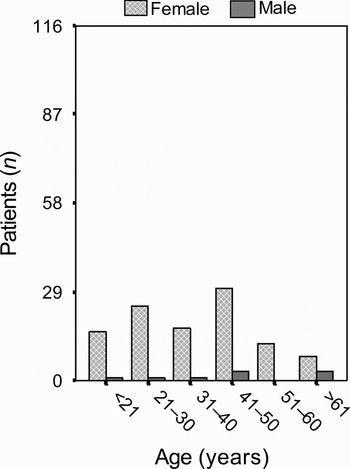
Patients' age and gender distributions are shown in Figure 1. There were 107 (92 per cent) female and nine (8 per cent) male subjects. The median age on presentation was 39 years (range, 10–77 years) for females and 45 years (range, 20–80 years) for males.
Distribution of age and gender for 116 consecutive non-organic voice disorder patients.

More than half the patients (61 per cent) presented with aphonia, while 39 per cent presented with dysphonia. Dysphonia could consist of breathiness, roughness, diplophonia, intermittent falsetto or strained phonation. The median duration of the problem was seven weeks, with a range of one to 312 weeks.
Cognitions
In 30 (26 per cent) patients, the onset of the voice disorder coincided with an apparent upper respiratory tract infection, and 22 (19 per cent) patients related the onset of their voice problem to a sore throat.
Ten (9 per cent) patients believed that a previous operation in the head and neck area might have been responsible for their voice disorder. The type of surgery varied, for example thyroidectomy, tooth extraction, and nasal or ear surgery. Seventeen (15 per cent) subjects mentioned as a probable cause episodes of coughing, singing, asthma or exposure to a smoky environment. One subject thought she might have forced her voice too much. Twenty-one (19 per cent) patients were unable to identify any specific event as a causative factor. Only 16 (14 per cent) patients mentioned a relationship between the onset of the voice disorder and stressful or traumatic life events.
Effect of therapeutic procedure
As mentioned above, patients were treated using mental imagery, laryngeal shaking or a combination of the two. Mental imagery was used in 54 (47 per cent) patients and shaking in 38 (33 per cent). Twenty-four (20 per cent) patients received a combination of the two strategies (usually mental imagery first then shaking).
Mental imagery was generally the first choice of strategy. However, the choice of strategy, including switching from one to the other, depended on certain factors. For instance, if the duration of the voice disorder had been so long that the subject could not recall their normal voice, or if they were unable to master the mental imagery strategy, laryngeal shaking was used. Laryngeal shaking was also sometimes chosen for practical reasons, for instance when not enough time was available.
On average, a treatment session (excluding the time required to identify and restructure cognitions) lasted half an hour. However, in some subjects the problem was cured within 10 minutes, while in others a two-hour session was necessary to restore the normal voice. All the subjects received a routine follow-up telephone call after one week.
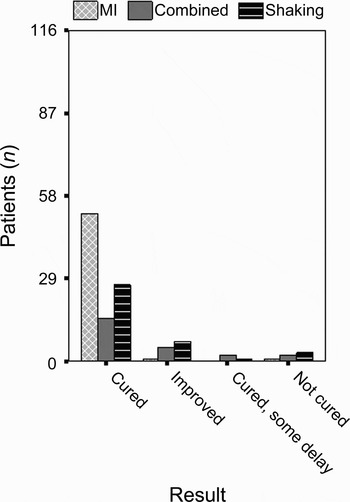
Figure 2 gives the overall results of the therapeutic procedures followed at our institute.
Overall results for therapeutic procedures used. MI = mental imagery; combined = mental imagery + laryngeal shaking

Overall, 100 (86 per cent) of the 116 patients were cured. Ninety-four (81 per cent) patients retrieved their normal voice within one therapy session, 52 (of 54) through mental imagery, 27 (of 38) through shaking and 15 (of 24) through a combined approach (first mental imagery, then shaking).
In three patients, the voice was not cured immediately but had returned to normal by the time of the follow-up telephone call (after one week). In 13 (11 per cent) patients, the voice improved although the voice quality was not completely normalised (some breathiness or roughness remained). In six (5 per cent) patients, the voice was not cured, even after three sessions. These ‘failed’ patients did not receive more than three therapy sessions.
Relapses
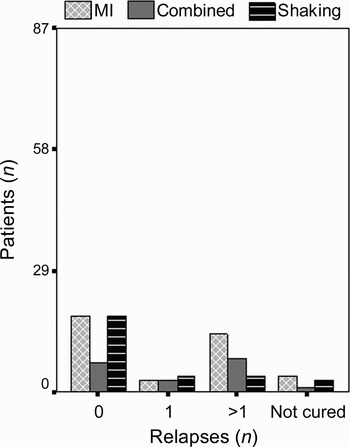
The results of the follow-up survey are shown in Figure 3. The response rate was 75 per cent (87 out of the 116 patients). At the time of questionnaire completion, the mean time since the last treatment session was 50.93 months (standard deviation, 22.72 months).
Number of patients suffering relapses. MI = mental imagery; combined = mental imagery + laryngeal shaking

Forty-three subjects of the 87 (49 per cent) patients who responded to the questionnaire had not had a relapse since their therapy ended. Ten (11 per cent) patients reported one relapse and 26 (30 per cent) reported more than one relapse. Of those reporting more than one relapse, the number of patients who had been treated using mental imagery (n = 14) was higher than the number who had been treated with laryngeal shaking (n = 4). However, overall, 15 of the 36 patients suffering relapses regained their voice by applying the mental imagery themselves, whereas only three subjects regained their voice by manually shaking their own larynx. When comparing treatments (mental imaging versus laryngeal shaking), different factors should be considered. Mental imagery yields a higher cure rate but also more relapses; however, mental imagery can more easily be applied by the patient when a relapse occurs. Other factors mentioned above also play a role when deciding on treatment. All these issues make it very difficult to prove statistically that mental imagery is better than laryngeal shaking.
Following relapse, 14 patients reported regaining their voice spontaneously, and four reported either visiting another speech pathologist or returning to our institute for an extra session.
The duration of relapses varied and could last a few hours, one or two days, or sometimes a fortnight.
Some patients were classified as ‘not cured’; these individuals had been discharged with a normal or improved voice, but indicated on the questionnaire that they had not been cured. One of these patients was a smoker, and her voice quality was what one would expect from a person with Reinke's oedema. Although this patient no longer suffered from aphonia, she was not completely satisfied with her voice quality. Another patient's voice quality had improved considerably, but he was subsequently diagnosed with Parkinson's disease and was no longer satisfied with his voice quality at the time of follow up. One patient was able to produce a normal voice but relational difficulties in her personal life prevented her from using her normal voice consistently, and she was advised to seek further psychological counselling. One subject was diagnosed with sulcus vocalis a few years after treatment, when updated equipment was used. She had been able to produce a voice approximating normal until she went to a teacher's training college, where her lifestyle changed dramatically (including smoking, socialising, etc), thus causing deterioration of her voice quality.
Discussion
The present, retrospective study reports therapeutic results for 116 consecutive patients with non-organic, moderate to severe dysphonia or aphonia, in whom ‘non-organic’ was defined as a dysphonia or aphonia occurring in the absence of any structural or neurological pathology.
In our patients, the onset of non-organic dys- or aphonia was often related to upper respiratory tract infections or a sore throat, even though the actual infection was no longer present. A number of studies have reported comparable findings. Harris and RichardsReference Harris and Richards26 noted this relationship for 11 out of 14 patients. In a study by House and Andrews,Reference House and Andrews11 30 out of 71 patients ascribed their voice problem to ‘laryngitis’ or a ‘heavy cold’; interestingly, twice that many patients had received antibiotics. Similarly, Schalen and AnderssonReference Schalen and Andersson6 noted the prevalence of respiratory symptoms, as well as over-treatment with antibiotics. Although antibiotics combined with voice rest is often prescribed, Schalen and Andersson rightly stated that this approach is most likely to be counterproductive in cases of non-organic voice disorder.
We believe that various causes, such as a viral infection or a traumatic life event, can disrupt the ability to pre-set the required tension pattern necessary for phonation (pre-phonatory tuning). WykeReference Wyke24 postulated this pre-phonatory tuning ability in his neuro-physiological model of phonation, and this concept is supported by Guenther and colleagues' feed-forward mechanism.Reference Guenther, Ghosh and Tourville25 The disruption in this pre-phonatory tuning ability might, to some extent, be similar to Sundberg's finding in singers.Reference Sundberg27 With a change in, for example, mass of the vocal folds or contraction properties of the laryngeal muscles, singers are unable to produce a specific note accurately, because peripheral factors do not behave as predicted from the singer's ‘muscle memory for pitch’. Given that the corticomotor areas activated during mental imagery of speaking and singing overlap with those activated during actual speaking or singing,Reference Shergill, Bullmore, Brammer, Williams, Murray and McGuire15, Reference Kleber, Birbaumer, Veit, Trevorrow and Lotze18, Reference Özdemir, Norton and Schlaug20 we are further convinced that the use of mental imagery is a logical approach to managing non-organic voice disorders. In addition, manual shaking of the larynx is a reliable back-up in patients who cannot grasp the mental imagery technique.
In contrast to these approaches, which target voice production directly, non-organic voice disorders are often seen as symbolic, necessitating insight into possible psychological causes. Studies have investigated the role of challenging life events or relational conflict,Reference Baker5, Reference House and Andrews12, Reference Andersson and Schalen14 psychological stressReference Rubin and Greenberg28 and personality traits.Reference Roy, Bless and Heisy29–Reference Kinzl, Biebl and Rauchegger31 However, to our knowledge no evidence exists that these studies have led to a therapeutic approach yielding superior results.
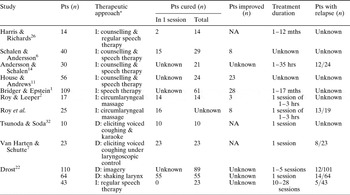
In the present study, the average cure rate was 96 per cent for mental imagery and 74 per cent for laryngeal shaking (with ‘cure’ defined as ‘normal voice’). Studies investigating the effect of therapy in non-organic voice disorders are sparse. Appendix 1 provides an overview of studies which used the same definition as the present one, and which included at least 10 subjects. As mentioned in the Introduction, clinicians' views on voice disorder aetiology generally determine which therapeutic approach is chosen. Thus, therapy may primarily target the assumed underlying aetiology, or target voice production directly. Seven of the 10 studies listed in Appendix 1 describe the effect of indirect approaches, two studies describe direct approaches, and the last study describes indirect as well as direct approaches. This last study was also conducted at our institute, but unfortunately the results were only published in Dutch.Reference Drost22
On average, studies of indirect therapeutic approaches to non-organic voice disorders reported a cure rate of 66 per cent. Two of these studies reported high cure rates. Harris and RichardsReference Harris and Richards26 stated that 14 out of 14 patients were considered cured, but this result was achieved after one year of intervention, which prompts the question of whether some of these results could have been ascribed to spontaneous recovery. Roy and LeeperReference Roy and Leeper2 reported that 14 out of 17 subjects achieved an approximation of normal voice. However, listener ratings showed that, out of 13 subjects who presented with moderate to severe dysphonia (rating more than four on a seven-point severity rating scale), only one had a normal voice quality post-treatment (i.e. a rating of one), and nine had very mild to mild dysphonia (rating one to two). Similarly, the outcome of the study by Roy et al. Reference Roy, Bless, Heisy and Ford9 included normal as well as mildly dysphonic patients.
In comparison to the 66 per cent average cure rate achieved by studies using indirect approaches, the average cure rate reported by studies using direct therapeutic approaches (as listed in Appendix 1) is 95 per cent. Based on the results of the present study and of the studies listed in Appendix 1, we tentatively conclude that approaches targeting voice production directly have a greater chance of success than indirect approaches targeting assumed underlying causes. Additionally, if one considers the treatment duration given in Appendix 1, direct approaches generally seem to require fewer sessions.
In the present study, the cure rate for mental imagery was much higher than that for laryngeal shaking. It is likely that specific patients will respond more readily to one approach than the other, as was alluded to in the Results section. For example, if the voice disorder has persisted for so long that the patient cannot remember their normal voice, shaking is more appropriate. Although logic and clinical expertise may be important when deciding which approach to use, it has not yet been investigated which patients benefit most from mental imagery and which from laryngeal shaking. Future, prospective studies are planned to clarify this issue.
• Non-organic dys- or aphonia may be treated using indirect techniques that target underlying aetiologies or direct techniques that target voice production directly, or both
• Very few studies of non-organic voice disorder have reported results for therapeutic techniques, even fewer for 30 or more subjects
• The use of mental imagery is a well known technique that effectively improves (motor) skills in athletes and musicians
• Both mental imagery and manual shaking of the larynx are effective therapeutic techniques for non-organic voice disorders
• The advantage of mental imagery is that patients can successfully apply this technique themselves, independent of the therapist
It seems that non-organic voice disorder relapses do occur, irrespective of the therapeutic approach. According to Günther et al., Reference Günther, Mayr-Grafl, Miller and Kinzl33 patients with recurring attacks of aphonia have higher levels of anxiety and a significantly higher number of problems in their private lives than patients without recurrences. Roy et al. Reference Roy, Bless and Heisy29 suggested that personality may act as a risk factor, causing relapses. Because only four studies reported relapses and the average follow-up period was generally shorter than in the present study, it is difficult to make a proper comparison. However, a comparison between the previous study conducted at our institute (DrostReference Drost22) and the present study shows that in the earlier study the number of patients suffering relapses was higher for laryngeal shaking than for mental imagery, whereas the present study shows the opposite trend. The advantage of mental imagery is that it allows the patient to retrieve their voice independently, as the results of the follow-up questionnaire confirmed. Mental imagery, especially repetition of mental motor tasks, has been proven to benefit motor performance in athletesReference Driskell, Copper and Moran34 and musicians.Reference Langheim, Callicott, Mattay, Duyn and Weinberger35 We hypothesise that the number of relapses in patients with non-organic voice disorders might decrease if patients were encouraged to practice mental imagery regularly.
Conclusion
Given the neuro-physiological basis and the proven effect of repetition of mental motor tasks, we believe that mental imagery is a powerful tool with which to reset and fine-tune ‘lost’ phonatory performance.
Overview of studies using the same definition of Non-Organic voice disorder as the present one, with ≥10 subjects

* To retrieve normal voice. I = indirect technique; D = direct technique; NA = not applicable; mths = months; hrs = hours