Introduction
Head bandages are commonly used for 7–10 days after pinnaplasty to protect the ears during the post-operative period, reduce the incidence of pinna haematoma and splint the ears into their new positions.Reference Simo and Jones1 However, head bandages can be problematic: they loosen and may slip, requiring re-bandaging,Reference Simo and Jones1 and they do not apply sufficient pressure to prevent haematoma unless they are tight enough to produce a headache.Reference Hill, Allan, Malhan and Williams2 Conversely, tight head bandages can produce serious complications, such as cartilage necrosis and pressure sores.Reference Demir, Haktanir and Yilmaz3
For this reason, several articles have suggested alternatives to the standard head bandage as safer options after pinnaplasty. These include occlusive dressings for the ear composed of siliconeReference Tang and Ponsky4 or Silastic® foam,Reference Bandey, Atkins and Neil5 cyanoacrylate tissue adhesives,Reference Vetter, Foehn and Wedler6 or wrestling headgear.Reference McIntire, Morgan, Kenney and Edgerton7 Other studies have investigated the use of head bandages for a shorter period after pinnaplasty to limit the complication risk. Finally, some authors have questioned the need for any dressings after pinnaplasty.
The aim of this systematic review was to evaluate the role of head bandages used after pinnaplasty as reported in the literature.
Materials and methods
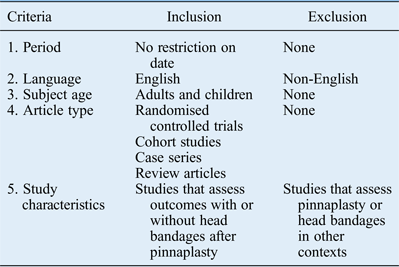
A comprehensive literature search was conducted of the Knowledge Network and databases including Medline, Embase (Ovid), CINAHL (‘Cumulated Index to Nursing and Allied Health Care’; EBSCO collections), the Cochrane Library, Pubmed (US National Library of Medicine) and Google Scholar. Search terms were ‘external ear’, ‘ear cartilage’, ‘auricle’, ‘prominent ear’, ‘bat ear’, ‘external ear malformation’, ‘otological surgical procedures’, ‘ear surgery’, ‘ear reconstruction’, ‘plastic surgery’, ‘aesthetic surgery’, ‘pinnaplasty’, ‘otoplasty’, ‘bandage’ and ‘dressing’, both individually and in combination. The final search was carried out on 9 January 2014. Inclusion and exclusion criteria are shown in Table I.
Inclusion and exclusion criteria

The literature search and a search of the reference lists of these articles identified 34 articles. Two authors (AELMcM and IK) reviewed all titles and abstracts, and 14 relevant articles were examined in full. Of these, seven met our inclusion criteria: one randomised controlled trial (RCT), one ‘quasi’ RCT, one cohort study, three case series and one review article.
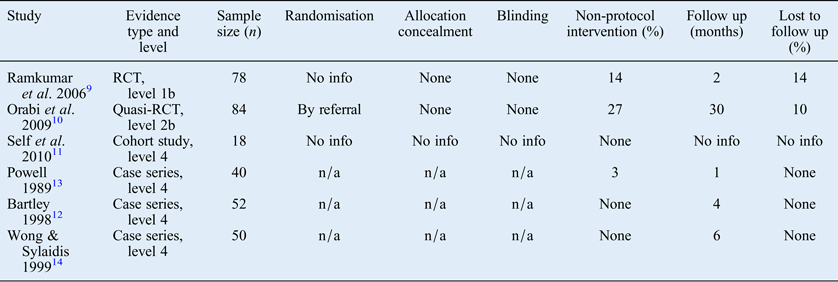
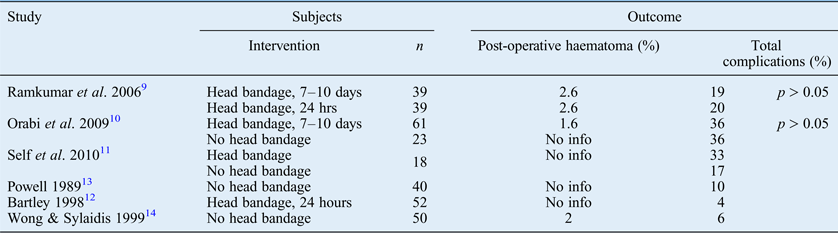
Data were collected from each of these articles, including number of participants, interventions, comparisons, outcomes, length of follow up and study design, with corresponding levels of evidence, as recommended in the PRISMA (‘Preferred Reporting Items for Systematic Reviews and Meta-Analyses’) statement.Reference Moher, Liberati, Tetzlaff and Altman8 Each paper was examined for the quality features noted in Table II. The primary outcome measure for this review was the rate of pinna haematoma, with a secondary outcome of the total complication rate following pinnaplasty with or without a head bandage (Table III).
Quality features of studies
RCT = randomised controlled trial; info = information; n/a = not applicable
Study outcomes
info = information
Results
The prospective RCT reported by Ramkumar et al. in 2006 compared outcomes for 78 children undergoing pinnaplasty who were randomised to have a head bandage for either the standard 7–10 days (control limb) or 24 hours (trial limb).Reference Ramkumar, Narayanan and Laing9 The patient groups were well matched; however, during the study six patients in the control limb had their bandages removed before 7–10 days and five patients in the trial limb had their bandages for more than 24 hours (i.e. 14 per cent non-protocol intervention).
In both the control and trial limbs, one patient developed a post-operative pinna haematoma. Of the 39 children who had a head bandage applied for 7–10 days, 19 per cent had at least 1 reported complication at 2 months. By comparison, of the children who had head bandages for only 24 hours, 20 per cent had a similar complication rate. There was therefore no significant difference in the complication rate between the two groups. The complications recorded included wound-related issues such as scarring, poor cosmetic result and pain.
A further ‘quasi’ RCT comparing outcomes between patients treated with a standard head bandage and no head bandage was reported by Orabi et al. in 2009.Reference Orabi, Chintamani and Timms10 This group of 84 consecutive cases included patients aged from 5 to 56 years rather than the solely paediatric population studied previously. These patients were referred by their general practitioner to one of five ENT surgeons at the same institution for pinnaplasty, four of whom used a head bandage for 7–10 days post-operatively and one of whom did not use any dressings. Referrals were randomly split between these surgeons. The authors argue that this action could be considered as randomisation into two groups, and have called this a ‘quasi’ RCT. However, these groups are not truly randomised, and this paper is best considered a non-randomised comparative study, therefore providing level 2 evidence.
Non-protocol intervention also took place in this study: 34 per cent of the head bandage group did not keep their head bandage in place for the full 7–10 days. However, unlike in the previous article, the trial limb was not compromised because none of these patients ever had a head bandage applied post-operatively. Therefore, the total for the study as a whole was 27 per cent. In this study, one post-operative haematoma was recorded in the head bandage group, which contradicts the theory that using head bandages prevents this complication. The overall complication rate in the head bandage group was 36 per cent compared with 26 per cent in the no head bandage group. Furthermore, there was no statistically significant difference in the complication rate between groups (p = 0.09).
A cohort study incompletely reported in a letter by Self et al. in 201011 compared the use of head bandages for an unstated period with not using head bandages after pinnaplasty in children. The authors showed that 33 per cent of those with a bandage experienced complications compared with 17 per cent of those without a bandage. However, no information was given about the types of complications recorded, and no statistical analysis was performed. Despite the lack of information reported, this is one of only three articles comparing different types of interventions that met our inclusion criteria.
Further information on the safety of using a head bandage for only 24 hours or not at all was reported in three case series. In 1998, Bartley prospectively studied 52 patients who had a head bandage in place for 24 hours, and found a 4 per cent complication rate.Reference Bartley12 In 1989, Powell studied 20 adults and 20 children who did not have head bandages after pinnaplasty and found that 10 per cent had complications.Reference Powell13 However, in truth the majority of the patients Powell describes did have a protective bandage applied until they recovered from the general anaesthetic, or until the first post-operative day in the case of the 20 children included. Only 7 of the adult patients truly had no post-operative head bandage applied as their operation was performed under local anaesthetic. In 1999, Wong and Sylaidis studied 50 patients of all ages without head bandages and reported a complication rate of 6 per cent, including one post-operative haematoma.Reference Wong and Sylaidis14
Finally, in 2012, NorrisReference Norris, Mabvuure, Cumberworth and Watts15 reviewed all of these studies except for the Powell study.Reference Powell13 This review concluded that use of a head bandage after pinnaplasty does not prevent complications and may actually cause them, and that not using one is a safe alternative. Therefore, it recommends that when head bandages are applied it should be for the shortest duration possible.
Discussion
The theory behind the use of head bandages after pinnaplasty is that they provide protection post-operatively, apply pressure to prevent the formation of pinna haematomas and help splint the ears into their new position. However, there is no evidence to support these theories. The evidence in this review demonstrates that pinna haematoma is rare post-operatively, and that it may occur whether a head bandage is used or not. In terms of total complications after pinnaplasty, there is no evidence for a statistically significant difference in the complication rates when using a head bandage for 7–10 days, 24 hours or not at all.
The authors acknowledge that the studies included in this systematic review are not without methodological flaws. The RCT and comparative studies have small sample sizes, are not blinded and do not make any concealment of group allocation. Ramkumar et al. reported results for 11 patients who did not actually receive the treatment to which they were randomised.Reference Ramkumar, Narayanan and Laing9 Orabi et al. compared a larger group of patients cared for by four different surgeons to those assigned to a single surgeon and referred to this as ‘quasi’ randomisation.Reference Orabi, Chintamani and Timms10 The cohort study reported by Self et al. was incompletely reported, and the case series had few participants.Reference Self, Madani, Senior, Howes and Dheansa11
However, in these studies it is clear that the use of head bandages for a shorter period after pinnaplasty does not affect the complication rate when compared with the standard 7–10 day head bandage. Nonetheless, clinical experience tells us that patients often find head bandages uncomfortable. Head bandage slippage is also a problem: as many as 50 per cent of patients with head bandages for 7–10 days return to hospital at least once for its re-application,Reference Self, Madani, Senior, Howes and Dheansa11 although this is not included as a complication in the reviewed articles. Reports of rare, but nonetheless serious, complications such as cartilage necrosis and pressure sores continue to support the argument against the use of a standard head bandage.
A robust RCT addressing the noted issues of sample size, randomisation and blinding and which directly compares these three treatment groups would be the best way to definitively answer this clinical question. However, if pinna haematoma is used as the primary outcome, the reported incidence of approximately 2 per cent across the studies included in this review becomes an important factor. This means that a huge number of participants would be required to show a statistically significant difference. A compound outcome such as the general rate of post-operative complications would be more practicable. However, bundling together a wide variety of issues into a single figure would lead to the same problems as those already discussed. This means that problems that matter to patients such as discomfort or having to return to hospital for re-bandaging are often neglected.
The authors therefore recognise the limitations of the information presented in this systematic review but also acknowledge the difficulty involved in designing a trial to provide more robust evidence. In this situation, there is no difference in the complication rate to recommend one intervention over another. However, the authors conclude that the duration of head bandaging after pinnaplasty should be reduced. Head bandages applied for 24 hours or less have been shown to be just as effective as a standard head bandage in preventing complications. They are also less likely to slip, require replacement or cause their own serious complications because of the limited duration of application.
Conclusion
Based on the available evidence, the authors advise that using a standard head bandage for 7–10 days after pinnaplasty can be problematic for patients and can cause serious complications. Therefore, the proven safe alternatives of not using a head bandage or using one for only 24 hours after pinnaplasty are recommended.
Acknowledgements
The authors would like to thank Ms Amanda Wright, of the NHS Greater Glasgow and Clyde Library Network, for her help with the literature search.