Introduction
Suicide is a significant, yet preventable, public health problem. WHO estimates that more than 800 000 people globally die from suicide every year, which roughly corresponds to one death every 40 s (WHO, 2012). In some countries, suicide ranks among the three leading causes of death among those aged 15–44 years (WHO, 2012). It is also often an especially large burden late in life, when suicide rates are highest in many countries (Shah, Reference Shah2007). In Japan, suicide was the seventh major cause of death in 2012 (Cabinet Office of Japan, 2013). Furthermore, among the G8 (group of eight) countries, Japan has the second highest suicide rate (24.2 per 100 000 in 2006) (Cabinet Office of Japan, 2013). Russia ranks first with a suicide rate of 30.1 in 2006, followed by France, Germany, Canada, USA, UK and Italy at 16.3 (2007), 11.9 (2006), 11.3 (2004), 11.0 (2005), 6.9 (2009) and 6.3 (2007), respectively. Therefore, suicide prevention is a major target of public health efforts.
Although social, economic, cultural and psychological factors are significant contributors to suicide rates, there is good evidence that changing the availability and popularity of lethal methods is also important (Cantor & Baume, Reference Cantor and Baume1998; Yip et al. Reference Yip, Caine, Yousuf, Chang, Wu and Chen2012). Thus, modification of the environment to restrict access to lethal means is not only an important suicide prevention strategy, but also one that is reported to have strong empirical evidence (Mann et al. Reference Mann, Apter, Bertolote, Beautrais, Currier, Haas, Hegerl, Lonnqvist, Malone, Marusic, Mehlum, Patton, Phillips, Rutz, Rihmer, Schmidtke, Shaffer, Silverman, Takahashi, Varnik, Wasserman, Yip and Hendin2005; Yip et al. Reference Yip, Caine, Yousuf, Chang, Wu and Chen2012). Previous research has shown that method-specific suicide rates decreased after firearm control legislation (Loftin et al. Reference Loftin, McDowall, Wiersema and Cottey1991; Gagne et al. Reference Gagne, Robitaille, Hamel and St-Laurent2010), restrictions on pesticides (Gunnell et al. Reference Gunnell, Fernando, Hewagama, Priyangika, Konradsen and Eddleston2007) and detoxification of domestic gas (Kreitman, Reference Kreitman1976) was introduced. In countries, where the method was common, restriction of means also could lead to lower overall suicide rates (Mann et al. Reference Mann, Apter, Bertolote, Beautrais, Currier, Haas, Hegerl, Lonnqvist, Malone, Marusic, Mehlum, Patton, Phillips, Rutz, Rihmer, Schmidtke, Shaffer, Silverman, Takahashi, Varnik, Wasserman, Yip and Hendin2005; Yip et al. Reference Yip, Caine, Yousuf, Chang, Wu and Chen2012). However, there have been some reports suggesting that restriction of certain means did not actually lower suicide rates because it might induce some suicidal individuals to shift towards other means of suicide (Amos et al. Reference Amos, Appleby and Kiernan2001; Klieve et al. Reference Klieve, Barnes and De Leo2009; Bridge et al. Reference Bridge, Greenhouse, Sheftall, Fabio, Campo and Kelleher2010).
In Japan, the annual number of suicides increased by 34.7% from 1997 to 1998, resulting in more than 30 000 cases (Cabinet Office of Japan, 2013), and has remained high ever since. The economic recession in the 1990s is thought to have led to this dramatic increase in suicides (Watanabe et al. Reference Watanabe, Furukawa, Nakamura and Ogura2006).With regard to trends in suicide rates by age group, although there has been a decreasing trend for people aged 50 years or more since 1998, rates for those in their twenties and thirties are increasing (Cabinet Office of Japan, 2013). However, little is known about whether the particular suicide methods have contributed differently to the recent unfavourable trends in suicide mortality in Japan. Previous time-trends analyses from various countries have shown that the percentage of different suicide methods used changes over time (Nordentoft et al. Reference Nordentoft, Qin, Helweg-Larsen and Juel2006; Baumert et al. Reference Baumert, Erazo, Ruf and Ladwig2008; Lin & Lu, Reference Lin and Lu2008; Thomas & Gunnell, Reference Thomas and Gunnell2010). Analysing such trends may shed light on the effect of potentially preventable factors, such as the impact of restricting access to certain popular suicide methods, on overall rates. Therefore, we aimed to assess method-specific suicide mortality by gender and age and corresponding time trends in Japan.
Methods
Data sources
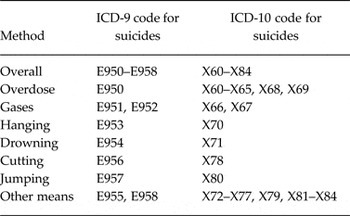
Mortality data between 1990 and 2011 were obtained from the Vital Statistics of Japan (Ministry of Health, Labour and Welfare, Japan, 1992, 1993, 2012) and included information on the number of deaths from suicide by gender, age (5-year age bands) and the underlying cause of death. To identify the method of suicide, the underlying cause of death according to ICD-9 or -10 (International Classification of Diseases, 9th or 10th revision) (WHO, 1977, 1992) was used. Death by suicide was defined as ‘intentional self-harm’ according to the ICD-9 categories E950–E959 in the time period from 1990 to 1994 and the ICD-10 categories X70–X84 and Y87.0 in the time period from 1995 to 2011. Since E959 in ICD9 and Y87.0 in ICD10 were labelled as ‘death following a suicide attempt’ and the underlying suicide method was not assessed, these codes were excluded from the present analysis. We defined seven different suicide means by allocating similar death causes to one group (Table 1): ‘Overdose,’ ‘Gases,’ ‘Hanging,’ ‘Drowning,’ ‘Cutting,’ ‘Jumping’ and ‘Other means.’ ‘Other means’ include suicide by firearms, explosives, flames or jumping/lying before moving objects, etc. Data on suicide victims 14 years old or younger were not analysed in this study. According to previous studies (Vichi et al. Reference Vichi, Masocco, Pompili, Lester, Tatarelli and Vanacore2010; Bando et al. Reference Bando, Brunoni, Fernandes, Bensenor and Lotufo2012), age was divided into four groups: 15–24, 25–44, 45–64 and 65+ years. Mid-year populations by gender and age were also obtained from the Vital Statistics of Japan. Age-adjusted suicide rates were calculated using the world population structure as a standard (Ahmad et al. Reference Ahmad, Boschi-Pinto, Lopez, Murray, Lozano and Inoue2001). Rates are per 100 000 individuals per year. Gender-, age- and method-specific death rates were calculated to examine suicide trends. Availability of specific methods for suicide and the lethality of available methods could affect overall suicide rates in a region as well as method-specific rates (Mann et al. Reference Mann, Apter, Bertolote, Beautrais, Currier, Haas, Hegerl, Lonnqvist, Malone, Marusic, Mehlum, Patton, Phillips, Rutz, Rihmer, Schmidtke, Shaffer, Silverman, Takahashi, Varnik, Wasserman, Yip and Hendin2005; Yip et al. Reference Yip, Caine, Yousuf, Chang, Wu and Chen2012). In this study, since we aimed to elucidate which specific methods of suicide have contributed to the recent trends in suicide mortality in Japan, we analysed suicide mortality trends based on suicide rates instead of proportions of each method to total number of suicide deaths.
Suicide methods by ICD-9 (1990–1994) and ICD-10 classification (1995–2011)

Statistical methods
To analyse age-adjusted trends in suicide rates by gender, age and methods used between 1990 and 2011, we performed a joinpoint regression analysis, which allows the identification of the calendar year where any temporal trend changed significantly (Kim et al. Reference Kim, Fay, Feuer and Midthune2000). The best fitting point (joinpoint), where the rate significantly changes (increases or decreases), is chosen. The analysis starts with the minimum number of joinpoints (a zero joinpoint, which is a straight line) and tests whether one or more joinpoints are significant and must be added to the model. A maximum of four joinpoints was allowed in this study because of the default maximum number of joinpoints when the number of data points is from 22 to 26 (National Cancer Institute, 2014). In the final model, each joinpoint (if any were detected) indicates a significant change in the slope. An estimated annual percentage change (EAPC) and the corresponding 95% confidence interval (95% CI) were then computed for each detected trend. The EAPC was considered significant if the corresponding confidence interval did not include zero. Furthermore, in order to compare the estimated changes in age-adjusted suicide rates during the overall research period (1990–2011), the average annual percentage change (AAPC) was calculated. The AAPC is a summary measure that is computed, over a fixed interval, as a weighted average of the slope coefficients of the joinpoint regression with the weights equal to the length of each detected segment over the interval. When no joinpoint is detected, the AAPC coincides with the EAPC.
The joinpoint analysis was applied to the age-adjusted rates (and their standard errors), separately, for gender, age and methods used and carried out using the Joinpoint Regression Program, version 4.0.4 (National Cancer Institute, Bethesda, MA, USA, http://surveillance.cancer.gov/joinpoint/). This is relatively new software, initially used in cancer research to identify secular mortality trends (Ries et al. Reference Ries, Wingo, Miller, Howe, Weir, Rosenberg, Vernon, Cronin and Edwards2000). It has also been used in several studies to evaluate temporal trends in mortality rates, e.g., from various cancers and coronary heart disease (Rodriguez et al. Reference Rodriguez, Malvezzi, Chatenoud, Bosetti, Levi, Negri and La Vecchia2006; Qiu et al. Reference Qiu, Katanoda, Marugame and Sobue2009). In recent years, it has been applied to psychiatric studies to evaluate time trends of suicide in several countries (Vichi et al. Reference Vichi, Masocco, Pompili, Lester, Tatarelli and Vanacore2010; Bando et al. Reference Bando, Brunoni, Fernandes, Bensenor and Lotufo2012; Kolves & De Leo, Reference Kolves and De Leo2014). However, it has not really been utilised to explore the situation in Japan. The advantage of the joinpoint method is that it can model changes in mortality data over time and identify the time point in which statistically significant changes in the trends occurred, as well as identifying the annual percentage of change within these periods. Thus, compared with only reviewing graphical charts of time courses, the joinpoint regression provides us with an objective method to evaluate changes in the trend of mortality data. However, the contribution of various well-known risk factors for suicide (e.g., unemployment, prescription of antidepressants, divorced, etc.) cannot be included in a more complex model due to Joinpoint regression limitations. All other statistical analyses except the joinpoint regression were performed using Stata statistical software, version 12.1, for Macintosh (StataCorp, College Station, TX, USA).
Results
Suicide methods by gender and age
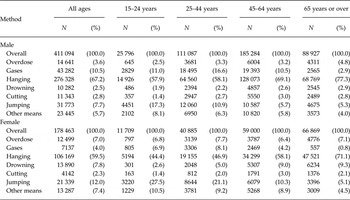
The number and the percentage of suicides by method, gender and age group between 1990 and 2011 are shown in Table 2. Mortality data in this study were restricted to suicides with the ICD-9 code E950–E958 (1990–1994) and the ICD-10 code X70–X84 (1995–2011). Furthermore, data on suicide victims 14 years old or younger were excluded. In males overall, hanging (67.2%) was by far the most commonly used method, followed by gases (10.5%) and jumping (7.7%). Furthermore, in each age group, hanging was also the most commonly used method in men, and was particularly high in the older age groups. With regards to females, as with males, hanging (59.5%) was by far the most frequently used method overall, followed by jumping (12.0%), drowning (7.8%) and overdose (7.0%). Hanging was also the most frequently used method in each age group. Similar to males, the percentages of suicides by hanging also increased with age. However, the percentage of suicides by hanging in females was smaller than in males.
The number and the percentage of suicides by method, gender and age group, for population aged 15 or above in Japan, 1990–2011

Overall suicide trends
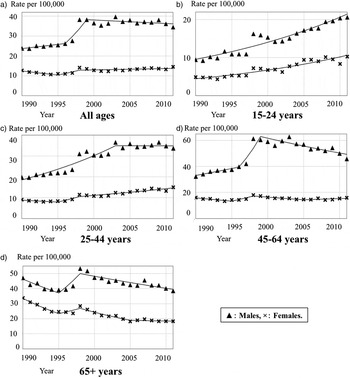
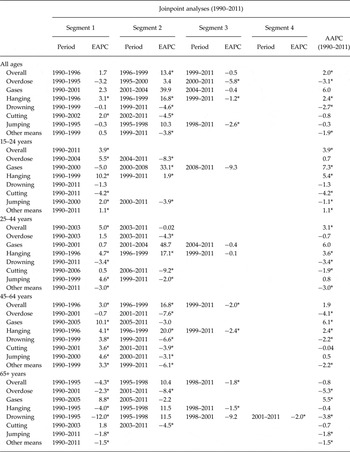
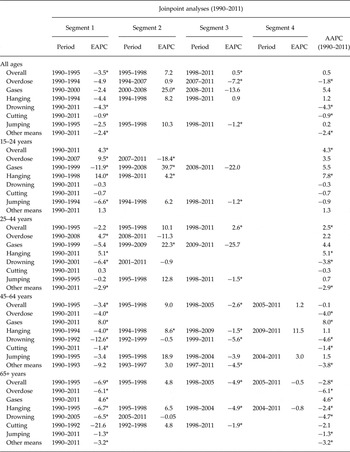
The results of the joinpoint regression analyses in males and females are summarised in Tables 3 and 4, respectively. Figure 1 shows the age-standardised suicide rates by age group with line segments from joinpoint regression models. For males of all ages, the trend in overall suicide rate tended to remain flat between 1990 and 1996, and then increased sharply between 1996 and 1999, after which it plateaued. Concerning trends by age group, in the late 1990s, an increasing trend in males of all age groups was observed. After 2000, an increasing trend in males aged 15–24 years was observed, while a decreasing trend in males aged 45–64 and 65 years or older was observed. For males aged 25–44 years, the trend increased until 2003, after which it plateaued.
Age-standardised suicide rates per 1000,000 population aged 15 or above by gender and age groups in Japan, 1990–2011, with line segments from joinpoint regression models.

Summary of the Joinpoint Analyses for trends in age-standardised suicide rates by age and methods used, for Japanese men aged 15 or above, 1990–2011

EAPC, estimated annual percentage change; AAPC, average annual percent change.
*EAPC or AAPC is statistically significantly different from 0 (two-sided p < 0.05).
Summary of the Joinpoint Analyses for trends in age-standardised suicide rates by age and methods used, for Japanese women aged 15 or above, 1990–2011

EAPC, estimated annual percentage change; AAPC, average annual per cent change.
*EAPC or AAPC is statistically significantly different from 0 (two-sided p < 0.05).
For females of all ages, the trend decreased between 1990 and 1995, increased sharply between 1995 and 1998, after which a slight increase was seen. In the late 1990s, an increasing trend in females of all age groups was also observed. After 2000, an increasing trend in females aged 15–24 and 25–44 years was observed, while a decreasing trend in females aged 45–64 and 65 years or older was found.
Method-specific suicide trends in the late 1990s
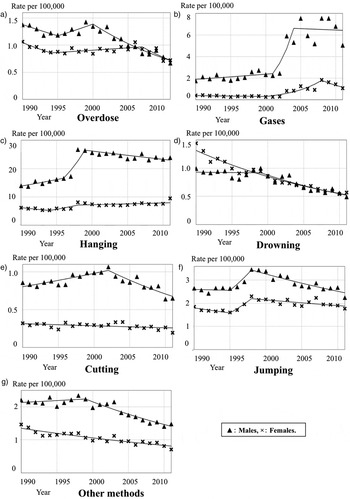
Figure 2 shows the age-standardised suicide rates by method used with line segments from joinpoint regression models. In the late 1990s, for both males and females of all ages, trends in hanging and jumping suicides increased sharply. For hanging suicide, an increasing trend was observed in both males and females of all age groups. For jumping suicide, an increasing trend was observed in both males and females aged 15–24, 25–44 and 45–64 years, but not in those aged 65 years or older. For overdose suicide, a trend showing a moderate increase in males of all ages was observed between 1995 and 2000, but this was not seen in females. For cutting and gas suicide, a trend showing a moderate increase in males of all ages was observed throughout the 1990s, but not in females.
Age-standardised suicide rates per 1000,000 population aged 15 or above by gender and methods used in Japan, 1990–2011, with line segments from joinpoint regression models.

Method-specific suicide trends after 2000
The trend in gas suicides in males of all ages increased dramatically between 2001 and 2004, after which it plateaued. The trend for suicide methods except gases in males of all ages decreased after 2000. For gases suicide after 2000, the trend in males aged 15–24 years increased dramatically until 2008, after which it has decreased sharply. The trend in males aged 25–44 years increased dramatically until 2004, after which it tended to remain flat. The trends in males aged 45–64 and 65 years or older increased sharply until 2005, after which they decreased slightly. For overdose suicide, the trend in males aged 15–24 years increased until 2004, and then decreased sharply. For hanging suicide, the trend in males aged 15–24 years increased after 2000.
For gas suicide in females of all ages, while the trend increased dramatically until 2008, it decreased sharply after that. The trends for drowning, cutting, jumping and other means of suicide in females of all ages decreased after 2000. The trend for overdose suicide in females of all ages tended to remain flat until 2007, after which a sharp decrease was observed. The trend for hanging in females of all ages has remained flat from 1998 onwards. For gas suicides, trends in females aged 15–24 and 25–44 years increased dramatically until 2008 or 2009, after which they decreased sharply. The trends in females aged 45–64 and 65 years or older increased without a joinpoint throughout the research period. For overdose suicides, the trends in females aged 15–24 and 25–44 years increased until 2007 or 2008, and then decreased sharply. For hanging suicides, the trends in females aged 15–24 and 25–44 years increased after 2000, whereas those in females aged 45–64 years increased sharply between 2009 and 2011.
We checked method-specific time trends in suicide rates by gender and age (5-year age bands) graphically, and did not observe an apparent difference in trends within each of the four age categories (15–24, 25–44, 45–64 and 65+ years).
Discussion
To clarify the contribution of different suicide methods to the overall transition, the present study analysed incidences and trends in method-specific suicide mortality by gender and age group over a 22-year period in Japan. We applied joinpoint regression to the data and quantified the observed changes. As far as we are aware, this is the first study to present such a detailed gender-and age-specific analysis in suicide methods over a recent period of time in Japan. For males of all ages, a trend analysis revealed that between 1990 and 2011 three different periods could be identified: an almost flat period in the early 1990s, a period of sharp increase until the late 1990s, followed by an almost flat period in the 2000s. For females of all ages, three different periods could also be identified: a period of moderate decrease in the early 1990s, a period of sharp increase until the late 1990s, followed by a period of slight little increase after the year 2000. Our results of analyses by suicide method revealed that different suicide methods varied in their contribution to these recent overall suicide transitions in Japan.
Suicide trend in the late 1990s
In the late 1990s, for both males and females of all ages, sharply increasing trends in overall suicide rates were observed. The economic recession in the 1990s is thought to have led to this dramatic increase in suicides (Watanabe et al. Reference Watanabe, Furukawa, Nakamura and Ogura2006). Watanabe et al. (Reference Watanabe, Furukawa, Nakamura and Ogura2006) indicated that unemployment and personal bankruptcy was associated with this increase. In 1997–1998, a widespread economic crisis hit many East/Southeast Asian countries, including Japan (Ito, Reference Ito2007). Chang et al. (Reference Chang, Gunnell, Sterne, Lu and Cheng2009) reported that, compared with 1997, suicide rates in males in 1998 rose by 39% in Japan, 44% in Hong Kong and 45% in Korea, while rises in female rates were less marked. Concerning suicide methods, for males of all ages, suicides by hanging and jumping tended to increase sharply in the late 1990s, and suicides by overdose, gases, cutting and jumping tended to increase slightly. For females of all ages, suicide by only hanging and jumping tended to increase. Thus, our results indicate that suicide by hanging and jumping, in particular, might have contributed to the sharp increase in overall suicide rates in the late 1990s. If the economic recession in the 1990s had equally influenced all method-specific suicides, all of the rates would have increased equally. Thus, we believe the economic recession does not fully explain why suicides by hanging and jumping tended to increase sharply only in the late 1990s. Further studies are needed to clarify the factors, other than economic factors, associated with the sharp increase in the suicide rate by hanging and jumping in the 1990s.
Suicide trend after 2000
After 2000, although a decreasing trend in overall suicide rates in both males and females aged 45–64 and 65 years or older was observed, there was an increasing trend in those aged 15–24 and 25–44 years. It has been reported that the suicide rate of young people in Japan has a close correlation with the unemployment rate of recent years (Cabinet Office of Japan, 2013). Despite a relative improvement in the economic situation, the employment situation for younger generations has deteriorated. Increased non-regular forms of employment such as temporary work, contract work or part-time jobs have led to many young people facing financial difficulties and distress.
Concerning suicide methods, for gas suicide, regardless of gender and age group, a substantial increasing trend was observed in the 2000s. For males and females aged 15–24 and 25–44 years, an increase in suicide by overdose and hanging was also observed in the 2000s. This indicates that these methods contributed to the increasing trend in overall suicide rates in younger generations after 2000. The increase in suicide by gases is thought to be attributable to the epidemics of suicides by charcoal-burning and homemade hydrogen sulphide gas (Morii et al. Reference Morii, Miyagatani, Nakamae, Murao and Taniyama2010; Yoshioka et al. Reference Yoshioka, Hanley, Kawanishi and Saijo2014). Concerning the charcoal-burning suicide method, the epidemic in Japan emerged around 2003 (Yoshioka et al. Reference Yoshioka, Hanley, Kawanishi and Saijo2014). It has been reported that the charcoal-burning suicide epidemic may have led to a 10–20% increase in overall suicide rates in both males and females aged 15–24 and 25–44 years. Concerning the homemade hydrogen sulphide gas method, there was a sharp increase in suicide attempts from January 2008 (Morii et al. Reference Morii, Miyagatani, Nakamae, Murao and Taniyama2010).
Regarding overdose suicide, inappropriate prescription of psychotropic drugs in Japan might have contributed to an increase in the rates in younger generations. The International Narcotics Control Board (2010) reported that consumption levels of benzodiazepine agents tend to be comparatively high in Japan, and that the high consumption levels observed might reflect inappropriate prescribing patterns and associated abuse. Furthermore, comparative research in East Asia revealed that the prevalence of antipsychotic polypharmacy in patients with schizophrenia in Japan tended to be higher (Sim et al. Reference Sim, Su, Fujii, Yang, Chong, Ungvari, Si, Chung, Tsang, Chan, Heckers, Shinfuku and Tan2004). Regarding hanging suicides, the reason why suicides using this method have tended to increase in younger generations after 2000 is not clear.
Implication for suicide prevention
There is strong and consistent evidence from international studies that restricting access to specific methods can prevent suicides (Cantor & Baume, Reference Cantor and Baume1998; Yip et al. Reference Yip, Caine, Yousuf, Chang, Wu and Chen2012). Means restriction proves most effective when the method is common and highly lethal (Yip et al. Reference Yip, Caine, Yousuf, Chang, Wu and Chen2012). Although substitution of one method with another does happen, people who attempt suicide with less dangerous means have an increased chance of survival when reduced access to a highly lethal method is possible.
During the research period in Japan, hanging was by far the most common method in both males and females, regardless of age group. Furthermore, an increasing trend in hanging suicides in young generations has been observed recently, although little is known about the reasons behind this unfavourable trend. Hanging is a particularly lethal method of suicide with an estimated fatality rate of 60–85% (Yip et al. Reference Yip, Caine, Yousuf, Chang, Wu and Chen2012). However, a means restriction approach is generally not possible for hanging suicides as the ligature points and ligatures commonly used are universally available (Gunnell et al. Reference Gunnell, Bennewith, Hawton, Simkin and Kapur2005). Although an exception to this is suicide in institutional settings – police custody, prisons and hospitals – such deaths are estimated to be only about 10% of all hanging suicides (Gunnell et al. Reference Gunnell, Bennewith, Hawton, Simkin and Kapur2005). Therefore, further studies are required to better understand the reasons for choice of this method. In addition, the focus needs to be on the prevention of factors leading to suicide generally.
The epidemics of charcoal-burning suicides in both Hong Kong and Taiwan preceded that of Japan (Liu et al. Reference Liu, Beautrais, Caine, Chan, Chao, Conwell, Law, Lee, Li and Yip2007). Yip et al. (Reference Yip, Law, Fu, Law, Wong and Xu2010) conducted an exploratory controlled trial to examine the efficacy of restricting access to charcoal to prevent charcoal burning-related suicides in Hong Kong. Their results indicated that the suicide rate from charcoal burning was reduced by a statistically significant margin in the intervention region, but not in the control region. Since the charcoal-burning method became a popular suicide method among Japanese after the Hong Kong epidemic and it is moderately lethal (Yip et al. Reference Yip, Caine, Yousuf, Chang, Wu and Chen2012), restricting access to the charcoal-burning method may be effective in reducing not only the charcoal-burning specific suicide rate but also the overall suicide rate in Japan. Therefore, although charcoal is generally perceived as a household leisure commodity used for home barbecues etc., and restricting it may be difficult, the efficacy of restricting access to charcoal should also be investigated in Japan. Regarding suicide by hydrogen sulphide, little is known about the impact of this epidemic on overall and method-specific suicide rates in Japan. Thus, further studies are needed to clarify the impact of this epidemic and the efficacy of restricting access.
The incidence of suicide by jumping from a height tends to be higher in cities, city states or countries that have extensive high-rise housing (Beautrais, Reference Beautrais2007; Ajdacic-Gross et al. Reference Ajdacic-Gross, Weiss, Ring, Hepp, Bopp, Gutzwiller and Rossler2008). Installation of safety fences at high-risk jump sites has been successful in reducing suicides by jumping at these sites (Beautrais, Reference Beautrais2007). Even though the rate of jumping suicides has tended to decrease from the year 2000 onwards, further research is needed due to the lack of information on geographical distribution and the effect of installing safety fences in Japan. Legislation to restrict the quantity of paracetamol and other analgesics sold in the UK in 1998 led to a decline in mortality and morbidity associated with paracetamol overdose, with little evidence of substitution to other kinds of analgesics (Hawton et al. Reference Hawton, Simkin, Deeks, Cooper, Johnston, Waters, Arundel, Bernal, Gunson, Hudson, Suri and Simpson2004). In Japan, inappropriate prescribing patterns of psychotropic drugs might be associated with an increase in the rates of suicide by overdose. Even though the rate of overdose suicide has decreased recently, further research is needed due to the lack of the findings on the association between psychotropic drugs and overdose suicide.
Limitations
The study had several limitations that deserve discussion. First, analyses are based on data from official death certificates which might underestimate true suicide rates. Social, cultural and religious elements affect the reporting of suicide and are compounded by poor population estimates. We carried out sensitivity analyses, including cases where cause of death was classified as an undetermined intent (E980–989 in ICD-9 and Y10–34, 87.2 in ICD-10), to assess any effects of possibly misclassified cases of suicide. The results of the sensitivity analyses were almost identical with the main findings in this research (data were not shown). Consequently, we believe that, in the present study, misclassification of mortality data would have a minimal effect on the results. Second, since cause-of-death classification changed from ICD-9 to ICD-10 during the research period, it was necessary to translate method-specific suicides from one diagnostic system to another. This might affect assignment of suicidal events to specific methods. However, visual inspection of the figures revealed no obvious discontinuities in the method-specific suicide rates between 1994 and 1995, when a revision of the ICD was implemented in Japan. Last, the study was descriptive in design, and the delineation of the complex relationships among risk factors of suicide was beyond the scope of this study.
Financial Support
This research received no specific grant from any funding agency, commercial or not-for-profit sectors.
Conflict of Interest
The authors have no conflicts of interests to state for the present manuscript.
Ethical Standards
None.