Background
Worldwide, the population is ageing. In 2017, there were approximately 962 million older people living worldwide (United Nations, 2017). While older people are generally defined as people aged 60 and older, it is acknowledged that factors such as health and socio-economic status can affect this definition (World Health Organization, 2010). For example, in low-income countries where people have shorter lifespans, older people may be defined as those over 50 years (World Health Organization, 2010). Furthermore, people with disabilities may experience the ageing process earlier in their lives (also known as accelerated ageing), which can cause a mismatch between chronological age and biological age (Molton et al., Reference Molton, Goetz, Jensen and Verrall2012; Access Independent Living Services, 2015). Nevertheless, the number of older people in the population is predicted to keep rising, and with falling birth rates, the proportion of older people in the population will continue to grow. For example, the number of older people living globally is projected to reach nearly 2.1 billion people by 2050 (United Nations, 2017). As people age, they experience normative physical and cognitive changes in several domains, such as vision, hearing, memory, strength and mobility (Rowe and Khan, Reference Rowe and Khan1987). While these changes are part of the ‘normal ageing’ process, they can also be indicators of future impairments to come. For example, these normal age-related changes can evolve into chronic diseases and conditions such as age-related vision loss (ARVL), hearing loss, dementia and mobility impairments (Rowe and Khan, Reference Rowe and Khan1987). To reduce further decline and maintain participation, many of these impairments can be mitigated by the use of assistive technologies.
Assistive technologies include a broad range of devices with a primary purpose of maintaining or improving a person's function and independence (World Health Organization, 2018). Assistive technologies can support occupational performance, mobility, safety, social and community involvement, and self-confidence; all of which contribute to positive wellbeing (Fok et al., Reference Fok, Polgar, Shaw and Jutai2011). For example, assistive devices targeting mobility such as walkers, canes, motorised scooters, prosthetic devices and wheelchairs can enable people with physical impairments to remain active and mobile in the community. Similarly, mainstream devices such as smartphones and tablets can be used for assistive purposes by people living with dementia, by providing reminders, storing information and keeping track of events (Astell et al., Reference Astell, Malone, Williams, Hwang and Ellis2014). However, despite the many benefits offered by these technologies, the rate of adoption (i.e. the decision to accept and regularly use something) among older adults is lagging far behind the rate at which these devices are being created (Lund and Nygård, Reference Lund and Nygård2003). For example, while personal emergency response alarms and telemedicine systems have been available for decades, the adoption of these devices remains low, despite older adults’ acknowledgement of their benefits to maintaining safety and independence (Stokke, Reference Stokke2016). To maximise older adults’ uptake of potentially helpful technologies, further understanding of the complex processes underlying their decisions to adopt or abandon any given technology requires further exploration (Lund and Nygård, Reference Lund and Nygård2003).
According to the Technology Acceptance Model (TAM; Davis, Reference Davis1989), perceived usefulness and perceived ease of use have long been recognised as significant predictors of technology adoption in the general population. In an effort to broaden the TAM's applicability to older populations, the Senior Technology Acceptance Model (STAM; Chen and Chan, Reference Chen and Chan2014) was developed to capture additional dimensions specifically relevant to older adults, such as age-related cognitive and physical changes, and computer self-efficacy. Furthermore, the Centre for Research and Education on Ageing and Technology Enhancement (CREATE; Create Center, 2017) has investigated the impact of several complex factors affecting older adults’ willingness to adopt technologies, such as attitudes towards technology, computer anxiety, and crystallised and fluid intelligence (Czaja et al., Reference Czaja, Charness, Fisk, Hertzog, Nair, Rogers and Sharit2006). However, although these models address many key aspects of decision-making regarding technology adoption, our understanding about older adults’ technology adoption decision-making patterns, and why older adults continue to reject devices despite their clear benefits, is lacking.
One theory is that older adults reject helpful technologies in an effort to resist or distance themselves from ageist stereotypes and negative identities augmented by using these devices (Coughlin et al., Reference Coughlin, D’Ambrosio, Reimer and Pratt2007). Stereotypes of ‘oldness’ are often negative, depicting old age as a time of ill health, disability, dependency, poor mental and physical functioning, loneliness and incompetence (Hurd, Reference Hurd1999; Dionigi, Reference Dionigi2002, Reference Dionigi2015; Nemmers, Reference Nemmers2004; Spafford et al., Reference Spafford, Rudman, Leipert, Klinger and Huot2010). These ageist stereotypes are often resisted by older adults, who aim to preserve and portray an identity congruent with notions of independence, competence and self-reliance (Hurd, Reference Hurd1999; Nemmers, Reference Nemmers2004; Spafford et al., Reference Spafford, Rudman, Leipert, Klinger and Huot2010; Dionigi, Reference Dionigi2015). For example, participants from a local senior's centre disassociated themselves from the stereotypical and negative image of ageing by actively avoiding people who they considered to fit the image of ‘old’ (Hurd, Reference Hurd1999). Similarly, older athletes used participation in competitive sport to distance themselves from the stereotypical image of ageing, citing a fear of becoming ‘very old, very quickly’ should they stop participating (Dionigi, Reference Dionigi2002). These examples suggest that identity and self-image play a prominent role in older adults’ daily decision-making.
To address the importance identity plays in older adults’ decision-making, this scoping review is informed by Identity Theory (Burke and Stets, Reference Burke and Stets2009). Although the authors did consider alternative theories, such as Positioning Theory (Harré, Reference Harré and Valsiner2012) and Role Theory (Hindin, Reference Hindin and Ritzer2007), it was decided that Identity Theory was best suited to the research question because it specifically looks at the influence that identity has on a person's behaviour. Considering our interest in understanding how one's desire to assume a particular identity influences their adoption of technology, Identity Theory provides the best theoretical fit. Identity Theory seeks to explain how people's identities influence their behaviour, thoughts, feelings or emotions (Burke and Stets, Reference Burke and Stets2009). It is argued that people employ multiple identities as they operate in the world in relation to their family, friends, colleagues, etc., and the roles they inhabit (e.g. parent, partner, athlete, cook, friend, etc.). Identity Theory suggests that humans strive to maintain a balanced and stable environment in the face of disturbances, and they do so by changing their actions to make their perceptions match a reference standard or ideal self (Burke and Stets, Reference Burke and Stets2009). As such, discrepancy or non-verification of one's desired identity (e.g. becoming older) disrupts the balance of the social environment. This causes individuals to modify their behaviour in order to disassociate themselves from the incongruent identity or to re-establish their desired identity (Burke and Stets, Reference Burke and Stets2009).
Technology usage is a component of people's identities (Bailey and Ngwenyama, Reference Bailey and Ngwenyama2010). For example, Lupton and Seymour (Reference Lupton and Seymour2000), who examined technology abandonment by people with physical disabilities, identified that stigmas associated with using assistive technologies and concerns about how device users were seen and treated by others, were key reasons for device abandonment. Similarly, Parette and Scherer (Reference Parette and Scherer2004) reported that stigma associated with disability and assistive technology use was found to be one of the main reasons people with developmental disabilities rejected mobility devices. In these examples, discrepancies between the user's desired identity – independent, capable, etc. – and the identity portrayed by using the devices – incapable, less able, etc. – affected decision-making patterns, resulting in rejection of both the device and the user image associated with it (Lupton and Seymour, Reference Lupton and Seymour2000; Parette and Scherer, Reference Parette and Scherer2004). While these findings could feasibly explain the reason behind the rejection or abandonment of many devices created for older adults, the role of identity has not previously been examined as a key factor in older adults’ technology decision-making. Thus, there is a clear need to understand further the psycho-social factors (i.e. personal thoughts and feelings, and responses of others) important to older adults when deciding whether to adopt or reject new technologies. This scoping review, which follows the five-step framework established by Arksey and O'Malley (Reference Arksey and O'Malley2005), aims to address this gap by gaining a preliminary understanding regarding the role of identity in the technology decision-making patterns of older adults.
Methods
For the purpose of this review, the five-stage scoping review framework, as proposed by Arksey and O'Malley (Reference Arksey and O'Malley2005), was chosen. The decision to conduct a scoping review rather than a systematic review was twofold. Firstly, a scoping review was chosen to conduct a preliminary assessment of the potential size and scope of available research literature, given that the role of identity in technology adoption is a broad and relatively unknown topic. Secondly, it was decided that a systematic review, which tends to be highly focused and uses defined study types (e.g. randomised controlled trials), would not be appropriate given that the landscape of the literature pertaining to our research topic has not yet been characterised in any way.
Scoping reviews aim to map systematically the existing literature in a field of interest in terms of the volume, nature and characteristics of the primary research (Arksey and O'Malley, Reference Arksey and O'Malley2005). A scoping review can be particularly useful when the research topic has not yet been reviewed extensively (e.g. role of identity), to provide a picture of main emphases and gaps within a larger topic area (e.g. technology adoption; Arksey and O'Malley, Reference Arksey and O'Malley2005). These emphases and gaps not only add to the body of existing literature, but also ‘pave the way’ for future investigations. Like a systematic review, the scoping review comprises stages, all of which are conducted both rigorously and transparently. The first stage of the scoping review framework (Arksey and O'Malley, Reference Arksey and O'Malley2005) is identifying the research question. This scoping review addressed the question:
• How are older adults’ decision-making processes regarding technology adoption influenced by their desire to preserve and portray an identity consistent with competence, independence and self-reliance?
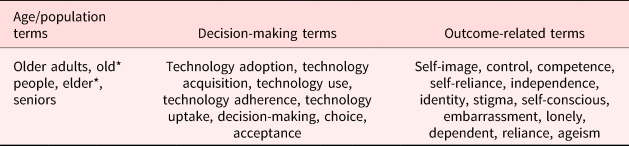
The second and third stages include identifying publications as well as screening and selecting relevant publications. A total of 25 terms were used to search nine electronic databases. The search terms used to guide this scoping review were determined in collaboration with an institutional librarian. Search terms were exploded to ensure that all variations of a word referencing identity and self-image were captured. Two independent reviewers identified relevant research studies in Web of Science, CINAHL, Medline, Embase, AMED, Cochrane Library, Healthstar, PsychINFO and Ageline. Hand searches of retrieved articles were completed to yield additional results. All search terms were mapped to subject headings where appropriate in the specific databases and all were searched as keywords. Search terms were categorised into three main groupings (see Table 1).
Details of search terms

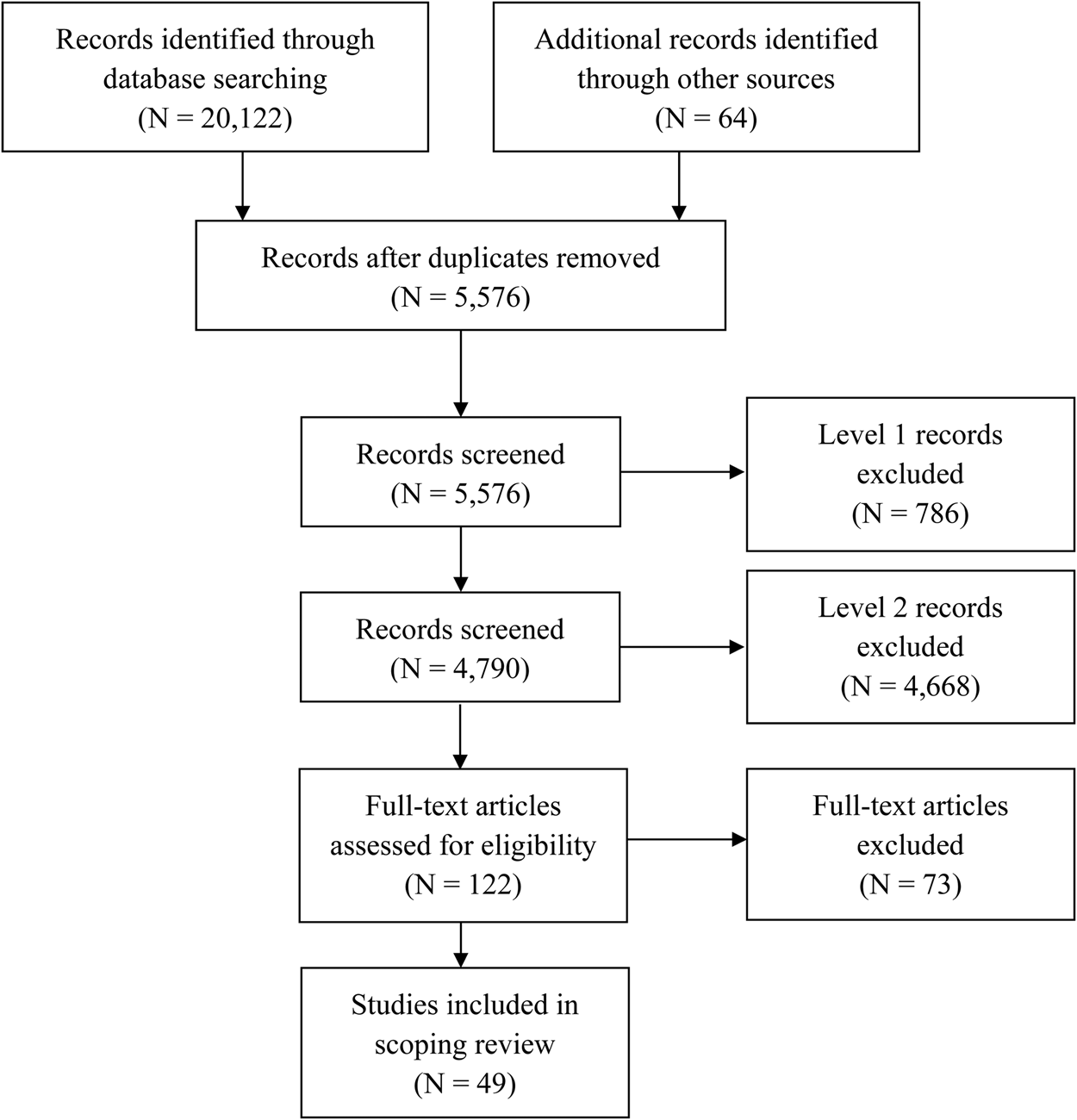
The application of inclusion criteria was applied in a tiered approach. At Level 1, peer-reviewed, empirical articles were included if: (a) they were published in English between 2000 and 2017; and (b) full text was available. At Level 2, articles were included if: (c) participants were aged 55 years and older; (d) the articles focused on decision-making relative to technology adoption; and (e) there was some reference to identity or self-image. The age of 55 was chosen as the lower cut-off point rather than 60–65 years old to include people with disabilities, who are often prospective users of assistive technologies, and may experience accelerated ageing (Molton et al., Reference Molton, Goetz, Jensen and Verrall2012; Access Independent Living Services, 2015). Given the scarcity of literature directly focusing on identity, articles that met the above criteria and made any reference (i.e. as little as one sentence) to self-image or identity, defined as ‘one's conception of oneself or of one's role, were included. This approach resulted in a final yield of 49 articles (for a detailed breakdown of the search procedure, see Figure 1).
Flow diagram of the search procedure.

Stages four and five include charting the data as well as collating, summarising and reporting the results. Within a scoping review, the published articles are the research data. As such, a synthesis approach to data analysis was utilised. Each article was read, in full, and decision-making patterns were coded, by hand, in an iterative process. These decision-making patterns, as related to the preservation and portrayal of an identity consistent with competence, independence and self-reliance, became the initial raw data. Next, the authors grouped similar decision-making patterns together into five overall themes. The five themes were determined using a deductive (i.e. bottom-up) approach based on the 49 articles. The authors began with a pre-existing theory (i.e. Identity Theory) and then tested a hypothesis derived from that theory (i.e. whether identity impacts older adults’ decision-making patterns regarding technology adoption) by collecting and assembling the data from the included articles. This was an emergent process in that the themes emerged from the literature, rather than approaching the literature with set themes into which the articles were fit.
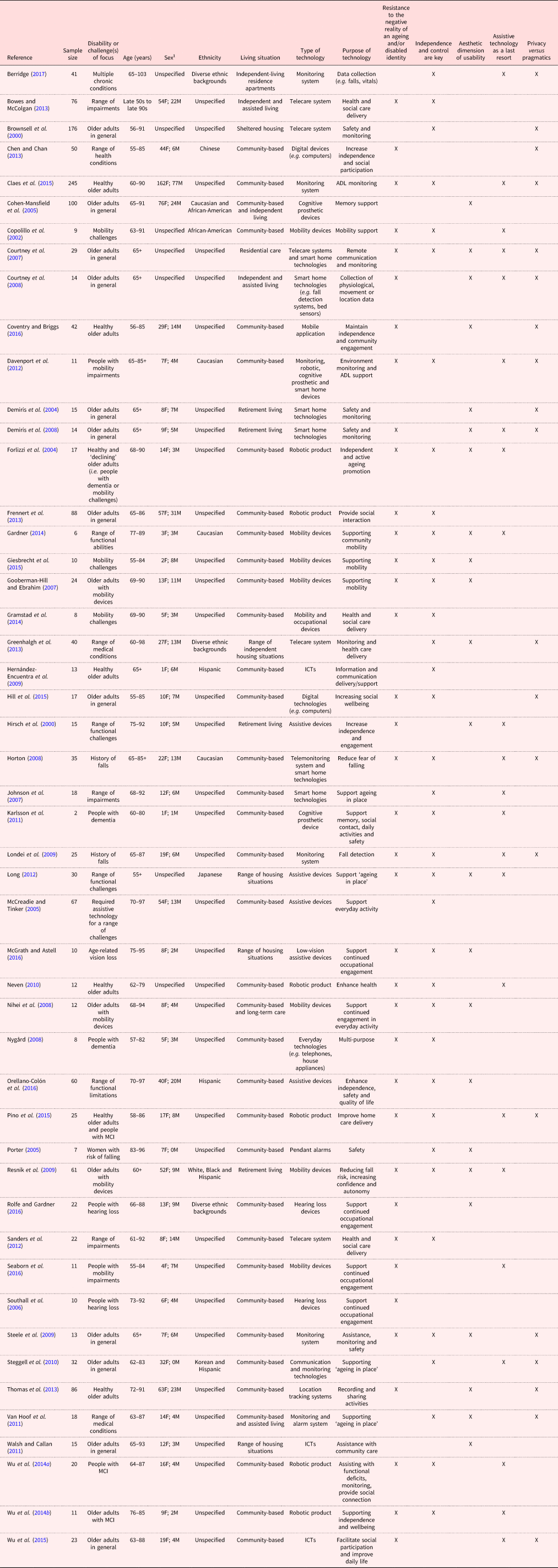
During the final phase of data analysis, the researchers engaged in a constant comparative method, which involves going back and forth between the articles to distil similarities and differences that can then be generated into themes (Kolb, Reference Kolb2012). Using this approach, similarities and differences across studies were distilled. The main study details were organised into a table, to be used as a reference during analysis (see Table 2).
Demographic details of studies included and themes addressed by each study

Notes: 1. M: male; F: female. ADL: activity of daily living. ICTs: information and communication technologies. MCI: mild cognitive impairment.
Results
From the 49 articles, which covered a range and breadth of studies featuring diverse populations and types of assistive technologies, five themes emerged revealing the influence of a desire to preserve and portray an identity consistent with competence, independence and self-reliance on older adults’ technology decision-making patterns (see Table 2). The five themes are: (a) resisting the negative reality of an ageing and/or disabled identity; (b) independence and control are key; (c) the aesthetic dimension of usability; (d) assistive technology as a last resort; and (e) privacy versus pragmatics. Findings pertaining to these five themes are described below.
Resisting the negative reality of an ageing and/or disabled identity
Of the 49 included articles, 37 (75.5%) of them addressed the theme of ‘resisting the negative reality of an ageing and/or disabled identity’ (Table 2). This is unsurprising given that assistive technologies such as assistive robots, pendant alarms and mobility devices are often viewed as a blatant indicator of ageing and/or disability in a society that equates ‘oldness’ and ‘disability’ with helplessness, dependence and incompetence. As such, the overwhelming desire to resist these associations is often threatened by using assistive devices, thereby increasing rates of abandonment and non-use (Courtney et al., Reference Courtney, Demiris and Hensel2007; Sanders et al., Reference Sanders, Rogers, Bowen, Bower, Hirani, Cartwright, Fitzpatrick, Knapp, Barlow, Hendy, Chrysanthaki, Bardsley and Newman2012; Chen and Chan, Reference Chen and Chan2013; Frennert et al., Reference Frennert, Eftring, Ostlund, Herrmann, Pearson, Lenz, Bremner, Spiers and Leonards2013; Wu et al., Reference Wu, Damnée, Kerhervé, Ware and Rigaud2015). The literature contains numerous examples of older adults resisting the use of assistive technology because it is a constant reminder of old age and the negative connotations associated with it (Gooberman-Hill and Ebrahim, Reference Gooberman-Hill and Ebrahim2007; Courtney et al., Reference Courtney, Demiris, Rantz and Skubic2008; Sanders et al., Reference Sanders, Rogers, Bowen, Bower, Hirani, Cartwright, Fitzpatrick, Knapp, Barlow, Hendy, Chrysanthaki, Bardsley and Newman2012; Bowes and McColgan, Reference Bowes and McColgan2013; Giesbrecht et al., Reference Giesbrecht, Miller and Woodgate2015; Coventry and Briggs, Reference Coventry, Briggs, Zhou and Salvendy2016). For example:
It must be for people who are very handicapped. It's not for me … It makes me think that my life is terminated. I'd rather die than live with a robot. (Wu et al., Reference Wu, Cristancho-Lacroix, Fassert, Faucounau, de Rotrou and Rigaud2014a: 8)
I didn't want my employer to think that I was using hearing aids and getting old. (Rolfe and Gardner, Reference Rolfe and Gardner2016: 670)
It suddenly marks you down straight away as an old so and so. Only old so and so's use sticks. (Gooberman-Hill and Ebrahim, Reference Gooberman-Hill and Ebrahim2007: 572)
Being stigmatised or discriminated against was an actualised fear for participants in many of the studies (Hirsch et al., Reference Hirsch, Forlizzi, Hyder, Goetz, Stroback and Kurtz2000; Cohen-Mansfield et al., Reference Cohen-Mansfield, Creedon, Malone, Kirkpatrick, Dutra and Herman2005; Southall et al., Reference Southall, Gagne and Leroux2006; Courtney et al., Reference Courtney, Demiris and Hensel2007; Gooberman-Hill and Ebrahim, Reference Gooberman-Hill and Ebrahim2007; Demiris et al., Reference Demiris, Hensel, Skubic and Rantz2008; Karlsson et al., Reference Karlsson, Axelsson, Zingmark and Savendtedt2011; Davenport et al., Reference Davenport, Mann and Lutz2012; Long, Reference Long2012; Bowes and McColgan, Reference Bowes and McColgan2013; Chen and Chan, Reference Chen and Chan2013; Frennert et al., Reference Frennert, Eftring, Ostlund, Herrmann, Pearson, Lenz, Bremner, Spiers and Leonards2013; Wu et al., Reference Wu, Cristancho-Lacroix, Fassert, Faucounau, de Rotrou and Rigaud2014a, Reference Wu, Wrobel, Cornuet, Kerhervé, Damnée and Rigaud2014b, Reference Wu, Damnée, Kerhervé, Ware and Rigaud2015; Claes et al., Reference Claes, Devriendt, Tournoy and Milisen2015; Giesbrecht et al., Reference Giesbrecht, Miller and Woodgate2015; Pino et al., Reference Pino, Boulay, Jouen and Rigaud2015; Orellano-Colón et al., Reference Orellano-Colón, Mann, Rivero, Torres, Jutai, Santiago and Varas2016; Seaborn et al., Reference Seaborn, Pennefather and Fels2016). This fear strongly impacted older adults’ willingness to adopt assistive technologies, whereby devices that could stigmatise older adults as ‘different’, ‘lonely’, ‘frail’, ‘dependent’ or ‘old’ were not popular. For example:
As long as it [smart home sensor] is installed in the others’ apartments, as long as it would be something they were going to use all over and I would not be different. (Demiris et al., Reference Demiris, Hensel, Skubic and Rantz2008: 122)
Some work has to be done if you don't want people to think that if they are given a robot it's because they are not worth a human company. People should think that the robot is there to help. There must be a way to present it in a positive way. (Pino et al., Reference Pino, Boulay, Jouen and Rigaud2015: 10)
Other participants resisted the use of assistive technology because they did not perceive themselves as ‘old enough’ or ‘disabled enough’ to justify using it. For example, a participant in Courtney et al. (Reference Courtney, Demiris, Rantz and Skubic2008) insisted that she was in ‘no need’ of a fall detection technology, despite describing a detailed history of falls (Courtney et al., Reference Courtney, Demiris, Rantz and Skubic2008: 199). Similarly, participants in Sanders et al. (Reference Sanders, Rogers, Bowen, Bower, Hirani, Cartwright, Fitzpatrick, Knapp, Barlow, Hendy, Chrysanthaki, Bardsley and Newman2012) viewed telehealth and telecare services as appropriate for someone who was ‘a lot more ill’ (Sanders et al., Reference Sanders, Rogers, Bowen, Bower, Hirani, Cartwright, Fitzpatrick, Knapp, Barlow, Hendy, Chrysanthaki, Bardsley and Newman2012: 7), and participants in Frennert et al. (Reference Frennert, Eftring, Ostlund, Herrmann, Pearson, Lenz, Bremner, Spiers and Leonards2013) perceived assistive robots as ‘good for others but not themselves’ (Frennert et al., Reference Frennert, Eftring, Ostlund, Herrmann, Pearson, Lenz, Bremner, Spiers and Leonards2013: 19). Being the only person to use an assistive device made participants in Copolillo et al. (Reference Copolillo, Collins, Randall and Cash2002) feel self-conscious, and as a result, less likely to use the device in public spaces. For example, a participant in Copolillo et al. stated:
That's what's holding … me back with my walking cane. And I have one, but I don't know. Look like I don't see too many. I should not feel that way; I just don't see too many people around here with a cane. (Copolillo et al., Reference Copolillo, Collins, Randall and Cash2002: 69)
However, being around peers who also used a device or technology made people feel more comfortable using their own device. Indeed, self-image appeared to be enhanced in situations where multiple people within the same peer group were relying on similar devices to support everyday activity. Others chose to adopt modern technologies to avoid being stereotypically labelled ‘old fashioned’ or ‘obsolete’, such as participants in Chen and Chan (Reference Chen and Chan2013), Nygård (Reference Nygård2008) and Wu et al. (Reference Wu, Damnée, Kerhervé, Ware and Rigaud2015) who described feeling socially pressured to use modern technologies to avoid being perceived as ‘different’ or excluded from society. For example:
I start to use computers because I do not want to be labelled as outdated. (Chen and Chan, Reference Chen and Chan2013: 4655)
Independence and control are key
Of the 49 included articles, 36 (73.5%) of them addressed the theme of ‘independence and control are key’ (Table 2). For example, participants across the studies frequently acknowledged the cultural norm of maintaining independence and personal autonomy in their daily lives, framing this as an essential goal of ‘ageing well’. For many older adults, the desire to remain independent stemmed from their wish to not be perceived as a burden to family, friends or society more generally. As such, technologies that enabled or prolonged independent performance in meaningful activities were met with great enthusiasm (Brownsell et al., Reference Brownsell, Bradley, Bragg, Catlin and Carlier2000; Johnson et al., Reference Johnson, Davenport and Mann2007; Horton, Reference Horton2008; Hernández-Encuentra et al., Reference Hernández-Encuentra, Pousada and Gómez-Zúñiga2009; Steggell et al., Reference Steggell, Hooker, Bowman, Choun and Kim2010; Van Hoof et al., Reference Van Hoof, Kort, Rutten and Duijnstee2011; Bowes and McColgan, Reference Bowes and McColgan2013; Gramstad et al., Reference Gramstad, Storli and Hamran2014; Claes et al., Reference Claes, Devriendt, Tournoy and Milisen2015; Hill et al., Reference Hill, Betts and Gardner2015; Pino et al., Reference Pino, Boulay, Jouen and Rigaud2015; McGrath and Astell, Reference McGrath and Astell2016; Berridge, Reference Berridge2017). For example:
Now what could you ask for more than that and you're independent. You don't owe anybody anything, right. You're standing on your own feet. (McGrath and Astell, Reference McGrath and Astell2016: 125)
When I'll be older, it [socially assistive robot] could allow me to maintain my autonomy for as long as possible. (Pino et al., Reference Pino, Boulay, Jouen and Rigaud2015: 9)
For others, the use of technologies such as assistive robots, wireless sensor networks and mobility devices acted as both a symbol and reminder of loss of independence (Courtney et al., Reference Courtney, Demiris and Hensel2007). In an effort to distance themselves from this image, which was incongruent with how older adults perceived themselves, many participants resisted the use of certain technologies altogether. In doing so, participants felt they were sending a message to others that they were still able to manage their lives independently. For example:
For me, a robot is associated with an onset of dependence. It's a passage … we do everything to distance ourselves from the image of dependence. We know that we are likely to encounter it, but we do everything to push it back as long as possible. (Wu et al., Reference Wu, Wrobel, Cornuet, Kerhervé, Damnée and Rigaud2014b: 808)
A walker to me is giving up … A walker to me just takes away an awful lot of independence. (Resnik et al., Reference Resnik, Allen, Isenstadt, Wasserman and Iezzoni2009: 84)
We cannot accept to use a robot for surveillance purposes. It is awful to do that to someone who has been free and independent during all his life. Human freedom is a wonderful thing, and we must keep it during our whole life. (Pino et al., Reference Pino, Boulay, Jouen and Rigaud2015: 10)
Along with participants’ desire to preserve independence was a desire to maintain control in their daily lives. This priority was evident through older adults’ preference for technologies that they could be ‘in charge’ of (Courtney et al., Reference Courtney, Demiris and Hensel2007; Horton, Reference Horton2008; Londei et al., Reference Londei, Rousseau, Ducharme, St-Arnaud, Meunier, Saint-Arnaud and Giroux2009; Davenport et al., Reference Davenport, Mann and Lutz2012; Frennert et al., Reference Frennert, Eftring, Ostlund, Herrmann, Pearson, Lenz, Bremner, Spiers and Leonards2013). For example, participants in Bowes and McColgan (Reference Bowes and McColgan2013) welcomed an electronic door entry system into their homes, as the device provided them with ‘control over one's own front door’, something perceived as ‘essential’ to remaining in control of one's environment. However, technologies that participants did not feel in control of were unsurprisingly rejected or abandoned (Bowes and McColgan, Reference Bowes and McColgan2013). For example:
I don't feel in control with these devices. I woke up at 2 am with a room full of people. It [bed occupancy sensor] has activated, and everybody turned up – the ambulance and neighbors. Straight away, I rang up the first thing in the morning and said to them ‘you'd better take it away.’ You need to feel in control. I just don't feel in control if it [bed occupancy sensor] can't work properly. (Horton, Reference Horton2008: 1188)
Lastly, participants feared that relying on assistive technologies would contribute to further experiences of dependence and decline (Forlizzi et al., Reference Forlizzi, DiSalvo and Gemperle2004; McCreadie and Tinker, Reference McCreadie and Tinker2005; Gooberman-Hill and Ebrahim, Reference Gooberman-Hill and Ebrahim2007; Johnson et al., Reference Johnson, Davenport and Mann2007; Nihei et al., Reference Nihei, Inoue and Fujie2008; Hernández-Encuentra et al., Reference Hernández-Encuentra, Pousada and Gómez-Zúñiga2009; Steggell et al., Reference Steggell, Hooker, Bowman, Choun and Kim2010; Davenport et al., Reference Davenport, Mann and Lutz2012; Sanders et al., Reference Sanders, Rogers, Bowen, Bower, Hirani, Cartwright, Fitzpatrick, Knapp, Barlow, Hendy, Chrysanthaki, Bardsley and Newman2012; Wu et al., Reference Wu, Cristancho-Lacroix, Fassert, Faucounau, de Rotrou and Rigaud2014a; Giesbrecht et al., Reference Giesbrecht, Miller and Woodgate2015; Hill et al., Reference Hill, Betts and Gardner2015; Orellano-Colón et al., Reference Orellano-Colón, Mann, Rivero, Torres, Jutai, Santiago and Varas2016). To distance themselves from this consequence, which directly contradicts the identity they wish to portray, many older adults resisted the use of assistive devices. For example:
I couldn't walk [while recovering at home from cancer], and I did not want a wheelchair. The reason I did not want a wheelchair – I would become an invalid! It's so easy to become an invalid. (Forlizzi et al., Reference Forlizzi, DiSalvo and Gemperle2004: 44)
Having things that you don't need yet and you're not going to use yet, like the remote controls, can make a person lazier and deteriorate quicker. (Orellano-Colón et al., Reference Orellano-Colón, Mann, Rivero, Torres, Jutai, Santiago and Varas2016: 681)
No, I can't imagine myself using a wheelchair. If I did, I would surely end up bedridden. (Nihei et al., Reference Nihei, Inoue and Fujie2008: 644)
The aesthetic dimension of usability
Until recently, the design of many technologies geared towards older adults was largely driven by function. However, aesthetic factors (referring to the look, feel and size) are emerging as important dimensions of usability (i.e. the degree to which something is able or fit to be used). For example, of the 49 included articles, 23 (46.9%) of them addressed the theme of ‘the aesthetic dimension of usability’ (Table 2). Across the studies in this scoping review, participants advocated for ‘discrete’ or ‘unobtrusive’ aesthetic designs, such as devices that fit in a purse or pocket (Cohen-Mansfield et al., Reference Cohen-Mansfield, Creedon, Malone, Kirkpatrick, Dutra and Herman2005; Courtney et al., Reference Courtney, Demiris, Rantz and Skubic2008; Demiris et al., Reference Demiris, Hensel, Skubic and Rantz2008; Rolfe and Gardner, Reference Rolfe and Gardner2016). Participants also overwhelmingly supported the notion of ‘fashion over function’. In fact, devices with an aesthetic design that were more positively associated with the older adult's desired identity were more likely to be adopted long term (Hirsch et al., Reference Hirsch, Forlizzi, Hyder, Goetz, Stroback and Kurtz2000). For example:
It should be unobtrusive, so that everybody doesn't say ‘look at that woman, she's wearing one of those things’. (Steele et al., Reference Steele, Lo, Secombe and Wong2009: 796)
Other participants described using items such as a bundle buggy (i.e. a shopping cart) in lieu of a walker, as it still provided the necessary function of stability but without the associated stigma of being a designated ‘assistive technology’. Similarly, a participant in Gardner (Reference Gardner2014) described using a walking stick which provided the individual with the same safety and functionality as a regular cane, but was differentiated in that it was hand-carved and was acquired during the participants’ travels in New Zealand. As such, the walking stick was never perceived as a mobility aid, per se, but rather ‘a beautiful object worthy of admiration, and an accessory that made him feel more “distinguished” than “feeble”’ (Gardner, Reference Gardner2014: 1254). Indeed, specifically designed technology, such as pendant alarms and mobility devices, can often become a ‘symbol of disability’ that serve to mark older adults as ‘different’ (Porter, Reference Porter2005; Walsh and Callan, Reference Walsh and Callan2011; Rolfe and Gardner, Reference Rolfe and Gardner2016).
Participants across multiple studies also described experiences where they felt embarrassed about wearing or using assistive devices in public spaces (Cohen-Mansfield et al., Reference Cohen-Mansfield, Creedon, Malone, Kirkpatrick, Dutra and Herman2005; Gooberman-Hill and Ebrahim, Reference Gooberman-Hill and Ebrahim2007; Karlsson et al., Reference Karlsson, Axelsson, Zingmark and Savendtedt2011; Chen and Chan, Reference Chen and Chan2013; Coventry and Briggs, Reference Coventry, Briggs, Zhou and Salvendy2016; McGrath and Astell, Reference McGrath and Astell2016; Orellano-Colón et al., Reference Orellano-Colón, Mann, Rivero, Torres, Jutai, Santiago and Varas2016). For example, powered wheelchair users avoided going to quiet public places such as movie theatres and libraries due to the embarrassment they felt when their mobility aids made loud noises (Seaborn et al., Reference Seaborn, Pennefather and Fels2016). Unsurprisingly, embarrassment deterred participants in several studies from wearing or using assistive devices in public spaces. For example:
I felt a bit of an idiot, you know, walking round with a stick … [Why did you feel like an idiot?] Well I don't know, a normal person doesn't use one, do they? (Gooberman-Hill and Ebrahim, Reference Gooberman-Hill and Ebrahim2007: 572)
I felt terrible with this thing [touchscreen assistive device]. Terribly self-conscious and vulnerable. (Coventry and Briggs, Reference Coventry, Briggs, Zhou and Salvendy2016: 430)
I would be embarrassed to use a device out in public. I would feel a little silly, yeah, because they look funny. What would people think if I used this in public? (McGrath and Astell, Reference McGrath and Astell2016: 128)
Along with participants’ concerns about the aesthetic appearance of technologies used in public were concerns about the appearance of technologies used in the home (e.g. fall detection systems). For example, participants across the studies expressed concerns about technologies that were visible to visitors (Courtney et al., Reference Courtney, Demiris and Hensel2007; Demiris et al., Reference Demiris, Hensel, Skubic and Rantz2008), or looked obtrusive, cluttered or distracting in their homes (Van Hoof et al., Reference Van Hoof, Kort, Rutten and Duijnstee2011; Greenhalgh et al., Reference Greenhalgh, Wherton, Sugarhood, Hinder and Procter2013; Orellano-Colón et al., Reference Orellano-Colón, Mann, Rivero, Torres, Jutai, Santiago and Varas2016). These concerns were related to fears of stigmatisation due to the visible presence of assistive devices (Van Hoof et al., Reference Van Hoof, Kort, Rutten and Duijnstee2011; Walsh and Callan, Reference Walsh and Callan2011). As such, technologies that were obtrusive-looking or visible to visitors were often perceived negatively by participants. For example:
It worries me looking at it [telehealth system]. My bedroom's such a tip with it. My grandson, he's maintenance. He's going to do something at the back of my bed so I can put machines down there. Save me looking at them all day. (Greenhalgh et al., Reference Greenhalgh, Wherton, Sugarhood, Hinder and Procter2013: 91)
Given concerns about the messages conveyed by using assistive technologies, it is unsurprising that many older adults prefer technologies that do not look ‘too medical’. In fact, their use of de-medicalised devices indicates a clear effort to maintain one's sense of identity. For example, participants in Gardner (Reference Gardner2014) made a conscious and purposeful decision to use ‘de-medicalised’ devices, such as a motorised scooter, to support community mobility. This was true even for participants who utilised canes, walkers and wheelchairs to manage mobility within the private arena of the home (Gardner, Reference Gardner2014). In reference to scooters, participants in studies by Gardner (Reference Gardner2014), Hirsch et al. (Reference Hirsch, Forlizzi, Hyder, Goetz, Stroback and Kurtz2000) and Resnik et al. (Reference Resnik, Allen, Isenstadt, Wasserman and Iezzoni2009) commented on how it portrays an image of youth, sportiness and sexiness:
Wheelchairs say sick, scooters say sexy. (Gardner, Reference Gardner2014: 1254)
More like a ride and less like a mobility aid [referring to scooters]. They make you feel young. (Resnik et al., Reference Resnik, Allen, Isenstadt, Wasserman and Iezzoni2009: 85)
Assistive technology as a last resort
Of the 49 included articles, 23 (46.9%) of them addressed the theme of ‘assistive technology as a last resort’ (Table 2). This is unsurprising given that many participants viewed the adoption of assistive technologies as a last resort, which was depicted across the studies by a strong ‘not yet’ attitude towards the adoption of assistive devices (Courtney et al., Reference Courtney, Demiris and Hensel2007, Reference Courtney, Demiris, Rantz and Skubic2008; Johnson et al., Reference Johnson, Davenport and Mann2007; Demiris et al., Reference Demiris, Hensel, Skubic and Rantz2008; Horton, Reference Horton2008; Londei et al., Reference Londei, Rousseau, Ducharme, St-Arnaud, Meunier, Saint-Arnaud and Giroux2009; Steggell et al., Reference Steggell, Hooker, Bowman, Choun and Kim2010; Karlsson et al., Reference Karlsson, Axelsson, Zingmark and Savendtedt2011; Davenport et al., Reference Davenport, Mann and Lutz2012; Wu et al., Reference Wu, Cristancho-Lacroix, Fassert, Faucounau, de Rotrou and Rigaud2014a, Reference Wu, Damnée, Kerhervé, Ware and Rigaud2015; Claes et al., Reference Claes, Devriendt, Tournoy and Milisen2015; Pino et al., Reference Pino, Boulay, Jouen and Rigaud2015). This was evident through participants’ potential willingness to accept assistive technologies at a ‘later’ point, when they were ready for it. For example:
I don't need this now, but perhaps at a later point – I have friends who'd benefit from this a great deal, I am not there yet. (Demiris et al., Reference Demiris, Hensel, Skubic and Rantz2008: 122)
Well, it [assistive technology] seems like a good thing. Like I've said, right now we may not need it, but one never knows when the time will come that we do. (Steggell et al., Reference Steggell, Hooker, Bowman, Choun and Kim2010: 444)
Many participants acknowledged that although they were not presently using assistive technologies, they would in future if they became ‘handicapped’, ‘sick’, ‘incapacitated’, ‘lonely’ or ‘demented’, all of which are value-laden terms that depict the negative connotations older adults commonly associate with assistive technology use. For example:
I am not indifferent, but I wouldn't want it [fall detection system] … I would feel handicapped. (Londei et al., Reference Londei, Rousseau, Ducharme, St-Arnaud, Meunier, Saint-Arnaud and Giroux2009: 386)
If you were, say, growing old and demented, then I could imagine this [assistive robot] being a good thing, but for me? You'd have to be a lonely old person, chained to your home with few contacts. I still go to my checkers club. (Neven, Reference Neven2010: 341)
Other participants acknowledged they would adopt assistive technology, albeit begrudgingly, only if no other choices were available to ensure continued engagement in meaningful activities, or if a physician indicated use of the technology was necessary. Even when devices where recommended by a doctor, participants questioned the recommendation if it was perceived to be incongruent with their perception of their capabilities (Copolillo et al., Reference Copolillo, Collins, Randall and Cash2002). For example:
If there were no other choices … yes … I would accept it, but not with pleasure. (Wu et al., Reference Wu, Wrobel, Cornuet, Kerhervé, Damnée and Rigaud2014b: 807)
A walker? Only if it comes to that! (Gardner, Reference Gardner2014: 1254)
I do not want any device. I want to do it on my own. So I don't feel comfortable with a device. I have no intention of going to one unless my doctor says I have to. (Resnik et al., Reference Resnik, Allen, Isenstadt, Wasserman and Iezzoni2009: 85)
In fact, in many situations, participants discussed how they would rather stay at home and forego meaningful participation in their valued community activities than use a device that would otherwise forefront their disability. For example:
I would never use a wheelchair. I would rather stay home – use a wheelchair? No way under any circumstances. (Nihei et al., Reference Nihei, Inoue and Fujie2008: 644)
I know someone with a panic alarm, and she won't wear it outside. If she's out the back hanging out the washing and she falls, there's nothing she can do until someone finds her. So now she's decided she just won't go outside, so she practically lives in her kitchen. (Steele et al., Reference Steele, Lo, Secombe and Wong2009: 793)
On Sunday, the children were going to the park … but just knowing I had to use the cane … I said: ‘No, I will stay home…’ (Resnik et al., Reference Resnik, Allen, Isenstadt, Wasserman and Iezzoni2009: 82)
Privacy versus pragmatics
Of the 49 included articles, 20 (40.8%) of them addressed the theme of ‘privacy versus pragmatics’. Unsurprisingly, technologies such as mobility aids, and devices for hearing loss and ARVL were not found to cause privacy-related concerns among participants (Table 2). However, concerns about privacy infringement that could arise from adopting technologies such as wireless sensor networks, bed occupancy sensors and fall detection monitors were expressed across multiple studies (Brownsell et al., Reference Brownsell, Bradley, Bragg, Catlin and Carlier2000; Demiris et al., Reference Demiris, Rantz, Aud, Marek, Tyrer, Skubic and Hussam2004, Reference Demiris, Hensel, Skubic and Rantz2008; Courtney et al., Reference Courtney, Demiris, Rantz and Skubic2008; Horton, Reference Horton2008; Londei et al., Reference Londei, Rousseau, Ducharme, St-Arnaud, Meunier, Saint-Arnaud and Giroux2009; Steele et al., Reference Steele, Lo, Secombe and Wong2009; Steggell et al., Reference Steggell, Hooker, Bowman, Choun and Kim2010; Van Hoof et al., Reference Van Hoof, Kort, Rutten and Duijnstee2011; Davenport et al., Reference Davenport, Mann and Lutz2012; Chen and Chan, Reference Chen and Chan2013; Thomas et al., Reference Thomas, Little, Briggs, McInnes, Jones and Nicholson2013; Claes et al., Reference Claes, Devriendt, Tournoy and Milisen2015; Pino et al., Reference Pino, Boulay, Jouen and Rigaud2015; Wu et al., Reference Wu, Damnée, Kerhervé, Ware and Rigaud2015). Participants’ concerns about privacy and the subsequent threats to maintaining control over one's personal information and environment superseded any perception of need, resulting in the rejection or abandonment of ‘intrusive’ devices. For example:
It's just kind of against my feelings of privacy. I think that that's my prerogative to make those choices. (Courtney et al., Reference Courtney, Demiris, Rantz and Skubic2008: 198)
I don't like for anyone to know that I went out and didn't get back until midnight or something like that – I don't think anyone needs to know that. (Demiris et al., Reference Demiris, Hensel, Skubic and Rantz2008: 122)
Other participants were reluctant to adopt monitoring/surveillance technologies (e.g. fall detectors) due to privacy-related fears, such as someone ‘always watching’ or ‘spying’ on them (Brownsell et al., Reference Brownsell, Bradley, Bragg, Catlin and Carlier2000; Courtney et al., Reference Courtney, Demiris and Hensel2007; Londei et al., Reference Londei, Rousseau, Ducharme, St-Arnaud, Meunier, Saint-Arnaud and Giroux2009; Van Hoof et al., Reference Van Hoof, Kort, Rutten and Duijnstee2011; Berridge, Reference Berridge2017). For example, a participant in Van Hoof et al. (Reference Van Hoof, Kort, Rutten and Duijnstee2011) promptly removed the newly installed surveillance devices from her apartment because she felt watched, which threatened her feelings of personal privacy (Van Hoof et al., Reference Van Hoof, Kort, Rutten and Duijnstee2011: 320). Other participants shared similar concerns:
I would be stressed, I would feel … spied. (Londei et al., Reference Londei, Rousseau, Ducharme, St-Arnaud, Meunier, Saint-Arnaud and Giroux2009: 386)
The first thing that comes to mind is Big Brother, you know, and I think you might have a pretty, pretty big obstacle there … there's just something about somebody watching over you that would bother me. (Courtney et al., Reference Courtney, Demiris and Hensel2007: 244)
Furthermore, participants expressed concerns about the potential consequences that may arise if their privacy was in fact breached by assistive technologies (Londei et al., Reference Londei, Rousseau, Ducharme, St-Arnaud, Meunier, Saint-Arnaud and Giroux2009; Steggell et al., Reference Steggell, Hooker, Bowman, Choun and Kim2010; Greenhalgh et al., Reference Greenhalgh, Wherton, Sugarhood, Hinder and Procter2013; Thomas et al., Reference Thomas, Little, Briggs, McInnes, Jones and Nicholson2013; Hill et al., Reference Hill, Betts and Gardner2015; Coventry and Briggs, Reference Coventry, Briggs, Zhou and Salvendy2016). These concerns included vulnerability to crime, such as strangers taking advantage of, stealing or misusing their personal information (e.g. identity, bank information), and being watched by unwanted viewers, in certain places or at certain times without their knowledge or consent. Across the studies, participants took these concerns very seriously:
Even without [the technology] … many older people are being cheated all the time … although the device was created for good use, if it falls into the wrong hands, many older people will become victims of cyberspace aid systems. (Steggell et al., Reference Steggell, Hooker, Bowman, Choun and Kim2010: 443)
If it's somebody who has a regular life, doing the same things every day, then you've got a pattern. That's it, you're vulnerable straight away. (Thomas et al., Reference Thomas, Little, Briggs, McInnes, Jones and Nicholson2013: 761)
In contrast, other participants were willing to ‘trade off’ personal privacy for the perceived usefulness or benefits of technologies, such as increased safety (Courtney et al., Reference Courtney, Demiris, Rantz and Skubic2008; Thomas et al., Reference Thomas, Little, Briggs, McInnes, Jones and Nicholson2013; Pino et al., Reference Pino, Boulay, Jouen and Rigaud2015). Similarly, others were also willing to accept ‘technological intrusion’ into their lives if it would allow them to remain independent and at home for longer (Londei et al., Reference Londei, Rousseau, Ducharme, St-Arnaud, Meunier, Saint-Arnaud and Giroux2009; Steggell et al., Reference Steggell, Hooker, Bowman, Choun and Kim2010). For example:
Why, you know if it's [smart home technology] going to be helpful then I have no problem. (Courtney et al., Reference Courtney, Demiris, Rantz and Skubic2008: 198)
It may be intrusive but, at the same time, integrating a security camera in the robot could be useful. My mother is alone at home during the night. If there was a camera, I could check from time to time if everything is OK. Between privacy and safety, is it not better to give priority to safety? (Pino et al., Reference Pino, Boulay, Jouen and Rigaud2015: 10)
Discussion
This scoping review confirmed that identity influences older adults’ decision-making patterns regarding technology adoption. From the 49 articles included in this review, five themes regarding older adults’ desire to maintain an identity associated with independence, competence and self-reliance emerged: (a) resisting the negative reality of an ageing and/or disabled identity; (b) independence and control are key; (c) the aesthetic dimension of usability; (d) assistive technology as a last resort; and (e) privacy versus pragmatics. Across the studies, older adults did not view themselves as an archetypal ‘old’ person, but rather showed a strong desire to preserve and portray an identity associated with self-reliance, competence and independence. This desire resulted in older adults’ rejection of helpful and beneficial technologies that they perceived as stigmatising or as reinforcing an image of being ‘old’. The findings of this review reveal that technologies aimed specifically at older adults reflect ageist views and stereotypes of later life, rather than addressing the way older adults view themselves. This results in lack of verification of their desired identity. Consequently, technologies that do not support the desired identity of older adults, such as devices that reinforce images of dependence, incompetence and reliance, are rejected because older adults do not perceive themselves as potential users of these devices, nor do they want to be associated with these negative connotations of ageing.
This concurs with Burke and Stets’ (Reference Burke and Stets2009) argument that people modify their behaviour in order to disassociate themselves from an incongruent or undesirable identity and/or re-establish their desired identity. As such, Identity Theory (Burke and Stets, Reference Burke and Stets2009) provides a useful framework for understanding the role of self-image in older adults’ decision-making about technology. Rejection or avoidance of devices perceived as stigmatising or ageist can be understood as older adults striving to maintain a balanced and stable environment in the face of disturbances to their desired identity or ideal self (Burke and Stets, Reference Burke and Stets2009).
This review contributes to the literature in several ways. Primarily, this is the first review and synthesis explicitly examining the role of identity in older adults’ technology decisions. Despite the extensive literature focusing on factors that influence technology adoption (Davis, Reference Davis1989; Venkatesh, Reference Venkatesh2000; Venkatesh and Davis, Reference Venkatesh and Davis2000; Czaja et al., Reference Czaja, Charness, Fisk, Hertzog, Nair, Rogers and Sharit2006; Chen and Chan, Reference Chen and Chan2014; Create Centre, 2017), identity has not previously been identified as a key factor. Furthermore, while identity clearly plays an important role in older adults’ technology decision-making patterns, this has not yet been highlighted in the literature. For example, none of the articles included in this review featured self-image as the primary research topic. This is unsurprising given that the function and usability of assistive devices is usually the main focus rather than their social acceptability, despite the fact that many devices are abandoned due to negative social influences (Astell et al., Reference Astell, Alm, Gowans, Ellis, Dye and Vaughan2009).
Secondly, this review is unique given that it is the first to apply Identity Theory (Burke and Stets, Reference Burke and Stets2009) to technology adoption, and the findings confirm its relevance to understanding older adults’ technology decisions. For example, many of the devices featured across the studies reflected ageist views prevalent in society, rather than the way older adults view themselves. As highlighted in the five identified themes, technologies that directly contradict the role(s) older adults fulfil in their lives and the peer groups they identify with are rejected or adopted as a last resort because older adults actively resist being associated with these negative connotations of ageing. This relationship provides further insight into why technology adoption rates are relatively low, despite the rapid development of devices created for older adults (Lund and Nygård, Reference Lund and Nygård2003).
Thirdly, the studies included in this scoping review are diverse, featuring an array of study populations (e.g. people with dementia, people with mobility impairments, hearing loss and ARVL), technologies of focus (e.g. assistive robots, mobility devices, wireless sensors, smart home technologies and telehealth interventions) and demographic variables (e.g. age, gender, housing). The diversity in study population, technology and participant demographics increases the generalisability of the findings, particularly given that the importance of self-image in older adults’ technology adoption decisions was apparent across all studies. Interestingly, while all articles addressed several themes relating to the role of identity in older adults’ technology decision-making, the type of technology used (e.g. monitoring technologies versus mobility aids) was found to influence which themes arose in each study. For example, participants in the studies with mobility aids had fewer concerns about privacy than participants in the studies focused on monitoring technologies.
While the findings of this review emphasise the importance of identity in older adults’ technology decision-making, they also emphasise the need for further investigation in this topic area. For example, to understand further the influence of older adults’ desire to preserve an identity associated with independence, competence and self-reliance on technology adoption, there is a need for more research which features self-image as the primary topic. Likewise, it is recommended that future research explores technology adoption decisions and the role of identity between different diagnostic groups (e.g. older adults with life-long versus late-life disability), types of technology (e.g. manual versus motorised scooters) and environments (e.g. community versus institutional settings) to gain a deeper understanding of this relationship and how it is further influenced by demographic factors. Despite these gaps, the findings of this scoping review highlight several possible avenues for future investigation.
Firstly, it is recommended that future technology development studies be conducted using participatory design approaches, which encourage the active involvement of end-users in the research, design and commercialisation of new technologies (Astell et al., Reference Astell, Alm, Gowans, Ellis, Dye and Vaughan2009). Older adults are frequently left out of these processes, despite evidence that their involvement can result in more successful product design and higher acceptance rates (McGrath et al., Reference McGrath, Ellis, Hwang, Williams, Archer, Harney-Levine, Wright and Astell2016). While participatory design approaches have been applied in human–computer interaction (Hakobyan et al., Reference Hakobyan, Lumsden and O'Sullivan2015), gerontechnology (Merkel and Kucharski, Reference Merkel and Kucharski2019) and gaming studies (DeSmet et al., Reference DeSmet, Thompson, Baranowski, Palmeira, Verloigne and De Bourdeaudhuij2016), the type of input requested from older adults has related more to function, usability and perceived ease of use than the aesthetics and social influences of the devices themselves. Future participatory design efforts, applied by inter-disciplinary research groups (e.g. designers, occupational therapists, psychologists, etc.), are required to ensure that all important factors influencing technology adoption, including social and psychological factors, are thoroughly addressed with prospective device users. Understanding this important topic at a deeper level is required in order to inform future research, development, infrastructure, policy and practice. Additionally, the use of participatory design research could help to challenge negative stereotypes that portray older adults as technologically inadequate (Broady et al., Reference Broady, Chan and Caputi2010).
This review also highlights a need for devices that are usable by a wider array of individuals, as previous work focusing on accessible design has tended to result in separate and specific solutions for individuals with disabilities, which can facilitate stigma and stereotypes (Spafford et al., Reference Spafford, Rudman, Leipert, Klinger and Huot2010). Additionally, leveraging the functionality and potential benefit of mainstream devices such as digital gaming systems for physical activity (Dove and Astell, Reference Dove and Astell2017) or tablets and smartphones that are desirable, ‘sexy’ and increasingly accessible (Joddrell and Astell, Reference Joddrell and Astell2016) will help drive uptake and promote new product development. For example, tablets and smartphones can allow people to access technological assistance discretely, such as a magnifying feature for people with ARVL or a reminder application for people with dementia.
Understanding the role of older adult's self-image is also important for future service delivery, given that increasing the adoption of helpful devices can support independence and ‘ageing in place’ (Fok et al., Reference Fok, Polgar, Shaw and Jutai2011). For example, wearable health-monitoring technologies can collect information as older adults go about their daily lives, resulting in fewer follow-up appointments, medical tests/procedures or unnecessary inpatient stays. With improved understanding of older adults’ technology decisions, health and social care practitioners could support their growing number of older clients better when prescribing assistive technologies (Coughlin et al., Reference Coughlin, D’Ambrosio, Reimer and Pratt2007). Additionally, technologies designed to support older adults can support care-givers by helping to absorb some of the workload, providing secondary benefits such as decreased burden and increased respite time (Coughlin et al., Reference Coughlin, D’Ambrosio, Reimer and Pratt2007). However, health-care practitioners and care-givers need to understand the best way to incorporate these devices to minimise stigma.
Moreover, adoption of helpful technologies can reduce the number of people requiring access to specialised housing (e.g. long-term care homes) by supporting them to remain at home for longer, providing housing markets with more time to prepare future infrastructure to suit the needs of older adults, and their devices (Normie, Reference Normie2011). Additionally, technologies that are acceptable to older adults and support mobility can facilitate local travel (e.g. grocery stores, banks) without external transport such as city buses, taxis or specialised older adult transport systems, thus decreasing demand and costs related to transportation.
Lastly, greater understanding of the role of identity in older adults’ technology adoption decisions can be used to inform new policy development, regulations and strategies to standardise the availability of technologies to ensure that older adults are provided with equal access to devices, services and appropriate training (Coughlin et al., Reference Coughlin, D’Ambrosio, Reimer and Pratt2007). Further research is needed to explore the current and ongoing effects of stigma on government policy related to service and delivery, such as access to social support services for new device users, particularly relating to designated assistive technologies (e.g. a mobility device prescribed by a doctor).
Conclusions
This scoping review presents compelling evidence that identity and older adults’ views of themselves (i.e. their self-image) influence their decision-making regarding technology adoption. Devices projecting negative images of ageing are rejected or avoided by older adults in an effort to maintain a desired identity associated with notions of competence, independence and self-reliance. These findings support a clear need for technology developers to work with older adults to take self-image into consideration if adoption rates of assistive devices are to be maximised. However, to understand further the influence of older adults’ desire to preserve an identity associated with independence, competence and self-reliance on technology adoption, there is a need for more research focusing on self-image as the primary topic. Further research is required to learn more about the needs, values and preferences of older adults regarding current and future technology creation. Additionally, it is recommended that future research explores technology adoption decisions and the role of identity between different diagnostic groups, types of technology and environments to gain a deeper understanding of this relationship. By ensuring that devices offered to older adults are more appropriately matched to their desired self-image(s), the adoption and use of potentially helpful devices is expected to increase.
Author ORCIDs
Erica Dove, https://orcid.org/0000-0002-4016-5630
Financial support
This work was supported by the Social Sciences and Humanities Research Council of Canada (AJA, grant number 421-2015-2037); and the Ontario Shores Foundation, through the Ontario Shores Research Chair in Dementia at the University of Toronto (AJA).
Conflict of interest
The authors declare no conflicts of interest.