INTRODUCTION
Savannas are complex ecosystems in which various groups of organisms interact to create heterogeneity in vegetation structure and ecological processes (Anderson et al. Reference ANDERSON, DEMPEWOLF, METZGER, REED, SERNEELS, Sinclair, Packer, Mduma and Fryxell2008, Pickett et al. Reference PICKETT, CADENASSO, BENNING, du Toit, Rogers and Biggs2003, Turner Reference TURNER1989). The resulting heterogeneity, together with that created by variation in the physical landscape, is an important determinant of savanna functioning (Pickett et al. Reference PICKETT, CADENASSO, BENNING, du Toit, Rogers and Biggs2003, Scholes Reference SCHOLES1990). To gain a better understanding of savannas it is important to identify the biotic agents of heterogeneity, understand their distribution and interactions, and quantify the scales at which they affect ecological processes. Important and often overlooked players in the ecology of savannas are litter-feeding termites, which move large quantities of litter, soil and nutrients through the landscape (Goudie Reference GOUDIE and Viles1988).
Termites are among the main macro-faunal organisms involved in litter decomposition in African savannas (Bignell & Eggleton Reference BIGNELL, EGGLETON, Abe, Bignell and Higashi2000, Scholes & Walker Reference SCHOLES and WALKER1993). Their total biomass can exceed large mammalian biomass in African savannas (Deshmukh Reference DESHMUKH1989) and litter removal by termites can amount to 60% of total annual litter production (Wood & Sands Reference WOOD, SANDS and Brian1978). By collecting live and dead plant material and herbivore dung (Freymann et al. Reference FREYMANN, BUITENWERF, DESOUZA and OLFF2008), and concentrating it in below-ground nest structures their mounds become nutrient hotspots in the landscape (Grant & Scholes Reference GRANT and SCHOLES2006, Holt & Lepage Reference HOLT, LEPAGE, Abe, Bignell and Higashi2000, Zaady et al. Reference ZAADY, GROFFMAN, SHACHAK and WILBY2003). Nutrients are also prevented from getting lost to the system through run-off or fire (Abenspergtraun & Milewski Reference ABENSPERGTRAUN and MILEWSKI1995). These actions, along with N2 fixation and the potential to change soil structure, can alter plant community composition on the nutrient-enriched mounds (Fox-Dobbs et al. Reference FOX-DOBBS, DOAK, BRODY and PALMER2010, Glover et al. Reference GLOVER, TRUMP and WATERIDGE1964, Jouquet et al. Reference JOUQUET, TESSIER and LEPAGE2004, Loveridge & Moe Reference LOVERIDGE and MOE2004, Moe et al. Reference MOE, MOBAEK and NARMO2009, Mordelet & Menaut Reference MORDELET and MENAUT1995), increase plant N and P concentrations (Grant & Scholes Reference GRANT and SCHOLES2006, Jouquet et al. Reference JOUQUET, TAVERNIER, ABBADIE and LEPAGE2005), and ultimately increase herbivory on the mounds (Dangerfield et al. Reference DANGERFIELD, MCCARTHY and ELLERY1998, Grant & Scholes Reference GRANT and SCHOLES2006, Loveridge & Moe Reference LOVERIDGE and MOE2004).
By creating heterogeneity termites have the potential to significantly affect ecosystem functioning and food-web dynamics (Pringle et al. Reference PRINGLE, DOAK, BRODY, JOCQUE and PALMER2010), however without identifying the determinants of termite distribution and consumption, the extent of their impact cannot be fully understood. Rainfall has been identified as a major determinant for termite abundance and consumption across continental and regional scales, where abundance and consumption increase with rainfall (Buxton Reference BUXTON1981, Deshmukh Reference DESHMUKH1989, Picker et al. Reference PICKER, HOFFMAN and LEVERTON2007, Pomeroy Reference POMEROY1978). This pattern is suggested to result from an increase in food availability with rainfall, reflecting the well-known positive relation between primary production and annual rainfall in semi-arid ecosystems. However, primary production and peak herbaceous biomass in African savanna ecosystems are also significantly affected by other variables, such as fire and herbivores (Scholes & Walker Reference SCHOLES and WALKER1993). While a handful of studies have quantified effects of fire and herbivores on termite species assemblages and abundance (Abenspergtraun Reference ABENSPERGTRAUN1992, Abenspergtraun & Milewski Reference ABENSPERGTRAUN and MILEWSKI1995, Tracy et al. Reference TRACY, GOLDEN and CRIST1998), it is unclear how termite consumption changes across a rainfall gradient in a system dominated by herbivores.
The goal of our research was to study the relationship between rainfall and termite consumption in the presence and absence of large herbivores, while controlling for the effects of fire. We expect termite activity to be higher in areas with high rainfall and in the absence of herbivores, as litter production should be highest under these conditions. Importantly, we quantify foraging intensity of the entire grass- and litter-feeding functional group without separating effects among species, as opposed to previous studies that selected species with large, above-ground mounds (Buxton Reference BUXTON1981, Deshmukh Reference DESHMUKH1989, Ferrar Reference FERRAR1982, Meyer Reference MEYER2001, Meyer et al. Reference MEYER, BRAACK, BIGGS and EBERSOHN1999, Picker et al. Reference PICKER, HOFFMAN and LEVERTON2007, Pomeroy Reference POMEROY1978) and therefore excluded the majority of termite species (Uys Reference UYS2002). However, because the factors that determine variation in termite consumption across a rainfall or productivity gradient are expected to be different than those that determine termite foraging activity on a local level, we conducted research at two spatial scales: within 450-m2 plots and across sites separated by 8–25 km. Within sites, where climate and soils are similar, we expect termite activity to be highest in patches with high vegetation cover as food availability and physical protection from predators and harmful solar radiation is highest there.
STUDY SITE
The study was conducted at Hluhluwe–iMfolozi Park (HiP) (28°00′–28°26′S, 31°43′–32°00′E) an 897-km2 reserve in KwaZulu-Natal, South Africa. Within HiP annual rainfall ranges between 630 mm in the low-altitude areas and 1000 mm on the highest peaks, resulting in a strong rainfall gradient over a relatively short distance (Balfour & Howison Reference BALFOUR and HOWISON2001). The Hluhluwe (northern) part of the reserve is characterized by mixed patches of forest, grassland, thicket and savanna. Vegetation in the iMfolozi (southern) part mainly consists of open savanna woodland (Whateley & Porter Reference WHATELEY and PORTER1983).
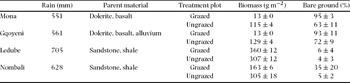
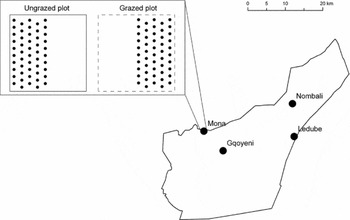
Termite consumption was studied at four sites within HiP: Mona, Gqoyeni, Ledube and Nombali. Nombali and Ledube are situated in a high-rainfall area (628 and 707 mm y−1, respectively) on nutrient-poor substrate (sandstone and shale) while Gqoyeni and Mona are situated in a low-rainfall area (561 and 551 mm y−1, respectively) on more mineral-nutrient-rich substrate (dolerite) (Table 1). Each site contains a long-term 40 × 40-m fenced herbivore exclosure (Figure 1) which excludes all herbivores larger than a scrub hare (Lepus saxatilis F. Cuvier, 1823). Common large herbivores visiting the sites were white rhino (Ceratotherium simum Burchell, 1817), buffalo (Syncerus caffer Sparrman, 1779), zebra (Equus quagga burchellii Gray, 1824), impala (Aepyceros melampus Lichtenstein, 1812) and warthog (Phacochoerus africanus Gmelin, 1718). Each exclosure was paired with an open area of similar size to control for the effects of grazing. Controlled burns were applied every second year both inside the exclosure and to the adjacent control areas.
Mean annual rainfall, interpolated from 11 rainfall stations in HiP, between 2001 and 2007 and parent geological material (King Reference KING1970) are given for the four study sites. Mean biomass from 200 disc-pasture meter measurements per plot (± SE) and the mean proportion of bare ground from 200 visual estimates per plot (± SD) are given for each treatment plot within site.

Hluhluwe–iMfolozi Park, South Africa, with the location of the four study sites where litter removal by termites was measured. The inset shows the schematic layout of two plots (40 × 40 m) within a site: an ungrazed plot from which mammalian herbivores were excluded and an equally sized control plot open to herbivores. The dots within the plots indicate the location of 100 litter bags used to quantify litter removal by termites.

METHODS
Quantification of termite activity
Termite consumption rates were measured by quantifying litter removal from mesh bags placed at the sites (Bodine & Ueckert Reference BODINE and UECKERT1975). Bags were filled with 5.0 g of dried (48 h at 60 °C) Themeda triandra Forssk. grass harvested from a single location to control for variation in forage quality. Since the grass placed within the bags was mostly moribund, it was assumed that nutrients had been largely resorbed by the plants (Ratnam et al. Reference RATNAM, SANKARAN, HANAN, GRANT and ZAMBATIS2008) and thus the harvested material was functionally equivalent to senesced grass litter. Grass was cut into segments of approximately 5 cm, mixing leaves and stems. Bags were constructed from aluminium mesh with a pore size of 2 × 2 mm, although the loosely woven structure of the material allowed slightly larger-bodied termites (i.e. Hodotermes mossambicus Hagen and Macrotermes natalensis Haviland) into the litterbags. The bags were approximately 10 × 10 cm and were secured to the substrate with a nail.
Litter removal rates were measured within 450-m2 plots (15 × 30 m) that were established in each exclosure and adjacent control area. Plots were divided in a regular grid of 200 cells measuring 1.5 × 1.5 m. A litterbag was placed in every second cell, starting in the first cell of each odd numbered row and in the second cell of each even numbered row to obtain an optimal coverage. The 100 litterbags in each plot were collected after 1 mo, dried at 60 °C for 48 h and then emptied. Grass was separated from soil that had accumulated in the bags as a result of soil sheathing by termites, and both were weighed separately. Within each grid cell grass biomass was measured using a disc-pasture meter (DPM) (Bransby & Tainton Reference BRANSBY and TAINTON1977) from which biomass under the disc was calculated by: grass biomass (g m−2) = 12.6 + 26.1 DPM (R2 = 0.73, N = 1745) (Waldram et al. Reference WALDRAM, BOND and STOCK2008). Proportion of bare ground was estimated visually within grid cells.
Statistical analyses
Local-scale patterns of variation in termite activity within plots were assessed by calculating Moran's I statistic for spatial autocorrelation. Our a priori expectation was that termite foraging would be patchy and that patches of high foraging activity would coincide with patches of high resource availability, such as herbaceous biomass (food) and the proportion of bare ground. Patchiness within plots of herbaceous biomass and bare ground was assessed with Moran's I. Within-plot correlations between litter removal and herbaceous biomass and bare ground were used to assess the spatial association of litter removal with resource availability. Inverse distance-weighted interpolation surfaces (power = 2, extent = 12 closest points) of litter removal were created using Spatial Analyst in ArcMap 9.2 (ESRI 2006, Redlands, CA, USA).
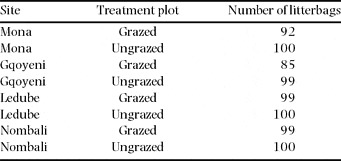
To test the effects of rainfall and herbivory on litter removal at the landscape scale, a linear mixed-effects model was constructed using the LME function in the NLME library version 3.1–89 (R Foundation for Statistical Computing, Vienna, Austria) for R (R Development Core Team, R Foundation for Statistical Computing, Vienna, Austria). The LME function employs a restricted maximum likelihood (REML) estimator. The main advantage of this method is that it is not sensitive to unbalanced designs or missing observations (Pinheiro & Bates Reference PINHEIRO and BATES2000). While our design was balanced, some observations (litter bags) were missing (Appendix 1). Close proximity of litterbags within a site could result in correlated measurements between them (spatial auto-correlation), however the LME function allows such correlated within-group errors to be estimated explicitly in the model. LME also allows unequal variances between groups to be modelled explicitly by adding a variance structure to the model. The model included rainfall and herbivory as fixed effects, while site was included as a random variable. The best model was selected using Akaike information criterion (AIC) where smaller values indicate a better model.
RESULTS
Within plots
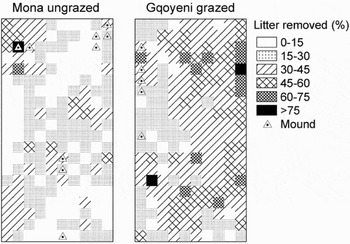
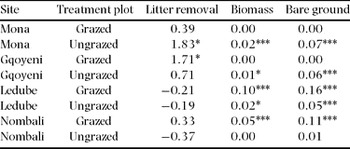
In general, we found no clear spatial association between termite mounds and spatial patterns of litter removal within sites. Within-plot values of litter removal revealed statistically significant spatial autocorrelation (patchiness) in only two of the eight plots (Figure 2, Table 2). Both plots were located in dry sites, however one (Mona) was inaccessible to herbivores, while the other (Gqoyeni), was exposed to herbivores. In those two plots the local litter removal rate was negatively correlated with proportion of bare ground: significantly in Mona ungrazed (r = −0.26, P < 0.01, n = 100) and with a small but not significant P-value in Gqoyeni grazed (r = −0.20, P = 0.06, n = 85). There were no significant correlations between proportion of bare ground and litter removal in the other plots, nor were there significant correlations between herbaceous biomass and litter removal in any of the plots. The small variance of biomass and proportion of bare ground within most plots (Table 1) indicates a fairly homogeneous vegetation structure at the measured scale, even though Moran's I for spatial clustering was significant for biomass and proportion of bare ground in five of the eight plots (Table 2).
Inverse distance-weighted interpolation surface (15 × 30 m) of litter removal within two out of eight study plots. The plots shown here were the only plots with significant spatial autocorrelation in litter removal by termites. The location of termite mounds within plots is indicated to show the poor relationship between patterns of litter removal and location of termite mounds.

Moran's I statistics for within-plot spatial autocorrelation of litter removal rates, herbaceous biomass and proportion of bare ground. *denotes significance at P < 0.05, **P < 0.01, ***P < 0.001.

Between plots
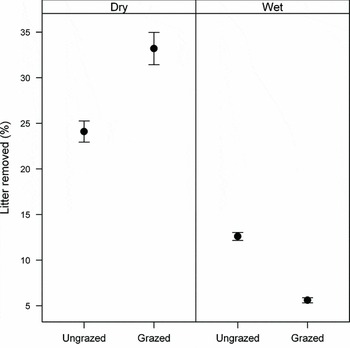
We found a significant interactive effect of rainfall and grazing (F1,2 = 71.7, P < 0.05) on litter removal, where grazing increased litter removal in the dry area but decreased litter removal in the wet area (Figure 3). The main effect of grazing on litter removal was also highly significant (F1,2 = 144; P < 0.01) while the effect of rainfall had a small but not significant P-value (F1,2 = 16.2; P = 0.057) (more litter removal in the drier sites).
Mean percentage of litter removal by termites in wet and dry areas, separated between herbivore exclosure plots and plots open to herbivores. Error bars indicate 1 SE.

Of the initial variation in litter removal, approximately 30% was associated with differences between sites, while the remaining 70% was associated with differences within sites. Of the 30% between-site variance, 90% was explained by adding rainfall as a predictor variable. Adding grazing and its interaction with rainfall to the model explained 10% of the initial 70% within-site variance.
A model including a random site effect had a significantly smaller AIC (−843) than the equivalent model without a random site effect (AIC = −818), indicating that common (unstudied) site characteristics had a significant effect on litter removal.
As can be seen from Figure 3, the variance in litter removal in the dry area was greater than in the wet area, and therefore modelling the variance for dry and wet areas separately significantly improved the model. The variance in the wet area was modelled as 46% of the variance in the dry area, which improved the AIC from −843 to −1059. Adding a correlation structure did not significantly improve the model (AIC was not reduced), indicating that there was no significant spatial auto-correlation within sites.
DISCUSSION
As litter-feeding termites contribute substantially to spatial heterogeneity and ecological processes in savannas (Pringle et al. Reference PRINGLE, DOAK, BRODY, JOCQUE and PALMER2010) it is important to identify determinants of their distribution and foraging intensity. In this study we show that termite foraging intensity varies with rainfall and herbivory across relatively large scales (among sites separated by 8–25 km), while termite foraging showed little spatial pattern and did not correlate well with herbaceous vegetation structure at local scales (within 450-m2 plots). The significant interaction effect between rainfall and herbivory on termite foraging intensity may indicate a switch between facilitation and competition between large herbivores and termites across the rainfall gradient in HiP. Additionally, an overall negative relation between rainfall and litter removal transpired from the rainfall main effect that explained the largest portion of variation in litter removal. Such a negative relationship between rainfall and termite consumption is inconsistent with previous studies (Buxton Reference BUXTON1981, Deshmukh Reference DESHMUKH1989). While we acknowledge that our small sample size and restricted rainfall range limits our ability to extrapolate the results to other ecosystems, we feel that our study highlights ecological interactions which may exist in other savannas.
Local scale
Our initial expectation was that epigeal mound placement within sites would serve as an indicator of termite foraging as they are useful indicators of termite distribution for species that construct them, e.g. Macrotermes spp. (Glover et al. Reference GLOVER, TRUMP and WATERIDGE1964, Meyer et al. Reference MEYER, BRAACK, BIGGS and EBERSOHN1999). One possible reason for the lack of association between mounds and termite activity on the local scale is that we made no attempt to test mound occupancy. Mound occupancy can however not be used to explain differences between grazed and ungrazed plots within a site, as these plots are in close enough proximity to overlap with the foraging range of a single termite colony (Coaton & Sheasby Reference COATON and SHEASBY1972, Heidecker & Leuthold Reference HEIDECKER and LEUTHOLD1984). Another possibility is that our plots were too small to capture termite foraging patterns at local scales. A final explanation is that some termite species do not construct (obvious) mounds and therefore mounds may be poor predictors of the foraging intensity of an entire functional feeding group (Abenspergtraun Reference ABENSPERGTRAUN1992).
Based on termite biology, foraging intensity on the local scale was expected to be higher under vegetation cover, e.g. from higher soil moisture that facilitates the construction of protective sheeting (Belsky et al. Reference BELSKY, AMUNDSON, DUXBURY, RIHA, ALI and MWONGA1989, Dangerfield & Schuurman Reference DANGERFIELD and SCHUURMAN2000, Whitford et al. Reference WHITFORD, STEINBERGER and ETTERSHANK1982) or through interception of harmful solar radiation (Holt & Lepage Reference HOLT, LEPAGE, Abe, Bignell and Higashi2000). The proportion of bare ground correlated negatively with termite activity but only in plots with significant spatial clustering of termite activity. In these plots, as expected, termites therefore concentrate foraging in covered patches, however this pattern was not present in plots without spatial clustering of termite activity at the scale of measurement. It is possible that termite activity in these plots is clustered at smaller or larger spatial scales than the measured scale and the negative relationship with bare ground might be present at the scale of clustering. Small-scale heterogeneity in termite activity found in other ecosystems was correlated to vegetation structure and attributed to litter availability (Tracy et al. Reference TRACY, GOLDEN and CRIST1998). Therefore, the weak correlation we found between litter removal and vegetation structure in two of our eight plots, may indicate that stronger relationships might be obtained by adjusting the scale of observation. This could be achieved by either increasing the spatial extent (plot size) to include more heterogeneity in vegetation structure, or by decreasing the spatial grain (cell size) to measure heterogeneity at a smaller scale.
Landscape scale
In contrast to the local scale, we identified strong predictors of termite foraging intensity on the landscape scale. Foraging intensity was much higher in dry sites compared with wetter sites, which contradicts previous studies that find an increase of termite consumption with increasing rainfall (Buxton Reference BUXTON1981, Deshmukh Reference DESHMUKH1989). Deshmukh (Reference DESHMUKH1989) compiled consumption rates from studies across the African continent and suggests that the increase in termite consumption with increased rainfall is driven by increased food availability, due to the increase of herbaceous primary production with rainfall (Rosenzweig Reference ROSENZWEIG1968, Rutherford Reference RUTHERFORD1981). Buxton (Reference BUXTON1981) also reports increased termite consumption with rainfall in Tsavo National Park, Kenya, even though the two driest sites (total sites = 9), which also had the highest termite consumption, were left out of the regression because they did not fit the trend.
We offer some possible explanations for the apparent mismatch between termite consumption and food availability in our study. Firstly, litter quality may be higher in the drier area. While litter N concentrations are likely to be higher in the dry area as a result of the nutrient-rich geological substrate, termites are highly adapted to food with extremely high C:N ratios and are therefore not likely to be attracted to more nutrient-rich litter (Rouland et al. Reference ROULAND, LEPAGE, CHOTTE, DIOUF, NDIAYE, NDIAYE, SEUGE and BRAUMAN2003). However, grasses in the wetter part of HiP have significantly higher concentrations of lignin and secondary metabolites such as phenolics (Masumelele Reference MASUMELELE2007), which may make them less palatable and hence decrease litter quality to termites and the Termitomyces sp. R. Heim fungus that is cultivated by Macrotermitinae species.
Secondly, food accessibility for termites may be facilitated in the dry part of HiP by the high abundance of mammalian grazers (Cromsigt et al. Reference CROMSIGT, PRINS and OLFF2009), potentially resulting in a higher carrying capacity for termites and an overall higher termite foraging intensity in this area. Grazers increase litter-fall by dropping plant fragments whilst grazing and trample the vegetation (Cumming & Cumming Reference CUMMING and CUMMING2003, Deshmukh Reference DESHMUKH1989), making it more accessible to termites. In addition, herbivore dung contains a large proportion of undigested plant material and is readily exploited by litter-feeding termites (Freymann et al. Reference FREYMANN, BUITENWERF, DESOUZA and OLFF2008). Within the dry sites, plots with large herbivores had higher termite foraging intensity, supporting the proposed positive effects of large herbivores on termites. It remains unclear why the opposite pattern is observed in the wet area, where termite consumption is higher in ungrazed plots. Possibly this is due to a less favourable microclimate within the tall-grass vegetation of the exclosures. Contrasting effects of large herbivores on termites are also reported in other studies. In a Chihuahuan desert ecosystem, termite activity was higher in ungrazed sites compared to grazed sites, which was attributed to changed litter availability in the grazed area (Tracy et al. Reference TRACY, GOLDEN and CRIST1998). In an Australian Eucalyptus woodland and a Burkina Faso savanna, no effects of grazing on termite diversity and abundance were found, although foraging activity was not measured directly (Abenspergtraun Reference ABENSPERGTRAUN1992, Traore & Lepage Reference TRAORE and LEPAGE2008). While herbivores clearly have effects on termites, the mechanisms by which they do so remain unclear and may be interactive, e.g. with rainfall, and location-specific.
The positive association between herbivores and termite consumption that we found may lead to food competition during droughts, as reported for African rangelands where harvester termites (Hodotermes spp.) consumed up to 60% of standing grass biomass and all the litter, resulting in stock mortality (Coaton & Sheasby Reference COATON and SHEASBY1972, Mitchell Reference MITCHELL2002). No such dramatic events have been reported for systems with wild herbivores, however a detailed understanding of interactions between herbivores and termites will improve understanding of ecosystem functioning and is likely to benefit the management of protected areas and large herbivores.
CONCLUSIONS
To fully understand ecosystem structure and functioning it is essential to identify determinants of termite distribution and foraging intensity and quantify relations with other ecosystem components such as herbivores. This study provides novel insights into the relationship of termites, the main litter decomposers and primary agents of nutrient and vegetation heterogeneity in savannas, with rainfall and mammalian herbivores. The exact mechanisms that produce the observed patterns and correlations need to be identified in order to improve understanding and management of savanna ecosystems.
ACKNOWLEDGEMENTS
The authors wish to thank Khanyi Mpandza and Aafke van Erk for assistance with data collection. We thank Ezemvelo KwaZulu-Natal Wildlife for allowing us to do research in HiP. The Marco Polo Fund and the Groninger Universiteits Fonds partially funded this research.
While in each plot 100 litterbags were laid out initially, some bags were not retrieved as a result of disturbance by animals. Here the actual number of litterbags per plot that were analysed is shown.