1. Introduction
The North China Craton (NCC) is one of the few areas on Earth where rocks older than 3.8 Ga have been identified (Liu et al. Reference Liu, Nutman, Compston, Wu and Shen1992; Song et al. Reference Song, Nutman, Liu and Wu1996; Wan et al. Reference Wan, Liu, Song, Wu, Yang, Zhang and Geng2005) and rocks older than c. 2.6 Ga occur widely (Wan et al. Reference Wan, Liu, Dong, Xie, Kröner, Ma, Liu, Xie, Ren and Zhai2015). The Archean crustal growth and reworking, the tectonic subdivision and amalgamation, the major magmatic and metamorphic events, and the tectonic settings of the NCC have attracted much attention within the international geological community in the past decades (Bai & Dai, Reference Bai and Dai1996; Wu et al. Reference Wu, Geng and Shen1998; Zhao et al. Reference Zhao, Sun, Wilde and Li2005; Lu et al. Reference Lu, Zhao, Wang and Hao2008; Zhai et al. Reference Zhai, Bian and Zhao2000, Reference Zhai, Guo and Liu2005, Reference Zhai, Li, Peng, Hu, Liu, Zhang, Kusky, Zhai and Xiao2010; Nutman et al. Reference Nutman, Wan, Du, Friend, Dong, Xie, Wang, Sun and Liu2011; Zhai & Santosh, Reference Zhai and Santosh2011; Zhang et al. Reference Zhang, Ying, Santosh and Zhao2012; Wang et al. Reference Wang, Liu, Santosh, Wang, Bai and Guo2015; Liu et al. Reference Liu and Cai2017 a). As the most voluminous rock type in Archean–Palaeoproterozoic cratonic blocks, the tonalite-trondhjemite-granodiorite (TTG) and potassium-rich granite gneisses (Barker, Reference Barker and Barker1979) are widely distributed in the preserved basement of the NCC, providing an opportunity to constrain the crustal growth, recycling, metamorphism and their tectonic settings. However, several events since the late Palaeoproterozoic Era modified the original features of the basement and make it difficult to comprehensively understand the early Precambrian geology of the NCC, so significant debates are still ongoing as indicated by different tectonic models, especially for the Neoarchean granitic gneisses and associated rocks in the eastern NCC (Geng et al. Reference Geng, Liu and Yang2006; Tang et al. Reference Tang, Zheng, Wu, Gong and Liu2007; Jahn et al. Reference Jahn, Liu, Wan, Song and Wu2008; Yang et al. Reference Yang, Wu, Wilde and Zhao2008; Nutman et al. Reference Nutman, Wan, Du, Friend, Dong, Xie, Wang, Sun and Liu2011; Wan et al. Reference Wan, Xie, Yang, Kröner, Ma, Dong, Du, Xie and Liu2014; Xie et al. Reference Xie, Xie, Wang, Kröner, Liu, Zhou, Ma, Dong, Liu and Wan2014 a; Shan et al. Reference Shan, Zhai, Wang, Zhou, Santosh, Zhu, Zhang and Wang2015; Wang et al. Reference Wang, Liu, Santosh, Wang, Bai and Guo2015).
Zircon is an accessory mineral in a wide variety of igneous rocks (especially intermediate to felsic intrusive rocks), and is one of the most useful minerals for gaining detailed information about the formation, recycling and metamorphism of high-grade gneiss terranes (Zheng et al. Reference Zheng, Zhao, Wu, Zhang, Liu and Wu2006; Wu et al. Reference Wu, Zhang, Yang, Xie and Yang2008; Gerdes & Zeh, Reference Gerdes and Zeh2009; Liu et al. Reference Liu, Robinson, Gerdes, Xue, Liu and Liou2010 a; Zeh et al. Reference Zeh, Gerdes, Jay and Klemd2010; Heinonen et al. Reference Heinonen, Andersen, Rämö and Whitehouse2015; Mukherjee et al. Reference Mukherjee, Dey, Sanyal, Ibanez-Mejia, Dutta, Sengupta, Pant and Dasgupta2017) because of its resistance to recrystallization during hydrothermal alteration. As well as internal zoning patterns (Corfu et al. Reference Corfu, Hanchar, Hoskin, Kinny, Hanchar and Hoskin2003; Harley et al. Reference Harley, Kelly and Moller2007), U–Th–Pb and Lu–Hf isotopes provide information about magmatic and/or metamorphic events and crustal evolution (Amelin et al. Reference Amelin, Lee, Halliday and Pidgeon1999, Reference Amelin, Lee and Halliday2000; Kinny & Maas, Reference Kinny, Maas, Hanchar and Hoskin2003; Griffin et al. Reference Griffin, Belousova, Shee, Pearson and O’Reilly2004; Hawkesworth & Kemp, Reference Hawkesworth and Kemp2006; Wu et al. Reference Wu, Li, Zheng and Gao2007), and the minor- and trace-element geochemistry of zircon is an indicator of its parental magma composition (Hoskin & Schaltegger, Reference Hoskin and Schaltegger2003; Hoskin, Reference Hoskin2005). Additionally, using an analytically consistent set of zircon trace-element data (including U, Yb, Nb, Sc, Ce and Gd), it is possible to discriminate the tectonomagmatic settings of mid-ocean ridge, plume-influenced ocean island and subduction-related arc environments (Grimes et al. Reference Grimes, John, Kelemen, Mazdab, Wooden, Cheadle, Hanghøj and Schwartz2007, Reference Grimes, Wooden, Cheadle and John2015; Carley et al. Reference Carley, Miller, Wooden, Padilla, Schmitt, Economos, Binderman and Jordan2014).
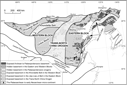
Different models have been proposed for the tectonic subdivision of the NCC since the application of terrane accretion and collision models (Wu et al. Reference Wu, Geng and Shen1998; Zhao et al. Reference Zhao, Wilde, Cawood and Lu1998; Zhai et al. Reference Zhai, Bian and Zhao2000; Kusky & Li, Reference Kusky and Li2003; Faure et al. Reference Faure, Trap, Lin, Monie and Bruguier2007; Kusky et al. Reference Kusky, Li and Santosh2007; Santosh, Reference Santosh2010; Wan et al. Reference Wan, Liu, Dong, Xie, Kröner, Ma, Liu, Xie, Ren and Zhai2015). In the southeastern NCC, the Bengbu area has been suggested as belonging to the Yuwan Block (Wu et al. Reference Wu, Geng and Shen1998), the Xuhuai Block (Zhai et al. Reference Zhai and Santosh2011) and the Eastern Block (Zhao et al. Reference Zhao, Sun, Wilde and Li2005). More recently, Wan et al. (Reference Wan, Liu, Dong, Xie, Kröner, Ma, Liu, Xie, Ren and Zhai2015) delineated three Archean terranes based on the spatial distribution of ancient rocks and zircons, namely the Eastern, Southern and Central ancient terranes (Fig. 1), in which the Bengbu area is located in the eastern end of the Southern Ancient Terrane and is suggested to be comparable with the Xinyang, Lushan, Huoqiu and Zhongtiao areas based on occurrences of zircons or rocks of age 3.65, 2.82–2.83 and 2.6–2.7 Ga (Wan et al. Reference Wan, Dong, Ren, Bai, Xie, Xie and Liu2017). However, recent geochronological studies in the Huoqiu area suggest two magmatic events at 2.76–2.71 Ga (Wan et al. Reference Wan, Dong, Wang, Xie and Liu2010; Yang et al. Reference Yang, Wang, Du, Wang, Wang, Tu, Zhang and Sun2012; Wang et al. Reference Wang, Zheng, Pan, Dong, Liao, Zhang, Zhang, Zhao and Tu2014 a) and 2.56–2.48 Ga (Wan et al. Reference Wan, Dong, Wang, Xie and Liu2010; Wang et al. Reference Wang, Liu, Gu, Hou and Song2012 a; Liu et al. Reference Liu, Wang, Li, Rolfo, Li, Groppo and Hou2013 a), and xenocrystic zircons of age 2.90–2.95 Ga have also been found (Yang et al. Reference Yang, Wang, Du, Wang, Wang, Tu, Zhang and Sun2012; Liu et al. Reference Liu, Yang, Santosh and Aulbach2015 a). In the Palaeoproterozoic Fengyang and Wuhe groups in the Bengbu area, the Archean detrital zircons yield similar age peaks of 2.88–2.94, 2.69–2.77 and 2.52–2.55 Ga (Liu & Cai, Reference Liu and Cai2017; Liu et al. Reference Liu, Zhao, Liu and Cai2018). Additionally, in consideration of an c. 400 km offset along the Mesozoic NE-striking Tan-Lu Fault (Zhao et al. Reference Zhao, Zhu, Lin and Wang2016; Fig. 1), the Jiaobei Terrane assigned to the East Ancient Terrane (Wan et al. Reference Wan, Liu, Dong, Xie, Kröner, Ma, Liu, Xie, Ren and Zhai2015) has a close spatial relationship with the Bengbu area and also underwent three episodes of magmatic events at 2.93–2.86, 2.74–2.69 and 2.56–2.50 Ga (Faure et al. Reference Faure, Lin, Monie, Breton, Poussineau, Panis and Deloule2003; Tang et al. Reference Tang, Zheng, Wu, Zha and Zhou2004, Reference Tang, Zheng, Wu, Gong and Liu2007; Jahn et al. Reference Jahn, Liu, Wan, Song and Wu2008; Zhou et al. Reference Zhou, Wilde, Zhao, Zhang, Zheng, Jin and Cheng2008 a; Liu et al. Reference Liu, Liu, Ding, Liu, Yang, Liu, Wang and Meng2013 b; Xie et al. Reference Xie, Wan, Wang, Liu, Xie, Liu, Dong and Ma2013, Reference Xie, Xie, Wang, Kröner, Liu, Zhou, Ma, Dong, Liu and Wan2014 a, Reference Xie, Wang, Xie, Liu, Dong, Ma, Ren and Liu2015; Wang et al. Reference Wang, Zhai, Li, Santosh, Zhao and Wang2014 b; Wu et al. Reference Wu, Zhao, Sun, Li, Bao, Tam, Eizenhöefer and He2014 a; Zhang et al. Reference Zhang, Tang and Zheng2014; Shan et al. Reference Shan, Zhai, Wang, Zhou, Santosh, Zhu, Zhang and Wang2015). However, it is still uncertain whether the Huoqiu, Bengbu and Jiaobei areas shared the same formation and evolution processes during the Archean–Palaeoproterozoic period. In this study, in situ zircon Th–U–Pb and Lu–Hf isotopes and trace-element compositions were analysed using laser ablation – multicollector – inductively coupled plasma – mass spectrometry (LA-(MC)-ICP-MS) applied to eight early Palaeoproterozoic – Archean granitoids in the Bengbu area, with a view to (1) determining their formation and metamorphic ages; (2) comparing the crust growth and reworking history of the Huoqiu, Bengbu and Jiaobei areas; and (3) providing evidence for a Palaeo- to Mesoarchean micro-continent entrained in the Jiao-Liao-Ji Belt at the southeastern NCC.
Tectonic subdivision of the North China Craton (modified after Zhao et al. Reference Zhao, Sun, Wilde and Li2005), showing the distribution of the Eastern Ancient Terrane (EAT) and Southern Ancient Terrane (SAT; Wan et al. Reference Wan, Liu, Dong, Xie, Kröner, Ma, Liu, Xie, Ren and Zhai2015). Note that the cropped out rocks or xenocrystic zircons with Palaeoarchean – early Neoarchean ages are indicated by stars. The early Precambrian position of the Jiaobei Terrane is based on the c. 400 km offset along the Mesozoic NE-striking Tan-Lu Fault (Zhao et al. Reference Zhao, Zhu, Lin and Wang2016). JG – Jiagou; JB – Jiaobei; HQ – Huoqiu; BB – Bengbu.

2. Regional geology
In the last decades, three Palaeoproterozoic mobile belts – the Khondalite Belt, the Trans-North China Orogen and the Jiao-Liao-Ji Belt (JLJB) (Zhao et al. Reference Zhao, Sun, Wilde and Li2005, 2012), alternatively named the Fengzhen, Jinyu and Liaoji belts (Zhai & Peng, Reference Zhai and Peng2007; Zhai & Santosh, Reference Zhai and Santosh2011), have been identified in the NCC. The Trans-North China Orogen divides the NCC into the Western Block and Eastern Block, and the Khondalite Belt subdivides the Western Block into the Yinshan Block in the north and the Ordos Block in the south (Fig. 1; Zhao et al. Reference Zhao, Sun, Wilde and Li2005, Reference Zhao, Cawood, Li, Wilde, Sun, Zhang, He and Yin2012). Previous studies suggested that the Yinshan and Ordos blocks collided along the Khondalite Belt at c. 1.95 Ga (Yin et al. Reference Yin, Zhao, Guo, Sun, Xia, Zhou and Liu2011, Reference Yin, Zhao, Wei, Sun, Guo and Zhou2014; Wan et al. Reference Wan, Xu, Dong, Nutman, Ma, Xie, Liu, Liu, Wang and Cu2013), and then the consolidated Western Block amalgamated with the Eastern Block along the Trans-North China Orogen at c. 1.85 Ga (Zhao et al. Reference Zhao, Sun, Wilde and Li2005, Reference Zhao, Cawood, Li, Wilde, Sun, Zhang, He and Yin2012) or slightly earlier at 1.95 Ga (Zhang et al. Reference Zhang, Wei, Tian and Zhou2013; Qian & Wei Reference Qian and Wei2016).
The nearly N–S-trending JLJB is located in the eastern part of the Eastern Block and extends for c. 1200 km from southern Jilin, through the Liaodong Peninsula and into the Jiaodong Peninsula (Fig. 1). Previous geochronological studies in the belt showed that most of the supracrustal successions and pre-tectonic granitoids formed during 2.20–2.10 Ga and were metamorphosed and deformed during 1.95–1.90 Ga (Luo et al. Reference Luo, Sun, Zhao, Li, Xu, Ye and Xia2004, Reference Luo, Sun, Zhao, Li, Ayers, Xia and Zhang2008; Li et al. Reference Li, Zhao, Sun, Han, Hao, Luo and Xia2005; Lu et al. Reference Lu, Wu, Guo, Wilde, Yang, Liu and Zhang2006, Reference Lu, Wu, Zhang, Zhao, Yang and Guo2004; Li & Zhao, Reference Li and Zhao2007; Zhou et al. Reference Zhou, Zhao, Wei, Geng and Sun2008 b; Tam et al. Reference Tam, Zhao, Liu, Zhou, Sun and Li2011; Liu et al. Reference Liu, Liu, Yang, Wang and Liu2012 a, Reference Liu, Liu, Liu, Wang, Liu, Yang, Cai and Shi2013 c), whereas the post-tectonic granites were emplaced at 1.88–1.83 Ga (Hao et al. Reference Hao, Li, Zhao, Sun, Han and Zhao2004; Lu et al. Reference Lu, Wu, Guo, Wilde, Yang, Liu and Zhang2006; Li & Zhao, Reference Li and Zhao2007; Liu et al. Reference Liu and Cai2017 b).
The Jiaobei Terrane, considered as the south segment of the JLJB (Zhao et al. Reference Zhao, Sun, Wilde and Li2005), is bounded by the Tan-Lu Fault to the NW and the Wulian-Yantai Fault to the SE, the latter being commonly regarded as the boundary between the NCC and South China Craton (Wallis et al. Reference Wallis, Enami and Banno1999; Tang et al. Reference Tang, Zheng, Wu, Gong and Liu2007; Zhang et al. Reference Zhang, Tang and Zheng2014). The Precambrian metamorphic basement is mainly composed of Archean–Palaeoproterozoic supracrustal rocks and (gneissic) granitoids (SBGMR, 1991; Lu, Reference Lu1998; Zhou et al. Reference Zhou, Wei, Geng and Zhang2004, Reference Zhou, Wilde, Zhao, Zhang, Zheng, Jin and Cheng2008 a, b; Tang et al. Reference Tang, Zheng, Wu, Gong and Liu2007; Jahn et al. Reference Jahn, Liu, Wan, Song and Wu2008; Tam et al. 2012). The Archean supracrustal rocks, which occur sparsely within TTG gneisses, are mainly biotite-plagioclase gneiss, biotite leptite, leuco-leptite, amphibolite and banded iron formation (BIF), all of which underwent amphibolite- to granulite-facies metamorphism. Amphibole 39Ar–40Ar and zircon U–Pb geochronological studies showed that they formed at c. 2.89 Ga (Jahn et al. Reference Jahn, Liu, Wan, Song and Wu2008) and experienced two episodes of metamorphism at 2.52–2.45 and 1.96–1.79 Ga (Faure et al. Reference Faure, Lin, Monie, Breton, Poussineau, Panis and Deloule2003; Tang et al. Reference Tang, Zheng, Wu, Gong and Liu2007; Jahn et al. Reference Jahn, Liu, Wan, Song and Wu2008; Zhou et al. Reference Zhou, Zhao, Wei, Geng and Sun2008 b; Tam et al. Reference Tam, Zhao, Liu, Zhou, Sun and Li2011; Liu et al. Reference Liu, Liu, Yang, Wang and Liu2012 a; Xie et al. Reference Xie, Wan, Wang, Liu, Xie, Liu, Dong and Ma2013; Wang et al. Reference Wang, Zhai, Li, Santosh, Zhao and Wang2014 b; Wu et al. Reference Wu, Zhao, Sun, Li, Bao, Tam, Eizenhöefer and He2014 a). The Palaeoproterozoic Fenzishan and Jingshan groups unconformably overlie the Archean TTG gneisses, and are composed mainly of Al-rich sillimanite-garnet-biotite-quartz schist, biotite leptite and gneiss, felsic paragneiss, marble and amphibolite. Metamorphic zircon ages of 1.80–1.95 Ga (Wan et al. Reference Wan, Song, Liu, Wilde, Wu, Shi, Yin and Zhou2006; Zhou et al. Reference Zhou, Zhao, Wei, Geng and Sun2008 b; Wang et al. Reference Wang, Liu, Liu and Liu2010; Tam et al. Reference Tam, Zhao, Liu, Zhou, Sun and Li2011; Zhang et al. Reference Zhang, Tang and Zheng2014) and detrital zircon ages of 2.00–3.40 Ga with peaks at 2.10–2.20 and 2.45–2.50 Ga (Wan et al. Reference Wan, Song, Liu, Wilde, Wu, Shi, Yin and Zhou2006; Xie et al. Reference Xie, Wang, Xie, Liu, Dong, Ma, Liu and Wan2014 b; Liu et al. Reference Liu and Yang2015 b) have been reported. The Archean granitoid (TTG and potassium granite) gneisses are mainly exposed in the Qixia area and are characterized by ductile shear deformation and anatexis resulting from amphibolite- to granulite-facies metamorphism (Liu et al. Reference Liu, Liu, Yang, Wang and Liu2012 a, Reference Liu, Liu, Liu, Wang, Liu, Yang, Cai and Shi2013 c; Tam et al. Reference Tam, Zhao, Liu, Zhou, Sun and Li2011). Zircon U-Pb dating results gave protolith ages of 2.86–2.93 Ga, 2.69–2.74 Ga and 2.50–2.56 Ga and metamorphism/anatexis ages of 2.46–2.52 Ga and 1.86–1.90 Ga for the TTG gneisses (Tang et al. Reference Tang, Zheng, Wu, Zha and Zhou2004, Reference Tang, Zheng, Wu, Gong and Liu2007; Jahn et al. Reference Jahn, Liu, Wan, Song and Wu2008; Zhou et al. Reference Zhou, Wilde, Zhao, Zhang, Zheng, Jin and Cheng2008 a, b; Liu et al. Reference Liu, Liu, Yang, Wang and Liu2012 a, Reference Liu, Liu, Ding, Liu, Yang, Liu, Wang and Meng2013 b, c; Xie et al. Reference Xie, Wan, Wang, Liu, Xie, Liu, Dong and Ma2013, Reference Xie, Xie, Wang, Kröner, Liu, Zhou, Ma, Dong, Liu and Wan2014 a, Reference Xie, Wang, Xie, Liu, Dong, Ma, Ren and Liu2015; Wang et al. Reference Wang, Zhai, Li, Santosh, Zhao and Wang2014 b; Wu et al. Reference Wu, Zhao, Sun, Li, Bao, Tam, Eizenhöefer and He2014 a; Shan et al. Reference Shan, Zhai, Wang, Zhou, Santosh, Zhu, Zhang and Wang2015). TTG gneisses are intruded by Palaeoproterozoic granitoids and mafic intrusions in the north of the Qixia, of which the former consists of deformed or undeformed monzogranites and granites, and the latter consists of gabbros and dolerites forming walls or sheets in the granitoid plutons. Relatively little work has been undertaken on these granitoid rocks and gabbros, and only two stages of zircon U–Pb ages of 2.10–2.18 and 1.80–1.84 Ga have been obtained (Liu et al. Reference Liu, Liu, Ding, Liu, Guo and Wang2014; Wang et al. Reference Wang, Zhai, Li, Santosh, Zhao and Wang2014 b).
The Precambrian basements at the southeastern margin of the NCC are distributed in the Huoqiu and Bengbu areas, which lie about 70 km west of the Tan-Lu fault zone (Fig. 1) and were suggested as the southwestern extension of the JLJB (Zhao et al. Reference Zhao, Cawood, Li, Wilde, Sun, Zhang, He and Yin2012; Wang et al. Reference Wang, Liu, Zhang, Zhao, Wang and Song2017a; Liu et al. Reference Liu, Zhao, Liu and Cai2018). In the Huoqiu area, the basement rocks are covered by late Precambrian and Quaternary strata and are composed of meta-supracrustal rocks and granitoid intrusions based on the drilling data (Yang et al. Reference Yang, Wang, Du, Wang, Wang, Tu, Zhang and Sun2012; Wang et al. Reference Wang, Zheng, Pan, Dong, Liao, Zhang, Zhang, Zhao and Tu2014 a). Recent LA-ICP-MS and secondary ion mass spectrometry (SIMS) zircon dating results suggested that the plagioclase amphibolite formed at 2.71 Ga with xenocrystic zircons of 2.95 Ga (Yang et al. Reference Yang, Wang, Du, Wang, Wang, Tu, Zhang and Sun2012). The metamorphosed siliciclastic rocks have two age groups at 2.95–3.02 and 2.74–2.77 Ga (Wan et al. Reference Wan, Dong, Wang, Xie and Liu2010, Wang et al. Reference Wang, Zheng, Pan, Dong, Liao, Zhang, Zhang, Zhao and Tu2014 a; Liu et al. Reference Liu, Yang, Santosh and Aulbach2015 a) and the granitoids emplaced at 2.76–2.71, 2.56 and 1.92–1.82 Ga (Wan et al. Reference Wan, Dong, Wang, Xie and Liu2010; Yang et al. Reference Yang, Wang, Du, Wang, Wang, Tu, Zhang and Sun2012; Wang et al. Reference Wang, Zheng, Pan, Dong, Liao, Zhang, Zhang, Zhao and Tu2014 a; Liu et al. Reference Liu, Yang, Santosh and Aulbach2015 a, Reference Liu, Yang, Santosh, Zhao and Aulbach2016; Liu & Yang, Reference Liu and Yang2015). Additionally, metamorphic zircons of 2.44 and 1.82 Ga have also been reported (Wan et al. Reference Wan, Dong, Wang, Xie and Liu2010; Liu et al. Reference Liu, Yang, Santosh and Aulbach2015 a).
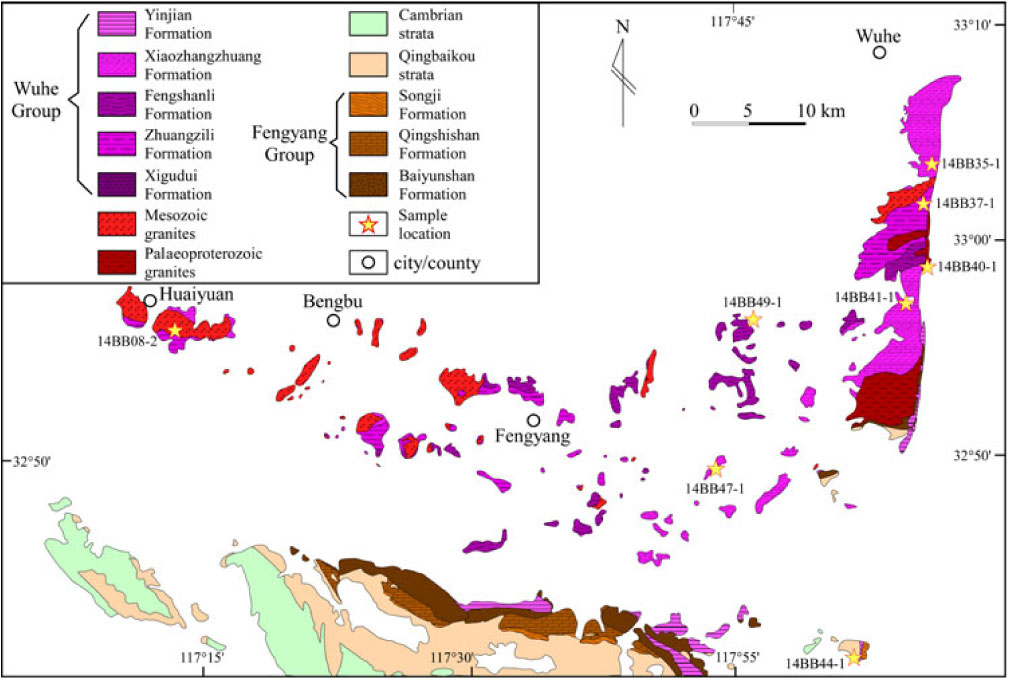
In the Bengbu area, the previously reported metamorphosed granitoids include the Palaeoproterozoic Zhuangzili and Shimenshan plutons (Fig. 2; Guo & Li, Reference Guo and Li2009; Yang et al. Reference Yang, Xu, Pei and Wang2009), whose deformation and emplacement ages are constrained at 2.06–2.10 Ga (Guo & Li, Reference Guo and Li2009; Yang et al. Reference Yang, Xu, Pei and Wang2009; Wang et al. Reference Wang, Liu, Zhang, Zhao, Wang and Song2017 a) and 1.74 Ga (Xu et al. Reference Xu, Hou, Qiu, Wu and Li2005), respectively. Based on the A-type granite geochemical feature, the high whole-rock ɛ Nd(t) values and zircon ɛ Hf(t) values, and the presence of inherited zircons of age c. 2.48 Ga, these potassic granites were suggested to derived from partial melting of TTG gneisses and juvenile mafic crust material at c. 2.5 Ga at an extensional tectonic setting (Yang et al. Reference Yang, Xu, Pei and Wang2009; Wang et al. Reference Wang, Liu, Zhang, Zhao, Wang and Song2017 a).
The supracrustal successions in the Bengbu area have been divided into the Wuhe and Fengyang groups (ABGMR, 1987). The Wuhe Group, which is composed chiefly of greenschist- to granulite-facies metamorphosed flysch-type sedimentary and volcanic rocks, has been subdivided into two subgroups separated by a disconformity (ABGMR, 1987). Tu et al. (Reference Tu, Chen and Tang1992) reported a muscovite K–Ar age of 1.65 Ga in the Yinjian Formation of the upper subgroup and suggested that the formation should be removed from the group. However, the youngest group of detrital zircons from a muscovite-quartz schist of the formation yielded ages of 2.16–2.19 Ga, consistent with the crystallization age of 2.13 Ga of a plagioclase amphibolite and the youngest detrital zircon group of 2.15–2.17 Ga from the lower group (Liu et al. Reference Liu, Zhao, Liu and Cai2018). On the other hand, metamorphic and anatectic zircons of age 1.8–1.9 Ga have been found in the lower subgroup, and metamorphic studies implied that the meta-mafic rocks and marbles experienced high-pressure granulite-facies metamorphism at 1.9–1.8 Ga (Xu et al. Reference Xu, Gao, Wang, Wang and Liu2006; Guo & Li, Reference Guo and Li2009; Liu et al. Reference Liu, Wang, Rolfo, Groppo, Gu and Song2009, Reference Liu, Zhang, Wang, Groppo, Rolfo, Yang, Li, Deng and Song2017 c, Reference Liu, Zhao, Liu and Cai2018; Wang et al. Reference Wang, Liu, Santosh and Gu2013).
The low greenschist-facies metamorphosed Fengyang Group is mainly confined to a 30-km long E–W-trending belt in the southern Bengbu area (Fig. 2) and is composed of metamorphosed sandstones, siltstones, mudstones, Mg-rich carbonates and marlaceous rocks (ABGMR, 1987). Detrital zircon U–Pb dating results from the quartzites of the lowest formation gave the major age peak of c. 2.52 Ga, the minor age peaks of c. 2.94 and c. 2.69 Ga, and the youngest age group of c. 2.37 Ga (Liu & Cai, Reference Liu and Cai2017). In consideration of similar detrital zircon age patterns and Lu–Hf isotopic features with those from the Huoqiu and Bengbu areas, Liu & Cai (Reference Liu and Cai2017) suggested that the early–late Neoarchean granitic rocks and the proximal metamorphosed supracrustal rocks are the main source rocks for the group.
Distributions of Precambrian basement rocks and sedimentary cover in the Bengbu area (modified after Liu et al. Reference Liu, Wang, Zhang, Groppo, Rolfo and Wang2015 c).

As well as the early Precambrian metamorphic basement exposure, abundant Neoarchean–Palaeoproterozoic mantle and lower crustal xenoliths have been found in the Mesozoic dioritic porphyries in the southeastern NCC. Most of the xenoliths are basic to intermediate composition and include garnet-plagioclase amphibolite, garnet amphibolite, garnet granulite, garnet-bearing plagioclase-amphibole gneiss and granitic gneiss (Liu et al. Reference Liu, Wang, Zhang, Groppo, Rolfo and Wang2015 c). Previous zircon U–Pb dating results suggest that these xenoliths record two stages of magmatism at 2.55–2.48 and 2.12 Ga and two stages of metamorphism at 2.49–2.47 and 1.90–1.80 Ga (Huang et al. Reference Huang, Xu and Liu2004; Xu et al. Reference Xu, Gao, Wang, Wang and Liu2006; Guo & Li, Reference Guo and Li2009; Liu et al. Reference Liu, Wang, Rolfo, Groppo, Gu and Song2009, Reference Liu, Liu, Ding, Liu, Yang, Liu, Wang and Meng2013 b; Wang et al. Reference Wang, Liu, Gu, Hou and Song2012 a).
3. Analytical methods
Fresh portions of eight representative granitic samples were crushed to c. 40–80 mesh and zircon grains were separated using a combination of density and magnetic techniques. Selected grains were then mounted in epoxy resin and polished to approximately half-grain thickness. After reflected and transmitted light photographing, cathodoluminescence (CL) imaging was taken by a JSM6510 scanning electron microscope (SEM) attached with a Gatan CL detector. Zircon U–Pb isotopic analysis were conducted on the transparent grains without obvious fracture or mineral inclusion using an Agilent 7700× ICP-MS at Nanjing FocuMS Technology Co. Ltd. The mounted grains were ablated using an attached Analyte Excite laser-ablation system with a spot diameter of 35 μm at 8 Hz repetition rate for 40 seconds (equivalent to 320 pulses). Ablation occurred in intervals of eight sample zircons, directly preceded and followed by two zircon 91500 crystals as external standard and one zircon GJ-1 crystal as quality control. ICPMSDataCal software 8.0 (Liu et al. Reference Liu, Gao, Hu, Gao, Zong and Wang2010 b) was used to select off-line raw data, integrate background and analytical signals, correct for time-drift, and quantitatively calibrate U–Pb isotopes and trace-element concentrations. Possible mixing of different age domains due to the relatively deep ablation depth (35 μm) and complexly zoned zircons was avoided by not choosing later-stage analytical signals with obviously changed 207Pb/206Pb ratios. Common lead correction was conducted following the method of Anderson (Reference Anderson2002). Concordia diagram plotting, probability density plotting and weighted average age calculation were carried out using Isoplot/Ex_ver 3.27 (Ludwig, Reference Ludwig2003).
For the youngest group of igneous grains with concordant ages large enough to accommodate another laser ablation spot, trace elements were measured using the same grain mount and the same LA-ICP-MS instrument in an effort to fingerprint their source reservoirs. NIST 612 was used as an external standard and analysis spots were undertaken on the same CL domain and as closely as possible to the U–Pb analysis spots. Samples and reference materials were analysed for 30 isotopes:29Si, 31P, 39K, 42Ca, 49Ti, 85Rb, 88Sr, 89Y, 91Zr, 93Nb, 139La, 140Ce, 141Pr, 146Nd, 147Sm, 153Eu, 157Gd, 159Tb, 163Dy, 165Ho, 166Er, 169Tm, 172Yb, 175Lu, 178Hf, 181Ta, 202Hg, 204Pb, 232Th and 238U. Corrections were made for mass bias drift which was evaluated by reference to standard glass NIST 610, and trace-element concentrations were obtained by normalizing count rates for each analysed element to those for Si, and assuming SiO2 to be stoichiometric in zircon with a concentration of c. 32.8 wt%. P, Ca, Ti and Th were used in this study to evaluate possible involvements of mineral inclusions (apatite, titanite, feldspar and monazite) in the studied zircons; when evident spikes of these elements were encountered, the analysis was discarded. To check for reproducibility, precision and accuracy, NIST 612 glass was also analysed after certain NIST 610 analysis as reference material for trace elements, and cross-calibration between NIST 610 and NIST 612 was conducted. Most trace-element concentrations measured for NIST 610 relative to NIST 612 agree within error with published data and vice versa, indicating that our technique is accurate.
Zircon Lu–Hf isotopic ratio analyses were conducted following U–Pb and trace-element analyses of the relatively large zircon grains with concordant U–Pb ages. Lu–Hf analysis spots were undertaken on the same CL domain and as closely as possible to the U–Pb analysis spots. Teledyne Cetac Technologies Analyte Excite laser-ablation system and Nu Plasma II MC-ICP-MS were combined for the experiments at Nanjing FocuMS Co. Ltd. Ablation protocol used a spot diameter of 50 μm at 8 Hz repetition rate for 40 seconds (equivalent to 320 pulses). Possible mixing of different age domains due to the relatively deep ablation depth (50 μm) and complexly zoned zircons was avoided by not choosing later-stage analytical signals with obviously changed 176Hf/177Hf ratios. Zircon GJ-1 was used as the reference standard and gave a weighted average 176Hf/177Hf ratio of 0.282011±0.000004 (2σ, n=22), indistinguishable from the ratio of 0.282000±0.000005 (2σ) by solution analysis method (Morel et al. Reference Morel, Nebel and Nebel-Jacobsen2008). ɛ Hf values were calculated based on the present-day chondritic 176Hf/177Hf ratio of 0.282772 and 176Lu/177Hf ratio of 0.0332 (Blichert-Toft and Albarede, Reference Blichert-Toft and Albarede1997).
4. Results
4.a. Zircon U–Pb geochronology
We present zircon U–Pb ages for five granitic samples and three granitic gneiss samples in the Bengbu area (Table 1). All analytical data are presented in online Supplementary Table S1 (available at http://journals.cambridge.org/geo).
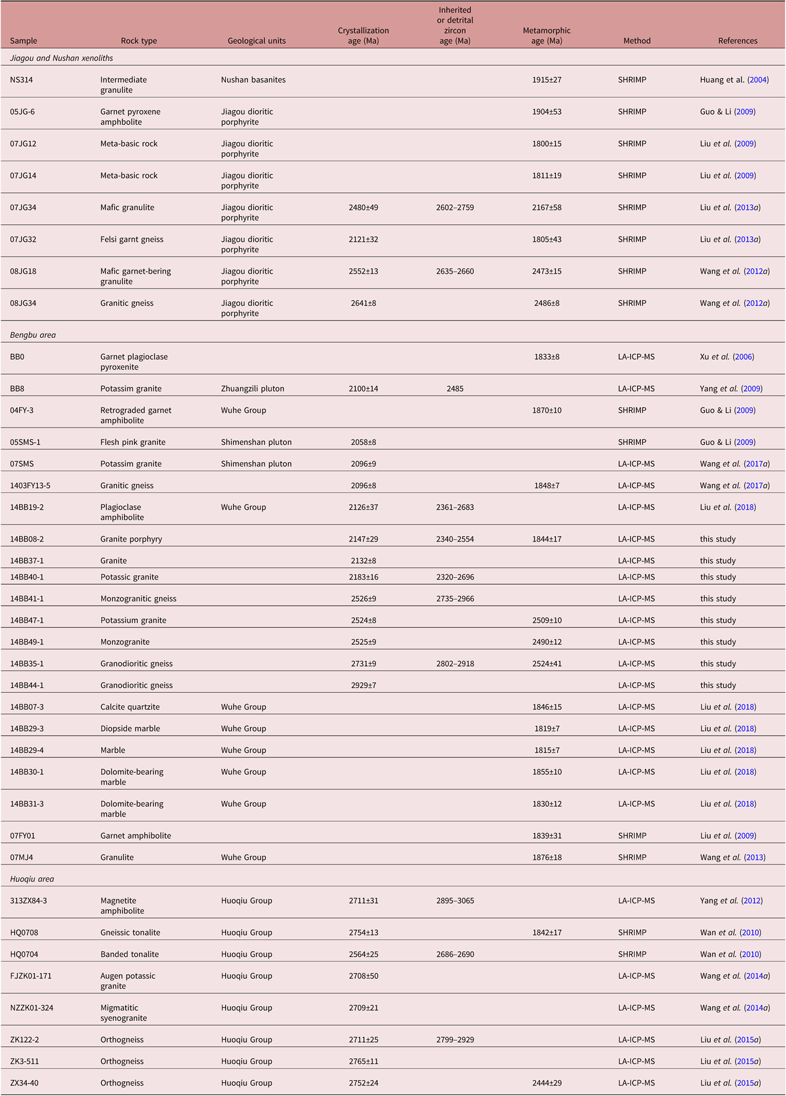
Summary of the zircon U–Pb data of major lithologies from the Bengbu and Huoqiu areas at the southeastern NCC

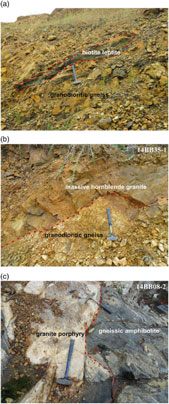
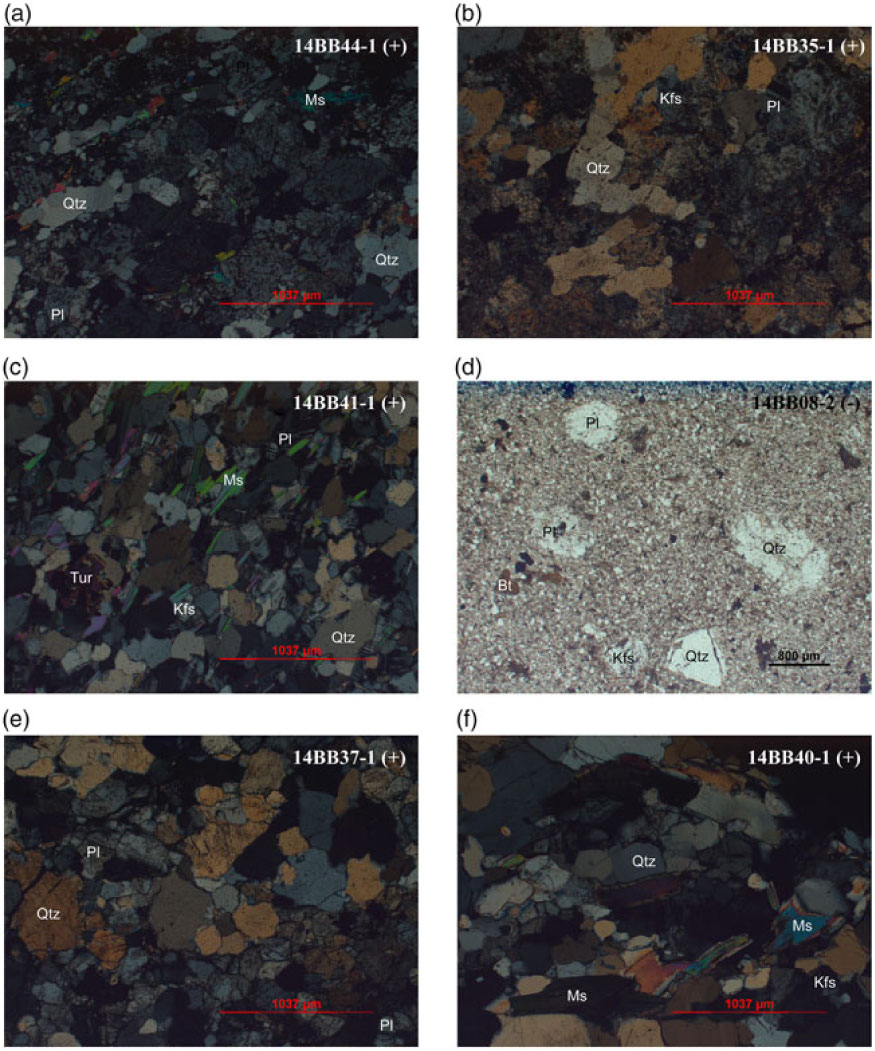
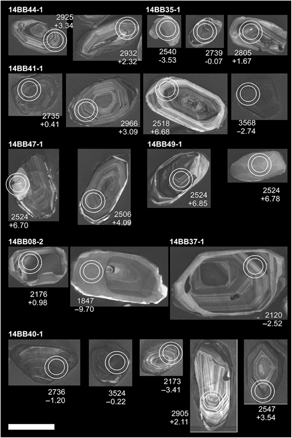
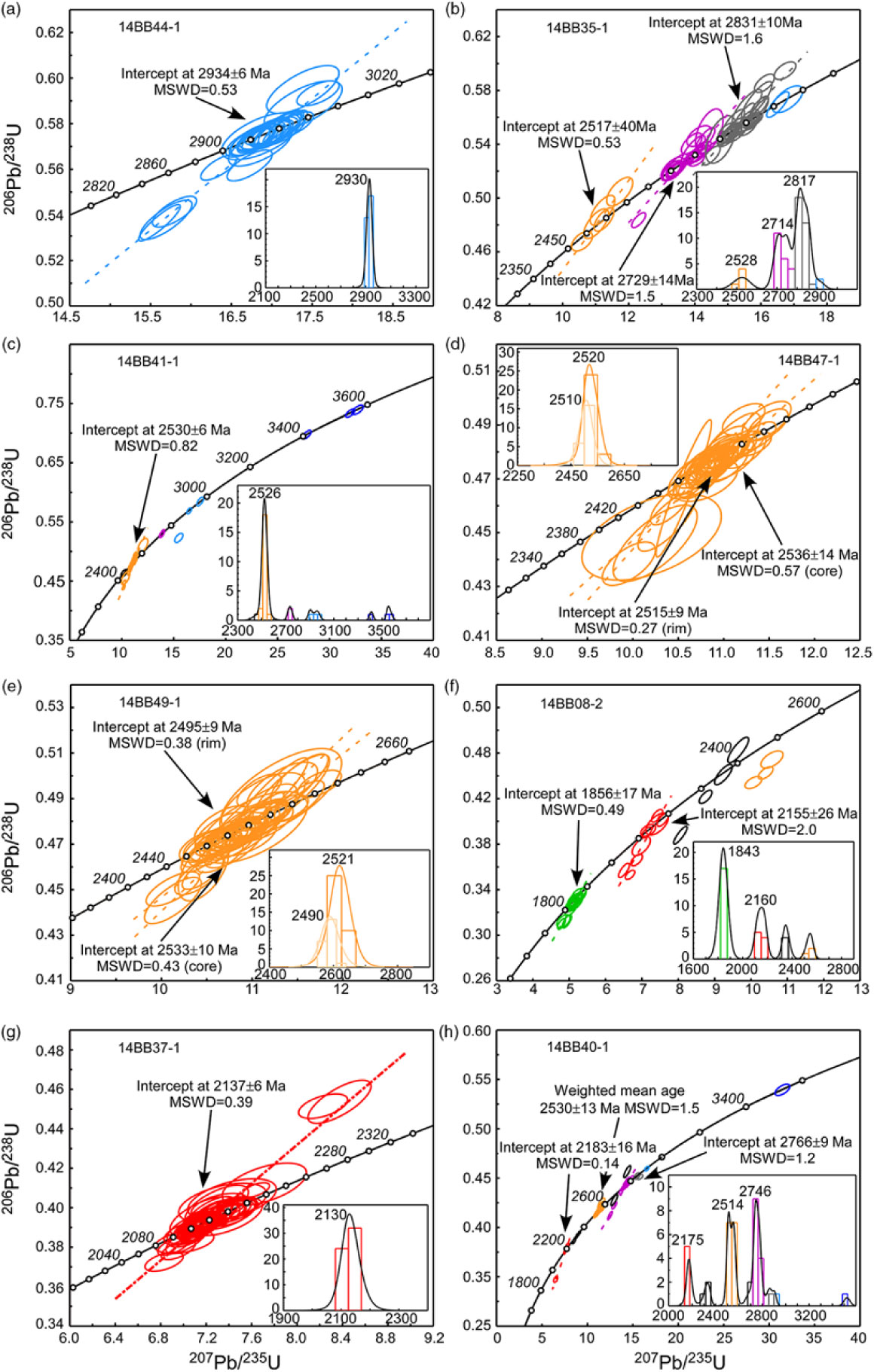
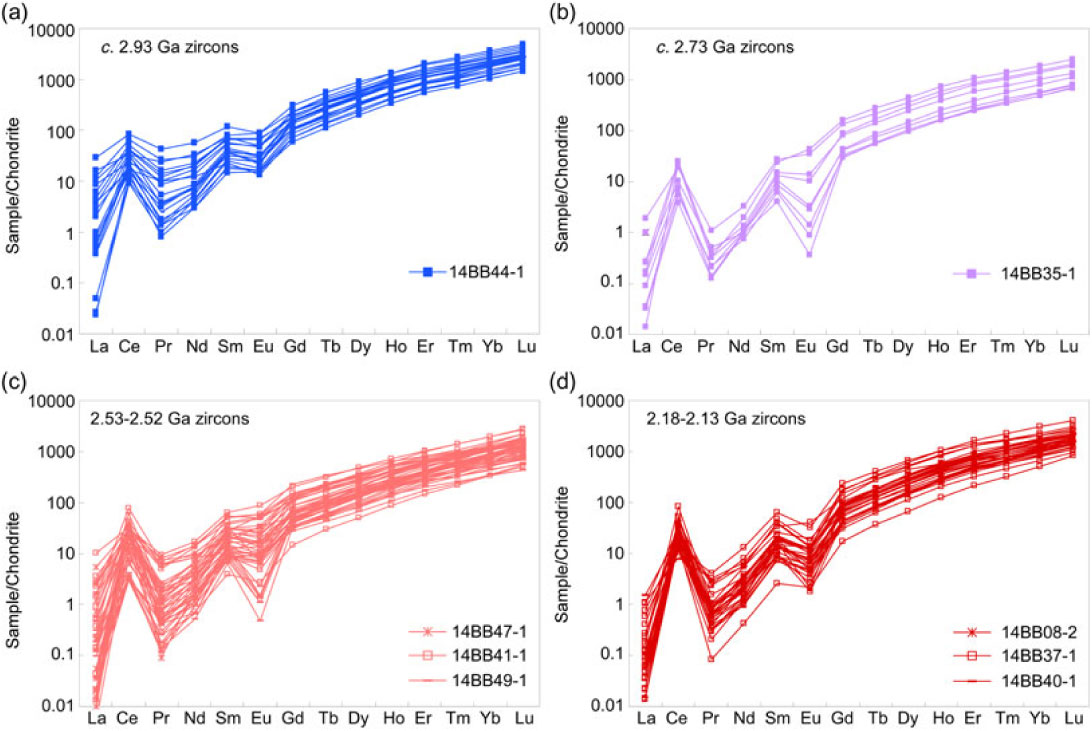
A Mesoarchean granodioritic gneiss sample (14BB44-1) was collected from a roadside outcrop c. 8 km SE of Hongxin Town (32.65828° N, 117.87200° E; Fig. 2). Dark biotite leptite, heavily weathered, occurred as enclaves in the gneiss, both of which were weakly mylonitized (Fig. 3a). Major phases of the sample were plagioclase (45%) and quartz (45%), with minor amounts of biotite, hornblende and K-feldspar; some biotite and hornblende were retrogressed to chlorite and some plagioclase were altered to muscovite (Fig. 4a). Zircon grains were 100–150 μm in length with length/width ratios of 1:1–2.5:1 (Fig. 5). CL images revealed bright oscillatory zoning patterns without an obvious core–rim structure. A total of 30 analyses were performed on 30 grains, yielding apparent 207Pb/206Pb ages of 2909–2947 Ma (Fig. 6a) which form the upper intercept age of 2934±6 Ma (MSWD=0.53), consistent with the weighted mean age of 2929±7 Ma (MSWD=0.33) defined by the 23 concordant analyses (Fig. 6a). These analyses are characterized by high Th/U ratios of 0.50–1.74 (Fig. 7d), low light rare earth element (LREE) and high heavy rare earth element (HREE) patterns with negative Eu anomalies (median Eu/Eu* = 0.41) and obvious positive Ce anomalies (median Ce/Ce* = 7.63; Fig. 8a). Based on these features, the weighted mean age of 2929±7 Ma is interpreted as the crystallization age of the magmatic precursor of the granodioritic gneiss.
Field photographs of Archean–Palaeoproterozoic (gneissic) granitoids in the Bengbu area: (a) dark biotite leptite occurs as enclaves in the Mesoarchean granodioritic gneiss sample (14BB44-1); (b) an early Neoarchean granodioritic gneiss sample (14BB35-1) is intruded by a Mesozoic dark hornblende granite; and (c) a middle Palaeoproterozoic biotite-bearing granite porphyry (14BB08-2) intrudes into dark gneissic amphibolites. The hammer is 30 cm in length.

Microscopic features of representative Archean–Palaeoproterozoic (gneissic) granitoids in the Bengbu area. (+): viewed under crossed polarized light; (−): viewed under plane polarized light. Abbreviations: Pl – plagioclase; Kfs – potassic feldspar; Qzt – quartz; Ms – muscovite; Tur – tourmaline.

Representative selection of cathodoluminescence (CL) zircon images. Circles (50 and 35 μm) show positions of Lu–Hf and U–Pb analytical sites. 207Pb/206Pb ages and ɛ Hf(t) values are also plotted. The scale bar is 100 μm long.

Concordia diagrams for all the nearly concordant or concordant zircon spots from the (gneissic) granitoids in the Bengbu area, showing histogram of the apparent 207Pb/206Pb ages (insets).

Comparisons of zircon trace-element and representative ratios of the Bengbu and Jiaobei granitoids. The average values and the standard deviations are plotted. X-axis represent crystallization age of the granitoids.

Chondrite-normalized REE patterns for the youngest magmatic zircons from the Bengbu granitoids. Normalizing values after Sun & McDonough (1989).

An early Neoarchean granodioritic gneiss sample (14BB35-1) was taken from a locality c. 10 km SE of Wuhe County (33.06038° N, 117.93361° E; Fig. 2), which is intruded by a Mesozoic dark hornblende granite (our unpublished data; Fig. 3b). The investigated sample was composed of quartz (30%), plagioclase (40%), (carbonatized) K-feldspar (10%), biotite (5%) and hornblende (5%), with minor amounts of apatite and zircon (Fig. 4b). Zircon grains were smaller than those from the Mesoarchean sample, being 80–100 μm in length with length/width ratios of 1:1–2:1 (Fig. 5). CL images revealed variably eroded oscillatory zoned or dark structureless cores enveloped by bright to dullish rims. A total of 60 analyses were conducted on 55 zircon grains, of which 55 older analyses with apparent 207Pb/206Pb ages of 2702–2918 Ma on the oscillatory zoned cores could be subdivided into three groups on the probability density plot (Fig. 6b). The oldest group was composed of two analyses, which had Th/U ratios of 0.34 and 0.65 and apparent ages of 2905 and 2918 Ma (Supplementary Table S1; Fig. 6b). The second group was composed of 32 analyses, with Th/U ratios of 0.14–0.98 (Supplementary Table S1). These data showed apparent ages of 2802–2860 Ma and yielded the upper intercept age of 2831±10 Ma (MSWD=1.6), consistent with the weighted mean age (2829±7 Ma) of the concordant analyses (Fig. 6b). The third group consisted of 21 analyses, which showed apparent ages and Th/U ratios of 2694–2759 Ma and 0.17–0.63, respectively (Supplementary Table S1). They yielded the upper intercept age of 2729±14 Ma (MSWD=1.5), consistent with the weighted mean age (2731±9 Ma) of the concordant analyses (Fig. 6b). On the other hand, five analyses conducted on the bright rims had relatively lower Th/U ratio than those on the cores, and gave apparent ages of 2502–2540 Ma (Supplementary Table S1), yielding an upper intercept age of 2517±40 Ma (MSWD=0.41) and a weighted mean age of 2524±41 Ma (MSWD=0.38; Fig. 6b). Based on the zircon internal structures, the magmatic precursor is considered to have been emplaced at 2731±9 Ma and subjected to later (c. 2524 Ma) metamorphism.
A late Neoarchean medium-grained monzogranitic gneiss (sample 14BB41-1) was collected from a roadside outcrop in the south of Wuhe County (32.95094° N, 117.91032° E; Fig. 2). The gneiss had a mineral assemblage of quartz (45%), plagioclase (20%), K-feldspar (15%), muscovite (10%) and tourmaline (5%; Fig. 4c). Zircon grains from this sample were relatively large with lengths and length/width ratios of 150–200 μm and 1:1–2:1, respectively (Fig. 5). CL images revealed blurred oscillatory zoned or structureless cores enveloped by clearly oscillatory zoned rims (Fig. 5). A total of 29 analyses were conducted on 29 grains with oscillatory zoning structure, yielding a large range of apparent 207Pb/206Pb ages of 2509–3568 Ma (Supplementary Table S1). Excluding the eight older and scattered analyses (2735–3568 Ma), the other 21 analyses showed a narrow range of apparent ages of 2509–2561 Ma. They yielded the upper intercept age of 2530±6 Ma (MSWD=0.82) and a weighted mean age of 2526±9 Ma (MSWD=0.41; Fig. 6c), of which the latter is taken as the best estimate of crystallization age of the granitic precursors.
Sample 14BB47-1 is a late Neoarchean coarse-grained potassium granite collected near Shitang Village, 20 km east of Fengyang County (32.82095° N, 117.73047° E; Fig. 2). It consists predominantly of quartz and K-feldspar (>90%) with minor plagioclase and biotite, with most plagioclase altered to sericite. Most zircon grains from this sample are elongated and prismatic with average crystal length of 100–150 μm and length/width ratios of 1.5:1–2:1 (Fig. 5). CL images showed oscillatory zoning cores indicative of magmatic growth, and most of them had a thin overgrowth or recrystallization rim (Fig. 5). A total of 27 analyses on the oscillatory-zoned cores gave apparent 207Pb/206Pb ages of 2506–2556 Ma (Supplementary Table S1), yielding an upper intercept age of 2536±14 Ma (MSWD=0.57) and a weighted mean age of 2524±8 Ma (MSWD=0.82) within analytical error (Fig. 6d), of which the latter is interpreted as the crystallization age of the potassium granite. A total of 22 analyses on the structureless rims with Th/U ratios of 0.02–1.31 have apparent 207Pb/206Pb ages of 2486–2524 Ma (Supplementary Table S1), yielding an upper intercept age of 2515±9 Ma (MSWD=0.27) and a weighted mean age of 2509±10 Ma (MSWD=0.19; Fig. 6d), indicating an end-Archean metamorphic event just after emplacement of the granitic magma.
Sample 14BB49-1 is a late Neoarchean monzogranite collected from a roadside outcrop near Mashan Village (32.93804° N, 117.76530° E; Fig. 2). It has a mineral assemblage similar to that of Sample 14BB47-1, with plagioclase (40%), K-felsdpar (25%), quartz (20%) and minor opaque minerals. Some zircon grains from this sample are elongated and prismatic, showing oscillatory zoned cores surrounded by thin overgrowth or recrystallization rims, whereas others are short and round, and have grey nebulous patterns (Fig. 5). A total of 35 analyses performed on oscillatory zoned cores yielded apparent 207Pb/206Pb ages of 2488–2561 Ma (Supplementary Table S1), giving an upper intercept age of 2533±10 Ma (MSWD=0.43) and a weighted mean age of 2525±9 Ma (MSWD=0.49; Fig. 6e). A total of 21 analyses of nebulous domains showed slightly younger apparent ages of 2477–2517 Ma (Supplementary Table S1), with an upper intercept age of 2495±9 Ma (MSWD=0.38) and a weighted mean age of 2490±12 Ma (MSWD=0.16; Fig. 6e). On the basis of zircon internal structures, the monzogranite emplaced at 2525±9 Ma and was subjected to a later (2490±12 Ma) tectonothermal event.
Sample 14BB08-2 is a middle Palaeoproterozoic biotite-bearing granite porphyry collected c. 3 km SW of Huaiyuan County (32.93130° N, 117.22049° E; Fig. 2), where it intrudes into dark gneissic amphibolites (Fig. 3c). It is characterized by porphyritic texture with quartz (15%), plagioclase (25%), biotite (10%) and K-feldspar (5%) phenocrysts surrounded by groundmass of fine-grained plagioclase and quartz (Fig. 4d). Zircon grains separated from this sample show stubby or oval shapes, with lengths and length/width ratios of 70–100 μm and 1:1–1.5:1, respectively (Fig. 5). In the CL images, some grains show blurred oscillatory zoning cores corroded by bright homogeneous rims, whereas others display nebulous patterns (Fig. 5). A total of 16 analyses were conducted on the oscillatory zoning domains, which plot on or close to corcordia and show apparent 207Pb/206Pb ages ranging over 2124–2554 Ma with Th/U ratios of >0.2 (Supplementary Table S1). With the exception of six older analyses of 2340–2554 Ma, the majority of results yielded similar apparent ages of 2124–2177 Ma with an upper intercept age of 2155±26 Ma (MSWD=2.0) and a weighted mean age of 2147±29 Ma (MSWD=0.87; Fig. 6f). Considering the occurrence of magmatic zircons of age 2360 and 2569 Ma in the gneissic amphibolites intruded by this sample (Liu et al. Reference Liu, Zhao, Liu and Cai2018), the weighted mean age of 2147±29 Ma is taken as the best estimate of the crystallization age of the granite porphyry. On the other hand, 17 analyses on the structureless rims and nebulous domains yielded a narrow range of apparent ages of 1821–1872 Ma, defining the upper intercept age of 1856±17 Ma (MSWD=0.49) and the weighted mean age of 1844±17 Ma (MSWD=0.29; Fig. 6f), consistent with the 1.8–1.9 Ga high-pressure granulite-facies metamorphism reported in the Bengbu area (Xu et al. Reference Xu, Gao, Wang, Wang and Liu2006; Guo & Li, Reference Guo and Li2009; Liu et al. Reference Liu, Wang, Rolfo, Groppo, Gu and Song2009; Wang et al. Reference Wang, Liu, Santosh and Gu2013; Liu et al. Reference Liu, Zhang, Wang, Groppo, Rolfo, Yang, Li, Deng and Song2017 c, 2018).
Another middle Palaeoproterozoic granitic sample (14BB37-1) was collected near Xiaoxi Village (33.03242° N, 117.92723° E; Fig. 2) and c. 3 km north of the Zhuangzili pluton. The sample has a massive structure and a mineral assemblage of plagioclase (45%), quartz (45%), K-feldspar (5%) and accessory muscovite and zircon (Fig. 4e). Zircon grains separated from this rock show elongated to stubby shapes, with lengths and length/width ratios of 100–200 μm and 1:1–2:1, respectively (Fig. 5). CL images reveal complex core-rim structures, with oscillatory and blurred zoning cores surrounded by narrowly patchy or structureless rims (Fig. 5). A total of 56 analyses were conducted on 56 zircon cores, and the data plot near or on the concordia line (Fig. 6g). They show apparent 207Pb/206Pb ages of 2118–2166 Ma, yielding an upper intercept age of 2137±6 Ma (MSWD=0.39) and a weighted mean age of 2132±8 Ma (MSWD=0.27; Fig. 6g). In consideration of the oscillatory zoning structures, positive Ce anomalies, negative Eu anomalies, steep HREE patterns (Fig. 8d), and high Th/U ratios (Fig. 7d), the weighted mean age of 2132±8 Ma is considered to be the crystallization age of the rock.
A middle Palaeoproterozoic massive potassic granite (Sample 14BB40-1) was collected near Gupei Village, c. 3 km south of the Zhuangzili pluton (32.97668° N, 117.92862° E; Fig. 2). It consists of quartz (40%), K-feldspar (40%), muscovite (10%), feldspar (5%) and minor biotite ilmenite and amphibole (Fig. 4f). Most zircon grains from this sample showed elongated and prismatic shapes, with a minor population exhibiting stubby shapes (Fig. 5). Their lengths and length/width ratios ranged over 100–200 μm and 1:1–2.5:1, respectively (Fig. 5). Most were characterized by blurred to clearly oscillatory and banded zonings, whereas some had nebulous domains in the CL images (Fig. 5). A total of 41 analyses were conducted on 41 oscillatory and banded zoning domains, and the data plot on or close to the concordia (Fig. 6h). These analyses yield apparent 207Pb/206Pb ages of 2172–3524 Ma with generally high Th/U ratios of 0.23–1.66 (Supplementary Table S1). On the probability density diagram, these analyses can be divided into three age groups. The oldest group is composed of 13 analyses and has the apparent age range 2736–2786 Ma, yielding the intercept age of 2766±9 Ma (MSWD=1.2) and the weighted mean age of 2757±14 Ma (MSWD=1.3; Fig. 6h). The middle group is composed of 14 analyses with apparent ages of 2506–2559 Ma, yielding the weighted mean age of 2530±13 Ma (MSWD=1.5; Fig. 6h). The youngest age group consists of five analyses and has an apparent age range of 2172–2177 Ma, yielding the upper intercept age of 2183±16 Ma (MSWD=0.14; Fig. 6h). Considering the wide occurrence of magmatic zircons of age 2.53 and 2.75 Ga in the study region (Wan et al. Reference Wan, Dong, Wang, Xie and Liu2010; Yang et al. Reference Yang, Wang, Du, Wang, Wang, Tu, Zhang and Sun2012; Wang et al. Reference Wang, Liu, Gu, Hou and Song2012 a, Reference Wang, Zheng, Pan, Dong, Liao, Zhang, Zhang, Zhao and Tu2014 a; Liu et al. Reference Liu, Yang, Santosh and Aulbach2015 a; this study) and the absence of signs of a later tectonothermal event, the youngest upper intercept age of 2183±16 Ma is taken as the best estimate of the intruding age.
4.b. Zircon trace-element composition
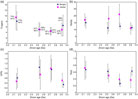
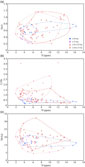
To investigate the possible involvement of hydrothermal zircons, we used a Ce/Ce* ratio of 3.5 and (Sm/La)N ratio of 4.4 (Hoskin, Reference Hoskin2005) as thresholds, allowing the zircons with lower ratios to be discarded. The entire dataset describing the magmatic zircon trace-element composition, selected ratios and statistical descriptions of the distributions classified by different ages is provided in online Supplementary Table S2 (available at http://journals.cambridge.org/geo), and the representative ratios and chondrite-normalized REE patterns are plotted in Figures 7 and 8, respectively. The means are calculated after removing outliers, and standard deviations relative to the means for each age group are reported. In addition, Figure 9 clearly shows that there are no apparent correlations between zircon Th/U, U/Yb and Yb/Gd ratios with Ti contents, indicating that the fractional crystallization process does not affect these ratios significantly. Nearly constant Th/U ratios for every zircon population may be explained by slightly changed fractionation factor (Th(zircon/rock)/U(zircon/rock)) below 800 °C (Kirkland et al. Reference Kirkland, Smithies, Taylor, Evans and McDonald2015). On the other hand, the narrow range of U/Yb and Yb/Gd ratios are probably due to absence of minerals (such as garnet and hornblende) in the HREEs in the fractional crystallization process. The average values and ratios can therefore generally indicate their source reservoirs.
Zircon (a) Th/U, (b) U/Yb and (c) Yb/Gd (c) ratios v. Ti (ppm) for the youngest magmatic zircons from the Bengbu granitoids.

Ti concentrations divide the late Mesoarchean – middle Palaeoproterozoic zircons into two overlapping but distinct populations (Fig. 7a). The population aged 2.13–2.17 Ga (8.08±3.38 ppm) is shifted towards higher Ti concentrations than the populations aged 2.53 (5.10±2.58 ppm), 2.73 (4.53±1.29 ppm) and 2.93 Ga (6.52±3.78 ppm). If we assume a TiO2 and a SiO2 of unity, the estimates represent minimum temperatures (Ferry & Watson, Reference Ferry and Watson2007). The mean calculated middle Palaeoproterozoic zircon growth temperature is 718±44 °C, much higher than that for the late Neoarchean (677±46 °C), the early Neoarchean zircons (674±22 °C) and the late Mesoarchean (699±41 °C), calculated using the same activities.
Chondrite-normalized REE patterns for all the magmatic zircons in this study are generally typical of those reported from igneous rocks (Fig. 8): HREEs are extremely enriched relative to LREEs, and positive Ce and negative Eu anomalies are ubiquitous. However, HREE concentrations are much higher in the zircons aged 2.93 Ga, in which Yb concentrations have a median of 346±116 ppm. For the other three populations, Yb concentrations are much lower (209±75, 145±53 and 182±90 ppm for the zircons aged 2.13–2.17 Ga, 2.53 Ga and 2.73 Ga, respectively). On the other hand, the Yb/Gd ratios, which are thought to correlate changes in crustal thickness (Barth et al. Reference Barth, Wooden, Jacobson and Economos2013), divide the zircons into two groups: mean ratio of the zircons aged 2.13–2.17 Ga is 15.1±4.0 ppm, whereas the mean ratios of the zircons aged 2.53, 2.73 and 2.93 Ga are 11.3±4.2, 12.5±2.2 and 11.5±2.0 ppm, respectively (Fig. 7b).
Trace elements in igneous zircon can be used both as general means to relate their formation to a general tectonic setting and as more specific proxies for change in magma compositions (Hoskin, Reference Hoskin2005; Carley et al. Reference Carley, Miller, Wooden, Padilla, Schmitt, Economos, Binderman and Jordan2014; Grimes et al. Reference Grimes, Wooden, Cheadle and John2015). For example, the U/Yb ratio has been used as a proxy for subducting slab fluid addition because the fluids are enriched in U relative to HREEs such as Yb (Barth et al. Reference Barth, Wooden, Jacobson and Economos2013). Our zircons yield U/Yb ratios which increase from those aged 2.93 Ga (0.34±0.12) to 2.73 Ga (0.96±0.42) and to 2.53 Ga (1.05±0.46), but there is an evident decrease at age 2.13–2.17 Ga (0.61±0.40; Fig. 7c). On the other hand, the Th/U ratios have been successfully employed as a proxy for crustal input based on the enrichment in Th over U as the crust matures (Barth et al. Reference Barth, Wooden, Jacobson and Economos2013). Two obvious changes can be observed in our data set: a decrease in Th/U ratios from 2.93 Ga (0.63±0.12) to 2.73 Ga (0.27±0.09) and an increase from 2.73 Ga to 2.53 Ga (0.62±0.22; Fig. 7d).
4.c. Zircon Lu–Hf isotopes
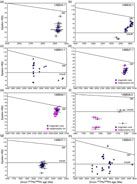
Magmatic and metamorphic zircons with concordant ages from the five granitic samples and three granitic gneiss samples from the Bengbu area were analysed for Lu–Hf isotopes, and the results are listed in online Supplementary Table S3 (available at http://journals.cambridge.org/geo) and plotted in Figure 10 in the ɛ Hf(t) versus 207Pb/206Pb age plots.
Plots of ɛ Hf(t) vs. zircon age for each sample from the Bengbu area. CHUR – chondrite uniform reservoir; DM – depleted mantle.

Calculated at the apparent 207Pb/206Pb age (t 1), most analyses of the youngest group of magmatic zircons for each sample yield nearly consistent 176Hf/177Hf(t 1) ratios: 0.280955–0.281045 for 14BB44-1, 0.281030–0.281074 for 14BB35-1, 0.281289–0.281341 for 14BB47-1, 0.281329–0.281383 for 14BB49-1, 0.281425–0.281453 for 14BB08-2, 0.281362–0.281444 for 14BB37-1 and 0.281303–0.281379 for 14BB40-1 (Supplementary Table S3). This implies that, with the exception of the magmatic zircons of 14BB41-1 aged c. 2.53 Ga, which yield a large range of 176Hf/177Hf(t 1) ratios of 0.281034–0.281364 (Supplementary Table S3), the youngest group of magmatic zircons of the other seven samples crystallized from the same magmatic system and was subjected to limited degrees of subsequent Pb loss (Zeh et al. Reference Zeh, Gerdes, Jay and Klemd2010). On the other hand, the large range of 176Hf/177Hf(t 1) ratios for the magmatic zircons of the monzogranitic gneiss 14BB41-1 aged c. 2.53 Ga, in combination with the presence of muscovite and tourmaline (Fig. 4c) and the Palaeoarchean – early Neoarchean xenocrystic zircons (Fig. 6c), may reflect different degrees of mixing of crustal sources.
Magmatic zircon U–Pb ages in this study can be generally divided into five populations according to age: 3.41–3.57 Ga, 2.91–2.95 Ga, 2.70–2.76 Ga, 2.49–2.56 Ga and 2.05–2.19 Ga. All the Palaeoarchean xenocrystic zircons were found from the potassium granites (Samples 14BB40-1 and 14BB41-1) on the eastern margin of the study area, and the analysed four grains have negative ɛ Hf(t) values of −3.81 to −0.22 and TDM2 model ages of 3.80–3.99 Ga (Fig. 10c and h), suggesting their origin from an Eoarchean crust. For the late Mesoarchean zircon population, most of their ɛ Hf(t) values are positive and more than two units lower than the value of the temporal depleted mantle (DM; +1.25 to +5.29; Fig. 10a, c, h) and have TDM2 model ages of 3.02–3.24 Ga, indicative of the recycling of an early Mesoarchean crust. The early Neoarchean zircons have a narrow range of ɛ Hf(t) values near to zero (−1.73 to +1.89) and TDM2 model ages of 3.07–3.29 Ga (Fig. 10b, c, h), similar to those of the late Mesoarchean zircons. Magmatic zircons with ages of 2.49–2.56 Ga from 14BB47-1 and 14BB49-1 have narrow ranges of ɛ Hf(t) values and TDM2 model ages of +3.83 to +7.52 and 2.56–2.77 Ga, respectively (Fig. 10c, d, e, h), indicating a significant juvenile crustal growth event with limited recycling of early Neoarchean crust. On the other hand, the large range of ɛ Hf(t) values and TDM2 model ages of −4.90 to +6.68 and 2.60–3.99 Ga, respectively, from 14BB40-1 and 14BB41-1 suggest different degrees of mixing of Eoarchean – early Neoarchean crust with juvenile addition. The zircons with ages of 2.12–2.18 Ga have a very large range of ɛ Hf(t) values of −7.49 to +0.98 and TDM2 model ages of 2.65–3.20 Ga (Fig. 10f, g, h), indicating recycling of the Mesoarchean–Neoarchean crust.
On the other hand, the end-Archean metamorphic zircons from samples 14BB47-1 and 14BB49-1 have ɛ Hf(t) values and TDM2 model ages of +7.33 to +4.10 and 2.54–2.75 Ga, respectively (Fig. 10d, e), overlapping with those of the magmatic zircons from the same samples and indicating solid-state recrystallization (Hoskin & Black, Reference Hoskin and Black2000). The metamorphic zircon rims from Sample 14BB08-2 of age c. 1.84 Ga have strongly negative ɛ Hf(t) values of −11.35 to −3.40 and TDM model ages of 2.69–3.19 Ga (Fig. 9f). In addition, all the metamorphic zircon rims of age c. 1.84 Ga have nearly identical 176Hf/177Hf ratios to those of the magmatic cores aged c. 2.15 Ga, suggesting solid-state recrystallization similar to the end-Archean metamorphic zircons (Hoskin & Black, Reference Hoskin and Black2000).
5. Discussion
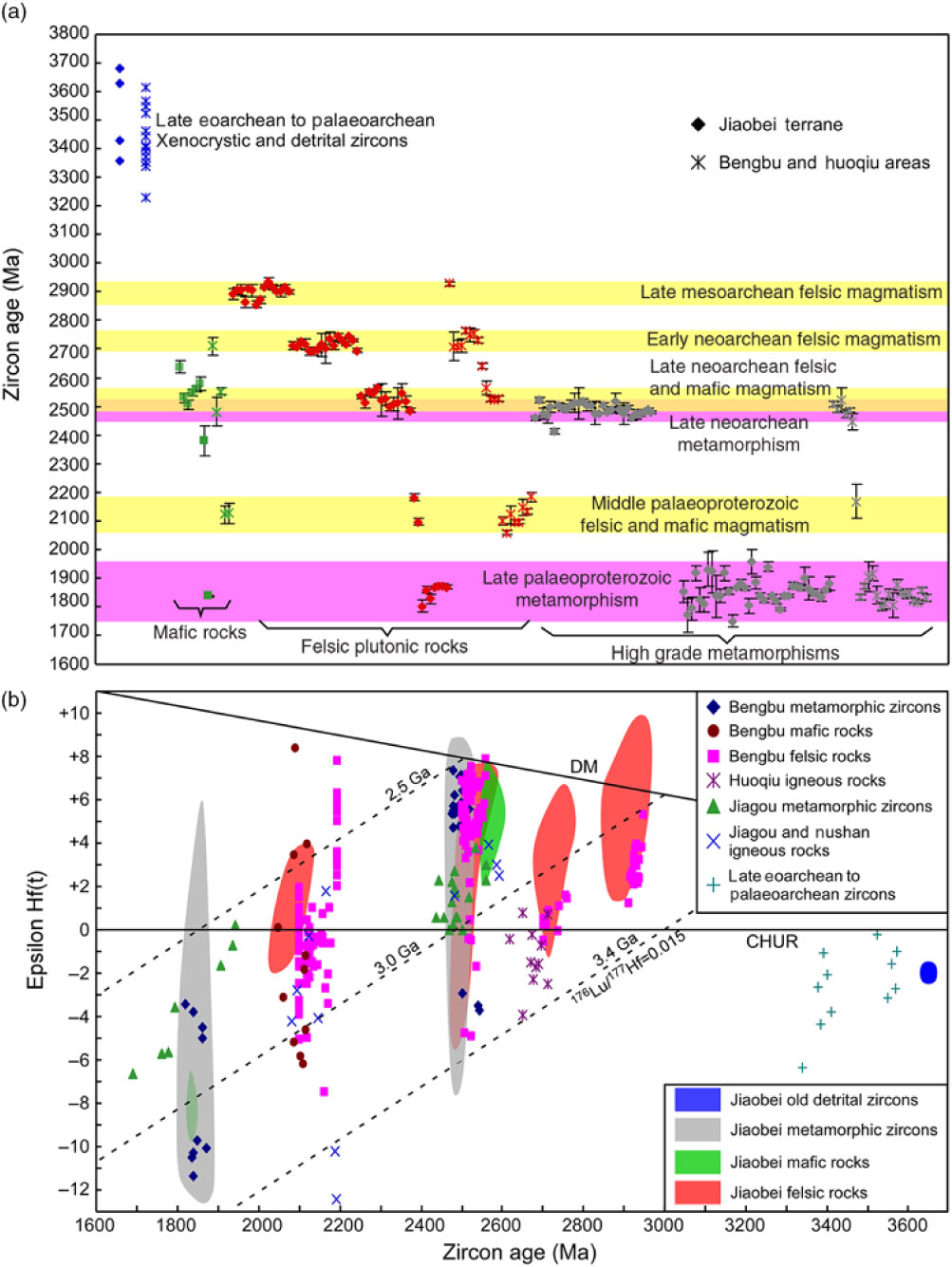
Zircon U–Pb geochronology and Lu–Hf isotopes obtained in this study and previous data of major lithologies from the Bengbu and Huoqiu areas are summarized in Table 1 and Figure 11, and are compared with zircon U–Pb, trace element and Lu–Hf data from the Jiaobei Terrane.
(a) Summary of geochronology for late Eoarchean to late Palaeoproterozoic crustal evolution at the southeastern NCC, based on age data from Table 1. (b) Plots of ɛ Hf(t) v. zircon age for the major lithologies at the southeastern NCC. CHUR – chondrite uniform reservoir. DM – depleted mantle. Data source: Bengbu metamorphic zircon from Liu et al. (Reference Liu, Zhao, Liu and Cai2018) and this study; Bengbu mafic rocks from Liu et al. (Reference Liu, Zhao, Liu and Cai2018); Bengbu felsic rocks from Yang et al. (Reference Yang, Xu, Pei and Wang2009), Wang et al. (Reference Wang, Liu, Zhang, Zhao, Wang and Song2017 a) and this study; Huoqiu igneous rocks from Wang et al. (Reference Wang, Zheng, Pan, Dong, Liao, Zhang, Zhang, Zhao and Tu2014 a) and Liu et al. (Reference Liu, Yang, Santosh and Aulbach2015 a); Jiagou metamorphic zircons from Liu et al. (Reference Liu, Wang, Rolfo, Groppo, Gu and Song2009, Reference Liu, Wang, Li, Rolfo, Li, Groppo and Hou2013 a); Jiagou and Nushan igneous rocks from Wang et al. (Reference Wang, Liu, Gu, Hou and Song2012 a) and Liu et al. (Reference Liu, Wang, Li, Rolfo, Li, Groppo and Hou2013 a); late Eoarchean to Palaeoarchean zircon from Liu & Cai (Reference Liu and Cai2017), Liu et al. (Reference Liu, Zhao, Liu and Cai2018) and this study; Jiaobei metamorphic zircons from Liu et al. (Reference Liu, Liu, Ding, Liu, Yang, Liu, Wang and Meng2013 b), Wang et al. (Reference Wang, Zheng, Pan, Dong, Liao, Zhang, Zhang, Zhao and Tu2014 a), Wu et al. (Reference Wu, Zhao, Sun, Li, Bao, Tam, Eizenhöefer and He2014 a), Zhang et al. (Reference Zhang, Tang and Zheng2014) and Xie et al. (Reference Xie, Xie, Wang, Kröner, Liu, Zhou, Ma, Dong, Liu and Wan2014 a); Jiaobei mafic rocks from Wang et al. (Reference Wang, Zheng, Pan, Dong, Liao, Zhang, Zhang, Zhao and Tu2014 a) and Wu et al. (Reference Wu, Zhao, Sun, Li, Bao, Tam, Eizenhöefer and He2014 a); Jiaobei felsic rocks from Liu et al. (Reference Liu, Liu, Ding, Liu, Yang, Liu, Wang and Meng2013 b, Reference Liu, Liu, Ding, Liu, Guo and Wang2014), Wu et al. (Reference Wu, Zhao, Sun, Li, Bao, Tam, Eizenhöefer and He2014 a), Xie et al. (Reference Xie, Xie, Wang, Kröner, Liu, Zhou, Ma, Dong, Liu and Wan2014 a), Zhang et al. (Reference Zhang, Tang and Zheng2014), Shan et al. (Reference Shan, Zhai, Wang, Zhou, Santosh, Zhu, Zhang and Wang2015) and Liu et al. (Reference Liu, Liu, Cai, Wang, Liu, Liu, Yang, Shi and Liu2017 d).

5.a. Geochronological framework of the Bengbu and Huoqiu areas
Magmatic zircons of a granodioritic gneiss (14BB44-1) from the southeastern Bengbu area have a Mesoarchean age of 2929±7 Ma, which is consistent with the 2.97 Ga zircons from an amphibolite collected from drill cores in the Huoqiu area (Liu et al. Reference Liu, Yang, Santosh and Aulbach2015 a). These magmatic zircon ages suggest the existence of late Mesoarchean crust in the southeastern NCC, which is further supported by the xenocrystic zircons aged 2.90–2.95 Ga from a magnetite amphibolite (Yang et al. Reference Yang, Wang, Du, Wang, Wang, Tu, Zhang and Sun2012) and TTG gneisses (Liu et al. Reference Liu, Yang, Santosh and Aulbach2015 a) in the Huoqiu area, and xenocrystic zircons aged 2.90–2.97 Ga from a granodioritic gneiss (14BB35-1) and a monzogranitic gneiss (14BB41-1) in the Bengbu area (this study). In addition, the early Neoarchean magmatic zircon age of 2731±9 Ma has been obtained from a granodioritic gneiss (14BB35-1), which matches the zircon ages of 2.71–2.76 Ga from the TTG gneisses, migmatic syenogranite, potassic granite and plagioclase amphibolite (Wan et al. Reference Wan, Dong, Wang, Xie and Liu2010; Yang et al. Reference Yang, Wang, Du, Wang, Wang, Tu, Zhang and Sun2012; Wang et al. Reference Wang, Zheng, Pan, Dong, Liao, Zhang, Zhang, Zhao and Tu2014 a; Liu et al. Reference Liu, Yang, Santosh and Aulbach2015 a) in the Huoqiu area. On the other hand, a monzogranitic gneiss (14BB41-1), a potassium granite (14BB47-1) and a monzogranite (14BB49-1) give end-Neoarchean zircon ages of 2526±9, 2524±8 and 2525±9 Ma, respectively, which are in good agreement with previously published zircon U–Pb ages of 2.56 Ga from a gneissic tonalite in the Huoqiu area (Wan et al. Reference Wan, Dong, Wang, Xie and Liu2010) and an age of 2.55 Ga from a garnet-bearing basic gneiss xenolith from the Jiagou Mesozoic intrusion (Wang et al. Reference Wang, Liu, Gu, Hou and Song2012 a). The last major early Precambrian episode of magmatism occurred during the middle Palaeoproterozoic Era, as evidenced by the 2147±29 Ma granite porphyry (14BB08-2), the 2132±8 Ma granite (14BB37-1) and the 2183±16 Ma potassic granite (14BB40-1), which are slightly older than the 2.06–2.10 Ga Shimenshan and Zhuangzili plutons (Yang et al. Reference Yang, Xu, Pei and Wang2009; Guo & Li, Reference Guo and Li2009; Wang et al. Reference Wang, Liu, Zhang, Zhao, Wang and Song2017 a) and nearly the same with the 2.13 Ga plagioclase amphibolite of the Wuhe Group (Liu et al. Reference Liu, Zhao, Liu and Cai2018) and the 2121 Ma felsic garnet-bearing gneiss xenolith in the Jiagou intrusion (Liu et al. Reference Liu, Wang, Li, Rolfo, Li, Groppo and Hou2013 a). In summary, all these geochronological data from the basement rocks and xenoliths in the Bengbu and Huoqiu areas suggest multistage magmatic events during the late Mesoarchean – middle Palaeoproterozoic period, with felsic magmatism occurring at c. 2.93, 2.76–2.71, 2.56–2.52 and 2.18–2.10 Ga, whereas mafic magmatism only occurred at 2.71, 2.55 and 2.13 Ga (Table 1 and Fig. 11a).
We also obtained metamorphic zircon ages of 2.49–2.52 Ga and 1.84 Ga from the major granitoid lithologies in the Bengbu area. Similar metamorphic zircon ages of 2.48–2.52 Ga have been previously reported from the Neoarchean – middle Palaeoproterozoic granitic gneisses (Wang et al. Reference Wang, Liu, Gu, Hou and Song2012 a; Liu et al. Reference Liu, Yang, Santosh and Aulbach2015 a) and basic granulite (Wang et al. Reference Wang, Liu, Gu, Hou and Song2012 a). The metamorphic ages of c. 2.5 Ga are consistent with those reported from other Archean basement complexes in the Eastern Block of the NCC (e.g. Zhao et al. Reference Zhao, Wilde, Cawood and Lu1998; Ge et al. Reference Ge, Zhao, Sun, Wu and Lin2003; Geng et al. Reference Geng, Liu and Yang2006; Yang et al. Reference Yang, Wu, Wilde and Zhao2008; Liu et al. Reference Liu, Santosh, Wang, Bai and Yang2011; Lv et al. Reference Lv, Zhai, Li and Peng2012; Wan et al. Reference Wan, Dong, Liu, Kröner, Yang, Wang, Du, Xie and Ma2012; Wang et al. Reference Wang, Liu, Wilde, Li, Zhang, Xiang, Yang and Guo2012 b, Reference Wang, Liu, Santosh, Wang, Bai and Guo2015, Reference Wang, Liu, Cawood, Guo, Bai and Guo2017 b; Wu et al. Reference Wu, Zhao, Sun, Li, He and Bao2013), representing a large-scale end-Neoarchean tectonothermal event related to underplating of large amounts of mantle-derived magma in the Eastern Block (Zhao et al. Reference Zhao, Wilde, Cawood and Lu1998; Yang et al. Reference Yang, Wu, Wilde and Zhao2008; Wu et al. Reference Wu, Zhao, Sun, Li, He and Bao2013; Wang et al. Reference Wang, Liu, Santosh, Wang, Bai and Guo2015). On the other hand, similar late Palaeoproterozoic metamorphic ages have been found in nearly all the major basement lithologies in the study area (Xu et al. Reference Xu, Gao, Wang, Wang and Liu2006; Guo & Li, Reference Guo and Li2009; Liu et al. Reference Liu, Wang, Rolfo, Groppo, Gu and Song2009, Reference Liu, Zhang, Wang, Groppo, Rolfo, Yang, Li, Deng and Song2017c, Reference Liu, Zhao, Liu and Cai2018; Wan et al. Reference Wan, Dong, Wang, Xie and Liu2010; Wang et al. Reference Wang, Liu, Zhang, Zhao, Wang and Song2017 a) and xenoliths in the Jiagou intrusions (Guo & Li, Reference Guo and Li2009; Liu et al. Reference Liu, Wang, Rolfo, Groppo, Gu and Song2009, Reference Liu, Liu, Liu, Wang, Liu, Yang, Cai and Shi2013 c), which are in good agreement with the timing of metamorphism of 1.96–1.80 Ga reported from other areas of the JLJB (Wan et al. Reference Wan, Song, Liu, Wilde, Wu, Shi, Yin and Zhou2006; Tang et al. Reference Tang, Zheng, Wu, Gong and Liu2007; Zhou et al. Reference Zhou, Zhao, Wei, Geng and Sun2008 b; Tam et al. Reference Tam, Zhao, Liu, Zhou, Sun and Li2011; Liu et al. Reference Liu, Liu, Yang, Wang and Liu2012 a, Reference Liu, Liu, Cai, Wang, Liu, Liu, Yang, Shi and Liu2017 d). In conclusion, all metamorphic zircon data suggest that the Bengbu and Huoqiu areas experienced regional metamorphism at c. 2.5 Ga and subsequently encountered reworking by a tectonothermal event that was related with the formation of the Palaeoproterozoic JLJB.
5.b. A Palaeoarchean – early Neoarchean micro-continent in the southeastern NCC
Numerous investigations have been performed on the formation and evolution of the early Precambrian metamorphic crystalline basement of the NCC, and the division of the NCC into the Eastern Block, the Western Block and the intervening Trans-North China Orogen has been generally accepted (Fig. 1; Guo et al. Reference Guo, O’Brien and Zhai2002; Zhao et al. Reference Zhao, Sun, Wilde and Li2005, Reference Zhao, Cawood, Li, Wilde, Sun, Zhang, He and Yin2012; Zhang et al. Reference Zhang, Zhao, Li, Sun, Liu and Yin2009; Liu et al. Reference Liu, Zhang, Li, Zhang, Wang and Yang2012 b). However, the spatial distribution of pre-Archean continental domains in the craton is still difficult to determine because of the poor preservation of ancient rocks as a result of the early hotter crust and mantle upwellings of the Earth (Bell et al. Reference Bell, Harrison, Kohl and Young2014; Kamber, Reference Kamber2015) and long-acting erosive and tectonic processes similar to recent Earth history. Because of resistance to recrystallization during hydrothermal alteration, zircon U–Pb–Lu–Hf isotopic systems are one of the most useful tools for gaining detailed information about the formation, recycling and evolution of the early continental crust (Amelin et al. Reference Amelin, Lee, Halliday and Pidgeon1999, Reference Amelin, Lee and Halliday2000; Kinny & Maas, Reference Kinny, Maas, Hanchar and Hoskin2003; Griffin et al. Reference Griffin, Belousova, Shee, Pearson and O’Reilly2004; Hawkesworth & Kemp, Reference Hawkesworth and Kemp2006; Wu et al. Reference Wu, Li, Zheng and Gao2007, Reference Wu, Zhang, Yang, Xie and Yang2008; Yang et al. Reference Yang, Wu, Wilde and Zhao2008; Gerdes & Zeh, Reference Gerdes and Zeh2009; Harrison, Reference Harrison2009; Zeh et al. Reference Zeh, Gerdes, Jay and Klemd2010; Diwu et al. Reference Diwu, Sun, Wilde, Wang, Dong, Zhang and Wang2013; Kenny et al. Reference Kenny, Whitehouse and Kamber2016).
Based on the spatial distribution of ancient (older than 2.6 Ga) rocks and detrital and xenocrystic zircons from Palaeoproterozoic or older rocks, Wan et al. (Reference Wan, Liu, Dong, Xie, Kröner, Ma, Liu, Xie, Ren and Zhai2015) have delineated three ancient terranes in the NCC: the Eastern, Southern and Central ancient terranes (Fig. 1). The Southern ancient terrane is located along the southern margin of the NCC and includes the Zhongtiao, Lushan, Dengfeng, Xinyang, Huoqiu and Bengbu areas from west to east. On the other hand, the Jiaobei Terrane was suggested to be in tectonic affinity with the Anshan-Benxi, eastern Hebei and western Shandong, all of which formed the Eastern ancient terrane (Fig. 1). However, the Jiaobei Terrane has a close spatial relationship with the Bengbu area if the c. 400 km sinistral strike-slip fault along the Mesozoic NE-striking Tan-Lu Fault is recovered (Zhao et al. Reference Zhao, Zhu, Lin and Wang2016; Fig. 1). The obvious similarities between the zircon U–Th–Pb–Lu–Hf isotopic and trace-element features of the Jiaobei Terrane and the Bengbu and Huoqiu areas suggest that they constitute a Palaeoarchean–Neoarchean micro-continent in the southeastern NCC.
5.b.1. Palaeoarchean
Our zircon U–Th–Pb isotopic dating results reveal xenocrystic zircons of age 3.41–3.57 Ga from the late Neoarchean and middle Palaeoproterozoic potassium granites on the eastern margin of the Bengbu area. Other recent studies have also reported detrital zircons of age 3.23–3.66 Ga from the middle Palaeoproterozoic Fengyang and Wuhe groups (Liu & Cai, Reference Liu and Cai2017; Liu et al. Reference Liu, Zhao, Liu and Cai2018). All the xenocrystic and detrital have negative ɛ Hf(t) values of −6.3 to −0.2 and TDM2 model ages of 3.8–4.1 Ga (Fig. 11b), indicating recycling of an Eoarchean crust. In the Jiaobei Terrane, detrital zircons of a similar age (3.34–3.68 Ga; Ji Reference Ji1993; Liu et al. Reference Liu, Liu, Ding, Yang, Liu, Liu, Xiao, Zhao and Geng2013 d; Xie et al. Reference Xie, Wang, Xie, Liu, Dong, Ma, Liu and Wan2014 b) and xenocrystic zircon (3.45 Ga; Wang et al. Reference Wu, Geng and Shen1998) have also been found, and their Lu–Hf isotopes show features consistent with those in the Bengbu area (Fig. 11b; Liu et al. Reference Liu, Liu, Ding, Yang, Liu, Liu, Xiao, Zhao and Geng2013 d).
On the other hand, a Palaeoarchean Beitai-Waitoushan micro-block was delineated in the NE NCC by integrating the newly discovered migmatized gneisses and inherited zircons of age c. 3.45 Ga from the Neoarchean granitoids (Liu et al. Reference Liu and Cai2017 a). Unlike the Palaeoarchean zircons in the southeastern NCC, these zircons exhibit complicated source material, with most of their ɛ Hf(t) values plotted between the DM and CHUR (chondrite uniform reservoir) lines as opposed to below the CHUR line, implying a Palaeoarchean crustal growth event (Dong et al. Reference Dong, Wan, Xie, Nutman, Xie, Liu, Ma and Liu2017; Liu et al. Reference Liu and Cai2017 a). Similar zircon U–Pb ages and evidently different Lu–Hf isotopes are suggestive of at least two separated Palaeoarchean micro-blocks in the southeastern and northeastern NCC.
5.b.2. Late Mesoarchean
In the southeastern NCC, the TTG gneisses with magmatic zircon ages of 2.86–2.91 Ga were not only identified in the Jiaobei Terrane (Jahn et al. Reference Jahn, Liu, Wan, Song and Wu2008; Liu et al. Reference Liu, Liu, Ding, Liu, Yang, Liu, Wang and Meng2013 b; Wu et al. Reference Wu, Zhao, Sun, Li, Bao, Tam, Eizenhöefer and He2014 a; Wang et al. Reference Wu, Zhao, Sun and Li2014 b; Xie et al. Reference Xie, Xie, Wang, Kröner, Liu, Zhou, Ma, Dong, Liu and Wan2014 a), but also in the southeastern Bengbu area (2.93 Ga granodioritic gneiss; this study). Additionally, both whole-rock Nd and zircon Lu–Hf reveal that the protoliths of the late Mesoarchean TTG gneisses were derived mainly from juvenile sources (Fig. 11b; Jahn et al. Reference Jahn, Liu, Wan, Song and Wu2008; Wu et al. Reference Wu, Zhao, Sun, Li, Bao, Tam, Eizenhöefer and He2014 a, b; Xie et al. Reference Xie, Xie, Wang, Kröner, Liu, Zhou, Ma, Dong, Liu and Wan2014 a; this study). They are dominated by low-HREE-type TTG, indicative of a possible origin through partial melting of meta-basaltic rocks within a garnet-dominated stability field, under relative higher pressure at deeper depths (over 50 km; Wu et al. Reference Wu, Zhao, Sun and Li2014 b). Different tectonic settings have been proposed for these TTG gneisses, from partial melting of a subducted oceanic slab based on the Nb–Ti–P depletions (Jahn et al. Reference Jahn, Liu, Wan, Song and Wu2008) to underplating of large amounts of mantle-derived magmas in consideration of the high SiO2, low MgO, Cr and Ni contents (Xie et al. Reference Xie, Xie, Wang, Kröner, Liu, Zhou, Ma, Dong, Liu and Wan2014 a; Wu et al. Reference Wu, Zhao, Sun and Li2014 b).
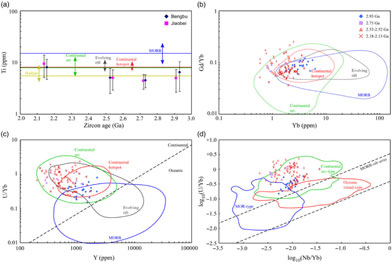
The geochemistry of zircon provides an indication of its parental magma composition, and an integrated analysis of U–Pb age and Lu–Hf isotope and trace elemental concentration on a single crystal offers a powerful approach to constraining the source nature recorded by detrital or xenocrystic grains (Barth et al. Reference Barth, Wooden, Jacobson and Economos2013; Carley et al. Reference Carley, Miller, Wooden, Padilla, Schmitt, Economos, Binderman and Jordan2014; Paulsen et al. Reference Paulsen, Deering, Sliwinski, Bachmann and Guillong2016) and the rare Mesoarchean crust in the NCC due to a lack of other geological evidence. By compiling a global database of zircon trace-element composition from different tectonic settings, Carley et al. (Reference Carley, Miller, Wooden, Padilla, Schmitt, Economos, Binderman and Jordan2014) found that zircons from settings without subduction influence (mid-ocean-ridge basalt or MORB and evolving continental-oceanic rift settings) are distinct in composition from those from Phanerozoic arcs and even more so from Hadean zircons (Fig. 12a–c). The former group is most notably featured by higher Ti and HREE concentrations and lower U/Yb ratios, reflecting hotter, drier magmas in juvenile rift and plume environments and cooler and wetter magmas in subduction environments (Fig. 12a–c). The mean calculated growth temperature of the late Mesoarchean magmatic zircons from the Bengbu and Jiaobei areas are 699 °C (6.52 ppm) and 678 °C (4.96 ppm; Liu et al. Reference Liu, Liu, Ding, Liu, Yang, Liu, Wang and Meng2013 b; Fig. 12a), respectively. Based on the similar rock type, SiO2 and TiO2 concentrations (Jahn et al. Reference Jahn, Liu, Wan, Song and Wu2008; Wu et al. Reference Wu, Zhao, Sun and Li2014 b), which are similar to the Hadean zircons, are slightly lower than those of continental arc zircons (8 ppm; Fig. 12a) and much lower than those of MORB zircons (15 ppm; Carley et al. Reference Carley, Miller, Wooden, Padilla, Schmitt, Economos, Binderman and Jordan2014; Fig. 12a). Due to the lack of reliable evidence to constrain a TiO2 and a SiO2, we assumed them to be unity and obtained minimum zircon growth temperatures (Ferry & Watson, Reference Ferry and Watson2007), so the much lower temperatures of these late Mesoarchean zircons compared with MORB zircons are possibly due to an overestimation of a TiO2. In addition, although zircon U/Yb ratios of the Bengbu (0.34) and Jiaobei areas (0.51; Liu et al. Reference Liu, Liu, Ding, Liu, Yang, Liu, Wang and Meng2013 b) show moderate differences, both are much higher than those of MORB zircons (0.06) and slightly lower than the Hadean zircons (0.60; Fig. 12c). Similar to the conclusion about the Hadean zircons proposed by Carley et al. (Reference Carley, Miller, Wooden, Padilla, Schmitt, Economos, Binderman and Jordan2014), we also suggest that the late Mesoarchean zircons in the southeastern NCC may reflect wetter and possibly cooler magmatism than Phanerozoic arcs.
(a) Comparison of Ti-in-zircon distributions of global zircon populations in different tectonic settings. Arrow represents middle 50% of zircon compositions for each population and line represents the median composition of the population (Carley et al. Reference Carley, Miller, Wooden, Padilla, Schmitt, Economos, Binderman and Jordan2014). (b) Plots of Gd/Yb v. Yb (ppm) of zircons from different tectonic setting (Carley et al. Reference Carley, Miller, Wooden, Padilla, Schmitt, Economos, Binderman and Jordan2014). (c) Plots of U/Yb v. Y (ppm) of zircons from different tectonic setting (Carley et al. Reference Carley, Miller, Wooden, Padilla, Schmitt, Economos, Binderman and Jordan2014). Dashed lines delineate continental (above the line) and oceanic (MORB) compositional fields. (d) Density distribution plots based on geochemical proxies for tectonomagmatic setting; the contours shown are for 95% level (Grimes et al. Reference Grimes, Wooden, Cheadle and John2015). MOR – mid-ocean ridge; MORB – mid-ocean-ridge basalt; OIB – ocean-island basalt.

5.b.3. Early Neoarchean
The granitoid gneisses of age c. 2.7 Ga in the Jiaobei Terrane display near to zero whole-rock ɛ Nd(t) values and zircon ɛ Hf(t) values and model ages of 2.9–3.0 Ga (Jahn et al. Reference Jahn, Liu, Wan, Song and Wu2008; Liu et al. Reference Liu, Liu, Ding, Liu, Yang, Liu, Wang and Meng2013 b; Wu et al. Reference Wu, Zhao, Sun and Li2014 b; Xie et al. Reference Xie, Wang, Xie, Liu, Dong, Ma, Ren and Liu2015). In combination with co-occurrences of low-HREE and high-HREE types, it is therefore suggested that the magmas were generated under different melting conditions during the same large-scale tectonic event, and the delaminated Mesoarchean lowest eclogite-facies crust was replaced by rising hot asthenospheric mantle which heated the residual Mesoarchean basaltic and intermediate lower crustal rocks (Jahn et al. Reference Jahn, Liu, Wan, Song and Wu2008; Wu et al. Reference Wu, Zhao, Sun and Li2014 b; Xie et al. Reference Xie, Wang, Xie, Liu, Dong, Ma, Ren and Liu2015). The continental hotspot setting for the early Neoarchean magmatic event does not contradict zircon trace element features (Fig. 12). U/Yb ratios (1.00±0.55 for Jiaobei and 0.96±0.42 for Bengbu; Liu et al. Reference Liu, Liu, Ding, Liu, Yang, Liu, Wang and Meng2013 b) and Yb/Gd ratios (21.0±7.5 for Jiaobei and 12.5±2.2 for Bengbu; Liu et al. Reference Liu, Liu, Ding, Liu, Yang, Liu, Wang and Meng2013 b) are all consistent with or slightly higher than those of the continental hotspot (0.66 and 12; Carley et al. Reference Carley, Miller, Wooden, Padilla, Schmitt, Economos, Binderman and Jordan2014; Fig. 12b, c); the obviously lower Ti contents (4.43 ppm for Jiaobei and 4.53 ppm for Bengbu compared with 8 ppm for the continental hotspot) may imply a cooler asthenospheric mantle during the early Neoarchean Era (Fig. 12a), assuming a TiO2 and a SiO2 to be unity. On the other hand, in consideration of the similar 2.9–3.0 Ga crust growth event reflected by the Hf model ages of the early Neoarchean magmatic zircons in the Huoqiu, Bengbu and Jiaobei areas, which are much older than 2.7–2.8 Ga in other areas of the NCC (Wan et al. Reference Wan, Dong, Ren, Bai, Xie, Xie and Liu2017), we suggest that the separated micro-block in the southern NCC did not unite with other parts of the NCC during the early Neoarchean Era.
5.b.4. Late Neoarchean – late Palaeoproterozoic
The late Neoarchean tectonic setting of the Eastern Block in the NCC has been under debate for a long time; one theory is that of a continental magmatic arc model (Peng et al. Reference Peng, Wang, Wang and Yang2015; Wang et al. Reference Wang, Liu, Wilde, Li, Zhang, Xiang, Yang and Guo2012 b, Reference Wang, Liu, Santosh, Wang, Bai and Guo2015, Reference Wang, Liu, Cawood, Guo, Bai and Guo2017 b; Nutman et al. Reference Nutman, Wan, Du, Friend, Dong, Xie, Wang, Sun and Liu2011), whereas others prefer a mantle plume model (Geng et al. Reference Geng, Liu and Yang2006; Yang et al. Reference Yang, Wu, Wilde and Zhao2008; Wu et al. Reference Wu, Zhao, Sun and Li2014 b). In the Jiaobei Terrane, Wu et al. (Reference Wu, Zhao, Sun and Li2014 b) suggested partial melting of pre-existing thickened lower crust with minor mantle-derived juvenile materials induced by a mantle plume, based on the high-HREE-type TTG, the large range of whole-rock ɛ Nd(t) values of −1.4 to +4.5 and zircon ɛ Hf(t) values of +1.3 to +7.6, and bimodal volcanic assemblages. However, Shan et al. (Reference Shan, Zhai, Wang, Zhou, Santosh, Zhu, Zhang and Wang2015) proposed partial melting of subducted oceanic slab in a continental arc environment, mainly in consideration of the high Cr and Ni contents of TTG gneisses. For the zircon trace-element features, the Bengbu (5.10±2.58 ppm) and Jiaobei (5.04±2.14 ppm) areas have similar Ti contents which are much lower than those of Phanerozoic continental arc and continental hotspot (8 ppm; Carley et al. Reference Carley, Miller, Wooden, Padilla, Schmitt, Economos, Binderman and Jordan2014; Fig. 12a). On the other hand, in consideration of the high U/Yb ratios of 1.05±0.46 for the Bengbu zircons (Fig. 12c), low Yb content (145±53 ppm; Fig. 12b) and low Yb/Gd ratios (11.3±4.2; Fig. 12b), slightly younger 2.49–2.52 Ga metamorphism, and Nb–Ta–Ti negative anomalies for the plagioclase amphibolite in the Jiagou xenoliths of age c. 2.5 Ga (Liu et al. Reference Liu, Wang, Li, Rolfo, Li, Groppo and Hou2013 a), a late Neoarchean subduction-related setting at the southeastern North China Craton is more likely (Fig. 12d).
In the Bengbu area, the middle Palaeoproterozoic meta-mafic rocks from the Wuhe Group have zircon ɛ Hf(t) values of −6.22 to +8.38; their geochemical isotopic features are indicative of partial melting of sub-arc depleted mantle wedge modified by different degrees of slab-derived melts at an active continental margin (Liu et al. Reference Liu, Zhao, Liu and Cai2018). On the other hand, the coeval granites are characterized by high Zr, Nb, Ga and Y contents, TFeO/MgO ratios and Zr-saturation temperatures of over 850 °C, suggestive of an affinity with A-type granite (Yang et al. Reference Yang, Xu, Pei and Wang2009; Wang et al. Reference Wang, Liu, Zhang, Zhao, Wang and Song2017 a). The much higher whole-rock Zr-saturation temperatures (>850 °C) compared with the zircon growth temperature (727±44 °C) can be explained by the assumption of unity of a TiO2 and a SiO2, so the calculated zircon crystallization temperatures are minimum estimates (Ferry & Watson, Reference Ferry and Watson2007). In the Jiaobei Terrane, c. 2.1 Ga hornblende-bearing monzogranitic gneiss and biotite-bearing monzogranitic gneiss (Liu et al. Reference Liu, Liu, Ding, Liu, Guo and Wang2014) have also been reported. In the Liaoji area, voluminous middle Palaeoproterozoic A-type granitoids and meta-mafic rocks with arc-like geochemical features have been widely identified (Hao et al. Reference Hao, Li, Zhao, Sun, Han and Zhao2004; Lu et al. Reference Lu, Wu, Zhang, Zhao, Yang and Guo2004; Li & Zhao, Reference Li and Zhao2007; Li & Chen, Reference Li and Chen2014; Meng et al. Reference Meng, Liu, Liu, Liu and Yang2014; Yuan et al. Reference Yuan, Zhang, Xue, Han, Chen and Zhai2015; Xu et al. Reference Xu, Liu and Liu2017). These magmatic events at c. 2.2–2.0 Ga spatially constitute a linear Palaeoproterozoic magmatic belt along the JLJB, and their zircon Hf isotopic analyses indicate remelting of Neoarchean or older continental crustal (Liu et al. Reference Liu, Liu, Ding, Liu, Guo and Wang2014, Reference Liu, Zhao, Liu and Cai2018; Wang et al. Reference Wang, Liu, Zhang, Zhao, Wang and Song2017 a). In addition, the almost identical metamorphic ages of 1.84–1.88 Ga from the Huoqiu and Bengbu areas (Xu et al. Reference Xu, Gao, Wang, Wang and Liu2006; Guo & Li, Reference Guo and Li2009; Liu et al. Reference Liu, Wang, Rolfo, Groppo, Gu and Song2009, Reference Liu, Zhang, Wang, Groppo, Rolfo, Yang, Li, Deng and Song2017 c, Reference Liu, Zhao, Liu and Cai2018; Wan et al. Reference Wan, Dong, Wang, Xie and Liu2010; Wang et al. Reference Wang, Liu, Santosh and Gu2013) implies that they have been involved in subduction- and collision-related tectonic processes at 1.9–1.8 Ga, similar to the Jiaobei Terrane (Zhou et al. Reference Zhou, Zhao, Wei, Geng and Sun2008 b; Wang et al. Reference Wang, Liu, Liu and Liu2010; Tam et al. Reference Tam, Zhao, Liu, Zhou, Sun and Li2011; Liu et al. Reference Liu, Liu, Yang, Wang and Liu2012 a, Reference Liu, Liu, Cai, Wang, Liu, Liu, Yang, Shi and Liu2017 d). The potassic granites of age c. 2.1 Ga, consistent with A-type granite affinity, the meta-mafic rocks of age c. 2.1 Ga with arc-like geochemical features, and the subduction- and collision-related granulite-facies metamorphism of age 1.8–1.9 Ga in the Huoqiu, Bengbu and Jiaobei areas suggest that they are the southern extension of the JLJB.
6. Conclusions
New zircon U–Pb and Lu–Hf isotopes and trace-element compositions provided by this study for the (gneissic) granitoids of the Bengbu area in the southeastern NCC, together with the results of previous studies, lead to the following conclusions.
(1) U–Pb age data for magmatic zircons reveal that the Bengbu and Huoqiu areas underwent four felsic magmatism events at c. 2.93 Ga, 2.76–2.71 Ga, 2.56–2.52 Ga and 2.18–2.10 Ga, as well as mafic magmatism events at 2.71 Ga, 2.55 Ga and 2.13 Ga.
(2) Metamorphic zircon ages suggest that the Bengbu and Huoqiu areas experienced a regional metamorphic event at 2.52–2.48 Ga as for most other metamorphic complexes in the Eastern Block, and a Palaeoproterozoic tectonothermal event at 1.88–1.80 Ga, which was likely associated with the formation of the Jiao-Liao-Ji Belt.
(3) Xenocrystic, magmatic and metamorphic zircon U–Pb and Lu–Hf data indicate the presence of a Palaeoarchean–Mesoarchean micro-continent entrained in the Jiao-Liao-Ji Belt at the southeastern North China Craton.
Supplementary material
To view supplementary material for this article, please visit https://doi.org/10.1017/S0016756818000869.
Acknowledgements
We thank Liang Li for his laboratory assistance. We are also grateful for thoughtful and constructive reviews that significantly improved the quality of this paper. This research was funded by NSFC grants (nos 41430210 and 41622203).