


Introduction
To date, research shows that developmentally sensitive adaptations of trauma-focused cognitive therapy (TF-CBT) are effective in treating posttraumatic stress disorder (PTSD) in young people (Smith et al., Reference Smith, Yule, Perrin, Tranah, Dalgleish and Clark2007). For some young people significant levels of shame are experienced within PTSD. This is important as it has been suggested that individuals with high levels of shame might do less well in standard cognitive therapy (see extended version). One explanation for this might be a tendency to re-evaluate negative appraisals in a self-critical way, perpetuating feelings of shame. This is thought to occur due to a lack of emotional experiences of feeling cared for and soothed in early life, leaving the individual's self-soothing system underdeveloped (Gilbert, Reference Gilbert2010). Consequently the brain's default mode can become threat focused as evidenced by self-critical evaluations. Thus, these individuals might benefit from compassion-focused therapy (CFT) to develop emotional experiences of warmth and safeness via a range of techniques that focus on learning and experiencing the attributes and skills of compassion (compassionate mind training; CMT). This enables alternative perspectives generated in CBT to be meaningful and felt (Gilbert, Reference Gilbert2010). CFT is used transdiagnostically with emerging evidence of its effectiveness in enhancing the treatment of PTSD (Lee, Reference Lee, Sookman and Leahy2009) as well as other psychological conditions in adults. There is no known literature on CFT in conjunction with TF-CBT in young people. This report describes a case study drawing on a self-help treatment guide, where CMT was used to enhance TF-CBT for the treatment of PTSD (Lee, Reference Lee2012).
Case presentation
Jodi (pseudonym) is a 17 year-old student referred to CAMHS by primary care services for assessment of PTSD following a sexual assault that happened 5 years previously. Jodi was diagnosed with PTSD by the treating trainee clinical psychologist (LB) and consultant clinical psychologist (JW). She also presented with symptoms of depression. Jodi struggled in assessment and treatment to discuss the incident and visibly curled her body up when reporting how sick and disgusted she felt about it. She reported believing the assault was her fault and had used self-harming behaviours intermittently since the age of 13 to “punish” herself for being “weak”, following which she said she “hates herself”. Jodi reported a lack of emotional validation, maternal nurturing and care throughout her childhood. She reported previous supportive counselling had been unhelpful.
Measures
The following measures were used: Post Traumatic Diagnostic Scale (Foa, Reference Foa1995)Footnote 1 ; The Beck Depression Inventory (BDI-II; Beck, Steer and Brown, Reference Beck, Steer and Brown1996); The Other as Shamer Scale (OAS; Goss, Gilbert and Allan, Reference Goss, Gilbert and Allan1994), which is an 18-item self-report measure that was used to assess how Jodi believed she lived in the mind of others (external shame); The Forms of Self-Criticizing/Attacking and Self-Reassuring Scale (FSCRS; Gilbert, Clark, Hempel, Miles and Irons, Reference Gilbert, Clark, Hempel, Miles and Irons2004), a 22-item self-report measure that looks at internal shame; self-criticism (“inadequate self” and the “hated self”) and the ability to self-reassure (“reassure self”) at times of difficulty.
Treatment
Overview
Jodi attended 14 one-hour sessions and 4 1.5-hour sessions. Treatment was based on TF-CBT (Ehlers, Clark, Hackmann, McManus and Fennell Reference Ehlers, Clark, Hackmann, McManus and Fennell2005; Smith et al., Reference Smith, Yule, Perrin, Tranah, Dalgleish and Clark2007) and CFT (Gilbert, Reference Gilbert2010). This report focuses on the key aspects of TF-CBT that were enhanced by CFT, namely, using a compassion focused formulation and updating a disgust-based flashback (Lee, Reference Lee2012).
Formulation
Using a compassion focused formulation (see extended version), various links at different stages of therapy were drawn out to allow Jodi to see her symptoms and behaviours (e.g. self-harm, withdrawal) as a set of strategies used to manage internal and external sources of threat and the resultant shame state. However, these strategies had the unintended consequences of perpetuating Jodi's self-attacking dialogues, reinforcing her shame state. During her flashbacks, Jodi would re-experience feelings of disgust and shame and increased self-critical dialogues. Not knowing what to do with these painful emotions, Jodi used self-harm to cope. This, however, perpetuated her shame state as she would then reflect critically on her coping methods and was unable to access other self-soothing mechanisms or associated feelings. Thus, it was formulated that re-living her trauma and attempting to update hotspots without the development of an alternative feeling to end the shame state would simply lead to the exacerbation of shame and disgust rather than reduction of the emotion over time as would be predicted by the cognitive model of PTSD (Ehlers et al., Reference Ehlers, Clark, Hackmann, McManus and Fennell2005).
The formulation suggested that Jodi a) lacked beliefs that were soothing and supporting and b) did not have access to emotional states that would make any new beliefs generated meaningful. Consequently, considering this formulation, traditional CBT techniques would not necessarily lead to a shift in affect. Enabling Jodi to develop compassionate feelings and beliefs thus had the potential to greatly enhance TF-CBT.
Psychoeducation
During the psychoeducation phase of treatment, particular attention was paid to the key insights of the compassionate mind evolutionary model alongside the psychoeducation used in TF-CBT:
-
1. The human brain is threat focused and has evolved to become more complex over many years (there is the “old” brain and “new” brain);
-
2. The human brain regulates threat through accessing various systems including the self-soothing or compassion system (The “3 circle model” was used idiosyncratically; Gilbert, Reference Gilbert2010);
-
3. In order to access self-soothing and regulate threat, the human brain needs experiences of care giving in order to internalize these experiences and lay down emotional memories to later access.
An analogy (baking a cake) was used to socialize Jodi to these insights. For example, if one baked a cake without certain key ingredients (i.e. enough appropriate care giving experiences) it may look the same on the outside but it may taste very different inside (not able to access the self-soothing or compassion systems). Developing these insights allowed Jodi to feel less ashamed as she realized that the assault, and how she had coped since, was not her fault as she had missed out on vital “ingredients” to develop self-soothing skills. She realized she was doing the best job she knew how to do in managing her emotions, although there were unintended consequences (e.g. she never learnt how to manage/talk about her emotions without self-harming and so lived with scarring on her arms).
Updating a disgust-based hotspot
After eliciting hotspots via re-living, we discussed that in order to break the maintenance of her shame state and PTSD, Jodi needed to be able to access her self-soothing system to elicit a congruent emotional experience to her alternative beliefs that the attack was not her fault. The key point was that feeling disgusted by the attack (old part of brain) does not equal that one is disgusting (new part of brain trying to interpret and make sense of feeling) (Gilbert, Reference Gilbert2010; Lee, Reference Lee2012). To develop an alternative visceral feeling to disgust (threat-focused emotion), CMT was continued to develop Jodi's compassionate feelings (Lee, Reference Lee2012). This was done via a range of exercises, utilizing imagery work (e.g. perfect nurturer, safe place). It has been shown that imagery affects brain chemistry as powerfully as actual experiences (see extended version). This work was the main focus of, but was not solely restricted to, around six sessions. Exercises were recorded and practised for work in between each session. We explored the attributes (sensitivity, sympathy, empathy) and skills of compassion (compassionate attention, compassionate behaviour) (Gilbert, Reference Gilbert2010). It was important to strengthen the compassionate self in conjunction with validating the disgust Jodi experienced. The key was to explore the disgust through the eyes of the compassionate self.
Now that Jodi was able to access congruent emotional experiences to her alternative beliefs, a visceral update to her disgust-based hotspots using the enhanced reliving paradigm was completed (Lee, Reference Lee2012). This is where new information/beliefs regarding “hotspots” traditionally achieved via cognitive restructuring, but in this case also heavily influenced by CMT, are brought to mind as an individual is re-living the traumatic event. In this case, however, self-soothing feelings (achieved via CMT) were also elicited during re-living. Indeed, prior to updating, a script was developed with Jodi using her compassionate mind: “It's ok to feel disgusted by this, it's not your fault; I am here to get you through this”. To update the hotspot, Jodi first elicited feelings of compassion and warmth within herself then re-visited the disgust hotspot within her trauma memory and used this alternative feeling and rehearsed script to soothe and tolerate the emotion of disgust so it could dissipate (Lee, Reference Lee2012).
Treatment outcome
PTSD
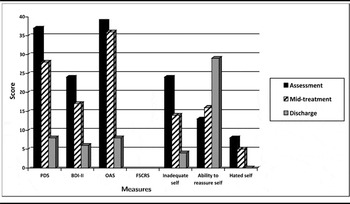
Jodi experienced a decline in her PTSD symptoms indicative of a change from “severe” to “mild” symptoms of PTSD. Jodi no longer met the DSM-IV diagnostic criteria for PTSD.
Depressive symptoms
There was a decline in Jodi's depressive symptoms from “moderate-severe” to “normal”. In addition, Jodi reported that she had stopped using self-harming behaviours using either compassionate imagery or music to self-soothe and bring down her levels of emotion before thinking through what to do (talk to someone).
Shame and disgust
There are no established scale interpretations for these measures. However, results indicated clinically significant increases in Jodi's ability to reassure and comfort herself and clinically significant decreases in how much she hated herself and believed she was inadequate.
For Jodi, the realization that things were not her fault but that she could take responsibility for the unintended consequences was key. These insights were reflected in a compassionate letter to herself where she wrote “you don't deserve it” and in her score for “hated self” on the FSCRS which fell to 0.
Outcome measures

Discussion and reflection
This case aims to illustrate the usefulness of undertaking CMT to enhance TF-CBT with adolescents. Given that no literature yet exists on this topic, the outcomes here are promising in terms of adapting CFT approaches for use with adolescents. Specifically, CMT enabled Jodi to develop self-soothing dialogues and a compassionate sense of safeness that she was then able to access in order to end her feelings of current threat and state of shame. These had in part been maintaining her PTSD, depression and self-harm. Formulating this with Jodi in the “3 circles” diagram (Gilbert, Reference Gilbert2010) helped her visually see how and why self-criticism kept her in the “threat circle”.
This study mirrors the benefits found using CMT alongside TF-CBT with adults (Lee, Reference Lee, Sookman and Leahy2009 ) and raises the importance of assessing the potential role of shame and disgust in young people, recognizing possible implications for treatment. Specifically, it raises the question about when and how the enhanced re-living paradigm is used in treatment. Shame cuts individuals off from forming the affiliative relationships both in and out of therapy, which we all need in order to feel forgiven, accepted, understood and validated. The therapeutic relationship was crucial to develop and model an affiliative relationship and to help Jodi see the importance of developing and enhancing this relationship with herself, and others, in order to help regulate threat. Pursuing re-living with individuals who are highly self-critical and stuck in a state of shame can potentially be re-traumatizing if the individual has no access to an experience of feeling forgiven, understood, validated and accepted as the shame state is reinforced repeatedly.
Further research is needed to develop and validate measures looking at shame and self-soothing in young people. Future work needs to address questions concerning what age groups and abilities might benefit from compassion-focused approaches. Research with larger samples is needed to evaluate TF-CBT treatment using CMT in order to generalize the findings obtained here, but perhaps the most useful first step would be generating a small case series using this treatment approach.
Acknowledgements
Many thanks to Jodi for allowing us to write-up this piece of work to help influence the thinking of others. Jodi chose not to contribute specifically to this article. Thanks also to Professor Paul Gilbert for his helpful comments on an earlier draft.




Comments
No Comments have been published for this article.