INTRODUCTION
Scyliorhinidae (Carcharhiniformes) is one of the largest and most diverse shark families with 17 genera, 146 recognized and described species and expanding (Yano et al., Reference Yano, Ahmad, Gambang, Idris, Solahuddin and Aznan2005; Last et al., Reference Last, White and Pogonoski2008; Clark & Randall, Reference Clark and Randall2011). Scyliorhinidae comprise very small sharks and have no importance in the commercial fishery of India. Ten scyliorhinid sharks are reported from the Arabian Sea, of which Cephaloscyllium is represented by only two species: Indian swellshark Cephaloscyllium silasi (Talwar, Reference Talwar1974); and balloon shark Cephaloscyllium sufflans (Regan, 1921) (Manilo & Bogorodsky, Reference Manilo and Bogorodsky2003).
For a long period after the original description by Talwar (Reference Talwar1974) the validity status of C. silasi was under question; Springer (Reference Springer1979) in his review of the Scyliorhinidae family included C. silasi as a synonym of the quagga catshark Halaelurus quagga (Alcock, 1899). Compagno & Talwar (Reference Compagno and Talwar1985) discussing the generic character positioned the species in Cephaloscyllium. After the original description, reports of Cephaloscyllium silasi from the Arabian Sea coast of the Indian exclusive economic zone (EEZ) are absent. This paper is also the first report of the egg case for the species, and provides a detailed re-description based on recent specimens collected from deep waters off the south-west coast of India (Kerala coast).
MATERIALS AND METHODS
Three specimens of Cephaloscyllium silasi were collected occasionally during regular weekly observations of fish landings from 2008–2011 along the south-west coast of India as by-catch of commercial deep-sea shrimp trawlers operating in the Arabian Sea, off Kollam at 200–500 m depths. The specimens were collected from Sakthikulangara Fisheries Harbour (SFH), Kollam (Kerala). Species identification was based on Talwar (Reference Talwar1974) and Compagno et al. (Reference Compagno, Dando and Fowler2005). Morphometric measurements of formalin (5%) preserved specimens were taken by following the method of Compagno (Reference Compagno2001). Morphometric measurements for the egg case followed the method of Ebert et al. (Reference Ebert, Compagno and Cowley2006). Tissue samples collected were preserved in 95% ethanol for genetic analysis. DNA was extracted by standard protocols (Miller et al., Reference Miller, Dykes and Polesky1988) and partial sequence information of the mitochondrial gene, cytochrome oxidase subunit I (COI) were generated using primers from Ward et al. (Reference Ward, Zemlak, Innes, Last and Hebert2005) for DNA barcoding purposes. Bidirectional sequencing was carried out using an ABI 3730 sequencer. Sequence data were submitted to the NCBI GenBank (Accession number: HM467791).
RESULTS
SYSTEMATICS
Family scyliorhinidae
Genus Cephaloscyllium Gill, 1862
The members of the genus Cephaloscyllium Gill, 1862 are known as swell sharks or balloon sharks related to their ability to inflate/swell body by swallowing seawater to deter predation and to settle the body among rocks or crevices (Nakaya et al., Reference Nakaya, Inoue and Ho2013). Cephaloscyllium can be separated from other species of the family by the lack of labial furrows, presence of supraorbital crests on the chondrocranium, first dorsal fin location behind pelvic origin, second dorsal fin smaller than the first and anal fins (Compagno, Reference Compagno1988; Nakaya et al., Reference Nakaya, Inoue and Ho2013). They inhabit continental shelf and oceanic insular waters of the temperate to tropical Indo-Pacific region (Inoue & Nakaya, Reference Inoue and Nakaya2006).
The genus Cephaloscyllium Gill, 1862 currently consists of 17 species (Eschmeyer, Reference Eschmeyer2014) and only a single species, C. silasi is known from the Indian EEZ (Raje et al., Reference Raje, Sivakami, Mohan, Kumar, Raju and Joshi2007). Reports of C. sufflans from India are questionable since no illustrations or images were provided in the respective reports.
Cephaloscyllium silasi (Talwar, Reference Talwar1974)
Indian swellshark
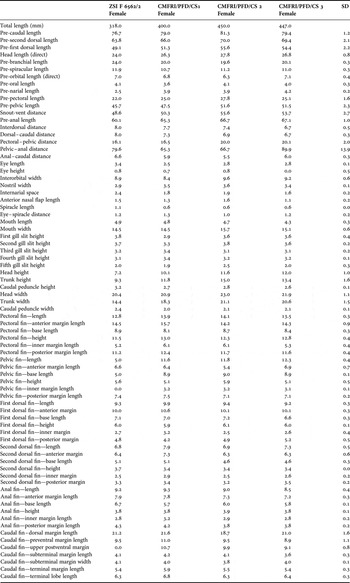
(Figures 1–4; Table 1)
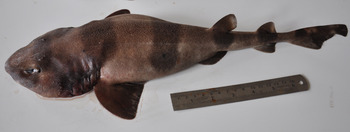
Cephaloscyllium silasi, lateral view (450 mm total length, female).

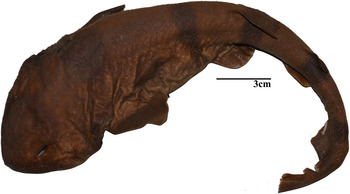
Cephaloscyllium silasi, dorsal view (holotype. ZSI F6562/2, 318 mm, female) (photograph: Barry Russell).

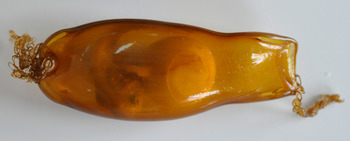
Egg case of Cephaloscyllium silasi containing embryo from gravid female (450 mm total length).

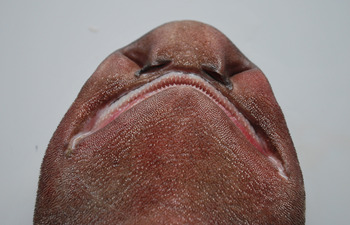
Ventral view of mouth portion of Cephaloscyllium silasi (370 mm total length, male).

Morphometric data for the specimens of Cephaloscyllium silasi. Measurements expressed as percentage of total length (% TL).

SD, standard deviation.
Scyliorhinus (Halaelurus) silasi Talwar, 1974. J. Mar. Biol. Ass. India 14, 779–783.
Holotype: ZSI F6562/2 (318 mm, female).
Paratypes: ZSI F6563/2 (1), F6564/2 (1), F6566/2 (188–360 mm) collected by RV ‘Blue fin’.
Type locality: Arabian Sea, off Quilon (9°N–76°E), Kerala, India, 300 m.
MATERIALS EXAMINED
Holotype ZSI F6562/2 (318 mm, female) and paratypes ZSI F6563/2 (1), F6564/2 (1), F6566/2 (188–360 mm); 3 females, CMFRI/PFD/CS1-3, 400–450 mm total length (TL), Arabian Sea, off Kollam (Kerala), south-west coast of India, 250–500 m.
DESCRIPTION
A small shark with a stout body and expanded belly. No labial furrows (a vestigial lower labial furrow may present), anterior nasal flaps broadly triangular. Head depressed, flattened and broad, rounded in dorsal and ventrally, mouth large and arched. Five gill slits, dorsolaterally placed and last two gill slits over pectorals. 1–3 gill slits subequal in length, 5th smallest. Eyes dorsolateral and slit like.
Head length (HL) 0.33–0.34 times precaudal length, and 26.3–27.8% TL. Head width 20.9–23% TL, head width maximum at just in front of first gill slit. Pre- oral length 0.25–0.27 times mouth width. Snout short, flattened, broadly rounded. Pre-orbital length 0.22–0.26 times HL and 0.66–0.81 times interorbital width. Pre-pectoral length 25–27.8% TL. Eye length 0.10–0.11 times HL. Inter-orbital width 8.4–9.6% TL and 0.32–0.35 times HL. Small spiracle, near to eye. Anterior nasal flaps broadly lobate or sub-triangular, nearly reaching mouth but not overlapping. Internarial distance 3.4–3.7% TL, shorter than prenarial length (0.4–0.5 times) and nostril width (5 times).
Mouth large, arched or crescentic, mouth width 0.6 times HL. First dorsal origin is slightly in front of pelvic insertion and placed above pelvics. First dorsal fin length is 9.2–9.9 %TL and first dorsal fin base length is 6.6–7.2% TL which is entirely above anal base; first dorsal fin length 0.74–0.80 times second. First dorsal fin height is 0.59–0.65 times its length. Anal fin larger than second dorsal fin. Anal caudal space 5.5–6 %TL. Dorsal caudal space 6.7–7.3% TL. Teeth small, pointed and tricuspid. Spiral valve count eight.
Scyliorhinid catsharks are a large and diverse family with 3 reproductive modes displayed (Francis, Reference Francis2006; Akhilesh et al., Reference Akhilesh, Bineesh, White, Ganga and Pillai2013). Cephaloscyllium silasi have one of the rarest and most primitive modes of reproduction; single oviparity with fertilized eggs deposited in a tough, leathery egg case which is deposited onto a suitable substratum where the embryo develops hatching directly into the external environment. Egg cases of scyliorhinids have been well-described in Iglésias et al. (Reference Iglésias, Du Buit and Nakaya2002) with comments on related and similar species. Egg case of C. silasi is of medium size length and has an egg case length (ECL) of 85.1–86.2 mm (N = 2) and has tendrils on posterior and anterior sides. Tendrils very long and highly convoluted. Posterior part oval in shape. Egg case surface is smooth, glossy and vase like. A small constriction in the anterior part of egg case. Posterior case width 41.6–42.8% ECL; waist width 30.5–30.9% ECL, anterior case width 30.8–31.3% ECL, anterior border width 24.7% ECL and egg case height 25.9–26.3% ECL. Only one egg case is found in each oviduct. Egg cases are transparent and golden yellow in colour. Lighter striations can be seen on egg case.
COLOUR
Dorsal surface light brown with clearly defined seven broad dark brown bands (Figures 1 & 2), paler brown ventrally, no spots. First band behind eyes, other band postions are: in the line of gills like an arch; after the pectorals; on the dorsals; on origin of caudal; and on the middle of caudal. Caudal tip and ventral side of caudal are also with a small dark band/blotch. Juveniles have similar colour pattern but faded and light brown. No scattered blotches on body.
SIZE AND BIOLOGY
Cephaloscyllium silasi is a single oviparous species and possibly attains a maximum size of 500 mm TL. Males have a reported length at maturity <367 mm TL (Compagno, Reference Compagno1988). The female of 450 mm examined by the authors was gravid and contained two egg cases, one in each uterus, containing visible embryos (85.1–86.2 mm) with attached yolk sac (Figure 3). Crustaceans and cephalopods were found in the gut of one specimen examined in the present study.
DISTRIBUTION AND HABITAT
Western Indian Ocean: India (Arabian Sea), endemic to south-west coast (Compagno et al., Reference Compagno, Dando and Fowler2005), however Manilo (Reference Manilo1993) reported the species from the Gulf of Aden, which needs to be confirmed. Though reported as a relatively common species in the holotype collection area (see Compagno, Reference Compagno1984), we could not find additional reports of C. silasi from India other than those quoted from Talwar (Reference Talwar1974) and Compagno (Reference Compagno1984) in the latest works related to elasmobranchs (Raje et al., Reference Raje, Sivakami, Mohan, Kumar, Raju and Joshi2007). Compagno & Talwar (Reference Compagno and Talwar1985) suggested that the species listed as Halaelurus natalensis from Quilon by Rao (Reference Rao1975) could be C. silasi. Cephaloscyllium sufflans listed in Jayaprakash et al. (Reference Jayaprakash, Kurup, Sreedhar, Venu, Divya, Hashim, Anish, Paul and Sudhakar2006) from the south-west coast also could be C. silasi.
REMARKS
Usually Cephaloscyllium ‘large groups’ reach maturity (Lm) at >800 mm TL and ‘dwarf group’ species reach maturity at a maximum of 500 mm TL (Compagno, Reference Compagno1988); and in Cephaloscyllium, C. fasciatum Chan 1966, C. silasi and C. sarawakensis Yano, Ahmad & Gambang, Reference Yano, Ahmad, Gambang, Idris, Solahuddin and Aznan2005 are the only dwarfs in the genus. Cephaloscyllium silasi, looks similar to species of the large Cephaloscyllium group: C. sufflans Regan, 1921 an endemic to the African coast (maximum length >1000 mm and Lm 890 mm for males and 820 mm for females) (Bass et al., Reference Bass, D'Aubrey and Kistnasamy1975; Compagno, Reference Compagno1984); and C. umbratile Jordan & Fowler, 1903 from the western north Pacific (maximum length 1200 mm for males and 1100 mm for females, Lm 947–948 mm and 948–1011 mm TL for males and females, respectively) (Compagno et al., Reference Compagno, Dando and Fowler2005; Schaaf-Da Silva & Ebert, Reference Schaaf-Da Silva and Ebert2008). Cephaloscyllium silasi can be differentiated from C. sufflans in terms of its colour pattern, extremely broad head, mouth wide and broadly rounded, shorter posterior dorsal fins and mature at less than 400 mm TL. Males were immature even at 600 mm and females at 700 mm TL in C. sufflans and teeth near the middle of the upper jaw have five cusps (Bass et al., Reference Bass, D'Aubrey and Kistnasamy1975; Bass, Reference Bass, Smith and Heemstra1986). Most of the publications quoted that C. silasi have ‘nasal membrane overlapping mouth’ (Compagno, Reference Compagno1984; Compagno et al., Reference Compagno, Dando and Fowler2005), but no recent materials of examined C. silasi had nasal membrane overlapped, except in a 370 mm TL male (Figure 4) and holotype where it just reaches to mouth. The original description of Talwar (Reference Talwar1974) also did not mention this character, so we ascertain this as a non-valid/variable character of C. silasi. A small swellshark similar to C. silasi occurs off Myanmar, Andaman Sea (Compagno et al., Reference Compagno, Dando and Fowler2005).
ACKNOWLEDGEMENTS
We are grateful to the Director, Central Marine Fisheries Research Institute (CMFRI), Kochi (India) and to the Director, Zoological Survey of India, Kolkata (India) for support and encouragement. The financial assistance received from the MoES/CMLRE, Government of India is acknowledged. David A. Ebert and Jayna A. Schaaf-Da Silva (Pacific Shark Research Center, USA); Kazuhiro Nakaya (Laboratory of Marine Biology and Biodiversity, Japan); John E. Randall, (Bishop Museum Honolulu, USA) are acknowledged for providing publications required for the preparation of the manuscript and discussions. We thank Barry Russell for providing the photograph (Figure 2). Support by A. Gopalakrishnan and K.A. Sajeela (National Bureau of Fish Genetic Resources (NBFGR), Kochi, India are much appreciated.