1. Introduction
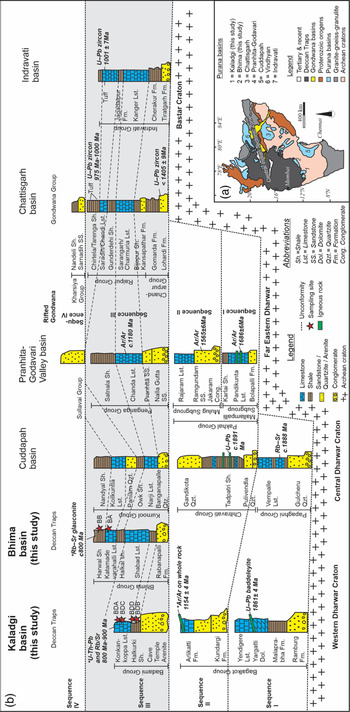
Proterozoic supracrustal successions, preserved in the so-called ‘Purana basins’ (e.g. Kale & Phansalkar, Reference Kale and Phansalkar1991; Chaudhuri et al. Reference Chaudhuri, Mukhopadhyay, Patranabis-Deb and Chanda1999, Reference Chaudhuri, Saha, Deb, Patranabis-Deb, Mukherjee and Gosh2002; Chakraborty et al. Reference Chakraborty, Dey and Mohanty2010; Meert & Pandit, Reference Meert, Pandit, Mazumder and Eriksson2015), cover large parts of the Dharwar, Bastar and Singhbum cratons of the India Shield south of the Indian Central Tectonic Zone (Fig. 1a). On purely stratigraphic grounds, the strata in these basins display a very similar development with four unconformity-bound sequences (Sequences I, II, III and IV) present (e.g. Conrad et al. Reference Conrad, Hein, Chaudhuri, Patranabis-Deb, Mukhopadhyay, Deb and Beukes2011) of which the third (i.e. Sequence III) is the focus of this study in the Kaladgi and Bhima basins (see Fig. 1b). Sequence III, with a thickness of about one hundred to a few hundred metres, has the widest distribution of the four sequences. It rests directly on the Archean basement in some areas, such as in the far eastern Indravati and Chattisgarh basins as well as in the Bhima Basin to the west (Fig. 1b). Sequence III also has a very persistent internal stratigraphy and character, with a sharp erosional base overlain by conglomerate and quartzite fining upwards into shale, and finally into a very distinctive upper succession of finely laminated non-stromatolitic deep-water, largely pelagic, limestone and dolomite (e.g. Mukhopadhyay & Chaudhuri, Reference Mukhopadhyay and Chaudhuri2003; Patranabis-Deb et al. Reference Patranabis-Deb, Saha and Tripathy2012). This carbonate-rich unit also appears to have a distinctive laterally correlatable internal stratigraphy, with a middle siliciclastic unit (shale with minor quartzite) and an uppermost shale (Fig. 1b) overlain with erosional contact by siliciclastics of Sequence IV comprising the Sullavai Group and correlatives (e.g. Saha et al. Reference Saha, Patranabis-Deb, Collins and Montenari2016). Apart from its apparent lateral persistent stratigraphy, the strata of Sequence III also differ from those of underlying Sequences I and II by being virtually undeformed and almost flat-lying (e.g. Saha et al. Reference Saha, Patranabis-Deb, Collins and Montenari2016). The erosional unconformity at the base of Sequence III therefore varies along-strike from a subtle low angle to marked steep angle.
(a) Simplified geological map of India showing the locality and outcrop distribution of the different Purana basins, the Gondwana Supergroup and the Deccan Traps (modified from Dey, Reference Dey, Mazumder and Eriksson2015). (b) General stratigraphy of the different Purana basins with existing absolute age constraints (modified from Conrad et al. Reference Conrad, Hein, Chaudhuri, Patranabis-Deb, Mukhopadhyay, Deb and Beukes2011; Collins et al. Reference Collins, Patranabis-Deb, Alexander, Bertram, Falster, Gore, Mackintosh, Dhang, Saha, Payne, Jourdan, Backé, Halverson and Wade2015; Meert & Pandit, Reference Meert, Pandit, Mazumder and Eriksson2015) showing the four unconformity-bound sequences. Carbonates of Sequence III (shaded) display very similar stratigraphic and sedimentological features that are apparently correlative across the subcontinent. Sampling sites are indicated. Age constraints with asterisk are discussed in the text.

Despite the apparent consistency of stratigraphy and sedimentological characteristics of Sequence III as depicted in Figure 1b, especially the persistence of deep-water carbonate units, there are still contrasting long-distance correlations. For example, in two of the most recent publications, this sequence in the Cuddapah and Kaladgi–Bhima basins are interpreted by Collins et al. (Reference Collins, Patranabis-Deb, Alexander, Bertram, Falster, Gore, Mackintosh, Dhang, Saha, Payne, Jourdan, Backé, Halverson and Wade2015) and Joy et al. (Reference Joy, Patranabis-Deb, Saha, Jelsma, Maas, Söderlund, Tappe, Gert Van Der Linde, Banerjee and Krishnan2018) as early Neoproterozoic in age, while it is considered to be late Mesoproterozoic in age further to the east in the Pranhita, Chattisgarh and Indravati basins. This discrepancy is essentially related to the interpretation of available radiometric age data of rock units in Sequence III. Arguably, the most robust age bracket for this sequence comes from the Chattisgarh Basin (Fig. 1b), where zircons extracted from tuff beds near its base and top indicate deposition between c. 1.4 Ga and c. 1.0 Ga (Patranabis-Deb et al. Reference Patranabis-Deb, Bickford, Hill, Chaudhuri and Basu2007; Bickford et al. Reference Bickford, Basu, Patranabis-Deb, Dhang and Schieber2011). The early Neoproterozoic age of Sequence III further to the west is based on a single outlier near-concordant U–Pb age of c. 0.91 Ga (Collins et al. Reference Collins, Patranabis-Deb, Alexander, Bertram, Falster, Gore, Mackintosh, Dhang, Saha, Payne, Jourdan, Backé, Halverson and Wade2015) obtained on detrital zircons extracted from the middle quartzite (i.e. Paniam Quartzite) of the succession in the Cuddapah Basin. The other detrital zircons, however, showed a much older and quite prominent peak at c. 1.7 Ga (Collins et al. Reference Collins, Patranabis-Deb, Alexander, Bertram, Falster, Gore, Mackintosh, Dhang, Saha, Payne, Jourdan, Backé, Halverson and Wade2015). In the Kaladgi and Bhima basins (the subject of this study), the Neoproterozoic age of Sequence III is based on U–Th–Pb and Rb–Sr ages of c. 800–900 Ma obtained on glauconite and limestone (Joy et al. Reference Joy, Patranabis-Deb, Saha, Jelsma, Maas, Söderlund, Tappe, Gert Van Der Linde, Banerjee and Krishnan2018). However, the outlier zircon age and glauconite ages must be treated with care; Conrad et al. (Reference Conrad, Hein, Chaudhuri, Patranabis-Deb, Mukhopadhyay, Deb and Beukes2011) suggested that in the Pranhita and Chattisgarh basins these minerals were most likely reset, as they gave ages younger than the c. 1.0 Ga zircons in the upper tuff bed of the sequence (Fig. 1b).
With reference to the above, the stratigraphic correlation of Sequence III as presented in Figure 1b and the ages determined from glauconites and limestones (Joy et al. Reference Joy, Patranabis-Deb, Saha, Jelsma, Maas, Söderlund, Tappe, Gert Van Der Linde, Banerjee and Krishnan2018) therefore remain unresolved. Another method that could be used to obtain more clarity on this question is that of palaeomagnetism. Such studies can yield insights into the lateral correlation and timing of deposition of deep-water carbonate units of Sequence III by comparing their remanent primary magnetization in the different Purana basins with existing results from dated Indian rock units. Additionally, information about the palaeogeographic setting of the southern Indian Shield during the Purana sedimentation can be constrained. However, a review of the palaeomagnetic database reveals that, except for the Pranhita–Godavari and Chattigarh basins, from which De Kock et al. (Reference De Kock, Beukes and Mukhopadhyay2015) obtained a well-constrained palaeopole, there is a lack of robust data for the carbonates in Sequence III of the Purana basins. Here, we report new palaeomagnetic results for these carbonates in the Kaladgi and Bhima basins.
2. Regional geology
Outcrops of the Purana successions in the Kaladgi Basin cover about 8500 km2 of the c. 400 000 km2 Dharwar craton, and consist of shallow-marine sediments of thickness c. 4 km (e.g. Dey, Reference Dey, Mazumder and Eriksson2015) that can be subdivided into the c. 3600-m-thick older Bagalkot Group and the c. 300-m-thick younger Badami Group, indicated here as part of Sequence III based on purely lithostratigraphic correlation (Fig. 1b). The virtually undeformed strata of the Badami Group overly deformed strata of the Bagalkot Group with sharp angular unconformity. The Badami Group comprises the basal Kerur Formation composed of conglomerate and quartzite, and the overlying Katageri Formation (e.g. Dey, Reference Dey, Mazumder and Eriksson2015). The Kategeri Formation includes the Halkurki Shale and the Konkankoppa Limestone, which are the subjects of this study (Fig. 1b).
The Bhima Basin (Fig. 1b) is developed adjacent to the Kaladgi Basin and covers c. 5200 km2 of the Dharwar Craton (e.g. Dey, Reference Dey, Mazumder and Eriksson2015). The succession in the basin is referred to as the Bhima Group and is subdivided into two formations: a lower siliciclastic Rabanpalli Formation and an upper limestone and shale Shahabad Formation (Fig. 1b). The Bhima Group is similar in appearance to the Badami Group of the immediately adjacent Kaladgi Basin, and is correlatable with it on lithostratigraphic grounds (Fig. 1b).
3. Sampling and methodology
For this study, a total of 49 oriented cores were collected from the Konkankoppa Limestone (sites BDA and BDC) and the Halkurki Shale (sites BDB and BDD) of the Badami Group in the Kaladgi Basin (Fig. 1b), and from the Katamadevarahalli Limestone (BA) and the Harwal Shale (BB) of the Bhima Group in the Bhima Basin (Fig. 1b). Individually oriented cores (33 cores in the Kaladgi Basin and 16 cores in the Bhima Basin) were collected in situ using a portable, hand-held petrol drill. We avoided hill exposures in order to minimize the risk of isothermal remanent magnetizations masking older magnetizations. In both basins, the limestone and shale that was sampled appeared finely laminated and of a deep-water below-wave-base depositional setting. We did not identify any conglomerates or rip-up clasts in any of the sampled units and this, combined with the virtually undeformed flat-lying nature of the beds, prohibited direct in situ conglomerate and/or fold stability tests.
Seven to nine oriented cores were collected from each of the six sites. Individual cores were oriented using a magnetic compass as well as a sun compass. No discrepancy between the magnetic and sun compass readings was observed.
The oriented cores were cut into c. 2-cm-long samples and subjected to stepwise demagnetization. Each core provided one sample. All measurements were made with a vertical 2G Enterprises DC-4 K superconducting rock magnetometer with an automated sample changer (Kirschvink et al. Reference Kirschvink, Kopp, Raub, Baumgartner and Holt2008) housed at the University of Johannesburg. Following a measurement of natural remanent magnetization and low-field-strength alternating-field (AF) cleaning of samples in four 2.5 mT steps up to 10 mT, the samples were thermally demagnetized in an ASC TD48-SC shielded furnace. Thermal demagnetization was achieved by heating samples at decreasing intervals from above 100°C until the magnetization of samples dropped below the noise level of the sample handler (c. 70 nAm2). Magnetic components were identified and quantified via least-squares principal component analysis (Kirschvink Reference Kirschvink1980) utilizing Paleomag 3.1.0 (Jones Reference Jones2002). All visualizations of calculated palaeopoles utilized GPlates 2.1 (Williams et al. Reference Williams, Müller, Landgrebe and Whittaker2012). For interpretation of the references to colour in figures, the reader is referred to the version of this article published online.
4. Demagnetization results
4.a. Badami Group of the Kaladgi Basin
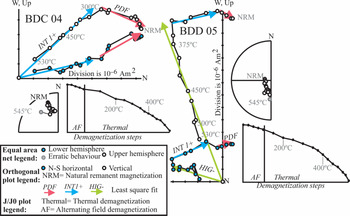
Stepwise (AF and thermal) demagnetization of sites BDB and BDD in the Halkurki Shale and BDA and BDC from the conformably overlying Konkankoppa Limestone revealed distinct magnetic components with variable stability (Figs 2, 3; Table 1).
Examples of demagnetization behaviour of Konkankoppa Limestone (BDC) and Halkurki Shale (BDD) of the Badami Group of the Kaladgi Basin represented as orthogonal projection onto the horizontal and E–W vertical planes, as well as on equal-area diagrams (both in geographic coordinates) obtained after demagnetization steps.

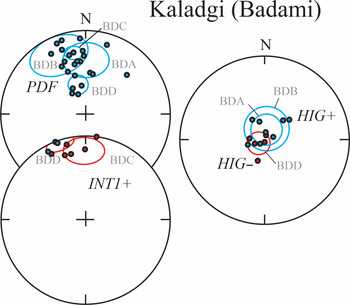
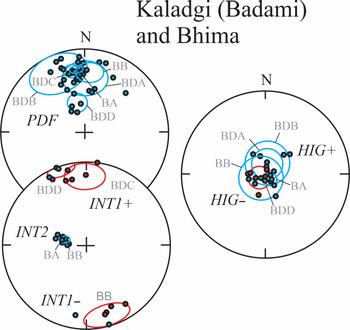
Summary of various magnetic components from Konkankoppa Limestone (BDA and BDC) and Halkurki Shale (BDB and BDD) of the Badami Group of the Kaladgi Basin. The blue (red) circles are α 95 confidence circles about the mean with positive (negative) inclination. Following the removal of the poorly resolved present-day field (PDF), INT1+ components were identified at 250–300°C at site BDD and at 475–530°C at site BDC. At higher temperature demagnetization steps (i.e. 450–490°C or 500–530°C), sites BDA, BDB and BDD revealed either steep downwards-directed (HIG+) or upwards-directed (HIG–) ChRMs.

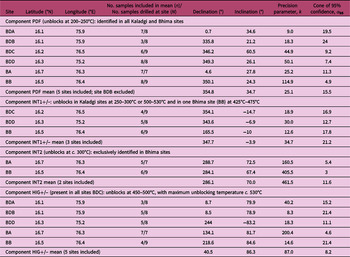
Summary of identified magnetic components.

PDF – present-day field.
The first component to unblock was revealed during the AF pretreatment in all sites, and persisted in most cases up to thermal demagnetization steps of 200–250°C (Fig. 2; Table 1). This low-stability magnetization, oriented north with a positive inclination, is comparable to the local present-day field, and is therefore denoted PDF (Fig. 3). Following the removal of PDF at site BDD, an intermediate unblocking component, denoted INT1+, was observed between temperature steps of 250°C and 300°C (Fig. 2). It consisted of a relatively well-grouped northerly set of directions with very shallow inclinations (Fig. 3; Table 1). INT1+ was also identified at site BDC, but there it represents a characteristic remanent magnetization (ChRM) that is unblocked by c. 530°C (Figs 2, 3; Table 1).
The ChRM of site BDA, denoted HIG+, was observed after the removal of PDF directions by c. 250°C, and was unblocked upon heating to 450–490°C. HIG+ directions have steep and positive inclinations in three samples (Fig. 3; Table 1), whereas these directions display much shallower inclinations in the remainder of samples, suggesting that they may not be adequately separated from PDF. The HIG+ component seen in site BDB (Fig. 3; Table 1) unblocked at temperature c. 500°C after the removal of a PDF component. The ChRM at site BDD is steeply inclined like HIG+, but is of opposite polarity and therefore denoted HIG– (Fig. 3; Table 1). Demagnetization of sites BDA, BDB, BDC and BDD above 530°C revealed no further consistent magnetic directions. The unblocking-temperatures range of HIG+ suggests that this component is carried by magnetite.
4.b. Bhima Group
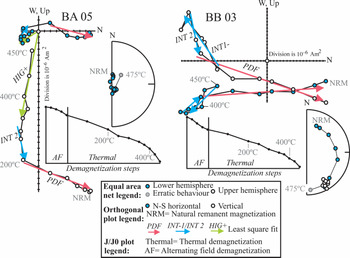
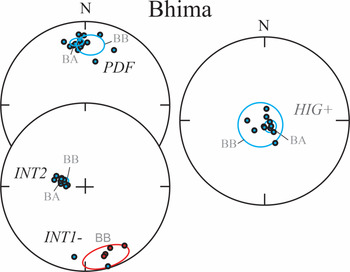
During the AF pretreatment and thermal demagnetization up to 200°C, all samples from the Katamdevarahalli Limestone (site BA) and Harwal Shale (site BB) of the Bhima Group in the Bhima Basin revealed a PDF component (Figs 4, 5; Table 1). Between 200°C and 300°C, an intermediate unblocking component (labelled INT2), which was not observed at Kaladgi sites, was identified as well-grouped W-oriented directions with positive inclinations (Figs 4, 5; Table 1). The steep-downwards directed ChRM at site BA (i.e. HIG+ component) was present in all samples (Figs 4, 5) and unblocked in the temperature interval of 425–450°C or 490–500°C. Further demagnetization of BA samples revealed no consistent components. At site BB, samples revealed a component that is near antipodal to INT1+ between thermal steps of c. 250°C and c. 475°C, and therefore denoted INT1– (Figs 4, 5; Table 1). INT– represents the most stable component (ChRM) in six samples. In the remainder of samples the ChRM corresponds to HIG+, which is unblocked at temperature c. 500°C after the removal of INT– (Table 1). As in the Kaladgi Basin, the magnetic carrier of the HIG+ component here is interpreted to be magnetite.
Examples of demagnetization behaviour of samples from the Katamdevarahalli Limestone (BA) and Harwal Shale (BB) of the Bhima Group, represented as orthogonal projection onto the horizontal and E–W vertical planes as well as on equal-area diagrams (both in geographic coordinates) obtained after demagnetization steps.

Summary of various magnetic components of the Katamdevarahalli Limestone (BA) and Harwal Shale (BB) in the Bhima Group. The blue (red) circles are α 95 confidence circles about the mean with positive (negative) inclination. Following the removal of the present-day field (PDF), INT2 directions were revealed at 200–300°C. During demagnetization steps up to 425–450°C, an HIG+ component was identified at site BA. At this temperature range, site BB revealed an INT1– component that is apparently antipodal to INT+ of Kaladgi samples. Subsequent demagnetization of some BB samples up to steps 500–505°C revealed a HIG+ component.

5. Timing of magnetizations
5.a. INT1+/– and INT2 magnetizations
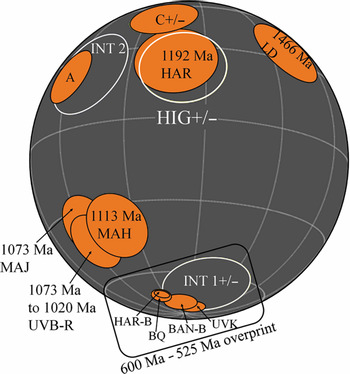
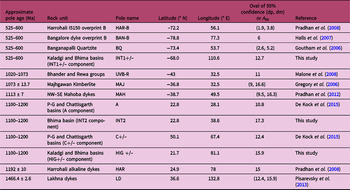
The INT2 magnetization (Figs 5, 6; Table 1) was isolated in the Bhima Group (sites BA and BB) as a low-coercivity component superimposed on the ChRM (i.e. the HIG+/– component). INT2 is reminiscent of an overprint (i.e. A magnetization) identified by De Kock et al. (Reference De Kock, Beukes and Mukhopadhyay2015) in Sequence III limestone of Pranhita–Godavari and Chattisgarh basins further NE of our study area. Similarly, the INT2 pole overlaps with the A pole of De Kock et al. Reference De Kock, Beukes and Mukhopadhyay2015 (Fig. 7; Table 2). De Kock et al. (Reference De Kock, Beukes and Mukhopadhyay2015) interpreted their A magnetization to most likely represent a 1.0 Ga overprint.
Summary of various magnetic components obtained from the Sequence III carbonates in the Kaladgi (Badami Group) and Bhima (Bhima Group) basins. The blue (red) circles are α 95 confidence circles about the mean with positive (negative) inclination.

Palaeopoles obtained from this study (white) compared with existing palaeopoles in India (orange). See Table 2 for pole details.

Selected Indian palaeopoles and palaeopoles from this study

The INT1+ magnetization was identified as the most stable component (ChRM) at site BDC, but was removed before HIG– at site BDD (Fig. 3; Table 1). INT1– was removed before HIG+ at site BB (Fig. 5; Table 1). Note that INT+ and INT– were never observed in the same sample. The INT1+/– pole is comparable to a widespread Ediacaran–Cambrian overprint (Fig. 7; Table 2) in India (e.g. Goutham et al. Reference Goutham, Raghubabu, Prasad, Subba Rao and Damodara Reddy2006; Pradhan et al. Reference Pradhan, Pandit, Meert, Srivastava, Sivaji and Rao2008; Belica et al. Reference Belica, Piispa, Meert, Pesonen, Plado, Manoj, Pandit, Kamenov and Celestino2014; Pivarunas et al. Reference Pivarunas, Meert, Pandit and Sinha2019).
5.b. HIG+/– magnetization
The HIG+/– magnetization displays both positive (4 sites, 19 samples) and negative (1 site, 5 samples) inclinations (Fig. 6) on which we were able to perform a reversal test. When the reversal test of McFadden & McElhinny (Reference McFadden and McElhinny1990) is applied on site means, the result is positive class ‘B’ (observed angle, γ o = 4.67° and critical angle, γ c = 6.96°). The reversal test is positive class ‘C’ at sample level (γ o = 5.39° and γ c = 14.12°). A positive reversal test has been used in multiple studies (e.g. Bates & Jones, Reference Bates and Jones1996; Bohnel, Reference Bohnel1999; Goutham et al. Reference Goutham, Raghubabu, Prasad, Subba Rao and Damodara Reddy2006; Pradhan et al. Reference Pradhan, Pandit, Meert, Srivastava, Sivaji and Rao2008; Letts et al. Reference Letts, Torsvik, Webb and Ashwal2010; Pisarevsky et al. Reference Pisarevsky, Biswal, Wang, Dewaele, Ernst, Söderlund, Tait, Ratre, Singh and Cleve2013) to argue for the primary nature of magnetization in the absence of field tests, although remagnetization can also produce dual polarity results (e.g. Evans et al. Reference Evans, Beukes and Kirschvink2002; De Kock et al. Reference De Kock, Beukes and Mukhopadhyay2015; Humbert et al. Reference Humbert, Sonnette, De Kock, Robion, Horng, Cousture and Wabo2017). In this study, the presence of distinctly different palaeomagnetic directions in sampling sites and the dissimilarity of HIG+/– to younger magnetizations in India could argue against a pervasive remagnetization of the sampling area. It is therefore most likely that the HIG+/– remanence was recorded during or just after the deposition of the studied carbonates.
A HIG+/– mean was calculated after all data were inverted to single polarity (i.e. positive inclination). Keeping in mind that the limited number of samples of the study (of the total of 49 samples, 24 had HIG+/– magnetization) detracted from the general cluster of directional groupings, the following conditions were considered for mean calculation: (1) the site mean is based on three or more samples; (2) Fisher’s (Reference Fisher1953) precision parameter k for the site mean is > 8; and (3) the radius of the cone of 95% confidence about the mean, α 95 < 21.5°.
The HIG+/– mean (declination, D = 40.49°; inclination, I = 86.32°; α 95 = 8.24°) was used to calculate a palaeopole at latitude λ = 21.67° N and longitude ϕ = 81.06° E with an A 95 of 15.9°. This pole fulfils four of the seven quality criteria (Q = 4) for palaeomagnetic poles (Van der Voo, 1990). Quality criteria not satisfied are (1) criterion 1, because there is uncertainty about the age of the studied carbonates; (2) criterion 2, because our pole is based on 24 samples and therefore falls short of the required > 24 samples; and (3) criterion 4, because the HIG+/– pole is not constrained by palaeomagnetic field tests.
6. Discussion
In order to investigate the possible timing of deposition of Sequence III carbonate successions in the Badami and Bhima groups, our HIG+/– palaeopole is plotted along with selected existing Meso- to Neoproterozoic palaeopoles from the southern Indian Shield (Fig. 7; Table 2). Such a comparison reveals that our pole is different from the pole for the c. 1.4 Ga Lakna dyke swarm (Pisarevsky et al. Reference Pisarevsky, Biswal, Wang, Dewaele, Ernst, Söderlund, Tait, Ratre, Singh and Cleve2013) and the c. 1.1 Ga and younger Indian poles (e.g. Gregory et al. Reference Gregory, Meert, Pradhan, Pandit, Tamrat and Malone2006; Malone et al. Reference Malone, Meert, Banerjee, Pandit, Tamrat, Kamenov, Pradhan and Sohl2008; Pradhan et al. Reference Pradhan, Meert, Pandit, Kamenov and Mondal2012). However, it largely overlaps with the HAR pole of the Harohalli alkaline dyke swarm (Radhakrishna & Mathew 1996; Pradhan et al. Reference Pradhan, Pandit, Meert, Srivastava, Sivaji and Rao2008). This is a very interesting observation because the HAR pole, previously considered to be of age c. 823 Ma (e.g. Li et al. Reference Li, Evans and Zhang2004; Maloof et al. Reference Maloof, Havlorsen, Kirschvink, Schrag, Weiss and Hoffman2006) based on the 800–850 Ma Rb–Sr and K–Ar ages obtained by Ikramuddin & Stueber (Reference Ikramuddin and Stueber1976) and Kumar et al. (Reference Kumar, Sivaraman, Bhaskararao, Gopalan, Roth and Poty1989) from individual Harohalli dykes, has more recently been suggested to be older by c. 400 Ma (Pradhan et al. Reference Pradhan, Pandit, Meert, Srivastava, Sivaji and Rao2008). This age revision was based on a U–Pb 1192 ± 10 Ma estimate obtained from laser ablation multicollector inductively coupled plasma mass spectrometry (LA-MC-ICP-MS) dating of zircon crystals extracted from one of the Haraholli dykes. If this new age for the Haraholli dyke swarm is accepted, it may well imply that the Badami and Bhima groups are Mesoproterozoic in age, as indicated by stratigraphic correlation of unconformity-bound sequences (Fig. 1b), rather than Neoproterozoic in age, as suggested by radiometric age data (e.g. Joy et al. Reference Joy, Patranabis-Deb, Saha, Jelsma, Maas, Söderlund, Tappe, Gert Van Der Linde, Banerjee and Krishnan2018; Patil Pillai et al. Reference Patil Pillai, Pande and Kale2018).
At this stage, it is perhaps worth noting that our HIG+/– pole for Sequence III carbonates in the Badami and Bhima groups is close to the C+/– pole that De Kock et al. (Reference De Kock, Beukes and Mukhopadhyay2015) delineated from Sequence III carbonates in the Pranhita–Godavari (Penganga Group) and Chattisgarh (Raipur Group) basins to the east (Figs 1b, 7). The C+/– pole is very robust in that it is based on > 24 samples, is of dual polarity, and is supported by a positive intraformational conglomerate test and a regional fold test. The close proximity of our HIG+/– pole to the C+/– pole (Fig. 7) most likely indicates a minimal apparent polar wander during the acquisition of the concerned magnetizations.
Although by far not definitive, the above indications that the Bhima and Badami successions are late Mesoproterozoic in age certainly validate a critical evaluation of the data that led to assignment of a Neoproterozoic age for these successions. The later age assignment is based on essentially three assumptions, namely (1) that the Rb–Sr ages of 798–813 Ma (Joy et al. Reference Joy, Patranabis-Deb, Saha, Jelsma, Maas, Söderlund, Tappe, Gert Van Der Linde, Banerjee and Krishnan2018) obtained from glauconite-bearing sandstone of the Bhima Group represent a depositional age; (2) that a dyke dated to give an 40Ar/39Ar age of c. 1154 ± 4 Ma is older than the Badami Group of the Kaladgi Basin (Patil Pillai et al. Reference Patil Pillai, Pande and Kale2018); and (3) that detrital diamonds present in conglomerates along the basal erosional unconformity of Sequence III were derived from the diamondiferous Raichur and Wajrakarur Kimberlites fields of age c. 1100 Ma (Chalapathi Rao et al. Reference Chalapathi Rao, Anand, Dongre and Osborne2010) further to the south (e.g. Collins et al. Reference Collins, Patranabis-Deb, Alexander, Bertram, Falster, Gore, Mackintosh, Dhang, Saha, Payne, Jourdan, Backé, Halverson and Wade2015).
Firstly, the suggestion that the c. 800 Ma Rb–Sr glauconites are of primary depositional origin (Joy et al. Reference Joy, Patranabis-Deb, Saha, Jelsma, Maas, Söderlund, Tappe, Gert Van Der Linde, Banerjee and Krishnan2018) appear to be rather dubious. The main reason for this is that it is not clear how these ages are brought in line or explained by the U–Pb age of c. 0.96 Ga and the Th–Pb age of 0.91 ± 0.13 Ga obtained by the same authors on limestone beds in the succession. A more logical interpretation may be that this discrepancy indicates that the glauconite ages were reset c. 800 Ma after deposition of the limestones. Also, the detrital zircon age populations obtained from the basal quartzites of the successions are difficult to place in the context of a Neoproterozoic age. The youngest near-concordant zircons have ages of 2.2–2.3 Ga with no indication of any zircons having been derived from very late Mesoproterozoic or early Neoproterozoic provenance. This is despite the fact that (1) one of the main periods of orogenesis along the Central Indian Tectonic Zone, which resulted in the amalgamation of the northern and southern cratonic blocks of India situated to the north of the Purana basins, was at 0.975 ± 0.067 Ga (Chatterjee & Ghose, Reference Chatterjee and Ghose2001); and (2) palaeocurrents measured by Joy et al. (Reference Joy, Patranabis-Deb, Saha, Jelsma, Maas, Söderlund, Tappe, Gert Van Der Linde, Banerjee and Krishnan2018) in the basal quartzite of the Badami Group have a major mode indicating transport from the NE. The U–Pb systems from which the 0.96 Ga ages were obtained on carbonates of the Bhima and Badami groups also appeared rather disturbed, so much so that Joy et al. (Reference Joy, Patranabis-Deb, Saha, Jelsma, Maas, Söderlund, Tappe, Gert Van Der Linde, Banerjee and Krishnan2018) considered them as derived from isotopic exchange between different fluids. Although not considered as an option by Joy et al. (Reference Joy, Patranabis-Deb, Saha, Jelsma, Maas, Söderlund, Tappe, Gert Van Der Linde, Banerjee and Krishnan2018), it may well be that this exchange took place during the c. 0.975 Ga orogenesis in the Central Indian Tectonic Zone.
Secondly, the suggestion by Patil Pillai et al. (Reference Patil Pillai, Pande and Kale2018) that the Badami Group is younger than the c. 1154 Ma mafic dyke that they described is also problematic. The only known outcrops of that dyke are from a small synclinal structure comprising upper strata of the Kaladgi Basin. However, the topmost beds of the Group have been removed by recent erosion in the syncline, so there is no direct geological evidence available that the dyke is actually cut by the unconformity at base of the Badami Group. It is therefore quite possible that this dyke could also have transected the strata of the Badami Group that have since been eroded. Even if follow-up mapping would indicate that the dyke of Patil Pillai et al. (Reference Patil Pillai, Pande and Kale2018) may actually be disconformably overlain by the Badami Group somewhere along its extension, then their 40Ar/39Ar age of c. 1154 Ma should also be considered with care. It is important to realize that this age was obtained using the whole-rock method. According to previous studies (e.g. Bernard-Griffiths, Reference Bernard-Griffiths, Roth and Poty1989), the geochemical and geological conditions for a whole-rock sample to represent a primary age is rarely fulfilled by older mafic dykes. Patil Pillai et al. (Reference Patil Pillai, Pande and Kale2018) noted that the dyke was affected by weathering as well as metamorphism. Among the secondary mineral phases that formed from primary minerals, these authors reported the presence of secondary hornblende and actinolite that replace the magmatic pyroxene. The whole-rock 40Ar/39Ar dating therefore involved mixed primary and second generations of K-minerals. Perhaps a more cautious approach should be taken and the c. 1154 Ma result regarded as the minimum age and not the crystallization age of the dyke.
Thirdly, there is also no geological evidence that the detrital diamonds present in the basal conglomerates of Sequence III were actually sourced from the diamondiferous kimberlite fields of age c. 1.1 Ga further to the south. These kimberlites intrude basement granitoids of the Dharwar craton (e.g. Crawford & Compton, 1973), and again there are no known localities where proper contact relationships with strata of either the Badami–Bhima successions or the upper units of the Cuddapah Basin are exposed. In this regard, it is also interesting to note that Dongre et al. (Reference Dongre, Chalapathi Rao and Kamde2008) described xenoliths of limestone in the kimberlite of the Siddanpalle cluster of the Raipur kimberlite field. These xenoliths are similar in appearance to the carbonates of the Badami and Bhima groups. Dongre et al. (Reference Dongre, Chalapathi Rao and Kamde2008) therefore suggested that these successions could well be older than 1.1 Ga, the age of the kimberlites.
7. Summary and conclusion
New palaeomagnetic results are reported from the carbonate units of the Badami and Bhima groups, tentatively correlated on stratigraphic grounds with unconformity-bound Sequence III in the upper parts of the Purana successions across the southern Indian Shield. A new pole position is obtained from these carbonates (HIG+/– magnetization) at latitude 21.7° N, longitude 81.1° E, with an A 95 of 15.9°. The HIG+/– magnetization is considered primary based on (1) its dissimilarity to known younger magnetizations in India; (2) the presence of distinctly different palaeomagnetic components at various sites; and (3) a positive reversal test. Our pole differs from the c. 1.4 Ga pole and various c. 1.1 Ga and younger Indian poles, but overlaps with the pole of the Harohalli alkaline dykes. The age of the Harohalli dyke pole was recently revised to c. 1.2 Ga (based on a U–Pb age of c. 1192 ± 10 Ma from one of the Harahalli dykes using LA-MS-ICP-MS on zircon), and not to 800–850 Ma as initially suggested from Rb–Sr and K–Ar whole-rock datings. On this basis, a Mesoproterozoic age can be interpreted for the studied carbonates, contrary to the generally interpreted Neoproterozoic age. Critical evaluation of the parameters from which the earlier Neoproterozoic age was established indicates that some were based on assumptions for which there is no direct stratigraphic field evidence, and that the available Rb–Sr and U–Pb ages on glauconites and limestone in the Badami and Bhima groups could be related to later alteration events rather than representing depositional ages. It may therefore be possible that the studied carbonates correlate laterally both in time and space with unconformity-bound Sequence III of the Purana successions. It implies that this virtually undeformed succession was deposited as a sheet of deep-water, including pelagic, carbonates over much of the southern Indian Shield area during late Mesoproterozoic times. However, our results are not fully definitive and further studies are required to refine them. Such studies should include sampling of more sites for palaeomagnetic research in the Bhima and Badami groups, as well as in other basins such as the Cuddapah Basin, combined as far as possible with radiometric age studies.
Conflict of interest
None
Acknowledgements
This research project, initiated by Professors NJ Beukes and VS Hegde, benefited from a Raman Fellowship scheme. The support of the DSI-NRF Centre of Excellence for Integrated Mineral and Energy Resource Analysis (DSI-NRF CIMERA) is also acknowledged. Opinions expressed and conclusions arrived at are those of the author(s), and are not necessarily to be attributed to the Centre of Excellence. HW also acknowledges financial contributions from the Paleoproterozoic Mineralization Research Group at the University of Johannesburg in South Africa. Professor J Mukhopadhyay is thanked for fruitful discussions about the geology of the Proterozoic Purana basins. We thank Professor S Patranabis-Deb for inviting us to contribute to this thematic issue of the Geological Magazine, and for handling the review process. Professor J Meert and two anonymous referees are thanked for their constructive criticisms and suggestions, which greatly improved the manuscript.