




No CrossRef data available.
Article contents
A survey of professionals delivering secondary care regarding their requirements for paediatric cardiac services as provided by specialists
Published online by Cambridge University Press: 16 September 2005
Abstract
The provision of outreach services by paediatric cardiac centres enhances the choice for both parents and professionals. We have conducted a survey to investigate the processes for information and communication at times of interface between specialist and local services for cardiac disease. Based on the responses, we suggest that distance from, and level of contact with, the specialist centre may influence satisfaction and the perceived usefulness of more information. We suggest strategies to increase contact, and make more effective targeting of resources.
Keywords
Information
- Type
- Original Article
- Information
- Copyright
- © 2005 Cambridge University Press
The choice for both parents and professionals is enhanced when centres providing specialist care for children provide an outreach service.1 This augments the flexibility of the service, and reduces unnecessary visits to hospital, but it also increases the workload for the consultants providing the specialist service, who have ongoing commitments in their specialist centre.2 This is particularly evident in paediatric cardiology, where the population needing life-long expert follow-up care is increasing, both following surgery and due to enhanced medical management.
In the United Kingdom, high priority has been given to improving the involvement of patients, and the disjointed delivery in services, following the Bristol Royal Infirmary Inquiry.3 In this survey, we sought the views of medical and nursing staff from the hospitals referring children to one centre in London providing paediatric cardiac services. Our aim was to discover their satisfaction with our specialist cardiac services, and to establish their need for better information and communication during the times of interface with the specialists.
Methods
A questionnaire, modelled on previously identified standards of good practice at times of interface between organisations providing acute and community healthcare,4 was sent to 58 paediatricians referring children to our institution, and who participated in clinics providing shared care. We also sent the questionnaire to 37 senior nurse managers, asking them to forward the questionnaire to the most relevant nurse in their outpatient department. These professionals were working in the 33 District General Hospitals which comprise our referring network of hospitals throughout Southeast England, and where our own 7 consultant paediatric cardiologists carry out more than 210 outreach clinics annually. In 18 of these hospitals, clinics are held quarterly (54.5 percent), in 9 bi-monthly (27.3 percent), with the remaining hospitals receiving monthly or fortnightly visits. Of the hospitals, 15 are close to our specialist centre, being within the boundary formed by the London orbital motorway, the M25, being a mean distance of 11 miles from the centre, with a range from 2 to 26 miles. The remainder are located outside the M25 boundary, with distances varying between 24 and 84 miles, with a mean of 50 miles. We asked those completing the survey to rate their satisfaction with 13 characteristics of our service, and asked them to comment on our service only, not that provided by other specialist centres. If an aspect was unavailable, respondents were asked whether this would be helpful (Table 1). In 14 additional questions, we asked how useful it would be to have more information, including about diagnosis, management of disease, and facilities for families. Scoring was on 4 point Likert scales, ranging from not satisfied at all, which scored 1, to completely satisfied, which scored 4, and not useful, scoring 1, to extremely useful at a value of 4. Data were analysed using non-parametric statistics, comparing the responses of the nurses and the paediatricians using Mann Whitney Tests. Spearman Correlation Coefficients were calculated as appropriate. We had obtained approval of our survey from our local committee governing the ethics of research.
Table 1. Satisfaction with aspects of the provision of service.

Results
Completed questionnaires were received from 22 (59.5 percent) nurses, and 47 (81.0 percent) paediatricians, these professionals working in 30 of the 33 hospitals. The questionnaire had acceptable reliability, with a Cronbach alpha value of 0.93. There were no differences between responders and non-responders regarding distance from the specialist centre.
Mean scores for paediatricians and nurses for each item of the questionnaire are detailed in Table 1. Nurses expressed greater satisfaction than paediatricians in all but two of the items, with the difference reaching significance for appropriateness of transfer letters, and quality of written information for families. One third of respondents said that more information about management of chronic disease, facilities at the specialist centre, and individual patients following discharge from hospital, would be extremely useful (Table 2).
Table 2. Usefulness of additional information.

Hospitals furthest away held less frequent clinics (r = 0.518, p < 0.001). Less frequent outreach clinics were associated with greater perceived need for information about surgical procedures (r = −0.260, p = 0.032), non-surgical corrective interventions (r = −0.270, p = 0.027), and individual patients discharged following surgery (r = −0.254, p = 0.048). Respondents outside the London Orbital were more likely than those nearer to the specialist centre to report that, when support in the home by specialist nurses was unavailable, it would be helpful to have it (z = −2.133, p = 0.033).
Of those respondents who reported annual referral information, one third referred up to ten children, with one half referring from 11 to 30, and a minority making more than 50 referrals. Respondents referring more children were more likely to report that it would be useful to have additional information about hospital facilities for families (r = 0.294, p = 0.017), but less likely to be satisfied with written information (r = 0.365, p = 0.05).
Discussion
In the United Kingdom, the provision of specialist health care of high quality to children and their families local to their homes is an important guiding principle in the recently established National Service Framework for Children.5 Outreach clinics can improve communication, provide better experiences and access for patients, enhance continuity, and develop local care by provision of education and training.1, 2, 6 Patients often prefer to be seen at their local hospital, with reports of satisfaction and convenience, due to less time being required for travelling, being generally higher for these when compared with consultations at the specialist centre.6 Sub-optimal facilities at local hospitals, however, along with the problems with accommodation and administration, and inefficient use of the time of the consultants, have all been identified as disadvantages.2, 6
Our study suggests that the distance from the specialist centre, and the level of contact with cardiac specialists, can influence the satisfaction experienced by the professionals working at the local hospital, along with their perceptions of usefulness of more information. One of the benefits of regular contact is that it enhances the opportunity for the processes of informal communication and sharing of information, the so-called “corridor effect”, and may reduce the desire for more formal methods of communication, such as letters.
It is unlikely, given the current workload of paediatric cardiologists in the United Kingdom, that it is possible to increase the attendances at outreach clinics which are remote to the specialist centre. One possible solution lies in the systematic development of Cardiac Liaison Nursing Services. One paediatrician wrote:
“I think some extra support of parents in peripheral clinics would be useful. When parents see the consultant cardiologist in the local hospital there is often very little time, and parents may leave distraught when told serious news. Our nurses pick up some of the pieces. Could one of your nurses come?”
The recent national report on Paediatric and Congenital Cardiac Services in the United Kingdom7 offered a framework on which to base such services. The challenge, however, is to translate this vision into an effective, high quality model which meets the needs of the children, their families, and the other professionals. Liaison nurses could bridge this gap by developing their role in local hospitals, both alongside the paediatric cardiologist, and alone in nurse-led clinics. By adopting a flexible approach to the provision of information and education, they could meet the different needs and perceptions of the nursing and medical personnel as well as the families.
We received a lower response from the nurses we approached than the paediatricians, and the responses, therefore, should be interpreted with caution. The likely reason was the indirect approach to clinic nurses through their manager. In addition, personnel working exclusively in outreach clinics may not be able to respond about some aspects of specialist services, such as inpatient work. It was also not possible to ascertain whether the findings related to the frequency with which clinics were held, or their distance from the centre. We suspect the results are linked to frequency of contact, supporting our view that additional visits by specialist professionals, either a liaison nurse or a cardiologist, would be beneficial.
Although respondents were generally satisfied with the services provided by our own specialist centre, areas of low satisfaction related to poor processes of communication. These included the timely arrival of discharge summaries, procedures for liaison at discharge, provision of a named keyworker, development of protocols for shared-care, and procedures following the death of a child. Better provision of information about individual children, particularly those with chronic conditions, as well as about facilities at the specialist centre, is likely to facilitate satisfaction. Proactive liaison nurses should target their support in these areas, and adapt technological tools, such as electronic mail and telemedicine, to their own skills and activities. The development of these nursing strategies using electronic communication will facilitate and enhance communication between specialist centre, parents, and local services.8 This approach is likely to be more cost efficient, will empower local healthcare teams, and facilitate appropriate targeting of resources to reduce morbidity in the minority of children and families for whom the presence of a heart condition has a significant impact on everyday life.9
References
Spencer NJ. Consultant paediatric outreach clinics – a practical step in integration. Arch Dis Child 1993; 68: 496–500.Google Scholar
Wagstaff MH, Rigby ML, Redington AN. Increasing workload and changing referral patterns in paediatric cardiology outreach clinics: implications for consultant staffing. Heart 1998; 79: 223–224.Google Scholar
Bristol Royal Infirmary. The report of the Inquiry into the care and management of children receiving complex heart treatment between 1984 and 1995, 2001. http://www.bristol-inquiry.org.uk/final_report/index.htm
Caring for Children in the Health Services. Bridging the Gaps. Action for Sick Children, London, 1993.
Department of Health. National Service framework for Children, 2004. http://www.dh.gov.uk/policyandguidance/healthandsocialcaretopics/childrenservices/childrenservicesinformation/fs/en
Powell J. Systematic review of outreach clinics in primary care in the UK. J Health Serv Res Policy 2002; 7: 177–183.Google Scholar
Department of Health. Paediatric and Congenital Cardiac Services Review Report, 2002. http://www.advisorybodies.doh.gov.uk/childcardiac/pccsreptdec03.pdf
Wray J, Maynard L. Living with congenital or acquired cardiac disease in childhood: maternal perceptions of the impact on the child and family. Cardiol Young 2005; 15: 133–140.Google Scholar

Table 1.
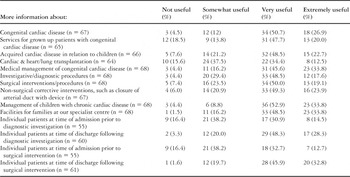
Table 2.
 You have
Access
- 1
- Cited by