


Introduction
Acceptance and commitment therapy (ACT) is a ‘third wave therapy’ that tries to change how individuals relate to their thoughts and emotions, rather than change the thoughts and emotions themselves. It is a therapeutic approach that uses acceptance and mindfulness processes, and commitment and behaviour change processes, to produce greater psychological flexibility (Hayes et al., Reference Hayes, Strosahl and Wilson1999). A number of meta-analyses have shown that ACT is better than treatment as usual control conditions, and may be better than some established therapies. It also appears to be effective for a range of problems, and being designed to have its action transdiagnostically, may be effective for complex, transdiagnostic and treatment-resistant clients.
Other third-wave therapies such as dialectical behaviour therapy (DBT) have been delivered by staff who are not qualified psychologists or therapists. However, most previous research for ACT has used trained psychologists. Some studies have found ACT to be effective with trainee psychologists or therapists with little prior experience of ACT (Forman et al., Reference Forman, Herbert, Moitra, Yeomans and Geller2007; Lappalainen et al., Reference Lappalainen, Lehtonen, Skarp, Taubert, Ojanen and Hayes2007). Pinto et al. (Reference Pinto, Kienhuis, Slevison, Chester, Sloss and Yap2015) delivered ACT groups that were co-run by a psychologist and a psychiatric nurse trained in ACT. However, no research to date has compared the effectiveness of ACT when delivered by health professionals without a background in psychology or psychotherapy.
Despite promising ACT outcomes, there is a lack of trained therapists and psychologists to deliver ACT. Therefore, ACT being conducted by other professions may increase the availability of ACT. This paper describes outcomes from individual therapy for a complex and often transdiagnostic population, and compares outcomes between psychologists and non-psychologists.
Method
Design
This studyFootnote 1 used a preliminary small-scale, pre–post open trial design.
The service
The service is a National Health Service (NHS) community mental health service for adults with severe and enduring mental health problems. DBT was an embedded treatment pathway delivered by Multidisciplinary Team (MDT) staff, as well as by qualified therapists. ACT was added to this, with psychiatric nurses, occupational therapists and social work colleagues providing interventions, alongside psychological therapists.
ACT was placed as part of a depression and transdiagnostic pathway. More complex cases such as those with multiple co-morbidities, significant physical health problems or higher suicide risk were allocated to psychological therapists. Patients received up to 12–16 sessions. The therapy and questionnaires completed were all part of routine NHS clinical practice, so Solent NHS Trust research service approved this research as a service evaluation.
Staff and training
The training was delivered by authors H.B. and S.C., over 5 days, to eight psychological therapists (one counselling psychologist, one senior psychotherapist and six clinical psychologists) and 12 non-psychologist staff (six psychiatric nurses, five social workers and one occupational therapist). All trainees took one case at a time initially (therefore more than one case per clinician is included in the data here), and received fortnightly supervision.
Of the eight psychological therapists, three left due to maternity or adoption leave shortly after training. Of the 12 non-psychologist staff initially trained, four remained 6 months after training. Two left due to maternity leave, two changed jobs, and four decided other job demands were too great to continue.
Measures
The following measures were administered pre-, post- and 3 months after therapy (Cronbach's alpha for current sample given):
Clinical Outcomes Routine Evaluation (CORE-OM) (Evans et al., Reference Evans, Mellor-Clark, Margison, Barkham, Audin, Connell and McGrath2000): a 34-item measure of general mental health to assess the effectiveness of psychotherapy interventions. Example questions include ‘I have felt overwhelmed by my problems’; α = .87.
Patient Health Questionnaire (PHQ-9) (Kroenke et al., Reference Kroenke, Spitzer and Williams2001): a 9-item measure of depression. It asks people how often in the past 2 weeks they have experienced symptoms such as ‘Little interest or pleasure in doing things’; α = .80
The following measures were used to measure ACT-specific outcomes. These were used as the clinicians felt it was useful for the therapy process to tap directly into these two specific ACT outcomes:
Cognitive Fusion Questionnaire (CFQ) (Gillanders et al., Reference Gillanders, Bolderston, Bond, Dempster, Flaxman and Campbell2014): this is a 7-item measure of cognitive fusion. Questions ask how true statements such as ‘I struggle with my thoughts’ are; α = .87.
Valued Living Questionnaire (VLQ) (Wilson et al., Reference Wilson, Sandoz, Kitchens and Roberts2011): this asks people to rate how important values such as recreation are, and also rate how much action has been made in line with those values in the past week. These are a rated on a scale from 1 to 10 with higher scores representing greater importance or more action. For this study, a total score for action (α = .71) and importance (α = .81) were calculated separately.
Participant characteristics
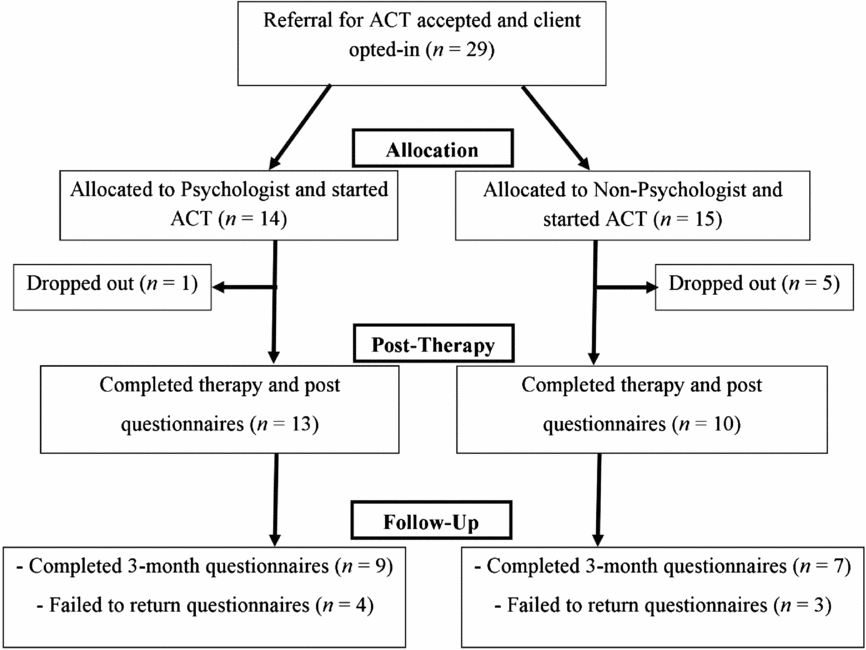
A total of 29 clients received ACT and completed pre-therapy measures. Figure 1 displays a recruitment flow chart. The sample was 72.4% female (n = 21) and 27.6% male (n = 8). Ages ranged from 21 to 67 years, with a mean age of 42 years (SD = 11.1). The sample was 96.6% White British ethnicity (n = 28). 72.4% (n = 21) had had previous psychological therapy.
Recruitment flow chart

In terms of psychiatric diagnoses, according to medical records, 58.6% (n = 17) had one diagnosis, 27.6% (n = 18) had two diagnoses, and 13.8% (n = 4) had three diagnoses. Multiple diagnoses were present in 26.7% (n = 4) of non-psychologists’ participants and 57.1% (n = 8) of psychological therapists’ participants.
Statistical analysis
Last Observation Carried-Forward was used for those with missing data at 3-month follow-up. A 2 (psychologist vs non-psychologist) by 2 (pre- vs post-/three-month) multiple analysis of variance (MANOVA) was used to analyse changes over time. This was initially carried out with completers only and then re-run with an intent-to-treat (ITT) analysis.
Results
Overall, 20.7% (n = 6) of the 29 participants dropped out of therapy prematurely. The drop-out was higher for clients of non-psychologists (33.7%, n = 5) compared with psychologists (7.7%, n = 1); however, there was insufficient sample size for a chi square analysis of this difference. For completers, the total number of sessions ranged from 6 to 24, with a mean of 13.9 sessions (SD = 4.0).
Outcomes post-treatment
A MANOVA analysed changes over time overall for all measures. For completers, there was a significant overall effect for time: Wilks's lambda = .26, F (5,16) = 8.99, p < .001, partial η2 = .74, but there was no significant overall interaction for clinician × time: Wilks's lambda = .08, F (5,16) = .27, p > .05, partial η2 = .08. Univariate analyses showed significant improvements over time for all measures individually, but no effects for clinician × time.
An ITT analysis had little impact on the findings: there remained a significant overall effect for time: Wilks's lambda = .39, F (5,22) = 6.65, p < .001, partial η2 = .60 and no significant overall interaction for clinician × time. Univariate analyses showed that there remained significant changes on all measures individually.
Outcomes at 3 months
For completers there was a significant overall effect for time: Wilks's lambda = .22, F (5,16) = 11.35, p < .001, partial η2 = .78; but no significant overall interaction for clinician × time: Wilks's lambda = .88, F (5,16) = .44, p > .05 partial η2 = .12. Univariate analyses showed significant improvements for CORE Total, PHQ and CFQ, but not VLQ Importance or Action. There were no significant interactions between clinician and time for any of the scales individually.
Table 1 shows the mean scores at each time point for the overall sample of completers.
Mean scores at each time point for overall sample of completers

FU = follow-up.
ITT analysis had little impact: there remained a significant overall effect for time: Wilks's lambda = .35, F (5,22) = 8.11, p < .001, partial η2 = .65; and no significant overall interaction for clinician × time. Univariate analyses for individual measures remained the same.
Discussion
This paper aimed to evaluate the effectiveness of ACT delivered by psychologists and non-psychologists for a complex population in a community mental health team for adults. The results tentatively suggest that ACT may be effective for clients with complex needs and co-morbidities, with reduced depression and improved global mental health post-treatment and 3 months after therapy. There was also reduced cognitive fusion post-treatment and at 3 month follow-up. Values action and importance increased post-treatment but not at 3 month follow-up.
The high levels of drop-out of staff after training highlights the need for careful recruitment of staff, and more information about specific reasons for drop-out by staff would have been helpful. Clinical outcomes were no different between psychologists and non-psychologists with minimal therapy-specific training and supervision. These results provide preliminary evidence that non-psychologists may be able to deliver ACT to those with severe and enduring mental health problems, and that this approach may be a way to extend access to ACT. This adds to the existing evidence base on the effectiveness of ACT (Ruiz, Reference Ruiz2010). Psychologists tended to have more complex cases, and though both groups showed improvements there was also a possibly higher drop-out rate for clients of non-psychologists. This suggests that those with minimal training may struggle to engage clients in therapy and may find it harder to do so with the most complex cases. This therefore supports the use of ‘two-tiered’ service depending on complexity.
This study is limited by a small sample size and poor response rate at 3 months, variation in total number of sessions and non-random allocation of clients to psychologists or non-psychologists. A number of factors such as previous training differing between different professions were also not measured. A randomized controlled trial would be needed to show that the outcomes come from ACT processes and not non-specific factors. There were also clinical differences between the clients of the psychologists and non-psychologists in this study, thus future research may be better controlled by randomly assigning clients to different clinicians so that clinical populations are matched. There was high reliability for the measures used, but additional measures such as the Acceptance and Action Questionnaire second version (Bond et al., Reference Bond, Hayes, Baer, Carpenter, Guenole and Orcutt2011), which is frequently used in trials, could have been considered. However, the current results provide preliminary evidence that ACT may be an effective therapy for a complex and often transdiagnostic secondary care population. Non-psychologists with limited training appeared to have similar outcomes to psychologists. A larger sample size is also needed to see whether the difference in drop-out rates between different professionals is statistically significant. Future research will need to compare outcomes with a larger sample size and ideally randomize cases to different therapist groups.
Acknowledgements
The authors thank those who administered questionnaires, and service users for taking part; thanks are also due to the assistant psychologists who helped with data entry and follow-up assessments.
Financial support: This work was partially funded by a grant from the National Institute for Health Research Capability Fund.
Conflict of interest: T.R. and L.B. have no conflicts of interest to declare. The training was a commission from Bournemouth University by Solent NHS Trust, and was delivered by H.B. and S.C.
Ethical standards: The authors assert that all procedures contributing to this work comply with the ethical standards of the relevant national and institutional committees on human experimentation and with the Helsinki Declaration of 1975, as revised in 2008.




Comments
No Comments have been published for this article.