Implications
Pyrroloquinoline quinone (PQQ) is a naturally occurring antioxidant. Its commercial product-PQQ disodium (PQQ.Na2) could benefit broiler production by improving growth and modulating cellular redox status. This study aimed to investigate the effects of dietary oxidized sunflower oil with PQQ.Na2 supplementation in laying hens. Dietary PQQ.Na2 supplementation significantly attenuated oxidized sunflower oil-induced reactive oxygen species production, lipid peroxidation and liver damage in laying hens, possibly via directly scavenging of free radicals and indirectly by enhancing the endogenous antioxidant defense system. These findings provide a theoretical basis for the use of PQQ.Na2 as a potential antioxidant feed additive for layer hens.
Introduction
Sunflower oil is one of the most commonly used vegetable oils in the diet of commercial laying hens. It contains high amounts of linoleic acid, which is important in maintaining optimum egg production, egg size and reproductive performance. However, the presence of linoleic acid also increases the relative autooxidation rate and decreases the oxidative and thermal stabilities of sunflower oil (Smith et al., Reference Smith, King and Min2007). Oxidized oil is known to have a lower nutritional value due to loss of polyunsaturated fatty acids, amino acids, tocopherols and other non-nutritive components (Eder and Ringseis, Reference Eder and Ringseis2010). A further and even more serious concern is the cytotoxicity and genotoxicity of oxidized oil, which could increase the risk of cardiovascular disease and lung cancer in human (Ng et al., Reference Ng, Leong, Masbah, Adam, Kamisah and Jaarin2014). Oxidative stress induced by lipid peroxidation products has been recognized as a central mechanism for the pathophysiologic effects of dietary oxidized oil (Ng et al., Reference Ng, Leong, Masbah, Adam, Kamisah and Jaarin2014). Birds are easily exposed to cumulative oxidative byproducts when oxidized oil is consumed, resulting in an impaired redox balance and depressed production performance (Lu et al., Reference Lu, Harper, Zhao, Corl, LeRoith and Dalloul2014a). In addition, the liver is the target organ for detoxication. The presence of lipid oxidation products in thermally oxidized oil could further contribute to liver tissues damage. To inhibit oxidation and alleviate oxidant stress, antioxidants have long been used in poultry production and food processing worldwide.
Pyrroloquinoline quinone (4,5-dihydro-4,5-dioxo-1H-pyrrolo-[2,3-f] quinoline-2,7,9-tricarboxylic acid; PQQ) has powerful antioxidant properties and is found naturally in plant tissues, mammalian organs and biological fluids (Noji et al., Reference Noji, Nakamura, Kitahata, Taguchi, Kudo, Yoshida, Tsujimoto, Sugiyama and Asami2007). The antioxidant action of PQQ depends on its ability to catalyze the conversion of superoxide to dioxygen with a concomitant reduction of the oxidized quinone-form of PQQ to both its semiquinone and hydroquinone forms (Bishop et al., Reference Bishop, Gallop and Karnovsky1998). Under appropriate conditions, PQQ is capable of catalyzing continuous redox cycling; the potential number of catalytic cycles is about 2000, while four catalytic cycles of ascorbic acid have been reported (Rucker et al., Reference Rucker, Chowanadisai and Nakano2009). Through its antioxidant properties, PQQ further exerts neuroprotective (Zhang et al., Reference Zhang, Xu, Sun, Li, Wang and Jin2009 and Reference Zhang, Ding, Cao, Zhang, Ding and Ke2013) and heptaoprotective (Tsuchida et al., Reference Tsuchida, Yasuyama, Higuchi, Watanabe, Urakami, Akaike, Sato and Maeda1993) effects against oxidative stress in mammals. In fast-growing broilers, we previously showed PQQ disodium (PQQ.Na2; the PQQ commercial product) could help maintain redox status and is a potentially effective feed additive (Samuel et al., Reference Samuel, Zhang, Wang, Wu, Yue, Sun and Qi2015; Wang et al., Reference Wang, Zhang, Samuel, Long, Wu, Yue, Sun and Qi2015). However, little research has addressed the protective effects of PQQ or PQQ.Na2 against oxidized oil-induced oxidative stress in laying hens.
The objective of the present study was to determine whether dietary PQQ.Na2 supplementation is able to alleviate the adverse effects of thermally oxidized sunflower oil in laying hens. We used vitamin E (Vit E), a commonly used chain-breaking antioxidant, as a positive control. Subsequently, the effects of dietary supplementation of PQQ.Na2 in an oxidized sunflower oil diet on laying performance and oxidative stress parameters in plasma and liver tissues were examined. Liver damage was judged by biochemical measurements and DNA damage by using comet assays.
Material and methods
All experimental protocols were approved by the Animal Care and Use Committee of the Feed Research Institute of the Chinese Academy of Agricultural Sciences.
Oil oxidation
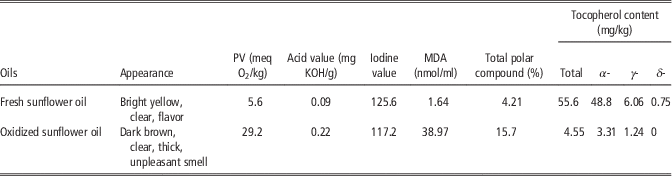
The sunflower oil was purchased from a local supermarket and was oxidized by the intermittent heating method as described previously (Yue et al., Reference Yue, Wang, Qi, Ji, Liu, Wu, Zhang and Qi2011). The fresh sunflower oil (~3 l) was initially heated at a temperature of 185±2°C for 6 h with constant blending in a stainless steel pan (capacity ~5 l, diameter 28 cm). At the end of the heating period, the oil was allowed to cool to room temperature (20±2°C) and was kept at room temperature for 24 h in the dark. The oil was again heated at 185±2°C for 3 h with continuously bubbling air (20 l/min). The peroxide value, acid value and iodine value of the oil were analyzed according to ISO 3960:2007 IDT (ISO, 2007), ISO 660:2009 IDT (ISO, 2009) and ISO 3961:1996 MOD (ISO, 1996), respectively. A Testo 270 oil tester (Testo AG, Lenzkirch, Germany) and a Colorimetric kit (Nanjing Jiancheng Bioengineering Institute, Nanjing, China) were used to measure the total polar compounds and the malondialdehyde (MDA) content in samples, respectively (Yue et al., Reference Yue, Wang, Qi, Ji, Liu, Wu, Zhang and Qi2011). The concentrations of Vit E isomers were assayed by HPLC (Waters E2595, Waters Technologies Corporation, Milford, MA, USA) using a Zorbox SB-C18 reverse phase column (5 μm particle diameter, 250×4.6 mm; Agilent Technologies, Palo Alto, CA, USA; Yue et al., Reference Yue, Wang, Qi, Ji, Liu, Wu, Zhang and Qi2011). The peroxide value, acid value, MDA and total polar compounds of the fresh sunflower oil were increased by 4.21-fold, 1.44-fold, 22.76-fold and 2.73-fold after heating, respectively, and the contents of Vit E was decreased by 11.22-fold (Table 1).
Characteristics of the experimental oils used in laying hen diets

PV=peroxide value; MDA=malondialdehyde.
Experimental design and diets
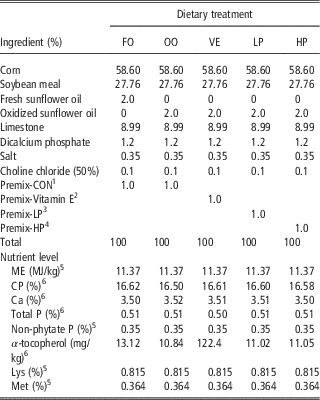
Three hundred and sixty 53-week-old Hy-Line Gray commercial layers with an initial egg production of 82.0±2.0% were randomly allocated into one of the five dietary treatments. The treatments included: a diet containing 2% fresh sunflower oil; a diet containing 2% thermally oxidized sunflower oil; an oxidized sunflower oil diet with 100 mg/kg of added Vit E; an oxidized sunflower oil diet with a low level of PQQ.Na2 (0.08 mg/kg); and an oxidized sunflower oil diet with a high level of PQQ.Na2 (0.12 mg/kg). Each group consisted of six replicates of 12 birds each, and three birds were placed in one cage (45×45×45 cm3). Diets (Table 2) were formulated to meet or exceed NRC (1994) guidelines. PQQ.Na2 (purity, ⩾99.5%) was provided by Shanghai Medical Life Sciences Research Center Co. Ltd (Shanghai, China) and was diluted with cornstarch to a concentration of 1 g/kg mixture before being mixed into the diet. PQQ.Na2 contents in a cornstarch carrier and complete feed was assayed by multiple reaction monitoring with LC/MS/MS (Agilent1100 and Thermo Finnigan TSQ Quantum) to confirm the designed contents. PQQ content in the fresh oil and oxidized oil diet was 0.0179 and 0.0176 mg/kg, respectively. All hens were fed the diet supplemented with 2% fresh sunflower oil for a 1-week adaptation followed by a 6-week trial period. Diets and water were supplied ad libitum in mash form and by nipple drinkers, respectively. Diets were prepared weekly and stored at the room with temperature kept between 8°C and 10°C during the experiment. Bird management was consistent with the recommendations of Hy-Line International Online Management Guide (Hy-Line International, 2011). The number of eggs from each replicate and egg weight were recorded daily. Feed consumption in each replicate was measured on a weekly basis. Average daily feed intake, average egg weight, egg production, feed conversion ratio (kg of feed/kg of egg) and egg mass (g/bird per day) over the study period were calculated. Egg mass was calculated by multiplying egg weight (g/egg) by egg production (egg/hen per day).
Dietary composition and nutrient levels of experimental diets of laying hens

FO=2% fresh sunflower oil diet; OO=2% thermally oxidized sunflower oil diet; LP=OO supplemented with PQQ.Na2 at 0.08 mg/kg; HP=OO supplemented with PQQ.Na2 at 0.12 mg/kg; VE=OO supplemented with vitamin E level at 100 IU/kg.
1 Provided per kg of diet: Vitamin A 12 500 IU; Vitamin D3 4125 IU; Vitamin E 5 IU; Vitamin K 2 mg; thiamine 1 mg; riboflavin 8.5 mg; calcium pantothenate, 50 mg; niacin 32.5 mg; pyridoxine 8 mg; biotin 2 mg; folic acid 5 mg; Vitamin B12 5 mg; Mn 65 mg; I 1 mg; Fe 60 mg; Cu 8 mg; Zn 66 mg; Se 0.3 mg.
2 Similar composition as premix-CON but provide 100 IU Vitamin E/kg diet.
3 Similar composition as premix-CON but provide 0.08 mg PQQ.Na2/kg diet.
4 Similar composition as premix-CON but provide 0.12 mg PQQ.Na2/kg diet.
5 Calculated values.
6 Determined values.
Sample collection
Pooled samples of diets were stored at −20°C until the α-tocopherol concentrations were measured. At the end of the feeding trial, two birds with average BW were selected from each replicate for sampling: one for blood and tissue sampling, and the other for measurement of liver weight. Blood samples were drawn from wing veins, and then centrifuged (3000×g for 10 min) at 4°C to obtain plasma, and stored at −20°C until biochemical analysis. After blood sampling, the birds were killed by exsanguinations of the left jugular vein by a trained personnel. Left liver lobes were separated for analysis of oxidative stress parameters. All samples were stored at −80°C until analysis. The ratio of liver weight (g) to BW (kg) was calculated.
Determination of plasma oxidative stress parameters
Colorimetric kits (Nanjing Jiancheng Bioengineering Institute, Nanjing, China) were used to measure enzymatic activity of total superoxide dismutase (T-SOD) and glutathione peroxidase (GSH-PX), and levels of total glutathione (T-GSH) and MDA in plasma samples. Each sample was analyzed in duplicate. The determinations were strictly performed according to the manufacturer’s instruction.
Determination of oxidative stress parameters in the liver
Liver samples were chopped into small pieces on ice, and then homogenized in nine volumes of the 10 mM phosphate buffer (pH 7.4). The liver homogenate was centrifuged at 4°C, 10 000×g for 15 min (Sorvall Biofuge Stratos, Thermo Fisher Scientific Inc., Karlsruhe, Germany). The supernatant was collected and stored at −80°C for analysis. The enzymatic activity of T-SOD and GSH-PX, and levels of T-GSH and MDA in the tissue homogenate were determined using with the same assay as for plasma samples. Carbonyl group content was detected by the method based on the reaction of carbonyl groups with 2,4-dinitrophenylhydrazine to form 2,4-dinitrophenylhydrazone. The protein concentration of liver homogenate was determined by means of the biuret reaction, using crystalline bovine serum albumin (Sigma, St. Louis, MO, USA) as the standard.
Hepatic reactive oxygen species (ROS) levels were detected with the electron spin resonance method according to the procedure of Zhang et al. (Reference Zhang, Yue, Wu, Xu, Zhang, Yan, Cao, Gong and Qi2010). Briefly, liver (~0.25 g) was homogenized in an ice bath in 1.0 ml of spin trap solution containing 50 mM of N-tertbutyl-α-phenylnitrone (Sigma-Aldrich Inc.), 2 mM diethylenetriamine-pentacetic acid, 10 mM HEPES, 0.05% Tween-80 and 5 mM β-mercaptoethanol in PBS (pH 7.4). The homogenate was then incubated in a 40°C water bath for 1.5 h, combined with ethyl acetate (400 μl), vortexed for 30 s and centrifuged for 10 min at 13 200×g at 4°C. The ethyl acetate phase was kept at 4°C in the dark and detected with a Bruker ER200D-SRC spectrometer (Bruker, Billerica, MA, USA) the following day. The relative intensity of ROS was expressed as the peak height of each electron spin resonance signal.
Biochemical measurements
Plasma activities of alanine aminotransferase (ALT) and aspartate aminotransferase (AST) were determined using an automatic biochemical analyzer (Model 7020; Hitachi, Tokyo, Japan).
Determination of liver DNA damage
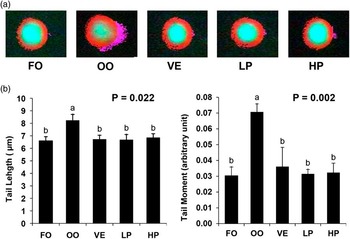
The comet assay (single cell gel electrophoresis assay) was performed to determine the degree of oxidative DNA damage. Briefly, liver samples (~10 g) were cut into small pieces with scissors and gently homogenized with 10 ml ice-cold buffer (0.075 M NaCl, 0.024 M Na2EDTA, pH 7.5). The liver homogenate was centrifuged at 0°C, 700×g for 10 min. The precipitate was collected and re-suspended in ice-cold homogenization buffer to obtain nuclei. The nucleus suspension was then mixed with an equal amount of 2% low melting point agarose and the slides were prepared as described previously (Bajpayee et al., Reference Bajpayee, Pandey, Parmar, Mathur, Seth and Dhawan2005). The slides was immersed in a lysis solution (2.5 M NaCl, 100 mM Na2EDTA, 10 mM Tris, 1% Trion X-100 and 10% DMSO, pH 10) for 1 h at 4°C in the dark. The slides were then subjected to DNA unwinding for 20 min and electrophoresis was conducted at 0°C in the dark for 15 min (25 V, 250 mA). The excess alkali was neutralized with Tris buffer (400 mM, pH 7.5), and then the slides were stained with 25 μl DAPI (Sigma). Fifty nuclei on one slide per liver were examined at 200× magnifications using a fluorescence microscope equipped with a green filter. Tail length and tail moment were measured by a comet assay software project (Końca et al., Reference Końca, Lankoff, Banasik, Lisowska, Kuszewski, Góźdź, Koza and Wojcik2003).
Statistical analysis
All data were analyzed using the one-way ANOVA, and means were compared using Duncan’s multiple range test (SPSS 16.0 for Windows; SPSS Inc., Chicago, IL, USA). The replicate (each replicate included four cages) was regarded as an experimental unit for analysis of performance data, and individual birds served as an experimental unit for other parameters. Differences were considered statistically significant at P<0.05. Data are expressed as means and pooled SEM.
Results
Laying performance
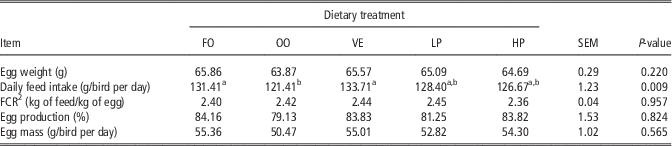
Birds fed the oxidized oil diet showed a lower feed intake compared with birds fed the fresh oil diet or oxidized oil diet supplemented with Vit E (P=0.009, Table 3). No differences were observed in the other performance data among the groups during the overall feeding period.
Effect of dietary oxidized sunflower oil with PQQ.Na2 supplementation on laying hen performanceFootnote 1

FO=2% fresh sunflower oil diet; OO=2% thermally oxidized sunflower oil diet; LP=OO supplemented with PQQ.Na2 at 0.08 mg/kg; HP=OO supplemented with PQQ.Na2 at 0.12 mg/kg; VE=OO supplemented with vitamin E level at 100 IU/kg; FCR=feed conversion ratio.
1 Data are the mean of six replicates with twelve birds each.
a,bValues within a row with different superscripts differ significantly at P<0.05.
The oxidative stress parameters in plasma and liver tissues
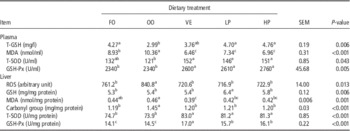
The oxidized sunflower oil diet increased MDA contents (P<0.001) and decreased T-GSH levels in the plasma of birds (P=0.006) compared with that of birds fed the fresh oil diet (Table 4). Dietary supplementation with PQQ.Na2 (both low and high levels) or Vit E in the oxidized oil diet increased activities of T-SOD and GSH-Px, and decreased the MDA contents in plasma as compared with the oxidized oil group (P<0.05). Compared with birds fed the oxidized oil diet, birds fed PQQ.Na2 diets at low or high levels had higher plasma T-GSH (P=0.006). There was no difference in plasma oxidative stress parameters between the Vit E group and the PQQ.Na2-added groups.
Effect of dietary oxidized sunflower oil with PQQ.Na2 supplementation on oxidative stress parameters in the plasma and liver of laying hensFootnote 1

FO=2% fresh sunflower oil diet; OO=2% thermally oxidized sunflower oil diet; LP=OO supplemented with PQQ.Na2 at 0.08 mg/kg; HP=OO supplemented with PQQ.Na2 at 0.12 mg/kg; VE=OO supplemented with vitamin E level at 100 IU/kg; ROS=reactive oxygen species; T-GSH=total glutathione; MDA=malondialdehyde; T-SOD=total superoxide dismutase; GSH-Px=glutathione peroxidase.
1 n=six per treatment group.
a,b,cValues within a row with different superscripts differ significantly at P<0.05.
Compared with the fresh oil group, hepatic carbonyl group contents and ROS levels were found to increase by 21.85% (P<0.001) and 10.46% (P<0.05) in the oxidized oil group, respectively. Dietary supplementation with PQQ.Na2 or Vit E in the oxidized oil diet decreased the MDA, carbonyl and ROS levels in the liver as compared with the oxidized oil group (P<0.05). Lower MDA concentration was observed in hens fed the oxidized oil diet supplemented with Vit E than those fed the fresh oil diet (P<0.05). The oxidized oil diet did not affect the T-SOD and GSH-Px activities compared with the fresh oil diet, while dietary supplementation with PQQ.Na2 or Vit E significantly increased T-SOD activities in the liver and GSH-Px activities in the plasma and liver (P<0.05). Vit E further elevated GSH-Px activity in the liver above that of PQQ.Na2 (P<0.05).
Liver index and plasma biochemical parameters
Laying hens fed the oxidized oil diet showed a higher liver weight (P<0.05) and liver to BW ratio (P=0.001) compared with hens fed the fresh oil diet or the oxidized oil diet supplemented with PQQ.Na2 or Vit E for 6 weeks (Table 5). Plasma activities of ALT (P=0.001) and AST (P<0.001) were higher in hens fed the oxidized oil diet than in hens fed the fresh oil diet or oxidized oil diet supplemented with PQQ.Na2 or Vit E. The increased liver ratio, ALT and AST activity induced by the oxidized oil diet were reversed by dietary addition of PQQ.Na2 or Vit E. Dietary supplementation of PQQ.Na2 or Vit E in the oxidized oil diet resulted in a similar liver index and plasma biochemical parameters to the fresh oil diet.
Effect of dietary oxidized sunflower oil with PQQ.Na2 supplementation on liver weight and plasma biochemical parameters of laying hensFootnote 1

FO=2% fresh sunflower oil diet; OO=2% thermally oxidized sunflower oil diet; LP=OO supplemented with PQQ.Na2 at 0.08 mg/kg; HP=OO supplemented with PQQ.Na2 at 0.12 mg/kg; VE=OO supplemented with vitamin E level at 100 IU/kg; ALT=alanine aminotransferase; AST=aspartate aminotransferase.
1 n=six per treatment group.
a,b,cValues within a row with different superscripts differ significantly at P<0.05.
Assessment of liver DNA damage
Compared with the fresh oil group, the oxidized sunflower oil increased hepatic DNA tail length (P<0.05) and tail moment (P<0.05) respectively (Figure 1). Dietary supplementation of PQQ.Na2 or Vit E decreased DNA tail length and tail moment as compared with the oxidized oil group (P<0.05).
Effect of dietary oxidized sunflower oil with PQQ.Na2 supplementation on hepatic DNA damage of laying hens. Representative images (a) and comet parameters (b) of cellular DNA damage were detected using a single cell gel electrophoresis assay (comet assay). FO=2% fresh sunflower oil diet; OO=2% thermally oxidized sunflower oil diet; LP=OO supplemented with PQQ.Na2 at 0.08 mg/kg; HP=OO supplemented with PQQ.Na2 at 0.12 mg/kg; VE=OO supplemented with vitamin E level at 100 IU/kg. Data are the mean of six replicates (one bird from each replicate). Data represent the mean ± SEM. Different lower case letters correspond to significant differences at P<0.05.

Discussion
A number of studies have shown that domestic animal production performance was depressed by dietary addition of oxidized lipids (Yue et al., Reference Yue, Wang, Qi, Ji, Liu, Wu, Zhang and Qi2011; Fontagné-Dicharry et al., Reference Fontagné-Dicharry, Lataillade, Surget, Larroquet, Cluzeaud and Kaushik2014; Lu et al., Reference Lu, Harper, Zhao, Corl, LeRoith and Dalloul2014a and Reference Lu, Harper, Dibner, Scheffler, Corl, Estienne, Zhao and Dalloul2014b; Rosero et al., Reference Rosero, Odle, Moeser, Boyd and van Heugten2015). The depression partly resulted from a reduced palatability of the rancid feed, leading to a lower feed intake (Liu et al., Reference Liu, Chen, Kerr, Weber, Johnston and Shurson2014). Lower feed intake was also observed in laying hens fed the oxidized sunflower oil diet compared with hens fed the fresh oil diet. No significant difference was observed in other performance items among the different groups, probably because of lower oxidation levels and a shorter period of feeding with oxidized oil as previously reported in broilers (Zhang et al., Reference Zhang, Yue, Wu, Xu, Zhang, Yan, Cao, Gong and Qi2010) and fish (Yuan et al., Reference Yuan, Chen, Liu, Yang, Liang and Tian2014). Furthermore, Sheehy et al. (Reference Sheehy, Morrissey and Flynn1994) and López-Varela et al. (Reference López-Varela, Sánchez-Muniz and Cuesta1995) noted that feeding heated sunflower oil reduced weight gain in broiler chicks, and decreased feed efficiency ratio in rats, respectively. The contents of total polar compounds, peroxide value and lipid peroxidation products of heated sunflower oil they used were higher than that in the current study, which suggests that the oil used in our study was only moderately oxidized. Further studies are required to determine the effects of dietary oxidized oil with PQQ.Na2 in long term feeding period.
The growth depression of broiler chicks fed with heated sunflower oil was probably due to the combined effect of oxidation products and a lower α-tocopherol content in the diet as suggested by Sheehy et al. (Reference Sheehy, Morrissey and Flynn1994). In the current study, although the Vit E and α-tocopherol levels of sunflower oil were decreased after thermal heating, their contents in the oxidized oil diet were comparable to the fresh oil diet. These results indicate that lower dietary Vit E or α-tocopherol contents might not be the major reason for the depression of production performance in laying hens. Furthermore, depression of production performance was not obvious when the dietary oxidized oil was supplemented with PQQ.Na2 in the current study, or with other antioxidant blends (ethoxyquin and propylgallate) in a previous study (Lu et al., Reference Lu, Harper, Zhao, Corl, LeRoith and Dalloul2014a). PQQ.Na2 might act as an antioxidant to alleviate the adverse effects of thermally oxidized sunflower oil on the performance of laying hens.
Oxidative stress induced by lipid peroxidation products has been proposed as a possible mechanism involved in the toxicity of thermally oxidized oil (Ng et al., Reference Ng, Leong, Masbah, Adam, Kamisah and Jaarin2014). The secondary lipid peroxidation products are readily absorbed into the blood directly through the intestines, which probably results in an increase of lipoxidation products in the organism (Staprans et al., Reference Staprans, Rapp, Pan, Kim and Feingold1994). The secondary lipid peroxidation also induces hepatic cytochrome P450 oxidase which contributes significantly to intracellular generation of ROS (Chao et al., Reference Chao, Chao, Lin and Huang2001). Moreover, ingestion of oxidized lipids may compromise free-radical-scavenging activity in vivo by depleting antioxidants in the gastrointestinal tract, plasma or other tissues (Sheehy et al., Reference Sheehy, Morrissey and Flynn1994; Engberg et al., Reference Engberg, Lauridsen, Jensen and Jakobsen1996). The current study showed that exposure to oxidized sunflower oil significantly increased plasma MDA, ROS and carbonyl group levels in the liver, but decreased plasma GSH levels in laying hens. These results suggest that enhanced peroxidation leads to an imbalance of the pro-oxidant/antioxidant system. However, this imbalance was efficiently reversed by dietary PQQ or Vit E supplementation. The restoration of hepatic ROS, MDA and carbonyl group levels and plasma MDA levels to normal levels with Vit E or PQQ treatment suggested that PQQ could act as an effective free radical scavenger against oxidant stress induced by dietary oxidized sunflower oil as with Vit E.
PQQ is an efficient non-enzymatic antioxidant. PQQ and its reduced form (pyrroloquinoline quinol) can scavenge superoxide anion, hydrogen peroxide and lipid radicals directly (Rucker et al., Reference Rucker, Chowanadisai and Nakano2009). PQQ exhibited oxidative stress protective ability not only by direct neutralization of ROS, but also by enhancement of the body’s antioxidant defense system (Misra et al., Reference Misra, Khairnar, Barik, Priyadarsini, Mohan and Apte2004). Non-enzymatic antioxidants (e.g. GSH and vitamin C) and antioxidant enzymes (SOD, GSH-Px and catalase) are responsible for the intracellular redox status. Increased plasma glutathione levels observed in PQQ treatment groups suggested that PQQ would facilitate cells to maintain redox homeostasis (Wang et al., Reference Wang, Zhang, Samuel, Long, Wu, Yue, Sun and Qi2015). PQQ has been shown to exert its protective effect by conserving reducing equivalents of cells, such as glutathione; furthermore, it can be used to reduce oxidized glutathione to glutathione (Bishop et al., Reference Bishop, Gallop and Karnovsky1998). PQQ.Na2-mediated increases in glutathione have also been reported in broilers (Wang et al., Reference Wang, Zhang, Samuel, Long, Wu, Yue, Sun and Qi2015), rat and cell-culture experimental models (Zhang et al., Reference Zhang, Ding, Cao, Zhang, Ding and Ke2013). Furthermore, PQQ seems to enhance the antioxidant defense system via induction of antioxidant enzymes (Misra et al., Reference Misra, Khairnar, Barik, Priyadarsini, Mohan and Apte2004). We found that dietary PQQ supplementation elevated the activities of T-SOD and GSH-Px both in plasma and liver of laying hens fed with the oxidized sunflower oil diet. Our results are consistent with a previous study, which showed PQQ improved enzyme activity in neuronal cells (PC12cells) exposed to highly toxic methyl mercury (Zhang et al., Reference Zhang, Xu, Sun, Li, Wang and Jin2009). The possible mechanism was suggested to be the regulation of the gene expression of transcription factors involved in several key antioxidants by activating cell signaling pathways (Tchaparian et al., Reference Tchaparian, Marshal, Cutler, Bauerly, Chowanadisai, Satre, Harris and Rucker2010). However, the absence of catalase activity in the current study might limit to complete understanding the effect of dietary oxidized oil and PQQ.Na2 on the enzymatic antioxidant systems. Along with T-SOD and GSH-Px, the catalase should be taken into account in the further study.
Excessive free radicals induced by oxidized oil could attack cellular components, cause oxidative damage to lipids, protein or DNA, and consequently compromise cellular integrity (Esterbauer, Reference Esterbauer1993). This speculation was confirmed by the increase of MDA and carbonyl contents in the livers of birds fed the oxidized oil diet. Oxidized oil was also found to increase the DNA tail length and tail moment in a comet assay, which implies that oxidized oil could cause single-strand breaks and DNA damage. Takabayashi et al. (Reference Takabayashi, Tahara, Kaneko and Harada2004) reported oxidative DNA damage in rat livers after the administration of oxidized oil, as shown by an increase of a typical oxidation product of DNA bases (8-oxo-2'-deoxyguanosine). ROS, 4-hydroxynonenal and possibly other lipid-oxidation products generated endogenously by lipid peroxidation might be a constant source of DNA damage (Esterbauer, Reference Esterbauer1993). Dietary supplementation with PQQ or Vit E reduced the oxidized oil-induced oxidative damage to lipids, protein or DNA in the liver of birds. These results suggested that PQQ and Vit E exert oxidative stress alleviating effects by their antioxidant roles in the inhibition of oxidative damage of biomacromolecules.
Furthermore, the assessment of plasma aminotransferase activities and liver weight changes suggests that liver damage induced by oxidized sunflower oil was alleviated by dietary PQQ.Na2 or Vit E intervention. In agreement with some previous studies in pigs (Lu et al., Reference Lu, Harper, Dibner, Scheffler, Corl, Estienne, Zhao and Dalloul2014b), an increment of liver weight and liver to BW ratio induced by oxidized oil was apparent in the present study. This increase resulted from the elevated absolute weight of the livers because dietary oxidized sunflower oil did not produce a significant effect on BW. Moreover, increase in the activities of ALT and AST in plasma is indicative of cellular leakage and loss of functional integrity of cell membranes in liver. However, liver enlargement and increased activities of ALT and AST were reduced by dietary supplementation with PQQ.Na2 or Vit E. A similar protective role of PQQ against hepatotoxicity was also reported in tetrachloride-treated rats (Tsuchida et al., Reference Tsuchida, Yasuyama, Higuchi, Watanabe, Urakami, Akaike, Sato and Maeda1993).
The present work shows that PQQ.Na2 is a potential antioxidant and effective against oxidized oil-related liver injury in laying hens. These beneficial effects of dietary PQQ.Na2 at low dosage (0.08 mg/kg diet) were comparable to those of Vit E at 100 IU/kg feed, which indicated that birds might be more sensitive to dietary PQQ, as previously reported in broilers (Samuel et al., Reference Samuel, Zhang, Wang, Wu, Yue, Sun and Qi2015; Wang et al., Reference Wang, Zhang, Samuel, Long, Wu, Yue, Sun and Qi2015). In our preliminary studies, the optimal addition level of PQQ.Na2 in the diet of laying hens was suggested to be 0.08 mg/kg or 0.01 mg/day per bird (Xu, Reference Xu2011) under normal feeding condition without stress challenge. The uptake of highly oxidized oils usually results in a greater need for antioxidants to maintain the balance between attacks of oxidized species and the antioxidant defense system (Sheehy et al., Reference Sheehy, Morrissey and Flynn1994; Yuan et al., Reference Yuan, Chen, Liu, Yang, Liang and Tian2014). Interestingly, there was no significant difference in redox status and the hepatoprotective effects of PQQ.Na2 between low levels (0.08 mg/kg) and high levels (0.12 mg/kg) in the current study. Further studies are required to determine the exact PQQ requirements for laying hens during oxidative stress.
In conclusion, dietary PQQ.Na2 supplementation significantly prevented oxidized sunflower oil-induced ROS production, lipid peroxidation and liver damage in laying hens, possibly via direct scavenging of free radicals and indirectly through enhancing the endogenous antioxidant defense system.
Acknowledgments
This study was financed by the National Natural Science Foundation of China (31172212), the China Agriculture Research System (CARS-41-K13), the China Agriculture Research System – Beijing Team for Poultry Industry and the Agricultural Science and Technology Innovation Program (ASTIP).